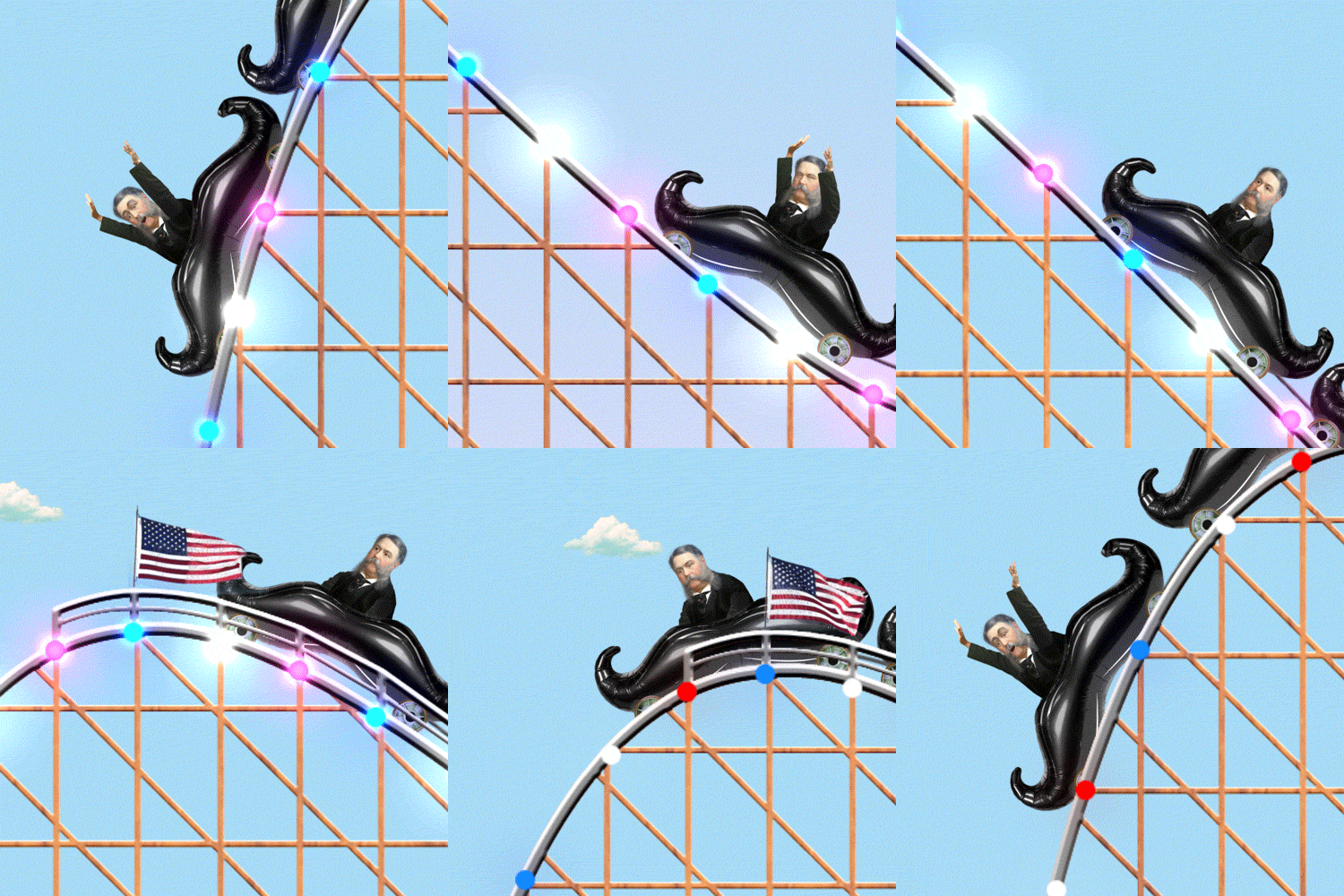
When President James Garfield was shot, no one in the United States was more dismayed than his Vice President, Chester Arthur. For years Arthur had been perceived as unfit to govern, not only by critics and his fellow citizens but by his own conscience.
From his promising start, Arthur had become a political hack, a shill for Roscoe Conkling, and Arthur knew better even than his detractors that he failed to meet the high standard a president must uphold. And yet, from the moment President Arthur took office, he proved to be not just honest but courageous, going up against the very forces that had controlled him for decades.
Arthur surprised everyone--and gained many enemies--when he swept house and courageously took on corruption, civil rights for blacks, and issues of land for Native Americans. His short presidency proved to be a turning point of American history, in many ways a preview of our own times, and is a sterling example of how someone can "rise to the occasion."
This beautifully written biography tells the dramatic, untold story of a virtually forgotten American president, a machine politician and man-about-town in Gilded Age New York who stumbled into the highest office in the land only to rediscover his better self, right when his nation needed him.
SCOTT S. GREENBERGER is coauthor of the New York Times bestseller Critical: What We Can Do About the Health-Care Crisis and author of The Unexpected President: The Life and Times of Chester A. Arthur. Currently the executive editor of Stateline, he was a staff writer at the Austin American-Statesman and The Boston Globe and has written for The New York Times, The Washington Post, Politico, and GQ. Greenberger has a bachelor’s degree in history from Yale University and a master’s degree in international relations from George Washington University. He lives in Takoma Park, Maryland.
Scott S. Greenberger seeks to enlighten the reader with this piece on Chester A. Arthur. Who’s that, you ask? Exactly the point Greenberger seeks to rectify with this book, by providing a comprehensive biographical piece that will leave reader with something other than a knowledge of the man’s impressive facial hair. Arthur was born in rural Vermont to a fiery immigrant preacher and docile mother. His early education saw him earn good grades, though opportunities at the time were limited. With a passion for learning, Arthur was able to earn a law degree and practiced in New York City for a time, meeting and marrying the quiet Ellen Herndon. Their time together was quite peaceful until Arthur was called into service during the American Civil War. This required a significant commitment by Arthur, something his ‘Nell’ came to understand. Rather than fighting, Arthur worked in the New York Militia as Quartermaster General, where he first tasted power and did not want to look back. While the war effort did end well for Arthur, the death of his infant son from am unknown disease all but paralysed the family. Arthur soon found himself immersed in the New York Republican Party, committed to the party machine, he climbed the ranks and was offered the lucrative position of Collector of the Port of New York by President Ulysses S. Grant. Arthur was able to amass great wealth from fees gathered and Greenberger only recounts a few of the more questionable actions that occurred. However, with power comes the risk that it can be rescinded, as was the case after the 1876 Presidential Election that saw the Democrats take back the White House with Rutherford B. Hayes at the helm. Arthur was fired when he would not voluntarily give up the position and forced back into a law practice. This smarted for a time, but Arthur was determined to see the Democrats spend only a short time in office. When the 1880 campaign began, Arthur worked ardently to see the GOP return to power, especially since Hayes had vowed not to serve more than a single term. With the country in disarray, many Republicans saw the only answer be to turn back to Grant. Greenberger illustrates the interesting goings-on in Chicago that summer of 1880, which saw lengthy debates and voting before black horse candidate James A. Garfield rose to accept the nomination—just barely—and Chester A. Arthur was plucked from the convention floor to serve as vice-president. Angering some of his fellow New York delegates, Arthur accepted the nomination and proceeded to campaign for a GOP victory that November. After victory at the polls, Arthur and Garfield made their way to Pennsylvania Avenue and began to govern. A few short months into the term, Garfield was on his way to vacation with his family, when Charles Guiteau, a deranged preacher, shot the president in the back. As he left, Guiteau uttered that he had done it to ensure ‘Arthur is president’. As the country waited that entire summer, Greenberger illustrates how newspaper editorials pointed the finger at Arthur and speculated that he might be an accomplice to the assassination attempt, all to ascend to the presidency. Plagued with guilt, Arthur waited and hoped that the president would recover, but it was a lost cause. By mid-September, Garfield was dead and Arthur was now the President of the United States. Greenberger illustrates that Arthur never wanted the post of POTUS and was extremely reticent of the role thrust upon him. However, Arthur was able to push for some key changes while in office, including his long-desired change to civil service hiring. He sought for meritocracy over party placements—interesting, since he scored his key civil service post as a GOP member—and pushed to have Congress enact it. Arthur also continued a series of letters with a woman who sought to challenge his views and tried to steer him in a certain direction, for the honour of the country. Greenberger includes some of their letter bantering throughout the latter portion of the book, which enriches not only the biography, but also shapes how Arthur thought during his brief time in office. However, it would seem that this merit over party mentality served only to ruin Arthur’s chances as formal election in 1884, when the GOP looked elsewhere for their candidate. When, at the General Eleciton, Grover Cleveland led the Democrats back to power, Arthur knew that he had done all he could for the New York GOP machine and began to remove himself from private life. Struck with an illness during the latter part of his presidency, Arthur soon succumbed and was mourned by some, while others noted his place in history with a simple asterisk. A man who was thrust into the limelight has found himself forgotten and remembered by few. Scott S. Greenberger seeks to remedy this and those who take the time to read this piece will discover a great deal about the man and his impact on New York and national politics. Recommended for those who enjoy presidential biographies as well as the reader seeking to open their minds to a great deal of little discussed facts.
It is so very difficult to adequately comment on an author’s final product when it comes to biographies, as the reader is not subjected to the piles of information available, only what makes it onto the page. Scott S. Greenberger has taken one of America’s least-known presidents and shaped his life into this piece, which is understandably short. In doing so, he has been able to create a strong piece that depicts the man in such a way that many will have taken at least something away. Greenberger does his best to offer a complete package of Chester A. Arthur, from birth to death, giving credence (and ink) to some of the more essential points. Did I come away with more than the man’s interest in facial hair? Certainly! Did I learn something politically about him that helps me see him in a new light? Most definitely! Arthur was not a man who magically appeared on the scene to become a vice-president and then an accidental president in the latter part of the 19th century. He was well-known, both in New York and in the ranks of the Republican Party. However, it is perhaps that he was a black horse AND fell into the role of POTUS that has many forget his rise to power and claims to fame. As I think back on the piece, I will admit that Greenberger could have gone into more depth with the piece—and yes, I look at some of the presidential biographies to which I have listened in the past that span 40+ hours—but this shorter piece does perhaps prove a point. The man was little known and so readers/listeners may not care or need to know about the minutiae. However, if I might offer some constructive criticism of this piece, the brevity of the biography is compounded by Greenberger’s branching out to offer mini-biographies of a few more popular men Arthur encountered. A few come to mind immediately, Grant and Guiteau, and there was lengthy mention of Garfield as well. These men, while essential to the larger story, need not have their own pocketed story. At times I wondered if Greenberger were trying to meet a page quota and padded his piece, but then I think back to how briefly he covered the Civil War era. Either way, the story reads well and is packed with information, perfect for the curious reader who wants to learn something without drowning in facts. Greenberger gives a well-rounded view of the man and his claims to fame, even if he will likely remain one of the most obscure presidents ever to occupy the White House.
Kudos, Mr. Greenberger, for this compacted piece. I did take much away from it and cannnot wait to see if you have published anything else on subjects of interest to me.
The presidents that served after the Civil War seem to have been forgotten. Therefore, I enjoyed Greenberger’s new biography of Chester A. Arthur (1829-1886). Arthur was an attorney who was part of Roscoe Conkling’s political machine in New York. Arthur became the vice president for James A. Garfield (1831-1881) and became president on Garfield’s assassination. Arthur served as our 21st president from 1881 to 1885. He was known as a corrupt politician but managed to rise above his reputation and was a successful president. Arthur enacted the first general federal immigration law. He reformed the civil service and modernized the navy. You might say he rose to the standard of the office.
The book is well written and meticulously researched. I am impressed with Greenberger’s research as Arthur is one of the presidents that had little information stored in the archives. The author also had access to Arthur’s papers held in a safe deposit box by a relative. Greenberger paints Arthur in a favorable manner but did not down play the corruption. The author reveals Arthur as a product of his time. I not only learned about Arthur but what life and politics were like at the time. This is an easy to read biography packed with lots of information. This is a great resource to learn about the post-civil war period.
I read this as an audiobook downloaded from Audible. The book is eleven and a half hours. Paul Heitsch does a great job narrating the book. Heitsch is a recording engineer and sound designer as well as an audiobook narrator.
That was Chester Arthur in a philosophical mood, a sentiment spoken to him which he immediately improved upon. And acted upon.
He had been the ooziest of political cronies and without apparent shame. He got wealthy abetting corruption. But when he spoke those appropriated words he was President of the United States.
Arthur was an unlikely and accidental President, never having run for public office before becoming Vice-President and then President when James Garfield was assassinated. The press and public assumed the worst.
Yet Arthur would not become the patronage king once President. Instead, he achieved real civil service reform. He vetoed a Chinese Immigration Act (although he did subsequently sign a less stringent measure of the same bill). And he called for environmental protections: “The conditions of the forests of this country . . . in protecting the earth’s surface, in modifying the extremes of climate, and in regulating and sustaining the flow of springs and streams is now well understood, and their importance in relation to the growth and prosperity of the country can not be safely disregarded.”
Arthur’s patrons were not amused.
So, what happened? What changed?
Well, for one thing, it was the way Arthur became President. Shot in the back in July, 1881, just months into his Presidency, Garfield suffered greatly until his death on September 19. By all accounts, Arthur was greatly moved by Garfield’s death. Or maybe it was that two years into his own short-termed Presidency, Arthur realized that he too was dying, from what then was called Bright’s disease. That will stoke self-reflection.
But maybe, the author says, it was something, someone else.
As his term was ending, knowing the slimy history of his pre-Presidential days, Arthur instructed others to burn his papers. And they did, under his supervision. So it seemed the suds were swept away.
Then Arthur died a year after his Presidency. His son died in 1937. His son, Chester Arthur III, inherited 1,800 documents, locked away in a bank vault for four decades. Most intriguing were 23 letters in a separately secured envelope, all written by a woman named Julia Sand.
Sand, an invalid who had never met Arthur, began writing long letters to him during the months Garfield lay dying. She assumed Arthur’s succession and worried, given his well-publicized political scummy-ness. The tone of the letters could be scolding, when they weren’t flirtatious. But the main theme was that history would judge, and that it was never too late to change.
Arthur never replied to the letters, not in writing. But one day, the President paid her a visit. That, and that he didn’t burn the letters with so much of the rest, shows they were not unimportant.
Perhaps. Why not?
And it got me thinking. 135 years later, immigration issues still inflame, climate change has not waned, and political aides have daily perp walks. I watch the man overseeing it all, unredeemed, with a horrid past.
But maybe a letter will arrive, perhaps a tweet:
You are free—free to be as able & as honorable as any man who ever filled the presidential chair. . . Your past—you know best what it has been. You have lived for worldly things. Fairly or unfairly, you have won them. You are rich and powerful . . . And what is it all worth? . . . Your name is now on the annals of history. You cannot slink back into obscurity, if you would. A hundred years hence, school boys will recite your name in the list of Presidents and tell of your administration. And what shall posterity say?
I know, I know, I know. But what if the letter writer was a stripper? Let’s think this through.
According to Harvard University's "Writing With Sources": "If your own sentences follow the source so closely in idea and sentence structure that the result is really closer to quotation than to paraphrase... you are plagiarizing, even if you have cited the source. You may not simply alter a few words of your source... You need to recast your summary into your own words and sentence structure, or quote directly."
By that definition, then, "The Unexpected President" is riddled with plagiarism.
Years ago, I read "Gentleman Boss", Thomas C. Reeves' 1975 biography of Chester Arthur. So I was looking forward to reading "The Unexpected President" for a fresh, new take on the subject.
"New" it is, but "fresh" it is not. Consider the following few passages, from Reeves and then Greenberger:
Reeves, p. 9: "He once threw the West College bell into the Erie Canal, and he carved his name at least twice on the somber college buildings."
Greenberger, p. 12: "He once threw the West College bell into the Erie Canal, and he carved his name at least twice into college buildings."
Reeves, p. 8: "Besides being an innovative educator, Nott was a well-known inventor who had patented thirty different kinds of stoves and devised an ingenious steamship boiler."
Greenberger, p. 12: "In addition to being an educator, Nott was a well-known inventor who had patented 30 different kinds of stoves and designed an innovative steamship boiler."
Reeves, p. 20: "Nell's father, Captain William Lewis Herndon, had won national attention a few years earlier as the leader of an expedition that explored the Amazon River from its headwaters to its mouth."
Greenberger, p. 25-26: "She was the daughter of US Navy Captain William Lewis Herndon, an explorer who had become famous a few years before for leading an expedition that explored the Amazon River from its headwaters to its mouth."
Those are just a few short examples of Greenberger's near word-for-word transcriptions of Reeves' writing, and that's just from the first two chapters of his book. I could go on. At times, Reeves is cited in Greenberger's end notes. Other times, he's not. At no time are any of these near-direct excerpts put into quotation marks to indicate they are Reeves' words and not Greenberger's.
In his acknowledgements, Greenberger rightly cites Reeves' work as an indispensable resource as he wrote his book. But it's clear Reeves' book was much more of a template than a mere resource. Any two biographies on the same subject are invariably going to include many of the same stories. But in telling those stories, Greenberger very often uses precisely the same facts and anecdotes that Reeves did, in the same order, with the same descriptive phrases, using the same sentence structure.
Consider these longer passages. While in this case, Greenberger's version is not a word-for-word transcription, it's apparent that he is merely rephrasing Reeves' version. And while Reeves is directly quoting a primary source, Greenberger simply incorporates the source's story into his narrative without any attribution in the text:
Reeves, p. 11: "In the words of one of those students: 'He said that he knew about the past problems, but that with the proper respect for each other's rights teachers and students could live together in harmony. He said he did not threaten but would demand that the students obey him, and that he would try to win the good will of all present. Some of the leaders smiled a bit. A lad of 13 sent a marble shooting across the floor. The teacher walked to the lad and said "Get up, Sir." He said it a second time, and then took him by the collar, as if to raise him...'"
Greenberger, p. 13-14: "He told the students he was aware of their dismal record but that he saw no reason why teachers and students could not live together in harmony - provided they respected each other's rights. He would not threaten them, he promised, but he would insist that they obey him. The class ringleaders smirked, and then one 13-year-old sent a marble shooting across the floor. Arthur strode over to the perpetrator. "Get up, sir." The boy remained in his seat. "Get up, sir," Arthur repeated, this time seizing the transgressor by his collar, as if to drag him to his feet..."
As the book progresses, Greenberger continues to rephrase entire paragraphs of Reeves' at a time. The blatant cribbing subsides, at times, when Greenberger strays from Reeves' narrative in order to add additional color and background material. But then even some of this additional material ends up closely mimicking the specific wording of the primary sources cited in the end notes:
Greenberger, p. 117: "Most of the men carrying the signs wore colorful badges, some with portraits of Grant, others of Blaine, and a few featuring the rugged face of John Sherman, stamped in black on green satin."
New York Times article, June 3, 1880: "They were of all colors, and variously inscribed - some bearing the portraits of Grant, others a picture of Blaine, and a few the rugged features of John Sherman, stamped in black upon green satin."
While Reeves' scholarly book is not exactly what one would call an easy read, it's long been considered the definitive biography of the 21st president. And it remains so. If nothing else, Greenberger has succeeded in rewriting Reeves' denser work to appeal to a modern, mass audience. But ultimately, essentially, it is just that - a rewrite. An abridged, derivative rewrite of someone else's work.
The now-elderly Reeves is owed a public apology, if not a share of the royalties, for what is largely a pilferage of his work. And Greenberger, his editor and his publisher ought to be ashamed for trying to pass this off as a wholly original piece of writing. Chester Arthur is overdue for a new, authoritative biography. But "The Unexpected President" isn't it.
I was nearing the end of this book when I read Bill’s review, which makes a good argument that Greenberger plagiarized Thomas C. Reeves’ 1975 book, Gentleman Boss: The Life of Chester Alan Arthur. I won’t say anything more about that, as I don’t feel skilled enough to evaluate these claims, but I would recommend reading Bill’s review if you are interested in the topic.
I did appreciate that this biography was concise (audiobook was about 11 hours). It nicely explains Arthur’s evolution from a master of “machine politics” to a man of principle. Back in those days, Republicans were divided into the “Stalwarts” who advocated the Spoils System to reward cronies with jobs, and the “Half-Breeds” who advocated Civil Service reform where positions should be filled based on merit. Arthur was a devout Stalwart and was remarkably adept not just at working the levers of the system to enhance the power of his allies but was also very successful at personally enriching himself.
Arthur won the nomination for Vice President in 1880, thanks to a couple lucky circumstances that favored him. The Republican Presidential candidate, James Garfield, was a Half-Breed and there was interest to balance the ticket with a Stalwart. There was also an interest in having that person be a New Yorker, which was a crucial Swing State.
The story takes a turn when Garfield is assassinated and dies just six months into his Presidency. Surprisingly, Arthur decides to continue to advance Garfield’s Civil Service Reform agenda, not just half-heartedly, but fervently and successfully. More generally he seems to change to being a more principled politician. Later in life, after the Presidency, Arthur is ashamed of his pre-Presidential actions.
This is an interesting enough story for a short biography. But I think Greenberger wanted more, and the reality is that Arthur only lasted as President less than one term and didn’t have lasting influence (relatively speaking, at least to other Presidents).
So we have this from Chapter 1: “It is the tale of a good man who veered off the right path but rediscovered his better self with the help of an ordinary young woman who believed in him”. All right, now we are getting a little more interesting! Here Greenberger is referring to Julia Sand, the “ordinary” woman who wrote 23 letters to Arthur during his Presidency, exhorting him to be a better man. Some of the letters encouraged him, saying that his past doesn’t matter and she knows he can be a better leader. Some of the letters congratulate him when he makes decisions she supports and blasts him when he makes decisions she does not like. Some of the letters beg and plead for him to write back or visit her. The letters were interesting. Sand was very knowledgeable about politics and her letters were extraordinarily, and often brutally, blunt.
But what was Arthur’s response to the letters? He did pay a mysterious visit to the Sand household, so he read at least some of the letters and based on how courteous he was, he probably did store at least some value in her opinion. But there is no evidence that he ever wrote back, and he never visited again. So in the conclusion when he describes Sand as the “conscience of a President” that seems overblown. Greenberger didn’t deliver the goods he teased us with on the Sand letters.
The book did have some positive qualities in giving a very readable and concise history.
Since I am reading presidential biographies chronologically, I already had an inkling of what Chester A. Arthur did as president. (As one bio ends it blends into the next new tale - there is no avoiding a little repetition.) The title is appropriate for two things: one is obvious - no one EVER expected Chester A. Arthur to become president. His assassinated predecessor, Garfield, was only 50 years old and healthy enough to do handsprings. His being shot by a maniac was not on the agenda. Secondly, no one expected Arthur to become a respectable president. But he was. To go from a slimey political manipulator to a man of decency is a rare occurrence in his or any age.
Plus, Arthur had a Muse! Julia Sand was a proper, unmarried woman, an invalid and a stranger to him, who started writing letters after Garfield was shot. She told Arthur this was his big chance at redemption and to not blow it. In her letters she sometimes flirted with the widowed Arthur - in one letter she wrote that she dreamt he sent her roses for Christmas. She apparently wasn't his romantic type but he did take her advice to heart. Otherwise, why would he have tucked 23 of her letters in with his official papers? This is the stuff of novels - not a dry political history. I enjoyed it a lot.
The grumpus23 (23-word commentary) Chester was part of the NY machine. The country feared patronage would be rampant under his unexpected administration but bad boy makes good.
"When James A. Garfield was yesterday reported as lying at the point of death new bitterness was added to the poignancy of public grief by the thought that Chester A. Arthur would be his successor," it read. "Gen. Arthur is about the last man who would be considered eligible to that position, did the choice depend on the voice either of the majority of his own party or a majority of the people of the United States."
When the bullet of a deranged man hit James Garfield, the country wept, not just for their president but also for the possibility that Chester Arthur would go on to become the next president of the United States. While Garfield was respected, Arthur was hated. Despite very promising begginnings, Chester Arthur wound up a cog in Roscoe Conkling's Republican Political Machine. A supporter and direct beneficiary of the patronage and spoils system, Arthur made a fortune and forged his name as 'Mr. Conkling's loyal lieutenant'. When Garfield died and Arthur assumed the presidency, everyone thought the worst but were thoroughly shocked when Arthur proved to have more character and backbone than the country gave him credit for. The rebirth of his consciousness led to the birth of an unexpected president.
Not too long ago, I read Destiny of the Republic by Candace Millard, an incredible account of the assasination attempt and subsequent death of James Garfield (this is an excellent book by the way and I will not tire of recommending it). As it was thought highly unlikely that Garfield would not serve his term out, there was little concern for Chester Arthurs ever becoming the president. But then he did. The Arthur that America knew was a far cry from where he started. Son of a abolitionist preacher, Arthur was a lawyer and a general quarter master for the Union during the war. He executed both of these jobs well and with integrity. But as he found his introduction into politics, he lost his way, ultimately becoming a vital part to Roscoe Conkling's machine. Even as vice-president, Arthur stood steadfastly by Roscoe even when Roscoe openly opposed Garfield. Needless to say when Arthur became president, most had a wide distrust and suspicion towards him. Then letters penned by a woman named Julia Sand began reminding Arthur that he was capable of becoming the man of the hour and rise to the ocassion. Arthur did. He went against the machine (when so many thought that Conkling was going to be president in every way except by name), was an early civil rights advocate and respected & embraced Garfield's legacy. This is one of the best redemption arcs I have ever read.
I love this book. Apparently presidential biographies/histories are a thing I enjoy a lot this year. Greenberger constructed this work in a way that is comphrehensive from Chester Arthur's story to the narrative of the Republican party rift (the battle between the Stalwarts and the Half-Breeds) and clearly explaining the spoils and patronage system that sustained Conkling's machine. I also think that the pace and flow of this book compliment each other nicely. The subject matter is far more fascinating that I anticipated. Chester Arthur might be one of the less memorable presidents but his history should be talked about more. Its no samll feat to go from being a major cog in Roscoe Conkling's political machine to becoming one of its most vocal opponents. I do believe that posterity should not forget Chester Arthur's shortcomings but it would be remiss to not acknowledge his change and growth. Definitely recommend this book as well.
Wonderful book on an overlooked President. We know little about Chester A. Arthur because he directed that his correspondence be burned and so the author has had to rely on other source material to give us a well rounded look at a man who never wanted to be President but on whom the office was thrust due to the assassination of President Garfield. He began his public career as an attorney and gained an important civil rights victory, but as time went on he sank into being a cog in the Machine politics of New York and eventually was part of the corruption that was at the New York Custom house and was deeply involved in the spoils system of patronage. Eventually chosen to run with Garfield because Garfield needed to win NY state to win the election, we begin to see Arthur grow in stature and dignity after Garfield is shot and his eventual succession as President almost 3 months later. We also see correspondence from a Julia Sands who is a private citizen who for some reason has an unwavering faith in Arthur and some say she was his moral compass, which is derived from the 23 letters she wrote to him. Actually she gets a bit strange, and by the end I found her letters to be rather troubling, but she always believed in the good that Arthur could do. As President, Arthur turned his back on machine politics and began the first Civil Service Reform in the country - something that most people believe started with Teddy Roosevelt but it was Arthur who laid the groundwork and got the first reform bill passed. He also scrapped our tired and outdated Navy and moved us from a Navy of wooden boats to one of steel plated boats as he realized that without a modern Navy the US could quickly become marginalized by European countries who were trying to make inroads into the Southern Hemisphere, as well as in shipping and trade. I could write more but this short book tells the story much better than I can. Suffice it to say I loved this book and recommend it quite highly. Only 4**** because I wish there would have been more in the book about the 3 1/2 years of his Presidency.
What if a a corrupt politician accidentally became president? In the case of Chester Arthur, he ended up rising to the occasion, pushing for reform, and surprising his critics.
This might be the most interesting presidential biography I've ever read -- and about our least known president, no less. Greensberger vividly retells the life of Arthur and how he fit into his times. I did not feel like I got to know Arthur personally or enter into his emotional life, but that might be due to the fact that Arthur destroyed his private papers at the end of his life.
This is an incredible book not only on the life of Chester Arthur, but the world around him. For a president that was unexpected and unknown, there is a lot of respect of Arthur. These biographies that are not 800 - 1000 pages are much better to read. Personally, I enjoy learning. I also represent the majority of us who read for fun. Greenberger gets right into it. He has great writing. Each chapter had something unique. Like other good biographies, he gives you a few other people or a plot to follow. I stayed in tune with the story and really enjoyed this. If you are interested in Gilded Age, I recommend this book.
Scott Greenberger brings Pres. Chester Arthur, one of our more obscure presidents, to life in this well-written biography. Though Greenberger could never redeem Arthur, he at least managed to make you appreciate Arthur’s attempt to rise above his sordid career and even feel sorry for him. Arthur was a product of his time, was nothing of a visionary, had no agenda but himself for most of his life, but gave the presidency his best shot when it literally fell into his lap.
Though hidden from the public, Arthur developed Bright’s disease during his single term that would take his life barely a year after he left office. Greenberger found the springs of Arthur’s life in the earlier chapters that provided great context for Arthur’s career. It appeared to me that Mr. Greenberger was somewhat harsh on Elder Arthur, the president’s father, but was correct, perhaps, in seeing Arthur’s life as one of running from his father’s Christianity. Though Mr. Greenberger wasn’t sympathetic to Elder Arthur, there’s no doubt that he was a committed, conservative Christian. President Arthur’s life never really followed in his father’s footsteps.
Arthur was blessed with a wonderful wife whom he seemed to love, but clearly he neglected her. When Arthur became a leader in the corrupt New York political machine, it appears he partied while she stated home with the family. Greenberger suggests there is evidence that he wasn’t faithful to her.
After Arthur moved to New York City, a different man became the father figure in his life– Sen. Conkling. Greenberger beautifully traces how that Arthur might never have had a political career without Sen. Conkling while also seeing Conkling’s fingerprints all over what is tragic about Arthur’s career. Chester Arthur became the Vice President of the United States as a pawn in a game, but surprised the game’s players when Pres. Garfield was shot and killed and Chester Arthur became the President.
Greenberger vividly describes the unexpected emotional life of Pres. Arthur. Whether it be the appropriate guilt upon the death of his wife, or the shocked sadness at the death of Pres. Garfield against the backdrop that mistakenly made it appear to the public that Arthur wanted the presidency.
Greenberger knows how to build suspense. He will introduce a preacher without telling you his name until much later, as well as a lady who wrote letters to the president that appeared to have an effect on him to the good while withholding her significance to later as well. I’ll not provide spoilers here, but you will enjoy Mr. Greenberger’s biographical skill and ability to grab our attention.
Mr. Greenberger appears to have a cautious, almost reluctant, appreciation of Chester Arthur. If you read Mr. Greenberger’s biographic blurb, you will see his own political affiliations, but I was pleasantly surprised at how he stuck to his task and left his own politics out of it.
This book is a home run. If you enjoy presidential biographies, I’d advise you to consider this book as your choice for Chester Arthur. In lesser hands, a biography on Chester Arthur might have easily sunk. I genuinely enjoyed this book and highly recommended it.
I received this book free from the publisher. I was not required to write a positive review. The opinions I have expressed are my own. I am disclosing this in accordance with the Federal Trade Commission’s 16 CFR, Part 255.
Greenberger seeks to illuminate the man behind the mutton chops, and retrieve Arthur from a Presidential footnote, facial hair jokes, and trivia answers.
The truth is that Arthur was better than rumored but still really just a caretaker of the job, particularly in a time of peace and relative economic prosperity. He was certainly one of those Presidents who would never have been elected there on his own merits (think Andrew Johnson, Calvin Coolidge, Gerald Ford) but I buy Greenberger's premise that he was better than advertised or expected. It's just that he didn't do much, other than not blowing it and making conscientious choices when needed.
He was a product of the corrupt political machines that grew in the expanse of the wealth of the Industrial Revolution in the wake of the Civil War. Everything he had in terms of wealth, power, and prestige he gained at the granting of his political boss, Roscoe Conkling (actually a more fascinating subject for a biography) who was as corrupt a political figure in the age than nearly everybody. When Conkling failed to grasp the Presidential nomination in 1880, the Republican party realized they still needed New York to win the Presidency, and so New Yorker Conkling's protege Chester Arthur was given the Vice Presidential nomination. Conkling was too feared and despised amongst his detractors to get it himself.
The unforeseen happened, and the lingering painful death from sepsis by James Garfield from an assassination attempt led to Arthur's ascension. In a 242 page book, his three and a half year Presidency occupies barely 40 pages, which tells you most of what you need to know. Fears that he would be a puppet for Conkling were assuaged when Arthur refused to listen to his direction, most likely because he took the office seriously and tried his best. Also of note is that Arthur's fatal illness (Bright's disease) took hold during his Presidency (talk about Constitutional crises with no VP - if he had perished, the Speaker of the House would have succeeded). I see the lifestyle and symptoms of gout as well, though Greenberger doesn't note it. It is also possible that the "attack" he suffered in the WH could have been an initial stroke, the real cause of his death just a few years out of the White House.
Regardless, if you are collecting Presidential biographies, this is the current one to turn to. I see him as Gerald Ford, a decent man who did his best, and certainly was more dignified than the jokes around him. He certainly wasn't great and probably belongs near the bottom of the rankings, but above those who did active harm to the office. The corruption and politics are the real star of the story, with Arthur listening to himself as a guide, which is to his credit. And just like Ford, his ascension certainly paved the way for the other party to take control of the executive branch, whether deserved or no. A story for political junkies, particularly of the Gilded Age.
I was inspired to read something about Chester Arthur after watching Death by Lightning (Nick Offerman does an awesome job playing him in the series and the series was a 5 star for me).
This book was ok but a little dry and not as first hand as I would have liked.
Still, another good look at Chester Arthur. He was in the middle of America’s and New York’s corrupt, revenue raising, patronage machine, Custom House. After he saw the light, thanks to Garfield(?) he became a very solid president and a champion of reform.
The series made him a very colorful character, the book less so but you still see the signs (nice clothes, late nights, cigars and booze).
This is the SECOND five-star presidential biography in a row that I've read. This book cost like $17 in the Kindle store but I am so glad I coughed up the money rather than try to power through another one in the American Presidents series.
Chester Arthur is another one of those presidents stuck in the dead zone between Lincoln and Wilson, where nothing much happened. He was a very unlikely candidate for president. He was a loyal follower of Roscoe Conkling, the senator from New York who ran the Republican party machine. Chester Arthur, or "Chet" as the boys called him, dutifully ran the New York Custom House, a prime position from which he could dispense good jobs and then milk the recipients of those jobs for campaign contribution. (Side note: although we talk about the machine now like it was a scandalous thing, it seems like it was actually sort of a RESPECTABLE thing then. Chester Arthur was never a crook or a cheat or anything bad like that. He was always really open about what he was doing, and convinced of the rightness of it. Even though reform was a thing back then, it was more like a respectable response to machine politics rather than clearly the RIGHT THING TO DO, like we see it today.)
Anyway, Chester Arthur was added to James Garfield's ticket because he balanced it out and because including him ensured that the Republicans would win New York. He had never held elected office and never aspired to; he was happy being appointed to increasingly more powerful patronage positions, and he looked forward to a life of leisure as v.p. When the unthinkable happened and James Garfield was shot in a train station in Washington, D.C., and then died after two months of suffering, it was debatable who was more terrified at the thought of Arthur as president -- the country, or Arthur himself. Arthur's response to Garfield's worsening condition and eventual death was to hide in his house and cry. Seriously.
The most interesting part of his whole story is the letters from Julia Sand. Julia Sand was an invalid who wrote a lot of letters to Chester Arthur giving him advice and encouragement on how to show the world that he was a better man than the world thought he was. Chester Arthur actually did this, by turning his back on Roscoe Conkling and by taking steps (some decisive, some half-assed) to end the spoils system. How much of his reformation was due to Julia Sand's letters and how much was due to his own realization that he owed the country better than what he'd given them so far, of course, will never be known. But he did show up on Julia Sand's doorstep one day. He spent what sounded like a pretty awkward several minutes talking with her.
I can't have been the only one who was hoping that the recently widowed and lonely Arthur would fall in love with his mysterious adviser, but that totally did not happen. After the short, awkward visit, her letters took on a sort of aggrieved and petulant tone, like, "Why don't you come see me anymore?" And they included things that were borderline inappropriate, like telling him that she dreamed that he came to her house with flowers and then woke up and realized that it was a dream and she was still miserable and lonely. So I don't really blame him for not coming to visit again. But he DID save her letters, and they languished in a locked trunk until his grandson found them long after his death.
This was quite an interesting story, and the author did a smashing job of putting the reader right there in late nineteenth century New York. The book almost reads like historical fiction. I wish this guy would write a biography of every president!
Chester Alan Arthur is one of the least written about presidents of the United States. When I wrote my biography (Chester Alan Arthur: The Life of a Gilded Age Politician and President, 2008) there were only a handful of books that focused on the twenty-first president. I could not locate any new primary sources (and my book was supposed to be largely synthetic anyway) so I tried to distinguish my work from previous books by incorporating the last thirty years of historiography in my account of Arthur. Greenberger, journalist tries to distinguish his account by keeping tight on Arthur, whom he presents as an idealistic young man who became a cynical machine politician before he unexpectedly president of the United States and redeemed himself to some measure. The strength of this book is presenting the personal side of an otherwise private man (he burned his papers before his death). The weakness is that it doesn't go deeply into the policy questions and does not include the writings of historians specializing the Gilded Age.
Chester A. Arthur is shockingly interesting. I think most importantly, he is one of the few presidents in history who became a better person when he reached the highest office. Yes, really. It is actually possible.
Arthur was a lawyer, devoted husband, and politically the product of the less than nice Roscoe Conkling. Conkling isn’t well known unless you are a politics nerd, but he was an extremely powerful senator and kingmaker. He was the ultimate power broker and practiced patronage with absolute impunity. Arthur was part of the machine…until he became president. Arthur effectively turned on Conkling and supported civil service reform. It was an amazing reversal for a lackey.
Arthur’s personal life is a sad one but it does shed light on the type of devotion he showed to his own family. It’s easier to like him because of it.
There are numerous other things about Arthur which are interesting. He has a presidency that looks better and better as time goes by. Go take a look!
I am not much of a biography reader, but this book caught my attention, as Chester Arthur was completely unknown to me, except as a president in the list. I learned a lot and discovered that I want to know more about the time, particularly about the powerful NY political machine of the time.
Another accidental presidential has came and gone during this challenge. Chester Arthur was a man who rose to power through corruption but went through a transformation when he reached the White House. This book was pretty interesting and I enjoyed the accounts of his life. For readability, I really enjoyed the flow of this book and thought the author did a great job breaking this book up into very simple sections, 8/10. This book was very engaging at some times, but there were some chapters that the author would focus on certain topics that didn’t seem relevant, but overall very fun to read, 7/10. Depth is where this book is very lacking. There were things that the author dug deep on, but overall, this was a very brisk overview over Arthur’s life and feels like it was very rushed. The author focused a lot on the correspondence between Julia Sand and Arthur, which I found odd, but a unique add-in that made this book difficult. I felt the portion of his presidency in this book was very lacking too, 5/10. Overall, this book was nothing to call home about, and although the author made it very easy to read, I close this book feeling pretty unsatisfied. Overall Rating 6/10. For author, his life feels so condensed and feels like I could sum it up in a paragraph. He was an incredibly interesting spoilsman and rose to power with the help of Roscoe Conkling and really just stayed there. As an accidental president, he really didn’t have much accomplishments, although he did change a lot of his ways and focus on civil service reform, 4/10. For “great” scale, there is not much that you can call him great on. He was not that good of a man up until his presidency, but did have some qualities that can make a man respectable. I honestly don’t feel like I know his character due to the briefness of this biography, 3.5/10.
Ellen Lewis “Nell” Arthur would’ve been a superb First Lady.
She just had so much going for her.
For one, she was a striking presence with her dark brown hair and perceptive eyes. She was slender and comported herself, historians tell us, with great elegance. Her good posture increased her height, almost to the point of becoming statuesque. She stood with her elbows tucked in at her waist. Her dignified carriage would’ve made her an impressive presence in the White House, as well as all the other glittering places that a First Lady is expected to permeate charm, style, and charisma.
But Nell’s stately presence belied a sunny personality. She could carry herself like a great lady, but she would do it in an authentic and kind way that would feel genuine and warm to the people she encountered. There’s no doubt that she would’ve been very well liked by the children of important visitors to the White House, and she, in turn would’ve delighted in the children.
And then, as if all this wasn’t enough to make her exceptional, Nell would sing for guests. And when she did so, everyone, no matter how important a visitor they might be, would sit in silent awe at the sheer beauty of her rich contralto voice.
But tragically, history missed the opportunity to witness and record the accomplishments of this great woman in the role of First Lady of the United States of America.
It was a heartbreaking set of events that befell her, sparked, as is too often the case, by an everyday, seemingly innocent occurrence. Nell Arthur caught a cold while waiting outside for a carriage after a concert. It quickly turned into a bad cold, then, hours later, her physician declared that it was pneumonia.
Arthur who was out of town on business, was informed of these disturbing developments, then immediately rushed back to his very ill wife. And hours later, with her husband at her bedside, Nell Arthur died.
The great love of his life, and his most important and cherished partner was lost to him. The loss of Nell overwhelmed Arthur with grief. And for a long time, he seemed, to his family and friends to be adrift.
But despite his extended period of crushing grief, Chester A. Arthur would, in a span of less than two years, rise from being Chairman of the New York Republican Party, to becoming the most powerful and recognized man on the planet.
As you may be able to tell by this point, I was intrigued by Nell Arthur’s story. I’d first learned about her through a website dedicated to the First Ladies, and when I read about what an amazing person she was, and then realized how close she came to becoming First Lady, I found myself imagining how great she might have been in that role.
And it was with this desire to learn about Nell that prompted me to purchase Scott Greenberger’s biography of her husband, President Chester A. Arthur.
After reading this book, I definitely gained a greater understanding and appreciation of this “First Lady That Never Was,” and I also learned about her husband, who lived an intriguing life himself. Greenberger helped me to sufficiently “connect the dots” of Nell’s family background, how she managed the challenges that came to her in life, and the Arthur’s marriage, which was strong, if not perfect. And once I learned enough, I found myself imagining the amazing asset that Ellen Lewis “Nell” Arthur would’ve been as First Lady in the Chester A. Arthur Administration.
She was from the South, and knew it well, especially from the society point of view. What a help she could’ve been to her Northern husband whose administration took place in the years following the Civil War. America was “united” again after the war, but tenuous and fragile was the union. A president needed to be able to see the perspectives of the whole country as he led. Nell’s trusted advice would’ve been invaluable to her husband president.
But as I read the story of Chester A. Arthur, I found myself intrigued with his story too. Greenberger had done a splendid job of telling the story of a man who started out his adult life carrying the solid values passed onto him by his backwoods preacher father. As a young lawyer he played a key role in integrating New York City’s streetcars, and as the Union Army quartermaster, he served his country honorably while many of his contemporaries were using the war to enrich themselves. Then as his career matured, he became a “machine politician,” a key player in the atmosphere of patronage, kickbacks, featherbedding and generally dishonorable and inefficient methods that were the New York State Republican party’s standard practice at the time. He became wealthy during this part of his career, and he fought the kind of reform that was needed to transform the civil service into something other than a place to give jobs to your political friends.
Greenberger then summed up the last chapter in the life and career of Chester A. Arthur when he said:
“This is the tale of a good man who veered off the right path but rediscovered his better self with the help of an ordinary young woman who believed in him.”
And the story of the ordinary young woman the author is referring to was a most incredible person in this story. She could’ve been a biography all by herself.
So, in the end I was so pleased to learn about the “First Lady that never was,” and the story of a man who ultimately came “full circle” in his life to be the man he was meant to be. This was one of those times when the thing I was hoping I’d learn was satisfied, and on top of it, the rest of the story was one I’m so glad I read.
A moving biography that was, for me, a “double win.” You can’t ask for much more than that.
I grabbed this because it was currently available on Libby, not because it was on my To Read list. I ended up liking it a lot. The third re-telling of the events of the Garfield assassination I’ve recently seen, this focuses on Chester Arthur abandoning the Machine Politics of New York when he became president after the assassination. I kept picturing Nick Offerman as Chester Arthur, because that’s who played him in the Netflix show “Death by Lightning. I like the “bad guy goes good” aspect of this story.
I’ve always found the obscure presidents interesting. The guys you never heard mentioned in history class but ascended to the Oval Office nonetheless.
All I ever knew about Chester A. Arthur was that he was the 20th president. And that he looked like a cartoon walrus.
Upon reading this book now I know that Chester A. Arthur was the 20th president, that he looked like a cartoon walrus and a bunch of other stuff I never knew before.
This book also highlights the presidents who preceded him. I especially appreciated all the Rutherford B. Hayes stuff. Being a fly on the wall of the most obscure presidential administrations was a dream come true for this history dork.
I read this book as it was the monthly selection for my historical book club. I didn’t expect to like it, but I did, very much so. Both content and style were great! What comes through is the character of President Chester A. Arthur. Brought up in a religious family, this talented something of a social genius gets his law degree, and then becomes a Union general in the Civil War. Afterward, he finds that an easy way to wealth is through politics, which, given he’s in New York City, gets him involved with the corrupt Republican Party at the time. There, on the dark side, his organizing talents and immense energy propel him ever upwards. Then James Garfield is surprisingly nominated for president but can’t win without the support of New York Republicans. Fulfilling the role of vice-presidential nominee, the corruption-tainted but slightly acceptable Arthur works hard, and the healthy and reform-minded Garfield is elected. Who would have ever thought Arthur would need to step in for Garfield? With Garfield’s assassination early in his term, the expectation is that Arthur would turn America toward the corrupt ways of New York. But unexpectedly the unexpected president doesn't. He focuses on fulfilling the political goals of reform championed by Garfield. Why? Putting the puzzle pieces together, it was likely a combination of the character traits he learned as a child, the fact that – spoiler alert -- he learned he was dying from Bright’s Disease and wanted to leave a decent legacy, and, to support that, at least 23 character-coaching letters from an invalid young lady otherwise unknown to him. To those readers curious as to why Quantrill and his raiders didn’t show up in the “Bleeding Kansas” chapter, it was because Arthur was there in the 1850’s while Quantrill and his Confederate bushwackers made their raid on Lawrence in 1863. Also those readers curious about how, on page 33, the author could say that the distance by boat from St. Joseph, MO, to Leavenworth, KS, was 80 miles when the driving distance is about 40 miles, must realize that the Missouri River does/did quite a bit of meandering between the two cities.
Bottom-line, a very interesting, highly recommended (by a fellow author) book about character redemption!
The title calls Arthur "unexpected" which is certainly true. Some may call him "underrated," although perhaps "underappreciated" is a better term. His life certainly exhibited an interesting turn of events. He was handsome and debonair, catching the eye of power brokers in New York. Eventually, as part of the Roscoe Conkling machine, he rose to the job of chief collector of the port of New York (the highest paying job in the Federal government; yes, outranking even President Grant). When reformist Republican Rutherford B. Hayes narrowly (and controversially) got elected in 1876, Hayes soon thereafter demanded Arthur's resignation. Arthur refused.
When James Abram Garfield won the GOP presidential nomination in 1880, the party wanted a New Yorker to balance the ticket; Arthur was selected. By this time, Arthur's reputation had sunk as a "machine politician," one indebted to the graft and deviousness of the spoils system. But none never dreamed that he would ascend to the presidency. And yet, a few months later, a deranged reject of that very spoils system, Charles Guiteau, shot Garfield evidently because he thought Arthur would give him a job (he was probably legally insane, by the way).
People were not happy with the thought of Arthur in the White House. They thought he would be a party hack that would put parochial interests above the good of the country. But Arthur stunned them all by supporting reform, and helping to carry it out. Historians believe he may have been helped by a constant stream of letters from a Manhattan invalid, urging him to listen to the better angels of his nature. Regardless of the reason, Arthur ended up enjoying one of the cleanest and forward-looking GOP administrations since the Civil War up to that point.
Arthur refused to campaign for the 1884 nomination, and Maine's James G. Blaine secured it instead. Blaine narrowly lost the White House to Grover Cleveland, the greatest Democrat president of all time (Blaine lost New York by about 1400 votes, out of 1.7 million cast; winning the state would have won him the electoral vote; however, New York's machine politicians refused to campaign for him, which assuredly would have put him over the top, despite Cleveland's being the Empire State's governor).
As it turned out, Arthur was ill with Bright's disease and died a year and a half after Cleveland was nominated. Thus New York saw presidential funerals in back-to-back years (Grant the year before). Grant is buried in a huge tomb in Manhattan; Arthur on a small hillside north of Albany.
The Ghost in the (Political) Machine. A decent bio of a President-in-brief.
Greenberger's 2017 biography of the 21st President, Chester A. Arthur, is almost as brief as Arthur's presidency itself. Only the last quarter of the book focuses on his time in office, which presents a challenge since Arthur as president was quite different from Arthur the New York machine politician.
Let's address the (GOP) elephant in the room: Chester Arthur epitomized the worst aspects of political generals, machine politics, graft, grift, and the burgeoning Gilded Age. While he is portrayed as affable and loyal to his friends, nearly every aspect of Arthur's public life involved grift and graft, all in the service of either his own personal gain through shady government contracts, political patronage, or outright corruption while in charge of New York's Customs House. For the first 3/4 of the book, it's hard to find much substance or ethics in Arthur beyond his loyalty to his party and his party boss, the powerful New York Senator Roscoe Conkling.
By the time of his unexpected nomination to the Vice Presidency alongside main candidate Garfield, followed by his even more unexpected ascendancy to the Presidency, the reader is still unsure what kind of man Arthur will be when actually given the reins of executive power.
So it's a surprise when President Arthur bucks his party and endorses civil service reform (the antithesis to the party patronage system), much to the chagrin and anger of his party—so much so that he failed to secure the nomination for his party the next time around.
While Greenberger does an adequate job of summarizing Arthur's presidency, there's little sense of why or how Arthur came to make the electoral and legislative choices he did. This isn't entirely Greenberger's fault, as Arthur ordered all his letters destroyed before leaving office. But the reader is still left wanting. It seems unlikely that a man who was all consumed with power and influence suddenly got a case of "the principles" once he got into the big chair. Certainly possible, but without more, it seems unlikely.
Ultimately, we get a richly detailed look at a partisan hack who became something else entirely when he became president—but frustratingly, I'm still not sure how or why that change occurred.
Greenberger goes through the history of the time period, as well as Arthur's uncommon rise to the Presidency. Instead of being an Arthur biography, it's more, a history surrounding Arthur's rise to the Presidency. Still really interesting, just maybe not what you expect for a bio. Wished it had more Chester A. Arthur content lol.
Side Notes
•In the author's note, he claimed Chester A. Arthur was the only president to take the oath of office in NY... but hello, GEorGe WaSHiNgtOn? •There was a story about Chester Arthur's dad and an angry mob in Utica...and i could think of was: •He spends a lot of time talking about slavery/abolitionists/stories that incite anger towards the time but don't necessarily lend to Arthur's biography. He gives a brief history of the civil war, and definitely sets a lottt of context for the Arthur administration. •I remember the scandals from APUSH more than anything about the President. •Well good job for Veto-ing the original Chinese Exclusion Act, but Arthur... that was the single worst piece of legislation in the history of the United States… •Definitely wish there was more about the policies and acts during his presidency.
Greenberger's 'The Unexpected President' (Accidental would've been equally apropos) was designed for general readership, not presidential scholars or obsessives. The book provides a perfect, and manageable, window into one of our lesser known Commanders in Chief. You get a little bit of NY machine politics, a bit of Gilded Age pomp, and a refresher course on patronage and the cynicism of the Grant administration. The story climaxes with the letter writing of a civic minded young woman, house bound by illness, who inspired Arthur to rise above his mediocre, self-serving past to be his best self for the 3.5 years of his inherited presidency.
Perhaps the most essential aspect of this book is how it reminds us that when it comes to political corruption and greed, there is nothing new under the sun. The United States has endured, and overcome, an endless litany of bad behavior by powerful men, and despite very reasonable fears, I'm sure we will survive our current situation as well.
The book is a perfect companion piece to Candice Millard's 'Destiny of the Republic,' the story of James Garfield's sudden rise, and equally quick demise. Both are quick paced, narrative histories that give terrific insight into a largely forgotten slice of American political history. Millard's book was a terrific read, and Greenberger's telling of the Chester Arthur story held my interest equally well and further piqued my curiosity about the era. Maybe a book on Grover Cleveland and his unique non-consecutive terms up next?
This was a delightful biography about one of the lesser-known US Presidents.
There's this fuzzy period of US History, between the end of the Civil War and the start of WWI. Arthur is a president that gives truth to the saying that "the office changes you." He was considered one of the most corrupt politicians of the era, a bag boy for the notorious Roscoe Conkling, and part of the whole New York Machine, where patronage and cronyism were the norm. He was put on the ticket as a compromise, to appease those machine politicians.
And then, an assassination. President Garfield was dead, and Arthur was thrust into a role he had no ambition for. Newspapers lamented, the world was in shock.
And then Arthur shocked everyone by continuing with the reform policies of his predecessors, helping to overhaul the civil service to eliminate patronage. He became the man that the office needed him to become.
I think that the author did the best that he could with the little information he had - Arthur burned all his letters from his pre-presidential life. He drew on a lot of contemporary sources to paint a picture of this president that fleshes out the scant sketch of history.
If you're someone who, like me, likes to read more obscure parts of history, this is a great book to read.
This was a good biography of one of our lesser-known presidents. Chester Arthur met the definition of a “machine politician”, following that faction of the Republican Party beholden to Roscoe Conkling, among others. When he was propelled to the presidency by the assassination of James Garfield, though, he emerged as a man willing to go beyond this party line, and take some real, positive, courageous steps towards ending corruption and establishing a much more democratic and progressive response to the needs of the country. I admire that about him, as well as his service for the Union cause during the Civil War. The author does a very good job of relating the story of the life, and the times, of an underrated president.
This is a terrific, short look at the 21st U.S. president, a man who found himself in the White House circumstantially, as opposed to the "destined" leaders we tend to read about in biographies. The assassination of James Garfield is covered thoroughly, a tragic piece of U.S. history that's been studied too little. (Part of the tragedy, you'll discover, is Arthur's unintended role in the scheme, one he had to overcome during his brief time as the country's chief executive.) This is a valuable read for those as unfamiliar with America in the 1880s as I was. Not a great president, or a great man. But one who found his way to decency, and that's to be saluted.