The Albuquerque barrio portrayed in this vivid novel of postwar New Mexico is a place where urban and rural, political and religious realities coexist, collide, and combine. The magic realism for which Anaya is well known combines with an emphatic portrayal of the plight of workers dispossessed of their heritage and struggling to survive in an alien culture.
Rudolfo Anaya lives and breathes the landscape of the Southwest. It is a powerful force, full of magic and myth, integral to his writings. Anaya, however, is a native Hispanic fascinated by cultural crossings unique to the Southwest, a combination of oldSpain and New Spain, of Mexico with Mesoamerica and the anglicizing forces of the twentieth century. Rudolfo Anaya is widely acclaimed as the founder of modern Chicano literature. According to the New York Times, he is the most widely read author in Hispanic communities, and sales of his classic Bless Me, Ultima (1972) have surpassed 360,000, despite the fact that none of his books have been published originally by New York publishing houses. His works are standard texts in Chicano studies and literature courses around the world, and he has done more than perhaps any other single person to promote publication of books by Hispanic authors in this country. With the publication of his novel, Albuquerque (1992),Newsweek has proclaimed him a front-runner in "what is better called not the new multicultural writing, but the new American writing." His most recent volume, published in 1995, is Zia Summer.
"I've always used the technique of the cuento. I am an oral storyteller, but now I do it on the printed page. I think if we were very wise we would use that same tradition in video cassettes, in movies, and on radio."
This novel by Rudolfo Anaya was a let down for me. His first novel, Bless Me, Ultima (1972) is fantastic and I’d also recommend another book by him that I like, Serafina’s Stories. Heart of Atzlan was his sophomore effort and it doesn’t measure up to “Ultima” for me. Something happens here that I don’t care for in a book—overt preaching and being lectured to incessantly. I’m sure he was taking the opportunity to support what was a very new cause in the early 1970s. Anaya is considered an early proponent of the Chicano movement in U.S. literature. I’m not sure the term Chicano is even used anymore. Anaya’s family moved from a rural New Mexican ranch to the city of Albuquerque in the early 1950s and this story has to be at least partially autobiographical.
The Chicano movement advocated pride in Mexican-American heritage, family culture and literature. In this novel the Chavez family moves from their ancestral land to the city because of economic hardship and opportunities for their children. The father finds a job at a powerful railroad yard where unions are ineffective or corrupt and Chicanos are abused. He loses pride and feels the loss of control and respect of his children. The teenagers have problems with gangs and marijuana. There is a wandering storyline and many distractions and diatribes. In the book’s favor you learn a lot about Chicano culture, mythic and real in the city barrios of the 50s.
There is a heavy machismo feeling that might seem off to readers today. The only developed characters are male. Females are very one dimensional or saintly mothers, or worse just mentioned in passing in a less than respectful way. The book is not long and it is historically interesting.
Life in a barrio in New Mexico, connecting with the Aztlán mythos. Maybe this was the first time it was done in fiction. Rudy is gone, but this classic remains. Chicano life has changes, but in some essential ways, we are still like this.
This is a deeply moving book about the Mexican people in Albuquerque. It represents a very different view of immigration from the current one, whether on the left or the right. The story takes place in the 1950s although it often feels decades older, and follows a man and his family as they struggle to survive in the urban poverty of industrial Albuquerque. There are beautiful passages alongside rather too many didactic calls for justice. A struggle for workers' rights and a love for the Mexican people are at the heart of this book, both of them transformed by the magic realism that pervades it.
There were some wonderful bits of writing. The gang of boys in the book were so familiar. I've seen them on the streets of NYC. Usually, they appall me. But I soon loved them, everyone. Machismo and all.
While I'm critical of the book for too much sermonizing, the profound innocence and passion of the author finally over rides every bit of the rhetoric.
It's interesting that so many of the rave reviews were from people with Hispanic names, and so many of the negative were from Anglos!
I recently flew across the states, from Maryland, to bring my husband to Albuquerque to meet family & experience life in their small NM community- while visiting we traveled through Old Town, the newer modernized areas, drove up Route 66 to Santa Fe, and more. Having sadly only visited over 10 years prior, it was interesting to see the development of the area. As we explored the changes, my family filled us with stories on the history of the area, learning from my grandma the changes throughout the years- how chicano life changed- tales of barrios life, urban poverty, and the industrial growth of the small neighborhoods.
Following our conversation, my grandma lent me this book to continue the conversation of the Mexican people and the culture of Albuquerque.
It was an interesting read, as the novel focuses on a family with very different experiences-covering many views including education, gender issues, racism, socialism, and immigration. I loved the flow of the novel, as well as the language from Spanish to English intertwined- reading felt immersive like being back in NM, listening to a story from an older relative.
Though a fictionalized tale, you could tell it derives from truth, honesty, and experience.
Anaya is a wonderful storyteller and a master wordsmith, especially in the descriptions of the New Mexico culture. Seemed like it took a while for me to really get into this book, but once I did I became hungry to know more of the culture, traditions and history of the area and the people who have made it home.
Wow, what a fantastic read. I moved to Albuquerque last year, and this is the first time I’ve read any of Anaya’s work- for the record, he’s a celebrated New Mexican author who has written many novels that combine political and social issues of the times alongside cultural mythos and magical realism. This particular read was absolutely astounding. We follow the Chavez family, primarily Jason, (one of the teenage sons,) and Clemente, (the family’s patriarch,) navigate their new life in the Barelas barrio in Albuquerque after essentially being forced to move from their native lands in Guadalupe. The way Anaya describes everything in this book is with deep adoration and feeling for his people and their circumstances. From the rituals of baptism & funerals, to the workers strikes and the growing sense of urgency within the Chicano movement, to the tenderness and pain of the young people who grow up stuck between the world of their parents and the new world of life in the city: this book is enriching and heartfelt on every level. This is also a story of Clemente’s arrival to his realization that he is the man who needs to lead his people to a better tomorrow. There is a sense of magic around every corner, both real and imagined. This is a story of the power of faith and family and a community’s love for their history which will not be stamped out or taken away.
I’ve read some of Rudolfo Anaya’s works before this (Bless Me Ultima, Alburquerque, The Sonny Baca novels) so my expectations were high. Heart of Aztlan exceeded my expectations. To summarize the story, it follows a family that moves from the countryside to Alburquerque, deep in the barrios. This makes a great setting, and the story takes its time getting to know these characters and their interactions with each other. This, to me, is the biggest strength of the book. The dialogue is well done and rich. The voice is unique and flavorful. We really get a good insight into the setting and how the characters fit into it. This was well-written, emotional, and thrilling. Anaya gives us an in-depth look at post-war Albuquerque, with his trademark mysticism throughout. I like how this is structured as well, as we get to see the insights of lots of different characters. Overall, Heart of Aztlan was a very good book. If you’re interested in Rudolfo Anaya or Chicano literature as a whole, I would highly recommend this book.
One of our neighbors is introducing me to Hispanic writers and this is the secomd book by Anaya I've read. This is the story of Clemente Chavez and his family living in the Barelas barrio in Albuquerque in the early 1950's. A quick note that the Barelas district is a real place and is currently going through, you guessed it, gentrification. The book is both sad and inspirational as the men are struggling through a strike at the railyards and of course the poverty is overwhelming. Clemente has a vision and finally comes to believe he's found a better way to resolve the strike. Any more would be a spoiler. I really enjoyed this book. It gets a little overwrought occasionally but I think that reflects the culture but in the end I really felt for this family. I hated things they had to go through but always managed to keep a mostly positive perspective. I'll look forward to reading another Anaya book and can recommend this one with enthusiasm.
This is an exceptional work! Rudolfo Anaya is one of my all-time favorite authors because of his ability to incorporate the beauty of culture, love of the land, and important political ideas that combine to create the essence of each book. While each of his novels have different plots, they all convey an important message for anyone who reads them. Heart of Aztlan is one of his lesser-known works but still holds such significance. Everything that I read in this novel touched my heart in different ways. This is an easy read, which is why I encourage people to pick it up! BTW, I don't think that he had an editor, so there are some spelling and grammar errors, but, in my opinion, these don't take away from the profound importance of reading this book.
This was Rudolfo Anaya's 2nd novel. Here he tells the story of the Chavez family as they move from the llanos of Eastern New Mexico to the Barelas barrio in Albuquerque at the end of the Korean War. The family finds community there, but also finds themselves breaking up, as a family. In the end, Clemente, the father, embraces traditional Mexican folk beliefs, and this helps pull the family and community together in a way, though the ending is left somewhat open-ended. I found the book to be somewhat stilted compared to BLESS ME, ULTIMO and ALBURQUERQUE.
I love Anaya and Southwestern stories, having studied writing one summer in New Mexico. Having read a number of his other novels, I'd say those who've read Bless Me, Ultima might enjoy this novel in which the time period covers the end of WWII and the Korean War in a barrio. It additionally contains a great 2 pages about the importance of education, which I’d marked a long time before reading the book – also shedding views on immigration, racism, and socialism.
Second in Rudolfo Anaya’s New Mexico trilogy; not quite as good as Bless Me, Ultima. The teen boy barrio dialogue not believable. This plot comes up EVERYWHERE in the world, across generations and centuries: working man wanting a decent life that church, layers of government, and business are too greedy to give. I’m so sick of this theme because those in power will NEVER get it. This could be the #1 plot line for mankind.
This is the 2nd of Anaya’s books that I’ve read. Having previously read BLESS ME, ÚLTIMA, I felt prepared for his style, which includes magical realism and phantasmagorical visions. This book is set in Barelas, an Albuquerque neighborhood, in the 1950’s (?)/1960’s (?). I appreciated the story, the writing, and the description of Chicano culture at that time.
first book i've read in a while (atleast since I've gotten goodreads). No idea how to speak about books intelligently so i will just say for now: I thought it was good!
Sometimes wondered the relevance thematically of some stuff but can't tell if that was the book's fault or my fault. Interspersing of myth and magical realist elements was nice I'm drawn to that sort of thing. Good!
Such a beautiful book. Chicano literature is something that I will always have a soft spot for in my heart, so any time that I get to read some Anaya I am more than thrilled. This was just so gritty and at the same time tender. Spiritual rebirth is such a beautiful idea that is explored here. Community is so prevalent here, it really is the heart of everything. #Ilovebeinglatino<3
To be honest, I was beginning to get tired of this book and, above all, the woo-woo part, which generally is not my thing. And then suddenly, I couldn't stop reading it. Hang in there! It's an amazing, profoundly moving story about the Chicano experience.
It was a great book. Enjoyed how the characters were flushed out and the sometimes magical realism of some of the descriptions. Would definitely recommend.
This story tells of a rural New Mexican family that had to move to the city and the challenges they faced after that move. I think it's written as an allegory of people's struggle to survive and be united.
This is a very good book. Non Spanish speakers may shy away but I think it's just as important for us to read it. Even without looking up direct translations of some of the longer Spanish sentences, the heart of the story came through and the narrative was easy to follow.
A very moving story. Having lived in ABQ for 8 yrs now, the story has had a profound impact on me. You can see this story reflected to some degree with any Burqeno you meet.
This is Rudolfo Anaya's sequel to Bless Me Ultima. It's a re-read for me after I first read it back in college over 20 years ago. It's very similar to Bless Me Ultima in its storytelling and description of the characters' spiritual maturation, but the setting is much different and more urbanized. There's a strong dual story of both the eldest son Jason and the father, Clemente, and each of their stories and journeys are a rollercoaster, and there is a decent story about the labor movement of the workers of Barelas that every event revolves around. The events at the end were a shock and were certainly depressing. This book lacked a presence of strong or developed female characters, and overall, it was no Bless Me Ultima, but it was a solid sequel nonetheless and worth the read.
So Clemente and his wife have to move their family to Albequerque from their beloved llanos. They learn from the man they sell their land to that the city usually swallows up the people who move. I could have told him his family would be weakened by their move. My childhood was spent in east Los Angeles and I experienced the vatos and pachucos and the stompers who dressed like cowboys. It was nothing like our beloved place in Utah where my grandma lived. It never felt like home. Little by little the family comes apart much to their distress. Benji becomes a marajuana dealer and user. Jacob gets involved with the wrong crowd. The sisters want to be modern Americans and dont even want to be called by the beloved name they were given in honor of their grandmother. Then Clemente has a vision of the Aztlan and follows a path to being the leader of the striking miners.
The usual Chicano novel: culture clash, class antagonisms, gender clashes between the father and the daughters, the mother is a saint, the sons are the archetypes of the pachuco/cholo, the worker, and the weird one, etc. This novel is a great example of the Chicano Power movement and the type of literature it produced: something similar to the boring and glorifying style of socialist realism. The ending, although appears to be an open ending, is more of a heppyly-ever-after-ending: the community organizes to protest injustice in an almost spontaneous way with a messiah at the head of the march. Good read as a book that exemplifies what Chicano militants want people to do as an automatic reaction and as a time piece of the 1970s.
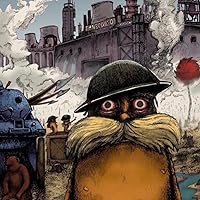
I haven't actually finished it; I abandoned it (at least temporarily) at page 23. I was interested in the culture, but could not identify with any character and was not engaged by the story or language. It's a pretty good book - just not for me. (I wrote all this before and lost it, so I hope it doesn't turn up as a duplicate post like the last one.) I lost it while I went looking for a link to the cover art, which is remarkable on its own. See for yourself.