Jump to ratings and reviews
Rate this book

Las últimas noches de París

Rate this book
Written in 1928 by one of the founders of the Surrealist movement, and translated the following year by William Carlos Williams (the two had been introduced in Paris by a mutual friend), Last Nights of Paris is related to Surrealist novels such as Nadja and Paris Peasant, but also to the American expatriate novels of its day such as Day of the Locust. The story concerns the narrator's obsession with a woman who leads him into an underworld that promises to reveal the secrets of the city itself... and in Williams' wonderfully direct translation it reads like a lost Great American Novel. A vivid portrait of the city that entranced both its native writers and the Americans who traveled to it in the 20s, Last Nights of Paris is a rare collaboration between the literary circles at the root of both French and American Modernism.

126 pages, Paperback

First published January 1, 1928

23 people are currently reading
1459 people want to read

About the author

Philippe Soupault

137 books53 followers
Philippe Soupault was a French writer and poet, novelist, critic, and political activist. He took an active role in the Dadaist movement and later founded the Surrealist movement with André Breton. Soupault founded the periodical Littérature together with the writers Breton and Louis Aragon in Paris 1919, which, for many, dates the beginnings of Surrealism. The first book of automatic writing, Les champs magnétiques (1920), was co-authored by Soupault and Breton. After imprisonment by the Nazis in World War II, Soupault traveled to the United States but subsequently returned to France. His works include such fat volumes of poetry as Aquarium (1917) and Rose des vents [compass card] (1920) and the novel Les Dernières Nuits de Paris (1928; tr. Last Nights of Paris, 1929).

Ratings & Reviews

What do you think?
Rate this book

Friends & Following

Create a free account to discover what your friends think of this book!

Community Reviews

5 stars
121 (24%)
4 stars
183 (36%)
3 stars
164 (32%)
2 stars
32 (6%)
1 star
4 (<1%)
Displaying 1 - 30 of 69 reviews
Profile Image for Eddie Watkins.
Author 48 books5,558 followers
October 14, 2014
Is there a better book, and in the determinants for this “better” must be factored in brevity, whose sole purpose is to make of a woman a city that one can live in and travel through, lured on by sweet and tragic mysteries, and by dread? Silly question, but I pose it only to say that even Breton’s Nadja can’t compare. Last Nights of Paris is something of a proto-noir, but a noir whose urban backdrop has been brought to the fore and endlessly (yet finitely) elaborated upon, while the plot is swallowed up by shadows; in these ways it has an abstract, impressionistic quality, like a painting whose main point is atmosphere and texture rather than narrative or discursive meaning. But there’s enough “story” to lure one into the insubstantial body of the narrator and merge with the pages as they turn. This is one seductive book!

It makes me very curious about Sue’s The Mysteries of Paris, a hugely popular 19th c. book that served as inspiration for the Surrealists and the Fantomas books. Though I haven’t read it I nevertheless get the feeling that Last Nights of Paris is a pure distillate of it, a pure and unassuming distillate that carries the full flavor, in concentrate, of its mystery and intrigue. “Unassuming” is a key word. This book is so unassuming that it has an air of anonymity, albeit an exquisitely formed and proportioned particularly French anonymity, and that the narrator himself is little more than an observing nonentity only adds to this anonymous quality, and this anonymity only adds to the mystery, in fact makes it irresistible. Like a city (or a woman?) this book can swallow you up (willingly) before you know it.


Profile Image for Nate D.
1,654 reviews1,252 followers
May 9, 2014
The deepest abysses into the liminal exist a hair's breadth from the quotidian. And so: the nighttime, a space where anything may happen, which we pass through nearly without noticing, every 24 hours. For Soupault, it is a space of limitless possibility, surprise, and intrigue, or at least the heightened sensation thereof. It's a book more about a feeling than about any specific occurrence, but that feeling is bottomless and perfect, murkily containing the universe, several universes, seen and unseen.

Perhaps because of my extreme interest in this subject, this sensation, though, the book came up a little short for me. Soupault juxtaposes his gorgeously crafted explorations of the night with increasing sections in which the mysteries of the night dissipate under the lamps of daylight. Really, both are "real", the night can never be abolished, but the increasing invasion of less inspired ordinariness into the storyline breaks the mood somewhat. Even the crimes that form the heart of the intrigue are oddly prosaic, hollow even, once they come into greater focus. Of course, this is also an effect of the novel falling increasingly under the influence of superficial characters -- the pair at the core of its night world can restore the full mystery at will, with the flick of a wrist.

Really, this day-night tension is probably an asset, formally, but it disturbs the purity of the experience for me nonetheless. Still, I love books like this for helping to hone exactly that kind of liminality that I most want to locate and plunge into.
Profile Image for Emily.
172 reviews268 followers
Read
May 10, 2011
In the interests of ramping up the Parisian reading prior to the France trip, I picked up Philippe Soupault's 1928 Last Nights of Paris, as translated by American Modernist poet William Carlos Williams. I wanted to soak up a bit of surrealist love for the City of Light, and indeed, Soupault's work is a kind of proto-noir love letter to nocturnal Paris, in which various shady characters roam the banks of Seine between sundown and dawn, interacting in mysterious ways and becoming fascinated and disenchanted with one another. The city itself is the most vivid character here; the humans are merely atmospheric outgrowths of the Parisian streets, "types" of the romanticized thief or prostitute. One can trace the precise paths they take while roaming from the railings of the Louvre to the skeletal shadow of the Petit Palais, to to the unsavory ambiance of the Gare St. Lazare in the early hours, but beyond a stylish silhouette they hardly exist as people—or, if they have distinguishing characteristics, they come off more as accessories to the city itself, parts of a collective hive rather than individuals.

Soupault's atmospheric creation comes off well in its first half, which is intensely visual. One is constantly reminded that this work is part of the original Surrealist movement. Not only does the world of the novella qualify as "surreal" to modern sensibilities (featuring unexpected juxtapositions, jarring metaphors and non sequiturs), but even Soupault's specific images recall those of his influences and contemporaries. The opening chapter, for example, features a plethora of umbrellas, bringing to mind Lautréamont's "chance meeting on a dissecting table of a sewing-machine and an umbrella" line. (Unsurprising, since Soupault apparently idolized Lautréamont, holding him up as a role model for the Surrealist movement as a whole.) Some of the umbrella images are quite good, and good examples of the classic surrealist vibe of Last Nights of Paris:

It is said that along one side of it is the meeting place of monastic bachelors. A modest and silent club. Here umbrellas take on the appearance of a flock.


And again:

Dragging an umbrella as one drags along an unhappy cur, a couple passed on the quay and stopped an instant to cast a look around. The woman let out little shrieks that recalled those of a screech owl. They checked their umbrella on the steps of the Pont des Arts.


The metaphorical transformation of umbrellas into animate creatures—dogs, groups of birds—is very characteristic of Last Nights of Paris. The boundaries between animate and inanimate are unclear: Paris itself comes off as a living, breathing entity, and everything else, whether street or human, is something like an organ to its organic body. Likewise, the woman in the second quote reminds the narrator of a screech owl: human/animal boundaries are just as fuzzy as the borderline between animate and inanimate. Indeed, the narrator is more or less guided around the city during the first chapter by a stray dog, with mongrels appearing over and over throughout the novella. Soupault is not suggesting that these dogs have human-style intelligence, or some kind of mystic knowledge—only that conscious decisions are of less importance, in nocturnal Paris, than the vagaries of chance. The most fitting thing, given the spirit of the nocturnal city, is to abandon oneself to the random chance, investigating odd details that catch one's eye or simply drifting from encounter to encounter with no conscious goal. And even if one has a conscious goal, like the narrator's desire to know the explanation of the events he witnesses during the first chapter, one is most likely to find the answers through a kind of zen abandonment to accident, than through applied logic. As the narrator remarks in the latter half of the book (which is less visual, more conceptual, and I thought generally weaker):


The days when we follow the secret voice of diversion are those chosen by chance to show us its ways. [...] Boredom with the eternal pageant turned my thoughts to what you will. I fled voluptuously.


This preoccupation with chance and night time leads nicely into another of Soupault's trademark Surrealist touches. Scattered more widely throughout the novella as a whole are clocks: looming and ticking, often becoming loci of fascination for different characters, or malfunctioning in one way or another. The narrator notices, in one section, that his watch has developed an odd habit:


And meanwhile, as if in answer to the city's signal, the small clock I used to measure time and ennui stopped each evening at eleven thirty-five. There was no explanation for this disconcerting regularity.
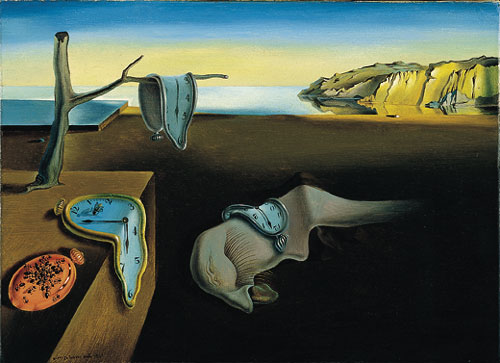

I love the koan-style nonsensical-ness of this. For how long does the clock stop every evening; when does it start up again? Does the narrator reset it to make up for the time lost during the period when it was stopped, or does the ostensibly precise stopping time shift slightly every day as the clock's lost time interferes with its accuracy? Perhaps Soupault is suggesting that the measurement of time—and even more so, one might assume, the measurement of ennui—is a more subjective process than commonly believed, so that the lost time does not need to be taken into account, and whenever the watch displays 11:35pm, 11:35pm it will be as far as the narrator is concerned. This image of the elusive, adaptive clock anticipates Dalí's famous Persistence of Memory (1931), with its melting, traveling clock faces:

persistenceofmemory.jpg


Elsewhere in Last Nights of Paris clocks are both reminders of the relativity of time (they are often unsynchronized, or malfunctioning), and simultaneously powerful creators of a moment in time. The character Octave is always staring at clocks, comparing them to his watch and to each other—presumably to check their agreement, reminding the reader of each timepiece's potential inaccuracy. In the opening chapter the "great clock of the Gare d'Orsay, the one on the left, pointed to three, strangest hour of all[, ...] three o'clock, the hour of indecision." Here the clock seems to embody and almost create the sense of this witching-hour in the narrator. The hands and face are less a neutral measurement device of an external quantity (time), but the co-creationist of a specific ambiance known as "three o clock." Could this 3am scene in the Gare d'Orsay achieve the same level of strangeness without the giant clock presiding over it? I think not. Elsewhere, the narrator himself becomes unreliable when he claims to know, without being told, that his friend Jacques "was obsessed with thoughts of a gigantic clock," and, finally, late in the book, chance itself is identified as "the hands of time."


I like Soupault's games here, but I'm not sure what to do with them. And in fact, after my delight at the visual oddity and atmospheric repetitions of the first half of this novella, I was taken aback to find myself slogging through the second half, which often reads like the journal of a stoned high school student or the more sophomoric passages of Julio Cortázar's Hopscotch. Still, at only 180 pages, 90 of which are delicious fun, and given the interesting geographical and historical context, Last Nights of Paris was definitely worth a read. And it will certainly flavor my impressions should I find myself in the neighborhood of the Louvre or Petit Palais after dark.
Profile Image for Tosh.
Author 14 books776 followers
April 28, 2008
Re-reading this book at the moment, and I forgot what a joy Soupault's writing is to me. Compared to the other Surrealists, Soupault has a light touch. He doesn't over-do it and there is a lot of charm in his work.

"Last Nights of Paris" is a Surreal narrative that is a love note to Paris. In many ways similar to Breton's great novel "Nadja" in that the city itself is the main character of the novel. The great thing is that when one gets to know Paris in an intimate manner they can go back to "Last Nights of Paris" to favor both the city and this book.
Profile Image for Andrea.
Author 8 books208 followers
May 23, 2015
Translated by William Carlos Williams.

Say what? you ask.

From one modernist master to another, this is quite a wonderful book. My favourite thing about it perhaps, is less the book itself and more the story behind the author's breakup with his movement -- as Soupault was 'ejected' from the surrealist movement in 1926 (along with Artaud) for 'their isolated pursuit of the stupid literary adventure.' (v)

Ah, the stupid literary adventure. I imagine it like Baudelaire's wild addiction to bad literature...

Back to the book, it presents to you... Paris:
The rue de Medicis along which we were strolling at a fair pace is sad around ten-thirty at night. It is the street of everlasting rain.

It is said that along one side of it is the meeting place of masochistic bachelors. A modest and silent club. Here umbrellas take on the appearance of a flock.

"You know," she said, "that around here are places where you can get coffee with cream."

At its very start the rue de Vaugirard stinks of books. The odor comes from every side. Its friend and neighbor, the rue de Tournon, is more inviting. So much so that I was prepared for a proposal and the address of a comfortable hotel. (3-4)

The Paris that belongs to the wanderers (and obviously, the lovers).
"Where are we going?"

I expected that petulant and vicious question. It is the night's query and Georgette did no more than express aloud that eternal interrogation.

One more question without answer, a question one also asks of the stars, the weather, the shadows, the entire city.

Georgette, the sailor, the dog and I myself had no answer ready and this we sought wandering at random, driven here rather than there by an invincible fatigue.

Thinking it is over as we were walking with soft steps under the trees of the Champs-Elysees, I seemed to catch a purpose, that of all the night prowlers of Paris: we were in search of a corpse. (20)

That this books contains a corpse and a mystery endears it immensely to me. Don't get me wrong, this is not noir nor thriller nor detective story. It is a book about the Paris that only comes alive in the night, and it cannot be roughly handled nor can all of its secrets ever be known.
Daybreak. Paris, heavy-headed, began to fall asleep. (21)

In this, Paris is like the woman of this story, Georgette. Another creature of night.
She loved only the dark which she seemed each night to wed and her charm itself did not become real until she withdrew from the light to enter obscurity. Looking closely at her one could not picture her as living during the day. She was the night itself and her beauty was nocturnal. (49-50)

A prostitute, yes. A romanticised and problematic figure, yes. But a complex one, and the narrative voice is aware of its own need to romanticise her, to preserve her mystery. In spite of himself the narrator follows her into the day, drags her into the well-lit and the known.
She went to the baker's, to the milkman...All the evidence of respectability .... But when I thought of what she had been, which some would have loved to call queen of mystery, I would rather have seen her dead at my feet.

She was everything that one would expect in a twenty-two-year-old girl.

She stopped before a house in the narrowest part of the rue de Seine, not far from the quays. At the rear of the court she climbed a narrow stairway to the fifth floor.

Day splashed the casing of the stairs; and all the blemishes wrought by time appeared. Georgette opened a door. (58-59)

All this, and yet he fails. He buys her attentions, attempts to shift her into a defined role in subservience to him for a night to take power over her that way. And fails.

Georgette is no Nadja.

Always he roams the streets. Following Georgette, following her brother Octave, equally mysterious. He seeks out the sailor, the one with him the first night, the murderer most likely, and what wondrous words are these:
I relied on Paris, on the night and on the wind. I expected much of the Gare d'Orsay where one may occasionally hope and wait without aim or reason. The two twin clocks pointed to the hour of one; on the Seine, the reflections of fires and lights were still dancing by, like a galloping flock. (91)

He meets up with Volpe, yet another shadowy underworld figure who seeks only profits in whatever quick scheme is possible, who was advising the police that first night standing over the corpse. He is never brought into clarity either, all is dreamlike.
The cold morning had given Volpe the only drunkenness of which he was capable.

"Tell me, when Georgette disappears, have you noticed that day is not far distant? If she should disappear forever, I have a feeling, and believe me I don't let things muddle me, I have a feeling there would be no more night." (121)

She disappears.

Her mystery allows her to be independent, part of the 'gang' without being anyone's lover (in particular). It allows her to be 'treated like a man. The women did not consider her to be one of their number.' (130) This despite her profession. I don't quite know what I think about these things, whether this gives her power or strips her of it, whether it makes of her object or subject. I like this unknowing.

This is a book of puzzles, but they are not meant to be solved.

It is above all a book of streets, of walking, of Paris and its secrets. It is a dark delight.
The days when we follow the secret voice of diversion are those chosen by chance to show us its ways.

Empty-handed, I set out upon the discovery of the flight of time and of space. Words, like joyous companions, started before my eyes and spun about my ears in a carnival of forgetfulness.

I was tired of those involuntary inquisitions, of those incessant curiosities. Boredom with the eternal pageant turned my thoughts to what you will. I fled voluptuously. (135)
Profile Image for Jane Mackay.
89 reviews12 followers
January 15, 2010
Surrealist novel translated by William Carlos Williams. Will make you long to wander Paris by night.
Profile Image for Marika_reads.
636 reviews482 followers
April 26, 2025
oniryczne dwoswiadczenie literackie ze spacerami po nocnym Paryżu
Profile Image for Rachel Kowal.
193 reviews21 followers
June 1, 2016
3.1 stars

Another book about a man entranced by a French woman who has no qualities other than being mysterious. "Georgette is a woman. That's all I can say. She lives and that's all." How novel. How fucking romantic. Maybe you'll think it's better if Georgette is a stand-in for Paris as Soupault inelegantly puts forth numerous times, but is it? Is it really? This book is lacking guts. It's just a skeleton, and one with many bones missing.

Still though. Translated by William Carlos Williams. That at least is interesting and makes for some pretty strings of words. Too bad they don't add up to anything.
Profile Image for Peter Landau.
1,102 reviews75 followers
December 19, 2020
Philippe Soupault is new to me. Everyone knows Andre Breton from that era, but he strikes me as a bit of an ass, which is often the fuel that drives popularity. Soupault wrote Magnetic Fields with Breton, which lead me to this novel. I knew I was in good hands when I saw the translation was by William Carlos Williams. What’s most striking is how 100 years later what was surreal is now commonplace. That doesn’t subtract from this episodic murder mystery, only adds to how ahead of his time it’s author was.
701 reviews78 followers
August 9, 2017
Pequeña joya de la narrativa surrealista, novela flâneur, nocturna, que protagoniza la ciudad de París y los misterios que provoca el azar de sus acontecimientos. La anécdota argumental en este caso es lo de menos: una intriga sostenida por diversos personajes marginales que no son más que símbolos de la calle, los puentes, las estatuas, las estaciones.
Profile Image for Tentatively, Convenience.
Author 16 books245 followers
October 26, 2017
review of
Philippe Soupault's Last Nights of Paris
by tENTATIVELY, a cONVENIENCE - October 25, 2017

The last review I wrote, finished today, was one of Bruce Sterling's Heavy Weather wch I began by writing: "I keep picking on Cyberpunk writing in much the same way I pick on Surrealist writing. At the same time that I like it in theory I'm annoyed by it in praxis." ( https://www.goodreads.com/story/show/... ) The point is that most Surrealist writing that I read doesn't strike me as Surrealist enough - but, then, I don't read much Surrealist writing anymore so I'm usually dependent of my memory of it.

This might be the 1st Surrealist novel I've read since Lisa Goldstein's The Dream Years read in April of this yr & that doesn't really qualify. Before that, the 1st bk I finished reading in 2009 might fit the bill: Giorgio de Chirico's Hebdomeros: With Monsieur Dudron's Adventure and Other Metaphysical Writings.. or maybe not. Even this novel doesn't fit into the category if one takes Soupault's expulsion from the Surrealists before its writing seriously.

William Carlos Williams, the poet, translated it & I think he did an excellent job. However, he refers to it as a "Dadaist novel" & I think that's even further off the mark than its being a Surrealist one is. The "Publisher's Note" has this to say:

"Co-author with André Breton of the first self-proclaimed book of automatic writing, Les Champs Magnétiques (1919), and co-editor with Breton and Louis Aragon of the avant-garde journal Lttérature (1919—1923), Philippe Soupault was one of the founders of the Surrealist movement. A poet, novelist, and journalist, with a much less political and less theoretical approach to writing than his colleagues Breton and Aragon, Soupault was expelled from the movement in 1926—along with Antonin Artaud—for "their isolated pursuit of the stupid literary adventure." Les Dernièrs Nuits de Paris was his third prose work, published in 1928." - p v

"Indeed, Last Nights of Paris seems to share much with both the Surrealist novels (Nadja, Paris Peasant) and the American expatriate novels (The Great Gatsby, The Day of the Locust) of its day." - p vi

"both the Surrealist novels"? Does that mean that it's commonly thought that there were only two? I've read them both & didn't find either very Surreal. As I've probably overstated by now I find Raymond Roussel's novels far more Surreal than anything the Surrealists ever wrote. As for "the American expatriate novels"?

Ok, The Great Gatsby was published on April 10, 1925 while the Fitzgeralds were traveling in Europe a few weeks before they settled in Paris but he began planning it in 1923 when he was still in New York. The Day of the Locust (1939) was written when Nathanael West was living in the US long after a brief 3 month trip to Paris in the early 1920s. Calling him an "expatriate" is stretching things a bit & calling either of those novels "expatriate" is also stretching it given that both are set in the US. Interestingly, West died the day after Fitzgerald did.

When I praise Williams' 'poetic' translation I mean passages like the following:

"The virtuosity of words in this historic quarter is amazing. Those that escape from the houses have a quicksilver sheen, those that hide in their cracks are phosphorescent." - p 4

In other words, the descriptions use images not usually associated w/ what's described, things like: words w/ a "quicksilver sheen" or words "that hide in" [..] "cracks". I enjoy this so the bk got off to a good start for me. It also has a fairly linear plot but one that's revealed in an intriguing enuf way:

"Georgette, the sailor, the dog and I myself had no answer ready and this we sought wandering at random, driven here rather than there by an invincible fatigue.

"Thinking it over as we were walking with soft steps under the trees of the Champs-Elysées, I seemed to catch a purpose, that of all the night prowlers of Paris: we were in search of a corpse." - p 20

Given that there've probably been many novels written about the criminal underworld, as this one partially is, I wonder how many criminals so depicted ever read such things?

"I read that they were on the assassin's track, a sailor from Chacal who had killed and cut to pieces one of his friends." - p 22

W/ friends like that, who need enemies?

The poetic descriptive language continues to please me: "Paris swelled out with boredom, then slept as if to digest it." (p 36) I hate to break it to you, Paris, but you might be pregnant & time has been known to eat his children. "I took pains to notice the time at each clock we passed on the trip, and on passing the seventeenth, and despite the distance run, pointed to eleven thirty-five. Had time stopped?" (pp 37-38) No, but when Paris is digesting, time slows down drastically.

Now, Philippe, is this type of behavior becoming of you?:

"She was picked up, near the Pont-Neuf, by some sort of student in a béret who was taken by her to a hotel room. With decision, Jacques bribed the patron of the hotel and obtained the room next to that in which the student was undressing. We were misled by the banality of that interview. Georgette first demanded her pay, then, having complained about its smallness, declared that she was in a hurry because of a rendezvous with a Spaniard.

"Jacques and I made no secret of your joy. Georgette was no more than an ordinary prostitute; and by ourselves we had manufactured a mystery out of whole cloth."

[..]

"However when the characteristic noises and the succeeding silence indicated to us that all was over, we quitted the room and took up our watch at the door of the hotel. We wanted at least to make the acquaintance of the Spaniard." - p 45

Hence, the historic meeting between Soupault, Cousteau, Breton, & Buñuel did not take place in an aqualung sauna as usually reported. This explains Soupault's eventual marriage to a street: "The avenue de l'Opéra was no longer the stream that I had always followed, nor the highway that one usually pictures. It was a great shadow flashing like a glacier, which one must first conquer, and then embrace as one would a woman." (p 46) Awkward, eh? Maybe this explains the alligators in the sewers? But to each his own & que sera, sera. Ah.. but what about Georgette? Men are so fickle.

"I realized perfectly that in appearance she was just a common prostitute, the sister of all the prostitutes who overrun Paris and who, they say, are all more or less alike. But Georgette was seductive only because she was somehow different and because her appearance was obviously deceptive." - pp 48-49

"She loved only the dark which seemed each night to wed and her charm itself did not become real until she withdrew from the light to enter obscurity." - p 49

Maybe it was just to hide traces of disease.

Chapter Five begins w/ a quote from Roussel, Soupault can do no wrong:

"O, Treïul, remember that we are of the same race
and that I am entitled to your aid.

"—Raymond Roussel
(La Poussière de Soleil)" - p 60

We are all the alligator children of Philippe Soupault & the avenue de lOpéra. As such, I make beginnings meet.

""You have come for some drawings, sir?" asked Georgette, and I couldn't tell whether she spoke in this way to deceive me or to deceive Octave. I was careful not to contradict and passed myself off as an art lover." - p 62

Well, I guess that makes sense: 1st he's embracing the avenue de lOpéra & now he's tossing off himself as an art lover. He's probably thinking of one of the sewer covers opened at a "^" intersection. Is it any wonder that Octave is a little odd? Thank goodness he's not a 9th, then he'd really be odd.

"He stopped talking suddenly and began to count the number of hairs in a paint brush.

"Then, in spite of my questions, he relapsed into silence like someone drowning.

"Wasted effort. Octave had departed, and for a realm to which I could not follow him. He seemed to push aside the horizon, drive back the walls of the room, wipe out the boundaries of day and dismiss the objects which surrounded us." - p 68

Then, all heck broke loose & metaphor was forsaken as simile piled on simile in a veritable cluster fuck tackle of the quarterback, halfback, fullback, & backhand. "One of them was torn and hung like a dead hand above the shining tracks of the railroad. Here and there the red point of an electric lamp, as sad as the dead body of a dog. The cars on the switches looked like pretentious tombs. / Octave took up his walk. It was like the refrain of a hackneyed ditty" (p 79)

"Chance meeting on a dissecting table of a sewing machine and an umbrella" - Comte de Lauréamont - NO WAY that was chance, Bub.

"Chance, said I to myself, is at least sincere in that it does not conceal its deceptions from us. On the contrary it exposes them in broad daylight, and trumpets them at night. It amuses itself, from time to time, by stupefying the world with the shock of a terrible surprise, as if to remind men of its great strength, thinking they might forget its flightiness, its mischief, its whimsicalities." - p 83

I discovered Restif de la Bretonne in recent yrs, in particular his "Anti-Justine". This is early 19th century French incest pornography of the most vivid sort. I just stumbled across the bk while browsing my favorite used bkstore & got it b/c of the reference to de Sade. I don't recall ever seeing any mention of de la Bretonne before when, Lo & Behold!:

"He described to us with many details the check room for small children, who were deposited under a number by nursery girls. This custom, he affirmed with a disarming certainty, is very ancient. And he cited cases of substitution of children infinitely more numerous than one would suppose. Now and then he underlined what he said with an observation borrowed from Restif de la Bretonne, who was plainly his model." - pp 106-107

The implication being here that the children were vulnerable to sexual use. As if that weren't enuf, we further get to learn of walking privies.

"["] Do you know," said he, smiling in his best manner, "that toward the end of the middle ages, bucket carriers circulated through the streets to give aid to people who were 'caught short'? They were armed with a great cloak forming a sort of temporary shelter from which emerged the face alone of the crouching client. After which the bucket was emptied into the nearest stream." - p 107

Chapter Nine begins w/ this quote:

"A something or other that has no name in any language.

—Tertullian
"

Lately I've been preoccupied w/ the notion of concepts specific to particular languages. See, e.g., my review of Howard Rheingold's They Have a Word for It: A Lighthearted Lexicon of Untranslatable Words & Phrases: https://www.goodreads.com/story/show/... . But an idea that I haven't come across yet is the one presented in the above Tertullian quote & an excellent idea it is. There are currently over 6,000 languages, what ideas don't have a word for them in any of them?! Discuss.

The novel's action meanders thru the activities of some criminals who're roughly clotted around a kingpin named Volpe:

"One day he sold pictures, the next day cotton and in all probability women. He possessed blocks of shares in a number of newspapers, whose policy he controlled and which served him at the same time as buffers against the world. What struck one about Volpe was his remarkable gift for using to the hilt everything that belonged to him. He had the taste for small enterprises whose yields were prompt and it could be said that he enriched himself through makeshifts. Like all those in his category, Volpe had a great number of vices. But he loved best of all to dominate." - p 126

The Publisher's Note declared Soupault a "poet, novelist, and journalist" & it's interesting to speculate how much of each was at play in the writing of this. The above description seems likely to me to be based on either a single individual known to the author or an amalgamation of character types - but is it? & what about the rest of it? I wonder if Soupault was ever interviewed in depth about just how fictional or non-fictional this is - but I don't wonder enuf to research it at the moment.

"One day, in a café—one of those cafés they love so much—I saw them listening with particular attention to a refrain spit out by a gramophone: it was the hackneyed of the hackneyed:

"Paris, c'est une blonde
Paris unique au monde.


"The imbecilic words spilled themselves before them and they listened with open mouths, ravished, convinced." - p 134

Ha ha! My French-Canadian friend Alan Lord wrote a bk called ATM SEX (you can read my review here: https://www.goodreads.com/story/show/... ) in wch he writes about Paris thusly:

"You love Paris because you've never actually lived there. You just passed through with a temporary load of money, gawked at the usual tourist trappings, then said au revoir Les Mis-arabes. You didn't have to try dialing for operator assistance in a phone booth (it doesn't exist, and anyway your pocket change is useless—you need a phone card, which you can only buy in a Bar Tabac). And you didn't get kicked out of a supermarket for squeezing in through a checkout aisle instead of going all the way to the end of the interminable checkout aisles and going in through the proper "IN" gate like the rest of the obedient French sheep, who in fact are much more conservative and knee-jerk respectful of rules, tradition, and hierarchy than their former Nazi masters." - p 98, ATM SEX

In my review of that I recount my own story:

"In 1984 I went into the Paris underground, the former Roman mining tunnels, w/ some friends & a Parisian reporter who knew his way around somewhat. I picked an area that I then proclaimed the "PS.B.B.T.O.U.C." (the "Paris Suburban Branch of the BalTimOre Underground Club"). I explained that everywhere I went became a suburb of BalTimOre. Now BalTimOre's a hopeless shithole of the 1st order & I was parodying imperialism but the reporter failed to see the humor in it & seemed more than a little offended that I wd dare to reduce the-great-Paris to a mere suburb of an American industrial city in decline. I thought that was funny."

I don't actually have any feelings about Paris one way or another. I remember being treated rudely there b/c my French was so horrible, I can't blame them for that - although when I meet someone who doesn't speak the local Lingua Franca I try to help them not castigate them. But let's not dwell, s-hell we? Let's refresh ourselves w/ some more poetic description:

"Empty-handed, I set out upon the discovery of the flight of time and space. Words, like joyous companions, started before my eyes and spun about my ears in a carnival of forgetfulness." - p 135

Do all Parisians speak like this? Alaseth, I thinketh noteth. They're more like our pal Blin below:

"Blin, seizing his courage in both hands, got up and said: "There are various degrees of doubt just as there are progressive stages of insanity. You make me laugh. Let one of you throw the first stone, I'll fling it back. My position today permits me to face these obligations of which I myself have fixed the value. I demand, I DEMAND. . . ." The words—empty, useless, out-of-date—flowed until he was breathless." - p 170

Ok, maybe not. Here're excerpts from Soupault's afterword on translator poet Williams's time in Paris:

"I think it was the memory of these nocturnal wanderings that made him decide to accept translating my "testimony," incorrectly subtitled "novel," Last Nights of Paris. Which for me was a great joy. I was one of the few Europeans (or Americans) who knew that Williams was a great, a very great poet and an admirable writer of incomparable lucidity and even of incurable modesty." - p 178

Perhaps my question-mark-less question above, "I wonder if Soupault was ever interviewed in depth about just how fictional or non-fictional this is", is answered here by Soupault saying ""testimony," incorrectly subtitled "novel["]". I think Williams did a great job - esp considering that the original is just one symbol: "^".

"But, as he has written, he had retained pleasant memories of our walks in Paris, which he evoked in translating, with his mother, Last Nights of Paris.

"And after reading his translation I congratulated him, because he had done an admirable job of describing the atmosphere of the Parisian nights." - p 179
Profile Image for sadeleuze.
150 reviews24 followers
August 8, 2023
A surreal text. A nocturnal wandering through the streets of Paris, with different characters following the narrator, disappearing and reappearing a little later. A murder, a fire and various adventures...but it doesn't really make sense, I think you have to let yourself be led by the story, get lost in it.

"the days when we follow this secret voice, which is that of distraction, are those that chance chooses to indicate its paths." (les jours où l'on suit cette voix secrète qui est celle de la distraction, sont ceux que le hasard choisit pour indiquer ses chemins)
Profile Image for ma¡a.
95 reviews3 followers
October 14, 2021
poezja codziennosci ktorej nadano forme powiesci
troche jak bardzo przyjemny film na ktorego fabule nie skupialabym sie najbardziej

mialam wrazenie ze cala ksiazka to przerost formy nad trescia ale chyba tak mialo byc

budowal slowami paryz
biegal po granicy dnia i nocy
prawdy i ułudy

chodzil po wspomnieniach i karmil poczuciem nierealnosci ktore paradoksalnie nadawalo zycie temu nocnemu miastu pelnemu snow
Profile Image for Lori.
1,372 reviews60 followers
June 21, 2016
Last Nights of Paris concerns the after-dark exploits of its narrator (who never seems to sleep - or work, for that matter), who gradually becomes acquainted with the various nocturnal creatures of the City of Lights. Ever since witnessing a bizarre, weirdly staged spectacle conducted on the rue de Seine around midnight - involving a procession of laborers, a desperate woman, and a giant sack - the narrator has grown obsessed with his companion at the time, a young prostitute he had just met named Georgette, who seemed all too knowing of what exactly they were observing. Hearing a newspaper account the next day of a sailor who had killed and dismembered one of his friends, the narrator finds himself slowly drawn deeper and deeper into an underworld that comes to life only in the dark. Presiding over it all is Georgette, whom the narrator comes to view as the embodiment of all the moods and mysteries of the Parisian night.

If real-life career criminal-turned-police investigator Eugène François Vidocq influenced Edgar Allen Poe's creation of the detective story, so too does Last Nights of Paris represent a mingling of two distinct cultures. "As the many memoirs of Paris in the twenties attest," says my edition's introduction, "the disparate worlds of the French avant-garde and the American expatriates rarely collided." As such, Williams's translation "stands at the unlikely juncture of both French and American literary modernism." With its cast of tough, amoral characters (including the obligatory femme fatale), evocative urban setting, and the protagonist's quest into the urban labyrinth unlock a puzzle, Last Nights of Paris is very reminiscent of the contemporary development of American noir and hardboiled detective fiction. Sam Spade would hardly be out of place.

At the same time, however, Last Nights of Paris is an undeniably Surrealist novel, following a recognizable plot but infused with the atmosphere of a dream. The night is a living character in its own right, personified by Georgette. It stands for the Surrealist fascination with the subconscious and for its desire to create art out of pure imagination, unordered by thought or reason. Although the narrator eventually arrives at an explanation (of sorts) for the events that transpired that first night he met Georgette, he does not get there, as your average detective hero would, by seeking, arranging, and interpreting clues. He drifts. He meanders from place to place. He pursues Georgette like the white rabbit. Coincidences arise: he meets a man in a cafe who claims to be a thief who meets regularly with other thieves to discuss the news of the trade. Later on, wandering through one of his favorite nightly haunts, the aquarium at the Pont d'Jena, the narrator comes across precisely that meeting, and hears Georgette's name mentioned.

Soupault's portrayal of Georgette is another fascinating aspect of the novel. She could have very easily turned into yet another stereotypical female symbolizing mystery and instinct and all that stands in opposition to the "male," Apollonian perspective of a rational world. Instead, Soupault makes it very clear that she is a fiercely independent woman who is well-respected by otherwise misogynist men. I wouldn't go as far as to call her a feminist character, but nor is she simply a reiteration of one of Western culture's long-running female tropes. And considering the basic tenets of Surrealism - its embrace of precisely those "female" realms of dreams, emotion, and intuition - Georgette, placed in this context, carries different connotations. She is exactly what Soupault's narrator (who may well be an author surrogate) is seeking as he lets the random power of chance take hold and strays further into a world that materializes only when most people are sleeping.

I had been dying to read Last Nights of Paris since I first heard of it. So many of my favorite things intersect in it: Paris, Modernism, the literary avant-garde, the 1920s. I was absolutely not the slightest bit disappointed. Despite its experimental nature, Last Nights of Paris is a very accessible read that can be enjoyed by a broad audience, even without any background in Surrealism, Modernism, or French social history. I absolutely recommend it to anyone and everyone.

Original Review
Profile Image for Iván.
129 reviews
November 20, 2019
Nunca me ha gustado la corriente de pensamiento como estilo literario. Siento que olvida el contenido para tratar de elucubrar una forma que nunca llega a fin y que siempre queda en el aire. Es lo más parecido a un poema en prosa, la articulación de sonidos que pueden percibirse como hermosos, pero cuyo significado se diluye frente a cualquier intento de comprensión. La trama, siempre secundaria, da un soporte a la divagación y al fluir de la conciencia. El libro trata de un sujeto, el narrador, que en las noches de París deambula por las calles encontrando una serie de personajes típicos del imaginario parisino: prostitutas, asesinos, amantes, despechados, quienes en una suerte de interpretación vampiresca, se alimentan de la noche y se ahogan durante el día. París adopta la forma de una criatura orgánica y oscura que solo cobra sentido desde lo nocturno. La noche es vida y el día es la muerte de la rutina. Las putas pierden su brillo y se vuelven una más entre la multitud. Georgette, ella, la puta, es París, dice el texto, y tener a la puta al frente, es tener a París frente a ti, con toda su promiscuidad esencial.
Cuando sale el sol la fiesta acaba, la vida duerme y la ciudad cambia de mando.
El texto está excelentemente pulido. Cada palabra justifica su uso y transmite el amor por lo nocturno, que en realidad termina siendo necesidad y no amor. Solo vivimos en la esperanza de una nueva noche y todas las esperanzas están puestas en ella. La novela transmite la sensación de dependencia y desasosiego. Sin Paris no vivimos, sin la noche tampoco. Pero estamos condenados al día.
La novela me gustó si la observo desde su propio lenguaje. Es un texto que debe leerse en voz alta para comprenderse pues el silencio le resta protagonismo a la construcción de sus párrafos. La novela me gustó si la observo desde su propio lenguaje, cierto, pero si alguien pregunta de qué se trataba, es poco más lo que puedo decir. Quizás solo tendería a verbalizar algo así como “sobre las oportunidades de la calle”.

--
Profile Image for Katia.
22 reviews18 followers
October 8, 2017
Poetycka mini-powieść jednego z ojców założycieli surrealizmu, powstała już po wykluczeniu go z paryskiego kręgu i być może dlatego, jak twierdzi wydawca, konsekwentnie pomijano ją w polskich antologiach, choć paradoksalnie jest bardziej surrealistyczna niż wszystko, co wyszło spod jego pióra wcześniej. Agnieszka Taborska przerywa ten zaklęty krąg milczenia, przekłada powieść na język polski, wspomina w swoim zbiorze esejów Spiskowcy wyobraźni. Surrealizm, a Soupaultowi tworzy w posłowiu Nocy intrygującą i przywracającą chwałę sylwetkę.

Ostatnie noce paryskie przenoszą w całkiem inną rzeczywistość, oniryczną, dekadencką, paryską do szpiku kości. Wraz z narratorem, niemalże pod rękę, spacerujemy uliczkami i zaułkami Paryża w magicznej atmosferze chłodnych nocnych mgieł i ledwie rozświetlającego mrok, żółtego blasku latarni. Spotykamy bezdomnych, prostytutki (jedna z nich stanowi „spiritus movens wszelkich wydarzeń”), kawiarnianych bywalców, włóczęgów „próbujących uciec od nawyków i codzienności”. Zostajemy świadkami zbrodni i próbujemy odkryć prawdę o tajemniczych, nocnych wydarzeniach. Jednakże istotą utworu nie tyle są te wydarzenia a nastrój niesamowitości, spacerowanie nocą, po tym – zupełnie innym niż dzienny – Paryżu; to one są celem samym w sobie. „Bohaterowie Soupaulta wiedzą, że obok snu spacerowanie jest najbardziej surrealistyczną czynnością, rozbudzającą zmysły i wprawiającą w szczególny stan ducha”.

Spotkania z lekturą rekomenduję nocą!
33 reviews
July 8, 2023
While not being used to surrealist literature, reading this book was joining its protagonist on a long journey, of constant openness to reality, as if seeing it for the first time. It was a synesthetic pallette of descriptions, observations and thought processes. And mystery. Paris is pushed and stretched at the same time into simple personification and outwards to universe, to a myth, to a religion. The book, vaguely following a story concerning this Georgette and her role in the protagonist life but also as part of some shady group, reads in fact like an artwork, which asks patience from the 21st century reader. For me it was a sometimes challenging read, but also strangely smooth and inwards - pulling. If you are up to the 141 pages, certainly worth your time.
Profile Image for teresa connolly.
94 reviews
October 8, 2025
Uau, de los mejores comienzos y finales que he leído jamas.

"Melancolía, melancolía, aquella noche comprendí tu poder y tu servidumbre. Me parecía ir persiguiendo a lo largo del río un rebaño de recuerdos, de arrepentimientos, de remordimientos, y cuando por fin iba a atrapar alguno de aquellos fantasmas lo olvidaba: olvidaba para siempre mi obsesión o mi perplejidad. Aquella mujer mortalmente triste estaba a mis es-paldas, seguramente esperando aún, y a mí no sé qué miedo me impulsaba hacia adelante. Estaba huyendo."
Profile Image for chacierrr.
172 reviews19 followers
June 20, 2022
Very good. Interesting and certainly worth the read, chance is in the air.
Profile Image for Elliott.
430 reviews53 followers
February 2, 2017
The pursuit of the ephemeral and an insatiable desire to immerse oneself in all of mysteries of Paris after dark. These impulses are the thematic heart of "Last Nights of Paris."

Paris at night is a distinct perception of the city and one which persists to the present day. Just last week I read an article in the New York Times lamenting the disappearance of this "other Paris" following a crack-down on noisy bars and nightclubs. The descriptions of the city in "Last Nights of Paris" reminded me of those I'd read in Louis-Ferdinand Celine's brilliant "Journey to the End of the Night;" the title of which alone speaks to this common image of Paris at nighttime.

To paraphrase another reviewer, "Last Nights of Paris" is the avant-garde French film of books.
Profile Image for Tuck.
2,264 reviews252 followers
January 20, 2015
i had heard a bit about this, just mentioned in passing, in the new biography of new directions press and james laughlin "Literchoor Is My Beat": A Life of James Laughlin, Publisher of New Directions and then some goodreaders too were talking about how good it was recently, so got it to read. and oh it is very good, modern novel of 1920's paris and what people get up too late late at night. night people will understand perfectly. just you, your footsteps, and lamplight
383 reviews1 follower
June 24, 2015
Written by the surrealist Philippe Soupault, its the story about a man obsessed with a woman and through her he experiences a side of 1928 Paris few tourists ever see. And it completely succeeds in sucking the reader down into that world with its round and flowing prose. Soupault is obsessed with Paris and this woman he follows is both guide and reflection. He grants the reader that rare, psychic taste, fleeting but with enough to leave what lingers. The reader becomes a piece of mental impressionist art I think after they read this beguiling memoir themselves - judging from the comments about the book.
Profile Image for Laurel.
4 reviews
January 3, 2025
I’m sure the book was beautifully written according to some people but I simply could not seem to finish this book fast enough. The only reason I finished it at all is because of my ego telling me I had to finish it rather than continue to let it sit on a shelf as I brought it home from Paris. Not my genre I guess I don’t even know what this book was about and I read the dang thing
3 reviews
August 29, 2024
"This large stain on the Sein's shore was once again rotating on itself, like the whole world did, with the same obstinacy and the same resignation. Like Earth, Paris was cooling and becoming only an idea. For how many more years would she keep this power of illusion, for how many more years would she remain mistress over time? I couldn't bear to answer."

Reading this book makes you empathise with the other surrealists' choice to kick Soupault out of the surrealist movement.
You can maybe smell a faint scent of surrealism, but there is really not much absurdity whatsoever in what, despite a well crafted and very quotable prose, less convoluted than Breton's and more classical but every bit as refined, thickly spread out and more substantial than the plotline, ends up being a symbolic novel, more of a crime story than anything else. The wording is somber, dusk-like, meditative, evocative and often loops back to the main concepts, like a refrain. The main character is a moody, thoughtful observer, who would much rather follow the train of his thoughts and be guided by Paris and seduced by its shadows than actively interact with his surroundings. What would be lengthy dialogues are summed up with few words, while going instead at great lengths to describe the atmosphere in melancholic detail.

"Tiredness petrified the houses entrenched in silence and rised to the sky that paled as it drew nearer. Not a breath. (...)
Like a great sick body, Paris turned and turned to escape the grip of its fever. But calmness kept rising suddenly from itself, like a flame not fully put out."

The plot consists of just a few events that are mostly talked about and pondered about with great rumination, with the protagonist being both entranced and at some points bored by its mysteries, ciclically running after them and then turning his back on them. It's not a fast paced book, as most of the emphasis is put into these lengthy, solitary strolls through the night and its unexplainable. Some pathos is picked towards the end maybe, with slow drumrolls leading up to the finale. Most of the surrealism can be found in this section and even then it's not much, with it being mostly an irrational desperation in the characters, although reminiscing also of the feverish, darker scenes that often happen in classical literature and the ones where human psyche is laid bare.

"One by one their gazes went out. Drowsiness passed over us, visible, and in the resurrected silence a heavier silence imposed itself. We awaited nothing but the light as the end of the world. Desperation was cautiosly approaching. "

The book is very successful at conveying an atmosphere of solitude, of desolation, of familiarity with a city that is wandered through with no direction and little ability to perceive its secrets, knowing, or at least percepting, that one day it all may come to an end. It leaves one with a feeling of light sadness and incompleteness, having realized by the end that some puzzles are meant to be looked at, felt, analyzed and appreciated, but never solved.

Soupault's surrealism is not as grandiose and all-encompassing as that in Breton's Nadja. His is mellow, subdued, almost hidden. Soupault's mystery is not the grand otherwordly mystery of the subconscious that's essential to the other surrealists, but a smaller, humbler and more urban one, tied to unusual, but likely crime scenes, Paris' underworld, its characters and streets. The characters are unidimensional and metaphorical: they are symbols more than they are people, what they represent is more important than the very little they say. They move like puppets and are an extention of Paris itself, each a different aspect.

And the alluring woman who is the real focal point of the book, despite the shroud of mystery that accompanies her and makes her into an allegory for the city and its bigger secrets, is just a woman as the protagonist will have to admit to himself. She is nothing more than the characteristics that others choose as a label for her. All of her power comes from the night, and during the day she is mundane and insignificant, while during the night she is as powerful and intangible as a shadow. In fact, most of the chapters start by nightfall, and end with the dawn. Because of her role as bringer of the night though, without her presence tensions, worry and desperation mount. Like the character Volpe explains, the night follows her as she exists only in the night and without her the night is no more. In this day, the philosophical concept of night and day is inverted. During the night Paris lives, and during the day she sleeps. Because of this, if the night never came again, Paris would cease to exist.

"Georgette? You probably think you know her. You can never understand her because we feel the need to allocate onto her ideas and intentions.
Georgette lives outside of anything we believe she is."

3.5, bumped up to 4 because of a very beautiful, complex and elegant prose. Not what I was looking for at the time, but it was still enjoyed.
1 review
March 11, 2020
The first Surrealist text that I've properly engaged with. An odd choice given its place around Soupault's expulsion from the movement, but one that ultimately cloaks its surrealist underpinnings with eloquent language and a straightforwardly engaging noir-thriller plot line.

The metaphors and similes on display are the most characteristically surrealist element. Often objects such as buildings - or in a few cases shoes and umbrellas - as well as Paris as a whole are anthropomorphised and permitted to take on incredibly fluid and arresting descriptions. The book is shot through with a sense of romance that imbues each line with a solid weight. The feeling that what you're being told is absolute and extremely vital to understanding is unmissable.

There's a dream-like mystery that coats everything in a haze, meaning characters and places become twisted and distorted, never truly pinned down. This owes to a setting that is deeply metamorphic; one that oscillates, is spontaneous and consistently new.

A Paris shrouded in mystery, the secret of which appears to sit as unattainable, is the focus of Soupault's nighttime meanderings. Even in this, a few elements of the city are drawn out and explored in their infinite subjectivity. First, the prevalence of the wanderer as someone who fundamentally fuses with the city; is a reflection or refraction of its very existence. Secondly, Paris is something of an inverted city. All that makes Paris, Paris, occurs during the night. It's a negative space that shows its true intentions when left like an undeveloped photograph. These great monoliths of darkness hold more explanation for the city than any clear portrait could.

This book is beautiful. It does not shy away from elegant description that performs on a grand scale. This stands in direct contrast to the 'underworld' setting that these descriptions conjure up. In this there is a perfect interlocking of opposites: Night and Day; beauty and horror; movement and stasis.
Profile Image for rossygram_.
606 reviews80 followers
May 28, 2019
G E N I A L🤩

Soupault {“sopa” que pronuncio yo} fue pionero del #surrealismo, y esta novela corta su obra más importante. Y me ha gustado descubrirla. En mi caso, hasta ahora, todo aciertos con los libros de #JusEdiciones.

Estamos en el París de los años 20. Un hombre pasea una noche por sus calles, topándose con una enigmática mujer y varios delincuentes. Todos están relacionados, en mayor o menor medida, con un crimen, y nuestro protagonista se ve atraído por todos ellos, llegándose casi a obsesionar con la noche parisina.

Y a través de las páginas de esta novelita acompañamos a nuestro curioso protagonista durante varias noches por esa enigmática París.

Por cierto, el libro incluye una copia digital (e-book), y me parece genial. Algo que también he visto en los libros de #Malpaso.

¿Qué encontraréis en este libro? Una pequeña joya del surrealismo francés.

Erratas encontradas: 10 {🤦🏻‍♀️ ¡psicoanalista ven a mí!}

FRASES SUBRAYADAS:

“Robar es apasionante: tiene algo de competición. Lo malo es que hay que llegar siempre el primero.”

“Escapaba del recuerdo y las palabras igual que se escurre un pez. Se alejaba, pero seguía presente o, incluso, crecía hasta hacerse enorme.”

“[...] tiene manías de toda clase. Lo que más le gusta es probar nuevas experiencias. Tiene que experimentarlo todo para conocer el resultado.”

“El tiempo no borra las huellas de quienes desaparecen: se contenta con ocultarlas a nuestro ojos, pero persiste su aroma o, sencillamente, un aura especial y sutil que las sugiere de cuerpo entero.”
Profile Image for Andy James.
Author 8 books3 followers
August 10, 2020
The back cover, front cover, inside cover, and any other cover you can think of keep comparing this to The Day of the Locust.... why? The only similarities between the two is an obsession of all characters with a centralized woman - thats not so unique that it should bind two stories together for eternity.

I would much rather speak of this book and A Moveable Feast in the same breath. Both of them transport the reader to 1920-30’s Paris. I would argue that Last Nights of Paris does it better as it was written by a Parisian in the era. The two stories are more interestingly contrasted than they are alike, but they end up complimenting each other so well that together they paint a more complete picture of Paris. It does the reader well to read both. They each captured the laid back, unemployed, cafe-life of Paris, but Lost nights did it with a more creative artistic initiative.

I think in the end if I were on my way to Paris I would grab A Moveable Feast, and if I were feeling nostalgic about Paris I would grab Lost Nights.
Profile Image for Kathleen.
Author 35 books1,358 followers
September 12, 2018
"Slowly I went on my way, following the day's ascent. While the sun rose and came to greet me, I marveled at being able to live in the midst of mystery without being wonderstruck each second. I admitted that we grow accustomed to the strangest circumstances and smiled with pity thinking of those who refuse to be what is called dupes--who want to know everything and are not even able to perceive the diurnal mystery which suffuses and bathes them from head to foot."
Profile Image for Heronimo Gieronymus.
489 reviews150 followers
December 14, 2021
Words that escape from the houses
have a quicksilver sheen;
those that hide in their cracks

are phosphorescent.

Everything is so simple when:

one knows all the streets as I do
and all the people who move in them;
seeking something without seeming to do so—

Night came closer and closer
more and more tangible.

The diurnal mystery that
suffuses and bathes them from head to foot.

The white hour has come.
Displaying 1 - 30 of 69 reviews

Can't find what you're looking for?

Get help and learn more about the design.