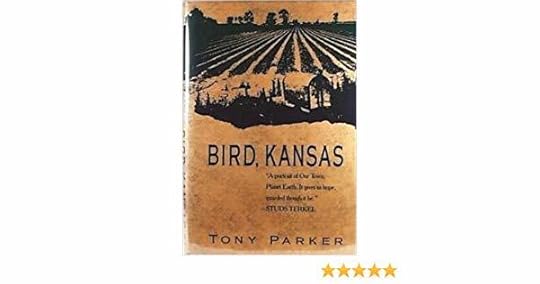
The citizens of the small town of Bird, Kansas, talk about the land they call home, their motivations, hopes, and dreams, their stories and their fears, and the day-to-day realities of their lives
Tony Parker (25 June 1923 – 3 October 1996) was an oral historian whose work was dedicated to giving a voice to British and American society's most marginalised figures, from single mothers to lighthouse keepers to criminals, including murderers.
Born in Stockport, Cheshire, Parker was a conscientious objector during World War II, and directed to work in a coal mine. He moved to London and worked as a publisher's representative at Odhams Press. He campaigned against capital punishment and became very interested in prisons and their occupants, eventually focussing on the experiences of prisoners after release.
Tony Parker died in Westleton, Suffolk, having just completed his study of his American counterpart Studs Terkel.
In the 1980s British journalist Tony Parker spent time in a small, fairly isolated Kansas farm town he called "Bird," to get a feel for the people and customs of agrarian small-town life so close to the end of the Twentieth Century. The results, published in book form in 1989 as Bird, Kansas are interesting enough, if no (excuse me) barn-burner. By and large the citizens in Bird seem content with their lot in life and the self-determination they have, even an elderly, retired deputy Sheriff who at age 74 still drives a school bus for the extra income.
A surprise to this reader was the extent of the high-school students' international ignorance, wondering if the landscape around London was similar to the Great Plains surrounding Bird. An ever greater surprise, to myself and to Tony Parker, was his trek to an all-black "settlement" called Nicodemus that was as isolated socially and economically from nearby Bird as could be imagined. BIRD, KANSAS might be a worthwhile read, if only for the fact that the more obviously political books to come, like What's the Matter with Kansas? How Conservatives Won the Heart of America, offer such a different focus.
This is a book I've had on Mt Git'r'Read for decades. My brother-in-law reommended it, I bought it at a bookstore in Madison Wisconsin and it followed me around from Air Force base to Air Force base then to the current [and last] house in packing boxes then onto a shelf. I finally felt it was the right time to read it after joining a 50 State challenge this year. I don't often read much in the way of nonfiction, but I do from time to time. I like when something resonates and this one did. I grew up an Air Force brat but most of my formative years were spent growning up in a small eastern Kansas town not unlike Bird. Fictional name for a real town, I spent some time trying to narrow down what name the town actually was. The interviews take place in the 80s. I went to school in the 70s but it wasn't much different and I could recognize many of the characters. There were hopeful people, hopeless people, visitors, rich, poor, farmers, business folks, clerks, librarians, all sorts. I liked the unassuming man who owned land where oil was found and he became the richest man in town. You wouldn't know it by looking at him and I loved the interview with him and his wife. I loved that he donated money to the library to build one that didn't make his wife, who loved to read, climb stairs. I enjoyed my time with this book. I can recommend it.
Every time I drive through a small rural town I wonder about the people are that live here. How do they make their living? How did they end up here? Have they always lived here? Do they want to be here? This book answers these questions for "Bird" (Stockton KS?). The book, written in the late 80's, is a collection of portraits of residents of a small Kansas town in their own words: The farmers, the store clerks, the teachers, accountants, bankers, bartenders, policemen, drifters, housewives, students, etc. Not exactly a page-turner, but at least for me, it answers some of the questions I'd always wondered about as I pass through these little towns.
From 1989, a provocative little book. An English reporter spent several months in "Bird", Kansas. The town name is changed but the rest of it is all too familiar. It is remarkable how little has changed in 30 years. The town is worried about keeping young people in town, racism, poverty. There is some emphasis on "living in sin" which doesn't exist today. The book was written about Stockton, Kansas, only an hour from my home town. Funny I didn't hear anything about it then.
It was interesting, but, started to drag towards the end. English author, Tony Parker, went to a small town in Kansas in the early 80's and interviewed everyone he could. Got their opinions, insights and feelings about life and living there. He could have been in small town Nebraska or Iowa and gotten the same feel for life in small town America.
I found this book used at Sam Weller's bookstore, in the American history section under "Midwest". It called out to me. Having spent my first 20 years in Hastings, Nebraska, but also having left it over 30 years ago, I wanted to know what I missed. What was life like for those that stayed. It's not about Hastings, but might as well be. A journalist went to a small town in Kansas and stayed for several months and interviewed many people of the town, and put their stories together. I thought it was wonderful. Made me grateful for from whence I came, but also for where I am now. I never wanted to leave Hastings, but I guess more strongly I wanted to be a veterinarian, and that led me out of town, and life proceeded and I never went back. For years I pined to move back, but now I am very happy where I am. I do like to visit my Midwest roots sometimes though, and I thought this book was a very good read. It tells the stories of a lot of brave and good people.
Quote: p. 55 "To know that your place in the community's secure is a great blessing and source of strength; and if you can be secure in your faith too I don't think there's anything much more that you can want in life. I thank God for it every day." Well, my place is in the Holladay 3rd Ward of the LDS church in Holladay, Utah and I absolutely agree with that quote!
In 1989, British author Tony Parker went to a small, rural farming town in Kansas where he stayed and interviewed its residents to paint a picture of rural, small town life. The book's style was awkward at first, the book consists of a number of three of page interviews with the different people of Bird, you essentially read transcripts of the interviews without the questions
The end result is good however, largely due to the diversity of the people interviewed. There are many who grew up in "Bird" and extoll the virtues of small town living with little crime, caring neighbors, and close knit community. But the interviewees include the disaffected, those who felt professionally and socially stifled. Especially interesting were interviews of people who grew up in Bird and moved away but often returned to visit family, their perspectives on the positives of Bird(no traffic jams, having your lost wallet returned) is balanced by discussion of the conformity and small town gossip. Also compelling were perspectives of African Americans who lived in a nearby town that was started as a settlement for newly freed slaves who moved to Kansas for homesteading opportunities