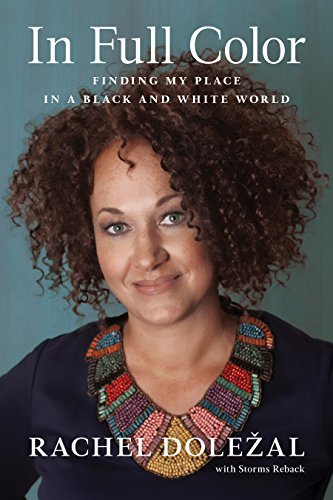
I want to be clear that this review is not of Dolezal’s actions (or inactions), her character, or the notion of racial identity. Rather, it is a review of two things: In Full Color’s literary merit and Dolezal’s accomplishment of (or failure to accomplish) her goals in publishing this memoir.
Most readers, I would imagine, approached this book with a curiosity of understanding why Dolezal could have acted in the way she did, rather than to find out who she is, as is the common goal of memoir reading. It’s a curious decision, then, for Dolezal to begin with story after story of her childhood which connects little, if at all, with her “racial identity.” To an audience already hostile and skeptical of her story, it was a bad choice to begin here. Even if true, her audience faces the conflict of abandoning her story, that reads falsely, before she even gets a chance to share her racial story. Simply, she relies on the sympathy card too much, and for an infamous character, her audience experiences the opposite emotion to her intended goal. We vilify her more for what has happened to her, rather than humanize her. Had I been her (or her editor) I would have considered starting with her siblings, as her experiences styling their hair seemed to be the spark that started Dolezal on her “path to identity.” If necessary, I then would have supported the said race story with her childhood.
Further, and more disturbing, Dolezal follows her childhood reflections with a loose comparison to slavery. If one of Dolezal’s goals was to make herself appear, or make herself revealed to be, less racist (and how could it not be?), it was disastrous to put herself in a position that so clearly highlighted her privilege and racist attitudes. Regardless of how horrible her childhood was, is it really a fair assertion to compare this experience to understanding slavery? Yes, her chores seemed outside of the normal range of childhood chores. Yes, if true, her parents were anything but kind. Yet, even at its worst, was her experience anything remotely close to slavery? Irrefutably no.
Once we got into the actual events that developed Dolezal’s racial identity, her story began to make more sense. She built a more logical argument and better explanations of her perception. Weaved within her story, Dolezal deposits other people’s thoughts on race, and explanations of racism and Black culture. For the credibility that Dolezal loses from her hostile audience, and from her own accidental admittance (like the instance above), she gains a bit back from her clear academic understanding of race. Dolezal paints herself as someone who hasn’t just stumbled on this life, but has wrestled with it. Whether or not this is an accurate image is up for discussion, but, for her part, she asserts herself well.
Yet still, she misunderstands her audience. As I’ve mentioned, we are not naturally warm to her. As a result, her tendency to paint herself as a martyr, and a victim, even if true, feels false. In seemingly each of her vignettes, Dolezal is unable to see from anyone else’s perspective. She is always in the right, and everyone else, in the wrong. Dolezal, throughout her testimony, is never able to shed her established image. Instead, she plays directly into all the negative judgements that have been projected on her. This, in my opinion, is her greatest downfall. In a “tell-all” the goal is to set the record straight. Yet by revealing her true self, Dolezal reveals almost exactly who’ve we always thought she was. Though it isn’t an entire failure. As I’ve mentioned, Dolezal does reveal herself as educated, and refutes many claims made by her parents in TV interviews. She just doesn’t do it enough.
While I am sympathetic to Dolezal’s perceived experience, and believe that in time we will revisit this topic of discussion in society, In Full Color simply didn’t push her agenda enough. It managed to assert her as a privileged white woman educated in Black culture, but still unable to avoid appropriation and other racist ideologies.
As for its merit, Dolezal writes well, but not incredibly. Overall, this is an okay memoir. The work has some organization issues and is much longer than it ever needed to be. But it’s still a decently composed memoir, it just doesn’t really add anything new to the genre.
The media, and all of us, should be slower to crucify people. Even though I disagree with her, I am glad I read this. Hearing from her at least gives us all a new perspective to consider in her case. It shouldn’t be blindly accepted, nor should we go easy on hard conversations, but it should be, at the very least, heard.