Short stories by science fiction authors about the role of the hard sciences in particular science fiction stories they have written. Essays by Heinlein (And He built a Crooked House), Leinster (Wabbler), Thomas (Weather Man), Silverberg (Artifact Business), Schmitz (Grandpa), Asimov (Not Final), Kornbluth (Little Black Bag), Latham (Blindness), Clarke (Take a Deep Breath), Vance (Potters of Firsk), Huxley (Tissue-Culture King).
Stories, works of noted British writer, scientist, and underwater explorer Sir Arthur Charles Clarke, include 2001: A Space Odyssey (1968).
This most important and influential figure in 20th century fiction spent the first half of his life in England and served in World War II as a radar operator before migrating to Ceylon in 1956. He co-created his best known novel and movie with the assistance of Stanley Kubrick.
Clarke, a graduate of King's College, London, obtained first class honours in physics and mathematics. He served as past chairman of the interplanetary society and as a member of the academy of astronautics, the royal astronomical society, and many other organizations.
He authored more than fifty books and won his numerous awards: the Kalinga prize of 1961, the American association for the advancement Westinghouse prize, the Bradford Washburn award, and the John W. Campbell award for his novel Rendezvous with Rama. Clarke also won the nebula award of the fiction of America in 1972, 1974 and 1979, the Hugo award of the world fiction convention in 1974 and 1980. In 1986, he stood as grand master of the fiction of America. The queen knighted him as the commander of the British Empire in 1989.
This collection is one of the most awesome I've ever read. Read it around 2000 and I've been looking for it ever since then. I particularly remember the house that was a cube within a cube within a cube within a cube that kept on folding on itself until it... I also remembered the medical bag that could do practically anything medical... I remember the one about the potters grinding virgin bones for colour yellow... And also the one about aliens turning off force fields on and off to sustain atmosphere in space... IF ANYONE KNOWS WHERE I CAN GET AN ELECTRONIC COPY OF THIS BOOK, PLEASE SHARE!!! Thank you...☺
UPDATE! February 29, 2020! Bought a copy from Abebooks! Almost pristine condition! Yesss! Thanks K, and other folks that suggested I check Abebooks. Thanks Abebooks!
Now to scan each page and keep in my cloud account for posterity. This book must NEVER get lost to history.
Arthur C. Clarke came up with a nice idea for a science-fiction anthology: one story for each of the sciences. So we have one for physics, one for biology, one for meteorology, etc.
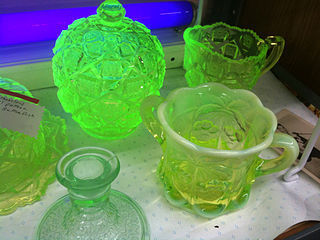
Most of the stories are quite good, or at least I thought so when I was in my early teens - I must have read the collection at least two or three times. The other day, I was reminded of the chemistry one, Jack Vance's The Potters of Firsk, when we saw a display of ouraline in the window of an antique shop here in Geneva. Everyone is aware that you can use uranium to make nuclear weapons. But it's less well known that it was originally used for coloring glass, a fact which turns out to be essential to Vance's clever little fable...
My favorite collection of Science Fiction stories is 'Time Probe: The Sciences in Science Fiction' introduced by Arthur C. Clarke published in 1966 and includes:
1. --And He Built a Crooked House by Robert A. Heinlein (Mathematics) 2. The Wabbler by Murray Leinster (Cybernetics) 3. The Weatherman by Theodore L. Thomas (Meteorology) 4. The Artifact Business by Robert Silverberg (Archaeology) 5. Grandpa by James H. Schmitz (Exobiology) 6. Not Final! by Isaac Asimov (Physics) 7. The Little Black Bag by Cyril Kornbluth (Medicine) 8. The Blindness by Philip Latham (Astronomy) 9. Take A Deep Breath by Arthur C. Clarke (Physiology) 10. The Potters of Firsk by Jack Vance (Chemistry) 11. The Tissure-Culture King by Julian Huxley (Biology)
My favorite; '---Crooked House'. A real live tesseract.
A delightful collection of stories from Sci-Fi's golden age, organized around a fun and interesting theme: scientific disciplines. Authors, both familiar and not, invite us along short; sometimes thought provoking (The Wabbler, Grandpa, The Blindness); sometimes exciting (Not Final!, The Little Black Bag, Take a Deep Breath); sometimes timeless (And He Built a Crooked House, The Weatherman, The Artifact Business, The Potters of Firsk); and sometimes disappointing (specifically I'm thinking of Julian Huxley's 1927 "The tissue culture king" replete with telepathy-proof tin foil hats) strolls through the avenues of the scientific method and how it could interact with the fabric of human life.
This was an awesome collection of short stories, each based around the theme of a particular field of science. It's an older collection but well worth it to find a copy. Every story is fascinating in its own way and very much worth exploring the science behind.
Arthur Clarke, mais conhecido pela história do filme “Uma Odisseia no Espaço”, preparou uma coletânea de histórias de ficção-científica reunindo os maiores nomes da época, e as organizou por área de conhecimento abordada, como, astronomia, medicina, arqueologia, etc.
O autor complementou a obra com uma saborosa apresentação de cada autor, situando-os no mundo da ficção científica e revelando suas impressões pessoais sobre eles.
Uma vantagem da ficção científica é que permite que questões filosóficas possam ser tratadas com menos restrições. E Arthur Clark se aproveitou disso na seleção dos contos.
Na ciência como na tecnologia não existe tal coisa como "a palavra final”. Arthur Clarke
Arthur C. Clarke, famoso autor de ficção científica (sendo sua obra mais conhecida "2001: Uma Odisséia no Espaço"), reúne aqui uma vasta gama de contos de sci-fi focados nas mais diversas ciências: física, química, biologia, medicina, astronomia... Clarke fez esta antologia na intenção de mostrar como a ficção cientifíca pode ser plural, juntando aqueles contos que, em sua opinião, são os melhores em suas próprias áreas. É interessante como ele nos apresenta cada autor e cada conto, e confesso que de 11 histórias, apenas 2 não capturaram tanto minha atenção. Do mais, é um livro excelente, pois nos mostra as várias ramificações do sci-fi, introduz novos temas para a época, e até mesmo prevê alguns acontecimentos que realmente ocorreram com o tempo (o que esse gênero faz diversas vezes). "A Sonda do Tempo" é um livro especial, único, e que merece ser conhecido e admirado, tanto por aqueles que não são familiarizados com a ficção científica, quanto por aqueles que já leram múltiplos autores. ⠀⠀⠀⠀⠀⠀⠀⠀⠀ Destaques pessoais: "A Maleta Preta", de Cyril Kornbluth, "As Experiências do Dr. Hascombe", de Julian Huxley, "...E Ele Construiu Uma Casa Torta", de Robert A. Heinlein, "Respire Fundo", de Arthur C. Clarke. ⠀⠀⠀⠀⠀⠀⠀⠀⠀ "O teste definitivo de qualquer história se faz quando é relida, de preferência após o lapso de alguns anos. Se for boa, a segunda leitura dará tanto prazer quanto a primeira. Se for excelente, a segunda leitura será mais saborosa. Se for uma obra-prima, melhorará a cada leitura."
Mais resenhas no instagram literário @livre_em_livros
An eclectic and interesting selection of well written short stories, each with a concise introduction which helps place the story in context with when it was written.