Honey bees get all the press, but the fascinating story of North America’s native bees—endangered species essential to our ecosystems and food supplies—is just as crucial. Through interviews with farmers, gardeners, scientists, and bee experts, Our Native Bees explores the importance of native bees and focuses on why they play a key role in gardening and agriculture. The people and stories are Paige Embry goes on a bee hunt with the world expert on the likely extinct Franklin’s bumble bee, raises blue orchard bees in her refrigerator, and learns about an organization that turns the out-of-play areas in golf courses into pollinator habitats. Our Native Bees is a fascinating, must-read for fans of natural history and science and anyone curious about bees.
My multi-year immersion into the lives of America’s native bees began with a gardening epiphany—European-import honey bees can’t pollinate tomatoes, but a variety of native bees can. This realization led to an obsession with native bees that cascaded into taking classes, wading through the scientific literature, raising bees, participating in bee science, modifying my garden, and trekking into fields and onto farms with bee experts to learn who America’s bees really are, and how they are faring. It also led to a book.
I've spent my adult life involved in science and nature. I tend to latch onto something and love it hard for a long time. I fell in love with geology in the very first geology class I took at Duke. Afterwards, I headed out to Montana to graduate school, a place where one can see the rocks so much better than in the deep south where they are so often covered in dirt and plants.
When I moved to Seattle I discovered gardening and fell in love with plants. After having a couple of kids, I started a garden design and coaching business. I've taught classes on geology, soils, gardening, and pruning. I started writing to promote the business, sending out monthly newsletters, and discovered the pleasure of writing and the power of story-telling. I've been surprised to find that my Georgia roots, which I thought were long-decayed, sneak into my writing. Despite living in Seattle for 25 years, when I write I hear the dropped g’s, slippery vowels, and soft, slurring rhythms that filled my childhood. This mid-life foray into writing has been an unexpected gift on many levels.
So, another local fauna book. This one is to assist in determining my planting plan.
After years of drought in California, I decided to reevaluate my open space, tiny as it is, and optimize for responsible resource use. That means planting things that don't require regular watering. I toughened up some of my plants and let the others die. Bye, roses. Good job, camellias. I do make small concessions to my fruit bearing citrus trees, but even they manage on limited water.
I have several hummingbirds who avail themselves of the fountain in my garden and fight over it. One made a nest in the pine tree right over it, and I hope there isn't a repeat of baby bird that I have to guard from the evil marauding neighbor's cat that roams until it hops up my orange tree to safety. Couldn't fly, but managed to flutter up a branch, rest for five to ten minutes and then do another. Meanwhile, I'm watching desperately wishing I could just stick it in the tree, but knowing better than to get involved especially since one of the parents was still cheerleading the little sucker.
But I digress, I'm presently in native pollinator spoiling/wooing mode. I've been optimizing for my hummers and trying to lure butterflies when it occurred to me that some bees would be a wise choice, so I picked this book to come up to speed with the basics and it was good. Generally insightful overview of the both the situation with native bees and European honeybees since they've been the default workers on farms. California produces >40% of the fruits and vegetables eaten in the U.S.; that's a lot of pollenating. Good discussions on habitat and the issues with various pesticides, which is more complicated than you might suspect.
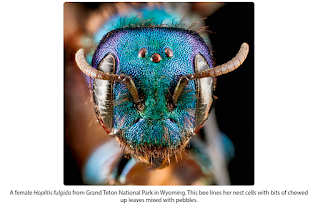
Some absolutely gorgeous pictures of the bees
And useful information like most native bees Don't Sting. Males can't and unless attacked, i.e. stepped on, then females don't either. In fact, there's a whole species called the Tickle Bee that doesn't at all!
I think the book did a good job for the average person to understand the importance of bees, the environment, and insects in general. What I really appreciate in an ebook and this one did it, clickable references--CLICKABLE! Takes you right to the paper. So disappointing when a medium doesn't utilize its advantages.
This book is SO IMPORTANT. I'm starting to get more and more into sustainability. How we as humanity can be good stewards of the land and natural resources so we don't kill the planet and starve ourselves out of existence. I'm honestly more concerned for the animals, plants and other natural things, because I am concerned that when we go, we're going to take everything else out with us. Which really isn't fair for everything else.
But I digress.
This book is SUPER important because bees. Because pollination is responsible for most of the food that we eat and most of the nutrients in it. Because honey bees are just the TIP of the iceberg when it comes to pollinators.
Did you know that North America has 4,000 different types of bees? Did you know that honey bees are a European import? Did you know that as pollinators, honey bees don't even come CLOSE to the native bees such as bumble bees? Did you know, that if we lost pollinators, we would basically all be in BIIIIIG trouble?
Yeah, me neither. But now I do. And I am TERRIFIED and also awed. Seriously, bees are that awesome? Most don't sting either. AND THEY HAVE TOES!!!! (sorry, lighting bug flashback! But it IS true.)
I don't want to go on and on and on about how great this book is, so I'm just going to tell you it is a 5 star and go get it, read it and do your part to help bees do their thing so we can keep on eating. :)
Only slight neg for the book, some of the pictures weren't very clear on my eReader, so I would probably recommend going "real" book route for this one. It's one you will probably want to reference more than once anyway, so worth the shelf space!
My thanks to NetGalley and Timber Press for an eARC copy of this book to read and review.
The book is structured as a series of essays with amazing photographs on various types of native bees, from Bombus to Ceratina. Embry travels to meet scientists studying and searching for bees around North America, while delving into each type of bee's habitat, behaviors, and the particular challenges in their conservation. I've done a fair amount of reading and research in this area, but there is always more to learn. Embry's discussion of some of the cleptoparasitic or "cuckoo" species that thieve their way into other bees' hives to either usurp or trick them into raising their own offspring was appreciated, as I didn't know that much about that practice before. While reading this book, I was able to attend a local lecture where we looked at dozens of native bee specimens under microscopes and magnifiers, and that heightened the experience even more.
As a biologist my first impressions of this book were two-fold: 1) I was thrilled to see a book on native bees, after honeybees have been hogging the spotlight for all these years, and 2) I was a bit skeptical that a non-biologist non-journalist was taking on this subject. But Paige Embry totally delivers with Our Native Bees. The format includes quite a few sidebars and lots of beautiful photos of bees and flowers, so it is a gorgeous book with lots of interest. Embry really follows her curiosity in the way of an investigative journalist, and each chapter reads like a really excellent long-form piece of journalism that you might find in National Geographic or the New Yorker. She addresses honeybees right off the bat in their own chapter, since they're the elephant in the room, then moves on to chapters on North American native bees. Her interest mostly arose from gardening, but her background is in geology and she has a scientific mind that follows the questions that bring out some really great stories about these species. The target audience for this book is really the public, I think anyone who is curious about nature and loves a good story will enjoy this book. I think even people who wouldn't call themselves naturalists would enjoy it, though obviously naturalists will love it. I was so surprised by how absorbed I got in this book! The issue of native bees is so important but has really been pushed to the back burner, and I am thrilled that this riveting book is out and is NOT BORING. Luckily Amazon seems to have an extensive preview on their site (pro tip: you can get longer previews if you click on the hard copy rather than the Kindle version!) so you can verify this for yourself.
Bees are SO INTERESTING. They are so complex and strange and alien, but they are everywhere. I hope that people find this book and really look at bees closely.
5/5 stars.
I am grateful to Netgalley and Workman Publishing for providing a free electronic copy of this book. My opinions are my own.
I wanted to read this book as soon as I saw it. I love nature and I love bees. The connection between earth’s diversity and bees has always intrigued me and this book seemed right up my street.
I really connected with the way this book is written. The writing is casual and does not assume prior knowledge. It is written in layman’s terms and anyone would be able to get on with this book. It is beautiful images of all sorts of bees and other insects.
The author’s love for bees shines through and as her knowledge of bees grows, so does ours. It made me want to keep a closer eye on the bees that zoom about in my garden (on a different continent).
This book looks at the efforts it takes to grow some of the foods that end up on your table and how bees are connected to them. It also touches on how you could improve your world to be a better place for bees to be. Also, I never knew that there were so many different types of bee.
I thoroughly enjoyed this book and I will be looking to get a physical copy when it is published in January 2018, partly to take a better look at those gorgeous photographs.
* Read as an e-book courtesy of the publisher via NetGalley*
A lot of the nonfiction I read is political, so sometimes it’s nice to just read about bees. Especially when you can tell how much fun the author is having. Embry really loves bees.
I also like that she doesn’t create an unnecessary divide between “wild” and “civilization.” She talks about a farm that simply doesn’t weed between rows of crops, providing bees with more variety in diet. She talks about a golf course that composts to reduce chemical nitrogen use.
Her overarching point seems to be: there are simple and effective ways to support wildlife, including wild bees. And stewardship arguments aside, humans often materially benefit from doing so.
This is a fascinating look at a subject I’d never thought to explore. It’s oddly endearing, and a good reminder of the beauty and complexity in nature. I suddenly feel like beekeeping. From my apartment. In January. I guess you could say I get what all the buzz is about. I’ll see myself out.
My fascination with bees dates back to my childhood. My mother's family were gardeners and my mother lavished special garden-love on pollinators. Thus, I was lucky to have seen a variety of bees that were not the common honeybee from an early age. My favorites were the leafcutter bees, neatly excising circles from rose leaves, flying away laden with their prizes. I could spend hours watching bees zoom around our garden, getting steadily more loaded with pollen. I remember declaring at age eleven that I wanted to have my own beehive (scoffed at by my father due to my bee sting allergy issues) but it wasn't until much later that I realized most of my favorite bees were actually solitary ones. I was lucky to have seen a variety of native bees that were not the common honeybee. But sadly in recent years they've been harder to find.
In the past decade we've also seen conflicting reasons given for the sudden disappearance or die-off of millions of honeybees that we need to pollinate our country's food crops. Actual causality (pesticides, viruses, parasites, cell phones, global warming) has been confusing, contradictory and has often been minimized. What has become clear is that honeybees cannot be the sole pollinator we rely on. Indeed, before the era of industrial farming, plants like apples, pears, blueberries and potatoes, relied on solitary bees and bumblebees as common pollinators. You've likely seen bumblebees but may wonder about solitary bees? Unlike eusocial honeybees (which produce honey and beeswax for their hives) and bumblebees which live in large hive colonies with well-organized jobs, solitary bees form solitary smaller communities. They are some of the bees you are used to seeing in your garden if you have pollen-producing plants. They are part of the class of native bees and a good guidebook on bees (I like the 2015 edition of The Bees in Your Backyard: A Guide to North America's Bees by Wilson and Carril) will help you start to learn to distinguish them. This book will help you sustain your native bee population and it's a wonderful resource for the bee lover.
Native bees, which include everything from mason or orchard bees to leafcutter bees (which have provided me with my most vivid childhood memories of gardening) to the bunchy and buzzy bumblebee, can provide vital relief for the stressed honeybee population. But only if we feed them, manage our gardens in a way that supports them, and provide them with the shelter they need. Am I telling you this book is all about how to have more bees in your garden? You bet! One of the best things about native bees is that unlike the honeybee population they are seldom if ever aggressive. They even include a class called stingless bees! These are bees that you want to promote in your garden but you definitely have to know how to do so. It's more than just planting bee balm, borage, and sunflowers!
This book describes how gardening and mechanized farming practices have changed over the past century, and where this has harmed or stressed the native bee population. This isn't just a story about large-scale farming being a bad thing. It can be as simple an issue as how you handle things in your own backyard. For instance, I have wild blueberry bushes growing at my home in New Hampshire. Every other year these bushes were getting pruned or even mowed to the ground, to foster the new growth required to produce new berries. However, it turns out that the older practice of burning back the bushes in small patches fostered better conditions for the wild bees that pollinate the blueberries. Pollen from genetically diverse blueberry plants is a requirement for production of fruit and we've been seeing less and less fruit in recent years in my yard. It turns out that many of the blueberry pollinators are tiny bees that have no internal temperature regulation. The blackened earth from burning back absorbs more radiant heat on cooler days and is helpful for the tiny blueberry bees. While bees like the scorched earth they won't travel far from, however. So burning a wide swath all at once removes what the bees need to survive in your blueberry patch- a nearby plant and some dark, warm earth. Our Native Bees is filled throughout with such details. It will help your fruit and vegetable production and help your bee population. I strongly recommend this book for anyone who gardens for vegetables, fruits or even flowers.
I received a Digital Review Copy of this book in exchange for an honest review, but I bought this book the minute it released.
Our Native Bees is a fascinating book about Native American bees. I was afraid Our Native Bees would cover information I already knew, especially when it started off talking about honey bees. However, as the book went on I learned all kinds of interesting stuff about native bees. It's amazing how many varieties there are and how much they accomplish. I am not a scientist, but it seemed very well researched to me.
One of my favorite parts was this quote about honey bees:
Honey bees are the bankers of the bee world, working short hours and taking all the holidays off. If it’s raining, they go home. Too cold? They don’t even leave the hive. [Blue orchard bees] BOBs, on the other hand, start flying as soon as their body temperature warms up to 54 degrees F, so the ambient temperature can be considerably less if it’s a sunny day. Now, bumble bees will fly in bad weather, but their prime season comes later in the year. In early spring with the BOBs first come out, the only bumble bees alive and possibly out gathering are last year’s queens-to-be, and there aren’t going to be enough of them to pollinate an orchard (p. 64 of the advance reader copy)
Highly recommended for those interested in bees, insects, the environment, and wildlife.
I read an advance reader copy of Our Native Bees. I had some trouble reading it, as it was in PDF format and I could not increase the tiny font size on my Kobo reader. It also expired before I finished it and I lost all the notes I had been making. I look forward to seeing the actual book and admiring the many bee photos in color instead of black and white.
I picked this book up on a whim at the library and I'm so glad I did! I usually don't read many nature books as I find them dry and boring. This book is not boring. In addition to this being a highly readable book, it has so much practical information. I would find myself reading a chapter, mulling it over, and then head out to my garden to take a look at the bees visiting my flowers. The author also has me seeing yard and garden management in a new way. I have left the clover in my lawn and I'm not as quick to weed out the long grasses that grow up in my flower bed. I now also am not bothered by bare dirt patches and have planned my flower plantings so that there is always something blooming. I have taken some grief for this "untidiness" from a neighbor but I would much rather spend my time with bees than win points with crabby people.
I definitely enjoyed this book and learned a great deal more about bees than I already knew. However, as sometimes happens with nature books, I already some of what is in the book, having seen talks by Sam Droege, as well as having an entomologist as a boss. That said, it was still a great book and well written. I loved the pictures, many of which appear to have been taken by Sam Droege. I would recommend this book for anyone who knows little about bees and is curious to find out just how diverse they are.
Some things I loved learning in the book:
She makes a great point that agriculture used to be so much more diverse in structure and habitat, including, hay fields for horses, wood lots for firewood and game and often weedy margins that separated small fields of multiple crop types. In the past 50 years with tractors, fertilizer, and pesticides, most of that structural and habitat diversity has been turned into massive monoculture fields that decimate whatever diversity was once found on farms. The ecological impacts of this must extend to more than bees. I had known that monoculture agriculture was terrible, but I had never considered just how diverse older farms used to be.
I found it interesting to learn the history of pesticide use in spruce forests. I found it fascinating that they spent something like 30 years battling budworm with pesticides and had they just let the budworm population explode and die off, the plague of budworms would probably have ended in 5 years. Meanwhile they did decades of intense damage do habitat in what seemed like a losing battle in the end. Sometimes it is better to let nature have its way I guess. I kind of feel like this with sea level rise. We can let the ocean take what it wants, or we can spend billions of dollars destroying marshes and dunes while only delaying the inevitable.
I will admit that this book made me consider raising bees, though I worry that there isn't enough pollen habitat around me to be effective.
I actually didn't know anything about the cleptoparasites so learning about their life cycle was fascinating.
I also like how she brought up the severe lack of taxonomists, to the point where there are only a handful of people in the world who know enough about bees to identify the really tricky and uncommon ones. This lack of specialists has severe consequences for anyone attempting conservation. There are so many things that are little known and unobserved that it is likely species are going extinct without anyone noticing.
Lastly I love how she brought up diversifying lawns. This is something of a pet project for me as I have noticed that there are actually many native species that grow hidden in lawns in our region. I honestly think it would only take slightly longer lawns and well timed mowing regimes to make one of the most boring monocultures into a beautiful garden of life.
I've considered myself a gardener and with that comes concern for pollinators, bees included, and so I plant considering what draws and support pollinators. But I an not the bee geek that Paige Embry is. She states:
hope is that after reading this book people will be so entranced by bees that they’ll throw away their weed-n-feed and plant flowers in the lawn. I’ve traveled to farms, labs, and even golf courses hunting for the best bee stories. At the same time, I’ve worked to become a bit of a local bee nerd. I’ve spent hours helping on a local bee survey. I’ve taken bee identification classes. I’ve modified my garden, ordered bees online, and wandered around the city eyeing bees at work to see what plants Seattle’s bees really like.
It is because Embry is a bee nerd and that she has the ability to tell an interesting story that her book was so entertaining to me, for there is nothing like being entertained and educated simultaneously.
While acknowledging the importance of honey bees in food production, Embry explains that native pollinators are crucial to food production as well. For instance did you realize that honey bees do not account for the pollination of the garden favorite tomato? Tomatoes need buzzing to pollinate and honey bees do not buzz. What? I did not know that, but I did know that a large black bee loved my tomato blossoms and took a cruise through every afternoon last summer. She may well have been a mason bee and I would like to give her a special thanks. Maybe a house or two is in order.
There is so much information packed into this book in an exciting way and loads of bee pictures that if this tickles your fancy (and did you know there is a tickle bee?) , that I encourage you to pick up a copy and read it.
One of the things that I rarely see in reviews of non-fiction books, let alone non-fiction books about animals, are the words "I couldn't put it down." Nevertheless, I truly couldn't put this book down the moment I began reading it. Every page was full of information that was utterly new to me, passionate writing, and a sense of humor and delight that was infectious. I began this book hoping to learn about bees - I finished this book not only full of new bee knowledge, but also thoroughly invigorated to do what I can to help their populations.
Luckily I've already two acres of yard full of clover.
The book is an information powerhouse on it own, but also includes a bibliography I devoured at the end. I hope the author continues in the ranks of "bee enthusiasts" and writes more on the subject in the future. Her writing style is wonderfully addictive, and the subject one that is shockingly uncommon.
Pros: - bees!!! - so many cute bee photos. Like there is one bumble bee that is SO ROUND - a good exploration of what sort of initiatives there are in the US for promoting native pollinators, as well as what’s going on with honey bees - there is a ton of good info also about the study and identification of bees - I’m low key obsessed with blue orchard bees now
Cons: - despite the title, this is less an overview of North American bees broadly, and more case studies of people looking after/looking to use/looking for native pollinator species - there are a lot of anecdotes about the author’s children finding her weird. The amount of time she spends talking about how weirdly bee obsessed she is makes me think it’s not the bees that are the issue
Overall: Some good info in here, but more about people than bees it feels like. Definitely worth a read if you’re interested in conservation efforts, maybe try a different book if you’re looking for just some pure, good bee facts (hey did you know that only female bees have stingers?)
This book was a pleasure to read. The author writes as if she is talking to you and the information between these pages, all that you can learn about bees, is truly mesmerizing. Did you know that honey bees are not native to North America ? Or that honey bees cannot pollinate tomatoes, they require a special type of pollination called 'buzz pollination' that honey bees cannot do ? And did you know that some bees build chimneys or turrets as their nest entrances ? I was also introduced to The Great Sunflower Project. Anyone can join this group and collect data on pollinators in their yards, gardens, schools and parks. Once you read this book, you will never look at bees the same way.
Quite a fine read! Definitely a great entry to learning more about bees’ role in the ecosystem and their diversity. There were many sections I was not fond of, with the author gabbing on about ideas or metaphors that hardly pertain to the “bee narrative”.
A large gripe I have with the book is the lack of common names and images/descriptions for the plethora of bees mentioned. Many sections have the scientific name of 5 bees mentioned, but truly means nothing to the reader if I cannot somehow relate to the species without pulling my phone out or waiting 5 pages for an image.
I absolutely loved this book. Written by a self-proclaimed ‘bee-enthusiast’, its full of humor and wonder and a sense of reality that can sometimes be lacking in more scientific-focused books. I found myself laughing and re-reading sentences or entire sections out loud to my partner, often ending in “Wow, that’s nuts!”. Of course, it is full of science and interviews and research projects and plenty of resources for those who desire to dig deeper in the topic, or follow one of the many branches of interest that surround bees and pollinations.
The accompanying photography and side panels were amazing, literally dazzling. I have never seen such a collection of beautiful bee portraits- easily my favorite feature of the book.
I want to share this book with my gardening mother, my organic farmer brother, my college entomology professor, and my volunteer-seeking friends. I hope when you read it, you’ll pass it along, too!
I quite enjoyed Paige Embry's book about our native bees. It covered a gamut of breads, their diversity and the challenges they face from numerous aspects. And the color photographs are just amazing. I will look at the bees in our garden with a new perspective.
Bee lovers are set for life. There are so many native varieties and we know so very little about them, that anyone interested can devote a lifetime to learning, and teaching the rest of us. Pretty much anyone can add to the knowledge base, just by observing and reporting. Our Native Bees is a voyage of discovery rather than a science book. Lots of great photos right where you need them, too.
Bees are not just hive residents; that’s a honeybee trait. And honeybees are European imports. Native bees seem to be mostly solitary and earth/hole dwellers. They come in a blizzard of colors and sizes, from smaller than grain of rice to a full inch. They have unique properties and habits, and have peculiarities and preferences in climate, foods and child rearing. There are four thousand native species of bee and 20,000 worldwide. Typically, we can name a handful at best.
We depend on the Paige Embrys of the world to catalog it all, because bees are just not a zoological priority for scientists. Embry says bees have broken her out of her own introspective cocoon, and this book has forced her to fly and drive far to meet the bee-loving celebrities and experts. Her enthusiasm is genuine and infectious. She has learned a ton, and is sharing it. On the other hand, she is clearly obsessive.
Bees are beset by all kinds of problems, not all of them manmade, though the manmade ones are truly unfortunate. Monocultures mean bees only get food while that one pant blooms. The rest of the year is a famine. Golf courses and manicured lawns are no help either, though the pesticide maker Syngenta is working with golf courses to line them with natural greenery outside the playing area. Pesticides don’t select to save bees, and we overspray something fierce. We need to just ease up and share the planet a little. It will pay huge dividends. The alternative is a well-known and predicted disaster for our food sources.
Not some dry natural history book, but rather the author's exploration of native bees, with many personal anecdotes.
For many years, I didn't THINK about bees...there were honey bees, bumble bees, and wasps, and I mostly avoided them. Then, 10 years ago, we moved to our current home and I saw what looked like little black honey bees on the flowers around the patio. When I looked online, I discovered that they were probably mason bees, and that they wouldn't sting me, so I began watching them more closely. I also discovered beautiful iridescent green bees, and that bumble bees came in many different sizes...and suddenly I was interested in bees! Soon I had a bee house, and was gardening not just for the hummingbirds and butterflies, but also for the bees. I was excited to see this title announced, and really enjoyed reading it. There are wonderful illustrations, and enough scientific information for a layperson like myself, with fascinating personal anecdotes of the author's discoveries of various native bees and the scientists and agriculturalists who study them. Highly recommended!
A terribly lovely read, with the cutest bee photos! I feel much more connected to the natural world around me after reading this. It was a quick read but enjoyable and informative (I took some notes). I even spotted a bee I haven't before, after finishing this book. Bee magic!
An excellent book on bees, Embry examines many aspects of their lifestyles, highlighting important species in each chapter. Numerous excellent photos of the various species.
The non-native European Honey Bee (Apis mellifera) is the most widely known bee, used for both honey production and pollination. Typically, 1.7 million hives are brought to California each year to pollinate the almond trees. The biggest step to modern-day beekeeping happened when Lorenzo Lorrain Langstroth invented the movable frame hive. The rental of hives for pollination goes back to 1920. The author examines the evidence for Colony collapse Disorder (CCD) and the decline of honey bees, buts finds much contradictory material. In Mexico, the Mayans used stingless honey bees (Melipona beecheii) to produce honey. They called the bees "xunan kab", royal lady bees, and considered them a gift of the gods.
Bumble bees are colonial with the queen hatching the first workers in the spring. Some syrphid flies look like bumble bees but have very short antennae and the rear legs are scrawnier that those of the bumble bee which store pollen. Bumble bees are the pre-eminent pollinators of tomatoes, because they, unlike honey bees, are capable of buzz pollination necessary to shake the pollen out of the tiny holes in the anthers. As late as 1987, Roland de Jonghe discovered how to raise bumble bees for the purpose of tomato pollination, replacing earlier manual-intensive methods. In the 1990's, bumble bee queens were sent to be raised in Europe, but on their return the populations of wild American species declined rapidly. It has been suggested that the farmed bees picked up a disease which they brought from Europe to America.
Blue orchard bees (Osmia lignaria), also known as orchard mason bees or BOB's, are great pollinators of early spring fruit trees as they are active at colder temperatures than either honey bees or bumble bees. An acre of fruit trees that requires one or two honey bee hives (with 20,000 or more bees per hive) can be pollinated by 250 to 750 female BOBs. In poor years, BOB's provide better yields than do honey bees. Some fruit growers are cultivating the solitary BOB's by providing suitable nesting boxes and mud, and collecting ans cleaning the cocoons each year. The non-native leaf-cutting bees (Megachile) cut pieces of leaves to line their egg cells. Related are the wool carder bees (Anthidium) which shave the hairs of plants such as lamb's wool (Stachys) to make a nest for each egg.
Blueberries are a major crop in Maine and neighbouring Canada. The wild blueberry (Vaccinium angustifolium) is different from the supermarket blueberries which are from cultivars of the highbush blueberry (V. corymbosum). Blueberry pollen must be shaken off the anthers, a task that certain native bees perform. The Maine blueberry bee, Osmia atriventris, drums the anthers with its forelegs. Bumble bees use their flight muscles to buzz pollinate blueberries. Other important pollinators are various species of miner bee (Andrena). The spraying of forests with insecticides to control spruce budworm has resulted in a decline in the native bee population.
For a farm to get pollination from wild bees, it needs adequate amounts and a variety of both flowers and nest sites—all within the flight ranges of the bees.
Some bees are parasites on other bee species, generally termed cleptoparasites as some species actually kill the queen and take over her nest.
Embry describes how lawns, apparently barren on their own, can become excellent environments for bees and other insects if they become ingrown with clover and dandelions. Once clover makes up about thirty percent of a grassy area, it supplies most of the nitrogen the grass needs. A study in Kentucky found twelve bee species as well as ten species of other pollinators on clover, and twenty bee species and five other pollinators on dandelions. Bee lawns have been made of fescue, self heal, creeping thyme and Dutch white clover. Each flower species attracts a different set of bee species. Operation Pollinator has been working with gold courses to establish meadows in unused areas to encourage bees.
"Native bees are the poor step-children of the bee world. Honeybees get all the press, the books, the movie deals; and they aren't even from around here."
This book drops home the reality that honeybees as we understand them are NOT native to the Americas in the first place and this may be one of the reasons why these favored honey-makers struggle so hard to survive. They are naturalized though. These pollinators have been massively helpful and should not be considered invasive. Honeybees ARE under threat, but in many ways the NATIVE pollinator species are at an even greater risk and should warrant far more of our attention. And yet folks know very little about them.
There are over 4000+ other species of bees other than honeybees, let alone birds, bats, moths, small animals, and other bugs which also operate as crucial pollinators. Some of which are far more efficient either in specialty pollination, or in quantity. Especially because most honeybees don't fly in cold temperatures. The only major difference is that few of these species produce honey. Thus, many native species have been shunted to the side due to their perceived "uselessness" to humans. But pollination itself alone is vital to human food supplies and should not be so easily dismissed.
Managed honeybee hives have declined by 50 percent while big agriculture land has doubled. But despite their supposedly hard work ethic, honeybees can only usually accomplish a small portion of the work that is actually done by native species such as squash bees, bumblebees, and mason bees (not to mention all the other pollinator species mentioned earlier).
The company based out of Woodenville, WA called "Crown Bees" is a prime example. Rather than working with honeybees, this company promotes the hardy Blue Orchard Bee, or BOB for short. These native bees fly earlier in the season even during cold PNW Spring temperatures, making them prime pollinators for early blooming fruit trees across the state. As a result, the trees are thoroughly pollinated at the crucial time with at least half the number of honeybees it would take to accomplish the job.
Most folks don't know that bumblebees are the ONLY ones who can properly pollinate tomatoes due to their unique "buzz pollination" technique which honeybees physically can't do. Unfortunately some species, like the Franklin's bumblebee are suspected to be already extremely endangered, if not already extinct, but it's status is still under review. Researchers have failed to record any in the last few years.
Obviously our understanding of and concern for vital pollinators needs to be expanded.
More than that, it's time to change the things we as a society value. One small example of which is the detrimental food deserts created by our society's obsession with monocultural grass lawns.Researchers Marla Spivak and Mary Meyer, from the University of Minnesota have initiated research into "Bee Lawns" - traditional lawns composed of pollinator friendly plants rather than harmful grass monocultures that actually help, rather than hinder, pollinators' search for food. So far, Dutch white clover, self-heal (native), and creeping thyme are all strong candidates for this new style of lawn. And in fact, something not mentioned by the text is that each of those three plants is also medicinal in some way or other towards humans.
Since we can't eat grass anyway (and yet, plants are VITAL to our health), let's take the step and start valuing truly organic and diverse natural spaces. Let's start caring about the land and pollinators, because in doing so, we will also reclaim our own health.
An absolutely fascinating book about the bees that are native to North America, the threats they face, and what can be done to keep them from disappearing - loaded with gorgeous photos.
I've been following stories about bees and their decline for years, but Our Native Bees made it clear that most of what we read about bees is a bit misleading. There are literally thousands of different species of bees. The best-known, honeybees, are European imports. While their work as pollinators and their recent colony collapse problems are widely reported, the author describes those that are native to North America and how some of them are actually much harder-working and better pollinators than European honeybees. She also details how some farmers are experimenting with native bees to replace their temperamental counterparts (European bees don't like cold or rain and are a little lazy compared to some native bees).
Author Paige Embry describes her research with a marvelous sense of humor and in easily digested prose. While she does use the scientific names for the bees (there are so many it would be impossible to do otherwise), you don't have to have any kind of a science background to follow her storytelling. I was particularly fascinated with the story of a particular bee that was part of a natural cycle that worked well until poison was injected into the mix. The bees brought a worm that attacked the trees they pollinated. The trees would then become sick or die and the next stage in the cycle was fire. After fire burned down the forests and the trees grew back, the bees appeared and brought back the worms. While it sounds like the bees were a nuisance to the forest, the cycle was completely natural and a success. Poison didn't so much save the forest as interrupt the cycle and screw everything up.
Because the author has such a delightful sense of humor, I found myself smiling a lot. If you have the slightest interest in bees, you should read this book. You will be amused, enraptured, sometimes horrified (at the lack of funds dedicated to the study of bees, the fact that bees actually have to be brought in to pollinate certain crops and there still may not be enough of them, the use of poison where nature sufficed, etc.) but always entertained.
I recently finished the book, “What a Bee Knows” by Stephen L. Buchmann. I really liked it because the author described native species from his research that I never knew existed. He went into specifics about their lives/behavior. I am a relative newcomer to pollinators. I am familiar with the popular honey bee. There seems to be a lot out there about them. But, I want to learn more about our native bees in North America. (The honey bees are all introduced species in North America.)
This book was very good. It was different from "What a Bee Knows", which was good. It gave a different person's perspective. It described some of the native bees of North America and how researchers are trying to find out more about them. In some cases, our native bees can pollinate our crops better than trucking in honey bees. But, native bees need places to live and raise young.
I will be searching for more on bees and other pollinators. And, when spring comes (I am writing this in January in Northeast Ohio), I will be out in the local parks searching for pollinators. (I enter the observations /photos on iNaturalist.)