Actor Michelle Pfeiffer. Humorist Garrison Keillor. Actor Joaquin Phoenix. Musician Lisa Marie Presley. Actress Glenn Close. WikiLeaks founder Julian Assange. Actress Rose McGowan. Each of these well-known people has more than fame in common; each was born or raised in a cult.
We think of cults as bizarre, inexplicable, or otherworldly places that only strange people inhabit, but cults and other abusive and high-demand groups (and relationships) are actually quite commonplace. In fact, the behaviors, social pressures, and authoritarian structures that create cults exist to a greater or lesser extent in every human relationship and every human group. Cult behavior is human behavior – and by studying cults, we can learn remarkably useful things about the social world and our place in it
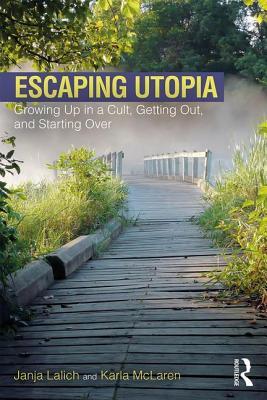
In the first in-depth research of its kind, sociologist and cult expert Janja Lalich interviewed sixty-five people who were born in or grew up in thirty-nine different cultic groups spanning more than a dozen countries. What’s especially interesting about these individuals is that they each left the cult on their own, without outside help or internal support. In Escaping Utopia: Growing Up in a Cult, Getting Out, and Starting Over, Lalich and award-winning author (and fellow cult survivor) Karla McLaren craft Lalich’s original and groundbreaking research into an accessible and engaging book, the first of its kind focusing on this particular population. Lalich and McLaren explore fundamental questions about human nature, human development, group dynamics, abuse and control, and triumphs of the human spirit in the face of intense and extended suffering.
In Escaping Utopia: Growing Up in a Cult, authors Janja Lalich and Karla McLaren interview individuals who were raised in religious and political cults, regarding their childhood experiences of extreme abuse and neglect, and their efforts to escape and recover.
Lalich and McLaren assert that cults typically possess four conditions including (1) charismatic authority figure, (2) transcendent belief system, (3) system of control, (4) system of influence.
Lalich and McLaren posit that every successful social group utilizes some or all of these dimensions to engage and energize people, but cults use these four specific dimensions to bring lure, entrap, manipulate and control people.
NOTE: by Lalich and McLaren’s definition, any narcissistically abusive, closed high demand groups or systems (CHDG) can engender cult like abuses.
This can include: narcissistically abusive relationships and families, certain therapeutic communities, quasi religious organizations like AA, and can even include CHDG corporate environments such as MLM scams and high performance evaluative corporate structures like Enron.
Cult abuses are bad news for anyone.
But they particularly damaging to children.
This book is quite good.
It will be particularly useful for survivors and clinicians working with survivors of these, or similar circumstances.
5/5 stars ⭐️
UPDATE: I initially gave this book a 4/5, but I upon reflection I’m giving it 5/5 stars ⭐️.
The interviews of actual child survivors of cult abuse (including former members of Hindu, fundamentalist Christian, and East Asian cults) are PRICELESS (for both survivors and clinicians).
If you’re a survivor.
You’re not alone.
This book will be a GREAT resource.
Some other great read on this (and related) topics are:
Traumatic Narcissism, Relational Systems of Subjugation by Daniel Shaw - It’s more theoretical, but also great.
The Alchemy of Wolves and Sheep: A Relational Approach to Internalized Perpetration in Complex Trauma Survivors by Harvey L. Schwartz - it’s about child soldiers, but contains similar insights on the effects of abduction, indoctrination and coercive control on children.
I listened to quite a bit of this before hitting the eject button. I was impressed by her interview on A Little Bit Culty and expected deep insights from this book.
My overall impression, based on that old comparison to the body, is that it has way too much fat, some flesh, and barely any bones. She’s a survivor of a leftist Marxist organization, a professor emeritus, and expert in this field, and uses her expertise in consulting as well as academia. I had been expecting a book with lots of strong bones in terms of technical information, some “sexy” flesh as human experience, fascia to connect it all together, and little fat for personal oomph, so I may be that my expectations were off.
I’m no expert, but I’ve read a few books about cults and found this to be very, very basic and slow. I’ll try her other book mentioned on the podcast next. If that one wows me, I’ll come back and give this one another try.
I was able to attend a group session with the author, and immediately listened to her book. I love that it's called “Escaping Utopia,” because the members of cults always think they are in Utopia, the ultimate and best place to be, but it can end up being a place of torture and hell for the members. I loved being able to hear all of these stories, and as somebody on the road to recovery from a cult, I wish these people health and healing moving forward. It's a beautiful world outside the group!
Escaping Utopia brings us a series of interviews of those who were raised in religious and political cults, covering the ways they grew up, their escape, and how they are acclimating to the world post-cult. The authors start with some basic background on what constitutes a cult- (1) charismatic authority figure, (2) transcendent belief system, (3) system of control, (4) system of influence, and several of the ways in which cults thrive. I really enjoyed how in-depth some of the interviews went and while some of the experiences are hard to hear (tw for child abuse, rape, trauma), the experience of being able to tell your story was likely incredibly beneficial to the survivors. My largest critique is that outside of the interviews, this reads a lot like a research paper and doesn’t have a lot of depth to it. I didn’t find myself captivated in the between sections but did want to keep hearing from the interviewees.
This nonfiction book focuses on a number of former cult members, who were either born into a cult or whose parents joined when they were children. The 65 individuals left the cult on their own with no internal support or outside help. It looks at their struggle to heal and find support from therapists who really understand what they had been through.
The clearest breakdown of cult structure that I've read and possibly the most useful. Even if you've never been inside a cult, or even cult adjacent, there's so much here that's useful for identifying and confronting unhealthy social dynamics within an organization. Political groups, fundamentalist churches, therapists, self-help organizations, even martial arts dojos all have tipped into unhealthy cultic behavior, and all of them share many of the elements described in this book. Incredibly useful resource.
After reading a book a while back about Jim Jones and the People's Temple, I've had a weird fascination with cults. This was a really interesting book that talks about the definition and attributes of a cult as well survivor stories. I was amazed at all the similarities from completely different cults. I've always thought that cults were just religious, but in this book I learned that cults can be a business, political group, or really any group that fits within this definition:
"A cult is a group or relationship that stifles individuality and critical thinking, requires intense commitment and obedience to a person and/or an ideology, and restricts or eliminates personal autonomy in favor of the cult's worldview and the leader's wants and needs."
This book was well researched and interesting to read. Some of the survivor stories were difficult to read because of the awful things they had been through, but it was amazing to see their transformations after leaving and being able to heal.
A well researched work to help anyone understand what survivors go through when getting out of a cult and the kind of help they might need. The authors give perspective and first hand accounts of survivors. This book may also be helpful for anyone who thinks they may have been influenced by a cult, as it goes through specific criteria unique to cult behavior. The authors are also careful to indicate a group or organization having a few criteria does not automatically make it a cult. They are very detailed and thorough in their exploration. As a future counselor this is a book I want to own a paper copy of so that I can tab pages. A good resource for survivors and those who care for them.
This is a strong book on what it's like to grow up in and escape from a cultic group. I like Lalich's model for the most part (though I think Lifton's is actually a better model of understanding cults) and really resonated with the way that she mixed in personal accounts from survivors along with her more academic approach. She also did an excellent job of noting when she was speaking from personal experience vs. when she was speaking about knowledge gleaned through her research.
This was a compelling listen, and I appreciated the (somewhat formulaic) structure designed to help people consider whether groups in their life are embodying any of the extreme & negative versions of the 4 aspects that constitute a "cult", how to try to address them if they are less extreme, and how to look for other groups/institutions that can provide beneficial versions.
This book discusses the various experiences of people who grew up in different cults. There are personal statements from six different people about rules, experiences, and life in and out of the cult they grew up in. This isn't about one specific cult, but features several different ones, such as the Children of God and others. It was a pretty short listen, and I finished it in one day at work.
Welp. The day you realize you grew up in a cult is quite a day. Listening to these stories was genuinely helpful! I would recommend it for anyone (especially those born on) processing their cult experience.
Probably should have DNF'd, knew this would be a three star from the beginning. Struggle to understand who this is actually written for, but interesting none the less.
An audiobook about cults, how people are influenced to join, stay and then find it so hard to leave (and when they do, the difficulties faced to live in the "outside" world).