

What do you think?

The Witch: A History of Fear, from Ancient Times to the Present
Why have societies all across the world feared witchcraft? This book delves deeply into its context, beliefs, and origins in Europe’s history
"Traces the idea of witches far beyond the Salem witch trials to beliefs and attitudes about witches around the world throughout history.”—Los Angeles Times
The witch came to prominence—and often a painful death—in early modern Europe, yet her origins are much more geographically diverse and historically deep. In this landmark book, Ronald Hutton traces witchcraft from the ancient world to the early-modern stake.
This book sets the notorious European witch trials in the widest and deepest possible perspective and traces the major historiographical developments of witchcraft. Hutton, a renowned expert on ancient, medieval, and modern paganism and witchcraft beliefs, combines Anglo-American and continental scholarly approaches to examine attitudes on witchcraft and the treatment of suspected witches across the world, including in Africa, the Middle East, South Asia, Australia, and North and South America, and from ancient pagan times to current interpretations. His fresh anthropological and ethnographical approach focuses on cultural inheritance and change while considering shamanism, folk religion, the range of witch trials, and how the fear of witchcraft might be eradicated.
"Traces the idea of witches far beyond the Salem witch trials to beliefs and attitudes about witches around the world throughout history.”—Los Angeles Times
The witch came to prominence—and often a painful death—in early modern Europe, yet her origins are much more geographically diverse and historically deep. In this landmark book, Ronald Hutton traces witchcraft from the ancient world to the early-modern stake.
This book sets the notorious European witch trials in the widest and deepest possible perspective and traces the major historiographical developments of witchcraft. Hutton, a renowned expert on ancient, medieval, and modern paganism and witchcraft beliefs, combines Anglo-American and continental scholarly approaches to examine attitudes on witchcraft and the treatment of suspected witches across the world, including in Africa, the Middle East, South Asia, Australia, and North and South America, and from ancient pagan times to current interpretations. His fresh anthropological and ethnographical approach focuses on cultural inheritance and change while considering shamanism, folk religion, the range of witch trials, and how the fear of witchcraft might be eradicated.
360 pages, Hardcover
First published September 5, 2017
About the author
Ronald Hutton
52 books556 followersRonald Hutton (born 1953) is an English historian who specializes in the study of Early Modern Britain, British folklore, pre-Christian religion and contemporary Paganism. A professor of history at the University of Bristol, Hutton has published fourteen books and has appeared on British television and radio.
Ratings & Reviews
Friends & Following
Create a free account to discover what your friends think of this book!
Community Reviews
Displaying 1 - 30 of 325 reviews

August 26, 2017
I teach a class on Witchcraft and Gender in the Early Modern World at Penn. The last time I taught the class, students asked many questions about witchcraft in non-Western contexts. When this book was published in 2017, I decided to see whether it might work when I next teach the class in Summer 2018. My conclusion: this is a fascinating book for people with some background in medieval and early modern history, especially with some knowledge of the history of witchcraft, but not a great choice if you are new to this topic. Hutton covers a lot of ground, and assumes a certain amount of knowledge, not only of history, but also of historiography.
Hutton's motivating interest in writing the book is to see whether evidence of belief in witchcraft, magic, and the supernatural from ethnography, ancient history, and folklore can provide some answers to historians' questions about why witchcraft trials in early modern Europe took the form that they did. He sets himself a complex task. Source survival casts a shadow over our understanding of beliefs and practices related to witchcraft and magic. Sources that do survive, such as inquisitor's manuals and court records, tend to reflect an ecclesiastical bias. Witness depositions and interrogations of defendants may represent a scribe's summary of questioning, rather than verbatim records. Confessions and accusations gained under torture are suspect, and leading questions may have put specific descriptions in the minds of defendants or witnesses who otherwise may have testified differently. In short, evidence of folk beliefs and practices, held by an oral or semi-literate population, is very difficult to uncover.
Despite these challenges, Hutton's book is an interesting and worthwhile read. He summarizes the state of ethnographic literature on non-Western societies, categorizing different aspects of witchcraft and magic found in these cultures and asking whether they provide any insights into Western history of witchcraft. His historical evidence, drawn from a vast range of primary and secondary sources from ancient to early modern societies, centers around the work of historians such as Carlo Ginzburg, Richard Kieckhefer, and Hugh Trevor-Roper. Hutton explores possible pre-Christian folk beliefs and practices, including shamanism, fairies, and fertility practices such as the witch hunt, tracing elements from these sources that may have shaped descriptions of witchcraft in medieval and, especially, early modern sources. He argues that the Middle Ages was an important time for Europeans to meld different aspects of these traditions into the image of a witch, which then started to spread through Europe in the early modern period as it gained popularity. Throughout the early modern period, different regions had slightly different descriptions of witches and witchcraft, reflecting an amalgam of pre-Christian beliefs native to that region and the developing European image of the witch.
How convincing is Hutton? He's very clear about the difficulty in proving his arguments. His interest lies in raising questions that the core group of historians studying medieval and early modern witchcraft may not have considered, suggesting that there is enough evidence presented by researchers such as Julian Goodare and Emma Wilby to prompt them to look again. The difficulty does not lie so much in believing that pre-Christian practices survived into the early modern period, but in determining the extent to which any extant written sources provide good enough evidence of those practices for historians to trace them today. Anyone interested in approaches to studying the history of folk beliefs, including appreciation of methodological difficulties, will likely be interested in reading The Witch: A History of Fear, from Ancient Times to the Present.
Hutton's motivating interest in writing the book is to see whether evidence of belief in witchcraft, magic, and the supernatural from ethnography, ancient history, and folklore can provide some answers to historians' questions about why witchcraft trials in early modern Europe took the form that they did. He sets himself a complex task. Source survival casts a shadow over our understanding of beliefs and practices related to witchcraft and magic. Sources that do survive, such as inquisitor's manuals and court records, tend to reflect an ecclesiastical bias. Witness depositions and interrogations of defendants may represent a scribe's summary of questioning, rather than verbatim records. Confessions and accusations gained under torture are suspect, and leading questions may have put specific descriptions in the minds of defendants or witnesses who otherwise may have testified differently. In short, evidence of folk beliefs and practices, held by an oral or semi-literate population, is very difficult to uncover.
Despite these challenges, Hutton's book is an interesting and worthwhile read. He summarizes the state of ethnographic literature on non-Western societies, categorizing different aspects of witchcraft and magic found in these cultures and asking whether they provide any insights into Western history of witchcraft. His historical evidence, drawn from a vast range of primary and secondary sources from ancient to early modern societies, centers around the work of historians such as Carlo Ginzburg, Richard Kieckhefer, and Hugh Trevor-Roper. Hutton explores possible pre-Christian folk beliefs and practices, including shamanism, fairies, and fertility practices such as the witch hunt, tracing elements from these sources that may have shaped descriptions of witchcraft in medieval and, especially, early modern sources. He argues that the Middle Ages was an important time for Europeans to meld different aspects of these traditions into the image of a witch, which then started to spread through Europe in the early modern period as it gained popularity. Throughout the early modern period, different regions had slightly different descriptions of witches and witchcraft, reflecting an amalgam of pre-Christian beliefs native to that region and the developing European image of the witch.
How convincing is Hutton? He's very clear about the difficulty in proving his arguments. His interest lies in raising questions that the core group of historians studying medieval and early modern witchcraft may not have considered, suggesting that there is enough evidence presented by researchers such as Julian Goodare and Emma Wilby to prompt them to look again. The difficulty does not lie so much in believing that pre-Christian practices survived into the early modern period, but in determining the extent to which any extant written sources provide good enough evidence of those practices for historians to trace them today. Anyone interested in approaches to studying the history of folk beliefs, including appreciation of methodological difficulties, will likely be interested in reading The Witch: A History of Fear, from Ancient Times to the Present.

March 26, 2019
Twenty years ago, Ronald Hutton literally wrote the book on modern witchcraft (The Triumph of the Moon: A History of Modern Pagan Witchcraft), in which he was generous and open-minded about the value of Wiccan religions, while also making clear that their claims to represent the survival of an ancient heritage of European paganism were nonsense. Now he turns his attention to the more culturally persistent kind of ‘witch’ – the figure of a maleficent magic-user, wreaking havoc on his (or more usually her) community from within.
Most people who have written about this before have tended to concentrate on the European witch-trials, which in the early-modern period saw some 40,000–60,000 people legally put to death (though probably ‘in the lower half of that range,’ Hutton judges). His own strategy is much broader, both in time and space: he goes all the way back to Ancient Mesopotamia in search of the origins of the witch figure, and ranges around the world to consider witchcraft as it is still conceived of (and feared) in many traditional societies. The results of this are enlightening, with the events of early-modern Europe emerging as part of a distinct patchwork of global-historical beliefs rather than looking like an explosive anomaly. In his summary, Europe's distinction when it comes to witchcraft is slightly different:
Hutton's approach is ruthlessly historiographical. Every line of inquiry is examined in the context of the scholars who proposed or investigated it. The advantage of this is that you feel like you're getting real oversight of the debate: with other books, when a given idea about paganism or witchcraft comes up, you might think vaguely: yes, I've heard of that, or I've seen someone argue against that somewhere. With Hutton things are infinitely clearer: you can now think, for example, Oh yes, that's an idea that was raised by American academics in the 50s but fell out of favour after research in Italy in the 1970s. The entire subject is flooded with light and acquires edges, handles.
The downside, though, is that it gives his prose a rather cool, distant tone: the impression one gets is not of someone digging into the context of witchcraft with relish, but rather of someone sifting dispassionately through the academic sources. It's kind of a shame, since my memory of reading some of his earlier books was that he seemed to really revel in the subject matter, while also taking it seriously. Indeed this is one of Hutton's hallmarks – he writes about subjects that some serious historians only mention in sneering tones, and manages to be completely even-handed (sometimes almost to a fault: in a section about magicians who claimed to liaise with elves and fairies, Hutton concedes that ‘to be perfectly just, one might admit the final possibility that some of the people concerned actually met non-human beings’!).
There was a lot in here that was new to me, since even the familiar material is being approached from strange new perspectives – the debt owed by Germanic folklore to Egyptian ceremonial magic, for instance, or the way the scientific method is still meshing with witchcraft (as it did during the European witch hunts) in present-day South Africa. I had also been unaware of the extent to which the witch is a Swiss creation – the first witch trials were held in the Valais and the mountains east of Lake Geneva, and the literary records of these events, circulated thanks to a major church council in Basel soon afterwards, did a lot to create the modern image of the witch and the Satanic sabbath.
Minor niggles about the style notwithstanding, then, this is a huge achievement, even if it can't easily be recommended for those looking for a pop-historical overview of witchcraft. But if you already have some familiarity with the field, or if you just like academic prose generally, then this is surely the most comprehensive and wide-ranging survey around – and likely to remain so for the foreseeable future (to the extent that futures can be foreseen, with or without some eye of newt).
Most people who have written about this before have tended to concentrate on the European witch-trials, which in the early-modern period saw some 40,000–60,000 people legally put to death (though probably ‘in the lower half of that range,’ Hutton judges). His own strategy is much broader, both in time and space: he goes all the way back to Ancient Mesopotamia in search of the origins of the witch figure, and ranges around the world to consider witchcraft as it is still conceived of (and feared) in many traditional societies. The results of this are enlightening, with the events of early-modern Europe emerging as part of a distinct patchwork of global-historical beliefs rather than looking like an explosive anomaly. In his summary, Europe's distinction when it comes to witchcraft is slightly different:
Europeans alone turned witches into practitioners of an evil anti-religion, and Europeans alone represent a complex of people who have traditionally feared and hunted witches, and subsequently and spontaneously ceased officially to believe in them. In fact, both developments came relatively late in their history and are probably best viewed as part of a single process of modernization, driven by a spirit of scientific experimentation.
Hutton's approach is ruthlessly historiographical. Every line of inquiry is examined in the context of the scholars who proposed or investigated it. The advantage of this is that you feel like you're getting real oversight of the debate: with other books, when a given idea about paganism or witchcraft comes up, you might think vaguely: yes, I've heard of that, or I've seen someone argue against that somewhere. With Hutton things are infinitely clearer: you can now think, for example, Oh yes, that's an idea that was raised by American academics in the 50s but fell out of favour after research in Italy in the 1970s. The entire subject is flooded with light and acquires edges, handles.
The downside, though, is that it gives his prose a rather cool, distant tone: the impression one gets is not of someone digging into the context of witchcraft with relish, but rather of someone sifting dispassionately through the academic sources. It's kind of a shame, since my memory of reading some of his earlier books was that he seemed to really revel in the subject matter, while also taking it seriously. Indeed this is one of Hutton's hallmarks – he writes about subjects that some serious historians only mention in sneering tones, and manages to be completely even-handed (sometimes almost to a fault: in a section about magicians who claimed to liaise with elves and fairies, Hutton concedes that ‘to be perfectly just, one might admit the final possibility that some of the people concerned actually met non-human beings’!).
There was a lot in here that was new to me, since even the familiar material is being approached from strange new perspectives – the debt owed by Germanic folklore to Egyptian ceremonial magic, for instance, or the way the scientific method is still meshing with witchcraft (as it did during the European witch hunts) in present-day South Africa. I had also been unaware of the extent to which the witch is a Swiss creation – the first witch trials were held in the Valais and the mountains east of Lake Geneva, and the literary records of these events, circulated thanks to a major church council in Basel soon afterwards, did a lot to create the modern image of the witch and the Satanic sabbath.
Minor niggles about the style notwithstanding, then, this is a huge achievement, even if it can't easily be recommended for those looking for a pop-historical overview of witchcraft. But if you already have some familiarity with the field, or if you just like academic prose generally, then this is surely the most comprehensive and wide-ranging survey around – and likely to remain so for the foreseeable future (to the extent that futures can be foreseen, with or without some eye of newt).

December 23, 2025
Ronald Hutton’s “The Witch: A History of Fear, from Ancient Times to the Present” looks at witchcraft comparatively around the globe. Like the vast majority of academic writers, Hutton’s work is what I call “heavy and dry”: heavy on research and on the use of examples (for an extreme example of this, read Darwin’s “On The Origins of Species”) and a bit dry on the writing. However, this shouldn’t be understood to mean that I didn’t enjoy this book.
Hutton looks at the regional variations in witchcraft around the world, including global comparisons, both ancient and modern; continent-wide studies of witchcraft trials; ceremonial magic; and a focus on Britain and British witch trials.
At times, I felt like I was in graduate school, listening to a suite of lectures, particularly when he discussed the “new” anthropology and the different theorists.
The narrator, Gildart Jackson, has a really monotone sound to his voice, which only cemented my feelings of sitting in a lecture hall. His name reminded me of Gilderoy Lockhart (who is anything but monotone), so the whole time Jackson was talking, that was who I was thinking of!
There is one major and serious criticism that I can level at this book. When Hutton discusses Syria, he calls it “Syria,” and when he discusses Great Britain and any other country, he uses their official names. Hutton denies this courtesy to only a single nation: Israel.
Throughout this book, Hutton consistently refers to Israel using the Roman-era name—Palestine or Palestina (from the official name of “Syria Palaestina.”). Yet in **EVERY** discussion where the author and narrator cites “Palestine” it is **ALWAYS** used when discussing the native Jewish people, Jewish religion, Jewish archeology, and Jewish magic and **NEVER** the surrounding Arab populations. So then, why didn’t Hutton just use the name Israel?
In comparison, when discussing the famous witch trials in the New World, Hutton doesn’t call it the “Naumkeag Witch Trials” (the name of the tribe who owned the land), he calls it “The Salem Witch Trials (in Massachusetts, in the United States)”—a city populated by British colonists. My complaint isn’t about semantics; it’s about discrimination and bias.
That said, this**is** an important historical work. Fear quickly morphs into hate, and this can plainly be seen, particularly in any society that targets witches, pagans, and heathens.
Hutton looks at the regional variations in witchcraft around the world, including global comparisons, both ancient and modern; continent-wide studies of witchcraft trials; ceremonial magic; and a focus on Britain and British witch trials.
At times, I felt like I was in graduate school, listening to a suite of lectures, particularly when he discussed the “new” anthropology and the different theorists.
The narrator, Gildart Jackson, has a really monotone sound to his voice, which only cemented my feelings of sitting in a lecture hall. His name reminded me of Gilderoy Lockhart (who is anything but monotone), so the whole time Jackson was talking, that was who I was thinking of!
There is one major and serious criticism that I can level at this book. When Hutton discusses Syria, he calls it “Syria,” and when he discusses Great Britain and any other country, he uses their official names. Hutton denies this courtesy to only a single nation: Israel.
Throughout this book, Hutton consistently refers to Israel using the Roman-era name—Palestine or Palestina (from the official name of “Syria Palaestina.”). Yet in **EVERY** discussion where the author and narrator cites “Palestine” it is **ALWAYS** used when discussing the native Jewish people, Jewish religion, Jewish archeology, and Jewish magic and **NEVER** the surrounding Arab populations. So then, why didn’t Hutton just use the name Israel?
In comparison, when discussing the famous witch trials in the New World, Hutton doesn’t call it the “Naumkeag Witch Trials” (the name of the tribe who owned the land), he calls it “The Salem Witch Trials (in Massachusetts, in the United States)”—a city populated by British colonists. My complaint isn’t about semantics; it’s about discrimination and bias.
That said, this**is** an important historical work. Fear quickly morphs into hate, and this can plainly be seen, particularly in any society that targets witches, pagans, and heathens.

September 4, 2017
Many thanks to Ronald Hutton, Yale University Press, and Netgalley for the free copy of this book in exchange for an unbiased review.,
This, I had assumed, was a Narrative format. Instead it read like a college thesis, which was a bit drab for my tastes. It was most certainly a treatise on the various definitions of magic and magical persons, as well as how the common folk dwelt with them; alas, I learned little about what I expected. Familiars were very briefly discussed, but it seemed that witches are simply expected to dance naked and drink blood and become an all around nuisance. I finished this book feeling quite dissatisfied and will continue my hunt for knowledge on this topic.
This, I had assumed, was a Narrative format. Instead it read like a college thesis, which was a bit drab for my tastes. It was most certainly a treatise on the various definitions of magic and magical persons, as well as how the common folk dwelt with them; alas, I learned little about what I expected. Familiars were very briefly discussed, but it seemed that witches are simply expected to dance naked and drink blood and become an all around nuisance. I finished this book feeling quite dissatisfied and will continue my hunt for knowledge on this topic.

June 7, 2022
For any friends of the author, those who read thesis papers for fun, or avatar-less trolls who feel the need offer groundbreaking morsels of criticism on my rating of this book on Goodreads, please consider: don't. Save your time and mine. You are not going to change society with a rude comment criticizing my personal opinion and rating on a book social media platform, lol.
I'll never understand why certain reviews of mine are like velcro for random trolling, but here we are.
This read much more like a dry thesis paper than the engaging nonfiction foray on witchcraft history that I thought I was opening. Obviously there is appeal here for a very specific market that doesn't include the casual book picker upper. The author's tone was and the presentation of the content both unappealing but I gave it a shot. DNF at 20%.
I'll never understand why certain reviews of mine are like velcro for random trolling, but here we are.
This read much more like a dry thesis paper than the engaging nonfiction foray on witchcraft history that I thought I was opening. Obviously there is appeal here for a very specific market that doesn't include the casual book picker upper. The author's tone was and the presentation of the content both unappealing but I gave it a shot. DNF at 20%.

September 17, 2026
Although definitions regarding witches and witchcraft tend to vary (and that there also has been considerable and often even fierce debate amongst academics, amongst scholars), most of said definitions do describe a witch and witchcraft negatively and with often quite denigrating and fiercely condemning judgmentalism, with witches rather consistently being depicted and analysed as someone (and yes, mostly a woman) who wishes to actively, to deliberately do harm (and that the practice, that the act of witchcraft itself is thus and equally so inherently evil, dangerous, more often than not even specifically demonic). However, and as leading witchcraft scholar Ronald Hutton points out in his 2017 monograph The Witch: A History of Fear, from Ancient Times to the Present this is not only inaccurate, it is also massively academically suspect, is ignorantly facile, and is as such also totally and ridiculously unhelpful as well (with Hutton successfully and believably arguing and also in my opinion proving in The Witch: A History of Fear, from Ancient Times to the Present that for many centuries and before the term rose to such absolute and total notoriety, witchcraft itself tended to mean something considerably more positive or was at least more moderate, more balanced and less one-sided, something that can most definitely be seen and encountered in traditional European folklore, since for example the Slavic Baba Yaga is most definitely both positive and negative, is both a healer and also someone who harms and that even the Brothers Grimm’s Frau Holle is both witch-like and also a kindly healer and benevolent goddess type).
Now the vast majority of standard academic treatises on witchcraft seem to focus primarily (and indeed far too often even solely) on the Early Modern period of European history (and indeed for good reason as well). For yes, this was indeed when (and also where) the widest reaching and the most horrifying “witch-hunts” took centre stage, becoming intertwined with the intense religious and social strife that was sweeping across much of Europe and resulting in a rash of high-profile witchcraft cases (all basically stemming from an absolutely horridly despicable 1484 papal bull issues by Innocent VIII, and which no longer considered so-called witches, wise women etc. as being simple magicians at worst and beneficial, caring healers at best, but they only being seen and described as active heretics working and communicating deliberately and directly with the Devil, with Satan himself) and that heresy was of course a total crime against the Church and as such could not be left unpunished, had to be dealt with severely, without compromise, without compassion and was equally so of course used as an active tool of putrid official and private misogyny as well. But while all of this sure does make for compelling, often terrifying and even weirdly voyeuristic reading (and that this of course can thus if put crassly and a bit vulgarly become a historian’s proverbial wet dream so to speak), what Ronald Hutton (and wonderfully, spectacularly so for me) does with and in The Witch: A History of Fear, from Ancient Times to the Present is to provide a much longer, broader and delightfully less judgmental, less misogynist, less hyper-critical perspective.
The Witch: A History of Fear, from Ancient Times to the Present is divided into three very readable, academic without being too exaggeratedly so parts, with in the first section, Hutton showing a general (and also a wonderfully enlightening) overview of attitudes towards witchcraft around the world and exploring how different societies have seen and approached suspected witches, wise women, sorceresses etc. (and also demonstrating the extent to which ancient shamanic beliefs and traditions have influenced European history and culture as well). Thus having established the context, the premise for witchcraft in section one, Hutton then goes on in The Witch: A History of Fear, from Ancient Times to the Present to consider the development of magic and witchcraft in Europe and in the Near East, moving his narrative to the Mediaeval and to the already alluded to above Early Modern periods, examining the impacts of Christianity on the evolution (or perhaps one should also say the devolution) of the witch and the ways in which witches (and also to a much lesser extent warlocks) were perceived by contemporaries (and with this of course also being the ages, the periods of the witch-hunts and crazes par excellence, when clerics, scholars and even many monarchs applied their “talents” to whipping up popular frenzy, fear and hatred of witches, of women in general, thereby prompting an outpouring of wild accusations against supposedly troublesome neighbours, outsiders and even against family members, basically against ANYONE and especially against those who were or might be considered as problematic or somehow rebellious and using their intelligence women and girls, as well as against ANYONE having and displaying mental health or even physical challenges). And yes, in the final part of The Witch: A History of Fear, from Ancient Times to the Present Ronald Hutton then explores the ways in which ancient, global and continental history has shaped witchcraft beliefs and practices in Britain, in the United Kingdom (and that by bringing together the evidence from the previous chapters, Hutton demonstrates in the final section of The Witch: A History of Fear, from Ancient Times to the Present just how pervasive this negative influence has been, how the nocturnal goddesses that were such a mainstay of magical tradition in the Alps, Italy and southeastern Europe can clearly be seen as versions of the fairies and ladies of the night so beloved of British folklore, but that these fairies are also much more negative now, and not just in Britain either, since in pretty much ALL of especially Western European folklore, elves, fairies, ladies of the night and such are only sometimes entirely positive, but are more often than not two-faced, enigmatic and are sadly far too often also and like with the witches of European lore entirely negative, dangerous and evil).
Finally, in concluding The Witch: A History of Fear, from Ancient Times to the Present, Ronald Hutton once again asks if his global historic, cultural, folkloric as well as mythologic approach and examination of witches and witchcraft has brought us any closer to being able to define a witch? And yes, with The Witch: A History of Fear, from Ancient Times to the Present Hutton does claims to have shattered the perspective of a witch as being someone inherently and entirely (or at least mostly) evil and depraved by providing a better understanding of the roots of the belief in as well as of such a figure, and while this is maybe a pretty bold claim, I for one am both convinced and also a firm believer of this (but that I also think how the image of the witch riding on a broomstick being on the cover of The Witch: A History of Fear, from Ancient Times to the Present is a bit unfortunate since for me and in my opinion, this illustration kind of represents what Ronald Hutton is trying to disprove and to show as being misguided, namely that witches and witchcraft are uncanny, creepy, evil and dangerous).
Now the vast majority of standard academic treatises on witchcraft seem to focus primarily (and indeed far too often even solely) on the Early Modern period of European history (and indeed for good reason as well). For yes, this was indeed when (and also where) the widest reaching and the most horrifying “witch-hunts” took centre stage, becoming intertwined with the intense religious and social strife that was sweeping across much of Europe and resulting in a rash of high-profile witchcraft cases (all basically stemming from an absolutely horridly despicable 1484 papal bull issues by Innocent VIII, and which no longer considered so-called witches, wise women etc. as being simple magicians at worst and beneficial, caring healers at best, but they only being seen and described as active heretics working and communicating deliberately and directly with the Devil, with Satan himself) and that heresy was of course a total crime against the Church and as such could not be left unpunished, had to be dealt with severely, without compromise, without compassion and was equally so of course used as an active tool of putrid official and private misogyny as well. But while all of this sure does make for compelling, often terrifying and even weirdly voyeuristic reading (and that this of course can thus if put crassly and a bit vulgarly become a historian’s proverbial wet dream so to speak), what Ronald Hutton (and wonderfully, spectacularly so for me) does with and in The Witch: A History of Fear, from Ancient Times to the Present is to provide a much longer, broader and delightfully less judgmental, less misogynist, less hyper-critical perspective.
The Witch: A History of Fear, from Ancient Times to the Present is divided into three very readable, academic without being too exaggeratedly so parts, with in the first section, Hutton showing a general (and also a wonderfully enlightening) overview of attitudes towards witchcraft around the world and exploring how different societies have seen and approached suspected witches, wise women, sorceresses etc. (and also demonstrating the extent to which ancient shamanic beliefs and traditions have influenced European history and culture as well). Thus having established the context, the premise for witchcraft in section one, Hutton then goes on in The Witch: A History of Fear, from Ancient Times to the Present to consider the development of magic and witchcraft in Europe and in the Near East, moving his narrative to the Mediaeval and to the already alluded to above Early Modern periods, examining the impacts of Christianity on the evolution (or perhaps one should also say the devolution) of the witch and the ways in which witches (and also to a much lesser extent warlocks) were perceived by contemporaries (and with this of course also being the ages, the periods of the witch-hunts and crazes par excellence, when clerics, scholars and even many monarchs applied their “talents” to whipping up popular frenzy, fear and hatred of witches, of women in general, thereby prompting an outpouring of wild accusations against supposedly troublesome neighbours, outsiders and even against family members, basically against ANYONE and especially against those who were or might be considered as problematic or somehow rebellious and using their intelligence women and girls, as well as against ANYONE having and displaying mental health or even physical challenges). And yes, in the final part of The Witch: A History of Fear, from Ancient Times to the Present Ronald Hutton then explores the ways in which ancient, global and continental history has shaped witchcraft beliefs and practices in Britain, in the United Kingdom (and that by bringing together the evidence from the previous chapters, Hutton demonstrates in the final section of The Witch: A History of Fear, from Ancient Times to the Present just how pervasive this negative influence has been, how the nocturnal goddesses that were such a mainstay of magical tradition in the Alps, Italy and southeastern Europe can clearly be seen as versions of the fairies and ladies of the night so beloved of British folklore, but that these fairies are also much more negative now, and not just in Britain either, since in pretty much ALL of especially Western European folklore, elves, fairies, ladies of the night and such are only sometimes entirely positive, but are more often than not two-faced, enigmatic and are sadly far too often also and like with the witches of European lore entirely negative, dangerous and evil).
Finally, in concluding The Witch: A History of Fear, from Ancient Times to the Present, Ronald Hutton once again asks if his global historic, cultural, folkloric as well as mythologic approach and examination of witches and witchcraft has brought us any closer to being able to define a witch? And yes, with The Witch: A History of Fear, from Ancient Times to the Present Hutton does claims to have shattered the perspective of a witch as being someone inherently and entirely (or at least mostly) evil and depraved by providing a better understanding of the roots of the belief in as well as of such a figure, and while this is maybe a pretty bold claim, I for one am both convinced and also a firm believer of this (but that I also think how the image of the witch riding on a broomstick being on the cover of The Witch: A History of Fear, from Ancient Times to the Present is a bit unfortunate since for me and in my opinion, this illustration kind of represents what Ronald Hutton is trying to disprove and to show as being misguided, namely that witches and witchcraft are uncanny, creepy, evil and dangerous).

October 8, 2017
I don’t often read non-fiction these days, but having an interest in the history of witchcraft, this book really appealed to me.
The good things about this book are that it is without a doubt exceptionally well researched, very informative and straight to the point with no bulking out of words. This would be a great book for anyone studying this subject. There is also a huge bibliography at the back, so plenty more to read after completing this book if you wish.
For my personal enjoyment this book was too academic and somewhat heavy going. I’ve not read something quite like this since my university days twenty years ago, when I studied a degree in Psychology, Sociology, Philosophy and English Literature. I think I used up too many brain cells in my twenties, as I struggle to take in this amount of information these days. I think I would have to read this a couple more times to be happy that I’ve absorbed enough information in this subject. I would say it is written a lot like a dissertation, so it really does cover a lot of information about different views, fears and beliefs about witches and witchcraft all around the world, during different periods of time throughout history.
Some of the information was very interesting. Having been fascinated about Ancient Egypt since a child and actually writing about Ancient Egyptian religion for my university dissertation, I did really enjoy the sections that discussed Egypt. I loved that Egypt didn’t fear witches and didn’t disapprove of the use of magic. I could definitely have been an Ancient Egyptian. Egypt is actually the only country that I’ve been to outside Europe, and I’ve actually been there twice, so I must love it.
Having also loved fairies since a child, I really enjoyed the section on witches and fairies, and how people believing in fairies led to them being treated as witches. Unless I lived in Ancient Egypt, I don’t think I’d have survived living in the past, as I have far too much of a whimsical mind, and love living in a fantasy world, which no doubt would have resulted in my demise somewhat earlier that I would have liked!
If this had been a fictional book, I would have rated it 3 stars based on personal enjoyment. However, I do feel this book deserves 4 stars because of the extent of information this book provides to the reader. Clearly a huge amount of effort went into researching this subject. So as long as you don’t mind absorbing a lot of information then I would recommend this book if you are interested in this subject.
The good things about this book are that it is without a doubt exceptionally well researched, very informative and straight to the point with no bulking out of words. This would be a great book for anyone studying this subject. There is also a huge bibliography at the back, so plenty more to read after completing this book if you wish.
For my personal enjoyment this book was too academic and somewhat heavy going. I’ve not read something quite like this since my university days twenty years ago, when I studied a degree in Psychology, Sociology, Philosophy and English Literature. I think I used up too many brain cells in my twenties, as I struggle to take in this amount of information these days. I think I would have to read this a couple more times to be happy that I’ve absorbed enough information in this subject. I would say it is written a lot like a dissertation, so it really does cover a lot of information about different views, fears and beliefs about witches and witchcraft all around the world, during different periods of time throughout history.
Some of the information was very interesting. Having been fascinated about Ancient Egypt since a child and actually writing about Ancient Egyptian religion for my university dissertation, I did really enjoy the sections that discussed Egypt. I loved that Egypt didn’t fear witches and didn’t disapprove of the use of magic. I could definitely have been an Ancient Egyptian. Egypt is actually the only country that I’ve been to outside Europe, and I’ve actually been there twice, so I must love it.
Having also loved fairies since a child, I really enjoyed the section on witches and fairies, and how people believing in fairies led to them being treated as witches. Unless I lived in Ancient Egypt, I don’t think I’d have survived living in the past, as I have far too much of a whimsical mind, and love living in a fantasy world, which no doubt would have resulted in my demise somewhat earlier that I would have liked!
If this had been a fictional book, I would have rated it 3 stars based on personal enjoyment. However, I do feel this book deserves 4 stars because of the extent of information this book provides to the reader. Clearly a huge amount of effort went into researching this subject. So as long as you don’t mind absorbing a lot of information then I would recommend this book if you are interested in this subject.

February 17, 2021
The Witch is a stunning examination of the mythological figure of the the witch, and the the destructive origins of the European witchcraft trial, using a deeply cross-cultural and historical examination.
Green Lung-Woodland Rites because \m/.
Unlike some of the other reviews here, I do not have a relevant academic background, but I do have an academic background, and I appreciate Hutton's historiographic approach. It's essentially impossible for a modern academic to accept at face value the literal factuality of the witch. While tens of thousands of people were tried and executed, none of them were in fact Satanically empowered magical workers. Worse, the area of study is divided between historical studies of European witchcraft and anthropological studies of current African witch trials, which are still killing people. Interdisciplinarity is hard.
Hutton opens by framing two very common mytho-social figures. The witch is a malevolent magic user who undermines the community in secret: blighting farms, causing illness, killing animals and children. And the service magician is someone empowered to protect people from supernatural threats, including witches, and is paid to intervene and protect people.
Hutton's journey begins in antiquity, where Egyptian religious ritual provides a framework for manipulating divine power that gets filtered through other Mediterranean and Near Eastern belief systems; Mesopotamian, Persian, Jewish, Greek, and eventually Roman. The Romans believed in curses and they believe in striga, malevolent female magicians who could transform into birds and drank blood. A cosmopolitan society still concerned with Roman vs foreign values, witches were accused of using foreign magic to undermine Roman emperors, and thousands were put to death, mostly in the 3rd century.
Witchcraft disappeared for a thousand years, though the Middle Ages saw the rise of new magical traditions. In the British Isles, faery courts blended Celtic legend with chivalric codes. The Italians imagined the benedicta, woman who brought blessings to those who respected them. And the Germans had the wild hunt, a ghostly procession of dead souls that could harm those caught up in it.
Witch trials as a social concern didn't really arise until the 1420s, when reformist Benedictine monks in Switzerland began to press for renewed, orthodox faith. Non-Christian elements, including ancient forms of ritual magic preserved in an educated counter-culture and revitalized by closer links to the Near East due to the Crusades, were the target, along with the superstitions of peasant culture. As Europe fell into schism between Catholic and Protestant, social enemies were labeled as part of heretical satanic cults. The fallout killed thousands.
Hutton's thesis is a direct counter of older, mostly discredited ideas that European witchcraft represented some kind of legacy paganism, either a continuation of Siberian shamanism or an undocumented matriarchal religion. Rather, witch trials are a response to massive political and social unrest, filtered through an imaginative Early Modern popular culture which drew on pre-Christian and Christian iconography of magic and evil. The accused in the trials were in no ways part of any organized faction or cult, even if they confessed so under torture.
Hutton book's is systematic and comprehensive. Evidence in this kind of folkloric field is a scanty thing, but I buy his conclusions. However, this is an academic tome that is not friendly to a beginner, and there may be other books. I felt particularly adrift with the lack of an exemplary witch trial, some concrete moment to hang the broad historical trends around. Still, very impressive and a worthy addition to my knowledge.
Green Lung-Woodland Rites because \m/.
Unlike some of the other reviews here, I do not have a relevant academic background, but I do have an academic background, and I appreciate Hutton's historiographic approach. It's essentially impossible for a modern academic to accept at face value the literal factuality of the witch. While tens of thousands of people were tried and executed, none of them were in fact Satanically empowered magical workers. Worse, the area of study is divided between historical studies of European witchcraft and anthropological studies of current African witch trials, which are still killing people. Interdisciplinarity is hard.
Hutton opens by framing two very common mytho-social figures. The witch is a malevolent magic user who undermines the community in secret: blighting farms, causing illness, killing animals and children. And the service magician is someone empowered to protect people from supernatural threats, including witches, and is paid to intervene and protect people.
Hutton's journey begins in antiquity, where Egyptian religious ritual provides a framework for manipulating divine power that gets filtered through other Mediterranean and Near Eastern belief systems; Mesopotamian, Persian, Jewish, Greek, and eventually Roman. The Romans believed in curses and they believe in striga, malevolent female magicians who could transform into birds and drank blood. A cosmopolitan society still concerned with Roman vs foreign values, witches were accused of using foreign magic to undermine Roman emperors, and thousands were put to death, mostly in the 3rd century.
Witchcraft disappeared for a thousand years, though the Middle Ages saw the rise of new magical traditions. In the British Isles, faery courts blended Celtic legend with chivalric codes. The Italians imagined the benedicta, woman who brought blessings to those who respected them. And the Germans had the wild hunt, a ghostly procession of dead souls that could harm those caught up in it.
Witch trials as a social concern didn't really arise until the 1420s, when reformist Benedictine monks in Switzerland began to press for renewed, orthodox faith. Non-Christian elements, including ancient forms of ritual magic preserved in an educated counter-culture and revitalized by closer links to the Near East due to the Crusades, were the target, along with the superstitions of peasant culture. As Europe fell into schism between Catholic and Protestant, social enemies were labeled as part of heretical satanic cults. The fallout killed thousands.
Hutton's thesis is a direct counter of older, mostly discredited ideas that European witchcraft represented some kind of legacy paganism, either a continuation of Siberian shamanism or an undocumented matriarchal religion. Rather, witch trials are a response to massive political and social unrest, filtered through an imaginative Early Modern popular culture which drew on pre-Christian and Christian iconography of magic and evil. The accused in the trials were in no ways part of any organized faction or cult, even if they confessed so under torture.
Hutton book's is systematic and comprehensive. Evidence in this kind of folkloric field is a scanty thing, but I buy his conclusions. However, this is an academic tome that is not friendly to a beginner, and there may be other books. I felt particularly adrift with the lack of an exemplary witch trial, some concrete moment to hang the broad historical trends around. Still, very impressive and a worthy addition to my knowledge.

February 14, 2024
A fascinating book from which I learned a lot, but certainly academic rather than popular history. Presumably Yale University Press chose to cross-market it to the general populace due to public interest in the topic, and I am glad I read it despite not being a historian myself. But be warned that it is not a narrative, but a very closely-researched and detailed examination of the sources and the work of other researchers, as well as the author’s own arguments about the development of various beliefs and how they impacted witch trials, or didn’t.
Hutton’s primary purpose is to examine how the beliefs leading to the infamous European witch hunts of the early modern period developed, and the causes of different outcomes in different places. However, he goes very broad; the first chapter, my favorite, examines witchcraft beliefs in a global context; the next looks at beliefs about magic in various ancient societies. I was somewhat less interested in the chapters examining how the beliefs that culminated in the Wild Hunt or British faeries evolved. But while the language is scholarly, it is not full of jargon and I did find it readable.
Some bits I found particularly interesting:
- Belief in witchcraft (meaning, in the context of this book, evildoers within a community perpetrating harmful magic, though the author acknowledges and respects other uses of the term) is the norm in human societies, and is found on every inhabited continent. A minority of societies, however, lack witchcraft beliefs and instead attribute senseless misfortune to gods, spirits, or unwitting human agency such as the “evil eye.”
- Societies that believe in witchcraft have enormous variation in their level of fear and their response to it. On the far end of the spectrum are societies where people never go out alone for fear of witches, or where most middle-aged men have killed someone for witchcraft. But in most societies, most of the time, the potential for witchcraft is treated more like the risk of driving a car.
- Many societies believe that the potentially harmful effects of witchcraft can be repelled through amulets or spells provided by service magicians, thus have no need to find the witch. Others are in favor of mediation between the witch and victim, forcing the witch to revoke the spell, or believe that simply outing the witch will negate their power. Nor does taking witchcraft through some judicial process inevitably result in execution as opposed to, say, forcing them to pay restitution. However, in societies determined to witch-hunt, a judicial refusal to do so can lead to vigilantism.
- Societies have idiosyncratic beliefs as to who witches and victims are: sometimes male, sometimes female. Sometimes old, sometimes young (children are rarely accused, though there are exceptions). Many societies have very specific beliefs about the contexts in which witchcraft occurs: used by the powerful against the powerless, or vice versa; by women against their husbands and in-laws; only against members of one’s own patrilineage; only against people whom one genuinely cares about! Some societies also have a disparity between the stereotype of a witch and the people most commonly actually accused.
- Societies also have an interesting range of beliefs for how witchcraft develops: in some places it is considered heritable, even resulting from imagined physical conditions like an extra organ. In other cases, it’s an evil spirit.
- However, the behaviors attributed to witches around the world have striking similarities. They tend to be held responsible for sudden misfortune, from the deaths of babies and young children, to the blighting of crops. Being the embodiment of evil also means they tend to be associated with common taboo behaviors: cannibalism, nudity, digging up the dead, associating with predators. They often fly, sometimes physically and sometimes in spirit form.
- Witch hunting does seem to follow community tensions, but not always directly. Nomadic groups tend to be less concerned with witches, but there are exceptions. Bouts of witch hunting have also been used by rulers to consolidate power.
- The introduction of Christianity in Europe didn’t seem to have immediate effects on witch hunting; the Roman Empire engaged in a couple of major witch hunts, both before and after its conversion to Christianity. In the early medieval period, churchmen tended to regard witchcraft beliefs as an ignorant delusion. Much later introduction of Christianity to other places tended to reinforce witchcraft beliefs, though: both in Latin America at a time when the Spanish firmly believed in witches, and in Africa even when the missionaries no longer did (the Bible confirms it, after all).
- Europe did engage in some witchcraft prosecutions during the Middle Ages, but as far as we know, comparatively few (though Russia had more in the medieval period than the early modern one). However, its biggest bout of witch hunting was in the early modern period, with probably between 40,000-60,000 victims, mostly between 1560-1640. This began in the 1370s when the mechanisms to prosecute heresy started to turn also against magic, and got some major kindling in the 1420s, when the stereotype of a satanic witch cult (as opposed to simply individual witches) was formed. It was an organized effort particularly by traveling friars to stamp out witchcraft that pushed the notion of a diabolic witch conspiracy to the levels it ultimately reached, often overriding local beliefs.
- Being known as a magic user did not necessarily mean you would be accused of witchcraft! In fact, these people often appeared in trials to testify against witches.
- Even in the continent-wide witch craze, though, there was enormous variation. The gender breakdown of accused witches was 75% women, 25% men, but in some places the accused were mostly men: from Russia, where accusations followed political power, to a part of France where shepherds were stereotyped as witches, to Austria, where witch hunts melded with a sharp change in attitude toward beggars and vagrants, who were mostly young men.
- Meanwhile, around the Mediterranean, witch hunting was far less severe. Venice, Sicily, Portugal, Malta, and even the notorious Spanish Inquisition managed to hold hundreds or thousands of trials, acquitting most of the accused and executing almost no one. In the author’s view, this resulted from a top-down, professionalized approach to witchcraft trials: demanding requirements for proof, and judges who were not themselves part of the local tensions leading to accusations.
- Likewise, the Celtic areas of the British isles—Ireland, Wales, the Scottish Highlands and the Isle of Man—had a much lower level of witch-hunting than England and the lowland areas and islands of Scotland. Hutton argues that this was not about an unwillingness to engage with the British justice system (which people did with many other disputes) or more cohesive communities, but stronger local beliefs in terrifying faeries, to whom misfortune tended to be attributed in places of witches.
- The worst places to be accused of witchcraft? The German-speaking areas of Europe, as well as part of France and what is now Poland had the highest body counts. Scandinavia, and Scotland outside the Highlands, also really took to witch-hunting.
- While witchcraft accusations certainly followed political and social tensions, and a cooler climate probably had something to do with Europe’s witch hunting craze (oddly Hutton does not emphasize the Reformation, except to note that witch-hunting crossed sectarian lines), Hutton argues that the people making these accusations still genuinely believed them. Faced with wildly different evidence about their witch cult experiences (often given by the accused under torture), one demonologist rationalized that demons might have practical reasons to appear in many forms: dogs and cats could pass unnoticed; horses could carry the witch; wolves could kill livestock for them; and “they enjoyed appearing at sabbaths as goats because their rank smell added to the diabolic atmosphere”! Another went so far as to use forced confessions to psychoanalyze the Devil: “witches described the Devil as taking so many forms that he was clearly a compulsive shape-shifter, as part of his general hatred of order and stability.”
- Globally, there are only two unique features of Europe’s affair with witch hunting: that (during this particular period in time) it viewed witches as members of an evil anti-religion, and that it spontaneously lost its belief in witchcraft after the fact.
Obviously, I learned a lot from this book, and found it extremely thorough. Every example I knew of was mentioned and contextualized, from the intense witch fears of the Gebusi of New Guinea, to Queen Ranavalona’s massive witch hunts in Madagascar in the 1830s, to the far-northern Norwegian islands that tore themselves apart in the early modern period, to the Chinese witch panic of 1768, ultimately suppressed by the government. And there was quite a lot I didn’t know as well. For my personal tastes, I’d have been interested in reading more about the trials themselves and less about the development of the beliefs that led to them; I’m still not entirely sure why the shamanism section is here, except that other scholars have tried to link it to development of beliefs in witchcraft. And this is in no way a quick read. But for me, the challenge was worth the effort.
Hutton’s primary purpose is to examine how the beliefs leading to the infamous European witch hunts of the early modern period developed, and the causes of different outcomes in different places. However, he goes very broad; the first chapter, my favorite, examines witchcraft beliefs in a global context; the next looks at beliefs about magic in various ancient societies. I was somewhat less interested in the chapters examining how the beliefs that culminated in the Wild Hunt or British faeries evolved. But while the language is scholarly, it is not full of jargon and I did find it readable.
Some bits I found particularly interesting:
- Belief in witchcraft (meaning, in the context of this book, evildoers within a community perpetrating harmful magic, though the author acknowledges and respects other uses of the term) is the norm in human societies, and is found on every inhabited continent. A minority of societies, however, lack witchcraft beliefs and instead attribute senseless misfortune to gods, spirits, or unwitting human agency such as the “evil eye.”
- Societies that believe in witchcraft have enormous variation in their level of fear and their response to it. On the far end of the spectrum are societies where people never go out alone for fear of witches, or where most middle-aged men have killed someone for witchcraft. But in most societies, most of the time, the potential for witchcraft is treated more like the risk of driving a car.
- Many societies believe that the potentially harmful effects of witchcraft can be repelled through amulets or spells provided by service magicians, thus have no need to find the witch. Others are in favor of mediation between the witch and victim, forcing the witch to revoke the spell, or believe that simply outing the witch will negate their power. Nor does taking witchcraft through some judicial process inevitably result in execution as opposed to, say, forcing them to pay restitution. However, in societies determined to witch-hunt, a judicial refusal to do so can lead to vigilantism.
- Societies have idiosyncratic beliefs as to who witches and victims are: sometimes male, sometimes female. Sometimes old, sometimes young (children are rarely accused, though there are exceptions). Many societies have very specific beliefs about the contexts in which witchcraft occurs: used by the powerful against the powerless, or vice versa; by women against their husbands and in-laws; only against members of one’s own patrilineage; only against people whom one genuinely cares about! Some societies also have a disparity between the stereotype of a witch and the people most commonly actually accused.
- Societies also have an interesting range of beliefs for how witchcraft develops: in some places it is considered heritable, even resulting from imagined physical conditions like an extra organ. In other cases, it’s an evil spirit.
- However, the behaviors attributed to witches around the world have striking similarities. They tend to be held responsible for sudden misfortune, from the deaths of babies and young children, to the blighting of crops. Being the embodiment of evil also means they tend to be associated with common taboo behaviors: cannibalism, nudity, digging up the dead, associating with predators. They often fly, sometimes physically and sometimes in spirit form.
- Witch hunting does seem to follow community tensions, but not always directly. Nomadic groups tend to be less concerned with witches, but there are exceptions. Bouts of witch hunting have also been used by rulers to consolidate power.
- The introduction of Christianity in Europe didn’t seem to have immediate effects on witch hunting; the Roman Empire engaged in a couple of major witch hunts, both before and after its conversion to Christianity. In the early medieval period, churchmen tended to regard witchcraft beliefs as an ignorant delusion. Much later introduction of Christianity to other places tended to reinforce witchcraft beliefs, though: both in Latin America at a time when the Spanish firmly believed in witches, and in Africa even when the missionaries no longer did (the Bible confirms it, after all).
- Europe did engage in some witchcraft prosecutions during the Middle Ages, but as far as we know, comparatively few (though Russia had more in the medieval period than the early modern one). However, its biggest bout of witch hunting was in the early modern period, with probably between 40,000-60,000 victims, mostly between 1560-1640. This began in the 1370s when the mechanisms to prosecute heresy started to turn also against magic, and got some major kindling in the 1420s, when the stereotype of a satanic witch cult (as opposed to simply individual witches) was formed. It was an organized effort particularly by traveling friars to stamp out witchcraft that pushed the notion of a diabolic witch conspiracy to the levels it ultimately reached, often overriding local beliefs.
- Being known as a magic user did not necessarily mean you would be accused of witchcraft! In fact, these people often appeared in trials to testify against witches.
- Even in the continent-wide witch craze, though, there was enormous variation. The gender breakdown of accused witches was 75% women, 25% men, but in some places the accused were mostly men: from Russia, where accusations followed political power, to a part of France where shepherds were stereotyped as witches, to Austria, where witch hunts melded with a sharp change in attitude toward beggars and vagrants, who were mostly young men.
- Meanwhile, around the Mediterranean, witch hunting was far less severe. Venice, Sicily, Portugal, Malta, and even the notorious Spanish Inquisition managed to hold hundreds or thousands of trials, acquitting most of the accused and executing almost no one. In the author’s view, this resulted from a top-down, professionalized approach to witchcraft trials: demanding requirements for proof, and judges who were not themselves part of the local tensions leading to accusations.
- Likewise, the Celtic areas of the British isles—Ireland, Wales, the Scottish Highlands and the Isle of Man—had a much lower level of witch-hunting than England and the lowland areas and islands of Scotland. Hutton argues that this was not about an unwillingness to engage with the British justice system (which people did with many other disputes) or more cohesive communities, but stronger local beliefs in terrifying faeries, to whom misfortune tended to be attributed in places of witches.
- The worst places to be accused of witchcraft? The German-speaking areas of Europe, as well as part of France and what is now Poland had the highest body counts. Scandinavia, and Scotland outside the Highlands, also really took to witch-hunting.
- While witchcraft accusations certainly followed political and social tensions, and a cooler climate probably had something to do with Europe’s witch hunting craze (oddly Hutton does not emphasize the Reformation, except to note that witch-hunting crossed sectarian lines), Hutton argues that the people making these accusations still genuinely believed them. Faced with wildly different evidence about their witch cult experiences (often given by the accused under torture), one demonologist rationalized that demons might have practical reasons to appear in many forms: dogs and cats could pass unnoticed; horses could carry the witch; wolves could kill livestock for them; and “they enjoyed appearing at sabbaths as goats because their rank smell added to the diabolic atmosphere”! Another went so far as to use forced confessions to psychoanalyze the Devil: “witches described the Devil as taking so many forms that he was clearly a compulsive shape-shifter, as part of his general hatred of order and stability.”
- Globally, there are only two unique features of Europe’s affair with witch hunting: that (during this particular period in time) it viewed witches as members of an evil anti-religion, and that it spontaneously lost its belief in witchcraft after the fact.
Obviously, I learned a lot from this book, and found it extremely thorough. Every example I knew of was mentioned and contextualized, from the intense witch fears of the Gebusi of New Guinea, to Queen Ranavalona’s massive witch hunts in Madagascar in the 1830s, to the far-northern Norwegian islands that tore themselves apart in the early modern period, to the Chinese witch panic of 1768, ultimately suppressed by the government. And there was quite a lot I didn’t know as well. For my personal tastes, I’d have been interested in reading more about the trials themselves and less about the development of the beliefs that led to them; I’m still not entirely sure why the shamanism section is here, except that other scholars have tried to link it to development of beliefs in witchcraft. And this is in no way a quick read. But for me, the challenge was worth the effort.

October 29, 2017
Book received from NetGalley.
I've had this book for awhile but something in me had to wait to read it until the "spooky" days of October. I have to admit I love Ronald Hutton, the television shows he's been in show just how quirky but knowledgeable he is. I've read a few other books of his and enjoyed them just as much. My only issue with the book is he seemed to have a set number of pages he wanted to write so he tried to shove quite a bit of information into these pages. I'm not sure how much a general history reader will get from this, and I definitely believe if you're just starting on your journey into this subject you shouldn't start with this book. You can tell he's an academic and that's who the book seems to be written for. Even with all that I loved it and even though I've read quite extensively on this subject I learned quite a few things. This is for the rest of the Pagans out there, this is a book I highly suggest you add to your library if you have one focused on The Craft.
Re-read 2018
I went on a bit of a Ronald Hutton kick after the new year. I still really enjoy this book, I listened to it this time and thought I got quite a bit more out of it that way. I really recommend the audio book for this, especially if the actual book seems to be a bit too much of an info dump for you.
I've had this book for awhile but something in me had to wait to read it until the "spooky" days of October. I have to admit I love Ronald Hutton, the television shows he's been in show just how quirky but knowledgeable he is. I've read a few other books of his and enjoyed them just as much. My only issue with the book is he seemed to have a set number of pages he wanted to write so he tried to shove quite a bit of information into these pages. I'm not sure how much a general history reader will get from this, and I definitely believe if you're just starting on your journey into this subject you shouldn't start with this book. You can tell he's an academic and that's who the book seems to be written for. Even with all that I loved it and even though I've read quite extensively on this subject I learned quite a few things. This is for the rest of the Pagans out there, this is a book I highly suggest you add to your library if you have one focused on The Craft.
Re-read 2018
I went on a bit of a Ronald Hutton kick after the new year. I still really enjoy this book, I listened to it this time and thought I got quite a bit more out of it that way. I really recommend the audio book for this, especially if the actual book seems to be a bit too much of an info dump for you.

March 25, 2025
Якщо останній книзі подібного жанру, як я читала, не вистачало науковості, то цій конче потрібно трохи публіцистики. Де цей горезвісний науково-публіцистичний стиль?
Тема, взагалі, дуже цікава, проте у мене склалось враження, що я прочитала чиюсь дипломну роботу, але до цього про тему і предмет дослідження ніби і не чула. Можливо, ця книга для тих, хто вже дуже обізнаний в цій темі і готовий читати сухий, суто науковий текст, щоб доповнити існуючі знання, проте «початківцям» у відьомстві буде, мабуть, складно, нецікаво і незрозуміло (як мені).
Тема, взагалі, дуже цікава, проте у мене склалось враження, що я прочитала чиюсь дипломну роботу, але до цього про тему і предмет дослідження ніби і не чула. Можливо, ця книга для тих, хто вже дуже обізнаний в цій темі і готовий читати сухий, суто науковий текст, щоб доповнити існуючі знання, проте «початківцям» у відьомстві буде, мабуть, складно, нецікаво і незрозуміло (як мені).

August 5, 2021
While the tone of this was a little on the drier, more academic side, it was a thorough and entertaining history of "the witch", complete with global overview of traditions and mythologies and a background of the beliefs and attitudes to fed into the medieval and modern European view of "magic", going back through the Romans, Egyptians, Greeks and Persians. Hutton demonstrates that what we often think of as ancient folk traditions are often much more recent and mercurial, subject to all sorts of influences - from cultural beliefs to passing fashions but may also have roots that reach further across time and geography than we might appreciate.

October 12, 2017
“I put a spell on you, and now you’re mine.”
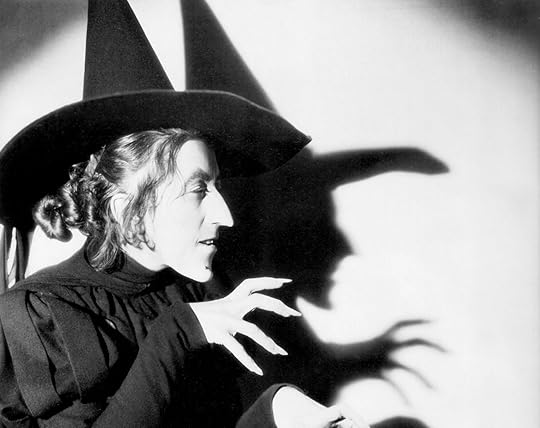
The Witch: A History of Fear, from Ancient Times to the Present is a grotesque but thoroughly researched must-read for those who enjoy scholarly work. Ronald Hutton takes his readers back to the days of early modern Europe and provides them with his insightful knowledge of a time where witchcraft wasn't considered a bunch of hocus pocus.
It was horrific to learn about the rituals that were practiced when Shamanism was at its peak, and it was even more disturbing that innocent men and women were being killed from baseless accusations. One wrong look at your neighbor could be implication enough that you were practicing satanic magic. Furthermore, the techniques used to gain one's confession back then were absolutely horrendous. Can you imagine being accused of a crime you did not commit while having black pepper rubbed in your eyes? Being starved to death? Beaten! Many falsely confessed at the time of their trial because they could no longer endure the torment.
The amount of citations and references the author provides his readers is commendable. Every statement is supported with factual information, so you never feel as if you are reading someone else's biased opinion on the subject.
I'll be honest though, this was an extremely dense read, and it would have engrossed me more if the contents had been presented in a more energetic manner. However, if you are someone who enjoys reading academic work (in a thesis format), then you should definitely give this one a go!
Many thanks to Netgalley and the publisher for providing me with an ARC.
*Quote was not taken from this book.

July 11, 2018
As usual, Hutton presents a meticulous and scholarly survey of previous work on the origins and nature of the early modern Witch Craze, with his quietly modest but actually highly perceptive analysis and careful original contributions. The scope of his book requires him to analyse a vast range of material - everything from non-European "witch" traditions from across the world to pre-Classical Egyptian magical traditions, Greco-Roman attitudes to magic, Siberian and Finno-Ugric shamanism and high medieval ritual magic - before he can even touch the core of his topic: the rise of the concept of a "Satanic witch cult" that lay as the cause of the early modern hysteria. But by the last quarter of his work the highly structured way he lays out this background material pays off and the careful underpinning of his conclusions becomes clear.
Hutton is respectful of the work of predecessors in the field - Grimm, Ginzberg, Kieckhefer, Trevor-Roper etc. - even when he is correcting what he feels are their misinterpretations of the evidence. The final result is a solid and wide ranging contribution that lays a foundation for further examination on key points, especially the nature of the differences in the witch beliefs in the various geographical "tradition zones" he identifies within the early modern European sphere. This book will most likely be will be a starting point for the next generation of scholars on this subject, which is always a useful and generous thing for a mature and experienced researcher like Hutton to provide for any field of inquiry.
Hutton is respectful of the work of predecessors in the field - Grimm, Ginzberg, Kieckhefer, Trevor-Roper etc. - even when he is correcting what he feels are their misinterpretations of the evidence. The final result is a solid and wide ranging contribution that lays a foundation for further examination on key points, especially the nature of the differences in the witch beliefs in the various geographical "tradition zones" he identifies within the early modern European sphere. This book will most likely be will be a starting point for the next generation of scholars on this subject, which is always a useful and generous thing for a mature and experienced researcher like Hutton to provide for any field of inquiry.

January 30, 2020
As I've been saying while reading, it seems Hutton had read just about everything on the subject in order to write this book. It's quite an in-depth research, with solid ideas, and great reasoning. It's helped a lot in writing my thesis and gave me a few ideas for another PhD, which I've been courting for a while now.
As I read a few negative reviews here, mainly pointing out that this reads as an academic text rather than a narrative, it's because IT IS AN ACADEMIC TEXT. Hutton is a professor in Bristol, this is his current research and it's been published by Yale University Press. Cheers.
As I read a few negative reviews here, mainly pointing out that this reads as an academic text rather than a narrative, it's because IT IS AN ACADEMIC TEXT. Hutton is a professor in Bristol, this is his current research and it's been published by Yale University Press. Cheers.

October 24, 2017
“The Witch: A History of Fear, from Ancient Times to the Present”, by Ronald Hutton, is a detailed researched book on a wide variety of beliefs about witches, as well as on the many ways those beliefs gave rise to the Western witch trials.
The focus lies on the definition of a witch as a person who harms others through the use of magic; witchcraft is seen as an internal threat to a community, as well as one of the very few embodiments of female power. As such, it was taken overtime as a form of social disruption which should be resisted and, sometimes, purged.
Through this perspective, the author draws upon historical, anthropological and ethnographic studies, to understand how the witch figure evolved over time, as well as how pre-Christian Western beliefs and Eastern traditions influenced our conceptions of witchcraft.
The book’s historical and geographical scope is wide. Firstly, the author explores how different societies around the world and in different times conceived of and treated witches. His research includes a variety of witchcraft traditions found in Africa, the Middle East, South Asia, Australia, North and South America.
Then, Hutton analyses the historical development of witchcraft in Europe and in the Near East, from ancient times to the medieval and early modern periods. He also examines Christianity and its impact on the perception and later persecution of witches, and points out to the advent of early modern witch hunts as a symptom of the crisis in European post-Reformation Christianity. Finally, the author narrows down his focus, and explores the ways in which ancient Western and Eastern beliefs shaped witchcraft in Britain.
I particularly enjoyed the way Hutton moves from a very wide range of beliefs to a very narrow one, and then back again, moving with ease through cultural and historical continuities and disruptions. The parallels he draws between worldwide traditions provide us with a better understanding of the early modern witch trials as defensive measures set in the context of a wide range of ancient traditions (Mesopotamian demonology; Persian cosmic dualism; a Graeco- Roman fear of magic as intrinsically impious; Roman images of the evil witch; and the Germanic concept of night- roaming cannibal women), and established by Christianity to cope with the challenges to its public credibility during the post-Reformation times.
The book provides a good overview of the scholarship on the subject. It will please readers who are in search of a wider picture about witch trials, as well as the ones interested in local traditions of witchcraft.
On my blog: https://theblankgarden.com/2017/11/06...
(This book was kindly sent to me by Yale University Press for review)
The focus lies on the definition of a witch as a person who harms others through the use of magic; witchcraft is seen as an internal threat to a community, as well as one of the very few embodiments of female power. As such, it was taken overtime as a form of social disruption which should be resisted and, sometimes, purged.
Through this perspective, the author draws upon historical, anthropological and ethnographic studies, to understand how the witch figure evolved over time, as well as how pre-Christian Western beliefs and Eastern traditions influenced our conceptions of witchcraft.
The book’s historical and geographical scope is wide. Firstly, the author explores how different societies around the world and in different times conceived of and treated witches. His research includes a variety of witchcraft traditions found in Africa, the Middle East, South Asia, Australia, North and South America.
Then, Hutton analyses the historical development of witchcraft in Europe and in the Near East, from ancient times to the medieval and early modern periods. He also examines Christianity and its impact on the perception and later persecution of witches, and points out to the advent of early modern witch hunts as a symptom of the crisis in European post-Reformation Christianity. Finally, the author narrows down his focus, and explores the ways in which ancient Western and Eastern beliefs shaped witchcraft in Britain.
I particularly enjoyed the way Hutton moves from a very wide range of beliefs to a very narrow one, and then back again, moving with ease through cultural and historical continuities and disruptions. The parallels he draws between worldwide traditions provide us with a better understanding of the early modern witch trials as defensive measures set in the context of a wide range of ancient traditions (Mesopotamian demonology; Persian cosmic dualism; a Graeco- Roman fear of magic as intrinsically impious; Roman images of the evil witch; and the Germanic concept of night- roaming cannibal women), and established by Christianity to cope with the challenges to its public credibility during the post-Reformation times.
The book provides a good overview of the scholarship on the subject. It will please readers who are in search of a wider picture about witch trials, as well as the ones interested in local traditions of witchcraft.
On my blog: https://theblankgarden.com/2017/11/06...
(This book was kindly sent to me by Yale University Press for review)

August 12, 2021
This must be the most scholarly study of the witchcraft phenomenon that I have read, and I have read quite a few books about the 16th-17th century witch trials in Europe. The author traces the origins of belief in the witch as not only a worker of malevolent magic, but, uniquely in Europe, a putative adherent of a Satanic religion that paralleled the official Christian church. He shows also how a belief in magic and even in witches did not necessarily lead automatically to witch hunting and mass executions: a number of societies balanced their anxieties about witches against beliefs about the evil eye and/or spirit beings, including fairies, which were blamed more for misfortune than witches. These therefore acted to displace the fear and hostility which in other places was directed against people believed to be witches.
The author also looks at witch beliefs in non European societies, and traces the various threads of scholarship which formerly regarded all such beliefs as survivors of paganism, a belief now largely discredited especially in relation to the works of Margaret Murray. He analyses the works of such writers as Carlo Ginzburg (which I have not yet read so will bear in mind the insights here when I do) and explores just how plausible it is that the magic workers Ginzburg wrote about were an offshoot of Shamanism. And Shamanism itself is analysed and explored, including its influence on other cultures where witch hunting did become active, including Norse culture in Scandinavia.
Where the book falls down slightly for me is that the style is very academic and dryly written. I also found the sentence structure rather convoluted in places which obscured the meaning. But given the depth of scholarship shown, I am rating it at 4 stars.
The author also looks at witch beliefs in non European societies, and traces the various threads of scholarship which formerly regarded all such beliefs as survivors of paganism, a belief now largely discredited especially in relation to the works of Margaret Murray. He analyses the works of such writers as Carlo Ginzburg (which I have not yet read so will bear in mind the insights here when I do) and explores just how plausible it is that the magic workers Ginzburg wrote about were an offshoot of Shamanism. And Shamanism itself is analysed and explored, including its influence on other cultures where witch hunting did become active, including Norse culture in Scandinavia.
Where the book falls down slightly for me is that the style is very academic and dryly written. I also found the sentence structure rather convoluted in places which obscured the meaning. But given the depth of scholarship shown, I am rating it at 4 stars.

May 20, 2019
I've chosen to listen to this book, and I had to listen to it twice to assimilate all the wealth of information. A deep, multicultural approach plus a wry sense of humour make for an engaging read. Now I feel the need to read everything else by Ronald Hutton :)

August 28, 2017
This was a fascinating bit of historical nonfiction. In particular, I enjoyed the balance between history and historiography. This was meticulously researched, and it shows. Unfortunately, that means the writing occasionally feels a bit like a glorified list. However, ultimately I thought this was a good thing--when Hutton makes a point, he backs it up with PLENTY of evidence.
I think it's worth pointing out that this book doesn't feel very accessible. It's clearly written with an academic audience in mind, and I don't think that people who are unused to monographs would enjoy reading this all that much. That said, I greatly enjoyed this!
I think it's worth pointing out that this book doesn't feel very accessible. It's clearly written with an academic audience in mind, and I don't think that people who are unused to monographs would enjoy reading this all that much. That said, I greatly enjoyed this!

January 9, 2022
It is an incredibly detailed insight into The Witch's history, however I found that it requires a pre-existing understanding of not only its origins and journey, but also pre-existing knowledge of ancient religion, and mythology. It wouldn't be considered an introduction to The Witch, to say the least.

Read
April 4, 2018A magisterial survey of the whole complex of witch beliefs, which pays particular attention to the area of special interest in the West – the early modern witch craze – while making sure to acknowledge also their relation to the diverse variations on the theme found in much (though crucially, not all) of the world. Of course, what's meant by 'witch' can vary greatly, and whatever definition you use, you’ll find certain witches wriggling free of it – but then, they are often reputed shapechangers, aren’t they? This is the first but not the last of the times that the book bogged me down somewhat, particularly when Hutton digresses into shamans, and the definition of that term, and how far they intersect with witches, and at one point there's a discussion of the various different sorts of service magician in Hungarian folk culture and I started to feel like I was reading one of those RPGs with too many character classes, and I was reminded of my own attempt at a setting which took Dunsany's reference to the fifty different types of magic as a starting point, but even in my desperate grasping for ways to fill out that number I didn't include the bed-maker and the smearer. Still, while you may need to take a breather at these points and read something else*, it is worth persevering, and as unlikely as it may sometimes seem, those digressions do all get drawn back into the main story. Hutton is building something here, and all the pieces matter. But do be aware that, if you’ve a fairly casual interest in the topic and just want a quick overview, this is not the book you’re looking for. Nor, for that matter, is this the review you’re after.
This depth and breadth of erudition also means, of course, that a lot of the things one vaguely thinks one knows about the subject turn out to be deeply partial, if not outright wrong. Readers in post-Protestant countries will be particularly surprised to learn that, if you were accused of witchcraft in Catholic territory, you’d have a much better chance of getting off entirely, or at least escaping with your life, if your case was dealt with by the Inquisition, who applied much higher evidential standards, and lenient punishments, than lay magistrates – and sometimes even came down hard on such overenthusiastic amateurs. Similarly, we tend nowadays to think of witch-hunts as largely being a way for the patriarchy to attack non-compliant women, but it's interesting how non-universal that is - some African instances (and there are horrifyingly recent ones in here) were more a way for dispossessed young people to attack the elders who had all the traditional power and resources, so more like Generation Rent with a body count. Elsewhere, the gender balance even of the victims of the European witch-hunting craze varied hugely by region. Of all the examples quoted, probably the one closest to the modern-traditional notion of wholly sexist witch persecution is that among the Kuranko of Sierra Leone, where women who reputedly changed shape to enact destruction were put to death…while men engaging in the exact same activities would brag about how crafty and powerful they were, and be generally respected for it. #everdayoccultsexism in its purest form.
Still, this is not to say there weren’t at least gendered inflections elsewhere. "A law from West Gotland of the early thirteenth century forbids various terms of slander against a woman, one of which is 'I saw you ride on a hurdle, with hair dishevelled, in the shape of a troll, between night and day’." Well, I think we'd all prefer people not gloat the morning after we've had a night like that. And the detective story takes in a fair bit of Norse material; I was particularly fond of "A man in the Vatnsdalers' Saga could make his friends invulnerable in a fight if he lay down motionless nearby”, which as wheezes to skive off a fight go, would be the envy of Flashman or Blackadder. And given the Northmen’s tardy and arguably less complete conversion to christianity, it is unsurprising to learn that pagan touches survived more there in magic – though even then it was largely in the academic field of ceremonial magic, where Odin (Hutton favours a more correct spelling, but I can't face digging out the characters) in particular was often mentioned as a chief among demons. And it’s in this ceremonial sorcery that most of the evidence for pagan survivals resides. It’s another of the sections where mission creep feels like it’s setting in, but it’s not without interest when Hutton analyses the mentions of non-native things like reed pens and hoopoes in mediaeval Northern European grimoires, tracing a line of descent to Egypt. And it serves as a useful contrast to the idea that witches represented a survival of pagan beliefs among the lower orders, where the evidence isn’t nearly so strong. Hutton points out the assumptions and wishful thinking underlying such notions, with folklorists attempting to composite various similar-ish local myths, and then deduce a lost ur-form from them - which by its very nature will tend to be unfalsifiable. True, certain old names will sometimes crop up, as when Diana was in some places reputed to lead the night rides we’d now tend to think of as variants of the Wild Hunt. But the woman leading them was equally likely to be known as Herodias, which doesn’t fit quite so nicely with folk horror notions of the old native ways surviving beneath the imported faith.
Still, looming over all this variety is an awareness of impending atrocity. How did we get from the situation in the early middle ages, where popes would condemn witch-hunts as an attempt to avoid wider moral responsibility for disasters which were clearly divine punishment, to a widespread acceptance that individual malicious humans, in league with infernal powers, were to blame? Hutton does an excellent job of drawing together various close work that's been done on the evolution of the witch hunt. He looks at some early spasms, before showing how strands of other persecutions which had been more popular in the early middle ages (of heretics, Jews, lepers) were woven together into the terrifying composite of baby-slaughtering, night-orgying, Satan-worshipping witches. He even comes reasonably close to identifying a Patient Zero for the whole crazy outbreak; we don’t get a name, but there’s a compelling case that a particular group of friars were key to what would ensue. Still, even as persecution becomes much more common, there are certain surprising details. For instance, the notion that it would be the harmless village midwife or cunning man on whom everyone suddenly turned? Not so much. It happened in a few areas, and if your success rate wasn’t so hot, or you got mixed up in the wrong sort of local politics, then yes, you could be in trouble. But service magicians are at least as likely to turn up as accusers or expert witnesses as victims.
There are two key points of interest, though. Two details unique to Europe and its North American offshoots. These were the only places where a belief in witches as individuals, a race or small groups morphed into a belief in a unified, organised anti-religion – and later, they were the only places where belief in witchcraft altogether faded. Well, almost altogether; Hutton notes that he’s personally aware of a Cornish village which turned on an alleged witch in 1984. And here the same close reading of both sources and earlier syntheses is brought to bear on the standard iconography of the Western witch. The broomstick, for instance, which was reported as one of the ways early modern witches rode to the Sabbat – though others rode animals, baskets or reeds, and you have to feel sorry for the poor schmucks who just walked there. And of course the familiar, which turns out to be a distinctly English and Welsh notion, whose evolution Hutton again traces, albeit stopping just short of explaining why it’s those two specific details, along with the hat, which have come to form the pop culture shorthand.
That mention of Wales should be qualified, mind, because the paucity of trials in Wales as against England is another of those regional variations which keep cropping up. Hutton wryly notes that it has been attributed to greater social cohesion and less wealth inequality - but then points out that these charming notions are rather undermined by wider trial records, which demonstrate the Welsh being perfectly happy to denounce each other for all sorts of other crimes, many absurd, just not really witchcraft. In Scotland, meanwhile, the fair folk were much more likely to be mentioned in witch trials than elsewhere – which provides an opening for the question of how accused witches and other folk magicians thought they got their powers, if not through pacts with the Devil. The answers being intriguingly varied; some said birth with cauls, or were dream warriors; perhaps an easily taught knack, or even the frank admission that nobody really knew why some people could do this stuff, not even the practitioners. In Scotland especially, getting them from the good neighbours seemed to be an occasional theme - but one complicated by the fact that, like myself, these people felt it impolitic to use the F-word, so it's unclear whether their 'seelie wights’ were a subset of the little people, or another class of being altogether. And then with James VI and the Reformation, the Scottish attitude to such beings starts to darken, and they’re more readily identified with disguised devils – even as, south of the border, an England ruled by an Elizabeth happy to be identified with the Faerie Queene held on to a merrier and more friendly interpretation. If you’ve ever wanted chapter and verse on the evolution of the moral role and cosmological placing of Robin Goodfellow, this is the section for you.
And this is a core part of Hutton’s argument, here: mediaeval and early modern peasants were not some stolid herd, their ideas necessarily either derived from the church or survivals of the old religion. Then, as now, poor people could have new ideas, or change existing ones. Contradictory ideas, too – Hutton talks of 'parallel cosmologies’, but it’s not as if you don’t get plenty of modern and educated people possessed of logically incompatible beliefs, yet showing no particular tension over holding them. Indeed, the rationalist approach to the history of witch-belief could be considered as fairly puzzling too, when you consider the weirdness of a whole field taking it for granted that they're writing about idiots or nutters (it was precisely this which put me off Religion and the Decline of Magic back when that was the go-to text):
"It seems therefore that in the case of the attempted use of witchcraft by early modern people we have a strong presumption that something happened without quite being able to prove that it did, while in that of the satanic witch religion we have ample evidence for the existence of something, which we disregard on the grounds that it is incredible.”
So did anyone perceive themselves as the Satanic witch with which good christian folk were so obsessed? Perhaps. One plausible suggestion here links the upswing of that belief to the Reformation and ensuing conflicts; when people are changing religion, and each form of christianity stigmatises others as in league with the Devil, turning to the old fellow himself in extremis doesn't feel like such an enormous leap as it did when European Catholicism was monolithic, and witches less feared. And of course, even if the Satanic witch cult was a prurient invention at first, such scandals do give people ideas. To use an example Hutton doesn’t, I was reminded of the old 'Chazbaps' story in Popbitch which, while an exaggeration of the original incident, inspired a few people I knew to try the more shocking version as per the rumour.
In summary: make no mistake, this is a lot of book. I mean, reading my review back I at once feel like I've waffled at great length, and that I've done Hutton no justice at all. But if you’re interested in really digging into this stuff, The Witch is more than worth it.
*This may explain why, in what I think is a new record, it took me eight months to get around to finishing this, despite generally trying to read Netgalley ARCs with some alacrity, and despite having already been intrigued by what I’d heard about Hutton. The friend who first alerted me to him has since kindly sent her old copies of some of his other books to me, though I think I may need a break before I attempt another.
This depth and breadth of erudition also means, of course, that a lot of the things one vaguely thinks one knows about the subject turn out to be deeply partial, if not outright wrong. Readers in post-Protestant countries will be particularly surprised to learn that, if you were accused of witchcraft in Catholic territory, you’d have a much better chance of getting off entirely, or at least escaping with your life, if your case was dealt with by the Inquisition, who applied much higher evidential standards, and lenient punishments, than lay magistrates – and sometimes even came down hard on such overenthusiastic amateurs. Similarly, we tend nowadays to think of witch-hunts as largely being a way for the patriarchy to attack non-compliant women, but it's interesting how non-universal that is - some African instances (and there are horrifyingly recent ones in here) were more a way for dispossessed young people to attack the elders who had all the traditional power and resources, so more like Generation Rent with a body count. Elsewhere, the gender balance even of the victims of the European witch-hunting craze varied hugely by region. Of all the examples quoted, probably the one closest to the modern-traditional notion of wholly sexist witch persecution is that among the Kuranko of Sierra Leone, where women who reputedly changed shape to enact destruction were put to death…while men engaging in the exact same activities would brag about how crafty and powerful they were, and be generally respected for it. #everdayoccultsexism in its purest form.
Still, this is not to say there weren’t at least gendered inflections elsewhere. "A law from West Gotland of the early thirteenth century forbids various terms of slander against a woman, one of which is 'I saw you ride on a hurdle, with hair dishevelled, in the shape of a troll, between night and day’." Well, I think we'd all prefer people not gloat the morning after we've had a night like that. And the detective story takes in a fair bit of Norse material; I was particularly fond of "A man in the Vatnsdalers' Saga could make his friends invulnerable in a fight if he lay down motionless nearby”, which as wheezes to skive off a fight go, would be the envy of Flashman or Blackadder. And given the Northmen’s tardy and arguably less complete conversion to christianity, it is unsurprising to learn that pagan touches survived more there in magic – though even then it was largely in the academic field of ceremonial magic, where Odin (Hutton favours a more correct spelling, but I can't face digging out the characters) in particular was often mentioned as a chief among demons. And it’s in this ceremonial sorcery that most of the evidence for pagan survivals resides. It’s another of the sections where mission creep feels like it’s setting in, but it’s not without interest when Hutton analyses the mentions of non-native things like reed pens and hoopoes in mediaeval Northern European grimoires, tracing a line of descent to Egypt. And it serves as a useful contrast to the idea that witches represented a survival of pagan beliefs among the lower orders, where the evidence isn’t nearly so strong. Hutton points out the assumptions and wishful thinking underlying such notions, with folklorists attempting to composite various similar-ish local myths, and then deduce a lost ur-form from them - which by its very nature will tend to be unfalsifiable. True, certain old names will sometimes crop up, as when Diana was in some places reputed to lead the night rides we’d now tend to think of as variants of the Wild Hunt. But the woman leading them was equally likely to be known as Herodias, which doesn’t fit quite so nicely with folk horror notions of the old native ways surviving beneath the imported faith.
Still, looming over all this variety is an awareness of impending atrocity. How did we get from the situation in the early middle ages, where popes would condemn witch-hunts as an attempt to avoid wider moral responsibility for disasters which were clearly divine punishment, to a widespread acceptance that individual malicious humans, in league with infernal powers, were to blame? Hutton does an excellent job of drawing together various close work that's been done on the evolution of the witch hunt. He looks at some early spasms, before showing how strands of other persecutions which had been more popular in the early middle ages (of heretics, Jews, lepers) were woven together into the terrifying composite of baby-slaughtering, night-orgying, Satan-worshipping witches. He even comes reasonably close to identifying a Patient Zero for the whole crazy outbreak; we don’t get a name, but there’s a compelling case that a particular group of friars were key to what would ensue. Still, even as persecution becomes much more common, there are certain surprising details. For instance, the notion that it would be the harmless village midwife or cunning man on whom everyone suddenly turned? Not so much. It happened in a few areas, and if your success rate wasn’t so hot, or you got mixed up in the wrong sort of local politics, then yes, you could be in trouble. But service magicians are at least as likely to turn up as accusers or expert witnesses as victims.
There are two key points of interest, though. Two details unique to Europe and its North American offshoots. These were the only places where a belief in witches as individuals, a race or small groups morphed into a belief in a unified, organised anti-religion – and later, they were the only places where belief in witchcraft altogether faded. Well, almost altogether; Hutton notes that he’s personally aware of a Cornish village which turned on an alleged witch in 1984. And here the same close reading of both sources and earlier syntheses is brought to bear on the standard iconography of the Western witch. The broomstick, for instance, which was reported as one of the ways early modern witches rode to the Sabbat – though others rode animals, baskets or reeds, and you have to feel sorry for the poor schmucks who just walked there. And of course the familiar, which turns out to be a distinctly English and Welsh notion, whose evolution Hutton again traces, albeit stopping just short of explaining why it’s those two specific details, along with the hat, which have come to form the pop culture shorthand.
That mention of Wales should be qualified, mind, because the paucity of trials in Wales as against England is another of those regional variations which keep cropping up. Hutton wryly notes that it has been attributed to greater social cohesion and less wealth inequality - but then points out that these charming notions are rather undermined by wider trial records, which demonstrate the Welsh being perfectly happy to denounce each other for all sorts of other crimes, many absurd, just not really witchcraft. In Scotland, meanwhile, the fair folk were much more likely to be mentioned in witch trials than elsewhere – which provides an opening for the question of how accused witches and other folk magicians thought they got their powers, if not through pacts with the Devil. The answers being intriguingly varied; some said birth with cauls, or were dream warriors; perhaps an easily taught knack, or even the frank admission that nobody really knew why some people could do this stuff, not even the practitioners. In Scotland especially, getting them from the good neighbours seemed to be an occasional theme - but one complicated by the fact that, like myself, these people felt it impolitic to use the F-word, so it's unclear whether their 'seelie wights’ were a subset of the little people, or another class of being altogether. And then with James VI and the Reformation, the Scottish attitude to such beings starts to darken, and they’re more readily identified with disguised devils – even as, south of the border, an England ruled by an Elizabeth happy to be identified with the Faerie Queene held on to a merrier and more friendly interpretation. If you’ve ever wanted chapter and verse on the evolution of the moral role and cosmological placing of Robin Goodfellow, this is the section for you.
And this is a core part of Hutton’s argument, here: mediaeval and early modern peasants were not some stolid herd, their ideas necessarily either derived from the church or survivals of the old religion. Then, as now, poor people could have new ideas, or change existing ones. Contradictory ideas, too – Hutton talks of 'parallel cosmologies’, but it’s not as if you don’t get plenty of modern and educated people possessed of logically incompatible beliefs, yet showing no particular tension over holding them. Indeed, the rationalist approach to the history of witch-belief could be considered as fairly puzzling too, when you consider the weirdness of a whole field taking it for granted that they're writing about idiots or nutters (it was precisely this which put me off Religion and the Decline of Magic back when that was the go-to text):
"It seems therefore that in the case of the attempted use of witchcraft by early modern people we have a strong presumption that something happened without quite being able to prove that it did, while in that of the satanic witch religion we have ample evidence for the existence of something, which we disregard on the grounds that it is incredible.”
So did anyone perceive themselves as the Satanic witch with which good christian folk were so obsessed? Perhaps. One plausible suggestion here links the upswing of that belief to the Reformation and ensuing conflicts; when people are changing religion, and each form of christianity stigmatises others as in league with the Devil, turning to the old fellow himself in extremis doesn't feel like such an enormous leap as it did when European Catholicism was monolithic, and witches less feared. And of course, even if the Satanic witch cult was a prurient invention at first, such scandals do give people ideas. To use an example Hutton doesn’t, I was reminded of the old 'Chazbaps' story in Popbitch which, while an exaggeration of the original incident, inspired a few people I knew to try the more shocking version as per the rumour.
In summary: make no mistake, this is a lot of book. I mean, reading my review back I at once feel like I've waffled at great length, and that I've done Hutton no justice at all. But if you’re interested in really digging into this stuff, The Witch is more than worth it.
*This may explain why, in what I think is a new record, it took me eight months to get around to finishing this, despite generally trying to read Netgalley ARCs with some alacrity, and despite having already been intrigued by what I’d heard about Hutton. The friend who first alerted me to him has since kindly sent her old copies of some of his other books to me, though I think I may need a break before I attempt another.
January 23, 2018
At turns an excellent synthesis of the scholarly work done up to this point, at other turns a frustrating and messy attempt at formulating a basis from which the historiography of witchcraft and medieval thinking could move forward from.
Hutton certainly knows his shtick, having written numerous works on witchcraft and its place especially in contemporary times. What he does here is attempt to construct a history of the development of the image and idea of the witch in various concentric contexts and attempt to strip away some outlying notions that muddy the waters. All he does is further muddy the waters by applying his own arguments inconsistently. While seeming to take a contrary or at least skeptical bent against scholars like Ginzburg who suggest that witchcraft emerged from the remnants of a Europe-wide pre-Christian agrarian culty sort of thing, Hutton tries to fill in the gaps himself just as iffy foundations, like literature. Like many historians, good and bad, Hutton makes the easy mistake of apportioning the thought of cultural and religious elites and splashing them all over the common person. Now, anyone who studies history knows, we're never gonna know what the common person thought, but we can make inroads towards understanding their world views from what we do know of them, and that's where the real value of studying the emergence of witch trails, persecutions, and the evolution of the fear of the image of a witch comes from: by studying the outlying mentions in testimonies that weren't just tortured people spouting what the Church wanted them to say. Scholars like Ginzburg and Behringer have dug into this tentatively. I'm surprised that Hutton, who maybe just couldn't access the information, spends so much time on the British Isles to show long-existing underpinnings and then turns right around and looks on the rest of Europe so skeptically. A flagrant omission is archaeology, like the work of Gimbutas who, take it for whatever you will, at least shows us that there were old, long-standing agrarian worldviews at play in SE Europe. Remote places untouched by the lurch of history couldn't help but have retained something of their past, but Hutton, who justifiably bemoans the lack of evidence, writes it all off a little too easily.
Still, this is a great book. I probably should've spent less time criticizing it since outside the theoretical bits, it does present some nice contexts and comparative studies.
Hutton certainly knows his shtick, having written numerous works on witchcraft and its place especially in contemporary times. What he does here is attempt to construct a history of the development of the image and idea of the witch in various concentric contexts and attempt to strip away some outlying notions that muddy the waters. All he does is further muddy the waters by applying his own arguments inconsistently. While seeming to take a contrary or at least skeptical bent against scholars like Ginzburg who suggest that witchcraft emerged from the remnants of a Europe-wide pre-Christian agrarian culty sort of thing, Hutton tries to fill in the gaps himself just as iffy foundations, like literature. Like many historians, good and bad, Hutton makes the easy mistake of apportioning the thought of cultural and religious elites and splashing them all over the common person. Now, anyone who studies history knows, we're never gonna know what the common person thought, but we can make inroads towards understanding their world views from what we do know of them, and that's where the real value of studying the emergence of witch trails, persecutions, and the evolution of the fear of the image of a witch comes from: by studying the outlying mentions in testimonies that weren't just tortured people spouting what the Church wanted them to say. Scholars like Ginzburg and Behringer have dug into this tentatively. I'm surprised that Hutton, who maybe just couldn't access the information, spends so much time on the British Isles to show long-existing underpinnings and then turns right around and looks on the rest of Europe so skeptically. A flagrant omission is archaeology, like the work of Gimbutas who, take it for whatever you will, at least shows us that there were old, long-standing agrarian worldviews at play in SE Europe. Remote places untouched by the lurch of history couldn't help but have retained something of their past, but Hutton, who justifiably bemoans the lack of evidence, writes it all off a little too easily.
Still, this is a great book. I probably should've spent less time criticizing it since outside the theoretical bits, it does present some nice contexts and comparative studies.

February 19, 2018
I'm about 1/3 through, and this book is startlingly incoherent. I read reviews saying it was "academic", which it is, but it's also a clusterfck. The author jumps across time periods, geography, traditions and gender within a few sentences in a dizzying effort to illustrate a point that has been all but lost. I read academic articles, and maybe this would be bearable if it was 20 pages, but this comparative ethnography doesn't seem to have any real steering messages or underlying thesis or any point at all. I'm listening to an audiobook, which I DO NOT RECOMMEND because I literally don't know what the purpose of any chapter is and can't easily check back to the title.
Part of this is the genre: comparative anthropology, by definition, will jump about a bit. But this felt like reading the Silmarillion with citations.
I'm going to keep going and hope that this was all just a painful lit review before we get to the point, but I don't have a lot of hope.
Part of this is the genre: comparative anthropology, by definition, will jump about a bit. But this felt like reading the Silmarillion with citations.
I'm going to keep going and hope that this was all just a painful lit review before we get to the point, but I don't have a lot of hope.

February 28, 2018
A bit of an unusual read, for me. As others have said, it’s very dry and academic in tone, and I’m surprised at the marketing it’s had and the coverage on Booktube etc. suggesting it might be a pop-history book. As someone with negligible prior knowledge on the topic, I think I would’ve found it too hard-going to read it in print. The audio worked really well, however. It’s a bit infodump-y with lots of lists of events and sources. Hutton doesn’t tend to labour his points, and the scope of the book is broad. This meant I could listen to the audiobook even in 10-15 minute snippets and hear something interesting every time. I really mean a lot of crazy interesting stuff. I’ve finished it with a long list of things I want to go and look up and read more about.

August 12, 2023
io: *aggiunge tutti i testi di Hutton al carrello amazon*

January 27, 2024
I have attended and listened to several of Hutton’s talks in various spaces online, but somehow this was my first time reading one of his amazing books! Needless to say, I am now quite looking forward to reading his others, starting with Triumph of the Moon! What a comprehensive overview. Any question you’ve ever had on why witches are associated with X, what cultures believe what about witches, and how the world is currently different from the past, will be quite satisfied with this entertainingly written book.


August 11, 2026
Суб'єктивна оцінка така, що місцями було цікаво і інформативно, але ну як же воно нудно викладено, аж зривався у діагональне читання. Хоча здавалось би, таку тему нудно викласти ще треба постаратись)

April 2, 2018
If you are a serious scholar of witches and witchcraft, then this is book for you. Meticulously researched, wide-ranging and comprehensive, Ronald Hutton traces witchcraft in great detail from ancient times to modern times. It’s a magisterial tome, learned and of immense interest. But it’s not an easy read and I gave up on it as I found it just too heavy-going. I’m possibly not the intended reader although I have seen it described as accessible to the general reader in other reviews, but I didn’t find it so. I found it dull and I was soon bored. That makes it very difficult for me to rate it as I suspect it’s actually a very good book. Indeed it has garnered many 5* reviews. But I can’t leave a review on Amazon without rating it. So I’ve had to hedge my bets and fall plumb in the middle. My rating reflects my reaction to it not its intrinsic worth.

October 26, 2017
Didn't get past chapter 3. So boring. I'm surprised this was written by a historian. I assumed it was by an anthropologist all the time I was reading. So dry an uninteresting... there are better things to read.
Displaying 1 - 30 of 325 reviews