

What do you think?

Телефон
Для дошкольного возраста
Иллюстрация на обложке и внутренние иллюстрации В. Конашевича.
Иллюстрация на обложке и внутренние иллюстрации В. Конашевича.
16 pages, Paperback
First published January 1, 1926
About the author
Korney Chukovsky
1,082 books52 followersKorney Ivanovich Chukovsky (Russian: Корней Иванович Чуковский) was one of the most popular children's poets in the Russian language. His catchy rhythms, inventive rhymes and absurd characters have invited comparisons with the American children's author Dr. Seuss. Chukovsky's poems Tarakanishche ("The Monster Cockroach"), Krokodil ("The Crocodile"), Telefon ("The Telephone") and Moydodyr ("Wash-'em-Clean") have been favorites with many generations of Russophone children. Lines from his poems, in particular Telefon, have become universal catch-phrases in the Russian media and everyday conversation. He adapted the Doctor Dolittle stories into a book-length Russian poem as Doktor Aybolit ("Dr. Ow-It-Hurts"), and translated a substantial portion of the Mother Goose canon into Russian as Angliyskiye Narodnyye Pesenki ("English Folk Rhymes"). He was also an influential literary critic and essayist. (from: wikipedia)
For Russian version of same author:
https://www.goodreads.com/author/show...
For Russian version of same author:
https://www.goodreads.com/author/show...
Ratings & Reviews
Friends & Following
Create a free account to discover what your friends think of this book!
Community Reviews
Displaying 1 - 13 of 13 reviews

July 1, 2019
The Telephone, adapted by Marguerita Rudolph, illustrated by Susan Perl.
The narrator of this delightfully idiosyncratic Russian poem for children relates the many odd calls he gets from various animals, each seeking something more outlandish than the last. Whether it be the "Elephone" seeking five tons of chocolates for his baby sister, the crocodile looking for a tasty snack of galoshes, or the heron who ate too many frogs, each caller needs help. The poem closes as the narrator attempts to pull a ten-ton hippo out of the mud...
Originally published in Russian in 1926, as Телефон, this classic nonsense poem from Kornei Chukovsky has been translated into English as least six times. Published in a variety of edition from 1939 through 1984, first by the Moscow-based Foreign Language Publishing House, and then by Malysh Publishers (also in Moscow), the Dorian Rottenberg translation has been paired with the artwork of V. Konashevich and Valentin Karpovich. In 1982, Malysh Publishers released a different translation, done by Peter Tempest, and paired with the artwork of V. Andriyevich. There is also a 1940s translation done by Padraic Breslin for Mezdunaradnaya kniga, artist unknown. In the west, in 1996, Jamey Gambrell presented an adapted picture-book version, with the artwork of Vladimir Radunsky. In 1977, William Jay Smith, who had also adapted Swedish picture-book great Elsa Beskow (see: Children of the Forest ), presented his own version, together with the illustrations of Blair Lent. Then there is this edition, translated and adapted by Marguerita Rudolph, with the artwork of Susan Perl. Released in 1971, it marks (according to the dust-jacket blurb) the first authorized translation of Telephone to be published in the United States.
As someone with an interest in translated children's literature, someone who enjoys comparing different picture-book presentations of the same tale, I had no sooner finished the aforementioned Gambrell/Radunsky title, than I was tracking down this older version. It was fascinating to compare and contrast the approaches taken by the two adapters. Unlike Gambrell, Rudolph presents a bilingual text in her book, with transliterated Russian on the left-hand page of each two-page spread, and the English on the right. The transliteration was done by Liuba Solov. At first I wondered at the choice to use transliteration, rather than the original cyrillic text, as this seemingly benefits neither those who can read Russian nor those who can't. Then I realized that the intention was not simply to provide the English readers with the original text, but rather, with the original sound and structure of the poem. Given that poetry is particularly reliant on cadence, I decided that this was actually a useful format to use, whether or not the reader could decode the meaning of the Russian words. It reminded me of a poetry reading I attended back in high school, in which the poets Andrei Voznesensky and Alan Ginsburg recited. Voznesensky read his poems in Russian, and Ginsburg the English translations, and while I understood not a word of the original, it was still fascinating to listen to.
Leaving aside the question of dual text, the language here was fun and inventive, the story silly and entertaining. There were a number of points where Gambrell and Rudolph chose different animals - baboons vs. monkeys, herons vs. storks, etc. - and a few verses that Gambrell seems to have summarized in no more than a few words, but overall the two versions are quite similar. Although I did enjoy the Gambrell/Radunsky version, both textually and visually, I think I prefer the Rudolph/Perl just a bit, because it feels like a fuller, more faithful presentation. The style of the artwork is very different - Radunsky all bold colors and collage, Susan Perl all cute animals depicted in simple greenish-brown monotone - and each appealing in its own right. Still, although I did prefer this version, the difference is not so very great. Perhaps I will have to track down some other adaptations...
The narrator of this delightfully idiosyncratic Russian poem for children relates the many odd calls he gets from various animals, each seeking something more outlandish than the last. Whether it be the "Elephone" seeking five tons of chocolates for his baby sister, the crocodile looking for a tasty snack of galoshes, or the heron who ate too many frogs, each caller needs help. The poem closes as the narrator attempts to pull a ten-ton hippo out of the mud...
Originally published in Russian in 1926, as Телефон, this classic nonsense poem from Kornei Chukovsky has been translated into English as least six times. Published in a variety of edition from 1939 through 1984, first by the Moscow-based Foreign Language Publishing House, and then by Malysh Publishers (also in Moscow), the Dorian Rottenberg translation has been paired with the artwork of V. Konashevich and Valentin Karpovich. In 1982, Malysh Publishers released a different translation, done by Peter Tempest, and paired with the artwork of V. Andriyevich. There is also a 1940s translation done by Padraic Breslin for Mezdunaradnaya kniga, artist unknown. In the west, in 1996, Jamey Gambrell presented an adapted picture-book version, with the artwork of Vladimir Radunsky. In 1977, William Jay Smith, who had also adapted Swedish picture-book great Elsa Beskow (see: Children of the Forest ), presented his own version, together with the illustrations of Blair Lent. Then there is this edition, translated and adapted by Marguerita Rudolph, with the artwork of Susan Perl. Released in 1971, it marks (according to the dust-jacket blurb) the first authorized translation of Telephone to be published in the United States.
As someone with an interest in translated children's literature, someone who enjoys comparing different picture-book presentations of the same tale, I had no sooner finished the aforementioned Gambrell/Radunsky title, than I was tracking down this older version. It was fascinating to compare and contrast the approaches taken by the two adapters. Unlike Gambrell, Rudolph presents a bilingual text in her book, with transliterated Russian on the left-hand page of each two-page spread, and the English on the right. The transliteration was done by Liuba Solov. At first I wondered at the choice to use transliteration, rather than the original cyrillic text, as this seemingly benefits neither those who can read Russian nor those who can't. Then I realized that the intention was not simply to provide the English readers with the original text, but rather, with the original sound and structure of the poem. Given that poetry is particularly reliant on cadence, I decided that this was actually a useful format to use, whether or not the reader could decode the meaning of the Russian words. It reminded me of a poetry reading I attended back in high school, in which the poets Andrei Voznesensky and Alan Ginsburg recited. Voznesensky read his poems in Russian, and Ginsburg the English translations, and while I understood not a word of the original, it was still fascinating to listen to.
Leaving aside the question of dual text, the language here was fun and inventive, the story silly and entertaining. There were a number of points where Gambrell and Rudolph chose different animals - baboons vs. monkeys, herons vs. storks, etc. - and a few verses that Gambrell seems to have summarized in no more than a few words, but overall the two versions are quite similar. Although I did enjoy the Gambrell/Radunsky version, both textually and visually, I think I prefer the Rudolph/Perl just a bit, because it feels like a fuller, more faithful presentation. The style of the artwork is very different - Radunsky all bold colors and collage, Susan Perl all cute animals depicted in simple greenish-brown monotone - and each appealing in its own right. Still, although I did prefer this version, the difference is not so very great. Perhaps I will have to track down some other adaptations...

June 27, 2019
Telephone, adapted by Jamey Gambrell, illustrated by Vladimir Radunsky.
A classic Russian children's poem, written in its original form by Kornei Chukovsky, is adapted and presented in English by Jamey Gambrell in this picture-book. The narrator relates all the crazy calls he gets from various animals, each of whom wants something unexpected. Whether it be baboons looking for spoons, or a kangaroo seeking Winnie-the-Pooh, the narrator finds that he is glued to his telephone...
Having now read a number of Chukovsky's poems for children - Wash 'Em Clean , Doctor Concocter , Cock-the-Roach - I was curious to pick up Telephone. It's pretty clear from the presentation - Jamey Gambrell gets top billing on this edition - that this is as much an adaptation, as it is a translation. Whatever the case might be - and I would certainly be interested to read other versions of this poem in English - I found this one quite entertaining. The silly nonsense poem here reads well and is quite entertaining, while the accompanying artwork from Russian-born illustrator Vladimir Radunsky, done in vividly-colored and boldly-patterned collage, is eye-catching, and accentuates the madcap humor of the tale. Recommended to anyone looking for nonsense rhymes for children, or interested in Russian children's literature.
A classic Russian children's poem, written in its original form by Kornei Chukovsky, is adapted and presented in English by Jamey Gambrell in this picture-book. The narrator relates all the crazy calls he gets from various animals, each of whom wants something unexpected. Whether it be baboons looking for spoons, or a kangaroo seeking Winnie-the-Pooh, the narrator finds that he is glued to his telephone...
Having now read a number of Chukovsky's poems for children - Wash 'Em Clean , Doctor Concocter , Cock-the-Roach - I was curious to pick up Telephone. It's pretty clear from the presentation - Jamey Gambrell gets top billing on this edition - that this is as much an adaptation, as it is a translation. Whatever the case might be - and I would certainly be interested to read other versions of this poem in English - I found this one quite entertaining. The silly nonsense poem here reads well and is quite entertaining, while the accompanying artwork from Russian-born illustrator Vladimir Radunsky, done in vividly-colored and boldly-patterned collage, is eye-catching, and accentuates the madcap humor of the tale. Recommended to anyone looking for nonsense rhymes for children, or interested in Russian children's literature.
July 3, 2019
The Telephone, adapted by William Jay Smith, illustrated by Blair Lent.
The narrator of this madcap children's poem, originally published in Russian as Телефон, relates how a series of animals called him on the telephone, each requesting something amusingly outlandish. Kept hopping by the constant calls, he is close to collapsing when a true emergency comes through: the hippopotamus needs rescuing from the swamp...
The third English translation/adaptation of this nonsense poem that I have read, following upon those done by Jamey Gambrell and Marguerita Rudolph, this version by William Jay Smith is the weakest, textually speaking. The rhyming and line structure feel rather awkward at times, creating a reading experience that was somehow disjointed. It was interesting, once again, to see the variation of animals chosen for some of the verses - here we have sick flamingos, rather than herons or storks; or chimpanzees, rather than monkeys or baboons - but that wasn't enough to make this a more enjoyable read. That said, I found the artwork here, done by Blair Lent in an appealing folk style, quite charming. His animal characters were expressive and amusing, his colors - lots of subtle oranges and greens - deep but also muted. I liked that Lent wasn't afraid of the white space on his page. Although I do prefer the other versions of The Telephone that I have read, this is one I would still recommend to those seeking amusing nonsense stories for young children, if they cannot obtain the other versions mentioned above.
The narrator of this madcap children's poem, originally published in Russian as Телефон, relates how a series of animals called him on the telephone, each requesting something amusingly outlandish. Kept hopping by the constant calls, he is close to collapsing when a true emergency comes through: the hippopotamus needs rescuing from the swamp...
The third English translation/adaptation of this nonsense poem that I have read, following upon those done by Jamey Gambrell and Marguerita Rudolph, this version by William Jay Smith is the weakest, textually speaking. The rhyming and line structure feel rather awkward at times, creating a reading experience that was somehow disjointed. It was interesting, once again, to see the variation of animals chosen for some of the verses - here we have sick flamingos, rather than herons or storks; or chimpanzees, rather than monkeys or baboons - but that wasn't enough to make this a more enjoyable read. That said, I found the artwork here, done by Blair Lent in an appealing folk style, quite charming. His animal characters were expressive and amusing, his colors - lots of subtle oranges and greens - deep but also muted. I liked that Lent wasn't afraid of the white space on his page. Although I do prefer the other versions of The Telephone that I have read, this is one I would still recommend to those seeking amusing nonsense stories for young children, if they cannot obtain the other versions mentioned above.

May 11, 2012
Telephone did not get my kids laughing. This nonsense poem just did not appeal to us, neither did the pictures, but maybe that's just us.

May 28, 2017
2.5 out of 5
I had to learn the beginning of this nonsense poem for my Russian class and I remember loving it. Jamey Gambrell did a good job translating it to English! Here is the beginning of Gambrell's translation:
And here's the same excerpt in Russian:
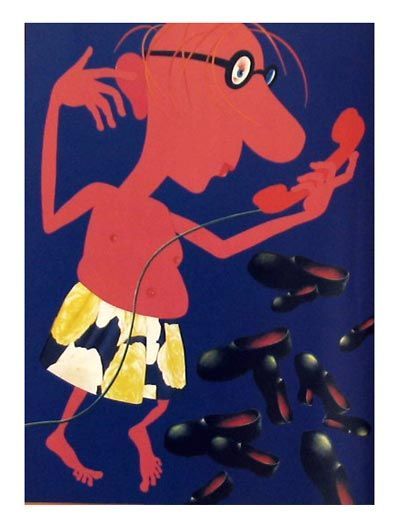
Although not my favorite, Vladimir Radunsky's collage illustrations are as bold and silly as the poem itself:
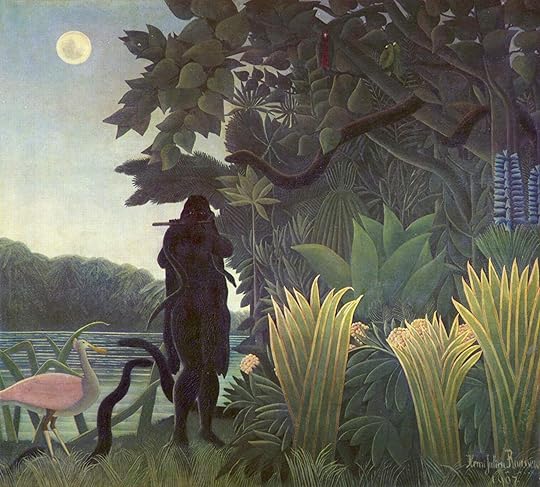
One of the doublespreads even has an edited version of this Henri Rousseau's painting, The Snake Charmer, with a telephone booth instead of a person:
I had to learn the beginning of this nonsense poem for my Russian class and I remember loving it. Jamey Gambrell did a good job translating it to English! Here is the beginning of Gambrell's translation:
Jing-a-ling-a-ling.
The telephone
began to ring.
Elephant was on the line,
calling from Chez Porcupine.
"What do you want?"
I asked him up front.
"If I had my druthers,"
he said in a mutter,
"I'd order some more of your peanut butter."
"How much,
who's it for,
and what's the location?"
"Just a ton,
for my son,
care of Pachyderm Station."
The Crocodile called me in tears.
He was crying so loud
that I plugged up my ears.
"I need some galoshes
for me and my wife
and our cousin Natasha."
"Wait a minute!
Not so fast!
I sent you three pair
the week before last!"
"But that was back then.
We ate them all up.
We're hungry again.
"It's been ages since lunch
and we're dying to munch
more delicious,
nutritious
galoshes."
And here's the same excerpt in Russian:
У меня зазвонил телефон.
- Кто говорит?
- Слон.
- Откуда?
- От верблюда.
- Что вам надо?
- Шоколада.
- Для кого?
- Для сына моего.
- А много ли прислать?
- Да пудов этак пять или шесть:
Больше ему не съесть,
Он у меня еще маленький!
А потом позвонил
Крокодил
И со слезами просил:
- Мой милый, хороший,
Пришли мне калоши,
И мне, и жене, и Тотоше.
-Постой, не тебе ли
На прошлой неделе
Я выслал две пары
Отличных калош?
- Ах, те, что ты выслал
На прошлой неделе,
Мы давно уже съели
И ждем, не дождемся,
Когда же ты снова пришлешь
К нашему ужину
Дюжину новых и сладких калош!
Although not my favorite, Vladimir Radunsky's collage illustrations are as bold and silly as the poem itself:
One of the doublespreads even has an edited version of this Henri Rousseau's painting, The Snake Charmer, with a telephone booth instead of a person:

March 27, 2021
A collection of nonsense rhymes about different animals using the telephone to relay and share their trials and day to day tribulations. This Russian poetry and verse was translated and adapted by William Jay Smith.

December 20, 2017
My favourite story from childhood, which I still remember of by hard. Pure love love love :)

February 3, 2022
Потрясающий перевод на английский. Очень близкий к тексту, но качество при этом превосходное.

November 13, 2025
Russian poem. A bit odd but has fun pictures.

July 31, 2013
A good rhyming short read that allows the girls to conjure up silly images just in time for bed. Nothing scary, nothing bad, just good old fashioned silly poetry. Doves wanting gloves, Baboons wanting spoons, Crocodile that needs galoshes, even a wrong number from Kangaroo wanting to speak to Pooh. It's about all the animals calling the narrator on his phone with various requests that they want filled.

March 10, 2014
He's definitely brilliant.

March 8, 2017
Książka w kształcie starego aparatu telefonicznego, z ruchomymi elementami (po pociągnięciu za słuchawkę). W środku wiersze o dzwoniących zwierzętach.
Displaying 1 - 13 of 13 reviews