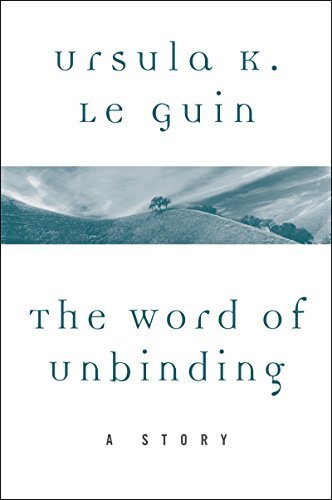
Story first published in 'Fantastic' in 1964, and reprinted in 'The Wind's Twelve Quarters' in 1975. Along with “The Rule of Names,” this was one of two short stories to serve as a precursor to the author’s famed Earthsea saga.
The recipient of numerous literary prizes, including the National Book Award, the Kafka Award, and the Pushcart Prize, Ursula K. Le Guin is renowned for her spare, elegant prose, rich characterization, and diverse worlds.
Ursula K. Le Guin published twenty-two novels, eleven volumes of short stories, four collections of essays, twelve books for children, six volumes of poetry and four of translation, and has received many awards: Hugo, Nebula, National Book Award, PEN-Malamud, etc. Her recent publications include the novel Lavinia, an essay collection, Cheek by Jowl, and The Wild Girls. She lived in Portland, Oregon.
She was known for her treatment of gender (The Left Hand of Darkness, The Matter of Seggri), political systems (The Telling, The Dispossessed) and difference/otherness in any other form. Her interest in non-Western philosophies was reflected in works such as "Solitude" and The Telling but even more interesting are her imagined societies, often mixing traits extracted from her profound knowledge of anthropology acquired from growing up with her father, the famous anthropologist, Alfred Kroeber. The Hainish Cycle reflects the anthropologist's experience of immersing themselves in new strange cultures since most of their main characters and narrators (Le Guin favoured the first-person narration) are envoys from a humanitarian organization, the Ekumen, sent to investigate or ally themselves with the people of a different world and learn their ways.
Such elegant, sharp prose and to fit so much into so few pages! What a gorgeous story. I will definitely need to start The Earthsea Cycle sometime soon.
Odlicna mala prica! Ursula K. Le Guin opasno dobro barata recima, bilo je pravo uzivanje citati po prvi put nesto od nje. Ovo moze biti dobar nagovestaj necega velikog.
This is the first Earthsea tale and only 9 pages despite that it manages to be quite fun,have some lore and some fun mythology. The magic here isn't imposing but what one as a child would think magic was, were and would be. You knew the name of objects and that's how you managed to change yourself but not too much otherwise the balance went to shit. The title itself is a magic wizards emselves only do once a lifetime cause essentially is suicide...well not that but a spell able that you unbind from your own body but may not return to it again but while in that state you can apparently battle creatures of similiar state like the Wizard Voll in this case. It has a pretty fun nostalgic tone and the prose is fun despite this being an early Le Guin tale.
OK on its own as a story of a good wizard who is imprisoned by a powerful evil wizard, but most readers will find it primarily interesting as Le Guin's first story in her Earthsea world
Ursula Le Guin sadə dillə sehirli ab-havaya saldığı bir hekayə daha - əbədi düşmənindən çevrilmə ilə qaçmağa çalışan insan həll yolunu Ölülər diyarına keçməkdə görür. "Ən uzaq sahil"ə göndərmə dolu.
Universo Terramar. Un joven mago llamado Festin, introvertido y amante de la naturaleza, despierta en una habitación oscura sin puertas ni ventanas. Festin habia salido en un viaje para explorar sus poderes y afianzarlos y en el camino es hecho prisionero por Voll, un mago oscuro y poderoso. Festin intenta escapar transformándose en diferentes elementos hasta que se convierte en trucha... Un cuento maravilloso que con pocos elementos Guin te sumerge en la atmósfera, en la tensión claustrofóbica de alguien queriendo recuperar su libertad.
Didn't like this one very much, I found it difficult to understand, alot of the writing lacked clarity. It has very strong thematic links to Earthsea and conveys them very well given it's short length but it's much too simplistic
2,5 Sasvim kratka pričica, lijepo napisana, osjećala sam se kao da sam u tim šumama s likovima. Ali to je sve, radnja i likovi ništa posebno. Prekratka je da bismo saznali nešto više o likovima, nedostaje mi i još pokoja stranica radnje. Čarobnjačke transformacije i nadmudrivanje su mi bili zanimljivi, ali htjela sam još. I kraj mi je malo nejasan.
Orilium: Astronomy – Qualified: Lunar Alignment – Read from a finished series
Hoje, 22 de setembro de 2021, eu começo minha odisseia pela saga de Terramar, de Ursula K. Le Guin. Fora do usual, começo pela ordem proposta nesse site, Earthsea Cycle.
O que posso notar da construção fantástica da autora é o foco em aspectos da fantasia que não são tão clarificados em outras obras clássicas, como o próprio Tolkien. Tolkien não foca em magos e nem mesmo nos feitiços que eles conjuram, tornando seus poderes obscuros durante a obra. Essa abordagem aos magos e seus poderes é mais semelhante ao trabalho de Glen Cook, mas não parece focar (nesta obra) na guerra e seus consequências. Nota-se que autoras como J. K. Rowling, que não têm preocupação com o refinamento da própria obra, pegaram aspectos do trabalho de Le Guin e o corromperam, enfraquecendo seus conceitos para uma audiência mais jovem e leiga. Apesar disso ser vital para a acessibilidade do conteúdo, não deixa de ser uma corruptela, e a leitura do trabalho inspirador é vital para uma compreensão completa do próprio gênero fantástico.
Collected in The Wind's Twelve Quarters: A Story, this is chronologically the first story to take place in the The Earthsea Cycle. It begins with Wizard Festin frantically trying to escape from imprisonment by an enemy wizard, Voll The Fell. By the end of this story I had a little tear in my eye at how Festin tried, and failed but never quit. This man is a true hero. If this were to be a person's first exposure to Earthsea, I'd hazard to say most would be impressed and decide to delve further into the universe.
This is a whimsical little short story—nine or so pages—about a wizard trapped in a dungeon who's trying to escape. It's one of the earlier works of Ursula K Le Guin, written before she wrote her critical acclaimed Wizard of Earthsea novel, and it's included in the giant Books of Earthsea bible I just got.
This story is more about texture than plot. The writing is flowery and purple, and probably worth it just for that. Besides, that it's interesting to see the spells the wizard casts, how he is foiled on every attempt, as well as how the story ultimately resolves. Now, to be honest, the writing is purple enough that I'm not sure I totally understand how it resolves. But even so, the ending still has a satisfying feel to it.
So interesting! It's Earthsea but then again it's not, just a rough and ready version. But reading this directly after The Farthest Shore is really fun
A quick set piece, thematically light, but heavy on the imaginativeness. It effectively manages to create a feeling of magic in incredibly unfamiliar terrain.
I'll never experience the joy of reading Earthsea for the first time again and that upsets me greatly. But this little story reminds me of how much I enjoyed being in that world.
I loved reading the different ways that a wizard might try to get out of an imprisonment and enjoyed how vivid Le Guin's description of the nature and environment was. I do have to be honest and say that it didn't grab me as much as some of her other stories have, though that is mostly due to the fact that I find I need to get used to an Earthsea story for a bit before I can fully dive in. The Word of Unbinding was just so short that I lost out on that. Also I was itching to get to the final few stories in the Cycle and that may have hurt the experience a bit as well.
Nonetheless - I am excited to reread it once I read The Wind's Twelve Quarters!
To give up oneself for the saving of the world is not new but in this age of self confirmation and hunt for wealth it is still a sobering read. Mrs. Le Guin had a way of creating sentence that both bind and unbind...
Ursula K. Le Guin’s 1964 short story The Word of Unbinding is the exact place where her legendary fantasy world of Earthsea first sprouted its roots. This little 24-page ditty drops us right into a deep, dark magical fix with a good-hearted wizard named Festin. Festin gets himself utterly cornered and trapped down in a stone dungeon by a downright nasty, power-mad sorcerer named Voll, who likes to go around locksmithing other magic-folks into sealed tombs. Our boy tries every slick transformation trick in the book to bust out—turning his own flesh and bones into a hawk, a gold ring, a blind worm, and even a trout swimming through the groundwater—but Voll’s dark magic blocks him at every single turn like a stubborn mule blocking a narrow barn door. Eventually, poor Festin figures out a terrifying truth: the reason Voll is completely bulletproof is because he’s already deader than a door nail, pulling the strings of his evil servants straight from the world of the dead. Realizing he can't win a physical slugfest, Festin makes a bone-chilling choice and whispers the "word of unbinding"—a ultimate, one-time spell that is basically voluntary suicide. Spreading that final word shatters his physical shell and blows the dungeon walls right into sawdust, letting his spirit march directly into the shadowy afterlife to drag Voll kicking and screaming back into his own corpse, saving the rest of the world at the cost of his own life. It is a short, elegant, and deeply moving piece of high fantasy moonshine that highlights how much power lies in a person's true name and their willingness to face down mortality.
The Word of Unbinding feels most valuable as a glimpse of Le Guin discovering what Earthsea would eventually become. The prose is already elegant and atmospheric, with flashes of the mythic register that would define the later books, but the world itself still feels provisional. The magic, terminology, and underlying logic have not yet settled into the coherence and depth that make Earthsea so distinctive.
As a standalone story, I found it slight and underdeveloped, but as an early experiment it is genuinely interesting. You can see Le Guin testing ideas and gradually finding the shape of the world she would later realize with far greater confidence.