

What do you think?

Maestros and Their Music: The Art and Alchemy of Conducting
An exuberant, uniquely accessible, beautifully illustrated look inside the enigmatic art and craft of conducting, from a celebrated conductor whose international career has spanned half a century.
John Mauceri brings a lifetime of experience to bear in an unprecedented, hugely informative, consistently entertaining exploration of his profession, rich with anecdotes from decades of working alongside the greatest names of the music world. With candor and humor, Mauceri makes clear that conducting is itself a composition: of legacy and tradition, techniques handed down from master to apprentice--and more than a trace of ineffable magic. He reveals how conductors approach a piece of music (a calculated combination of personal interpretation, imagination, and insight into the composer's intent); what it takes to communicate solely through gesture, with sometimes hundreds of performers at once; and the occasionally glamorous, often challenging life of the itinerant maestro. Mauceri, who worked closely with Leonard Bernstein for eighteen years, studied with Leopold Stokowski, and was on the faculty of Yale University for fifteen years, is the perfect guide to the allure and theater, passion and drudgery, rivalries and relationships of the conducting life.
John Mauceri brings a lifetime of experience to bear in an unprecedented, hugely informative, consistently entertaining exploration of his profession, rich with anecdotes from decades of working alongside the greatest names of the music world. With candor and humor, Mauceri makes clear that conducting is itself a composition: of legacy and tradition, techniques handed down from master to apprentice--and more than a trace of ineffable magic. He reveals how conductors approach a piece of music (a calculated combination of personal interpretation, imagination, and insight into the composer's intent); what it takes to communicate solely through gesture, with sometimes hundreds of performers at once; and the occasionally glamorous, often challenging life of the itinerant maestro. Mauceri, who worked closely with Leonard Bernstein for eighteen years, studied with Leopold Stokowski, and was on the faculty of Yale University for fifteen years, is the perfect guide to the allure and theater, passion and drudgery, rivalries and relationships of the conducting life.
272 pages, Hardcover
First published November 7, 2017
Ratings & Reviews
Friends & Following
Create a free account to discover what your friends think of this book!
Community Reviews
Displaying 1 - 30 of 49 reviews

August 31, 2024
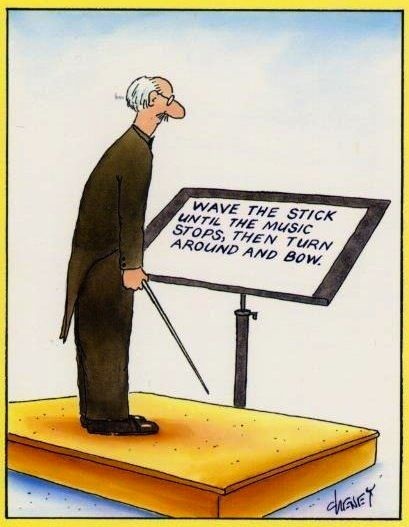
Strictly speaking, this was more of a 4-star read, but I loved it, even if it’s a bit all over the place, so objectivity be damned: it gets the full five stars from me.
Conductor John Mauceri narrates his own book and does it very well, listening to it was a pleasure.
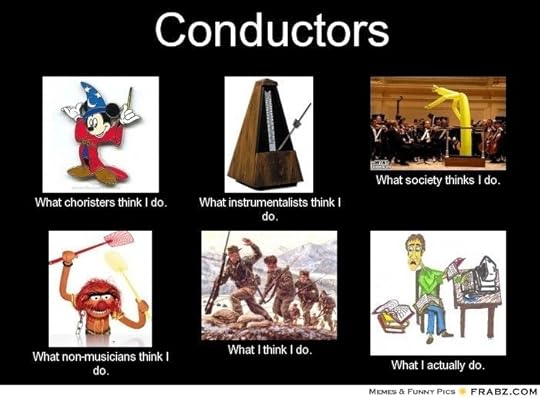
While I love classical music in general, the real push for picking up this book came after a minor disagreement with my husband. We’d just attended a concert, and I was raving about the conductor’s style and interpretation. He brushed it off, saying the conductor doesn’t matter—“the music’s the same.” I was incredulous. He thought I was showing off; I thought he lacked nuance.
It could have gotten nasty, but we are still married 🤭, despite this serious philosophical and musical divide.
Oh well, ours is a marriage a la Terry Pratchett: "A marriage is always made up of two people who are prepared to swear that only the other one snores." Obviously he's the one snoring and I'm the one putting up with it with infinite patience. Don’t let him tell you otherwise.
Anyway, I remain firmly convinced that conductors do matter and no two will ever interpret a piece in exactly the same way, even with the same orchestra. My practical (and yes, sophisticated!) argument still falls on deaf ears at home. But just go listen to the Berliner Philharmoniker perform the same musical piece under Herbert von Karajan, Claudio Abbado, Simon Rattle, or Kirill Petrenko. All brilliant. All different. Varietas delectat, indeed.
So, imagine my satisfaction when John Mauceri echoed this very idea. Through his memoir, he offers an honest and engaging look at the life of a conductor: the struggles, the triumphs, the compromises, and the dedication required. He peels back the mystique of the maestro and reveals the human being behind the music stand.
He occasionally dives into technical aspects, but never at the expense of accessibility or enjoyment. He's never dry or didactic. Instead, he invites the reader backstage—sharing insight, stories, and even the occasional bit of gossip. Yet he always remains respectful toward his peers: fellow conductors, musicians, composers, singers, critics, and audiences alike.
In the end, what comes through most is his love for the art form—its drama, its beauty, its complexity, and yes, its humanity. This isn’t just a book for music scholars or die-hard classical fans; it’s for anyone curious about what it is all about. For me, it was a great experience that deepened both my appreciation for conductors and my determination to keep stubbornly disagreeing with my husband about them.

Read
June 7, 2026I didn’t plan to finish listening to this book initially. I read the blurb and listened to the intro and was worried that given the author’s long relationship with Bernstein ( whom I deeply respect), his view would be inevitably shaped by that experience. As someone who’s quite new to classical music and was trying to get a better idea of the alchemy of conducting, I wasn’t sure if an opinionated understanding of conducting was what I needed. In the end, that concern didn’t matter because I came to understand that even conductors viewed conducting as something of a mystery and everything about this profession involved opinions and personal interpretations. I ended up learning a great deal about the profession, as well as how I should approach different recordings going forward.
The following are some notes as well as my personal musings:
Mauceri makes a great analogy that conducting is like holding a candle in front of the statue of David in the dark. In each performance, the conductor can only illuminate certain parts of the statue, and only by attending different performances and listening to different recordings, can one form a more complete understanding of a piece. He then compares the approaches of Karajan, Bernstein, and Boulez using art restoration as an analogy:
Karajan was someone who loved the da Vinci paintings as he found them and never cared to remove the layers of varnish , preferring soft outlines and intentionally dark and blurring surfaces. Bernstein attempted to restore the original background and middle ground. Boulez used dispassionate X-ray machines to reveal the framework and process. Far more interesting is his idiosyncratic choices of tempo than his ability to balance complex music gestures.
Mauceri points out that the missing elements in each performance don’t matter; each conductor’s work reveals more about them as people— this is the part I personally relate to a lot. It seems strange that we can hear things like “humility” or “confidence” in the conducting , but they are in fact all there in the music: sometimes in the way a conductor allows the orchestra to let the notes linger just a tiny bit longer as if relinquishing his control and handing it back to the natural flow of the music ( eg Haitink); or in the way how clean and incisive a conductor makes everything sound (e.g., Boulez).
I’d add that perhaps the listener’s preferences also say a lot about their personalities. Recently, I am really into Boulez’s Mahler 2 ( Vienna). Apart from my preference for clarity, I find I am also drawn to his steady tempo and the comfort of the predictability his tempo choices offer ( though because the tempo is kept steady, when the music hits a fermata or a structural shift, the shock of the sudden silence / change is so much more visceral). On the other hand, Fischer’s whimsical approach to tempo tends to stress me out; the elasticity of the music makes me feel disoriented. Maybe I am a bit of a square 😅
I also like the bit where Mauceri talks about silence ( in the chapter on recording vs. live performance): Silence is irrelevant on a recording but essential in a live performance. Things like how long a fermata should be are to the conductor. Silence coalescing that had happened and indicating something about to happen— it’s a pregnant pause.
I sometimes find the lack of silence can reveal a lot too. I recently attended a Mahler 3 performance, and there was no pause at all between movement 5 and 6— that lack of silence can’t be reflected on the recordings either. In this case, the choice of playing the two movements with no pause illuminated how compositionally and emotionally coherent Mahler’s music was— there was such beautiful inevitability that I hadn’t noticed before.
Something else that moved me while I was listening was Mauceri’s experience sitting in a Giulini rehearsal, a conductor of profound spirituality. He described Giulini conducting Schubert’s Unfinished with such deep humility, at one point he looked as if he was a beggar with his hands held out. I sought out one of Giulini’s recordings to listen to, and I could understand why Mauceri commented that Giulini makes the “ Unfinished “ complete after I finished listening.
Another thing I never knew was that composers in fact changed their minds about their scores all the time. eg , Mahler tuning and changing his own orchestration of symphony 8 to fit the acoustics of the concert halls. He in fact felt it was his responsibility to make changes to his own music as well as that of others’ to fit the sound of a hall.
Also apparently, Strauss conducted his own music in a dispassionate manner -isn’t that super interesting?
There is much more that’s interesting but I am running out of steam today.
The long and short of it is that this is a very informative and accessible book about conducting that I’d recommend to anyone who wants to get a better understanding of the wizardry of conducting.
The following are some notes as well as my personal musings:
Mauceri makes a great analogy that conducting is like holding a candle in front of the statue of David in the dark. In each performance, the conductor can only illuminate certain parts of the statue, and only by attending different performances and listening to different recordings, can one form a more complete understanding of a piece. He then compares the approaches of Karajan, Bernstein, and Boulez using art restoration as an analogy:
Karajan was someone who loved the da Vinci paintings as he found them and never cared to remove the layers of varnish , preferring soft outlines and intentionally dark and blurring surfaces. Bernstein attempted to restore the original background and middle ground. Boulez used dispassionate X-ray machines to reveal the framework and process. Far more interesting is his idiosyncratic choices of tempo than his ability to balance complex music gestures.
Mauceri points out that the missing elements in each performance don’t matter; each conductor’s work reveals more about them as people— this is the part I personally relate to a lot. It seems strange that we can hear things like “humility” or “confidence” in the conducting , but they are in fact all there in the music: sometimes in the way a conductor allows the orchestra to let the notes linger just a tiny bit longer as if relinquishing his control and handing it back to the natural flow of the music ( eg Haitink); or in the way how clean and incisive a conductor makes everything sound (e.g., Boulez).
I’d add that perhaps the listener’s preferences also say a lot about their personalities. Recently, I am really into Boulez’s Mahler 2 ( Vienna). Apart from my preference for clarity, I find I am also drawn to his steady tempo and the comfort of the predictability his tempo choices offer ( though because the tempo is kept steady, when the music hits a fermata or a structural shift, the shock of the sudden silence / change is so much more visceral). On the other hand, Fischer’s whimsical approach to tempo tends to stress me out; the elasticity of the music makes me feel disoriented. Maybe I am a bit of a square 😅
I also like the bit where Mauceri talks about silence ( in the chapter on recording vs. live performance): Silence is irrelevant on a recording but essential in a live performance. Things like how long a fermata should be are to the conductor. Silence coalescing that had happened and indicating something about to happen— it’s a pregnant pause.
I sometimes find the lack of silence can reveal a lot too. I recently attended a Mahler 3 performance, and there was no pause at all between movement 5 and 6— that lack of silence can’t be reflected on the recordings either. In this case, the choice of playing the two movements with no pause illuminated how compositionally and emotionally coherent Mahler’s music was— there was such beautiful inevitability that I hadn’t noticed before.
Something else that moved me while I was listening was Mauceri’s experience sitting in a Giulini rehearsal, a conductor of profound spirituality. He described Giulini conducting Schubert’s Unfinished with such deep humility, at one point he looked as if he was a beggar with his hands held out. I sought out one of Giulini’s recordings to listen to, and I could understand why Mauceri commented that Giulini makes the “ Unfinished “ complete after I finished listening.
Another thing I never knew was that composers in fact changed their minds about their scores all the time. eg , Mahler tuning and changing his own orchestration of symphony 8 to fit the acoustics of the concert halls. He in fact felt it was his responsibility to make changes to his own music as well as that of others’ to fit the sound of a hall.
Also apparently, Strauss conducted his own music in a dispassionate manner -isn’t that super interesting?
There is much more that’s interesting but I am running out of steam today.
The long and short of it is that this is a very informative and accessible book about conducting that I’d recommend to anyone who wants to get a better understanding of the wizardry of conducting.

June 26, 2023
Нормальная книжка для начинающих и продолжающих любителей музыки: погуглить все упомянутые фамилии дирижеров и исполнителей, легендарные выступления и ключевые записи произведений — и у вас сформирована неплохая база знаний Classical Music in the 20th century 101 (даже, может, 102).

October 6, 2023
I’m likely a bit better than average as a amateur musicologist. I can’t play any instrument (though I’ve tried a dozen), but I know symphonic form and can distinguish major from minor from diminished from augmented. I normally can recognize over half “European Art Music” written between 1700 and 1937, and can tack on Phillip Glass and Arvo Pärt.
This book convinces me I screwed up: I should have tried to become a conductor. In college, I took two semesters of music theory, three of composition, and a seminar on conducting. But I did that because the School of Engineering allowed me to classify them as two and a half years of English lit or foreign languages. It never was in the cards for me.
That didn’t dampen my enjoyment of John Mauceri’s 2017 autobiography. He might have subtitled the book: “My life as a guest conductor.” And, indeed, I realized I attended one concert he describes. But for the most part, this isn’t a detailed dwelling into music theory. Instead, it’s mostly “tales from the podium.” He supplies ample history to those unfamiliar with particular symphonies and operas. He reproduces a page from a score fewer than five times. You don’t have to read music, or know much about it, to enjoy this book.
That’s because his style is appealing and educational. Although he was Leonard Bernstein’s assistant for many years, he’s anything but the “glad to meet you; call me Lenny” of his late boss. Indeed, in a telling manner, the author concedes Lenny was the best conductor in the world only “for 445 days”—between the death of Herbert von Karajan and Bernstein’s death. You don’t get the impression of much love lost there.
I wish this book were written 45 years ago. Not that I could have been a contender. But because Mauceri has a simple yet informative style I missed back then. (Speaking of back, he says the second most important thing a Conductor needs, after an ability to read music and understand its history, is exercising shoulder and back muscles.)
The third most important thing you need to do is suck up to the orchestra. They’re union members; conductors aren’t. Guest conductors are rated by orchestras, and those ratings are used in hiring decisions. Mauceri managed some original research that convinced him two notes in the score of an orchestral work long in the repertoire were wrong—a copy editor error. Excited by this discovery, he explained the finding at his next gig. The orchestra barely tolerated it; the reviews must have been terrible; and he never was invited back.
Although Mauceri apparently found a full-time gig at the Hollywood Bowl, he never describes the sequence of events leading to that—an odd omission. But once there, he describes some genuinely exciting experiments with redoing live music with existing films.
You needn’t be a wannabe conductor to like this book. Mauceri is such a likable guy, and his prose style so unaffected, I’d recommend this book to everyone.
This book convinces me I screwed up: I should have tried to become a conductor. In college, I took two semesters of music theory, three of composition, and a seminar on conducting. But I did that because the School of Engineering allowed me to classify them as two and a half years of English lit or foreign languages. It never was in the cards for me.
That didn’t dampen my enjoyment of John Mauceri’s 2017 autobiography. He might have subtitled the book: “My life as a guest conductor.” And, indeed, I realized I attended one concert he describes. But for the most part, this isn’t a detailed dwelling into music theory. Instead, it’s mostly “tales from the podium.” He supplies ample history to those unfamiliar with particular symphonies and operas. He reproduces a page from a score fewer than five times. You don’t have to read music, or know much about it, to enjoy this book.
That’s because his style is appealing and educational. Although he was Leonard Bernstein’s assistant for many years, he’s anything but the “glad to meet you; call me Lenny” of his late boss. Indeed, in a telling manner, the author concedes Lenny was the best conductor in the world only “for 445 days”—between the death of Herbert von Karajan and Bernstein’s death. You don’t get the impression of much love lost there.
I wish this book were written 45 years ago. Not that I could have been a contender. But because Mauceri has a simple yet informative style I missed back then. (Speaking of back, he says the second most important thing a Conductor needs, after an ability to read music and understand its history, is exercising shoulder and back muscles.)
The third most important thing you need to do is suck up to the orchestra. They’re union members; conductors aren’t. Guest conductors are rated by orchestras, and those ratings are used in hiring decisions. Mauceri managed some original research that convinced him two notes in the score of an orchestral work long in the repertoire were wrong—a copy editor error. Excited by this discovery, he explained the finding at his next gig. The orchestra barely tolerated it; the reviews must have been terrible; and he never was invited back.
Although Mauceri apparently found a full-time gig at the Hollywood Bowl, he never describes the sequence of events leading to that—an odd omission. But once there, he describes some genuinely exciting experiments with redoing live music with existing films.
You needn’t be a wannabe conductor to like this book. Mauceri is such a likable guy, and his prose style so unaffected, I’d recommend this book to everyone.

December 30, 2017
Disappointing. Dry.
I felt like I was at a dinner party listening to the author talk about random things in the conducting and music world. He didn’t go into enough depth or detail about specific things - just snippets about this and that. It was hard to stay interested. He should have coauthored with a writer or journalist to make it more engaging.
For example he mentioned the conductor Muti a couple times, but he didn’t say anything meaningful about Muti. Was Muti good or not good, and why? Tell me something interesting about Muti. And the same with other conductors, give me some opinions.
The author briefly mentioned that Petrillo in Chicago was a key figure behind unionizing musicians. Petrillo claimed recorded music took jobs away from musicians. Petrillo was also against something about small musician groups. I was confused. I wanted to know more about Petrillo - how were things before and after him, but it was just sort of mentioned in passing.
Slightly annoying was the way the author frequently said “I was asked to conduct ...” It felt egotistical. I would have preferred hearing him say “I conducted ...”
ONE THING I REALLY LIKED AND I LEARNED SOMETHING:
I was interested in the following comment about Maria Callas. The author was giving his opinion and judgment. I wish he did more of that on other subjects.
“Anyone who attended the farewell performances of Maria Callas in recital with tenor Giuseppe Di Stefano will know precisely what I mean. By 1974 Callas was barely Callas - her voice having shrunk in size, her vibrato having curdled into a wobble in its upper register, and her sound clouded and covered. But every now and then something happened, a fiery flash in her eyes, a gesture of vulnerability, a perfectly turned phrase, and memories were awakened of when she was great and members of the audience were young. Respect, sadness, mortality, curiosity and a desire to stop inevitability, fueled the public’s emotions during the performances and buoyed them and Callas through each evening. It occasionally felt as if the audience were giving her the strength to carry on, and probably it did.”
AUDIOBOOK NARRATOR:
The author narrated his own book. He was good as a narrator.
DATA:
Book copyright: 2017. Genre: nonfiction, memoir.
I felt like I was at a dinner party listening to the author talk about random things in the conducting and music world. He didn’t go into enough depth or detail about specific things - just snippets about this and that. It was hard to stay interested. He should have coauthored with a writer or journalist to make it more engaging.
For example he mentioned the conductor Muti a couple times, but he didn’t say anything meaningful about Muti. Was Muti good or not good, and why? Tell me something interesting about Muti. And the same with other conductors, give me some opinions.
The author briefly mentioned that Petrillo in Chicago was a key figure behind unionizing musicians. Petrillo claimed recorded music took jobs away from musicians. Petrillo was also against something about small musician groups. I was confused. I wanted to know more about Petrillo - how were things before and after him, but it was just sort of mentioned in passing.
Slightly annoying was the way the author frequently said “I was asked to conduct ...” It felt egotistical. I would have preferred hearing him say “I conducted ...”
ONE THING I REALLY LIKED AND I LEARNED SOMETHING:
I was interested in the following comment about Maria Callas. The author was giving his opinion and judgment. I wish he did more of that on other subjects.
“Anyone who attended the farewell performances of Maria Callas in recital with tenor Giuseppe Di Stefano will know precisely what I mean. By 1974 Callas was barely Callas - her voice having shrunk in size, her vibrato having curdled into a wobble in its upper register, and her sound clouded and covered. But every now and then something happened, a fiery flash in her eyes, a gesture of vulnerability, a perfectly turned phrase, and memories were awakened of when she was great and members of the audience were young. Respect, sadness, mortality, curiosity and a desire to stop inevitability, fueled the public’s emotions during the performances and buoyed them and Callas through each evening. It occasionally felt as if the audience were giving her the strength to carry on, and probably it did.”
AUDIOBOOK NARRATOR:
The author narrated his own book. He was good as a narrator.
DATA:
Book copyright: 2017. Genre: nonfiction, memoir.

September 25, 2018
This book seems to be more of an introduction for people not overly familiar with classical music or symphonic orchestration. As a classical musician, I knew a good deal of what he was talking about.
However, since I am not a conductor, I found a lot of his observations insightful and informative. John Mauceri knew a lot of the really important conductors of the last century and he tells many interesting stories about them and their philosophies and methods of conducting.
Chapters include: A short history of conducting; learning to be a conductor, why do different conductors interpret works in dramatically different ways; the relationships between the conductor and music, musicians, audience, and composers.
I especially appreciated his section on critics. It seems no matter how famous and wonderful you are as a conductor, there will be a reviewer that will trash your work. This made me feel better due to the criticism I have received from certain stupid louts who couldn't play the piano if their life depended on it....I mean....people who have given their "expert" opinion of my own performances.
I also liked his chapter on recordings vs. life performances.
If you are interested in classical music from a conductor's perspective, I recommend this book.
However, since I am not a conductor, I found a lot of his observations insightful and informative. John Mauceri knew a lot of the really important conductors of the last century and he tells many interesting stories about them and their philosophies and methods of conducting.
Chapters include: A short history of conducting; learning to be a conductor, why do different conductors interpret works in dramatically different ways; the relationships between the conductor and music, musicians, audience, and composers.
I especially appreciated his section on critics. It seems no matter how famous and wonderful you are as a conductor, there will be a reviewer that will trash your work. This made me feel better due to the criticism I have received from certain stupid louts who couldn't play the piano if their life depended on it....I mean....people who have given their "expert" opinion of my own performances.
I also liked his chapter on recordings vs. life performances.
If you are interested in classical music from a conductor's perspective, I recommend this book.

Read
May 7, 2018In Maestros and Their Music, John Mauceri gives us unique access into the world of conducting. What is the man waving with his hands in front of the orchestra really doing? How does one become a conductor? How is quality in conducting judged; what makes one better than another? And truly, why are they important in performances of classical music? All the natural questions that might arise in anyone thinking about the art of conducting are wonderfully and convincingly explored in this book. John Mauceri writes from personal experience, as well as the experiences of people he has gotten to know through the years; combining anecdotes with general discussions of the staple-parts of the job, the skill, the controversy, and the history of the conductor. He begins with giving the historical origins of the conductor, as music began to change in the 19th century and the need arose for someone to oversee increasingly complex compositions, and further gives us an overview of this invisible art form’s development and progression through the 20th century and beyond.
Full Review: https://weneedhunny.wordpress.com/201...
Full Review: https://weneedhunny.wordpress.com/201...

April 27, 2018
While the book is a bit repetitious, and has at its center a bit of a shrug (paraphrasing: "We don't really know what makes a great conductor"), this is definitely worth reading if you have any appreciation for or interest in classical music. The author, a conductor himself, talks about the history of conducting and, more interestingly, the myriad choices that a conductor has to make, to satisfy him(almost always him)self as well as to meet the constraints of the musicians, the management, the schedule, and so forth. It's a very nice elucidation of something that does look and sound a bit like alchemy.
December 9, 2017
One of the best books of 2017. A must read for anyone with the slightest interest in music or theatre.

July 5, 2020
What do conductors actually do? How do they command the trust and respect of the orchestra? And what defines greatness in a field of subjective interpretation? John Mauceri, an acclaimed conductor in his own right, explores these questions in a memoir that is insightful, entertaining, and rich with personal anecdotes. The book is not without its weaknesses though. The writing is engaging but also a bit messy. The chapters don't necessarily follow a logical sequence. Moreover, Mauceri’s treatment of his conductor peers is very uneven. He doesn’t make a single reference to Carlos Kleiber who is widely regarded as the greatest conductor of the past half-century. This is an unforgivable omission in a book about conducting, not least since Mauceri gives Gilbert Kaplan, an amateur conductor who was obsessed with Mahler’s Second Symphony, an overgenerous treatment in the introduction.

November 20, 2017
A wonderful series of essays on conducting. It’s part observation, part autobiography, and part insider's gossip. I've read several books by conductors and it's interesting that they rarely discuss individual musicians in the orchestras they lead. They'll talk about directors and managers but rarely about oboists or bassists.
February 4, 2026
For a classical music fan, this was a real pleasure to read, and will make future visits to the symphony more meaningful. My only regret is that the book doesn’t cover the new , young breed of current conductors, but rather focuses on older and previous generations.
July 22, 2017
I was lucky enough to get my hands on a copy of esteemed American conductor John Mauceri's upcoming book, Maestros and Their Music, half autobiography and half pop-history account of conductors and everything that makes their arcane art so unique. The book, Mauceri's first, shows few signs of being unpolished and is rarely amateur work - rather, it consistently makes engaging reading while staying light and unconcerned. As a disciple of the legendary American maestro Leonard Bernstein, the author has as many anecdotes of his own to share as ones passed down through oral (or is it aural?) legend over generations of greats, from modern masters like Sir Simon Rattle back to progenitors of modern conducting like Mahler and Strauss.
If the book has one major flaw, it's that its audience is somewhat difficult to pinpoint - those with extensive musical background will find the stories interesting but some of the explanations geared towards the layman to be tedious; likewise, those with little knowledge of conducting or the wider classical world may be grateful for some of Mauceri's explanations but have little actual interest in whatever rude thing Herbert von Karajan had to say about his concertmaster. Regardless of this fact, anyone with sufficient interest should find Maestros and Their Music to be a fun read to pass time during intermissions or as a jumping off point in exploring the great conductors of both today as well as antiquity.
If the book has one major flaw, it's that its audience is somewhat difficult to pinpoint - those with extensive musical background will find the stories interesting but some of the explanations geared towards the layman to be tedious; likewise, those with little knowledge of conducting or the wider classical world may be grateful for some of Mauceri's explanations but have little actual interest in whatever rude thing Herbert von Karajan had to say about his concertmaster. Regardless of this fact, anyone with sufficient interest should find Maestros and Their Music to be a fun read to pass time during intermissions or as a jumping off point in exploring the great conductors of both today as well as antiquity.

January 20, 2019
This book is AMAZING, and anyone who is the least bit interested in orchestral music should read it. Mauceri's book isn't exactly a memoir of his life as a conductor, although he does illuminate a lot of his points with examples from his own life and experiences. Mauceri explores the nature of the conductor's job, and what it demands to be a good one. He writes about how conducting developed, how conductors approach the music, how they relate to the individual musicians and to the concertgoing public, and even how they live lives of constant travel. His writing style is warm and conversational, but also erudite and infused with a deep love of his subject. Great book.

August 19, 2019
This book was a fascinating one to me for several reasons. For one, I have long been involved in choral and orchestral music, since my youth in both cases, and have a great experience in dealing with conductors. In addition, I have on a few occasions been a conductor myself, an experience I have generally enjoyed, although I have no formal education in it. This particular author is someone I had never heard about personally although he works in circles that I am familiar with and is writing about a compelling and interesting subject. This book certainly makes me want to pay attention more to the work of conductors and to examine the subtle influence that they have on the way that music is played, a certain style that they tend to encourage in the orchestras and other groups that they lead. And any book that makes me want to know more about someone or something is generally one I can appreciate and recommend to others, especially those in the NPR-listening set or who enjoy going to concerts. Then again, it seems unlikely that anyone would want to read a book like this unless they appreciated the work that conductors did anyway.
At any rate, this book is about 250 pages long and is divided into ten chapters. The author begins with an introduction that puts himself and his own career and education as a conductor into context. After that he provides a short history of conducting (1) as well as some discussion of the techniques that are used in conducting (2). The next two chapters answer obvious questions that someone would have about conducting, namely how one learns an orchestra score (3) and how one learns to be a conductor in the first place (4). After that the author ponders the question of what makes one conductor's performance different from another's and looks at the individual sense of style that great conductors have (5). The next, and by the far the largest, chapter examines relationships (6), such as the relationship a conductor has with the music, with musicians, with the audience, with critics, and with owners and management. The author then deals with the thorny question of who is in charge in a given performance (7), which varies depending on the circumstances. The author gets personal with a discussion of the loneliness of the long-distance maestro (8), discusses recordings vs. performances vs. recordings of performances (9), and then closes the book with a discussion of the mystery of conducting (10), after which there are acknowledgements, notes, and an index.
What does one get out of this? Well, for one, the growth of performances of classical music to the point where music became part of a repertoire and wasn't merely occasional music led by the composer created a niche for the development of a profession that quickly attracted a lot of power-hungry people to it. That said, conductors themselves have had to deal with a lot of complex expectations where being true to the music is by no means straightforward, and where the interests of management, vocal or instrumental soloists, and production directors (in the case of opera) often trump the desire of the conductor to do things their own way. The author is also very moving on the struggle that conductors face to make a living themselves when dealing with the itinerant life and its expenses as well as the lower money that pops conductors make when compared to those who limit themselves to the more prestigious classical repertory. All of this makes for some deeply fascinating reading about a profession that few people know about in detail.
At any rate, this book is about 250 pages long and is divided into ten chapters. The author begins with an introduction that puts himself and his own career and education as a conductor into context. After that he provides a short history of conducting (1) as well as some discussion of the techniques that are used in conducting (2). The next two chapters answer obvious questions that someone would have about conducting, namely how one learns an orchestra score (3) and how one learns to be a conductor in the first place (4). After that the author ponders the question of what makes one conductor's performance different from another's and looks at the individual sense of style that great conductors have (5). The next, and by the far the largest, chapter examines relationships (6), such as the relationship a conductor has with the music, with musicians, with the audience, with critics, and with owners and management. The author then deals with the thorny question of who is in charge in a given performance (7), which varies depending on the circumstances. The author gets personal with a discussion of the loneliness of the long-distance maestro (8), discusses recordings vs. performances vs. recordings of performances (9), and then closes the book with a discussion of the mystery of conducting (10), after which there are acknowledgements, notes, and an index.
What does one get out of this? Well, for one, the growth of performances of classical music to the point where music became part of a repertoire and wasn't merely occasional music led by the composer created a niche for the development of a profession that quickly attracted a lot of power-hungry people to it. That said, conductors themselves have had to deal with a lot of complex expectations where being true to the music is by no means straightforward, and where the interests of management, vocal or instrumental soloists, and production directors (in the case of opera) often trump the desire of the conductor to do things their own way. The author is also very moving on the struggle that conductors face to make a living themselves when dealing with the itinerant life and its expenses as well as the lower money that pops conductors make when compared to those who limit themselves to the more prestigious classical repertory. All of this makes for some deeply fascinating reading about a profession that few people know about in detail.

April 21, 2018
A unique and worthy book. While it drags a bit in spots (the middle of the ~250-page volume is occupied by a big, honking chapter on "Relationships"--relationships with the composer, the music, the orchestra, the audience, the critics--that dwarfs every other chapter and could have been cut down or split up, for my money), it's also a very educational book, and its many ideas are backed up by thoughtful, illustrative stories, often personal anecdotes from the author himself, about many of the world's great conductors, composers, performance spaces, and musical works.
My favorite section is the final chapter, which discusses the problem of whether to perform what people expect to hear, or what the composer originally intended. This is illustrated, in part, by the dilemma over how to perform a symphony by Bruno Mahler. Mahler's original score says that one part of the orchestra is to continue briefly at a fast tempo while the rest comes in at a slow one, creating a moment where the orchestra is playing at two different speeds--i.e., not together. This can sound like a mistake, so for a long time, no one performed it that way, instead having the whole orchestra slow down, or "ritard," together as the slower instruments enter. But the author decides he wants to perform it:
"In the opening moments of his fourth symphony, Mahler seemed to be painting an aural image of a sleigh going by. It does not slow down. A completely different musical element begins without regard to the speed of the sleigh music... Once I came to believe this was Mahler's intention, I brought this conclusion to my next performance...Having never heard it myself, I was astounded by its impact, a few seconds into a symphony that would last an hour. The next day, I read in the local paper, 'One can always tell whether a conductor understands the music of Mahler by how he controls the graceful ritard into the charming melody of his Fourth Symphony. Unfortunately, Mr. Mauceri...' You can extrapolate the rest."
The author goes on to discuss whether he was right to do what he did. ("Was I right? Yes. Did I convince? No.") This kind of minute choice can make or break an audience's experience of a piece of music--and a conductor's career. Inside baseball details like this are what makes the book come to life, and I heartily recommend it!
My favorite section is the final chapter, which discusses the problem of whether to perform what people expect to hear, or what the composer originally intended. This is illustrated, in part, by the dilemma over how to perform a symphony by Bruno Mahler. Mahler's original score says that one part of the orchestra is to continue briefly at a fast tempo while the rest comes in at a slow one, creating a moment where the orchestra is playing at two different speeds--i.e., not together. This can sound like a mistake, so for a long time, no one performed it that way, instead having the whole orchestra slow down, or "ritard," together as the slower instruments enter. But the author decides he wants to perform it:
"In the opening moments of his fourth symphony, Mahler seemed to be painting an aural image of a sleigh going by. It does not slow down. A completely different musical element begins without regard to the speed of the sleigh music... Once I came to believe this was Mahler's intention, I brought this conclusion to my next performance...Having never heard it myself, I was astounded by its impact, a few seconds into a symphony that would last an hour. The next day, I read in the local paper, 'One can always tell whether a conductor understands the music of Mahler by how he controls the graceful ritard into the charming melody of his Fourth Symphony. Unfortunately, Mr. Mauceri...' You can extrapolate the rest."
The author goes on to discuss whether he was right to do what he did. ("Was I right? Yes. Did I convince? No.") This kind of minute choice can make or break an audience's experience of a piece of music--and a conductor's career. Inside baseball details like this are what makes the book come to life, and I heartily recommend it!

May 15, 2023
Interesting to learn what it means to be a conductor. Though I started spacing out during some details near the last chapter. I like John Mauceri's voice narration. He does impressions well and I'm intrigued by his pronunciation of words in different languages.
=====
Chapter 12 / 09:17:56
Sun, May 14 | 12:06:42 PM
In the “translation”, going for resonance rather than accuracy. I agree. Dr. Jekyll (vs Jee-kel) comparison to illustrate what this means.
Chapter 11 / 08:56:41
Sun, May 14 | 11:35:09 AM
Artifact vs artifiction (love this word!)
Chapter 11 / 08:43:18
Sun, May 14 | 9:17:37 AM
Benefit of the recording: total control over aspects. It’s not a “performance”
Chapter 11 / 08:40:16
Sun, May 14 | 9:14:22 AM
Nor the loudness?
Chapter 11 / 08:39:05
Sun, May 14 | 9:13:15 AM
You will never hear “density shifts” in recordings of classical music. You can’t hear or single out something like “who plays the opening of Beethoven’s Fifth?” Most people would answer “the entire orchestra” which isn’t true
Chapter 8 / 06:03:07
Sat, May 13 | 3:42:33 PM
A journalist that believed—was convinced—Mauceri and Bernstein were lovers and was set out to punish him in her reviews (yikes)
Chapter 4 / 01:56:04
Tue, May 2 | 6:10:33 PM
Blue = indicate musical phrases, allowing you to see the entire page in an instant and remind you what’s important. By marking a score, you make it your own.
Chapter 4 / 01:54:27
Tue, May 2 | 6:10:10 PM
Leonard Bernstein using red and blue pencils. Developed in Europe and used by accountants: blue for incoming money and red for expenditures. Bernstein was imitating Mahler, who also marked his scores in red/blue. The blue = where his eye needed to go while conducting performance. The red = editorial changes he wished to make in the score (dynamics, orchestration, tempo).
Chapter 1 / 00:02:49
Sat, Apr 29 | 11:47:39 AM
Eliot’s character in TÁR
=====
Chapter 12 / 09:17:56
Sun, May 14 | 12:06:42 PM
In the “translation”, going for resonance rather than accuracy. I agree. Dr. Jekyll (vs Jee-kel) comparison to illustrate what this means.
Chapter 11 / 08:56:41
Sun, May 14 | 11:35:09 AM
Artifact vs artifiction (love this word!)
Chapter 11 / 08:43:18
Sun, May 14 | 9:17:37 AM
Benefit of the recording: total control over aspects. It’s not a “performance”
Chapter 11 / 08:40:16
Sun, May 14 | 9:14:22 AM
Nor the loudness?
Chapter 11 / 08:39:05
Sun, May 14 | 9:13:15 AM
You will never hear “density shifts” in recordings of classical music. You can’t hear or single out something like “who plays the opening of Beethoven’s Fifth?” Most people would answer “the entire orchestra” which isn’t true
Chapter 8 / 06:03:07
Sat, May 13 | 3:42:33 PM
A journalist that believed—was convinced—Mauceri and Bernstein were lovers and was set out to punish him in her reviews (yikes)
Chapter 4 / 01:56:04
Tue, May 2 | 6:10:33 PM
Blue = indicate musical phrases, allowing you to see the entire page in an instant and remind you what’s important. By marking a score, you make it your own.
Chapter 4 / 01:54:27
Tue, May 2 | 6:10:10 PM
Leonard Bernstein using red and blue pencils. Developed in Europe and used by accountants: blue for incoming money and red for expenditures. Bernstein was imitating Mahler, who also marked his scores in red/blue. The blue = where his eye needed to go while conducting performance. The red = editorial changes he wished to make in the score (dynamics, orchestration, tempo).
Chapter 1 / 00:02:49
Sat, Apr 29 | 11:47:39 AM
Eliot’s character in TÁR

November 11, 2019
I enjoy listening to music, including going to symphony performances, but I’m no musician. Furthermore, my knowledge of music theory and the language required to discuss music is limited. These shortcomings were no impediment to enjoying and learning from this book. It’s well written and accessible. It’s clear that the author has a general audience in mind, as his use of technical language is often followed by an explanation of the terms, yet he doesn’t give the sense of being condescending toward those of us whose knowledge is limited.
Mauceri draws on a lifetime of experience as a conductor, including time spent in his early years as a protege of Leonard Bernstein and Gustav Meier. The book is enjoyable on many levels, including the numerous stories and incidents he recounts to give specificity to his assertions about conducting. These stories sometimes come across as name-dropping, but his light and friendly tone keep these from being obnoxious.
My only disappointment with the book is that a great many of his examples come from opera, a musical form I know virtually nothing about. Consequently, the examples don’t carry the instructive force for me as when he refers to more familiar works - which to be fair, he also does. His examples did give me some incentive to listen to and learn more about opera.
I’m short-I highly recommend this book as an engaging and useful introduction to the world of the conductor.
Mauceri draws on a lifetime of experience as a conductor, including time spent in his early years as a protege of Leonard Bernstein and Gustav Meier. The book is enjoyable on many levels, including the numerous stories and incidents he recounts to give specificity to his assertions about conducting. These stories sometimes come across as name-dropping, but his light and friendly tone keep these from being obnoxious.
My only disappointment with the book is that a great many of his examples come from opera, a musical form I know virtually nothing about. Consequently, the examples don’t carry the instructive force for me as when he refers to more familiar works - which to be fair, he also does. His examples did give me some incentive to listen to and learn more about opera.
I’m short-I highly recommend this book as an engaging and useful introduction to the world of the conductor.

December 28, 2018
For me this book was between a three and a four. I thought a lot of it was interesting, but not always coherently written. Rarely did one topic *really* follow logically from another, and a lot of his explanation of the basics of music theory were pretty incomprehensible (and I'm a professional conductor!)
I liked a lot of the anecdotes, but I agree with other reviewers that it seemed pretty name-droppy. The subject matter played more to the writer's strengths as it progressed. I thought the stuff about the loneliness of life on the road was spot on, and his description of some of the choices you have to make as a conductor (both in the music itself, and in career choices) were spot on.
I also thought that this book was pretty old school (I think he refers to a conductor as "he or she" maybe one time) and a lot of the issues he talks about aren't quite so relevant any more, but the things he knows and writes well about are genuinely interesting, and I would recommend this to enthusiasts of orchestral music looking to get a deeper view of what life is like as a conductor.
I liked a lot of the anecdotes, but I agree with other reviewers that it seemed pretty name-droppy. The subject matter played more to the writer's strengths as it progressed. I thought the stuff about the loneliness of life on the road was spot on, and his description of some of the choices you have to make as a conductor (both in the music itself, and in career choices) were spot on.
I also thought that this book was pretty old school (I think he refers to a conductor as "he or she" maybe one time) and a lot of the issues he talks about aren't quite so relevant any more, but the things he knows and writes well about are genuinely interesting, and I would recommend this to enthusiasts of orchestral music looking to get a deeper view of what life is like as a conductor.

November 30, 2017
Excellent behind-the-scenes look into the world of the classical music conductor. I found the beginning a bit difficult, uncertain as to whom Maestro Mauceri imagined as his audience for his book -- some of it seems almost too simplistic for those readers already 'into' classical music, while other passages seem aimed at the specialist and the formally trained. But the book gradually unfolds its beauties. I left the book with a keener appreciation for the complicated nature of the conductor's work (it involves so much more than standing in front of a group of musicians and waving a baton -- or one's hands). I really enjoyed some of the sections related to specific problems with specific compositions for their insights into the real work a conductor must do, even with allegedly 'established' works. Maestro Mauceri also leavens his book with many vignettes of famous conductors and dollops of humor. Very insightful!

May 20, 2018
This book has a pacing problem. A giant one. I kept counting the times Mauceri said "We'll come back to this later" and cringing. This book also needs an appendix which is truly THE red flag for pacing.
about halfway through this book I wondered who it's for. Clearly not me, a hipster teenager. Which I think is the biggest reason for DNFing this book.
I saw Mauceri conduct the Adelaide Symphony Orchestra for a celebration of Bernstein, it's how this book came to be in my hands. There he was enchanting. I sat in awe at the front row of the epic tales and humorous anecdotes between the amazing music.
His book is similar. Once in awhile I'll have those magical moments of serendipity but those moments are few and far between the endless wade of endless words that just mean nothing to me.
For these reasons while I don't hate this book it's probably better in someone else's hands.
about halfway through this book I wondered who it's for. Clearly not me, a hipster teenager. Which I think is the biggest reason for DNFing this book.
I saw Mauceri conduct the Adelaide Symphony Orchestra for a celebration of Bernstein, it's how this book came to be in my hands. There he was enchanting. I sat in awe at the front row of the epic tales and humorous anecdotes between the amazing music.
His book is similar. Once in awhile I'll have those magical moments of serendipity but those moments are few and far between the endless wade of endless words that just mean nothing to me.
For these reasons while I don't hate this book it's probably better in someone else's hands.

February 18, 2025
All great conductors are different. The mediocre ones are more or less the same.
This half-memoir, half-didactic look at the world of classical conducting was highly readable, engaging, and informative. I thought Mauceri did an excellent job of presenting the content in a way that would be totally understandable for the average layperson while also including depth and insights that would be interesting to those with decades of musical experience. I have come away from the book with a much greater understanding of the work that goes on behind the scenes to build a conductor's reputation, and I also got a few practical takeaways that I will try to incorporate into my own amateur conducting. The book suffers a little from repetition and the vagueness of its core message, but it is otherwise an excellent read.
This half-memoir, half-didactic look at the world of classical conducting was highly readable, engaging, and informative. I thought Mauceri did an excellent job of presenting the content in a way that would be totally understandable for the average layperson while also including depth and insights that would be interesting to those with decades of musical experience. I have come away from the book with a much greater understanding of the work that goes on behind the scenes to build a conductor's reputation, and I also got a few practical takeaways that I will try to incorporate into my own amateur conducting. The book suffers a little from repetition and the vagueness of its core message, but it is otherwise an excellent read.

December 26, 2018
Mauceri takes readers on a guided tour into the world of music and conducting. This book was a delight and a surprise as it brought the history of orchestras and its most famous musical leaders to life. His candid look behind the scenes on an entire industry as well as the intense love, education, and practice involved were fascinating. I at times laughed out loud at his descriptions and at others puzzled over some of the more technical descriptions of scores. More because of my own lack of musical knowledge. I close the covers of this book eager to experience more live music and with a deeper appreciation for the work musicians perform.

May 27, 2018
As an insight into what it may be like to be a conductor, this book did just that. I enjoyed the perspective and the musicality that Mauceri brought out. What I found quite hard to get over is the elitist tones, bias toward people he liked/studied with, and the occasional contradiction, such as stating how free art and music is, and then lashing out at certain conductors for their interpretations of music.
Mauceri certainly is an accomplished conductor, though not so much as a professional writer.
Mauceri certainly is an accomplished conductor, though not so much as a professional writer.

November 9, 2018
I enjoyed this well-written look look at how (and why) conductors do what they do, and this particular conductor's path. Lots of stuff I never considered (because I never knew -- for instance, about opera conducting -- or because I never really thought about it -- for instance, how soul-killing it is to conduct a soundtrack while the movie is playing). Got a nice bit of music history and theory, too. I liked how he was able to write about himself and yet not be self-indulgent, balancing background and personal experience without being an egomaniac. Educational and entertaining all around.

November 20, 2018
After reading Jamie Bernstein’s memoir, which mentions Lenny’s mentee a few times, I naturally gravitated to Mauceri’s newly released book. It’s not only a memoir, but also an insightful, engaging exploration of the conductor’s world: scores, techniques, interpretation, the demands of audiences, orchestras, soloists, and singers, recordings, and travel. Along the way, we’re treated to many great stories about famous musicians and composers. Mauceri’s honesty is refreshing, especially when he addresses his own faults and challenges, critics, and difficult artists.

October 6, 2018
Terrific book about conducting classical music in the 21st century.
The deeper your knowledge of classical music -- composers, conductors, orchestras, musicians, opera -- the more you will appreciate this. It's not for folks just starting out in the discovery of the great music literature.
I do wish that it had come with a CD or other references to the music he discusses, but that's about the only criticism/suggestion I would level.
The deeper your knowledge of classical music -- composers, conductors, orchestras, musicians, opera -- the more you will appreciate this. It's not for folks just starting out in the discovery of the great music literature.
I do wish that it had come with a CD or other references to the music he discusses, but that's about the only criticism/suggestion I would level.

November 12, 2018
I enjoyed Mauceri's book about big-league orchestral conducting. For me, the book opened strongly, but kind of petered out as the book progressed. However, I enjoyed most of his anecdotes, the history of conducting, and insights into how conductors approach their work, as well as the challenges of conductors' paripatetic lives.

July 12, 2019
This was kind of like the Kitchen Confidential of the music world. It cracked me up when he said stuff like “the life of the conductor is not as glamorous as most people imagine.” Like, dude, no one’s imagining your life. Haha. But his passion for music and for the nuances of performance were addictive and super informative for someone like me who knows very little about classical music.

April 23, 2023
This was a brilliant book, I very much enjoyed Mr. Mauceri’s writing and learned a lot about the work of a conductor through his many years of experience. I have no formal education in music nor can I play an instrument – I am just a guy who enjoyed listening to beautiful music. I believe that thanks to this book I will be able to appreciate some aspects of it better.
Displaying 1 - 30 of 49 reviews