Brian K. Vaughan is the writer and co-creator of comic-book series including SAGA, PAPER GIRLS, Y THE LAST MAN, RUNAWAYS, and most recently, BARRIER, a digital comic with artist Marcos Martin about immigration, available from their pay-what-you-want site www.PanelSyndicate.com
BKV's work has been recognized at the Eisner, Harvey, Hugo, Shuster, Eagle, and British Fantasy Awards. He sometimes writes for film and television in Los Angeles, where he lives with his family and their dogs Hamburger and Milkshake.
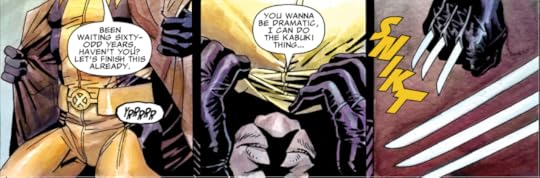
After the events of House of M, Logan finds himself in a luxury he never had before. He remembers.... everything. He remembers his childhood, Weapon X program and all the stuff that happened to him in last 120 years, give or take.
And there are some unfinished businesses..... In Japan! *Cue flashback*
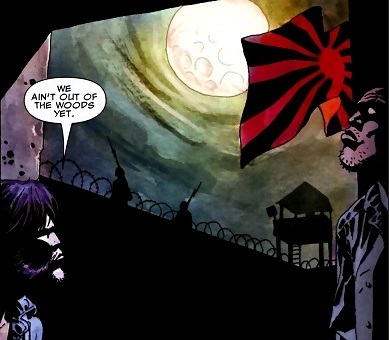
The year is 1945. The war had made Logan a prisoner of War in Japan. But he manages to escape with another POW: An American.
Anyways, Logan meets a lovely Japanese lady whose life he kind of saves, falls in love. Their souls intertwine for eternity and all the usual eternal love crap.... and all this happens in six hours.
But then tragedy strikes, Logan meets his foe and they lock horns and fight, only to be rudely interrupted by small boy. The small boy.
Now, it's payback time.
The only problem is, it doesn't make any freaking sense.
I repeat, the story doesn't make sense at all. Especially the villain and his powers. And Wolverine's heart? Seriously? Also, the art is very average.
Why is it only 3 issues? The greatest fumble in comic book history oat😭😭😭
Jesus, this comic would be more influential than any Wolverine comic if it had a longer story. You can literally finish this thing in 25 minutes or something sadly
SUPER FAST REVIEW: Not as good as I hoped it would be. So it had some potential for a good story and the art was actually pretty great. The narrative was well written. It unfortunately seemed slightly anti-military. It’s also a bit too rushed and slightly confusing because of that (though I mostly got it). Would have been 3-stars but the ending was kinda stupid and left me wanting more so...
Such a shame. If Brian had two more issues this could have been a classic IMO.
The story of Logan meeting a racist piece of shit army boy who wants to kill "japs" and then befriends a beautiful Asian lady and then the aftermath of it all is well done but very rushed. You feel like if they built on this, let this story flow for two more issues, give more background to all the characters this could have been amazing.
The art is solid throughout and the fights are both bloody and scary. It's entertaining to say the least. I also really loved the scenery as it changed with the emotion of the characters and always seemed to fit the moments that were happening on screen.
This is def worth the read though you will probably feel the same as me and wish it was longer. That's it's only fault. Check it out though, worth a read for sure if you enjoy Wolvie.
It is always a delight to behold an Eduardo Risso-illustrated comic book. He always seem to pair up with writer Brian Azzarello (100 Bullets); so its a double treat to see him collaborate with one of my favorite writers in Brian K. Vaughan (BKV).
This was a MarveL Knights-produced miniseries so BKV could play with the continuity and Risso could show all the blood in its scarlet glory. This is an excellently illustrated story, Risso was at the top of his game. So much so, I'd like to think much of the imagery here inspired the P.O.W. flashback scene of the recent movie The Wolverine. Where else could the director get an image of Wolverine in a hole in the ground as a Japanese prisoner of war?
This story showed how much range BKV got, and now he's killing it with his family space opera Saga with Fiona Staples. But he got his start at Marvel and his stories are some of my favorites, especially Runaways. That's one property that I wished he'd make a return to, ala Neil Gaiman on Sandman Overture . One could only hope.
Maybe because I was distracted by Atsuko's utter pointlessness. Maybe because I don't really have an affection for soldiers going to foreign lands they're attacking and hooking up with the women during war time. Maybe because this didn't really seem to go anywhere. I don't know but this is probably the least enjoyable of the Brian K Vaughn books I've read, thus far.
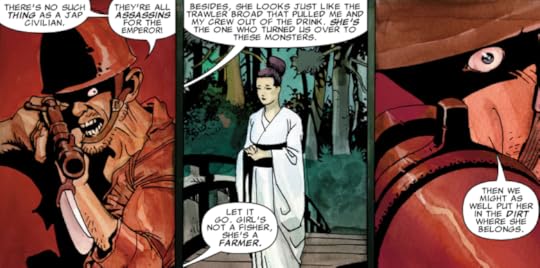
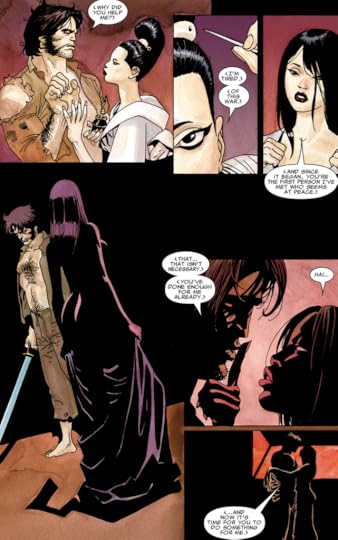
This reads a bit like a watered down version of what a Loed/Sale Wolverine color series would look like. He tells the story of being captured in Japan and waking up alongside another soldier, Warren. They escape and run across a Japanese woman, Atsuko. Warren wants to kill her because he's a racist and generally terrible. Logan saves her because he's a person. She hides him at her place and sleeps with him because he saved her???
Atsuko is a pointless character. It's not her fault but she was written in such a regressive way. She sleeps with Logan to thank him which is fucked up. She doesn't really speak about herself except to talk about her father's sword and being a-okay with dying in Japan. I know nothing about her outside of that. She exists for Logan and that's so problematic.
This also falls into the trap of the 2 day insta-romance. They knew each other for like a night? Or a day and a half and Logan just remembers her as someone he loved? Wolfy gets attached rather quickly. Jesus.
There was nothing here for me to latch onto and it's rare for a Brian K Vaughn book to leave me so unaffected.
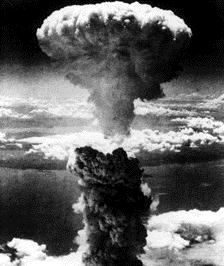
The story is set in the present when Logan is Wolverine and in 1945 when Logan was a GI. In 1945 he gets taken prisoner by the Japanese and busts out of jail only to find that his fellow American prisoner is a racist murderer who threatens women. Factor in the fact that they're in Hiroshima and that it's 1945 and you'll get an idea of what happens in the book.
It's a very short read, 3 issues with a lot of extras such as Brian Vaughan's outline to the mini-series, script pages, and Eduardo Risso's sketches of the characters and layouts to pad out the book and bump up the price. A tad dishonest considering the extras really aren't that interesting but there you go.
I like Wolverine books but this isn't one of the better ones. A lost love, a revenge story, and a big explosion probably summarise the book. It's a surprisingly dull read given that Vaughan is a tremendous writer and I've really enjoyed his past books "Y: The Last Man" and "Ex Machina". Logan never jumps off the page like he does when he's in the hands of other writers like Mark Millar or Frank Miller.
"Wolverine: Logan" is for completists only rather than casual fans of Wolverine. If you're looking for an awesome Wolvey book, try Mark Millar's "Old Man Logan" or the classic by Frank Miller and Clare Claremont, "Wolverine".
English (but not so good) / Italiano History with intense meaning but whose schematic and sequential realization has compromised the performance, despite the undisputed validity of intents and excellent graphics. Good allusions to the orrors of war and to love life in this brief period of our gaijin. To complete the volume the self-contained “Bloodlust” by Alan Davis, nothing special. Indeed how to vote I was undecided between 3 and 4 stars, an half past 3 that this last chapter led me to round down.
Italiano Storia dal significato intenso ma la cui realizzazione schematica e sequenziale ne ha inficiato il rendimento, nonostante l’indiscussa validità di intenti e l’ottima grafica. Buone le allusioni agli orrori della guerra e alla vita sentimentale in questa breve parentesi del nostro gaijin. A completare il volume lo speciale autoconclusivo “Sete di sangue” (Bloodlust) di Alan Davis, niente di che. Infatti come voto ero indeciso fra le 3 e le 4 stelle, un 3 e mezzo che quest’ultimo capitolo mi ha portato ad arrotondare per difetto.
As I always enjoy the X-men movies, this comic book about Wolverine caught my attention.
The Canadian James Howlett, alias Logan, is a mutant. His superpowers allow him to recover very quickly from every possible injury. Later his skeleton will be reinforced with the unbreakable metal adamantium. Before he joined the X-Men, he worked for the Canadian government. Later he also became a member of the superhero-teams X-Force and the Avengers.
The Dutch version that I read contained 3 different stories: - Logan, episode 1 till 3: this story takes place in Japan during World War II - Roar: this story is set in New Mexico in 1938 - Birth of a weapon: this story takes place in Canada during the 19th century and tells us the story of the first encounter between Logan and professor Charles Xavier, the strongest telepath in the world and the founder of the X-men (to protect people against mutants who feel superior and want to dominate the world)
The story in Japan is the longest one and is worth 4*. The one in New Mexico is rather confusing and not as compelling. Thus it only gets 2*. The last one, about the origins of Wolverine, was nice but a bit too short. Therefore 3*. That brings the average on 3* in total.
5/10 Very hard to rate this one. On one side, the story is blessed by beautiful art. Thin ink lines, strong black shadows, all supported by a nice warn colouring. I was not a fan of the way Risso renders Wolverine's face, though. The narration flows well, with decent layouts and sexy compositions of panels here and there. (I mean 'sexy' in a figurative sense, I am not referring to all the shots of the sexy Japanese girl...even if, incidentally, those are another plus for me!) Strong Frank Miller vibes in these pages, thankfully not too much to ruin the reading experience. Not only in the art and pacing, but also in the dialogues. Vaughan tries to go poetic and a bit deep here, and honestly the result is not terribly bad for my tastes. What does not work is the plot. This story is a collage of tropes - some specific to Wolverine comics, some more generic - that writers should get rid of once and for all. Where to start. Let's see, the setting. So, Wolverine was born in the 19th century, tends to remain quite young over the decades and basically cannot die. (Plus, when he does die he gets resurrected as soon as Marvel decides to hire a decent writer on the X-men comic series, but that's another issue...) Which means that we can use him in so many adventures all over the world and all over the 20th century. Cool! Now, I would expect writers to exploit this feature with a bit of decency and sophistication. Which means that, yeah, you are welcome to use Wolverine for a WWII story...but putting him in Hiroshima the very day the Enola Gay dropped the bomb?!? Come on, that is coarse to say the least. What's next? Was private Logan already in Berlin when the Red Army arrived to end WWII? Was he chilling in the famous bunker the day Hitler blew up his own head? Or was he in Auschwitz when the Allies liberated the camp? Was Wolverine on the Titanic? Was he in Sarajevo in 1917 when the Emperor of Austria was murdered? No, maybe that year he was busy in Moscow to partake in the bolshevik revolution!? Will we see a story where Wolverine witnesses Martin Luther King's assassination? Was Wolverine in Chernobyl in 1986? Wolverine is not Forrest Gump, for fuck's sake! Back to the story. So, apparently the trope of Wolverine going back to Japan, or some other place, to revenge or retrieve a lost love interest is quite overused. The Japanese sex bomb that turns Logan into a man here is not much more than a tool to get Wolverine bloody horny and then, when she dies, bloody angry. Her depiction is quite poetic, yes. But maybe a bit too much. She is literally compared to the actual bomb that, according to Wolverine's monologue, made him a man. I am not even complaining about her stereotypical over-sexualisation. Nonetheless, her character could have used a bit more of life. Last but not least, the bad guy waiting decades in the woods as a flaming monster sounds a bit too convenient for the only purpose of providing the story with a final fight.
All in all, I did not dislike to read this, but only for the art.
I can appreciate what Brian K. Vaughn (Runaways, Y: The Last Man) tried to accomplish here, but trying to fit this story into three issues took away much of the emotional impact. It is a beautifully visceral accomplishment by Eduardo Risso (100 Bullets), set in WWII Japan -- Hiroshima, to be exact, before the cataclysmic voyage of the Enola Gay -- but overall Wolverine: Logan really lacked energy. I think if Vaughn had been given five or six issues to pull this story off, he could have, but the end result of Wolverine: Logan felt like I was reading the condensed version of a much larger, more epic tale.
Not to detract from Vaughn, who I do feel is a very good writer, but I can mainly just recommended Wolverine: Logan for Risso's fantabulous renderings. Though I would also like to give a shout out to colorist Dean White, who really breathed life into Risso's artwork.
The sketchbook in the back of the graphic novel is a nice added bonus. I love seeing the building blocks behind the stories, and Wolverine: Logan does this quite nicely.
3.5 stars. During World War II, Logan awakes to find himself captured somewhere in Japan. He is there with another prisoner and once Logan gets his bearings together he tells him he’s going to escape. This fellow prisoner Logan is with is a real piece of shit. Logan notices this and sends him on his way. Wolverine meets a young lady in the countryside of Japan and falls for her but this piece of shit dude shows back up and the drama begins. Logan discovers this guy is not a regular human which makes the fight between them crazy!! Solid artwork throughout with some sad sequences help make the end of this story all the better. Yes this is a little short but still entertaining.
A story of Logan after regaining all of his lost memories back, going back to Hiroshima, for revenge. The flashback story takes place back when he was a POW in Japan during WWII, with another captured American by the Japanese, escaping and making their way out of prison.. and then the problems start.
A solid read, with amazing artwork, if only was a longer story it could be much better.
"See, I can recover from just about anything. Anything but getting my heart ripped out." - Logan
The story was OK but too short, it really needs something more to be a full, proper story. I loved the artwork in this, very rough and beautiful at the same time.
Manasız bir mini seri. Brian K. Vaughan yazdığı için daha özgün bir şeyler görmeyi beklemiştim. Onun yerine Wolverine hikayelerinin değişmezi kaba kuvvet üzerine kurulu dövüş, bu dövüştüğü tipin de Wolverine'e yakın dayanıklılıkta olması, güzel kadınların Wolverine'den anında etkilenip birlikte olması gibi görmekten bıktığım klişeler hikayeyi anlatmayı yetiyor.
For once, an example of a comic that needed more issues not less. There's half a great story here. With a little more room to flesh it out, this could have been a definitive comic story. As it is, it's a good addition to Wolverine's backstory, but on its own it's kinda like "Oh. That's it?"
Fantastic. Art is insane and the story is a page turner. Logan is one of my favorite Marvel characters and having him walk through a beautiful Japanese landscape was a great idea.
I enjoyed this a lot, just wish it was longer so it could’ve been more fleshed out and explored further. Even then, it’s an interesting piece of Logan’s history to explore and I wasn’t disappointed by the main reason I bought this comic, the nuke.
Book Info: This collection contains Logan issues #1-3.
ABSOLUTE RATING: {3+/5 stars}
STANDARDIZED RATING: <3/5 stars>
"Into every life, a few bombs must fall... failure, misery, heartbreak... but even an ordinary Joe can survive an explosion or two. The thing that kills you next is what comes next. Fallout. It's the slow descent of all the unstable crap left behind by your mistakes. Hard to see while it's raining down around you, and by the time you finally notice the poison filling up... you're already drowning in it." – Logan
The story opens with Wolverine returning to Japan to settle a decades-old score with a mysterious rival. Things then shift to Logan's time as a Canadian soldier fighting in WWII, which one can assume is somehow related to present events. During this time, Logan is captured and imprisoned in a Japanese detention center in the company of US Lieutenant Warren. Together the two are able to escape under the cover of nightfall, but end up parting on bad terms after Logan prevents the trigger-happy Warren from needlessly killing a young woman they encounter on a bridge. This woman is a beautiful Japanese farmer named Atsuko who, in return for saving her life, offers to provide shelter and... hospitality... to Logan before he sets out again after the sun sets the following day.
You know, I'm really trying to do my best here, but the whole Wolverine tragic-romance-slash-revenge story has been done so many times throughout the years that it will be difficult to rate this book independent of that knowledge. As is the case for most Wolverine stories, the themes of loss and guilt are prevalent throughout, and Vaughan really doesn't offer anything new. The best part of the book comes at the very end, where – depending upon your chosen interpretation (and assuming mine's valid) – Vaughan seems to offer an an ambiguous ending shrouded in a touch of metaphor as payment for your time spent reading this. And I suppose, for a Wolverine book, it's a good enough pay-off.
When it comes to the characters, Wolverine is exactly as you would expect – a jaded, tough, and troubled man who speaks in a voice tinged by pseudo-wisdom and many years of harsh experience. Atsuko is a sad and gentle, yet self-assured woman who is able to see past Logan's coarse exterior, and touch his soul deeper than he probably thought possible. Lt. Warren is a kind of dark reflection of Logan's violent tendencies. He's a bat-shit crazy S.O.B. whose not particularly well-written, and very similar to more than half the major antagonists Logan has encountered over the years.
As for the story's overall atmosphere, sadness, atrocity, and violence are the themes that reign supreme. While Vaughan's writing does help to create this effect, I'd almost say that it's Risso who steals the show. Although decent, the writing alone wasn't quite enough to carry the story into the dark territory in which it inevitably descends, so I think Vaughan was lucky (or smart) to have selected an artist who was up to the task of picking up the slack. I may have come across a few of Risso's books here and there throughout the years, but it was only now that I was able to acknowledge his skill when utilizing shadows to bring out the horror and madness of the world he creates on the panels. It's also very good at capitalizing on the intimate and sensual encounters of the characters he portrays. I'd definitely say he's good enough that his talent seems a bit wasted here.
Logan is a short and stylized tale of Wolverine's past that's *just* effective enough to succeed at keeping you interested, but it fails to add anything new to the character that we all haven't seen before.
deze strip was de reden dat ik de strips uit de serie Humo presenteert marvel wilde kopen want de schrijver van deze strip is Brian K. Vaughan. ik ben dol op de andere strips van hem (Saga, papergirls, Y the last man) maar ben ook dol op Wolverine. hij is mijn favoriete X-men. je hebt een langer verhaal en twee kortere verhalen. het lange verhaal speelt zich af in Japan en in een van de kortere verhalen zie je hoe hij professor X voor het eerst ontmoette. weet door de X-men en Wolverine films al best veel over hem maar heb erg genoten van deze strip.
Najromantizovanija verzija Vulverina koju ćete pročitati i iskreno, nisam siguran da li to treba posmatrati kao prednost ili manu. S tim u vezi, priča je prilično zbrzana. Da je kojim slučajem bilo još makar dva broja, nemam sumnje da bi ovo bila jedna od najboljih priča sa Vulverinom. Ovako smo dobili zbrzanu ljubavnu priču, neupečatljivog negativca i nepotrebnu ratnu dimenziju. Crtež je jedino što vredi od početka do kraja, nemam zamerke što se toga tiče. Druga priča poboljšava utisak, mada ne znam koliko da je smatram relevantnom s obzirom da nije kanon. Jako čudan strip.
Brian K. Vaughan explores an unknown event in Logan’s life prior to his transformation into “Weapon X”, back in 1945 right at the time of the Hiroshima and Nagasaki A-bombings. In present day- back in 2005 when the series were at their 3rd volume-, Logan returns to Japan to encounter the remnants of that destruction, which happens to also be the place where he met his very first love, a Japanese farmer woman named Atsuko, who lost her father in the war. But tragedy will invade Logan’s life once he meets another prisoner from the camp he ended trapped in in ’45, an American soldier named “Warren”, who was tortured by the Japanese, resulting in a profound hatred for them. But Lieutenant Warren is also a mutant quite similar to Logan, and the bombings will turn him into one of Wolverine’s most fearful and dangerous ghosts from his past. With only 3 issues, Vaughan crafts one of “Wolverine’s” most profound, and quite emotionally engaging stories, depicting the kind of romance, brutality, and tragedy characteristic from his character. He nails the mysticism “samurai-like” personality of his honor code, and the fact that Wolverine managed to live one of the most tragical events in Japanese- and humankind-history, just at the same time he was experiencing quite the tumultuous set of emotions; while knowing and falling for the woman that turned him into a man, and also, enraging in an animal-like rampage for revenge against a man who took the little was left from him, all paying off in the present days, when he confronts his old enemy, while also realizing what he had turn into because of his mutation. Basically, Logan’s first encounter with Japanese culture, during his involvement in the Great War- one of the many he was participant-, but most importantly, the moment he acquired a sense of honor, loss, and rage, all at once. Perhaps, also, the moment he experiences the greatest pain pre- “Weapon X” program, in both ways: physically, and emotionally. It’s always interesting to discover fragments of Logan’s past, however, it is a tricky sense of discovery, since it’s not that effective to get the full picture out of his backstory. Jenkins, Quesada, and Kubert tried with their “Origin”, and while this last one wasn’t a bad way of depicting the character’s very early days, it took something away from the mystery. So, trying something similar a second time was a gamble from Vaughan, but fortunately, this kind of premise reaches similar levels as the main stories delivered by Claremont, even Windsor-Smith’s take on the character’s origins as “Weapon X”, which I personally consider another great risk at exposing Wolverine’s past, ultimately resulting in one of the character’s most memorable titles. While not as iconic as what Claremont and Miller accomplished in their 4-issue mini-series, Vaughan, and artist, Eduardo Risso, both succeed at maintaining the grip and the depth in the character’s main narrative core, which is a fancy way of saying they kept what makes Wolverine “cool”. The perfect mix between his ravage action, bestial brutality, honor code, and the tragedy behind his romantic life, and the pain that comes right with it. Atsuko, for being a randomly thrown character to the mix, worked quite well, maybe because we’re already familiarized with Wolverine’s romance with Mariko Yashida, and his connection to Japan, so this works more as a connecting dot for that relationship. It reminded me of the “Rose” effect from “Origin”; she essentially was a younger version of Jean Grey, more likely existing to explain us why Logan has a thing for redheads. It may sound simplistic, but in within the context of the comic book it does make all the sense in the world, particularly with the tragedy behind that character in connection with him. Atsuko works in a similar way, at least, in relation to why Logan falls for Mariko in “the Uncanny X-Men” storyline. As for Lieutenant Warren, he was a decent villain, more of a symbolism of a “ghost-past” for Wolverine than an actual fleshed character, but his background was serviceable adding to Logan’s tragedy. Risso does a great job depicting the aesthetic of the Japan from the 1940s, and his character designs were quite attractive, mostly thanks to Dean White colors, but he does deliver the peaceful, as well as the violent moments in a similar consistency. Highlights to Logan and Atsuko’s relationship panels, as well as Logan’s confrontation against Warren, both in the past and present days. I was surprised at how short and condensed this story was, although, its resonance and effectiveness were evident throughout all 3-issues. Sometimes you don’t need a whole volume, or an entire arc to make a story work. The little I’ve read about Vaughan he has always been a perfectly capable writer of achieving a great sense of depth with so little content, and that speaks highly of his abilities as a storyteller. Regarding this one, it was better than I could’ve thought. While not perfect, and definitely not on the same level as other titles written, nor drawn, by old-school talents, it is one of the few modern Wolverine stories that stand out from the bunch. A great entry to the character’s collection, and a successful addition that enriches his troublesome, and heartbreaking backstory.
The story of Logan "becoming a man" (meant both literally and figuratively) in Hiroshima Japan just before the bomb was dropped at the end of World War II. A very poignant tale of humanity, war, and the middle ground between. Easily one of the best X-Men related books I've ever read.
Overall just a really good wolverine story. I thought most of the themes were handled pretty well, and I thought the final fight and especially final panel was really great. So all in all, just a good story.
A short wolverine story, this entry does not focus on the x-Men but rather a personal story involving WWII. A very quick read but a lot of fun. The art is very untraditional but enjoyable.
Didnt appeal a lot to me as other wolverine stories. Very short and packed. Weak villain in my opinion. I think thats why i give it 2 stars, plus a very weak love story in my opinion.