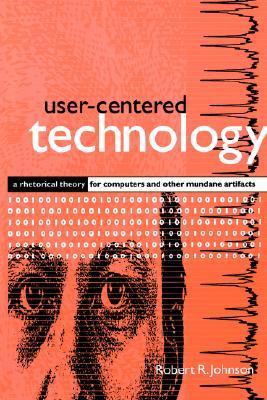
Awarded "1998 Best Book" by the National Council of Teachers of English for Excellence in Technical and Scientific Communication. User-Centered Technology presents a theoretical model for examining technology through a user perspective. Johnson begins with a historical overview of the problem of technological use from the ancient Greeks to the present day - a problem seen most clearly in historical discussions of rhetoric theory. The central portion of the book elaborates on user-centered theory by defining three focal issues of the user knowledge, human-technology interaction, and technological determinism. Working from an interdisciplinary perspective, Johnson uses rhetoric theory to present a definition of user knowledge; human factors engineering to illuminate the ideological presuppositions built into technology design; and history, philosophy, and sociology to explain technological determinism, possibly the greatest impediment to user-centered technology development in modern times. The latter part of the book applies user-centered theory in two the nonacademic sphere, where the writing and design of computer user documentation is discussed, and the academic sphere, through a discussion of how user-centered concepts might drive university technical communication and composition curricula.
Johnson's book is a cornerstone for re-imagining the relationships between users, developers, and the texts/spaces they create. Unfortunately, the field of technical communication is often seen as an arhetorical field that functions on the premise of a conduit. For technical documents to work, the writer merely has to get the information down with clarity. Johnson is making the argument that technical writers need to take into account the ecologies of use and consider users as situated, knowledge producers. Though not a recent book in technological terms, the argument is still surprisingly relevant, especially as Web 2.0 and social software re-imagine user relationships to the web (even if we don't).