

What do you think?

Det kvinner vil ha, det menn vil ha
Basert på 40 år med forskning - endelig er resultatet her! Dr. John M. Gottman er tilbake, og denne gangen har han svaret på historiens best bevarte hemmelighet: «Hva er det kvinner egentlig vil ha?»
«Det kvinner vil ha, det menn vil ha» gir deg en unik innsikt i den revolusjonerende forskningen om hvordan man kan oppnå lykke hos både menn og kvinner, ved å se på mannen som den avgjørende faktoren. Forskningen avslører nemlig at det er mannen som avgjør om et forhold er velfungerende eller ikke.
Boken er en hyllest til kvinnen og tilbyr mannen en komplett forståelse av kvinnens natur. Hvis mannen virkelig forstår sin kvinne og imøteser hennes behov, vil han oppleve færre krangler og mer (og bedre) sex. I tillegg viser studien at menn i sunne og lykkelige forhold lever lenger, tjener mer og har færre kroniske sykdommer og mindre kognitiv svikt når de blir eldre.
DETTE ER EN FORSKNINGSBASERT FREMSTILLING AV HVORDAN EN MANN KAN TILTREKKE, TILFREDSSTILLE OG LYKKES MED EN KVINNE, LIVET UT.
«Det kvinner vil ha, det menn vil ha» gir deg en unik innsikt i den revolusjonerende forskningen om hvordan man kan oppnå lykke hos både menn og kvinner, ved å se på mannen som den avgjørende faktoren. Forskningen avslører nemlig at det er mannen som avgjør om et forhold er velfungerende eller ikke.
Boken er en hyllest til kvinnen og tilbyr mannen en komplett forståelse av kvinnens natur. Hvis mannen virkelig forstår sin kvinne og imøteser hennes behov, vil han oppleve færre krangler og mer (og bedre) sex. I tillegg viser studien at menn i sunne og lykkelige forhold lever lenger, tjener mer og har færre kroniske sykdommer og mindre kognitiv svikt når de blir eldre.
DETTE ER EN FORSKNINGSBASERT FREMSTILLING AV HVORDAN EN MANN KAN TILTREKKE, TILFREDSSTILLE OG LYKKES MED EN KVINNE, LIVET UT.
219 pages, Hardcover
First published February 2, 2016
About the author
John M. Gottman
90 books2,229 followersDr. Gottman was one of the Top 10 Most Influential Therapists of the past quarter-century by the Psychotherapy Networker. He is the author or co-author of over 200 published academic articles and more than 40 books, including the bestselling The Seven Principles for Making Marriage Work; What Makes Love Last; Eight Dates: Essential Conversations for a Lifetime of Love; The Relationship Cure; Why Marriages Succeed or Fail; and Raising An Emotionally Intelligent Child — among many others. Dr. Gottman’s media appearances include Good Morning America, Today, CBS Morning News, and Oprah, as well articles in The New York Times, Ladies Home Journal, Redbook, Glamour, Woman’s Day, People, Self, Reader’s Digest, and Psychology Today.
Co-founder of The Gottman Institute and co-founder of Affective Software, Inc. with his wife, Dr. Julie Schwartz Gottman, John was also the Executive Director of the Relationship Research Institute. He is Professor Emeritus of Psychology at the University of Washington, where he founded “The Love Lab” at which much of his research on couples’ interactions was conducted.
Co-founder of The Gottman Institute and co-founder of Affective Software, Inc. with his wife, Dr. Julie Schwartz Gottman, John was also the Executive Director of the Relationship Research Institute. He is Professor Emeritus of Psychology at the University of Washington, where he founded “The Love Lab” at which much of his research on couples’ interactions was conducted.
Ratings & Reviews
Friends & Following
Create a free account to discover what your friends think of this book!
Community Reviews
Displaying 1 - 30 of 345 reviews
March 10, 2018
Yeah, I laughed when my mother recommended this book to me. It does sound pretty sleazy. But my mother probably has a stronger opinion about quality than I do. There had to be something here, or she wouldn't recommend it.
Still, I waited until it was only a few bucks on Kindle.
Right off, the authors waste no time telling you "the secret" of what women want, and I'll go ahead and spoil it: trustworthiness. Now that's a loaded word. I talked to a few of my woman friends about the book as I was reading it, and they at first disagreed. As I asked them what trustworthiness meant to them, we were all slowly converted to the idea.
And that's good, because, let me tell you, that right there pissed me off on first reading. Thing is, I live with some great guys, and not a single (heh) one of them has had long-term success in their dating relationships. And they were super trustworthy, so far as I could tell. I was really ready to be disappointed with women in general if that's all they wanted, and yet they couldn't see it even when it asked them on a date time and again.
On top of that, the authors frequently say that what men want is no confrontation and sex. I'm not that simple. I want a relationship. Acceptance. Affection. Love. I don't know how much time and experience would have to elapse before I'd be thinking about sex in the relationship.
Then I kept reading.
Yeah, it's deeper. On both sides of the coin.
The authors really have done their research. 40 years of it. This book is the result of those findings.
Turns out, there really is a lot I only superficially understand about dating and relationships. I didn't understand how to tell if a woman is interested, for example. Sure, I've recognized it a few times for my part, and a lot for others. But I'm kind of a masochist when it comes to doing things that are hard.
I didn't want to have any regrets when it came to my dating life. And, for my part, that meant that I would always ask out a girl if I was interested and she was available. Turns out, I could avoid a lot of nos if I just checked to see if she was interested first. Most women give off cues subconsciously. Some consciously. And yeah, some are oblivious themselves.
I also learned how to talk to women better. How to ask open ended questions and steer conversations in positive directions. And, perhaps hardest of all, to talk about the things I was really good at. Which are nerdy things.
Yeah, I guess I sabotage my chances in most dating experiences by hiding my best talents and energies behind a wall of social insecurity.
All this was in the first couple chapters.
Yes, there a section in the middle about physical intimacy, sensuality, and sex. I've never read anything more direct and explicit on the subjects. The section on properly kissing is several pages on its own. Then a couple chapters build up to intercourse. And by then, you've had a lesson in anatomy and a detailed walk through on foreplay.
If this makes you uncomfortable, it's really easy to skip the whole section. So don't worry about that. However, I feel that the authors talked about these and most subjects in a very intelligent and almost reverent way. They were honest, but they weren't brief. Aside from giving "the secret" away in the first chapter, they really build to every subject. They frame things appropriately, giving proper context.
And after that section it gets into such meaty subjects as conflict resolution. (Breathe, men. Don't let you anger boil over.) Motherhood. (Don't try to interfere with your wife's relationship with her baby. Build a relationship with your baby too.) And shopping. (Don't do it together if you want to be happy.)
There's a lot in here that I'll have to read again and again to properly grok.
Recommended.
Still, I waited until it was only a few bucks on Kindle.
Right off, the authors waste no time telling you "the secret" of what women want, and I'll go ahead and spoil it: trustworthiness. Now that's a loaded word. I talked to a few of my woman friends about the book as I was reading it, and they at first disagreed. As I asked them what trustworthiness meant to them, we were all slowly converted to the idea.
And that's good, because, let me tell you, that right there pissed me off on first reading. Thing is, I live with some great guys, and not a single (heh) one of them has had long-term success in their dating relationships. And they were super trustworthy, so far as I could tell. I was really ready to be disappointed with women in general if that's all they wanted, and yet they couldn't see it even when it asked them on a date time and again.
On top of that, the authors frequently say that what men want is no confrontation and sex. I'm not that simple. I want a relationship. Acceptance. Affection. Love. I don't know how much time and experience would have to elapse before I'd be thinking about sex in the relationship.
Then I kept reading.
Yeah, it's deeper. On both sides of the coin.
The authors really have done their research. 40 years of it. This book is the result of those findings.
Turns out, there really is a lot I only superficially understand about dating and relationships. I didn't understand how to tell if a woman is interested, for example. Sure, I've recognized it a few times for my part, and a lot for others. But I'm kind of a masochist when it comes to doing things that are hard.
I didn't want to have any regrets when it came to my dating life. And, for my part, that meant that I would always ask out a girl if I was interested and she was available. Turns out, I could avoid a lot of nos if I just checked to see if she was interested first. Most women give off cues subconsciously. Some consciously. And yeah, some are oblivious themselves.
I also learned how to talk to women better. How to ask open ended questions and steer conversations in positive directions. And, perhaps hardest of all, to talk about the things I was really good at. Which are nerdy things.
Yeah, I guess I sabotage my chances in most dating experiences by hiding my best talents and energies behind a wall of social insecurity.
All this was in the first couple chapters.
Yes, there a section in the middle about physical intimacy, sensuality, and sex. I've never read anything more direct and explicit on the subjects. The section on properly kissing is several pages on its own. Then a couple chapters build up to intercourse. And by then, you've had a lesson in anatomy and a detailed walk through on foreplay.
If this makes you uncomfortable, it's really easy to skip the whole section. So don't worry about that. However, I feel that the authors talked about these and most subjects in a very intelligent and almost reverent way. They were honest, but they weren't brief. Aside from giving "the secret" away in the first chapter, they really build to every subject. They frame things appropriately, giving proper context.
And after that section it gets into such meaty subjects as conflict resolution. (Breathe, men. Don't let you anger boil over.) Motherhood. (Don't try to interfere with your wife's relationship with her baby. Build a relationship with your baby too.) And shopping. (Don't do it together if you want to be happy.)
There's a lot in here that I'll have to read again and again to properly grok.
Recommended.

March 11, 2017
I give this book 5 stars for the relationship advice; it's well researched. I love well researched advice because it works! If you've read anything by the Gottmans, Sue Johnson, or have learned about attachment theory, the main premise of the book will be familiar to you: Turn towards your partner instead of away from them.
This book is written for men and I'm curious about how well men feel it speaks to them. The authors tell men that they will have more sex and less fighting if they follow this advice. The advice is simple but it would take a lot of work and energy. For men who are motivated to have a good relationship, I think it will be very helpful.
I took off a star because, very unfortunately, there are some creepy sexist theories in the book. Amidst their very well researched relationship advice, they throw in some theories about the personality differences between men and women based on their ideas of what primitive society was like; men evolved to be the hunters, women to be the gatherers. If these differences were true, it would be useful information, but, in fact, time and again, research has shown that you can't predict what someone's personality will be like based on their gender. Well validated personality tests will tell you a lot more about someone's personality than their gender will, and both women and men are found in all personality types.
There are some differences between men and women that have been researched, but you really have to separate the wheat from the chaff here. This is a good reminder that no matter how smart someone is and how reasonable their theory sounds, it has a good chance of not matching reality- the only way to know it matches reality is to do the research.
These cringe worthy ideas are scattered throughout the book, but most notably make their appearance in the chapter devoted to shopping, and the information about fear. The fear information is interesting because part of it is based on research, but their interpretation is a text book case of gender bias.
When I was in my first class in college, already a budding feminist, the professor handed us a picture of a baby and we all rated what we thought the baby's personality was like based on the picture. Then she asked us to raise our hands as she read the various choices. When she read "sad", one half of the class raised their hands, when she read "angry" the other half of the class raised their hands. She went through every attribute and this pattern continued. We all got the same picture of the same baby. How could it possibly be that one half of the class thought one thing and the other the opposite, and that each side was unanimous? On my side of the class the baby was named "Amber" and on the other side of the class, the baby was named "Henry." No matter how enlightened we might have thought we were, every single person in the class showed the exact same gender bias. We thought we were making a judgement based on the picture, but we were making a judgement based on the gender.
The author's make a similar mistake when presenting their ideas about fear. They say that women experience more fear in their daily lives - which I'm guessing is true. (This is important for men to understand for personal relationships and for social justice.) But they interpret that to mean that women are more hard wired to experience fear, which I thought could be true, but interestingly they later show their own assertion to be false, but use gender bias to keep their theory!
First they share factual information. One in four women have been sexually assaulted by the time they reach 18. What they don't share, but imply, is that while women are far more likely to be sexually assaulted than men, men are more likely to be murdered than women. However, the places men and women are murdered are different. Men are likely to be murdered in what we think of as typically dangerous situations - in dangerous neighborhoods, jails, war zones, etc. Places that men know to be dangerous and may be able to avoid. Women are most likely to be murdered in their own homes, neighborhoods, and workplaces. Can you imagine that these facts might be why women are more likely to experience daily fear than men? They are, in fact, in more daily danger than men.
Assuming that women are more naturally fearful than men because they experience more daily fear would be like assuming soldiers are hardwired to be more fearful than other people because they experience more daily fear. Wouldn't that be ridiculous?
Later in the book, they share an experiment where both men and women are startled and both genders have the same physiological fear response. This disproves their earlier theory that men are hardwired to be less fearful. The men and women do have different outward responses. After being startled, more women expressed fear, more men expressed anger. So, at the very most we could say that maybe there are hardwired differences in how men and women express their fear. But it could just as easily be that men and women are raised to express fear differently. It could also be that the researchers have gender bias, just like we all did in my psychology class.
All that said, I think this book is worth reading and would be helpful to most people. Take the relationship advice seriously, take the pronouncements about gender with a handful of salt. It might be a fun book to read as a couple, as long as people use it to learn more about each other as individuals and don't use the information to blame or judge each other.
This book is written for men and I'm curious about how well men feel it speaks to them. The authors tell men that they will have more sex and less fighting if they follow this advice. The advice is simple but it would take a lot of work and energy. For men who are motivated to have a good relationship, I think it will be very helpful.
I took off a star because, very unfortunately, there are some creepy sexist theories in the book. Amidst their very well researched relationship advice, they throw in some theories about the personality differences between men and women based on their ideas of what primitive society was like; men evolved to be the hunters, women to be the gatherers. If these differences were true, it would be useful information, but, in fact, time and again, research has shown that you can't predict what someone's personality will be like based on their gender. Well validated personality tests will tell you a lot more about someone's personality than their gender will, and both women and men are found in all personality types.
There are some differences between men and women that have been researched, but you really have to separate the wheat from the chaff here. This is a good reminder that no matter how smart someone is and how reasonable their theory sounds, it has a good chance of not matching reality- the only way to know it matches reality is to do the research.
These cringe worthy ideas are scattered throughout the book, but most notably make their appearance in the chapter devoted to shopping, and the information about fear. The fear information is interesting because part of it is based on research, but their interpretation is a text book case of gender bias.
When I was in my first class in college, already a budding feminist, the professor handed us a picture of a baby and we all rated what we thought the baby's personality was like based on the picture. Then she asked us to raise our hands as she read the various choices. When she read "sad", one half of the class raised their hands, when she read "angry" the other half of the class raised their hands. She went through every attribute and this pattern continued. We all got the same picture of the same baby. How could it possibly be that one half of the class thought one thing and the other the opposite, and that each side was unanimous? On my side of the class the baby was named "Amber" and on the other side of the class, the baby was named "Henry." No matter how enlightened we might have thought we were, every single person in the class showed the exact same gender bias. We thought we were making a judgement based on the picture, but we were making a judgement based on the gender.
The author's make a similar mistake when presenting their ideas about fear. They say that women experience more fear in their daily lives - which I'm guessing is true. (This is important for men to understand for personal relationships and for social justice.) But they interpret that to mean that women are more hard wired to experience fear, which I thought could be true, but interestingly they later show their own assertion to be false, but use gender bias to keep their theory!
First they share factual information. One in four women have been sexually assaulted by the time they reach 18. What they don't share, but imply, is that while women are far more likely to be sexually assaulted than men, men are more likely to be murdered than women. However, the places men and women are murdered are different. Men are likely to be murdered in what we think of as typically dangerous situations - in dangerous neighborhoods, jails, war zones, etc. Places that men know to be dangerous and may be able to avoid. Women are most likely to be murdered in their own homes, neighborhoods, and workplaces. Can you imagine that these facts might be why women are more likely to experience daily fear than men? They are, in fact, in more daily danger than men.
Assuming that women are more naturally fearful than men because they experience more daily fear would be like assuming soldiers are hardwired to be more fearful than other people because they experience more daily fear. Wouldn't that be ridiculous?
Later in the book, they share an experiment where both men and women are startled and both genders have the same physiological fear response. This disproves their earlier theory that men are hardwired to be less fearful. The men and women do have different outward responses. After being startled, more women expressed fear, more men expressed anger. So, at the very most we could say that maybe there are hardwired differences in how men and women express their fear. But it could just as easily be that men and women are raised to express fear differently. It could also be that the researchers have gender bias, just like we all did in my psychology class.
All that said, I think this book is worth reading and would be helpful to most people. Take the relationship advice seriously, take the pronouncements about gender with a handful of salt. It might be a fun book to read as a couple, as long as people use it to learn more about each other as individuals and don't use the information to blame or judge each other.

January 27, 2016
I love the Gottman's. I've trained with them. I am enamored by them. But this book? Basic and a bit silly. I was hoping for more. I suppose you could say this is geared/written for the average layman who knows nothing at all about women - it may actually work for that particular population. After all, the things that the Gottmans are writing about (along with two other scholars that are in much smaller print on the front cover), I found myself nodding my head and totally agreeing many times. One thing did get me however, in which they express a very definitive sentence that states that "people don't change." That threw me. Pretty sure I disagree, in some sense. I mean why write a book like this at all if you're going to say that? Well, two things got me, I guess. They also call men Heros or Zeros. Thus, you are a hero if you do all these things and you are a Zero if you do another set of things - there is even a cheat sheet for each chapter that explains which category you may be in. Not sure, if I was a dude, I would be pumped up to learn from a list that made me one extreme or the other. I think this was just a futile attempt to make some money, and sucker that I am, I gave them mine, so it worked. Will I recommend it to clients? I'm not sure - I can't say it would be in my top ten and, even then, I may only recommend a few sections.

September 8, 2026
۱۰. جالبانگیزناکنامه
ـ ترس(دو برابر)
هورمونها ـ» آلفا و بتا برخورد کردن مرد بسته به شرایط
برقراری امنیت عاطفی در شرایط پر تنش و اهمیت دادن در شرایط ترس
- قابل اعتماد و حمایتگر بودن
بدیهیه موقعیت اجتماعی تاثیر گذاره
خفه شدن و شنونده بودن و فهمیدن احساسات طرف مقابل :دی
خوشپوش بودن :ای
زبان بدن و سیگنال رو حوصله ندارم بنویسم (از عوارض افزایش سن)
- فرومونها
هیچ راهی وجود ندارد و کنسلی، عطر و ادکلن هم فایده نداره :ایکس
- هماهنگ بودن جسم، ذهن و قلب با او برای بلند مدت
به سوالات مطرح شده و اساسی بشه پاسخ داد در حال خارج از وضعیت شیفتگی اول رابطه
- عموما ناراضی از بدن خود (و بخش زیادی از ارزشمندی را وابسته به آن میداند)
عدم تایید با نظر وی در این رابطه :) و در عوض تعریف از جزءجزء بدن برای رفع لایههای تردید تلقین شده از سمت جامعه و تبلیغات
- نوازش و نگاه و دوپامین
قسمت مثال خارپشت رو ازش عبور میکنیم :)))
نگاه و لبخند صمیمانه، در عین حال داستانوار بودن قبل از هر چیز جنسی با کارها و کمکهای کوچیک و بعد مسائل دیگر
پایان باز...
توجه: سوءاستفاده جنسی توجه شود و ربطی به جنسیت ندارد.
- درست دعوا کردن را باید آموخت
گوش شنوا بودن در مقابل حل مسئله (که بیشتر برای مردان مهم هست)
عدم رضایت زن بیشتر به احساس ضعف، بی عدالتی و بیمسئولیتی دیگران بر میگرده
چهار الگوی ارتباط منفی (چهار سوارکار): انتقاد، تحقیر، جبهه گیری و سکوت
خفه شدن مرد باز جوابه :)))))
- خرید لباس حکم مرگ و زندگی را دارد و بی ربط با دیانای نیست!
این مورد بانمک بود
- دوستیهای زن با زن دیگر مهم هست از حیث سلامت روان
برای مرد دوستی با یک زن لازمه.
- تعهد
مردها هم همون اندازه دنبال تعهد هستند و مراحل رابطه:
شیفتگی - اعتماد سازی - وفاداری
بعدش میشه
سازگاری در احساسات (در مواجه با مسائل مختلف) با وجود تفاوتهای زیاد میتونه کار رو دربیاره.
تعهد، عشق و احترام و راحتی در کنار هم مهمه. اینکه با وجود این که تضاد هم پیش بیاد باز شخص فکر کنه در بهترین حالت خودشه. احساس آزادی، راحتی و آرام بودن در حین ارتباط یا رابطه یه نشانهی مهمه که دو طرف داشته باشند.
تمایل طرفین به بچهدار شدن و نشدن پرچم قرمز دیگه نیست بلکه هارد گیته اگر هماهنگ نیست خواستهها دیگه کلا کنسله.
- حمایتگری بیشتر در زمان بارداری
حتی تاثیر در ضریب هوشی فرزند
- تلاش همیشگی برای شناخت او
و یه مشت نکنه ریز که من نمینویسم اینجا
---
یه مشت چیز دیگه هست که اونا رو اینجا نیاوردن، لابد چون علمی (!) نیست :))) ولی گاهی دارک میشه و یادمه یه خانم انگلیسی زبان بود توی اینستاگرام و اونا رو میگفت؛ کمی دارک بودن و گاهگاهی در اکسپلور که ظاهر میشد منو زخمی میکرد. اما درست بودن ://
---
بدجنسی:
حسادت رو کتاب جا انداخته 🤌🏻
---
از مجموعه چکیده خوانیهام در چکیدا.
پینوشت: عدم حوصله کافی برای خواندن کامل از این دست کتابها با خطر زرد بودن!
پ.ن: منطقیه که یه نفر دیگه اینا رو رد و تایید کنه :))
سلب مسئولیت: محتوا به گردن نویسنده کتاب!
ـ ترس(دو برابر)
هورمونها ـ» آلفا و بتا برخورد کردن مرد بسته به شرایط
برقراری امنیت عاطفی در شرایط پر تنش و اهمیت دادن در شرایط ترس
- قابل اعتماد و حمایتگر بودن
بدیهیه موقعیت اجتماعی تاثیر گذاره
خفه شدن و شنونده بودن و فهمیدن احساسات طرف مقابل :دی
خوشپوش بودن :ای
زبان بدن و سیگنال رو حوصله ندارم بنویسم (از عوارض افزایش سن)
- فرومونها
هیچ راهی وجود ندارد و کنسلی، عطر و ادکلن هم فایده نداره :ایکس
- هماهنگ بودن جسم، ذهن و قلب با او برای بلند مدت
به سوالات مطرح شده و اساسی بشه پاسخ داد در حال خارج از وضعیت شیفتگی اول رابطه
- عموما ناراضی از بدن خود (و بخش زیادی از ارزشمندی را وابسته به آن میداند)
عدم تایید با نظر وی در این رابطه :) و در عوض تعریف از جزءجزء بدن برای رفع لایههای تردید تلقین شده از سمت جامعه و تبلیغات
- نوازش و نگاه و دوپامین
قسمت مثال خارپشت رو ازش عبور میکنیم :)))
نگاه و لبخند صمیمانه، در عین حال داستانوار بودن قبل از هر چیز جنسی با کارها و کمکهای کوچیک و بعد مسائل دیگر
پایان باز...
توجه: سوءاستفاده جنسی توجه شود و ربطی به جنسیت ندارد.
- درست دعوا کردن را باید آموخت
گوش شنوا بودن در مقابل حل مسئله (که بیشتر برای مردان مهم هست)
عدم رضایت زن بیشتر به احساس ضعف، بی عدالتی و بیمسئولیتی دیگران بر میگرده
چهار الگوی ارتباط منفی (چهار سوارکار): انتقاد، تحقیر، جبهه گیری و سکوت
خفه شدن مرد باز جوابه :)))))
- خرید لباس حکم مرگ و زندگی را دارد و بی ربط با دیانای نیست!
این مورد بانمک بود
- دوستیهای زن با زن دیگر مهم هست از حیث سلامت روان
برای مرد دوستی با یک زن لازمه.
- تعهد
مردها هم همون اندازه دنبال تعهد هستند و مراحل رابطه:
شیفتگی - اعتماد سازی - وفاداری
بعدش میشه
سازگاری در احساسات (در مواجه با مسائل مختلف) با وجود تفاوتهای زیاد میتونه کار رو دربیاره.
تعهد، عشق و احترام و راحتی در کنار هم مهمه. اینکه با وجود این که تضاد هم پیش بیاد باز شخص فکر کنه در بهترین حالت خودشه. احساس آزادی، راحتی و آرام بودن در حین ارتباط یا رابطه یه نشانهی مهمه که دو طرف داشته باشند.
تمایل طرفین به بچهدار شدن و نشدن پرچم قرمز دیگه نیست بلکه هارد گیته اگر هماهنگ نیست خواستهها دیگه کلا کنسله.
- حمایتگری بیشتر در زمان بارداری
حتی تاثیر در ضریب هوشی فرزند
- تلاش همیشگی برای شناخت او
و یه مشت نکنه ریز که من نمینویسم اینجا
---
یه مشت چیز دیگه هست که اونا رو اینجا نیاوردن، لابد چون علمی (!) نیست :))) ولی گاهی دارک میشه و یادمه یه خانم انگلیسی زبان بود توی اینستاگرام و اونا رو میگفت؛ کمی دارک بودن و گاهگاهی در اکسپلور که ظاهر میشد منو زخمی میکرد. اما درست بودن ://
---
بدجنسی:
حسادت رو کتاب جا انداخته 🤌🏻
---
از مجموعه چکیده خوانیهام در چکیدا.
پینوشت: عدم حوصله کافی برای خواندن کامل از این دست کتابها با خطر زرد بودن!
پ.ن: منطقیه که یه نفر دیگه اینا رو رد و تایید کنه :))
سلب مسئولیت: محتوا به گردن نویسنده کتاب!
April 3, 2020
This book is truly dreadful. I got 50 pages in before deciding that it wasn’t useful even as a curiosity. The authors paint with broad brushstrokes and appear to believe that all men are fundamentally the same and all women are fundamentally the same, which is certainly not the case. How this book was published in 2016 (instead of 1970) is beyond me.
In the first few pages, the authors frame couples’ issues as the following: women want more intimacy and support and men want less fighting and more sex. Surprise surprise, the book then continues to frame everything for men as a way of achieving that ultimate goal.
While there were a few (only a few) accurate observations in the sections that I read, the authors attempt to explain each of their theories as a product of evolution, which is inaccurate and fails to consider any other research or science. For example, the authors state that women have stronger emotions than men, which is due to hormones that stem from our hunter-gatherer days. There's so much inaccuracy in that entire premise that it's hard to know where to start unpacking it.
The authors never acknowledge that there could be societal reasons for some of their observations. At one point they state that “women are conditioned to fear for their safety.” What does that even mean? That is a wholly incomplete explanation as to why women are in fear more often than men, and it’s a real disservice to the readers.
Not to mention that there are some serious flaws in the theories themselves. In a section about emotions, the authors illustrate how men deal with emotions: a boy sits down and starts crying while playing with his friends because he is upset that he never gets the ball. So the other boys give him the ball and they continue playing, problem solved, “emotions dealt with.” The authors’ explanation of this interaction is that the crying boy was “an unwelcome leech” that the other boys wanted to get rid of, and that this illustrates that men prefer to “dispense” with emotion and move on.
To illustrate how women handle emotions, they use this example: one girl gets upset because she brought a hair clip for her friend who didn’t want to wear it, so she thought her friend didn't want to be best friends. So the girls talked about it and then continued chatting, leaving the hopscotch game they were playing behind. According to the authors, this demonstrates that what’s important for girls is intimacy, and games are only a means to an end, and even that the resolution of the emotional interaction is unimportant.
These two examples are completely different situations that cannot be used to illustrate the authors' theories about genders and emotions. That the authors don’t see the inherent flaws here is troubling.
Other books I’d suggest that will give a lot more insight into relationships and male behavior generally: Attached by Amir Levine and Rachel Heller, and For The Love of Men by Liz Plank.
In the first few pages, the authors frame couples’ issues as the following: women want more intimacy and support and men want less fighting and more sex. Surprise surprise, the book then continues to frame everything for men as a way of achieving that ultimate goal.
While there were a few (only a few) accurate observations in the sections that I read, the authors attempt to explain each of their theories as a product of evolution, which is inaccurate and fails to consider any other research or science. For example, the authors state that women have stronger emotions than men, which is due to hormones that stem from our hunter-gatherer days. There's so much inaccuracy in that entire premise that it's hard to know where to start unpacking it.
The authors never acknowledge that there could be societal reasons for some of their observations. At one point they state that “women are conditioned to fear for their safety.” What does that even mean? That is a wholly incomplete explanation as to why women are in fear more often than men, and it’s a real disservice to the readers.
Not to mention that there are some serious flaws in the theories themselves. In a section about emotions, the authors illustrate how men deal with emotions: a boy sits down and starts crying while playing with his friends because he is upset that he never gets the ball. So the other boys give him the ball and they continue playing, problem solved, “emotions dealt with.” The authors’ explanation of this interaction is that the crying boy was “an unwelcome leech” that the other boys wanted to get rid of, and that this illustrates that men prefer to “dispense” with emotion and move on.
To illustrate how women handle emotions, they use this example: one girl gets upset because she brought a hair clip for her friend who didn’t want to wear it, so she thought her friend didn't want to be best friends. So the girls talked about it and then continued chatting, leaving the hopscotch game they were playing behind. According to the authors, this demonstrates that what’s important for girls is intimacy, and games are only a means to an end, and even that the resolution of the emotional interaction is unimportant.
These two examples are completely different situations that cannot be used to illustrate the authors' theories about genders and emotions. That the authors don’t see the inherent flaws here is troubling.
Other books I’d suggest that will give a lot more insight into relationships and male behavior generally: Attached by Amir Levine and Rachel Heller, and For The Love of Men by Liz Plank.
May 16, 2016
I'm a big fan of the Gottmans both as a clinician myself and as an individual invested in maintaining strong personal relationships. While this book is obviously geared toward men, I found it very validating to read as a woman. The Gottmans really know their stuff and know how to tailor it to their audience. The book is rich with findings from various studies that helps to buttress their central concepts but is also written in a language that is particularly clear and linear(hence why it is so palatable for the average man.) It's also written in a very easy-to-read fashion with a lot of humor and a few insightful and relevant cartoons. The book is broken into clearly defined sections with chapters and there are cheat sheets at the end of every chapter reiterated the primary take-aways for each chapter. Overall, the book is both a quick and pleasant read and filled with pertinent research and conclusions.
My one caveat--this book is really written for the common man and so if you are someone looking for meatier research and more robust analysis this may disappoint. Even still, I'd recommend it to most and will likely re-read it again later in life.
My one caveat--this book is really written for the common man and so if you are someone looking for meatier research and more robust analysis this may disappoint. Even still, I'd recommend it to most and will likely re-read it again later in life.

February 29, 2024
The book "The Man's Guide to Women" focuses on providing a better understanding of relationships and women's perspectives. The authors argue that men's actions and attitudes in a relationship are crucial to determining its success. They highlight the importance of empathy, attention, and respect for a woman's emotions. Reliability is the most essential quality that women look for in a man. Moreover, the book emphasizes that the goal should not be to become the perfect lover, boyfriend, or husband in general but to be so for one's specific partner.
The authors support their claims with a series of studies and observations. For example, they point out that men who learn to emotionally tune in with their partners get what they want from their relationships: fewer fights and more sex. The perception of women regarding security and trust and how men can help create a safe and trusting environment is also emphasized. Additionally, the differences in how men and women experience and handle their emotions are explored, and guidance is provided on how men can learn to accept and manage their own emotions as well as their partner's.
The book concludes with the idea that understanding and accepting a woman's emotions, rather than trying to change them, can deepen the emotional connection and improve the relationship. The authors suggest that men should practice emotional attunement in all areas of their lives to improve this skill. Hormonal changes in women and how they can affect their behaviour and emotions are also discussed, offering men a greater understanding of these fluctuations and how to handle them.
This book significantly impacts the understanding of relationships and gender differences. It provides a unique and valuable perspective for men on understanding women better and improving their relationships with them. Men are encouraged to read and reflect on these ideas and apply them in relationships.
However, the book also raises several questions for future research and reflection. For example, how can these concepts be applied in different cultural contexts? How can women use these ideas to understand men and themselves better? These open questions suggest that, although this book offers valuable insights, there is still much to explore and know about relationships and gender dynamics.
The authors support their claims with a series of studies and observations. For example, they point out that men who learn to emotionally tune in with their partners get what they want from their relationships: fewer fights and more sex. The perception of women regarding security and trust and how men can help create a safe and trusting environment is also emphasized. Additionally, the differences in how men and women experience and handle their emotions are explored, and guidance is provided on how men can learn to accept and manage their own emotions as well as their partner's.
The book concludes with the idea that understanding and accepting a woman's emotions, rather than trying to change them, can deepen the emotional connection and improve the relationship. The authors suggest that men should practice emotional attunement in all areas of their lives to improve this skill. Hormonal changes in women and how they can affect their behaviour and emotions are also discussed, offering men a greater understanding of these fluctuations and how to handle them.
This book significantly impacts the understanding of relationships and gender differences. It provides a unique and valuable perspective for men on understanding women better and improving their relationships with them. Men are encouraged to read and reflect on these ideas and apply them in relationships.
However, the book also raises several questions for future research and reflection. For example, how can these concepts be applied in different cultural contexts? How can women use these ideas to understand men and themselves better? These open questions suggest that, although this book offers valuable insights, there is still much to explore and know about relationships and gender dynamics.

February 13, 2016
one of the best i books have read about how to approach women to how really satisfy her in bed
but about the question of learning from the book what women really want i guess it will really disappoint you very much because there is no book in the world no matter who can really know what women really want even the great Freud stopped trying to find what women want.
What Women Really Want is a question we men i think will never know
but about the question of learning from the book what women really want i guess it will really disappoint you very much because there is no book in the world no matter who can really know what women really want even the great Freud stopped trying to find what women want.
What Women Really Want is a question we men i think will never know

July 6, 2018
I probably should have read this years ago. I say this as a father of three, having gone through multiple relationships and a marriage. A quick read with practical tips that make sense to me, both in retrospect and going forward. The book is most focused on the traditional committed heterosexual relationship, but I believe could be read more generally. Summary: undivided attention and trustworthiness.

November 9, 2023
I like this book, and enjoy reading books directed to men just to judge how accurate it is 🧐. This is pretty wholesome, and gives really good advice. There was a section where I was like yeesh cuz he was talking about red flags to look out for when considering committing to a woman and I was thinking damn (cannot complete this thought publicly)… anyways I like this quote:
“The greatest mystery of all, when it comes to women, is not why they do what they do, but why men feel so much when they are with them. Women are a man’s connection to the world and to life itself.”
My dad was reading an Urdu poem to me & my mom the other day and it uses that same exact concept on the statement above^. So that’s why I like it and thought it was sweet.
There were some examples in how to talk to woman they made me go :D so that’s a good sign this book is on to something.
“The greatest mystery of all, when it comes to women, is not why they do what they do, but why men feel so much when they are with them. Women are a man’s connection to the world and to life itself.”
My dad was reading an Urdu poem to me & my mom the other day and it uses that same exact concept on the statement above^. So that’s why I like it and thought it was sweet.
There were some examples in how to talk to woman they made me go :D so that’s a good sign this book is on to something.

October 18, 2019
This book. As a woman reading what a man considers women's wants to be, I had to admit that some of this is on point. I will say not all of it was great, but it was interesting to read about how one man (with a collection of scientific data) explains to the man who picked this up what to expect of women and how to understand them.
One point I have to context: consent is always sexy, John Gottman. If a man wants to ask my permission to kiss me, that's sexy as hell.
A few quote that resonated: "the causes of women's anger could be rooted in one or more of three categories: powerlessness, injustice, and the irresponsibility of other people."
"When conflict happens, a woman wants one thing: a good listener. A woman's goal in conflict is to be better understood by her partner. Problem solving is secondary. Now for men, problem solving is usually primary."
"A recent study found that women are better than men at remembering objects [...] The number of object the men remembered correctly: about 7 items, on average. [...] The women were able to remember about 20 items, on average--a huge difference, almost three times as many."
Maybe I need to be less mean to my brothers when they can't find something that's clearly in front of them...
One point I have to context: consent is always sexy, John Gottman. If a man wants to ask my permission to kiss me, that's sexy as hell.
A few quote that resonated: "the causes of women's anger could be rooted in one or more of three categories: powerlessness, injustice, and the irresponsibility of other people."
"When conflict happens, a woman wants one thing: a good listener. A woman's goal in conflict is to be better understood by her partner. Problem solving is secondary. Now for men, problem solving is usually primary."
"A recent study found that women are better than men at remembering objects [...] The number of object the men remembered correctly: about 7 items, on average. [...] The women were able to remember about 20 items, on average--a huge difference, almost three times as many."
Maybe I need to be less mean to my brothers when they can't find something that's clearly in front of them...

October 24, 2016
The authors have years of experience in helping people in relationships and this shows with how easily they tackle serious issues that can occur when two people decide to enter into the great unknown of relationships.
Loved the scientific explanations for what happens to people in relationships and the information about how our brains react to these things, as well as the research that was done into predictors for certain behaviors based on how you were raised.
Book is geared toward men as the title suggests. Is a quick, easy read and provides lots of tips and pointers. Because come on, who doesn’t want to get better at relationships? And there’s always room for improvement.
My favorite line comes about midway through the book when the authors write, “Breasts are to be cherished.” As should the woman who owns said breasts.
Great read! Highly recommend it.
Loved the scientific explanations for what happens to people in relationships and the information about how our brains react to these things, as well as the research that was done into predictors for certain behaviors based on how you were raised.
Book is geared toward men as the title suggests. Is a quick, easy read and provides lots of tips and pointers. Because come on, who doesn’t want to get better at relationships? And there’s always room for improvement.
My favorite line comes about midway through the book when the authors write, “Breasts are to be cherished.” As should the woman who owns said breasts.
Great read! Highly recommend it.

April 26, 2017
One of the best books i read this year!! Simple language, good scientific information backed by researchers, and free of gimmicky tips and tricks. Its really simple guide (written for men heavily) on how to run a good relationship. highlighting the most common problems from a man prospective and how to solve it.
I wish we encourage adding these kind of information on our Saudi education system. People get married really young in here with 0 knowledge about marriage life, leading to high rate of divorce and domestic violence or plane bad marriages that goes on and on for years without any love or respect, and sadly still consider a kind of taboo to either address it or solve it!
Anyway, highly highly recommend for real genteel!
I wish we encourage adding these kind of information on our Saudi education system. People get married really young in here with 0 knowledge about marriage life, leading to high rate of divorce and domestic violence or plane bad marriages that goes on and on for years without any love or respect, and sadly still consider a kind of taboo to either address it or solve it!
Anyway, highly highly recommend for real genteel!

April 1, 2017
This may be slightly embarrassing to admit, but I found it very instructive about me... For example... I'm not a shopper (so that chapter wasn't fun) but the chapter on why women need other women as friends was fascinating! So was the chapter on conflict and how female brains work. The chapter on body image (and the actual numbers!) made me furious. But really-- can't the media just give it a rest? And can't we, as consumers, refuse to buy into their propaganda?
Disclaimer: if you're like me, skip chapters 8 and 9. Additionally, I disagreed on moral grounds with a couple of claims. #selfacclaimedprude
Disclaimer: if you're like me, skip chapters 8 and 9. Additionally, I disagreed on moral grounds with a couple of claims. #selfacclaimedprude

May 14, 2020
یکی از بهترین کتابها در رابطه با مشاوره و روانشناسی ازدواج که با استفاده از پژوهش های علمی و به زبان ساده همه آنچه را که لازم است گفته بود. جامع بودن کتاب شما را از خواندن کتاب های متعدد بی نیاز می کند.

November 26, 2018
Uggghhh

March 7, 2018
When this book was added to our book swap pile, I picked it up with the sole intention of doing a hate read for it. The chapter titles were horrendous, and scanning the pages, the content looked completely ridiculous and patronizing.
However, my Twitter thread quickly became more humor/satire and awkwardness than the hate read I had intended. This Man's Guide isn't all bad--there's quite a bit of good advice inside, regarding courting and sex, consent and communication.
I will say that this book deals in generalizations, and it is VERY heteronormative, so know what you're getting when you go into it. If they talk about women, it's all women feel this same way...and visa versa on the male spectrum. Also, men are either a Hero or a Zero, which I felt was very patronizing.
Obviously, I am the exact opposite of the target market for this book, so the humor is not "for me" but I'm glad I had the wrong impression. Would I give this to my husband to read? Probably not. Did I hate it, though? No.
However, my Twitter thread quickly became more humor/satire and awkwardness than the hate read I had intended. This Man's Guide isn't all bad--there's quite a bit of good advice inside, regarding courting and sex, consent and communication.
I will say that this book deals in generalizations, and it is VERY heteronormative, so know what you're getting when you go into it. If they talk about women, it's all women feel this same way...and visa versa on the male spectrum. Also, men are either a Hero or a Zero, which I felt was very patronizing.
Obviously, I am the exact opposite of the target market for this book, so the humor is not "for me" but I'm glad I had the wrong impression. Would I give this to my husband to read? Probably not. Did I hate it, though? No.

January 14, 2017
A must read to be the husband your wife needs
I used to think my wife was negative because of her fears, anxieties, and insecurities. I now understand that almost all women are like her. I still find it frustrating but I love my wife enough to take the time to listen without interrupting and not to suggest solutions.
Tom Cunningham
Napoleon Hill Foundation Certified Instructor
Creator of the Journeys To Success book series
Founder of Journey To Success Radio
International Inspirational Speaker
I used to think my wife was negative because of her fears, anxieties, and insecurities. I now understand that almost all women are like her. I still find it frustrating but I love my wife enough to take the time to listen without interrupting and not to suggest solutions.
Tom Cunningham
Napoleon Hill Foundation Certified Instructor
Creator of the Journeys To Success book series
Founder of Journey To Success Radio
International Inspirational Speaker

June 12, 2022
The author goes out of his way to convince you this book is somehow not anecdotical but based on hard science and the crunching of numbers. Yet, the numbers are way too limited and the "studies" appear more like "conclusions" after some experience. It's very traditional: women would look for trustworthiness and strength in possible partners. Men supposedly look for a nice hip-to-waist ratio. Enough said, I guess..

Read
October 10, 2022PODCASTové zamyslenie je tu
Po viac ako štyridsaťročnom výskume došiel uznávaný svetový expert na vzťahy John Gottman a jeho spolupracovníci k ohromujúcemu, ale v praxi mnohokrát overenému záveru – muži sú tí, ktorí držia v rukách kľúč k vzťahu.
Ich kniha dáva jednoznačnú odpove%d na otázku, čo ženy priťahuje, po akom mužovi skutočne túžia a čo v ňom potrebujú nájsť, ak má ísť o vzťah na celý život.
Autori svoje tvrdenia stavajú na množstve výskumov, príkladoch z vlastnej praxe a poznatkoch o hormonálnych procesoch v tele ženy, ktoré ju ovplyvňujú oveľa výraznejšie, ako si akýkoľvek muž dokáže predstaviť.
Kapitoly sú chronologicky zoradené tak, aby ste s knihou skutočne prechádzali celým svojím vzťahom a dozvedeli sa, ako ženu zaujať, osloviť a pozvať ju von, o čom sa s ňou rozprávať na prvom rande a kam ju naň vziať, ako ju pochopiť a uspokojiť fyzicky aj emocionálne a vďaka čomu sa dá vybudovať šťastný dlhodobý vzťah
Prvá veta: Kolujú zlomyseľné klebety, že muži si nekupujú knihy.
Posledná veta: Povedzme si to otvorene: Možno máte občas problém ženy pochopiť, ale porozumieť im a milovať ich je tým najväčším dobrodružstvom, ktoré vám život ponúka.
Goodreads Challenge 2022: . kniha
Po viac ako štyridsaťročnom výskume došiel uznávaný svetový expert na vzťahy John Gottman a jeho spolupracovníci k ohromujúcemu, ale v praxi mnohokrát overenému záveru – muži sú tí, ktorí držia v rukách kľúč k vzťahu.
Ich kniha dáva jednoznačnú odpove%d na otázku, čo ženy priťahuje, po akom mužovi skutočne túžia a čo v ňom potrebujú nájsť, ak má ísť o vzťah na celý život.
Autori svoje tvrdenia stavajú na množstve výskumov, príkladoch z vlastnej praxe a poznatkoch o hormonálnych procesoch v tele ženy, ktoré ju ovplyvňujú oveľa výraznejšie, ako si akýkoľvek muž dokáže predstaviť.
Kapitoly sú chronologicky zoradené tak, aby ste s knihou skutočne prechádzali celým svojím vzťahom a dozvedeli sa, ako ženu zaujať, osloviť a pozvať ju von, o čom sa s ňou rozprávať na prvom rande a kam ju naň vziať, ako ju pochopiť a uspokojiť fyzicky aj emocionálne a vďaka čomu sa dá vybudovať šťastný dlhodobý vzťah
Prvá veta: Kolujú zlomyseľné klebety, že muži si nekupujú knihy.
Posledná veta: Povedzme si to otvorene: Možno máte občas problém ženy pochopiť, ale porozumieť im a milovať ich je tým najväčším dobrodružstvom, ktoré vám život ponúka.
Goodreads Challenge 2022: . kniha

June 24, 2024
This should be in the Bible.
March 2, 2017
I read this book, despite the title and somewhat concerning comments here and there in articles for it, because I'd seen and liked some of Gottman's other work and thought it interesting and insightful. I shouldn't have. The articles about the book which saw it as having a slightly sexist overtone if anything underplayed that tone in the book; it might be the most blatantly sexist book I've ever read. It's chock full of generalizations and stereotypes about how men and women work and how fundamentally different they are, and the interspersing of scientific study anecdotes starts to feel like a thin veneer over a very archaic view of relationships and the world. The perspectives on men alone were downright insulting, assuming us to all be effectively socially ignorant cavemen. On top of that, the vast majority of the "advice" within it is a mixture of very basic elementary relationship advice intermixed with the kind of comments that would fit better in those magazines in the grocery store checkout aisle than a book that purports to be a serious work. There are a handful of genuinely interesting and thoughtful comments or suggestions intermixed with these as well, but they're rare enough and small enough to not be worth the rest.
Maybe for men who fit that caveman stereotype this would be a useful book, and maybe for the world of the 1960s it would be considered forward thinking, but in this day and age it's just bad. If you're looking for a book on relationships and you're a reasonably mature thoughtful adult then find another book; there are far better ones out there.
Maybe for men who fit that caveman stereotype this would be a useful book, and maybe for the world of the 1960s it would be considered forward thinking, but in this day and age it's just bad. If you're looking for a book on relationships and you're a reasonably mature thoughtful adult then find another book; there are far better ones out there.

January 21, 2020
As the authors state throughout this one, this is not a book about picking up women, but a guide to creating a long-lasting, loving relationship. As corny as that may sound, the authors do a great job putting this guide together and presenting it to the reader in an approachable fashion.
I found all of the advice here to be straightforward, sensical, and helpful. As problem solvers, many of us men try to figure out and solve our girlfriend’s / wive’s issues. On the whole, our women hate such an approach and label it as their man not listening to them. The authors continually warn the reader of the danger of such behavior and state that in order to really create a bond with his woman, a man must instead be fully attentive.
What I really liked about this book is that while it’s not a pick-up book per se, it does run the gamut from meeting a woman to keeping the passion alive in a preexisting relationship. Even though one would have to put the ideas here into practice in order to really assess their effectiveness, there’s just a sensibility to all of them that really makes you feel like they’re legit. No tricks, no gimmicks, just honesty, affection, caring, and playfulness. It’s hard to argue with that kind of formula.
In the end, the reader is still the one who has to get out there and do the work, but with the help of this book, I think he will find doing so a lot less frustrating.
-Brian Sachetta
Author of “Get Out of Your Head”
I found all of the advice here to be straightforward, sensical, and helpful. As problem solvers, many of us men try to figure out and solve our girlfriend’s / wive’s issues. On the whole, our women hate such an approach and label it as their man not listening to them. The authors continually warn the reader of the danger of such behavior and state that in order to really create a bond with his woman, a man must instead be fully attentive.
What I really liked about this book is that while it’s not a pick-up book per se, it does run the gamut from meeting a woman to keeping the passion alive in a preexisting relationship. Even though one would have to put the ideas here into practice in order to really assess their effectiveness, there’s just a sensibility to all of them that really makes you feel like they’re legit. No tricks, no gimmicks, just honesty, affection, caring, and playfulness. It’s hard to argue with that kind of formula.
In the end, the reader is still the one who has to get out there and do the work, but with the help of this book, I think he will find doing so a lot less frustrating.
-Brian Sachetta
Author of “Get Out of Your Head”

February 14, 2016
I had hoped this book would be a good one for counseling couples preparing for marriage. I will stick with Gottman's Seven Principles for Making Marriage Work for that. But this could be the perfect book for a college age male. A good gift for a son.

Read
January 31, 2022I liked it .. It's a light book. science-based and written in a funny and easy way.
It explains women accurately.. I like the summary after each chapter.
we need another one woman's guide to men <3
It explains women accurately.. I like the summary after each chapter.
we need another one woman's guide to men <3
March 9, 2016
know what to ask for

January 9, 2023
I enjoyed this book and felt like the Gottman’s were thorough in their research. The book is entertaining to read overall. It’s the kind of book you could even read selecting chapter by chapter.

January 10, 2026
Note: Until explicitly stated otherwise, the points below are a summary of the book, not a blanket endorsement of everything it says.
Introduction
The topic of the book is fairly self-evident. But how do the Gottmans know what they're talking about?
John Gottman is known for being able to predict with 94 percent accuracy whether a couple will get divorced. Julie Gottman, a clinical psychologist, has worked side by side with John to strengthen
couples’ relationships worldwide. I do not know much about the other two co-authors.
The Gottmans used many different methods to study couples.
- Record couples: Videotaped conversations about their day, conflicts, and pleasant topics.
- Measure vitals: Monitored heart rate, blood flow, breathing, and sweat in real-time.
- Code interactions:Analyzed facial expressions, tone of voice, and gestures second-by-second.
- Follow for decades: Tracked couple for up to 20 years to see long-term outcomes.
Nonetheless, no advice works for everyone, so communication with your partner is key. Pay attention not only to stated beliefs, but to revealed preferences.
"All of the research studies show that men who are in happy, healthy relationships make more money, have more sex (yes, believe it or not, married men typically have much more and better sex than single men), live longer, suffer less chronic illness, and show less cognitive impairment—i.e., don’t lose their minds—in their later years."
PART 1: Understanding a Woman
Ch. 1: What do women really want?
According to the authors, what women want the most isn't a six-pack physique or a six-figure bank account - though those are good to have. What they want above all is this: Trustworthiness. Reliability. Can she depend on you?
This isn't simply about being faithful, though of course there's that too. It's about being there for her when she needs it. You demonstrate trustworthiness by being who you say you are and doing what you say you are going to do.
"Trait women want most: trustworthiness.
Trust is built through: emotional connection.
Emotional connection is created through: attunement.
Therefore, emotional attunement = trustworthiness."
"Women need to feel emotionally connected and emotionally safe. This happens through attunement. When a woman wants to connect with you, especially when she’s upset about something, you A-TT-U-N-E: You Attend to her, you physically Turn Toward her, you seek to Understand her by asking questions, you Non-defensively Listen, and you Empathize by accepting and affirming her emotions."
"Women also need to feel physically safe with you. A Hero never uses his size or his voice to intimidate a woman or make a point. A lack of physical safety is a deal breaker with women."
Ch. 2: A mind of her own
A simple way to understand this is that while men and women have the same brain "hardware", hormonal and other biological differences mean that they don't run exactly the same "operating system." Importantly, this isn't about intelligence. Men and women have the same average intelligence.
There are two areas in which a woman's brain on average works differently: Rhythm and fear.
"Rhythmicity: Understand the effect of hormones on the day-to-day emotional state of a woman. Know that these influences are different in every woman and will change in a woman as she goes through different stages of her life. Her sex drive and what she needs from you will also change depending on where she is in her cycle. Ask questions to find out what she needs."
"Fear: Women experience fear differently than men. Women are more easily fear conditioned, meaning that if you both go through a fearful experience, she will be twice as likely to feel fear again in a similar situation. Offering comfort to a woman when she is afraid can immediately shut down her brain’s fear response. That is, of course, assuming she’s happy with you. If she’s unhappy with you, your comfort may not be effective."
PART 2: Dating a Woman
Ch. 3: Read My Hips: Understanding Women and Attraction
"Stress is Not Sexy: Acording to research by Fhionna Moore, PhD, from the University of Dundee, women find low-stress men much more attractive than men with higher levels of cortisol (a stress hormone). Apparently remaining calm is another one of those evolutionary advantages that women are very attracted to. If there’s a saber-toothed tiger attacking your cave, no woman wants a man who is going to freak out and end up fainting from all the excitement."
Women are attracted to confidence and high status. Become the best “you” possible and exhibit the nonverbal behaviors that indicate social dominance, such as space maximization, male-to-male touching, relaxation, and looking into her eyes and smiling. Avoid fidgeting, poor posture, folding your arms across your chest, or crossing your legs at the knee.
Women control whether men approach them by exhibiting a series of nonverbal cues and indicators. Learn the signs that indicate she’s interested.
- She repeatedly glances at you and looks away.
- She leans toward you while talking.
- She points in your direction with her leg, foot, or shoulders.
- She plays with or tosses her hair.
- She fidgets with a piece of jewelry (like an earring) or strokes the stem of her
glass.
Ch. 4: The Do's and Don'ts of Dating
Do's (the Don'ts are simply the opposite)
- Ask open-ended questions.
- Ask questions that will help you get to know her and help her tell her story.
- Be authentic, but try to speak in your lowest register if your natural voice sounds a bit like Mickey Mouse on helium.
- Create safety in conversations by being a good listener.
- Put the woman at the center of any conversation or date.
- Look into her eyes and match her gestures in a natural and easy way .
- Briefly touch her forearm when you ask her to dance, ask for her number, or ask her on a date.
- Be creative when planning your first date. Think of something adventurous, playful, or exciting to do.
- Be a gentleman—open doors, pull out her chair.
- Be protective and confident.
A note on low-pitch voice:
"Professor David Feinberg, from the Department of Psychology, Neuroscience, and Behavior at McMaster University, is the director of the Voice Research Laboratory, and his studies over the last decade have shown that lower-pitched voices in men are considered more attractive to women, and also that men with deep voices have more children. His research also looked at US presidential candidates between 1960 and 2000 and found that in all eight elections, the candidate with the lower voice won the popular vote. So channel your inner James Earl Jones rather than your inner Mike Tyson
when speaking to a woman."
"Researchers at Duke University found that CEOs with lower voices manage bigger companies and, as a result, make more money. The research specifically found that a decrease in voice pitch of 22.1 hertz translates to an increase in company size of $440 million in assets. They also found that CEOs with lower-pitched voices earned an average of $187,000 a year more than CEOs with higher-pitched voices."
Why is low-pitch voice in men generally more attractive both personally and professionally? Simple. Because "anxiety makes the pitch of your voice rise." A low-pitch voice is a proxy for being calm and having a high-stress tolerance. Aim to become more calm, competent, and confident. Your voice will automatically tend to go as low as your natural fundamental frequency.
How to find your natural fundamental frequency?
"To find your fundamental frequency, stand in the shower and use your thumb and index finger to lightly pinch the bridge of your nose. Now hum, varying the frequency. Your fundamental frequency causes the bones of your nose to vibrate the most. Actors use this pitch range to project in a theater without causing voice strain."
Other tips: Belly breathing, relaxation exercises.
Read more: https://www.psychologytoday.com/us/bl...
PART 3: Romancing A Woman
Ch. 5: Making Your Move: The Science of Seduction
- Pheromones are chemical signals that lead to attraction and a sense of well-being when you are with someone who just “smells right. ”
- A woman’s sense of smell is much more acute than a man’s, and your pheromones will smell right to some women and not to others. It’s not personal.
- You do have control over your non-pheromone-related smell. Practice good hygiene accordingly .
A bad first kiss is a relationship killer.
- A woman will remember a first kiss more than she will remember losing her virginity and other big life moments. Make that kiss one worth remembering.
- Kissing releases a flood of feel-good hormones.
- You can learn to give a great first kiss.
Postmodern politically-correct joy kill culture has spent years convincing both men and women that explicit verbal agreement (preferably signed and notarized) is necessary before making a move on someone. On that topic, the authors (two of whom are women):
"BE CONFIDENT. Did Rhett Butler hesitate when he kissed Scarlett O’Hara in Gone with the Wind? No. He told her she “should be kissed often and by someone who knows how.” Then he proved he was the man for the job. There’s a reason the covers of so many romance novels show a woman in the midst of a passionate kiss. Nothing is more of a mood killer than a man who asks for permission. “May I kiss you now?” It’s polite, but it’s not likely to ignite any chemical cocktails in her brain. Instead, read her nonverbal signals to know if it’s the right moment."
Naturally, since people vary, you might be with someone who does prefer explicit verbal consent. So learn to read the signs, trust your instincts, go slow (give her enough opportunity to lean away if she's not interested), and build anticipation.
Ch. 6: Deals with some qualities to look for and avoid in a long-term partner.
PART 4: Making Love to a Woman
Ch. 7: Deals with understanding how women view their bodies.
Gist: Biology and advertisements bombard her with insecurities all the time. Do not joke about her body. Compliment her. Show her you adore and desire her just as she is. If a woman has a poor body image or believes you don’t find her attractive, she will not be comfortable with you sexually.
Ch. 8 & Ch. 9: Deals with an anatomy lesson and a primer on passionate physical intimacy.
PART 5: Living With a Woman
Ch. 10: Deals with Handling Relationship Conflict
"When conflict happens, a woman wants one thing: a good listener. A woman’s goal in conflict is to be better understood by her partner. (This means you.) Problem solving is secondary. Now for men, problem solving is usually primary. They attack a problem with the same shock and awe their ancestors used to attack a wild buffalo, a neighboring tribe, or another hominid who was getting just a little too close to their cave or their woman. There is no place for shock and awe when you’re trying to resolve a conflict with the woman in your life."
The Four Horsemen: Four key negative patterns that, if left unchecked, can ruin a relationship.
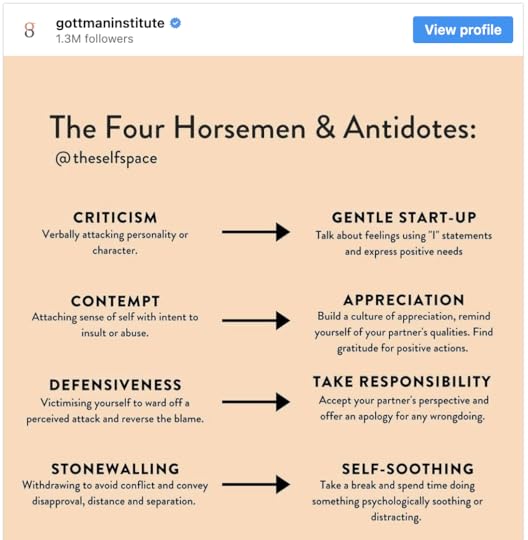
If a conflict makes you angry/overwhelmed, ask for a break and specify when you'll resume the discussion (aim for 30 mins). During the break, the focus should be on doing anything else that soothes you, not on replaying the argument in your mind. Also think of one thing you could've done better if you could start over.
You can learn to downregulate your anger by remembering to breathe, counting to 10, and taking a break. If your partner is criticizing you, she is in pain. Your job is to find out the source of
her pain by asking three questions:
1. What do you need?
2. What are you concerned about?
3. What are you feeling?
Ch. 11: Why Does It Take So Long To Buy A Pair of Shoes? Understanding the Evolutionary Importance of Shopping
- Shopping is in a woman’s DNA. Women have had to be good foragers since the dawn of time. Lives depended on it.
- Most, but not all, women love to shop. It is an expression of their creativity and a positive and social experience for them.
- Women make about 85 percent of the buying decisions for the household.
- Shopping requires a keen memory, and women have better memories than men.
- Men shop the way their ancestors hunted—get in, make the kill, get out. Women connect and create relationships around their shopping.
- If you hate to shop, don’t go.
- Research shows that the degree to which a woman is clothes-conscious is a long-term predictor of marital success.
- Don’t complain if she spends a lot of time shopping for shoes—specifically high heels.
"Anthropologist Helen Fisher says that when women wear high heels it simulates the courting posture, called lordosis, of most mammals. High heels arch the back and thrust out the buttocks, which in the animal kingdom is the universal symbol of sexual readiness."
"British researchers conducted a shopping study of 2,000 men and women and found that men last for approximately 26 minutes" before getting frustrated with the experience.
Ch. 12: Understanding Women and Friendships
- Women are more socially connected than men.
- Female humans and primates form social groups to ensure their survival and the survival of their offspring.
- Women tend and befriend when experiencing stress, and this releases oxytocin and reduces their stress response.
- The more friends a woman has, the more health benefits she experiences.
- Women who are socially isolated have a 66 percent increased risk of dying prematurely from any cause.
- Men typically turn to their wives or partners for their social support, but women typically turn to their female friends.
- A hallmark of domestic violence is a man feeling threatened by a woman’s friends and attempting to control or limit a woman’s social contacts, or to isolate her socially .
- Think of your partner’s female friends as supporting you in supporting your partner.
- Encourage your partner to join a women’s group or seek out friends if she feels she is lacking in female friendships.
- You live longer if you are married or have a long-term partner. She lives longer if she has female friends. You live longer if she lives longer. Encourage her female friendships.
- Women have a huge capacity for friendship and a need to connect with others, as well as an unlimited capacity for love.
(That a woman needs female friends is a no brainer. But this doesn't mean that if you consider a particular friend to be a negative influence, that you shouldn't be able to bring it up for discussion.)
PART 6: Loving a Woman for a Lifetime
Ch. 13: Is She The One? : Understanding Women and
Commitment
- Men want commitment just as much as women do.
- Most men know when a woman is “the one.” There has to be an inherent rightness for a woman to be the one—she has to smell right, feel right, taste right, and look right.
- There are three stages of love, and the stages are very selective. You can’t just fall in love with anyone, and you can’t make it work with everyone.
- Stage one (limerence) usually lasts a few months and is not the time to decide if a woman is the one.
- Stage two is about trust and knowing if you’ll be there for each other.
- The third stage of love is about loyalty and commitment.
- Married men live longer, make more money , and are healthier than men who choose to live with a woman but stay unmarried.
- You don’t need to have similar likes and dislikes to work as a couple, but you do need to be compatible in how you handle conflict and express emotions and affection.
- You will know she’s the one if she makes you feel like you are your best self, and
- you feel more alive, adventurous, joyful, and loved when you are with her.
- Finding the one and making a commitment are about doing what it takes to make a
relationship last.
Ch. 14: Mother Nature: Understanding Women and Children (and the role of a father)
- If you want to truly understand a woman, you have to understand and support her role as a mother. She has a biological drive to bond with her child and ensure her child’s survival. This isn’t about her not loving you or you not being as important to her.
- As a woman becomes a mother, she needs you more than ever, and your support during this transition is critical to the health of your relationship.
- Men play a critical role in a child’s development—dad’s playtime with a baby or child leads to the child having a higher IQ, becoming a more empathic adult, and having happier and healthier relationships later in life. You matter a lot.
- Whether you are the biological father or the father by marriage or choice, you are important to the health and well-being of your child or children.
- If you are feeling left out after a new baby is born, talk to your partner about it.
- It’s up to you to ensure that the demands and workload of having a family are shared and equal. See family life as a great adventure and your relationship will thrive. You can keep the romance, flirtation, play, and adventure alive (and the conflict down) by sharing the workload and becoming her equal partner in the home, family, and relationship. Nurture your friendship and continue to attune.
Ch. 15: Staying Together - Loving a Woman for a Lifetime
Affairs and betrayal don't necessarily happen in a vacuum, they're often the result of long-term neglect. Build trust by managing conflict instead of building a wall in order to avoid conflict. Use every opportunity to turn towards your partner, not away from them. Here are some tips to making love last.
- Six Second Kiss before you leave each other for the day.
- Weekly dates
- Keep getting to know her
- Appreciate her
- Honor her dreams
Personally, I would add, hold her accountable to being the best version of herself. Be someone she can look up to for support, not a passive "yes man."
Introduction
The topic of the book is fairly self-evident. But how do the Gottmans know what they're talking about?
John Gottman is known for being able to predict with 94 percent accuracy whether a couple will get divorced. Julie Gottman, a clinical psychologist, has worked side by side with John to strengthen
couples’ relationships worldwide. I do not know much about the other two co-authors.
The Gottmans used many different methods to study couples.
- Record couples: Videotaped conversations about their day, conflicts, and pleasant topics.
- Measure vitals: Monitored heart rate, blood flow, breathing, and sweat in real-time.
- Code interactions:Analyzed facial expressions, tone of voice, and gestures second-by-second.
- Follow for decades: Tracked couple for up to 20 years to see long-term outcomes.
Nonetheless, no advice works for everyone, so communication with your partner is key. Pay attention not only to stated beliefs, but to revealed preferences.
"All of the research studies show that men who are in happy, healthy relationships make more money, have more sex (yes, believe it or not, married men typically have much more and better sex than single men), live longer, suffer less chronic illness, and show less cognitive impairment—i.e., don’t lose their minds—in their later years."
PART 1: Understanding a Woman
Ch. 1: What do women really want?
According to the authors, what women want the most isn't a six-pack physique or a six-figure bank account - though those are good to have. What they want above all is this: Trustworthiness. Reliability. Can she depend on you?
This isn't simply about being faithful, though of course there's that too. It's about being there for her when she needs it. You demonstrate trustworthiness by being who you say you are and doing what you say you are going to do.
"Trait women want most: trustworthiness.
Trust is built through: emotional connection.
Emotional connection is created through: attunement.
Therefore, emotional attunement = trustworthiness."
"Women need to feel emotionally connected and emotionally safe. This happens through attunement. When a woman wants to connect with you, especially when she’s upset about something, you A-TT-U-N-E: You Attend to her, you physically Turn Toward her, you seek to Understand her by asking questions, you Non-defensively Listen, and you Empathize by accepting and affirming her emotions."
"Women also need to feel physically safe with you. A Hero never uses his size or his voice to intimidate a woman or make a point. A lack of physical safety is a deal breaker with women."
Ch. 2: A mind of her own
A simple way to understand this is that while men and women have the same brain "hardware", hormonal and other biological differences mean that they don't run exactly the same "operating system." Importantly, this isn't about intelligence. Men and women have the same average intelligence.
There are two areas in which a woman's brain on average works differently: Rhythm and fear.
"Rhythmicity: Understand the effect of hormones on the day-to-day emotional state of a woman. Know that these influences are different in every woman and will change in a woman as she goes through different stages of her life. Her sex drive and what she needs from you will also change depending on where she is in her cycle. Ask questions to find out what she needs."
"Fear: Women experience fear differently than men. Women are more easily fear conditioned, meaning that if you both go through a fearful experience, she will be twice as likely to feel fear again in a similar situation. Offering comfort to a woman when she is afraid can immediately shut down her brain’s fear response. That is, of course, assuming she’s happy with you. If she’s unhappy with you, your comfort may not be effective."
PART 2: Dating a Woman
Ch. 3: Read My Hips: Understanding Women and Attraction
"Stress is Not Sexy: Acording to research by Fhionna Moore, PhD, from the University of Dundee, women find low-stress men much more attractive than men with higher levels of cortisol (a stress hormone). Apparently remaining calm is another one of those evolutionary advantages that women are very attracted to. If there’s a saber-toothed tiger attacking your cave, no woman wants a man who is going to freak out and end up fainting from all the excitement."
Women are attracted to confidence and high status. Become the best “you” possible and exhibit the nonverbal behaviors that indicate social dominance, such as space maximization, male-to-male touching, relaxation, and looking into her eyes and smiling. Avoid fidgeting, poor posture, folding your arms across your chest, or crossing your legs at the knee.
Women control whether men approach them by exhibiting a series of nonverbal cues and indicators. Learn the signs that indicate she’s interested.
- She repeatedly glances at you and looks away.
- She leans toward you while talking.
- She points in your direction with her leg, foot, or shoulders.
- She plays with or tosses her hair.
- She fidgets with a piece of jewelry (like an earring) or strokes the stem of her
glass.
Ch. 4: The Do's and Don'ts of Dating
Do's (the Don'ts are simply the opposite)
- Ask open-ended questions.
- Ask questions that will help you get to know her and help her tell her story.
- Be authentic, but try to speak in your lowest register if your natural voice sounds a bit like Mickey Mouse on helium.
- Create safety in conversations by being a good listener.
- Put the woman at the center of any conversation or date.
- Look into her eyes and match her gestures in a natural and easy way .
- Briefly touch her forearm when you ask her to dance, ask for her number, or ask her on a date.
- Be creative when planning your first date. Think of something adventurous, playful, or exciting to do.
- Be a gentleman—open doors, pull out her chair.
- Be protective and confident.
A note on low-pitch voice:
"Professor David Feinberg, from the Department of Psychology, Neuroscience, and Behavior at McMaster University, is the director of the Voice Research Laboratory, and his studies over the last decade have shown that lower-pitched voices in men are considered more attractive to women, and also that men with deep voices have more children. His research also looked at US presidential candidates between 1960 and 2000 and found that in all eight elections, the candidate with the lower voice won the popular vote. So channel your inner James Earl Jones rather than your inner Mike Tyson
when speaking to a woman."
"Researchers at Duke University found that CEOs with lower voices manage bigger companies and, as a result, make more money. The research specifically found that a decrease in voice pitch of 22.1 hertz translates to an increase in company size of $440 million in assets. They also found that CEOs with lower-pitched voices earned an average of $187,000 a year more than CEOs with higher-pitched voices."
Why is low-pitch voice in men generally more attractive both personally and professionally? Simple. Because "anxiety makes the pitch of your voice rise." A low-pitch voice is a proxy for being calm and having a high-stress tolerance. Aim to become more calm, competent, and confident. Your voice will automatically tend to go as low as your natural fundamental frequency.
How to find your natural fundamental frequency?
"To find your fundamental frequency, stand in the shower and use your thumb and index finger to lightly pinch the bridge of your nose. Now hum, varying the frequency. Your fundamental frequency causes the bones of your nose to vibrate the most. Actors use this pitch range to project in a theater without causing voice strain."
Other tips: Belly breathing, relaxation exercises.
Read more: https://www.psychologytoday.com/us/bl...
PART 3: Romancing A Woman
Ch. 5: Making Your Move: The Science of Seduction
- Pheromones are chemical signals that lead to attraction and a sense of well-being when you are with someone who just “smells right. ”
- A woman’s sense of smell is much more acute than a man’s, and your pheromones will smell right to some women and not to others. It’s not personal.
- You do have control over your non-pheromone-related smell. Practice good hygiene accordingly .
A bad first kiss is a relationship killer.
- A woman will remember a first kiss more than she will remember losing her virginity and other big life moments. Make that kiss one worth remembering.
- Kissing releases a flood of feel-good hormones.
- You can learn to give a great first kiss.
Postmodern politically-correct joy kill culture has spent years convincing both men and women that explicit verbal agreement (preferably signed and notarized) is necessary before making a move on someone. On that topic, the authors (two of whom are women):
"BE CONFIDENT. Did Rhett Butler hesitate when he kissed Scarlett O’Hara in Gone with the Wind? No. He told her she “should be kissed often and by someone who knows how.” Then he proved he was the man for the job. There’s a reason the covers of so many romance novels show a woman in the midst of a passionate kiss. Nothing is more of a mood killer than a man who asks for permission. “May I kiss you now?” It’s polite, but it’s not likely to ignite any chemical cocktails in her brain. Instead, read her nonverbal signals to know if it’s the right moment."
Naturally, since people vary, you might be with someone who does prefer explicit verbal consent. So learn to read the signs, trust your instincts, go slow (give her enough opportunity to lean away if she's not interested), and build anticipation.
Ch. 6: Deals with some qualities to look for and avoid in a long-term partner.
PART 4: Making Love to a Woman
Ch. 7: Deals with understanding how women view their bodies.
Gist: Biology and advertisements bombard her with insecurities all the time. Do not joke about her body. Compliment her. Show her you adore and desire her just as she is. If a woman has a poor body image or believes you don’t find her attractive, she will not be comfortable with you sexually.
Ch. 8 & Ch. 9: Deals with an anatomy lesson and a primer on passionate physical intimacy.
PART 5: Living With a Woman
Ch. 10: Deals with Handling Relationship Conflict
"When conflict happens, a woman wants one thing: a good listener. A woman’s goal in conflict is to be better understood by her partner. (This means you.) Problem solving is secondary. Now for men, problem solving is usually primary. They attack a problem with the same shock and awe their ancestors used to attack a wild buffalo, a neighboring tribe, or another hominid who was getting just a little too close to their cave or their woman. There is no place for shock and awe when you’re trying to resolve a conflict with the woman in your life."
The Four Horsemen: Four key negative patterns that, if left unchecked, can ruin a relationship.
If a conflict makes you angry/overwhelmed, ask for a break and specify when you'll resume the discussion (aim for 30 mins). During the break, the focus should be on doing anything else that soothes you, not on replaying the argument in your mind. Also think of one thing you could've done better if you could start over.
You can learn to downregulate your anger by remembering to breathe, counting to 10, and taking a break. If your partner is criticizing you, she is in pain. Your job is to find out the source of
her pain by asking three questions:
1. What do you need?
2. What are you concerned about?
3. What are you feeling?
Ch. 11: Why Does It Take So Long To Buy A Pair of Shoes? Understanding the Evolutionary Importance of Shopping
- Shopping is in a woman’s DNA. Women have had to be good foragers since the dawn of time. Lives depended on it.
- Most, but not all, women love to shop. It is an expression of their creativity and a positive and social experience for them.
- Women make about 85 percent of the buying decisions for the household.
- Shopping requires a keen memory, and women have better memories than men.
- Men shop the way their ancestors hunted—get in, make the kill, get out. Women connect and create relationships around their shopping.
- If you hate to shop, don’t go.
- Research shows that the degree to which a woman is clothes-conscious is a long-term predictor of marital success.
- Don’t complain if she spends a lot of time shopping for shoes—specifically high heels.
"Anthropologist Helen Fisher says that when women wear high heels it simulates the courting posture, called lordosis, of most mammals. High heels arch the back and thrust out the buttocks, which in the animal kingdom is the universal symbol of sexual readiness."
"British researchers conducted a shopping study of 2,000 men and women and found that men last for approximately 26 minutes" before getting frustrated with the experience.
Ch. 12: Understanding Women and Friendships
- Women are more socially connected than men.
- Female humans and primates form social groups to ensure their survival and the survival of their offspring.
- Women tend and befriend when experiencing stress, and this releases oxytocin and reduces their stress response.
- The more friends a woman has, the more health benefits she experiences.
- Women who are socially isolated have a 66 percent increased risk of dying prematurely from any cause.
- Men typically turn to their wives or partners for their social support, but women typically turn to their female friends.
- A hallmark of domestic violence is a man feeling threatened by a woman’s friends and attempting to control or limit a woman’s social contacts, or to isolate her socially .
- Think of your partner’s female friends as supporting you in supporting your partner.
- Encourage your partner to join a women’s group or seek out friends if she feels she is lacking in female friendships.
- You live longer if you are married or have a long-term partner. She lives longer if she has female friends. You live longer if she lives longer. Encourage her female friendships.
- Women have a huge capacity for friendship and a need to connect with others, as well as an unlimited capacity for love.
(That a woman needs female friends is a no brainer. But this doesn't mean that if you consider a particular friend to be a negative influence, that you shouldn't be able to bring it up for discussion.)
PART 6: Loving a Woman for a Lifetime
Ch. 13: Is She The One? : Understanding Women and
Commitment
- Men want commitment just as much as women do.
- Most men know when a woman is “the one.” There has to be an inherent rightness for a woman to be the one—she has to smell right, feel right, taste right, and look right.
- There are three stages of love, and the stages are very selective. You can’t just fall in love with anyone, and you can’t make it work with everyone.
- Stage one (limerence) usually lasts a few months and is not the time to decide if a woman is the one.
- Stage two is about trust and knowing if you’ll be there for each other.
- The third stage of love is about loyalty and commitment.
- Married men live longer, make more money , and are healthier than men who choose to live with a woman but stay unmarried.
- You don’t need to have similar likes and dislikes to work as a couple, but you do need to be compatible in how you handle conflict and express emotions and affection.
- You will know she’s the one if she makes you feel like you are your best self, and
- you feel more alive, adventurous, joyful, and loved when you are with her.
- Finding the one and making a commitment are about doing what it takes to make a
relationship last.
Ch. 14: Mother Nature: Understanding Women and Children (and the role of a father)
- If you want to truly understand a woman, you have to understand and support her role as a mother. She has a biological drive to bond with her child and ensure her child’s survival. This isn’t about her not loving you or you not being as important to her.
- As a woman becomes a mother, she needs you more than ever, and your support during this transition is critical to the health of your relationship.
- Men play a critical role in a child’s development—dad’s playtime with a baby or child leads to the child having a higher IQ, becoming a more empathic adult, and having happier and healthier relationships later in life. You matter a lot.
- Whether you are the biological father or the father by marriage or choice, you are important to the health and well-being of your child or children.
- If you are feeling left out after a new baby is born, talk to your partner about it.
- It’s up to you to ensure that the demands and workload of having a family are shared and equal. See family life as a great adventure and your relationship will thrive. You can keep the romance, flirtation, play, and adventure alive (and the conflict down) by sharing the workload and becoming her equal partner in the home, family, and relationship. Nurture your friendship and continue to attune.
Ch. 15: Staying Together - Loving a Woman for a Lifetime
Affairs and betrayal don't necessarily happen in a vacuum, they're often the result of long-term neglect. Build trust by managing conflict instead of building a wall in order to avoid conflict. Use every opportunity to turn towards your partner, not away from them. Here are some tips to making love last.
- Six Second Kiss before you leave each other for the day.
- Weekly dates
- Keep getting to know her
- Appreciate her
- Honor her dreams
Personally, I would add, hold her accountable to being the best version of herself. Be someone she can look up to for support, not a passive "yes man."

April 24, 2025
If you've ever been confounded when a date went bad or a relationship soured, the answers you seek very well could be within "The Man's Guide to Women."
Written by two couples, long-time experts in studying love, this book uses science, research, evolution, and humor to explain the differences between how men and women think and operate. It covers everything -- meeting women, dating, romance, sex, relationships, and raising kids. The book provides lots of simple advice men can use to improve their relationships with women.
One of the first assertions in the book is a very empowering message for men -- what men do in a relationship is the main factor in determining if it's a good one or a bad one.
So this is not a book telling men to roll over or just acquiesce to their partner as a way to keep things going. This is a book to guide men into taking smart actions.
In some cases, inaction is even advised.
A chapter on how the hunter-gatherer roles of ancient humans factors into the different styles of shopping for men and women advises men to duck out of shopping trips if they can't be good about the time women take. The advice is either not go at all or camp out somewhere in the mall where you can relax while she shops.
Another eye-opening chapter in the book explained how mens' desire to solve problems gets badly in the way during conversations with women when all the latter wants is to have her emotions acknowledged. (And that's not even necessarily agreed with, but just acknowledged.) Knowing that before would've personally saved me numerous failed attempts to troubleshoot a girlfriend's problems when I just had to sit there, listen and show just a little empathy. That sounds much easier!
There are a lot of great insights in the book about ways to navigate the differences between sexes to maintain a good relationship. I'm sure for some men, a lot of this will reflect what they've already done. Others may be clueless. For me it was a mix of stuff that came naturally, and other things that explained a whole lot about past relationships that didn't work out.
For your convenience, each chapter of the book ends with bulleted lists of DOs and DON'Ts to summarize the key points. And there are occasional humerous comics, anecdotes, and quips in the book to keep it funny. It's an enjoyable, easy-to-digest read.
This is not a book of "tricks" to get women in bed -- the authors take a few jabs at such sleazy pick-up guides. But the authors do say this relationship advice should lead to more frequent and better sex. So if that's what you're looking for, the book doesn't deny you that goal.
Yes, I was a little embarrassed to check out a relationship advice book from the library. (Working evenings in a library does help me covertly bring books home without waiting in line at the front desk, so that did help.) But I was glad I picked up this book. Read it once and then went back through it a second time to refresh myself on some key points.
Written by two couples, long-time experts in studying love, this book uses science, research, evolution, and humor to explain the differences between how men and women think and operate. It covers everything -- meeting women, dating, romance, sex, relationships, and raising kids. The book provides lots of simple advice men can use to improve their relationships with women.
One of the first assertions in the book is a very empowering message for men -- what men do in a relationship is the main factor in determining if it's a good one or a bad one.
So this is not a book telling men to roll over or just acquiesce to their partner as a way to keep things going. This is a book to guide men into taking smart actions.
In some cases, inaction is even advised.
A chapter on how the hunter-gatherer roles of ancient humans factors into the different styles of shopping for men and women advises men to duck out of shopping trips if they can't be good about the time women take. The advice is either not go at all or camp out somewhere in the mall where you can relax while she shops.
Another eye-opening chapter in the book explained how mens' desire to solve problems gets badly in the way during conversations with women when all the latter wants is to have her emotions acknowledged. (And that's not even necessarily agreed with, but just acknowledged.) Knowing that before would've personally saved me numerous failed attempts to troubleshoot a girlfriend's problems when I just had to sit there, listen and show just a little empathy. That sounds much easier!
There are a lot of great insights in the book about ways to navigate the differences between sexes to maintain a good relationship. I'm sure for some men, a lot of this will reflect what they've already done. Others may be clueless. For me it was a mix of stuff that came naturally, and other things that explained a whole lot about past relationships that didn't work out.
For your convenience, each chapter of the book ends with bulleted lists of DOs and DON'Ts to summarize the key points. And there are occasional humerous comics, anecdotes, and quips in the book to keep it funny. It's an enjoyable, easy-to-digest read.
This is not a book of "tricks" to get women in bed -- the authors take a few jabs at such sleazy pick-up guides. But the authors do say this relationship advice should lead to more frequent and better sex. So if that's what you're looking for, the book doesn't deny you that goal.
Yes, I was a little embarrassed to check out a relationship advice book from the library. (Working evenings in a library does help me covertly bring books home without waiting in line at the front desk, so that did help.) But I was glad I picked up this book. Read it once and then went back through it a second time to refresh myself on some key points.

January 3, 2025
My husband and I read this together over the course of several months, discussing as we went. We learned a lot. Much of the information taught really goes both ways, although this book is specifically directed at men. There is an undertone of humor that may or may not be off-putting. We didn't mind, seeing as much of it is based on common cultural bias.
The most important takeaways are to be a trustworthy partner, be attuned to your partner and seek to know each other, help each other, stay committed, love each other. . .
The Gottmans and Abramses rock relationship education. We can always count on them to teach us some new skills. John Gottman is considered the authority on relationship research, counseling, and understanding. We have found his books and institute's articles to be reliable and relatable as resources for learning to communicate better, turn towards each other, and to help us strengthen our marriage.
The most important takeaways are to be a trustworthy partner, be attuned to your partner and seek to know each other, help each other, stay committed, love each other. . .
The Gottmans and Abramses rock relationship education. We can always count on them to teach us some new skills. John Gottman is considered the authority on relationship research, counseling, and understanding. We have found his books and institute's articles to be reliable and relatable as resources for learning to communicate better, turn towards each other, and to help us strengthen our marriage.
Displaying 1 - 30 of 345 reviews