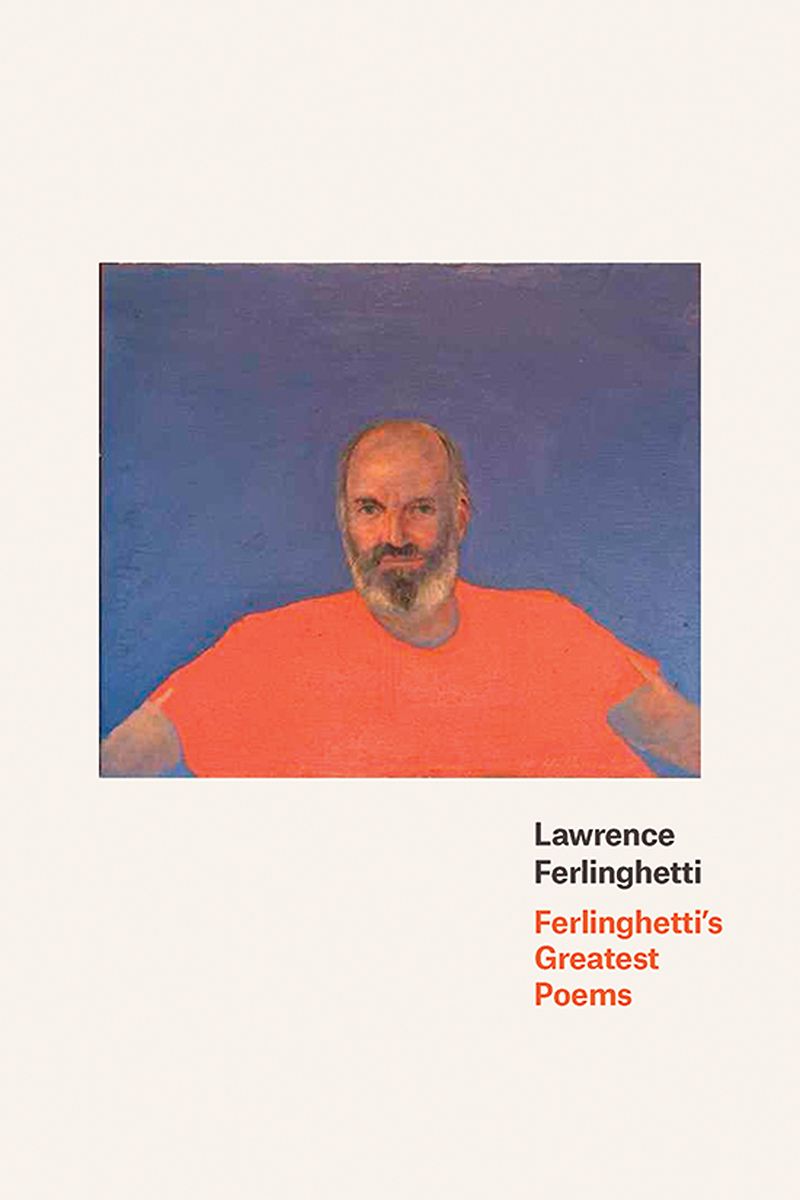
At last, a compact, powerful overview of one of America’s most beloved and radical poets―spanning more than six decades of work At last, just in time for his 99th birthday, a powerful overview of one of America's most beloved New Directions is proud to present a swift, terrific chronological selection of Ferlinghetti's poems, spanning more than six decades of work and presenting one of modern poetry's greatest achievements.
A prominent voice of the wide-open poetry movement that began in the 1950s, Lawrence Ferlinghetti has written poetry, translation, fiction, theater, art criticism, film narration, and essays. Often concerned with politics and social issues, Ferlinghetti’s poetry countered the literary elite's definition of art and the artist's role in the world. Though imbued with the commonplace, his poetry cannot be simply described as polemic or personal protest, for it stands on his craftsmanship, thematics, and grounding in tradition.
Ferlinghetti was born in Yonkers in 1919, son of Carlo Ferlinghetti who was from the province of Brescia and Clemence Albertine Mendes-Monsanto. Following his undergraduate years at the University of North Carolina at Chapel Hill, he served in the U.S. Navy in World War II as a ship's commander. He received a Master’s degree from Columbia University in 1947 and a Doctorate de l’Université de Paris (Sorbonne) in 1950. From 1951 to 1953, when he settled in San Francisco, he taught French in an adult education program, painted, and wrote art criticism. In 1953, with Peter D. Martin (son of Carlo Tresca) he founded City Lights Bookstore, the first all-paperbound bookshop in the country, and by 1955 he had launched the City Lights publishing house.
The bookstore has served for half a century as a meeting place for writers, artists, and intellectuals. City Lights Publishers began with the Pocket Poets Series, through which Ferlinghetti aimed to create an international, dissident ferment. His publication of Allen Ginsberg’sHowl & Other Poems in 1956 led to his arrest on obscenity charges, and the trial that followed drew national attention to the San Francisco Renaissance and Beat movement writers. (He was overwhelmingly supported by prestigious literary and academic figures, and was acquitted.) This landmark First Amendment case established a legal precedent for the publication of controversial work with redeeming social importance.
Ferlinghetti’s paintings have been shown at various galleries around the world, from the Butler Museum of American Painting to Il Palazzo delle Esposizioni in Rome. He has been associated with the international Fluxus movement through the Archivio Francesco Conz in Verona. He has toured Italy, giving poetry readings in Roma, Napoli, Bologna, Firenze, Milano, Verona, Brescia, Cagliari, Torino, Venezia, and Sicilia. He won the Premio Taormino in 1973, and since then has been awarded the Premio Camaiore, the Premio Flaiano, the Premio Cavour. among others. He is published in Italy by Oscar Mondadori, City Lights Italia, and Minimum Fax. He was instrumental in arranging extensive poetry tours in Italy produced by City Lights Italia in Firenze. He has translated from the italian Pier Paolo Pasolini’s Poemi Romani, which is published by City Lights Books. In San Francisco, his work can regularly be seen at the George Krevsky Gallery at 77 Geary Street.
Ferlinghetti’s A Coney Island of the Mind continues to be the most popular poetry book in the U.S. It has been translated into nine languages, and there are nearly 1,000,000 copies in print. The author of poetry, plays, fiction, art criticism, and essays, he has a dozen books currently in print in the U.S., and his work has been translated in many countries and in many languages. His most recent books are A Far Rockaway of the Heart (1997), How to Paint Sunlight (2001), and Americus Book I (2004) published by New Directions.
He has been the recipient of numerous prizes, including the Los Angeles Times’ Robert Kirsch Award, the BABRA Award for Lifetime Achievement, the National Book Critics Circle Ivan Sandrof Award for Contribution to American Arts and Letters, the American Civil Liberties Union’s Earl Warren Civil Liberties Award. Ferlinghetti was named San Francisco’s first poet laureate.
A master of word alchemy - illuminated and incandescent. As time goes by I find that Ferlinghetti is one of the poets I like to come back and read after I have gone through another decade; like talking to the uncle you can always trust to tell you the truth. Really wish I could have gone to one of his readings.
I recently entered a contest to win a copy of Lawrence Ferlinghetti's new novel "Little Boy" and was surprised at receiving favorable responses simply for showing an interest in the book, published as Ferlinghetti (b. March 24, 1919) reaches the century mark. The response encouraged me to read Ferlinghetti rather than merely to enter a contest. I turned to this collection, "Ferlinghetti's Greatest Poems" published by New Directions in 2017 when the poet was the young age of 98.
Ferlinghetti has been a presence in American life for many years. I have been most familiar with him through my reading of Beat works by Allen Ginsberg and Jack Kerouac. Ferlinghetti published Ginsberg's poem "Howl" and defended the poem in a subsequent obscenity trial. Among other things, Ferlinghetti has also owned San Francisco's City Lights bookstore for many years, and he has become almost synonymous with the cultural life of the city. I have read Ferlinghetti before, but this is the first time I remember reading through an entire book. It was a rewarding thing to do and shouldn't have had to wait until the poet was reaching 100.
The book offers an overview of Ferlinghetti's poetry from 1955 to 2014 and includes works from 12 published collections. The poetry has a feeling of spontaneity and accessibility as Ferlinghetti avoided the difficult, academic style of some contemporary poetry. The poems are a fun to read and also frequently serious. Many of the works have the feel of a painting. The poems are set in San Francisco, of course, but also in New York City, Paris, and elsewhere. Figures such as Pablo Neruda, Jack Kerouac, Ezra Pound, and Dylan Thomas receive recognition in these poems. While many of the poems have a political bent, many others celebrate individual feeling and experience and the joy of being alive. Many of the poems are written in a form of variable, broken lines which reminded me of William Carlos Williams. There are many other poetic influences, including Whitman, as well.
I thought the best of these poems were those included in Ferlinghetti's early collection "The Coney Island of the Mind", a book which has become a rare million-seller for a work of poetry and is probably the work for which Ferlinghetti will be remembered. There are 13 works included from this collection, including the work in which the poet declares "The pennycandystore beyond the El/ is where I first/ fell in love/ with unreality." It is difficult not to fall in love with this poem. In the poem "I am waiting" Ferlinghetti announces a theme for his poetry and for his understanding of life as he repeats "I am perpetually awaiting/a rebirth of wonder." The poetry from "Coney Island of the Mind" is accessible and inspiring.
Ferlinghetti continued to write in his own style through the rest of the books excerpted in this anthology with many outstanding poems. The poems I especially enjoyed included the short "Recipe for Happiness in Khaboravosk or Anyplace", "Baseball Canto", "The Scavengers on a Truck: Two Beautiful People in a Mercedes" "The Old Italians Dying", "Roman Morn" and more. In an excerpt from a series called "Paris Transformations" Ferlinghetti reflects on the inevitability of death.
"For years I never thought of death. Now the breath of the eternal harlequin makes me look up as if a defrocked Someone were there who might make me into an angel playing piano on a riverboat."
This is a book to get to know and to revisit. It enhanced my appreciation of the Beats and of other American poetry and art with a broad-based appeal. I enjoyed sitting down with Ferlinghetti at last and thinking about his accomplishments and vision as he reaches 100 years of age.
Ferlinghetti is 101 years old. I saw him in a Zoom celebration of his birthday last spring, and he was still standing sturdily upright at his window to wave to a crowd celebrating him below. The books featured in this collection were published from 1955 to 2014. My first encounter with him was when I got to college, not in class, but when my roommate handed A Coney Island of the Mind to me, saying, “I think you’ll like this.” She was right. That was the second collection featured in these greatest hits.
For me, there’s an energy and buoyant momentum to his early work that I can’t compare to any other poet I know. They’re less profound, perhaps, than later poems, being more wonderful in the joy of reading than in meaning, and yet it’s their uniqueness that makes me prefer his poems published before 1981. So I was all the more surprised when I came to Blasts Cries Laughter(2014). That was the year Ferlinghetti turned 95, but the events of 9/11 and following 9/11 propelled him to write more political, pessimistic poems about the state of the world and failures of humanity. This is not usually poetry I’m drawn to, but I found his poems brilliantly heartbreaking.
In some cases, knowing what I now know, turns good poems into great ones. In 1973, Open Eye, Open Heart was published, including the poem “Pound at Spoleto.” Pound died in 1972. At the time the poem was written, he was in his 80s and exceedingly frail. Pound was seated in a theatre box, so he could take his turn reading without having to struggle to the stage.
“After almost an hour, his turn came. Or after a life….The applause was prolonged and Pound tried to rise from his armchair. A microphone was partly in the way. He grasped the arms of the chair with his bony hands and tried to rise. He could not and he tried again and could not. His old friend did not try to help him.” The contrast with Pound’s condition to the hale Ferlinghetti at 101 made this poem (with prose poem or prose intro) much more heartbreaking.
This is the beginning of an early poem I enjoyed. It sounds so light, breezy, joyful, then he smacks you with amusing sarcasm and contradiction. You still the world is a beautiful place because he makes awful things seem funny. (Picture this poem with the lines sprawled across the page and lots of spacing. Goodreads reformatted this when I hit preview/post.)
“The world is a beautiful place to be born into if you don’t mind happiness not always being so very much fun if you don’t mind a touch of hell now and then just when everything is fine because even in heaven they don’t sing all the time….”
I always liked greatest hits albums, especially when full of new discoveries. I always liked artist retrospectives that enable us to see change over time—the blue phase, the island years, etc. I always liked protest songs that said no to death and yes to life. A book to share and share.
Driving a cardboard automobile without a license At the turn of the century My father ran into my mother On the fun-ride at Coney Island Having spied each other eating In the French boardinghouse nearby And having decided right there and then That she was for him entirely He followed her into The playland of the evening Where the headlong meeting Of their ephemeral flesh on wheels Hurtled them forever together
And I now in the back seat Of their eternity Reaching out to embrace them
We are the same people Only further from home On freeways fifty lanes wide On a concrete continent Spaced with bland billboards Illustrating imbecile illusions of happiness
Most of the poems in this collection have great lines, but not so much on the poem as whole.
Nonetheless, there were bangers such as New York-Albany; Underwear; Recipe for Happiness in Khabarovsk or Anyplace; Jack of Hearts; “Driving a cardboard automobile”; The Lord’s Last Prayer.
Although I'm a declared not fan of beat poetry, I wanted to read some more of Ferlinghetti's poetry (yet Ferlinghetti did not consider himself to be a Beat poet, as he said in the 2013 documentary Ferlinghetti, Rebirth of Wonder: "Don't call me a Beat, I never was a Beat poet"). I must say I prefer Ferlinghetti over Ginsberg, and Ginsberg over Kerouac. I think the myth around these last two is not "literaturelly" justified, more so for Kerouac. As I said before, beat is not my cup of tea. I see it, as we say in Spanish, a lot of noise but few nuts. Having been twice to City Lights Bookstore, Ferlinghetti's library in San Francisco (where Ginsberg's Owl was published), I needed to read at least two of his books. I already read A Coney Island of the Mind, so what better than an anthology of Ferlinghetti's poems, especially this book being a present.
Much of Ferlinghetti's free verse attempts to capture the spontaneity and imaginative creativity of modern jazz. As I read in the preface for the Casimiro Parker edition of A Coney Island of the Mind, he was know for having frequently incorporated jazz accompaniments into public readings of his work.
With Ferlinghetti I do connect in some of the shorter poems. The longer poems might be alright if you listen to them, but not in the context of a page. It is just a set of examples with word and sound games within a broad topic without much depth, like in Baseball Canto or I am waiting. Some of the other poems have the high virtue of being good when reading and when listening. For me, a poem has to attemp to blend universality from the particular in all levels, like in Deep Chess. In its last verses, he talks about life as a momentum, either you want it or not, but not as an obligation. And more:
"And there's still time - Your move"
Ferlinghetti's poetry is also characterized by its distinctive rhythm. His mastery of sound is evident throughout the collection, creating musicality from the sound of words and silences. He employs various prosodic techniques, including alliteration, assonance, and internal rhyme, to create a musical quality in his verse. He often employs a "ping-pong pattern" in his verse, creating a staggered, free-form typography that mirrors the content of his work. I think it is meant to help the reading of his poems, because it actually works with the emphasis that they require. This typographical experimentation serves not just an aesthetic purpose but also a functional one, guiding the reader's breath and attention. For example, in "In Goya's greatest scenes we seem to see", we read:
"We are the same people only further from home"
Nevertheless, his rejection of traditional punctuation and capitalization, while innovative, can sometimes lead to ambiguity in interpretation. I also don't like about Ferlinghetti is the use of "and" in each other sentence as a connector. It makes me lose the wire, especially in the longer poems.
Ferlinghetti's background as a painter is evident in his poetry, with many of his of his works depicting scenes. His poems often read like verbal canvases, employing techniques such as ekphrasis and synesthesia to create rich, multisensory experiences for the reader. This painterly approach adds a unique dimension to his work, although sometimes he falls into the narrative hole of lyricism. In any case, his ability to transform everyday objects into experiences is particularly evident in poems like "The pennycandystore beyond the El":
"The pennycandystore beyond the El is where I first fell in love with unreality Jellybeans glowed in the semi-gloom of that September afternoon"
Ferlinghetti's work is deeply rooted in social and political commentary, which sometimes gets a bit frivolous. His poems often serve as a critique of contemporary society, addressing issues such as environmental destruction, political corruption and the role of the artist in society. Other poems are just shallow words on ultra complex social phenomena, like White on White. While Ferlinghetti's work is generally strong, there are occasional moments where his political fervor overshadows his poetic craft. Some critics might argue that poems like Underwear, while entertaining, lack the depth and nuance of his more accomplished works.
I don't like the excessive culturalism in the way he conceives it. Of course poetry is born out of situations, but they sometimes feel like a burden to connect with the poem. If you don't know San Francisco, you lose a lot. And that is not fair.
In addition, he talks about love being sexually explicit, but in a good way. I don't see him taken about semen and breasts in a provocative or pornographic way, but as a down to earth approach to the topic. We have a great poem in "What could she say to the fantastic foolybear", where sperm is the result of sex which a seed of life (various interpretations) that birds, guardians of freedom for life, go to spread the word of the body:
"and birds went mad and threw themselves from trees to taste still hot upon the ground the spilled sperm seed."
Other than the poems I already highlighted, I personally recommend:
- In Paris a loud dark winter - Recipe for happiness in Khabarovsk or anyplace - Two scavengers in a truck, two beautiful people in a Mercedes - Roman morn - Driving a cardboard automovile without a license - O heart - History of the airplane - Pity the nation - South of the border
Beat or not, Ferlinghetti is a great poet, especially for those skeptical with experimental poetry.
Love his sense of humor. The quote by Coppola on the back cover is true, Ferlinghetti’s poems get you laughing and then hit with a force of truth. I couldn’t relate to much of the works lauding his favorites writers. The streaming multi-page poems that tap into the iconic Beat bebop ramble were often some of my favorites. Many of the short slices of poems were just as powerful. A lot of those had some of his best wordplay and flips
There were a couple poems I loved in their entirety, and several with wonderful lines. His poetry as a whole, however, didn’t speak to me. Nor did one poem speak loudly enough to make me fall in love with the poetry. I would, however, be keen on reading more of his work.
I think Ferlinghetti is pretty hit or miss for me, but his misses are still interesting and his kind spirit comes through in all his poetry. Really liked "The General Song Of Humanity" and some others.
The first half did not grab me. Too many proper French nouns that I will not decipher. But the second half really picks up (each collection of poems is arranged chronologically). Wonderful poems, I may revisit sometime
Seems more like an overview of his career than his greatest poems. Some hits, but plenty of misses. Multiple references to New York City, San Francisco, Paris, Pablo Neruda, and God / Jesus.
Favorites: "It was a face which darkness could kill" - from Pictures of the Gone World "Sometime during eternity" - from A Coney Island of the Mind "Rough Song of Animals Dying" - from Northwest Ecolog