This quiet story of the Holocaust chronicles the lives of several Danes through the summer of 1943. It is the discontinuity of small things--the scattered inconveniences, chance meetings, glimpses of injustice, and indulgences of hope, --that haphazardly directs each individual to his fate. An hypnotic story of ordinary people caught in a silent maelstrom, ultimately driven to extraordinary feats.
Kevin Haworth is the author of three books: Famous Drownings in Literary History, The Discontinuity of Small Things, and Lit From Within: Contemporary Masters on the Art and Craft of Writing. A two-time winner of the Ohio Arts Council's Individual Excellence Award, he has received fellowships from Headlands Center for the Arts, Vermont Studio Center, and Ledig International Writers House. He teaches at Ohio University and at Tel Aviv University.
It is the 1940s in Nazi-occupied Denmark. Jews survive by maintaining a low profile but we all know it’s just a question of time before the Nazis come for them.
A young Danish girl begins to discover her Jewish identity and feels inexplicably drawn toward Israel. Escaping to Norway to survive the Holocaust, she later became a pioneer in the first wave of post-war European settlement in Israel.
The book does a good job of building up to the sheer terror that is coming, all the more horrific because the young German occupiers look clean-cut and even act politely until the time comes.
The book has exciting language and thoughtful passages such as these two, drawn from consecutive pages to show the richness of the writing:
“Perhaps it is because people without direction subconsciously seek the last place they knew direction…”
A character speaking of his maternal grandmother: “… Bakman always suspected that she died in order to pursue her adversary, his father, into the afterlife.”
The author teaches English and literature at Ohio University and Tel Aviv University. He has written or edited a dozen books and is best known on GR for his novel The Wife of Martin Guerre. This book I am reviewing, The Discontinuity of Small Things won the Samuel Goldberg award for best Jewish fiction.
Disclaimer: When I was dean of the Ohio University Zanesville campus the author visited the campus to speak and graciously gave me a copy of this book.
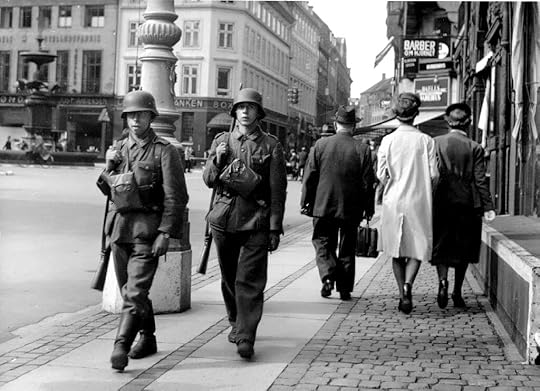
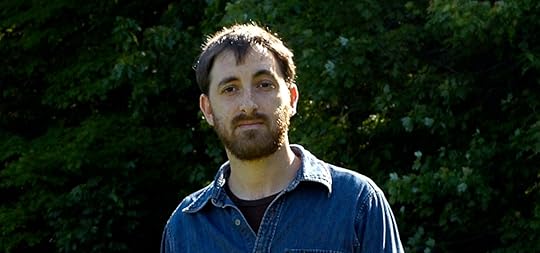
Top photo of German troops in Copenhagen from dailyscandinavian.com The author from woub.org
This book has a certain quality, an understated, black-and-white film kind of feeling that I enjoyed. It's bleak, with a quiet, spare sense of humor. There's nothing great about it but it's solidly good, the characters feel relatively well drawn, their struggles make sense. Each character is up against daily some combination of frustrations: poverty, relationship complications, the German occupation. Meanwhile, as the novel progresses. the occupation gets more and more violent and intense.
The central character is Hannah Bergstrom, a young Jewish woman who lives in Copenhagen with her comfortably wealthy parents and dreams of setting sail for Palestine after she receives a long letter from a childhood friend whose family emigrated to Palestine at the start of the war (and who describes her kibbutz life in great detail.) She gets involved with a group of zionists and keeps these and other activities from her parents. She is navigating young adulthood during wartime and in some sense this is a coming of age story.
Other important characters: Carl, a fisherman, and his wife Jutte, both suffering (differently) from isolation and loneliness; medical student Bakman and his friend Henrik, both involved in resistance activities. Someone whose name I can't quite figure out, but he comes from a whaling village as far as I can tell, and has some kind of connection to Hannah.
All in all this is an engaging book about Denmark during the war. Sometimes I was frustrated with the chronology and unnecessary (I think) confusion about people and places. But a good first novel by Haworth.
THE DISCONTINUITY OF SMALL THINGS is a deeply moving and beautifully written novel, one of the best I've read in a long time.
A striking difference between Kevin Haworth’s book and other Holocaust literature is the degree of realism his work brings to readers whose lives were never directly touched by the Holocaust.
When I read some of the other novels, I felt so numbed and shocked that I could’t believe what I “saw.” It was horrifying, but didn't seem believable. I couldn't relate to it -- not only because I'm not Jewish, but also because I've never experienced war firsthand.
THE DISCONTINUITY OF SMALL THINGS, which focuses not on the unspeakable horrors of the Holocaust, but on the hardships of daily life -- a preview of what was to come -- is different. What Haworth wrote seems real. This I can see happening. I can see it happening here in the U. S., too, and if it does, our experience may be much like that of the Danes during the 1940 German invasion and continuing occupation of their country.
Awareness dawns slowly for Bakman. Nazi propaganda pamphlets rain down from the sky:
“Bakman has heard—where he has heard he can’t quite remember...it comes like a change of weather—that there are places in Europe where Jews clean the streets. Dragged from their shops, scrubbing the pavement on their hands and knees. Not in Denmark, of course. These things would never happen in Denmark.”
Carl Jensen, a fisherman in the village of Gilleleje, facing economic ruin during the occupation, feels desperate:
"The sea smelled rich and hungry. If that plank sprung a leak now, if the tar holding it melted or if he caught his sweater in the net and got pulled over the sea would swallow him and his body would not return to the shore. He would disappear.... The salt water lapped against the side of the boat. It called to him. It would be easy."
When Jette, Carl’s wife, can endure hardship no longer, she tells him she will leave on the eleven a.m. train [to] Copenhagen:
"[Carl] put down his bread and its stingy trace of butter and said simply, No.
No?
No.
Jette looked at him and said, No, there is no eleven a.m. [to Copenhagen] or No I will not be found on that train?
No, he repeated. . . .
She looked around her at their tiny house, at the small bedroom where she had slept alone six nights a week for more than twenty years while Carl was fishing in the Sound. She had tried to explain to Carl that leaving for Copenhagen to visit her sister was not the same as leaving him, but this was a distinction he had trouble grasping even before trains began to explode all across Denmark. . . .
I am going, she said. It is time for you either to hit me until I am unconscious or get out of the way.
They stood looking at each other, each of them searching for a safe route down from the precipice of that last statement."
The “small things” began to pile up:
"[Bakman] had never felt the war so presently as today. Each moment of the war until this day had been only a small adjustment: cold water instead of lukewarm in his shower, ersatz coffee instead of real, and milk only on occasion. A small stockpiling of incident... But today—seeing the mound of small weaponry at a fashionable square—Bakman knows that something vital has changed.... The dream of a simpler, purer Denmark, lovely country by the sea, has passed him by."
The characters seem as real as your family and friends. They are ordinary people who find within themselves extraordinary courage.
I could not put this book down. Small book depicting, in separate veins, a fictionalized account of the Danish resistance during World War II, and the mobilization and transformation of moderate middle class Jews who become desperate to save their families and country. Probably the best new book I have read.
A surprising and wonderful find, this fairly spare novel offers an unusual view of the terrors inflicted on Europe and persecution of Jews by Germans (and others) in WWII, in this case Denmark. Beautifully written, compelling storylines, realistic yet satisfying ending. I couldn't put it down.
A novel about World War II from a Danish perspective. Things happen on a smaller scale, but somehow these more ordinary acts of horror are all the more striking. Gorgeous.
Why I didn't finish this: The other reviews I read for this book kept praising its spare prose, and I think that's where my own discontinuity (ha!) with the story came into play. Sorry, it's not you, it's me.
Things get tied up a little too neatly. There are some great WWII Europe images in here, though. Things you don't think about or see in WW II movies that actually happened.