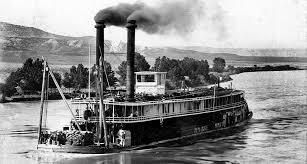
Jump to ratings and reviews
Rate this book

زندگی بر روی میسی‌سیپی

Rate this book
زندگی بر روی میسی‌سیپی در حقیقت، بخشی از زندگی نویسندهٔ اثر، مارک تواین، است. او در این کتاب به حدی داستان، حکایت، لطیفه و نکته‌های تازه، خنده‌دار و بانمک آورده که خواننده در پایان کتاب شگفت‌زده از خویش می‌پرسد که آیا نویسنده قصد داشته شرحی از زندگی در کنارهٔ آن رودخانهٔ شگفت به دست دهد یا آن‌که داستان‌پردازی خود را از مسائل انسانی به نمایش بگذارد.

540 pages, Paperback

First published January 1, 1883

2902 people are currently reading
16808 people want to read

About the author

Mark Twain

9,003 books18.8k followers
Librarian Note: There is more than one author by this name in the Goodreads database.

Samuel Langhorne Clemens, known by the pen name Mark Twain, was an American writer, humorist and essayist. He was praised as the "greatest humorist the United States has produced," with William Faulkner calling him "the father of American literature." His novels include The Adventures of Tom Sawyer (1876) and its sequel, Adventures of Huckleberry Finn (1884), with the latter often called the "Great American Novel." Twain also wrote A Connecticut Yankee in King Arthur's Court (1889) and Pudd'nhead Wilson (1894), and co-wrote The Gilded Age: A Tale of Today (1873) with Charles Dudley Warner.

Ratings & Reviews

What do you think?
Rate this book

Friends & Following

Create a free account to discover what your friends think of this book!

Community Reviews

5 stars
4,636 (29%)
4 stars
5,820 (37%)
3 stars
3,880 (24%)
2 stars
901 (5%)
1 star
321 (2%)
Displaying 1 - 30 of 962 reviews
Profile Image for Bill Kerwin.
Author 2 books84.5k followers
May 24, 2024

I first read this book fifty years ago when I was in high school, and I recalled Twain's account of his days as a Mississippi steamboat pilot's apprentice as a work of great humor and style with quintessentially American themes, equal in power to Huckleberry Finn. A recent re-reading has left me both gratified and disappointed: gratified because Twain's history and description of the ever-changing Mississippi and his account of his life as a young river pilot are just good as I remembered them, but disappointed because this account occupies only the first third of the book.

The other two-thirds has moments of equal power--Twain's account of his return to his boyhood home Hannibal, for example--but most of it is a casually organized travelogue of a trip up the Mississippi by the fifty-year-old Twain, interrupted by random anecdotes and tall tales. This second two-thirds is uneven but entertaining, full of characteristic Twain humor; it is as good as "Roughing It," a book I like and admire.

Nevertheless, it nowhere equals the power of the first hundred pages. And a book the ends worse than it began is always a disappointment.
Profile Image for Fionnuala.
893 reviews
Read
January 23, 2026
This long book feels like two separate books—although life on the Mississippi is very much at the centre of both.

The first book, as I think of it, focuses mostly on Mark Twain's youth spent on the river—after a short account of the first Euopeans to settle along the Mississippi shores.

Twain is not very specific about what age he was when he began his life on the river, but he must have been a teenager because he tells us he'd run away from home to pursue his dream of working on a steamboat.

Home was Hannibal, Missouri, and according to Wikipedia, when Twain was born there in 1830, Hannibal was a tiny community of approximately 30 people, but by 1846—around the time Twain began his steamboat career—it had become Missouri's third-largest city. A lot of that growth was due to the town being a stopping point for steamboats on the way downriver to New Orleans, 1000 miles south, and upriver towards St Louis, some 200 miles to the north. Incidentally, steamboat trade became an established mode of transport just around the time Twain was born so you could say the boy and the steamboats grew up together.

Steamboats transported all sorts of merchandise, both agricultural and industrial, as well as passengers.
Twain tell us that every boy in his town dreamed of working on the steamboats, so glamorous did they appear to those watching from the shore. The boys were prepared to do anything, even shoveling coal into the great furnaces in the boiler rooms below decks. But Twain himself, whom I imagine as the Tom Sawyer of his bunch of friends, set his sights higher. Nothing would do for him but to be, not the captain, not the first mate, but the pilot. And not just any pilot but one in the mode of Horace Bixby, who was thought of as the most accomplished pilot navigating the Mississippi in the 1840s and 50s. So the young Samuel Clemens, as he was known then, managed to waylay Bixby, who was piloting the ‘Paul Jones’ upriver at the time. This is how Twain tells it :
"I planned a siege against my pilot, and at the end of three hard days he surrendered. He agreed to teach me the Mississippi River from New Orleans to St. Louis for five hundred dollars, payable out of the first wages I should receive after graduating. I entered upon the small enterprise of ‘learning’ twelve or thirteen hundred miles of the great Mississippi River with the easy confidence of my time of life. If I had really known what I was about to require of my faculties, I should not have had the courage to begin. I supposed that all a pilot had to do was to keep his boat in the river, and I did not consider that that could be much of a trick, since it was so wide."

Twain tells his story of 'learning' the river so entertainingly that the pages flew by as fast as the landmarks he was managing to navigate. But learning to read the river and its banks and its various moods destroyed all the romance it had originally held for him. He describes a glorious sunset he witnessed in the early months of his apprenticeship:
"A broad expanse of the river was turned to blood; in the middle distance the red hue brightened into gold, through which a solitary log came floating, black and conspicuous; in one place a long, slanting mark lay sparkling upon the water; in another the surface was broken by boiling, tumbling rings, that were as many-tinted as an opal; where the ruddy flush was faintest, was a smooth spot that was covered with graceful circles and radiating lines, ever so delicately traced; the shore on our left was densely wooded, and the somber shadow that fell from this forest was broken in one place by a long, ruffled trail that shone like silver; and high above the forest wall a clean-stemmed dead tree waved a single leafy bough that glowed like a flame in the unobstructed splendor that was flowing from the sun."

Recalling that sunset after he'd learned to read the river, he tells us that now his reaction could no longer be so full of rapture. Instead his thoughts on viewing such a sunset would be boringly practical:
"This sun means that we are going to have wind to-morrow; that floating log means that the river is rising, small thanks to it; that slanting mark on the water refers to a bluff reef which is going to kill somebody’s steamboat one of these nights, if it keeps on stretching out like that; those tumbling ‘boils’ show a dissolving bar and a changing channel there; the lines and circles in the slick water over yonder are a warning that that troublesome place is shoaling up dangerously; that silver streak in the shadow of the forest is the ‘break’ from a new snag, and he has located himself in the very best place he could have found to fish for steamboats; that tall dead tree, with a single living branch, is not going to last long, and then how is a body ever going to get through this blind place at night without the friendly old landmark."

I posted part of that section in the updates, and goodreads friend Clinton told me that he'd come across the sunset episode mentioned in a book about interpretation in art: basically, the more we learn about art, the less we may be able to appreciate it. And that may apply to literature too—a reminder not to over-analyze and to honour the pureness of our initial reactions.
There's no need to worry about over-analyzing the first half of this book in any case. It is straightforward memoir with a wonderful weight of geography and history thrown in—alongside the many tall tales about life on the river which Twain hears from his colorful steamboat companions. He's very good at capturing these people in all their idiosyncratic reality so that we see them and hear them very clearly indeed.

The second half of the book is set some thirty years later and tells of a steamboat journey Twain made with some writer friends from St Paul, Minnesota down to New Orleans and back up again. He'd long given up piloting steamboats at that stage in his life, and had lived for many years far from the Mississippi—he briefly mentions New England as well as Europe, and talks a little about the journalism and writing that has occupied him since.

But the main focus of this second half is on the stages in his journey down the river, and the memories evoked by every thing he sees—or doesn't see—on the way. Because the river has changed. He had learned as an apprentice pilot that it could change from one season to the next as, eg, when great loops in its course were cut off from the main stream because a 'chute' of the river cut through a short span of land and connected itself to a bend further on. He had learned that islands and headlands could form and could disappear, and that sandbars could change the course of the current, pushing the river, now further east, now further west.

The changes he sees in the 1880s are man-made ones. In the intervening years, engineers have been reforming the river using various river-training stratagems such as banks and dykes and other control structures. There's a note of nostalgia underlying Twain's reporting of all this. The reader (if she dares interpret this work of art;-) figures he much preferred the river before it was tamed. And perhaps he preferred the towns along the river before they changed too, in particular Hannibal which he stops off in, and finds it resembles hardly at all the place in which he spent his childhood years.

He remarks on the population increases and the flamboyant architecture in the all the new cities, contrasting them with their humbler beginnings as he remembers them in the 1840s and 50s. But his greatest sorrow seems to lie in the drastic reduction in the number of steamboats on the river. Yes, the most important feature in all the new cities, which had formerly depended so much on the steamboat trade, is the brand new railway station. Twain goes to great lengths to explain that moving goods by river is less expensive and quicker than moving them by rail, but the railways still became the preferred method of moving goods and people. The irony, although he doesn't mention it, is that his father, John M Clemens, was one of the leading figures behind the development of the railways in the state of Missouri.

Could that be part of the reason the author changed his name from Samuel Clemens to Mark Twain? Or was it simply nostalgia for his time on steamboats when the pilot's day was rhythmed by the chant from the 'leadsman' announcing the depth of the river? The 'leadsman' had a lead-weighted sounding rope with knots on it which he dropped over the side and then called out the depth to the pilot based on how many knots were still visible. The minimum depth needed for a steamboat to be piloted safely through a shallow stretch of river was two fathoms, or 'mark twain'.

Isn't it the perfect name for an accomplished steamboat pilot who lived and loved every aspect of the river, shallows and all. And it seems to me to be the perfect name for an accomplished writer who can present his deep ponderings on life on the Mississippi in the light and entertaining style he manages to maintain throughout this unique book.
Profile Image for Lyn.
2,013 reviews17.7k followers
August 9, 2016
Life on the Mississippi by Mark Twain was first published in 1883 and describes his apprenticeship and success as a Mississippi River pilot and then returning to the river more than twenty years later. At its heart this is a travel book, but really more than that this is a portrait of America in the 19th century. Told with Twain’s inimitable wit and charm, this contains histrionic and speculative facts, half-truths, wild exaggerations and tall tales. Written by anyone else, this would have been unsuccessful, Twain makes it thoroughly enjoyable.

I have wanted to read Life on the Mississippi for over twenty years. Once upon a time I was a young Coast Guardsman assigned to work on the Mississippi River aboard a buoy tender, a vessel tasked with maintaining aids to navigation on the navigable interior waterways. Our home station was Hickman, Kentucky, a once proud but antiquated river town in extreme southwestern Kentucky. I recall cornfields and the river and little else. Twain, writing about the river over a hundred years earlier than when I was there described St. Louis, Cape Girardeau, MO, Cairo, Il, New Madrid and Hickman, KY (he called it a pretty little town) – and even the aids to navigations on the river! He saw the river before and after the advent of the aids to navigation and he remarked that the buoy and lights system diminished the romance of being a pilot.

description
Profile Image for Kenny.
600 reviews1,511 followers
August 24, 2025
Now and then we had a hope that if we lived and were good, God would permit us to be pirates.
Life on the Mississippi ~~~ Mark Twain


1

Disjointed ~~ surprisingly so, outrageous ~~ definitely, hilarious ~~ that goes without saying, fascinating ~~ obviously, all of these adjectives describe Mark Twain's Life on the Mississippi , a meandering tour through a vanished America. Thru a series of autobiographical sketches describing his life on the Mississippi River, Twain both entertains and educates his audience as only Twain can.

Here, Twain details his days as a steamboat pilot on the Mississippi River before and after the American Civil War. Twain begins with a brief history of the river, continues with anecdotes of his training as a steamboat pilot ~~ the cub of an experienced pilot. He describes, the science of navigating the ever-changing Mississippi River. The second half of the book describes Twain's return, 20 years later, to travel onboard a steamboat from St. Louis to New Orleans. Here he describes the competition from railroads, the changing landscape of new cities, as well as his observations on greed, gullibility, tragedy, and bad architecture. He also tells some engaging stories that are very tall tales.

1

Life on the Mississippi vividly details the story of a young man gaining confidence in the world, and also gives a peek into the prodigious feats and odd habits of the fraternity of steamboat pilots. Most importantly, you'll learn how Samuel Clemons devised his pen name, Mark Twain .

1

This concludes my month-long project of reading Mark Twain . Delving into Twain this month reminds of how rich English language is, and how bland contemporary American writers have made it. Twain has the ability to catch you completely by surprise, as he can transform what starts as a seemingly normal sentence into an utterly unexpected gem.

My advice to you all is to read more Mark Twain . Life on the Mississippi would be a good place to start; it's wonderful and one of the greatest of American books.

1
Profile Image for Theo Logos.
1,300 reviews295 followers
July 31, 2024
Don’t come to Mark Twain looking for a tightly outlined, focused work. He wasn’t that type of writer. His books are closer to theme and variations — starting with an idea, riffing on it, detouring from it, throwing in another theme, detouring from that with wild, tangentially connected variations, and back around again. And somehow he makes it work with his one of a kind American voice that’s always just barely concealing a chuckle.

Life on the Mississippi is Mark Twain’s memoir of his early life learning to be a pilot on a Mississippi River Boat during the glory days of those crafts. It’s also a travel book, recording his trip on the river over twenty years after he had left it. It includes excerpts from his then work in progress, Huckleberry Finn (in a form different than you will find in that novel). It’s full of broad jokes, tall tales, shaggy dog stories, and legends and folklore that Twain satirically deconstructs. He includes a bit of Mississippi River history, takes a few shots at some of his favorite targets (religion and the medieval romances of Sir Walter Scott) and even engages in some touching nostalgia as he visits his childhood home, Hannibal, Missouri.

I first read this book over twenty years ago, and it rekindled my fascination with Mark Twain. It has a little bit of everything he does well (save only the dark satire of his later years). It’s not a bad place to start exploring this first great American writer.
Profile Image for Teresa.
Author 9 books1,035 followers
August 17, 2017
So often my reading seems to unintentionally reflect upon itself. I’ve been doing a very slow read of the Michael Slater biography of Dickens and had finished the account of his first American tour when I started this after a friend asked me to read it with her. Almost immediately I encountered a mention of Dickens and then references to two earlier British travel writers, Captain Marryat and Captain Basil Hall. Dickens read the works of the two captains in preparation for his own trip to the U.S. And Mark Twain must’ve read the three in preparation for this work. So perhaps that’s why I thought of calling my review A Tale of Two Halves: certainly this holds “the best of times” and “the worst of times” for Twain, encompassing both personal triumph (though spoken of self-deprecatingly) and personal tragedy.

In the book’s first half Twain relates an entertaining history of the river; his love for the river starting from his time as a young boy in Hannibal, Missouri; and, most famously, his experiences as a very young man as a cub pilot on a steamboat. In the second half he describes his return to the river after the war, again on a steamboat but as a passenger; the changes to the steamboat industry; and the towns and cities he passes and visits on the river, from St. Louis to New Orleans to Minneapolis, including a stop in Hannibal. Interspersed are facts, tales, anecdotes and legends, told with hyperbole, humor, wit, and irony— in short, everything we’ve come to associate with Mark Twain. I suppose I shouldn’t have been surprised by several beautiful (though never sentimental) passages.

As I wrote in a comment to a friend (and thank you to another friend for telling me how much he liked the comment): It's a meandering read, but that's ok, it's like a river.
Profile Image for Jan-Maat.
1,692 reviews2,523 followers
Read
January 27, 2019
Back in the day before pesky child labour laws stole the liberty of a hard dreaming child to go forth and make their way in the world, running the risk of boiler explosions, sinking paddle-steamers, and night time collisions. Young Samuel Clemens worked his way up to the dizzying heights of river pilot, stole another pilot's nom de plume, "Mark Twain!" was a depth reading to help the pilot not to run the ship aground and so was well on his way to becoming a writer.

He reflects at one a moment when a traveller looks out over the Mississippi at night and drinks in the romance of the scene, contrasted with how Twain, as a trainee river pilot, sees the river, in his vision every branch on the water to the level of the river is something to be read in order to steer the boat safely - when he started the river was a river, after learning the river was not a river, later he understood again that the river was a river!
Profile Image for Diane Barnes.
1,635 reviews446 followers
February 10, 2024
3.5 stars. Twain proved to be a great tour guide on this trip down the Mississippi. I learned a lot about his time as a riverboat trainee and pilot, not to mention the river itself, and the origin and inspiration of his pen name. The last half of the book was a return trip for him 21 years later, and was even more interesting, especially his return to his hometown of Hannibal.
Profile Image for Michelle.
1,565 reviews271 followers
March 28, 2022
I really struggled with this one.

It's a long wordy book that is basically about a river and nothing apart from the river. It's a very detailed account of said river.

This wasn't what I was expecting at all, it is however another classic off the list!
Profile Image for Terry.
483 reviews98 followers
February 14, 2024
My interest in this book waned as it devolved from the geography and history lessons which I founded very interesting, to being a boat pilot which went on too long, to storytelling of various characters which was variable, to travelogue to Native American mythology. I may be outgrowing Twain at this stage of my life. I was glad when the book ended.
Profile Image for Roy Lotz.
Author 2 books9,098 followers
September 22, 2018
And, mind you, emotions are among the toughest things in the world to manufacture out of whole cloth; it is easier to manufacture seven facts than one emotion.
This is an awkward book to review, since it consists of so many, varied sections. Yet it can be neatly divided between the first third and the remaining portion. After a few brief chapters about the mighty river and its history, the beginning section focuses on Twain’s young days as a steersman aboard Mississippi River steamboats. These are easily the best pages. As evinced by the Huckleberry Finn stories, Twain had a marvelous way of writing from a child’s perspective, naively learning to navigate the world. What is more, Twain does an excellent job in illustrating the extensive knowledge necessary to effectively pilot a steamboat—memorizing hundreds of landmarks, learning how to gauge speed and depth, and dealing with difficult coworkers.

The second section is a meandering account of a voyage he took two decades after leaving the steamboat business, when he was an accomplished author. At this point he was already so famous he had to adopt a pseudonym. Here he pauses so often to lose himself in tributary wanderings that the narrative breaks down into a vaguely connected series of anecdotes, most of which seem obviously inflated or simply fictional. Though there is much to amuse in this section, I found myself growing increasingly restless and bored as I continued on, eager for the end. Though I did not dislike this book as much as I did A Connecticut Yankee, I nevertheless felt that the joke had gone stale and that Twain was merely filling up space.

My reactions to Twain tend to shift violently. Again, in the beginning section of this work, when he is writing from the perspective of his younger self, his writing is energetic and witty and wide-eyed. But when he dons the cap of a raconteur, I tend to find his stories mechanical and dull. His account of the Pilots’ Association is an excellent example of this—proceeding in predictable steps to the inevitable conclusion. And when he shifts away from humor, the results can be pretty grim. His flat-footed tall tale of the man who sought revenge for his murdered family—a mix of the ghoulish and the sentimental—is an excellent example of this.

Even with these faults and lapses, this book is an unforgettable portrait of a time and place that are gone for good, written by an indefatigably mordant pen.
Profile Image for KOMET.
1,263 reviews145 followers
February 11, 2026
By turns, this book served as a travelogue, a history of the Mississippi, and as a source for Twain's reminiscences of his life as a steamboat pilot on the same river in the antebellum era. Of all these functions, I enjoyed most reading about Twain's return to the Mississippi in the early 1880s and his younger days working on steamboats from Cairo, Illinois to New Orleans. Only the latter part of the Appendix I felt was a little superfluous and out-of-place. It pains me to say that as a Mark Twain fan, but that was one part of the book that held little appeal for me.
Profile Image for Aaron.
29 reviews3 followers
January 31, 2008
Twain on the river as a kid. Twain back on the river again as a sneaky pete writer. I wanted to like this book, which is why, I suppose, I hung in for 350-odd pages before setting it aside. The book is entertaining intermittantly and occasionally sharp and funny but it meanders. I should probably have my keyboard revoked for using the word 'meander' in a review about a book about a river, but clearly I can't help myself. Seriously, tho, Twain needed an editor with a heavy hand for this one.
Profile Image for Christopher.
732 reviews271 followers
September 27, 2013
What I wish: Oh!, to live my life as a steamboat captain on the Mississippi in the nineteenth century of the year of our Lord!

How I'm living: Alas!, to have been born in Kentucky in the 1980s!

WIW: To float down the Mississippi, smoking a corn cob pipe, piratical, unruly, and barbarous!

HIL: Sitting at a desk, cultivating carpal tunnel as a professional button pusher and microwaving leftovers for lunch.

WIW: To take my turn at the helm, dodging rocks and aiming for smaller crafts, yelling out "quarter twain! half twain! quarter less ta-ree!"

HIL: Still sitting at my desk, still pressing buttons, yelling out "grrrrr! you stupid computer, why are you so slow!"

Profile Image for S. ≽^•⩊•^≼ I'm not here yet.
700 reviews125 followers
January 24, 2025
پس از تحقیق درباره کسانیکه می‌توانستم به خاطر بیاورم، بالاخره درباره خودم سوالی کردم:
خیلی خوب پیشرفت کرده، چون او هم احمق ملعون دیگری بود. اگر او را به سنت‌لوئیس فرستاده بودند، زودتر پیشرفت میکرد.
Profile Image for Dan.
1,250 reviews52 followers
August 16, 2019
Life on the Mississippi is like a time capsule as Twain revisits many of his earlier haunts and remarks on how the towns have changed. The book is equal parts travelogue, history, nostalgia and yarns.

I really love this book even though it was written some 130 years ago.

Twain exhibits his characteristic wit throughout the book but he is more often wistful. I feel that Twain exhibits a great intuition for when his audience might be getting bored with the subject at hand and he is able to quickly wrap it up and advance the story forward.

I am not a fan of Twain novels, such as "A Connecticut Yankee in King Arthur's Court", that may focus heavily on comedy and the absurd. This type of humor seems very dated in retrospect. But this book "Life on the Mississippi" and also "The Adventures of Huckleberry Finn" are some of the best books ever written. The sentimentality and humanity still hold up well upon re-reading.
Profile Image for Cheryl.
13.1k reviews483 followers
November 25, 2019
Life on the Mississippi by Mark Twain

I'm so very glad I read this. I've been meaning to read more by Twain for decades of course, but my move to Missouri motivated me enough to finally choose this one. I thought it might be a bit of a task, leavened by some history and some wit. It was the reverse. Lots of wit, lots of history, very accessible prose (only a few bits of slang were unfamiliar, and only a few sentences were structured in such a way that I had trouble following them), and almost no aspects of the onerous a'tall.

I marked far too many passages, as you see below. But there were lots more that I was tempted to mark. I recommend you read this yourself, and find your own favorite bits!

“For instance, when the Missisippi was first seen by a white man... Margaret of Navarre was writing the “Heptamaron” and some religious books,--the first survives, the others are forgotten, wit and indelicacy being sometimes better literature-preservers than holiness.”

“La Salle set up a cross with the arms of France on it, and took possession of the whole country for the king—the cool fashion of the time—while the priest spiously consecrated the robbery with a hymn.”

“Between La Salle's opening of the river and the time [when it begun to be well-used], seven sovereigns had occupied the throne of England.... Truly, there were snails in those days.”

On the steamboats arriving in town, “... great volumes of the blackest smoke are rolling and tumbling out of the chimneys—a husbanded grandeur created with a bit of pitch pine...”

“There is something fascinating about science. One gets such wholesale returns of conjecture out of such a trifling investment of fact.”

I need to learn about Murel, of Murel's Gang, an evil genius who should be more infamous than he is, given Clemens' lurid but calmly told account.

Mr. H. warns Clemens of another man, “I will not deceive you;he told me such a monstrous lie once, that it swelled my left ear up, and spread it around so that I was not actually able to see around it...”

A survivor of the siege of Vicksburg reveals that even the kinds of stress that the civilians there underwent became, effectively, commonplace, after those several weeks, but does also say, “Mule meat? No, we only got down to that the last day or two. Of course it was good; anything is good when you are starving.”

“... a general conversation which began with talk about horses, drifted into talk about astronomy, then into talk about the lynching about the gamblers in Vicksburg half a century ago, then into talk about dreams and superstitions; and ended, after midnight, in a dispute over free trade and protection

“I hope to be cremated. I made that remark to my pastor once, who said, with what he seemed to think was an impressive manner,--”I wouldn't worry about that, if I had your chances.” Much he knew about it—the family also opposed to it.”

I want to adopt the New Orleans custom of lagniappe, as in “Give me something for lagniappe.”
(pronounced 'lanny-yap' and meaning something akin to baker's dozen)

“Then comes Sir Walter Scott with his enchantments, and by his single might checks this wave of progress, and even turns it back; sets the world in love with dreams and phantoms; with decayed and swinish forms of religion; with decayed and degraded systems of government; with the sillinesses and emptynesses, sham grandeurs, sham gauds, and sham chivalries of a brainless and worthless long-vanished society. He did measureless harm, more real and lasting harm, perhaps, than any other individual that ever wrote.”

“A curious exemplification of the power of a single book for good or harm is shown in the effects wrought by Don Quixote and those wrought by Ivanhoe. The first swept the world's admiration for the mediaeval chivalry-silliness out of existence; and the other restored it.”
He noted the effect of the new steamboats' feature on wildlife at night, as they “suddenly inundated the trees with the intense sunburst of the electric light, a certain curious effect was always produced: hundreds of birds flocked instantly out from the masses of shining green foliage and went careering hither and thither through the white rays, and often a song-bird turned up and fell to singing. We judged that they mistoook this superb artificial day for the genuine article.”

Clemens admired manufactured ice. “These big blocks were hard, solid, and crystal-clear. In certain of them, big bouquets of fresh and brilliant tropical flowers had been frozen-in; in others, beautiful silken-clad French dolls, and other pretty objects. These blocks were to be set on end in a platter, in the center of dinner-tables, to cool the tropical air; and also to be ornamental, for the flowers and things imprisoned in them could be seen as through plate glass.”

I highly recommend it. Not as much as I recommend the audiobook of Huck Finn as narrated by Patrick Fraley, but more than I recommend Roughing It. I will continue to read more Twain; maybe The Prince and the Pauper or The Innocents Abroad next.
Profile Image for Franky.
625 reviews63 followers
March 3, 2024
“I was a traveler! A word had never tasted so good in my mouth before. I had an exultant sense of being bound for mysterious lands and distant climes which I have never felt so uplifting degree since.”

I have mixed feelings of travelogues and, in general, memoir type books where an author injects their own views on life and topics. I feel like these type of books can get too preachy, when all I want is to revel in adventurous or entertaining storytelling.

Twain provides such a yarn here, as Life in the Mississippi has all of the author’s trademark storytelling abilities and, as usual, he adds his own unique style of flavor, wit, and humor. As the title indicates, this book centers around his experiences along the great Mississippi River, and branches off into other recollections of life.

He opens with a historical perspective about the river, including LaSalle’s ventures and discoveries, and then ties the river into his early youth. One of the more remarkable attributes to Twain is just how versed he was in occupations and travel, as he wore so many hats in different jobs, and travelled to so many places. All this knowledge helps to add to his narrative, and he also remarks about how industrialization and technology forever changed the landscape of particular jobs along the river, namely the steamboat profession.

I felt like the most engaging anecdotes and bits were the early chapters dedicated to his experiences as a steamboat cub pilot and the rather eccentric types he met along the way. This is when Twain is in top notch form, on top of his game with witticisms and humor.

That being said, the book has an odd blend of humorous chapters juxtaposed with chapters including stories that are dark, grim, and uncomfortable.

Overall, while there were some less-than-engaging chapters, this was a fun experience, and I was fascinated with some of the descriptions and interactions with Twain and others in his adventures. It was good finally getting back to reading Twain, as it had been quite a while, and I do consider him to be one of my favorite classic authors.
Profile Image for Daniel Silveyra.
101 reviews3 followers
July 30, 2010
I didn't finish this book - I stopped around page 220 in my edition.

As much as I love Mark Twain, and as much as he can write...the book is about a river. The first few chapters are about Twain's days as an apprentice steamboat pilot, and they are interesting and fun to to read.

After them, however, begin a series of chapters regarding how the towns on the Mississippi have changed, what European travelers of old said of them, what the different prices of shipping through rail or train were, and in general a lot of researched facts about an area in the US from the late 19th century.

If this is your cup of tea, then have at it. I was looking for entertainment.

What is painful about setting this book aside is that, interspersed with the minutiae about the river itself are great "yarns" that Twain picked up from fellow travelers. Those are riveting and well written, but too few and far in between to really endure.
Profile Image for  Cookie M..
1,454 reviews163 followers
September 8, 2021
From now on when I think of Mark Twain he will have Grover Gardner's voice, no disrespect intended to the late Hal Holbrook who did such a wonderful job portraying him for many years. This is just the second audio book I have listened to by Gardner and his voice has become familiar to me.

I grew up in a Mississippi River state, but nothing was ever made of it. We had another river in our town, The Wisconsin River, "The Hardest Working River in the World," so called because it had more hydro electric plants, paper making facilities, locks and dams, and who knows what all on it than any other river in the 1950's and 60's. So they never even talked about the Mississippi in school.
I was surprised as a 12 year old, on a trip to Minneapolis, to cross it and realize it bordered my own state!

I have now had the joy of living on a Great River town and I am enamored of it. I love as much as I love the sea.
Mark Twain loved it, too.
I don't know if "Life on the Mississippi" is on any of those "read before you die" lists, but UT should be.
There are places along the river that are lost to time, and will never be the same again, but there are places that are the same as they were during Twain's day.
There are river towns that are restored to their 19th Century glory, there are natural wonders that change season to season, but are always glorious.
Read the book. Visit the river. These are both American treasures.
(There is racism in this book. It is a product of its time. I believe if Twain were writing today it would be a different book, but history is painful.)
Profile Image for Nandakishore Mridula.
1,358 reviews2,714 followers
September 8, 2017
I have a love-hate relationship with this book. When I read it originally in my schooldays, I couldn't digest half of it. When I read it subsequently as an adult, I loved the steamboat experience but hated the patently untruthful yarns and the rather long-winded expositions. I will rate Mark Twain's fiction above his factual prose anytime.
Profile Image for Craig Childs.
1,055 reviews17 followers
September 24, 2023
“One who knows the Mississippi will promptly aver—not aloud, but to himself—that ten thousand River Commissions, with the mines of the world at their back, cannot tame that lawless stream, cannot curb it or confine it, cannot say to it, Go here, or Go there, and make it obey; cannot save a shore which it has sentenced; cannot bar its path with an obstruction which it will not tear down, dance over, and laugh at.”

This American classic from the pen of Samuel Clemens is more than just a memoir of his days as a steamship pilot. In fact, the autobiographical section in which he details his five years boating between St. Louis and New Orleans makes up less than half the book. It is also part travelogue, history lesson, and geography primer. It is an often rambling potpourri of anecdotes about Southern culture, industrial progress, and aging.

It is a book of myth-making with a healthy dose of tall tales sprinkled throughout. My favorites are the pilot who navigated his steamship through a treacherous stretch of water while sleepwalking, and a treasure hunt that begins in a Bavarian death house and ends on the bluffs of Napolean, Arkansas.

The core of the narrative is a series of Atlantic Monthly magazine articles that were originally published in book form as Old Times on the Mississippi (1875). Twain later updated and supplemented this content with ancillary material including excerpts from then-unpublished Huckleberry Finn, the short story "The Professor's Yarn", and 11,000 words quoted from other 19th century travel writers. There is even a chapter of tables memorializing various steamboat races with the distances, times, and winners set down for posterity.

Twain's grasp of economics, commerce, and politics is unexpected if you've only read his novels.

He waxes rhapsodic about his "cub" training under the pilot Horace Bixby, the formation of a powerful pilots union, steamboat racing, meeting Joel Chandler Harris, and debunking spiritualists. He reminisces about the tragic death of his brother in a boiler explosion, the Great Flood of 1882, and the decline of the steamboat after the Civil War caused by railroad expansion. He provides eyewitness testimony from noncombatants at the Battle of Vicksburg. He recounts Native American folk stories. He offers opinions on everything from the cost of funerals to appropriate Mardi Gras costumes. One of his oft-recurring topics is the writing of Sir Walter Scott and its deleterious effect on Southern thinking.

Some of the book’s memorable lines include:

“There is something fascinating about science. One gets such wholesale returns of conjecture out of such a trifling investment of fact.”

“I had a bet on a mule which would have won if the procession had been reversed.“

I alternated between paperback and audiobook, preferring the latter. The narrator Grover Gardner is excellent, and I did not have to struggle with Twain's phonetic spellings of Southern and Black accents. I wish my paperback edition included the 300 illustrations from the first 1883 edition.
Profile Image for Cody.
1,006 reviews313 followers
August 1, 2024
As pacific and becalming a book about a river that is anything but could possibly be. (Sure, why not.) It is an idyll, an inconspicuous travelogue told with humility and deep admiration for the bygone pilots of the once mighty steamboat. Twain’s dogeared drollery is kept very much in restraint, once again astonishing me that his was not a comedic genius born out of Indianapolis. Somehow.
Profile Image for Alison.
191 reviews9 followers
Read
February 5, 2026
An Honest Account
Mark Twain is the consummate unreliable narrator. You can never really be sure he isn’t pulling your leg. It takes a certain forbearance, then, to enjoy his non-fiction. This is part memoir and part travelogue but it is also always storytelling, and Twain is the last man to let the truth get in the way of a good joke (even though he says at least twice that a particular claim is “literally true.”) He doesn’t hesitate to make fun of both liars and their credible dupes and at times enjoys belonging to either or both parties (such as when he pretends to be someone else and solicits stories about himself, or when he pretends to know nothing about piloting and listens patiently to utter nonsense about the river). He would seem to have sympathy for the unfamiliar visitor: “Unfortunate tourists! People humbugged them with stupid and silly lies, and then laughed at them for believing and printing the same” (311) – he gives the example of the gullible Mrs. Trollope, fed a tale about alligators that “crept into a squatter cabin one night, and ate up a woman and five children. The woman, by herself, would have satisfied any ordinarily-impossible alligator; but no, these liars must make him gorge the five children besides.” But this truthteller and denouncer of humbug also claims, later in the book, that a libel suit forced his publisher to suppress ten million copies of The Gilded Age – which is an impossible sum.

Death in Munich
I read Twain’s classics as a youth, but as an adult have only read pieces he wrote during his travels in Europe. I didn’t expect to see any references to those years here. Imagine my surprise to stumble on Twain’s explanation for wanting to stop in Napoleon, Arkansas: he had to keep a deathbed promise he had made to an old man in Munich. The man, Karl Ritter, owed a debt and asked Twain to repay it for him by retrieving from Napoleon what was, in effect, a buried treasure. When Twain tells his traveling companions about his errand, it leads to a brawl over who should keep the treasure. The conflict is only set aside when they learn that all of Napoleon has been swept away by the Mississippi River; every building, and the treasure along with it.

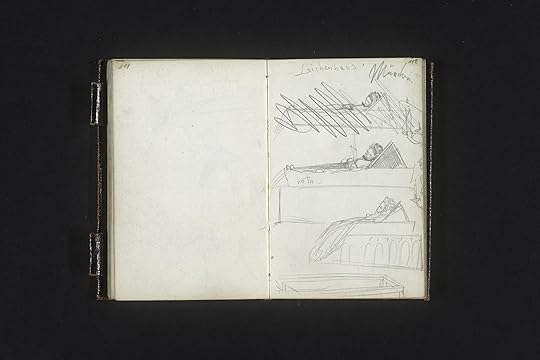
This amusing anecdote has a grisly element that might seem just as fictional but has a kernel of truth. As already mentioned, Twain learns about the treasure from Karl Ritter, whom he met in Munich – where Twain lived in real life from mid-November 1878 to the end of February 1879. (By this time, Napoleon, Arkansas, had already been swept into the Mississippi.) Twain claims that, while in Munich, he visited “one of the two establishments where the Government keeps and watches corpses until the doctors decide that they are permanently dead, and not in a trance state.” His questions about the establishment are grisly enough that he gets kicked out – but he meets, by chance, a former night watchman who had been employed in one – none other than Ritter himself – and hears his tale. The mechanism for ensuring none of the bodies in the “Leichenhaus” (Dead House) was living involved a complex system of wires and bells connected to a ring placed on one finger of each corpse. The night watchman’s job was to sit “always alert and ready to spring to the aid of any of that pallid company who, waking out of death, shall make a movement – for any, even the slightest, movement will twitch the wire and ring that fearful bell” (246).

(image from: Staatliche Museen zu Berlin / Wolfram Büttner)

There are numerous reports confirming the popularity of these dead houses among tourists. Apparently by the early twentieth century there were ten of them in Munich! I had no idea.

Sunrise and Sunset on a River
Twain’s description of a riverine sunrise reminded me of one of the most serene experiences of my own life: waking up just before dawn, at first light, on the Elbe River. Early spring, fog. I was on a moving ship, so neither the water nor the landscape was still, exactly – and yet the sense of profound quiet was like nothing I had ever experienced before or since. Here is Twain on his sunrise: “First, there is the eloquence of silence; for a deep hush broods everywhere. Next, there is the haunting sense of loneliness, isolation, remoteness from the worry and bustle of the world. The dawn creeps in stealthily; the solid walls of black forest soften to gray, and vast stretches of the river open up and reveal themselves; the water is glass0smooth, gives off spectral little wreaths of white mist, there is not the faintest breath of wind, nor stir of leaf; the tranquillity is profound and infinitely satisfying.” (241)

Strangely, much later he describes a sunset in the Upper Mississippi: “It is the true Sunset Land: I am sure no other country can show so good a right to the name” (423). And this, too, resonated with my own experience, again not in the same place, but with the same sentiment: I once visited a friend in Frankfort, Michigan, who makes a habit of walking to the lake every single evening to watch the sunset, and when I joined her, I thought to myself that I would never again see anything so stunning as the sun setting on Lake Michigan. But of course it’s easier for someone like me, who has seen so little of the world, to make such a claim.

Novelty and Narration
Another one of my favorite moments was when Twain reflected on the importance of the proximity between experience and narration. This is something I have struggled with as a writer of non-fiction: before I write, I want to convince myself that I know what I’m writing about. In that process, I lose some of the freshness of the experience of learning – the sensation of surprise and wonder that I hope to impart to readers. Perhaps my inability to articulate this makes you wonder what kind of writer I could ever be. Haha, fair. Let’s listen to Twain describe the phenomenon instead: “Those are the materials furnished by history. From them might not almost anybody reproduce for himself the life of that time in Vicksburg? Could you, who did not experience it, come nearer to reproducing it to the imagination of another non-participant than could a Vicksburger who did experience it? It seems impossible; and yet there are reasons why it might not really be. When one makes his first voyage in a ship, it is an experience which multitudinously bristles with striking novelties; novelties which are in such sharp contrast with all this person’s former experiences, that they take a seemingly deathless grip upon his imagination and memory. By tongue or pen he can make a landsman live that strange and stirring voyage over with him; make him see it all and feel it all. But if he wait? If he make ten voyages in succession – what then? Why, the thing has lost color, snap, surprise; and has become commonplace.” (279)

Graveyards
Here, just for fun, a few more words about the dead (yes, I’m weirdly fascinated by cemeteries):
“I will gradually drop this subject of graveyards. I have been trying all I could to get down to the sentimental part of it, but I cannot accomplish it. I think there is not genuinely sentimental part to it. It is all grotesque, ghastly, horrible. Graveyards may have been justifiable in the bygone ages, when nobody knew that for every dead body put into the ground, to glut the earth and the plant-roots, and the air with disease-germs, five or fifty, maybe a hundred persons must die before their proper time” (319). Twain’s fear of miasma – air tainted by disease – is appropriate to his age, an age in which people hoped they could cure tuberculosis by moving into the mountains. Today the health risks posed by graveyards involve not disease but chemicals used in embalming that leach into the soil.

Don Quixote and Ivanhoe
Having recently read and absolutely adored Don Quixote, I was delighted to see Cervantes’s comic genius duly recognized by Twain. I had no idea how much Twain hated Sir Walter Scott until I came upon no fewer than two and a half pages of blaming him for everything “wrong” with “Southern” literature. That passage ended with this comparison: “A curious exemplification of the power of a single book for good or harm is shown in the effects wrought by ‘Don Quixote’ and those wrought by ‘Ivanhoe.’ The first swept the world’s admiration for the medieval chivalry-silliness out of existence; and the other restored it. As far as our South is concerned, the good work done by Cervantes is pretty nearly a dead letter, so effectually has Scott’s pernicious work undermined it” (350). Life on the Mississippi was published two years after Twain’s The Prince and the Pauper, which I haven’t read. I don’t know if he tries to take Ivanhoe down a peg in the latter.

Moving States
One of my favorite elements of the book is the way Twain conveys the mutability of the river. Most of this occurs in the first portion of the book, in which he shares reminiscences of his time as a pilot’s “cub.” The shape and course of the river, its banks and shoals and curves and currents, change dramatically over time. Islands appear and disappear. When the border between Louisiana and Mississippi is defined by the river, its movement can mean that a town or village shifts from one state to another as the course of the river changes. Much later in the book, Twain describes an “ancient mariner,” a veteran pilot, who would say things like “When the State of Mississippi was where Arkansas now is” or “When Louisiana was up the river farther” or “When Missouri was on the Illinois side” (370). This pilot also happens to be the first writer to use the pen name “Mark Twain,” which Samuel Clemens took as his own after the pilot’s death (or so he claims, I never know when to believe him).

With More Than 300 Illustrations
My husband thoughtfully procured an edition of this book with all the original illustrations. The book makes no mention of who drew them – apparently they were not all the work of the same person, but John Harley is credited with the lion’s share (along with Edmund Henry Garrett, and A. B. Shute). I wish I had read an edition without the illustrations. Some were enjoyable, but none was absolutely necessary, and the caricatures of Black women, children, and men seasoned Twain’s language in a way that made even the relatively innocuous seem downright distasteful. He was a man of his age, and it was an age when he could, as an adult returning to his hometown, comment on the “colored folk” who resided in his boyhood home: “At present rates, the people who now occupy it are of no more value than I am; but in my time they would have been worth not less than five hundred dollars apiece” (402). I didn’t find that either respectful or amusing.

The Fortifying Effects of Schools and Libraries
I read this book in January and early February 2026, when many eyes were turned toward Minneapolis. Twain, coincidentally, ends his book along the Upper Mississippi. It’s easy to forget that the same river runs through New Orleans (which Twain visited countless times) and Minneapolis-St. Paul (which he seems to have only visited once? It’s not clear). He has nothing but praise for this part of the country, its independent spirit and, above all, its commitment to learning:

“This is an independent race [Twain refers here to the people living along the Upper Mississippi] who think for themselves, and who are competent to do it, because they are educated and enlightened; they read, they keep abreast of the best and newest thought, they fortify every weak place in their land with a school, a college, a library, and a newspaper; and they live under law” (424). Hear hear.
Profile Image for Ulysse.
411 reviews230 followers
February 12, 2021
Like the river it commemorates, this book has its long stretches, its vistas of tedium, its drowsy numbness-inducing disquisitions on the life nautical; but every once in a while you come across a passage like this:

"The face of the water, in time, became a wonderful book--a book that was a dead language to the uneducated passenger, but which told its mind to me without reserve, delivering its most cherished secrets as clearly as if it uttered them with a voice. And it was not a book to be thrown aside, for it had a new story to tell every day. Throughout the long twelve hundred miles there was never a page that was void of interest, never one that you could leave unread without loss, never one that you would want to skip, thinking you could find higher enjoyment in some other thing. There never was so wonderful a book written by man; never one whose interest was so absorbing, so unflagging, so sparklingly renewed with every re-perusal. The passenger who could not read it was charmed with a peculiar sort of faint dimple on its surface (on the rare occasions when he did not overlook it altogether); but to the pilot that was an italicized passage; indeed, it was more than that, it was a legend of the largest capitals, with a string of shouting exclamation points at the end of it; for it meant a wreck or a rock was buried there that could tear the life out of the strongest vessel that ever floated. It is the faintest and simplest expression the water ever makes, and the most hideous to a pilot's eye. In truth, the passenger who could not read this book saw nothing but all manner of pretty pictures in it, painted by the sun and shaded by the clouds, whereas to the trained eye these were not pictures at all, but the grimmest and most dead-earnest of reading-matter."
Profile Image for Greta Nettleton.
Author 1 book5 followers
May 22, 2013
Another book I've read over and over--It's free on Kindle in the old edition, which is fun to read because of its authentic touches. America's 1880s are my current decade of choice, having spent years mired in research about the period, and Life on the Mississippi captures the rapid change in this country that took place after the Civil War, as it changed from a land of bucolic wilderness filled with independent workingmen to one of safer, duller regulated organized industrialization and automation. Twain, who grew up among Southerners in Missouri, can't resist skewering his former slave-owning fellow citizens, but reports vividly about the horrors of the disastrous Mississippi floods that devastated Louisiana in 1882--evoking Beasts of the Southern Wild & Hurricane Katrina for modern readers. A visit after 25 years to his childhood hometown of Hannibal is a perfect meditation on the ravages of time that mixes comedy with profound insight. And who can resist stories about boats? Steamboats, sailboats, rowboats, any boats--i love 'em all.
Profile Image for Nancy.
416 reviews95 followers
January 31, 2019
Memoir, travel, history, humor, fiction served up in deceptively folksy prose (which is in fact as sharp as it is funny) to evoke the 19th century Mississippi in all its glory and heartbreak. Admittedly there were a few too many tall tales for my taste or they went on too long, yarns not being my favorite reading, but I concede their necessity in creating the larger truth here. Evocative and endlessly gripping and droll.
Profile Image for Tabuyo.
485 reviews49 followers
January 26, 2025
Es un libro de no ficción en el que Mark Twain relata sus inicios como aprendiz de piloto por las aguas del Misisipi pero no solo se centra en eso, intercala temas como la complicada orografía del río, anécdotas, personas que influyeron en su formación, los cambios que provocó en el transporte la llegada del ferrocarril y la guerra... habla de un montón de cosas interesantísimas que me tuvieron la mar de entretenida.

Además la edición que tengo está llenísima de ilustraciones y hacen que la lectura sea todavía más placentera.

Me llevo apuntado para leer próximamente el libro de un autor que aparece viajando con Mark Twain: 'Los Grandissime' de GEORGE WASHINGTON CABLE, considerada la primera novela sureña moderna.
Profile Image for Hannah.
65 reviews317 followers
Read
March 1, 2024
like most Americans my age I read Tom Sawyer in middle school, Huck Finn in high school, and encountered Mark Twain afterwards mainly via pithy quotes, with the exception of a class on Arthuriana that I took in college, in which we read Connecticut Yankee in King Arthur's Court and were all roughly as insulted by it and dismissive of it and annoyed by its wrong armor facts as I imagine Tennyson must have been (assuming, of course, that Tennyson gave a damn about Mark Twain). it seemed very plain to us that he had missed the entire point of Arthuriana, and indeed of satire, by asking "imagine a world... of true love and high adventure... but it smells bad." well, I'm imagining it, Mark! realism is sure providing piercing insights into human nature here!

as a result the most interesting passage to me in this book is the one where Mark Twain states, in more or less these exact words, that he blames Sir Walter Scott completely for the Civil War. the argument he makes is borne of experience in antebellum white society, and lines up with thoughts I often kick around on the romanticization of feudalism and the legacy of the 19th century ~invention of the Middle Ages~ especially in settler colonies. it makes me much more thoughtful about Connecticut Yankee ("oh," I said to myself, "the TITLE"), and it only really falls apart when one asks oneself such questions as "Did Sir Walter Scott make enslavers do the Civil War."

I understand from the grapevine that Huck Finn is being broadly phased out of high school American Lit curricula, in favor of books that are not quite so much in the line of "the most starkly human thing you can be, in a slave society, is a white boy with feelings". if Life on the Mississippi is any indication, "historical artifact literature" rather than "literary value literature" is entirely the right place for Mark Twain. he is inarguably funny. he is visibly striving, with the whole of his body, to have access to quote-retweets. halfway through this book, he quietly and without fanfare tells the story of how his little brother died, in a way that makes it very obvious that he believes it to be his fault, and will believe this until he goes into his grave, at which I wept. there are certain moments in life that intentionally or unintentionally cut through the depth & quantity of postbellum bullshit and provide a horrifying moral and factual clarity. one of these came for me toward the end of the book, when Twain visits his hometown, notes the people who now own his boyhood home, quite casually and offhandedly estimates what their market price would have been, and moves on. I'm glad I revisited him as an adult; I'll probably visit him again, if only to watch him dunk on Mormons. I had him classed as a writer who can be easily dismissed as an antiquity—one of those writers who cares too much about being "modern", in his time, to be relevant out of it—and I think that was a mistake. I think his writing shows more than he means it to.
Profile Image for George.
3,299 reviews
February 4, 2023
An interesting, easy to read, sometimes humorous, historical, mostly non fiction book about the Mississippi River since the river was first discovered by European settlers, the author’s life working as a pilot on the Mississippi river, and the formation of the pilot’s union. Mark Twain quit being a river pilot, pursuing other occupations including casual employments, newspaper reporter, being a miner and a “scribbler of books”.

Twenty one years after Twain stopped working as a river pilot, he undertook to visit the Mississippi river, writing about all the changes that had occurred to the river, transportation and the settlements along the river. He includes a number of accounts of the people he met and the stories they had to tell, mainly about their lives.

An informative, pleasant reading experience.

This book was first published in 1883.
Displaying 1 - 30 of 962 reviews

Can't find what you're looking for?

Get help and learn more about the design.