Jump to ratings and reviews
Rate this book

American Wolf: A True Story of Survival and Obsession in the West

Rate this book
The enthralling story of the rise and reign of O-Six, the celebrated Yellowstone wolf, and the people who loved or feared her.

Before humans ruled the earth, there were wolves. Once abundant in North America, these majestic creatures were hunted to near extinction in the lower 48 states by the 1920s. But in recent decades, conservationists have brought wolves back to the Rockies, igniting a battle over the very soul of the West.

With novelistic detail, Nate Blakeslee tells the gripping story of one of these wolves, O-Six, a charismatic alpha female named for the year of her birth. Uncommonly powerful, with gray fur and faint black ovals around each eye, O-Six is a kind and merciful leader, a fiercely intelligent fighter, and a doting mother. She is beloved by wolf watchers, particularly renowned naturalist Rick McIntyre, and becomes something of a social media star, with followers around the world.

But as she raises her pups and protects her pack, O-Six is challenged on all fronts: by hunters, who compete with wolves for the elk they both prize; by cattle ranchers who are losing livestock and have the ear of politicians; and by other Yellowstone wolves who are vying for control of the park’s stunningly beautiful Lamar Valley.

These forces collide in American Wolf, a riveting multi-generational saga of hardship and triumph that tells a larger story about the ongoing cultural clash in the West—between those fighting for a vanishing way of life and those committed to restoring one of the country’s most iconic landscapes.

300 pages, Hardcover

First published October 17, 2017

1373 people are currently reading
16044 people want to read

About the author

Nate Blakeslee

2 books122 followers

Ratings & Reviews

What do you think?
Rate this book

Friends & Following

Create a free account to discover what your friends think of this book!

Community Reviews

5 stars
6,571 (52%)
4 stars
4,524 (36%)
3 stars
1,252 (9%)
2 stars
154 (1%)
1 star
35 (<1%)
Displaying 1 - 30 of 1,790 reviews
Profile Image for Will Byrnes.
1,372 reviews121k followers
October 2, 2025
There was a time when millions of us roamed the continent. We fed when there was need. We played in forests and open places. Our kind lived well, from the warm woodlands of the south to the frosty forests of the north and in the gentler landscapes between. We raised our pups in cozy dens, and raised our voices at night to call out to others. Sometimes, we joined our brothers and sisters in joyous chorus for no reason at all. We lived in a world with many others, hunters, prey, and creatures who seemed to have no great part of our existence. There were people here then. We lived with them, too. But other people came, people with guns, poison, and traps, people armed with fear, hatred, and ignorance. They took our food sources, and when we were forced to look elsewhere to feed, they turned their quivering, murderous hearts toward us. And there came a time when there were practically none of us left across the entire land.

description
Nate Blakeslee - image from Texas Monthly

In Eurasia and North America, at least, where there have been people there have always been wolves. They have been a significant feature in the lore of most cultures, usually in a negative way. While the tale of the she-wolf Lupa nurturing Romulus and Remus gives wolves some rare positive press, and native peoples of North America offer the wolf considerable respect, wolves have not, for the most part, received particularly positive press in the last few hundred years. The obvious cultural touchstone for most North Americans and Europeans would be the story of Little Red Riding Hood, followed closely by tales of lycanthropy, and maybe a shepherd boy who sounded a false alarm a time too many. The wolf is embedded in our culture as something to be feared, a great and successful hunter, a rival. Homo sap is a jealous species and does its best to eliminate other apex predators whenever we take over their turf. Such has been the case with Canis Lupus. And we have been taking over lots and lots of turf.

description
O-Six - image from StudyBreaks.com

As is so often the case when people are involved, action precedes understanding. European settlers in North America, carrying forward Old World biases, saw wolves as a threat to their safety. Incidents of wolf attacks on people are quite rare, though. Settlers feared for their livestock as well. There was certainly some basis for concern there, but not nearly enough to warrant the response. In fact, wolves serve a very useful function in the larger biome, culling the weaker specimens from natural populations, and thus helping secure the continued health of the overall prey population. The settler response was wholesale slaughter, a public program of eradication, a final solution for wolves. But actions have consequences. The result, in Yellowstone Park, was a boom in ungulate population, which had secondary effects. Increased numbers of elk and other prey animals gobbled up way too much new growth, impacting the flora of the area, unbalancing the park’s ecosystem, seriously reducing the population, for example, of cottonwood and aspen trees, with many other changes taking place as well. Where wolves live they contribute to the balance of their environment. When they are removed, that balance is destroyed.
As a science, wildlife management [in the early 20th century] was still in its infancy, and park officials genuinely believed that predators would eventually decimate the park’s prey population if left to their own devices. They didn’t realize that wolves and elk had coexisted in Yellowstone for thousands of years, that the two species had in fact evolved in tandem with each other—which explained why the elk could run just as fast as the wolf but no faster. Wolves were the driving force behind the evolution of a wide variety of prey species in North America after the last ice age, literally molding the natural world around them. The massive size of the moose, the nimbleness of the white-tailed deer, the uncanny balance of the bighorn sheep—the architect of these and countless other marvels was the wolf.
It is eminently clear that people are quite accomplished at ignoring reality, and extremely proficient at substituting the mythological for the actual, often helped along by the unscrupulous self-interested, who promote falsehoods in order to preserve their personal investments, enhance their proprietary interests, or enrich themselves or those they represent. But sometimes science breaks through the veil of obfuscation and is able to get a hearing for the truths it has unearthed. Such was the case with our understanding of how wolves impact our world. It was due to this understanding and the persistent efforts of ecological activists that a plan was approved to reintroduce wolves into a few locations in the lower 48 states. Yellowstone was the primary site for the program.

description
Rick McIntyre - image from Earthjustice.com

The first wolves were reintroduced into Yellowstone in 1995. That year a star was born, “21M.”
Even before 21 left his natal pack, Rick had known he was unusual. One morning in the spring of 1997, two years after Doug Smith and Carter Niemeyer rescued 21 following the death of his father, Rick watched the handsome young wolf returning from a hunt. With him was the big male who had become the pack’s new alpha when 21 was still a tiny pup. The pair had killed an elk, and 21, already an outstanding provider, had brought a massive piece of meat back to the den, where a new litter of pups had been born.

The pups, his new brothers and sisters, showered him with affection, but 21 seemed tense, pacing back and forth across Rick’s scope. Finally the wolf found what he was looking for: a troubled pup that he had recently taken an interest in. There was usually one pup who held the lowest rank in a litter’s pecking order, but this pup was different; he had some physical problem that held him back. Rick couldn’t tell exactly what was wrong with him, though his littermates clearly recognized that he was different and shunned him. But 21 seemed to have empathy for the pup, the way a dog seems to know when his owner is feeling depressed or lonely. As Rick looked on, the strapping 21 played with the tiny wolf as though he were still a pup himself, giving him the attention he so seldom enjoyed from his siblings.
21 becomes the alpha of the Druid pack, manifesting that most important of leadership qualities, empathy. The Druids were like the Kennedys to some, lupine royalty. In 2006, one generation removed, 21’s granddaughter is born, O-Six. It is her tale that Blakeslee tells here. Well, one half of the tale, anyway. There are two paths followed. One is the life and times of O-Six, a remarkable creature, and another remarkable creature, one who stands upright, Rick McIntyre.

description
Half Black – a Druid pack female - image from the National Park Service

We follow O-Six’s life from her puppyhood in the Agate Creek pack to her gathering together the wolves that would make up the Lamar Valley Pack. She is a wise leader, a skilled hunter. As she births pups, the pack grows. But there are other packs of wolves in Yellowstone, and conflict among them is a natural condition. In battle, O-Six demonstrates remarkable courage, in one instance standing fast, seriously outnumbered, against an invading pack, and engaging in Hollywood level derring-do to save the day. She succeeds despite having in her pack an Alpha male and his sibling referred to by watchers as Dumb and Dumber for their limited hunting skills. We see her relocate as needed to take advantage of propitious territorial openings, or quarters removed from hostile forces. One of her moves put her in a location where wolf watchers could follow her pack’s exploits from the safe remove of a park road cutout. It is publicity from the group that gathered to ardently keep track of O-Six and her Lamar Pack’s exploits from this convenient watching site (and others) that made her the most famous wolf in the world.

description
Wolf watchers - image from the National Park Service

Rick McIntyre was constitutionally more of a lone wolf sort, a National Park Ranger, happiest out in the field, whether studying grizzlies in Denali, where he became a top-drawer wildlife photographer, or studying wolves in Yellowstone. He was introduced to wolves by a top wolf biologist, Gorbon Haber, building his expertise and writing A Society of Wolves. The book was published in 1993. It expounded on the culture of wolves, significantly broadening our understanding of the species. His work was instrumental in providing support for reintroduction efforts. This work landed him a spot at Yellowstone, where he slowly improved his people skills, and became a fixture around which study and monitoring of the park packs centered, the leader of the wolf-study pack. He is a charismatic, passionate character and you will enjoy getting to know him.

description
O-Six howling with her mate and his brother - image from NatGeo Wild

There are other elements in the book. The growth of the wolf-watching culture and the Yellowstone watchers club is given plenty of attention. The politics of reintroduction, protection, and attempts to remove protection get their share of ink as well. There is much in here that will raise your blood pressure. Impressively, Blakeslee includes a depiction of the man who shot O-Six. It is not the drooling monster portrayal one might expect. Blakeslee takes pains to consider the perspective of hunters. There is a description of a marauding, death-dealing pack, the Mollies, that will remind you of the Borg, or a zombie apocalypse. It is as tension, and fear-filled a portrayal as you will find in any of the best action-adventure fiction.

description
Yellowstone wolf pup - image from NatGeo Wild

When studying wildlife, researchers are discouraged from forming emotional attachments to the objects of their study. Few animals live nearly so long as people, so your favorite [insert species here] will, as likely as not, perish before you. But readers of this book are under no such caution. Sitting in a laundromat, parked on a backless bench, book on an attached table, looking through the plate glass, rain soaking Hazle Avenue, drops cascading down the window, my eyes join the mass drip on reading Blakeslee’s description of the death of O-Six. I will admit that this happens sometimes when reading about people, but it does not happen often. I am saved from a public exhibition of heaving shoulders and stifled sobs by the buzzer announcing the end of a wash. If you have any tears left after this, you will turn them loose in an epilogue tale of 21’s mountain top trek as he neared death.

description
O-Six - image from NatGeo Wild

I only had one small beef about the book. I understand that researchers are discouraged from naming their study subjects, but it was quite inconsistent in application. Some had names, others were just numbers, and, frankly, it became a bit tough at times, keeping track of which number came from which pack, and was that one with this pack and this one with that pack? Really that’s it. Otherwise, no problemo

description
Wolf #10 of the Rose Creek pack - image from the National Park Service

American Wolf is a complex work, offering some science, some history, some political analysis, some prompts to raise your spirits, some that will make you cheer, and some dark moments that will make you turn away, fold the book closed, and wonder just what is wrong with some people. You will learn a lot, particularly about wolf culture. But primarily, it is a tale of hope, of reason triumphing over ignorance, of courage and heroism besting villainy. It joins the intellectual heft of offering considerable information with the gift of being incredibly moving.

description
Unidentified Yellowstone wolf – 1996 - image from National Park Service

Tail high, standing tall, the gray alpha raises his muzzle and howls a long call. Pack members miles away lift their heads, point their ears toward the siren summons and begin loping home. There are fewer now than there were, an inexperienced young adult having found mortal peril on the fringes of their land. But still, enough of the pack remained, strong and healthy. They would gather. The gray knew where they would go once joined, into the valley. Caribou were plentiful there. They would fill their bellies before grizzlies stole their prize, and then would carry large chunks in their jaws, for the nursing alpha female. It was not the best of all possible world, but it would do, for now.

description
image from wolf.org

Review first posted – October 12, 2017

Published – October 17, 2017

This review is cross-posted on my site, Coot’s Reviews. It is complete there, with all EXTRA STUFF in one place. Stop by and say Hi!
Profile Image for karen.
4,012 reviews172k followers
August 31, 2018


this is my nonfiction book for the month, chosen because i like wolves, but sean of the house LOVES wolves, and i was going to give this to him when i finished, but i'm afraid it would break his sensitive irish heart.

according to this book, wolves have a life expectancy of about five years in the wild, and this book chronicles several generations of wolves living in yellowstone, so you do the math there.

this book was pulled together from the well-detailed accounts of the wolf-watchers in yellowstone; individuals who devoted their lives to observing these magnificent beasts every day, coming to know their behaviors and ‘personalities,’ monitoring their struggles for dominance within their packs, their clashes with other packs, and witnessing births and deaths in an ever-changing pack dynamic.

as i said, i like wolves, but in a casual “oh, how lovely they are” way without being any kind of wolf scholar or anything, so i learned a lot from this book. i didn’t know that wolves had been eliminated from yellowstone (and most of the US) in the ’20’s in order to protect the park’s delicious elk, deer, moose, & etc and were only reintroduced in 1995, when wolves imported from canada were allowed to return to an ecosystem that had actually been negatively impacted by their removal in the first place. what followed was a wolf explosion that did indeed restore the natural balance but also caused outrage in the local humans, as idaho, montana and wyoming are full of hunters and ranchers long accustomed to viewing wolves as a threat to their livelihood. so not only is the book full of the stories of the wolves under the park’s protection, but also about the inevitable wolf diaspora, as packs ranged outside of safety and caused no end of consternation and legislature about what should be done to protect the elk and cattle that humans were planning on killing. it’s Planet Earth meets Law & Order and both situations are fascinating in their own way.

on the wolf side, the star of the book is the alpha female O-Six (named for the year of her birth)*, who made herself a favorite of yellowstone’s many wolf-watching groupies by demonstrating phenomenal abilities in hunting prowess, strategic evasion, admirable leadership qualities, and fecundity. if you google “O-Six and yellowstone,” you get the cliffs notes version of what happened to her, but you’d miss out on all the stories told in this book about her and her pack and her rivals. this is a nature book, so there’s no shoddy anthropomorphization, but it’s hard not to fall in love a little bit. internet assures me the following are all photos of her, and more can be found here.


a superstar of a wolf.

the legal track is absolutely bizarre; convoluted and counterintuitive. it involves the authorization of wolf-hunting in the three states surrounding yellowstone: idaho, montana and wyoming, and it turns into a mishmash of state and federal legislature, sneaky riders smooshed into unrelated bills, science vs. politics, rulings overturned, wolves placed on and off the endangered species list with shifting boundaries, and flinging money at the problem in such contradictory ways:

one federal agency was reintroducing predators on public land, a second was leasing adjacent land to ranchers, and a third was dispatching trappers or men in helicopters to kill those same predators when they inevitably crossed paths with livestock.

america is crazytown.

it kind of hurts my heart a little to think of someone hunting a wolf, since there’s no “feeding my family” exemption, and it’s purely for sport or the protection of livestock (which i do understand, but cattle are big and dumb and delicious, and it’s not just wolves who get that - there are also bears and coyotes and probably some other beasts determined enough to attack a little one), but i will say that of all the wolves who died in this book, at least the ones shot by hunters died instantly, as opposed to the many who died of injuries sustained in territory disputes with other packs or starved to death.

actually, scratch that - there was one wolf who was illegally shot by a hunter and wandered off to die slowly, and his story was the one that hit my heart the worst, because he was a collared wolf, so his location was known to the biologists working on the wolf restoration project, but because “they weren’t zookeepers, after all,” and didn’t intervene in the fates of the wolves, he slowly starved to death over the course of eleven days. again, this is a decision i understand with my brain, but it does nothing to soothe my heart. it’s like that scene in that BBC Africa documentary series where the baby elephant gets turned around in the sand storm and wanders in the opposite direction from the rest of the herd and dies and sir david attenborough just kinda shrugs and says, “nature, amiright?”** instead of swooping in to rotate the calf or at the very least, not airing that footage. because jeez.

but i know, i know - when it comes to reading about/watching animals in the wild, it would be irresponsible to go into it thinking it’s going to be a disney paradise where animals help each other out and share the territory and no one ever eats anyone or wanders out into the storm, bawling piteously.

nature gets hungry and nature doesn’t share.

sure, sometimes someone forwards you some heartwarming story about a bear that adopts an orphaned raccoon and everyone goes “aawwwwww,” but generally speaking, in an environment with limited resources, benevolence to those outside of a very short range of community or family is a liability an animal cannot afford.

wolves are pack animals, so loyalties extend somewhat outside of the pure family, but even within a pack, members submit to their alphas in frequent demonstrative ways, and wolves are also highly territorial, so when packs cross paths, carnage ensues.

so, there are some parts of this book i know will ruin sean of the houses’s day, but he’s a particularly soft touch when it comes to animals, and if i could get him over that, i’m sure he would find this as fascinating and illuminating as i did, and be grateful that there are more wolves in our country, even if they don’t get to live as long as we’d like them to.


* this is one of my few gripes - because they aren't pets, the wolves aren't given memorable people-names, but referred to by collar-numbers: 754, 820, 859 or, if uncollared, distinguishing markings or traits: middle gray, shy male. i am bad at math, so i got mixed-up sometimes.

** that is what my heart heard him say, anyway.


*********************************************


full review still in the works, but definitely one for 'to-read' lists of those who can handle the end results of animals doing what animals do, and hunters doing what hunters do.

come to my blog!
Profile Image for Shelby *trains flying monkeys*.
1,748 reviews6,569 followers
October 25, 2017
3.5 stars
I've always been a wolf fan. They are majestic animals and not just because I love reading the porny books featuring wolf shifters.

Back in the day my now ex-husband and I heard about a man that bred hybrid wolves. We were interested and that's way before any legal aspects were really talked about. (I know..I'm old as crap.)
We visited the man and we immediately fell in love with one of the pups. He was a shy little guy but the owner would not just let us take him. We had to meet with him several times before we could take the animal. I never really knew the animals wolf percentage but at the time I was young and stupid enough to think it would all be okay. I know his mom was an Alaskan Malamute but I knew that there was definitely wolf blood in the pup.
We named him Diablo and he really did become a member of our family.


(My kids face is blurred on purpose even though this pic is over 20 years old...because trolls) Diablo was a pup in this photo.

Now I'm going to admit. I loved that animal. He was extremely protective of my family. Would I do it again? Not on your life. Now as I'm older I know that wild animals should be wild and not bred with domestic animals. I love and appreciate them but we went through hell with him just being a mixed breed. Not because of the animal. My neighbors hated him. Not dislike. HATE. If he left our property (as animals will tend to do) people freaked out. Diablo was shot by my neighbor while he was standing in my yard. While we were outside with him. Was he doing anything? No, that didn't matter though. He was hit by a car once..on purpose. We went to court about him twice. Finally he was found poisoned when we returned home one day. I still miss him.

If he had been an alpha male we probably would have had some trouble. I know this so don't troll me and tell me how stupid we were. Like you've never been stupid.

Anyways, this book tells about wolves being reintroduced into Yellowstone Park. It does try and tell both sides of the story. From the hunter/farmer side to the wolf enthusiast. It is obvious that the author is pro-wolf though. As am I.
He follows the story of one of the most famous wolves called O-six. She is an alpha female and it follows her from the time she meets her mate until she is killed.


I'm not going to describe her life because I think you should read this book. I do know that it sucks that wolves have such short life spans. Not just because natural events happen that lessons their chances of survival, but that people hate what they really don't understand or can control.

I will admit that when this wolf dies in the book I spent a good thirty minutes crying...and I hardly ever cry. I felt gut punched when I read that her mate cried over her body.
Stop this stupid, people. Go read up on all the good things that happen when you have natural predators in an ecosystem.

Booksource: I received a copy of this book from the publisher in exchange for review.
Profile Image for Diane S ☔.
4,901 reviews14.6k followers
October 24, 2017
3.5 Yellowstone and the wolf reclamation project, two main characters, McIntyre and one a wolf named O-six. The struggles with the ranchers, who see the wolves as predators, a risk to their cattle and their way of life. The hunters, who depend on elk for themselves and those they take on the hunt, are also concerned because a growing wolf population, means a lessening elk population. Those who love the wolves and spend much time watching them are of course on the side of the wolves. It was interesting seeing this from all sides, and even though the author goes to great lengths to present a clear and unbiased viewpoint, one can tell he is firmly on the side of the wolves.

O-Six, a fearless female, strikes out on her own and puts together her own pack. She becomes the target of other packs, ether defending their own territory or wanting hers. Much of this book is about following the different packs, who is fighting with who, what packs are the dominant ones. Quite interesting, a large pack can become decimated in a short period of time, either through the death of the alpha male or female or at the hands of a dominant pack. Admit to cheering O-Six on more than once, she was quite a wolf and managed to outrun many threats, obviously she was extremely smart as well.

I came to my love of wolves in a round about way, through my children. A few of them had a fourth grade teacher who loved wolves, her classroom was full of everything and anything wolf, she took her vacations at places such as Yellowstone where she could observe them. Slideshows were regularly shown and parents were often invited. I grew to share in her passion, she was so enthusiastic about them it was hard to resist. This was well written and ably presented but not quite what I was looking for. Wanted more on individual wolf studies but this is not that book. Still glad I read it and glad more books about wolves are being published once again.
Profile Image for Jessaka.
1,008 reviews229 followers
February 17, 2019
description
Wolf 0-06

Spoiler in Italic****

“He decided he wanted the gray. He exhaled and squeezed the trigger…

The gray staggered and dropped.

It was a long walk through the snow to where she lay…This was a trophy very few people in his part of the would had ever taken…

When he came within fifty yards of his prize he caught a glimpse of movement in the brush behind her. The black wolf had returned. His eyes on the hunter, he stepped cautiously out of the willows and sat down not far from where the gray lay…He seemed to be waiting to see what the hunter would do next…

Then the black lifted his snout into the air and howled. It was the sound the hunter had heard many times over the years but never like this, alone in the snow with the wolf a stone’s throw away. He stood still and listened, transfixed. The wolf howled again, long and louder this time.

From the willows behind the black, more wolves began to emerge…They arrayed themselves in a loose semicircle around the black, all silently focused on the body of the gray…

The black howled a third time, and suddenly they all joined in. The hunter stood there, agape, disarmed by the otherworldly sound, by the sheer overwhelming sadness of the cry. She was their leader, he thought.”


This book was powerful and unforgettable. If you think that you can’t stop the killing of wolves, well, you are wrong. Public outcry has worked. It still can.

If you think that wolves can’t live peacefully with man, you are again wrong. Some are learning to stay away from ranches, but there is more that can be done, mostly outcry.

Rick McIntyre worked for over 20 years at Yellowstone, just watching wolves all day long along with other watchers who could be seen parked along the roads with telescopes and cameras. My husband and I were driving through Yellowstone one day, and stopped when we saw cars and pickups parked along the road.

I walked across the street to ask what was happening. A man told me that an elk was down and a bear and 5 wolves were fighting over it, but that the wolves had retreated. He allowed me to look through his binoculars. I saw nothing. He walked over to another man and then came back and took me over to look through another man’s telescope. I saw a white wolf. Then a black wolf was sitting down looking at the crowd. The man moved the telescope so that I could see the bear standing over the elk. I think I said, “Oh, my God!” I would have never had thought that I would even have wanted to see something like this. Me, who wishes no animals to be ever killed. But I wanted to stay there all day with them and wished I had come earlier.

Rick never grew tired of it. He watched them play, fight, have cubs, go after their prey. He watched everything, and he took notes, but he never stayed away long enough to write a book. Perhaps these are his notes, or at least some of them.
This book is mostly about his watching 0-06, the most famous of all the Yellowstone wolves.

The fight between Fish and Game, the ranchers and the public has raged for years in and out of the courts. This is not an easy book to read. If you are a rancher you just want to kill every wolf, and I suppose this book would infuriate you. If you love wolves you will be brought to tears and then to anger. You will even ask yourself why the Department of Agriculture thinks it has to kill “ten of thousands of predators annually—mostly coyotes but also bobcats, mountain lions, black bears, foxes, and red-tailed hawks—just to protect the cattle and sheep. Have we ever thought to live differently? To allow life to survive on its own terms?

The wolves’ impact on cattle has only been about 200 a year, whereas out of 5 million cattle across three States, tens of thousands have been killed every year by winter storms, lightning, floods and drought.” The wolves do so much less damage, but some people like to hunt, and then in time they can wipe out wolves, if we don’t put a stop to it.

I had read another book right after coming home from our trip through Yellowstone, “In the Temple of Wolves” by Rick Lamplugh. He has suggestions online on what we can do to change things. He has a blog called, “How to Build a Culture that Respects Wolves.”

I want to thank NetGalley for allowing me to read and review this book. And I wish to thank the author for writing it, and hope that if he doesn’t put a wolf on the cover, then perhaps he will put a photo of the famous wolf, 0-06 in the inside cover.

Note: I wish to add this article by another wolf lover who has written books as well:

Wolves and Coyotes Need Not Die So We Can Eat Meat
by Rick Lamplugh, wildlife advocate & author

My previous post, “We Have More to Fear from Livestock than from Wolves,” (http://bit.ly/2rsCJf1) evoked many comments. The post’s premise: While ranchers claim that wolves threaten their existence and should be eradicated, the livestock production that ranchers make a living off of is killing the ecosystem that sustains the rest of us.
Many readers commented that they had already stopped eating beef or sheep. Some readers wrote that they are vegetarians or vegans. Still others wondered how they could continue to enjoy meat without supporting an industry that unnecessarily kills wolves, coyotes, and other predators.
Ranchers can keep livestock and predators separate and alive. Some choose to do so and become what is called predator friendly. Here’s how being predator friendly works for Becky Weed and Dave Tyler in Belgrade, Montana. On the website of their Thirteen Mile Lamb & Wool Company, they write, “Our principal protection against native predators are our guard dogs and llamas and our own vigilance; because we have chosen not to use lethal control methods against coyotes, bears, wolves, mountain lions, our ranch is certified as ‘predator friendly.’”
Ranchers earn Predator Friendly® certification. An annual audit must find that the producer maintains and enhances wildlife habitat, employs a mix of nonlethal methods, and quickly modifies management practices when conditions change.
There is no one-size-fits-all solution to living with predators, but here are some of the nonlethal methods Predator Friendly producers employ:
* Using guard animals such as llamas, donkeys, and dogs
* Scheduling pasture use when predation pressure is low
* Grazing cattle with smaller livestock to protect sheep, goats, and calves
* Timing calving and lambing to avoid predation risk
* Lambing in sheds, secure fenced lots, or protected pastures
* Making frequent and unpredictable patrols in pastures
* Protecting vulnerable animals by fencing out predators
* Learning the ecology and habits of area wildlife
The Animal Welfare Institute states that the Predator Friendly program encourages livestock producers like Weed and Tyler to protect some of the most important habitat and species in the United States, while opening up a new market for their sustainable ranch.
We can support ranchers that choose coexisting over killing by purchasing their Predator Friendly® products. Products sold from the Predator Friendly website include beef, bison, goat, lamb, turkey, eggs, and honey as well as sheep and cattle breeding stock. To check out the Predator Friendly website: http://www.predatorfriendly.org/
To learn more about ways that ranchers can keep livestock and wolves separate and alive, check out “Livestock and Wolves,” the guide from Defenders of Wildlife. The principal author is Suzanne Asha Stone. Contributors include Carter Niemeyer, Linda Thurston and others. Here’s the link: http://bit.ly/1RVw4SA
Rick Lamplugh writes to protect wildlife and preserve wildlands. He lives near Yellowstone’s north gate and has just finished his new book, Deep into Yellowstone: A Year’s Immersion in Grandeur and Controversy. He is the author of the Amazon bestseller In the Temple of Wolves. Available as eBook or paperback at http://amzn.to/Jpea9Q. Or as a signed copy from Rick at http://bit.ly/1gYghB4.
This entire review has been hidden because of spoilers.
Profile Image for Maxwell.
1,441 reviews12.4k followers
December 7, 2017
I was pleasantly surprised by this book. It's an incredibly well told story about a pack of wolves, particularly focused on the alpha female, in Yellowstone National Park. But it's also so much more than that. It's about people who are passionate about something, about fighting for what you love, about educating others, and how all three of these things combine to really make a difference in the world. And even if that difference seems small, it can have a great impact on a person's life. I love that about this story, on top of just being thoroughly entertained by the story of the wolves and learning more about them. I'd highly recommend this if you're looking for a microhistory that will probably be unlike anything you've ever read before.
Profile Image for Darwin8u.
1,835 reviews9,034 followers
August 9, 2019
“Rick’s dream, though he seldom described it as such, was to someday tell a story so good that the people who heard it simply wouldn’t want to kill wolves anymore.”
- Nate Blakeslee, American Wolf

description

This book is haunted by all the John McPhee I've read. I wanted to like it more. I love wolves, adore Yellowstone, and am even planning a trip this winter to try and spot some damn wolves (even if I have to wrap my ass in bacon and tie my sorry self to a tree). But back to the book. It just wasn't that well written. I mean it was good. It told the story of 06, , but with wolf books (and wolves almost have their own fiction and nonficiton genre) this one, while popular a couple years ago, just wasn't great. I mean, sure, the periods were probably all where they were supposed to be and all, but if the book appeared outside of Yellowstone, I'm pretty sure not even Steven Turnbull (a pseudonym) would shoot it.

But that leads me to wonder why the abundance of positive reviews:

1. I am wrong and the book was brilliant.
2. I am right, but people like wolves. So, even mediocre stories told of compeling wolves evoke posiitve responses. I'd equate this to watching a wolf out of a crappy spotting scope. Yes, a Swarovski® would have been much better, but YOU JUST SAW A F#&%ING WOLF, so who cares.
3. Other readers are just dumb.

I'm old and wise enough to believe it might be a bit of all three. Anyway, not great, not horrible, just a mediocre narrative nonficiton about Yellowstone and its wolves.
Profile Image for Monica.
780 reviews690 followers
October 9, 2022
Vacillating between 4 and 5. I admit to being completely captivated by this book. The infuriating and opportunistic politics contrasted with the detailed and meticulous observations of the various wolf packs at Yellowstone, especially O-six. This was riveting. As a funny aside, the end of this book has a recording of a pack of wolves howling. My dog looked up from his luxurious slumber on the couch wanting to join in. Ancestral ties...

4.5 Stars

Listened to the audiobook. Mark Bramhall was fantastic! The author came in effectively for the epilogue.
Profile Image for Celia.
1,437 reviews246 followers
June 10, 2020
I have an undying love for Yellowstone National Park. I visited it 36 years ago (1984). My memories of what I saw and experienced are still fresh!! Saw so many animal and ecological sights. No wolves though. Wolves were reintroduced to Yellowstone in 1995; this gave biologists a unique opportunity to study what happens when a top predator returns to an ecosystem. They were brought in to manage the rising elk population, which had been overgrazing much of the park.

This book studies the wolf and how it interacts with its environment and other wolves. It also chronicles the fight to keep wolves safe from human predators.

I was surprised to find out that there are wolf watchers at Yellowstone and the watchers give the wolves names. The watchers also impart human characteristics to the wolves. I especially enjoyed following the story of O-Six (born in 2006): a hunter, a mother, an outstanding alpha female.

I love non-fiction written like a novel and this book is an excellent example.

5 stars
Profile Image for Mehrsa.
2,245 reviews3,580 followers
December 15, 2017
Before I picked up this book, I didn't give a rats A** about wolves. I had heard about the Yellowstone reintroduction program, but I'm no animal lover so I didn't really think a book about wolves would be all that interesting. But I saw this book on an awards list so I picked it up. Fast forward to me closing the book, tears in my eyes, and with a new favorite animal. This is a well-written book and I promise it will move you. Honestly, I don't even like dogs, but this book blew me away. But this is about more than wolves, though the wolves are amazing, it is about the environment and politics and human/animal nature. I had no idea. One of my favorite reads this year.
Profile Image for Chrissie.
2,811 reviews1,421 followers
October 20, 2017
The central focus of this book is the reintroduction of wolves into Yellowstone Park and thus the Northern Rockies. By the 1920s wolves had for the most part become extinct in the lower 48 states of the US. In 1995 Canadian wolves were brought into Yellowstone Park. The book follows this reintroduction from the mid-90s to 2015.The conflict between conservationists, ecologists and environmentalists on one side and hunters, ranchers and miners on the other is the primary focus of this book. The book is less about the species canis lupis. Nor is this a book of nature writing. It is about politics and money and competing interests in relation to wolves.

Much attention is given to Obama’s efforts to reach a federal budgetary agreement in 2011 and Senator Jon Tester’s rider that reversed U.S. District Judge Donald Molloy’s court ruling classifying wolves as one of the endangered species. The book flips between court proceedings and political discussions and sections about the wolf packs in the Lamar Valley of Yellowstone Park, Wyoming. The author himself mentions that to attract readers there has to be a heartfelt tie to some wolf and that names work better than numbers.

We hear a bit about Limpy, but primarily we follow 0-Six, an alpha female, named for the year of her birth and granddaughter of wolves 21 and 42 who were the stars of those wolves originally brought in from Canada. We follow O-Six, her mate, his brother and three litters. I will admit that by the book’s end I had indeed become attached to her. Of course, I was rooting for those who supported the need to keep wolves protected by the Endangered Species Act (ESA).

This is a book of non-fiction, but one person goes by the alias Steven Turnbull. His name is changed to protect him. Yeah, he is the “bad guy”. The book concludes with an epilog. The author relates of his meeting with man. No, he still does not regret what he has done. I do think the author makes an attempt to be nonjudgmental, to express the views of opposing camps in a fair and balanced manner, but it is not hard to guess on which side he stands.

I was looking for a book more focused on new research about wolves. That they have cognitive abilities and emotions is shown. The book sheds light on the dissolution and formation of wolf packs and the status of members within. However, I cannot say I learned anything new about wolves. The phenomenon of trophic cascade is mentioned. Classic wolf literature is referenced.

Information is too often repeated. Why are we told of the rangers’ vehicle brands, the clothes they wore and the equipment used? To me this sounded like advertising.

The audiobook is narrated by Mark Bramhall. He does a fine job. The information is easy to follow. My only quibble would be that when things go bad he sounds sour and whiny, but in a masculine way. The narration I have given four stars.

I do not regret reading this book, but it was not quite what I was looking for. I would have preferred less politics and more about wolves.
Profile Image for Bam cooks the books.
2,303 reviews322 followers
August 12, 2019
Have you ever been to Yellowstone? Did you spot a wolf there? This is the fascinating story of the Yellowstone Wolf Project and most especially the life story of O-Six, the great-granddaughter of one of the original wolves reintroduced to the national park in the winter of 1995.

Yellowstone had been essentially devoid of wolves for almost seven decades. Their reintroduction has not been without controversy and heated debate with the inevitable conflict between hunters, ranchers, wildlife management, and environmentalists. Nate Blakeslee delves deeply into the political wrangling and maneuvers that have gone on to decide the issue of allowing the hunting of wolves in Idaho, Montana and Wyoming.

His story is most interesting when he delves into the personal stories of the people who cared so deeply for these wolves, most especially the park ranger Rick and his sidekick Laurie Lyman, a devoted wolf watcher whose notes Blakeslee relied upon for much of his story.

But the stars of the story are really the wolves themselves and most especially O-Six, a powerful gray female with attractive markings that Rick and the watchers enjoyed keeping track of as she found a mate, boldly hunted and fought off members of other packs and eventually raised three litters of pups before her own demise. The reader gets a fascinating, in-depth look at what the daily life of a wolf is like: the interactions between alpha male and female and others in the pack, how they hunt, den and raise their pups, how they protect their territory from other packs, etc.

There is also the villain in the story, in the form of the hunter Steven Turnbull (name changed). The debate over whether the hunting of wolves is needed to control their numbers will probably continue but it has been decided that 'wolves belong in the Northern Rockies because they play a vital role in the ecosystem.'

Many thanks to NetGalley, the author and publisher for giving me the opportunity to read an arc of this very interesting new book.
Profile Image for Lauren .
1,834 reviews2,549 followers
October 19, 2020
Blakeslee looks at the Yellowstone wolf reintroduction project 20 years in, and documents the biological and social ramifications in the park and the surrounding areas in American Wolf (alternate title of "The Wolf"). He introduces a cast of characters, both human and canine: scientists, alphas, park rangers, hunters, yearlings, and park visitors.

O-Six is the star at the center of this story, the other characters orbiting around her. O-Six is a dynamic and skilled alpha female, who leaves her natal pack, becomes a skilled hunter and strategic planner, and eventually finds a mate and has three litters. O-Six was the most photographed Yellowstone wolf in the pack that she founded, the "Lamars" who lived in the Lamar Valley in Yellowstone.

Blakeslee briefly touches on the reintroduction program, but spends much more time talking about the progress and the attitudes about wolves in the surrounding regions. Inevitably, this also becomes a political issue, and several of the Northern Rockies states (Montana, Idaho, and Wyoming) campaign on eliminating the wolves, and encouraging wolf hunts, etc. Several chapters in the book delve into these court decisions, many of them extensions of the Endangered Species Act.

The book is not a hard scientific look at reintroduction, but does give an overview on the ecosystem both before and after establishment, and an overall journalistic perspective.
Profile Image for L.G. Cullens.
Author 2 books96 followers
August 18, 2020
When I occasionally read an exceptional book that I find meaningful on multiple levels, I need to step back and let my mind clear before writing a review. This is one such book, arousing subjective feelings even as this jaded old naturalist reader's mind wrestled with tangential thoughts relative to humankind's relentless march to the abyss.

This book is oriented around the life of a Yellowstone wolf known as O-Six, and encompasses the broader wolf reintroduction program in Yellowstone National Park in a multi-generational saga, together with the clashing cultural aspects of the reintroduction.

It's the kind of story that could be boring to a broader audience, yet the author does a more than adequate job of engaging the reader and maintaining the flow. I was particularly impressed with the innovative approach of bookending the story with the final scene. Additionally, though this is a nonfiction work it has the qualities of a novel, even treating some of the wolves as protagonists with their own narratives. This isn't a Watership Down type story though, as the author doesn't anthropomorphize the wolves. Rather the author depicts the behaviors and idiosyncrasies of the wolves, leaving it to the reader to recognize how alike all life forms are. Undoubtedly some readers won't recognize the distinction, inculcated in the human bubble as many are.

As you might have gleaned from my first paragraph, this book subtly encompasses multiple levels of comprehension, from a specific species adaptation to an overall reflection of the natural world we humans are undeniably a part of. A reader will gain the most from this book if they understand the natural world model of life fueled by life in a closed loop system, and Nature's focus on the continuum of physical life through balancing abundant biodiversity, each life form paradoxically interacting to achieve sustaining productivity for all in ecosystems. Something a critical mass of humans needs to get their heads around if we are to have much of a future. The extremes of over compassionate and self-righteous lord-of-the-manor thinking are contrary to respectful coexistence in the natural world.

Lest I digress too far, this book might also give the reader an idea of what trophic cascades are. When reading consider how the wolf population quickly expanded initially, then declined with more stabilized prey (separate from human intervention), while the beaver population and others multiplied, and what effects this had on the overall ecosystem habitat.

To maybe help with understanding trophic cascades there is a 4 min. 33 sec. video from another source.
https://www.youtube.com/watch?v=ysa5O...
If you watch it, be aware that there are a couple errors in it. First George Monbiot explains trophic cascades as top down, which they are not exclusively [see: https://en.wikipedia.org/wiki/Trophic... ]. And secondly, George Monbiot can't seem to tell the difference between deer and elk in the footage.

To my thinking this book is a must-read experience, and an interesting starting point to understanding how we might mitigate the dire environmental consequences we are creating.

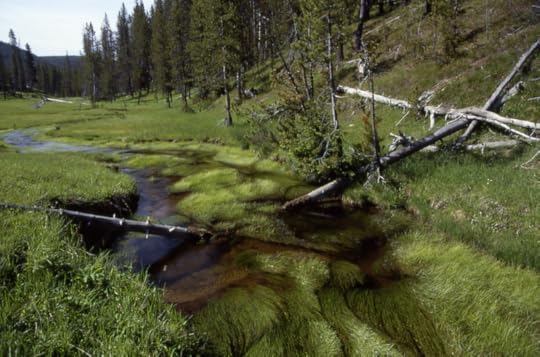
Yellowstone Green
Image Source: https://commons.wikimedia.org/wiki/Fi...

"Wilderness is the soul's elixir of life, as within is nurtured the biodiversity essential to our being." ~ L. G. Cullens

"We can't solve problems by using the same kind of thinking we used when we created them." ~ Albert Einstein

This story occurred within the stomping ground of my youth, so it was perhaps easier for me to visualize the settings. The map in the book being difficult to see the detail of, I'm including a map here that hopefully is easier to read.

Yellowstone Map
Map source: https://commons.wikimedia.org/wiki/Fi...

Side note relative to the story:
How do you pronounce Absaroka as in the Absaroka mountain range in the northeast of Yellowstone National Park. People from elsewhere generally pronounce the word Ab-suh-ROKE-uh, despite the American Heritage Dictionary noting the pronounciation ab-sär’u-ku. Even most Montanans in the region pronounce the word Ab-zor-kuhs, with a colloquial version being Absorkee. All a little confusing? Actually, Absaro-ka is the name of a Crow Indian tribe in their native language meaning Bird People. The Crow originally pronounced and now spell the word Apsalooka (ap-SUH-luh-guh). How the word got turned around is as with many languages — the Crow language contains sounds that are not easily represented by the English alphabet. I'm more familiar with the Shoshone language, whose pronunciation is a lot closer to the Crow pronunciation.

What was confusing to me was when years ago I came out east to New England. Why do people here drop Rs in words that use them (e.g. Cah for Car) and add Rs where they don't belong (e.g. Idear for Idea, or lawr for law). I had a heck of a time learning how to pronounce some of the town names :-)
Profile Image for Hayley Stenger.
308 reviews100 followers
October 9, 2018
Who knew wolves were so complex and interesting? I have never looked into wolves or researched them, but I am glad I read this book and learned about what is going on in our country today since the reintroduction of wolves into the Yellowstone area during the mid-90s. I recommend this book to anyone even slightly interested in the topic.
Profile Image for Francisco.
Author 20 books55.5k followers
October 11, 2019
Sometimes it is good to think about why we pick a particular book at a particular time. Suppose that it is not just happenstance that guides us to a book but some inner principle of growth intent on giving us an awareness needed just then. Then I would say that what this true story about the introduction of wolves into Yellowstone in 1995 (re-introduction because they were there before and then eliminated) brought me was a kind of needed sadness for our times. I mean, sometimes it is not enough to intellectually bemoan how alienated we've become from nature and from each other, sometimes you actually need to feel the alienation and the deep sadness that comes from it. This is not, however, a sentimental book - one where the author seeks to manipulate your feelings by presenting you certain images. This book tells the story of one particular wolf and her pack - a story that is based on thousands of hours of direct observation by persons who spent years of daily watching. It is like a novel in that there are main characters whose travails you follow with suspense and with hope. And like a good novel, the author withholds judgment. The careful description of the wolves behavior and the words and actions of the humans that you will meet will allow you to make your own judgments. In the course of this telling about wolves, the pettiness and hypocrisy, the politics and conflicts, and the kindness of human beings becomes a subplot that ends up overpowering the story of the wolves. The wolves are territorial - they kill wolves from other packs who enter the land they have marked as their own. This violence which you quickly perceive as natural in wolves has the effect of making it seem unnatural in human beings. Unnatural as in it is no longer needed. As in the separation of us versus them in us humans seems to be a "pleasure" we do not want to give up. But all this is just trying to explain the effect of the book and I know I am missing the mark. There is a nobility about the wolf that I feel as a loss, somehow. I know nobility is a human term but I don't know what else to call it nor how to explain the sense of loss. But I am grateful for the deepening awareness the book gave to me.
Profile Image for Rebecca.
4,185 reviews3,448 followers
October 2, 2017
By the 1920s, wolves had almost been eradicated from the Lower 48 states. In 1995–6, though, two rival packs were brought in from Canada to repopulate Yellowstone National Park. Blakeslee gives a panoramic overview of the reintroduction project and the recurring clashes between hunters and biologists about whether wolves should be a protected species. He keeps his account relatable by focusing on particular family groups of wolves and bringing out the animals’ individual personalities.

One important wolf pack was the Druids, which “were like the Kennedys, American royalty.” O-Six, an alpha female of the third generation so named because she was born in 2006, is one of the main animal characters here, with two central human characters being Rick McIntyre, a long-time National Park Service ranger and wolf expert, and Steven Turnbull (an alias), an elk hunter from Crandall, Wyoming.

The 2011 federal budget snuck in a rider removing wolves from the endangered species list in Montana and Idaho. The same followed for Wyoming, heralding an open hunting season on wolves for the first time in 50 years. Though his sympathies are clear, Blakeslee doesn’t demonize those who killed Yellowstone wolves that strayed beyond the park boundaries. He also emphasizes that the battle over this species reflects a wider struggle “over public land—what it should be used for and who should have the right to decide.”

It’s especially interesting to read about the animals’ behavior: a wolf uncle hanging around to help raise the pups, O-Six fighting off grizzlies near her den, showdowns between packs, and pups hunting mice and ravens for fun.

Originally published on my blog, Bookish Beck.
Profile Image for Lavinia.
67 reviews
January 14, 2019
Game of Thrones with Wolves !
This book is a breathtaking written documentary of life, friendship, love, betrayal and politics.
Much like Game of Thrones, it makes you fall in love with the heroes of the story only to have your heart broken time and time again.
This books deserves more than 5 stars. It's educative, enlightening, thrilling, funny and sad at the same time.
Profile Image for Sharon.
248 reviews133 followers
March 9, 2019
I visited a wolf sanctuary in Pennsylvania for the first time last year. I enjoyed the visit, but it went from "nice" to "must-see" shortly before leaving: A wolf down the hill began howling. Within seconds, another one joined in. Then another. I was further up the hill and observing a white wolf liaising about in the shade. She listened to the howls intently, started to grow restless, and finally, threw up her head, letting out her own distinct howl. This went on for about a full minute. It gave me goosebumps (it gives me goosebumps just writing about it). I asked a volunteer beside me, also speechless with the warm fuzzies, why the wolves were howling.

She shrugged. "To communicate? That's just what they do." She paused and said, "We close the sanctuary shortly after this tour and that's when they get fed. It might be a hungry howl."

Thus started my fascination with wolves, leading me to queue up a bunch of subsequent wolf tours and documentaries.

American Wolf is fascinating in its own right. Not so much the content—while excellent, I think I need to be watching the wolves to get the chills—but how the information was presented. The format was nothing short of brilliant. It starts with a chapter from the hunter's perspective, right before he pulls the trigger on a wolf (one you just know is not just any wolf). Then you hear about the wolves of Yellowstone National Park, and the rangers and enthusiasts, like naturalist Rick McIntyre, who track them obsessively. You learn why the farmers hate them, making the material more even-handed. You hear about the politics. Sprinkled within this content, however, are chapters from the wolves themselves, put together from copious note-taking by the park's observers, who took pleasure in wolf-spotting every single day. It gives personality and story-telling to the famous wolves of Yellowstone, particularly O-Six, who reached near superstar status on social media. So much so that at long last, when the book returns to the hunter about to pull the trigger on the wolf mentioned in Chapter One (and you know who it is), I had tears in my eyes.

Powerful material. (But again, not as powerful as seeing these creatures in the wild.)

My favorite quote from the book was ironically in the forward, from Margaret Atwood:

”All stories are about wolves. All worth repeating, that is. Anything else is sentimental drivel.

All of them?

Sure, he says. Think about it. There's escaping from the wolves, fighting the wolves, capturing the wolves, taming the wolves. Being thrown to the wolves, or throwing others to the wolves so the wolves will eat them instead of you. Running with the wolf pack. Turning into a wolf. Best of all, turning into the head wolf. No other decent stories exist.”
Profile Image for Joy D.
3,129 reviews329 followers
September 3, 2018
Non-fiction about the reintroduction of wolves into Yellowstone in Wyoming in the mid-1990s. Park ranger Rick McIntyre, after spending time at Denali in Alaska, relocated to Wyoming, and became a diligent wolf observer, documenting wolf behavior over the course of years. The author relied heavily on the Rick’s and other wolf-watchers’ field notes as reference material from which to create this account of wolves in the wild. The storyline focuses on an alpha female, O-Six (the year of her birth), and pack behavior throughout the region. Highlights include the social and family interactions of the pack, territorial aggression, and tracking prey.

I found this book extremely informative and well-written. The author has a knack of converting notes, interviews, and research into a cohesive and compelling story. In fact, one of the themes of this book is the impact of storytelling, conveyed through Rick and his interactions with the many visitors to the park. It communicates the passion of the wolf-watchers of Yellowstone, as well as portraying the differing points of view of hunters and ranchers. The book excels when it focuses on O-Six, her pack, and the other Yellowstone packs. I was very interested in the portions on the wolves and animal behavior but less fond of the chapters on politics. Unfortunately, a book of this sort was almost required to delve into the political aspects of wolf-hunting. The author interviewed one of the wolf hunters and included his viewpoints, assigning him a pseudonym. Even so, the tone is pro-wolf, elucidating the environmental benefits of a thriving ecosystem, complete with both predators and prey, eventually leading to balance.

Obviously, in the wild lots of harm comes to animals through a variety of means, so if you are sensitive to animals being injured or killed, you may want to skim or skip certain segments. Recommended to those interested in animal behavior, wolves, or environmentalism.
Profile Image for Nancy.
1,904 reviews474 followers
October 26, 2017
For National Wolf Awareness Week I read American Wolf by Nate Blakeslee. It is the story of the reintroduction of wolves to Yellowstone National Park and the battle between state and Federal agencies over wolf hunting. By telling the story of one wolf, O-6, Blakeslee engages the reader's heart and mind while revealing the complicated political process that determines American law that is too often independent of informed knowledge.

O-6 became a favorite of wolf watchers and her life is well documented. Blakeslee introduces readers to National Park Service employee Rick McIntyre who every day watched and recorded the activities of the wolves. And we meet those who rely on elk hunting for income or food or sport and who hate the wolves.

The hunters believe that wolves decimate elk herds and that banning any hunting leads to ending all hunting, therefore the end of any need for guns, therefore the banning of guns. In other words, they are fighting for their way of life. States arbitrarily determined how many wolves could be taken and how many were 'needed', totally unbased on any scientific understanding.

While one Federal agency reintroduced wolves into the Yellowstone ecosystem, another leased land contiguous to the park for ranchers to graze their livestock. Wolves don't understand imaginary boundaries and often their territory went into non-park land where they could be hunted. When packs are decimated and weak they take easy prey, which include the grazing livestock. The ranchers are then reimbursed for their losses. It is a vicious cycle that makes no logical sense.

I was appalled whle learning how Washington politics impacted the Yellowstone wolves. Congress overruled the court regarding the hunting of wolves. It had cost $117 million to restore wolves to the ecosystem. The results were dramatic; flora and fauna flourished as the environment returned to its natural state. Fewer elk ended overgrazing and brought a flourishing of fauna that brought back the beaver and rodents and consquently raptors. Yet no fewer elk were taken in the hunt, it just was not easy to find them. Legalizing hunting adjacent to the park land was like throwing that money and environmental stability to the wind.

Toward the end of the book, Rick realizes that wolf 21 had returned to die where his pack had once ruled. It puzzled him until he recalled the story of Hachiko, the Japanese Akita who had always waited at the train station for his owner, and after the owner's death had continued to come every day for nine years. 21 was waiting for his mate.

"Can a wolf in the wild experience what we know as joy and happiness? Rick said, his voice breaking noticeably. "And my answer is yes."

Blakeslee's book is a wonderful study both of the wolves and the complicated human reaction to wolves.

I received a free book through Blogging for Books in exchange for a fair and unbiased review.

See photos of O-6 at Shumway Photography at http://www.shumwayphotography.com/Yel...

*****
Reading about the death of O-6 was sad because two days previous we let go of our last Shiba Inu. The Shiba is an ancient breed and according to DNA research is closest to the wolf. Kamikaze had spent seven years as a puppy mill breeder before we adopted her through a rescue shelter. She was only 14 but had multiple health issues, some the results of bad breeding or early living condition. We lost our Suki, another puppy mill breeder rescue, at age 15 in June. Kamikaze had gone down hill significantly after Suki's loss. Both dogs were blind and spent their time cuddled together, drinking from the same bowl at the same time, and going in and out together.
Profile Image for Barbara.
321 reviews388 followers
December 24, 2018
Oh no! I thought I would be getting a breather from politics reading this book. But, I guess, politics are ubiquitous and the policies are often questionable.

Should wolves be hunted? If they are hunted, should there be limits? Should all states involved in wolf hunting have the same limits and hunting seasons? Should the decision be made by the states or by the federal government?- so much politics!

As a lover of animals I was enthralled by the descriptions of wolf behavior in Yellowstone National Park. The familial nature of packs, the relationships between alphas, pups and other pack members were fascinating. These majestic animals are highly intelligent. They can be compassionate. They feel loss and can grieve. Their defense of their territory reminded me of the Jets and the Sharks in West Side Story. I was unaware of the number of wolf-watchers in Yellowstone and the dedicated work of Rick McIntyre, a renowned naturalist who daily followed and recorded the life of O-Six, an exceptional collared alpha female. O-Six and all the wolves followed in this book had so many human traits. Is that why they are so interesting to us? Don't we love watching apes and chimpanzees for the same reason?

The paradox for me is this. I love these adorable wolves, wild yet so much like us. I don't want them hunted. Yet, living in an area with an over-abundance of deer, I have no problem with deer hunting (as long as they are hunted for food). They carry lyme disease infected ticks (I have had lyme disease the last three years) and they eat my beloved and expensive plants. How can I be critical of the hunters of Idaho, Wyoming and Montana? I would highly recommend this book to anyone who loves animals and nature. It is well-written and compelling.
Profile Image for Navi.
112 reviews216 followers
December 20, 2019
This was an emotionally-charged and gripping narrative! I did not think I would be so invested in the lives of the wolves mentioned in this book.

I have been fascinated by the Yellowstone wolves ever since I heard about the reintroduction project a little while back. Before reading this book, I thought that repopulating an apex predator would destroy the ecosystem. I could not be further from the truth. I did not know that Yellowstone Wolves are keystone species. Without them, the ecosystem becomes stunted in its biodiversity. I was surprised to learn that multiple wolf packs live in the park. That gives you an idea of the vastness of Yellowstone.

I really must commend Nate Blakeslee. This book is written so beautifully and evocatively that I felt as if I was there in Yellowstone Park a stone's throw away from the wolves. The main focus is on an alpha female named O-Six - a fierce, intelligent leader and hunter. I loved the fact that the author told the story through the perspective of O-Six. After being immersed in her day-to-day life, her personality really shone through.

It was interesting to read about how controversial the Yellowstone Wolves are and the different perspectives people have. Not only does Blakeslee provide the opinions of professional wolf guides, we also get perspectives from the Park Department and the individuals living in and around the park lands.

I highly recommend this book!
6,202 reviews80 followers
November 27, 2017
I won this book in a goodreads drawing.

A history of the effort to reintroduce wolves to the Yellowstone area. There's definitely pros and cons to the idea. Blakeslee is firmly in the "pro" camp.

Profile Image for Katy O..
2,977 reviews705 followers
October 17, 2017
Stunningly addictive, this nonfiction account of wolves, Yellowstone and humanity reads like a fictional account of dueling mob families in a turf war. A must-read for nature lovers and hunters alike.

Thanks to Crown Publishing for providing me with an advance copy of this book for review purposes.

Nate Blakeslee has done what very few writers can. He has taken a group of wild animals and created an epic drama surrounding their lives ~ a drama that reads entirely like fiction or the best type of biography. I honestly didn't think it was possible for an almost-300-page tome about wolves to be a page turner, but it truly, truly is. Blakeslee includes just the right balance between the people and politics surrounding the wolves with the actions of the actual wolves to ensure that readers understand just how perilous this animal's survival chances are. And really, the survival chances of any wild animals in the United States. The stories in this book about Yellowstone and the federal and state agencies regulating the park and wildlife honestly make me despair about the way our nation is run on an entirely new level. Bureaucracy trumps nature at every single turn, but the hearts of those dedicated to protecting wolves give me hope.

Required reading for nature lovers, hunters, and anyone who loves quality nonfiction. This is one of the best out there.

Now, a little bit about my background coming into this book so you can understand my unbridled love for it. First of all, I read National Geographic cover to cover every single month. Nature writing is my THING. Next, we live in rural Wisconsin and the hunting/preservation topic is always close by. In addition, my family has a major wolf obsession due to my son's extreme interest in them ~ he currently has 8 stuffed wolves that he has with him at all times, a wolf mask, posters, calendars, blankets, and countless books on this topic. The arrival of this book in my household as an advance copy was a cause for great celebration, and I can not wait for my husband and son to get to share it next. My husband also has family in Wyoming and is an avid hunter ~ we have always had spirited conversations about wildlife management, and this book just adds to our discussion fodder.

One of my favorite reads of 2017.
Profile Image for Jay Pruitt.
222 reviews19 followers
August 12, 2019
“Man, in character, is more like a wolf… than he is any other animal.”
--Carveth Read, English philosopher--


American Wolf is all about the plight of wolves reintroduced to Yellowstone and surrounding states in the 1990s, and how local ranchers and elk hunters have fought against the growing population of packs by both illegal hunting and political pressure to remove wolves from the endangered species list in order to allow them to be legally hunted. In particular, the book focuses on probably the most notable and popular of these wolves, an alpha female referred to as "06".

I found the story fascinating, but my perspective is colored by the good fortune of having visited the Lamar Valley (Yellowstone) and viewing a pack of wolves with my daughter, who has read numerous books on wolves and is a huge fan/follower of the animal. Together, we braved weather which, at least one day, was 20 below zero. As I read the book, the story perfectly matched the conditions and setting we experienced. For example, on one of the days we were there a pack had chased an elk off the hills in the northern part of the valley, where it then stood in the frigid Lamar River hoping the wolves would lose interest and go away. The next morning we returned and found the elk had at some point fled the protection of the river, only to become a meal for the pack.

I highly recommend the book for those who have more than a casual interest in wolves. Others may find the story a little tedious at times, but certainly educational.
Profile Image for Elizabeth☮ .
1,817 reviews14 followers
July 11, 2018
A lot of the content seemed familiar to me and I realized that I have probably seen the documentary on the wolves described in the book.

The narrative here is told from the perspective of the gaming and hunting community in the area and the wolf preservationists and advocates. One of those advocates is Rick who watches the wolves and follows their lives and informs the public of their habits.

I loved watching through Rick's scope and learning about the mundane and the transcendent scenes. I don't want to give away anything that happens, but let's just say the circle of life endures (and most times man intervenes).

This is written in the style of Hillenbrand or Larson in that it is non-fiction written as fiction. Highly readable.
Profile Image for Denver Public Library.
734 reviews337 followers
September 23, 2021
The enthralling story of O-Six, the celebrated and enigmatic descendant of one of the original wolves reintroduced to Yellowstone in 1995, and the complicated human reactions that ultimately led to her tragic death. Herein lies a tale about a wolf and the characters who orbit her life, as well as a riveting saga of hardship and triumph that tells a larger story about the ongoing cultural clash in the West—between those fighting for a vanishing way of life and those committed to restoring one of the country’s most iconic landscapes. You don't need to be a fan of wildlife writing to adore this story, the writing is that good. Be forewarned, it's an emotional read. I cried many tears!
Profile Image for Andrew.
687 reviews250 followers
May 22, 2017
Hoooooooooooowwwll!

A visceral and dramatic look at the lives, deaths, and empires of Yellowstone's wolves. Animal stories done well are always incredible insights into the world around us. And this is a worthy addition to the catalogue. Based on thousands of hours of observation and a multi-million word journal, you could not get closer to the wolves of the park. A must-read if you loved H Is For Hawk or The Hidden Life Of Trees .
Displaying 1 - 30 of 1,790 reviews

Can't find what you're looking for?

Get help and learn more about the design.