

What do you think?

Modern Art in Detail: 75 Masterpieces
Great works of art cannot be fully understood in a single encounter. This is perhaps even truer for modern artworks that may not immediately make sense to, or even appeal to, the casual observer. Viewing an artwork— whether it is a painting, sculpture, installation, video, or photograph— as a whole is one method of interacting with it, but a deeper understanding can only be gained by analyzing it in detail.
Modern Art in Detail: 75 Masterpieces spotlights the finer points that even connoisseurs may miss. The book includes all the minutiae that a quick glance will almost certainly fail to reveal, including subtle internal details. Susie Hodge writes intelligently and informatively about relevant external influences on the artist—everything from global political events to groundbreaking movements such as Cubism, Futurism, and Primitivism, and even scientific and mathematical theories.
This book examines seventy-five artworks from the late nineteenth century to the modern day. It treats each of its subjects on its own merits, but it also views each as part of a tradition that links it to the past, which sees artists pass a baton down through the ages. Moreover, it charts the shift from the supremacy of artistic technique to the dominance of the idea or concept behind the object created.
Modern Art in Detail: 75 Masterpieces spotlights the finer points that even connoisseurs may miss. The book includes all the minutiae that a quick glance will almost certainly fail to reveal, including subtle internal details. Susie Hodge writes intelligently and informatively about relevant external influences on the artist—everything from global political events to groundbreaking movements such as Cubism, Futurism, and Primitivism, and even scientific and mathematical theories.
This book examines seventy-five artworks from the late nineteenth century to the modern day. It treats each of its subjects on its own merits, but it also views each as part of a tradition that links it to the past, which sees artists pass a baton down through the ages. Moreover, it charts the shift from the supremacy of artistic technique to the dominance of the idea or concept behind the object created.
- GenresArtNonfiction
336 pages, Hardcover
First published November 1, 2017
Ratings & Reviews
Friends & Following
Create a free account to discover what your friends think of this book!
Community Reviews
Displaying 1 - 9 of 9 reviews

July 7, 2018
A Beautiful but Disappointing Sequel
In 2016, Thames & Hudson produced a beautiful book by Susie Hodges, Art in Detail: 100 Masterpieces. The concept was simple. Each artwork, from the Middle Ages through the present, would be given a four-page spread. A page containing basic information and the artist's bio would face a full-page reproduction of the painting of excellent quality. The next two pages would contain half-a-dozen enlarged details from the work, commenting on subject matter, iconography, technique, palette, and other special features. Often there would be one or more sidebars showing related works by other artists.

The page-spread above shows details from Rogier van der Weyden's Deposition. The topics covered are: Jesus, the Virgin, Crossbow references (the painting was commissioned by the Guild of Crossbowmen), Contrivances, Three Figures, Mary of Clopas, and Symbolic Color. A less well-known painting by Rogier is shown at bottom right. Like many Christian subjects, this painting is full of references that require footnoting somehow, and how better to do it than through details that show the painting more clearly than you usually see in a gallery?
======


The next year, 2017, Hodges produced a sequel devoted to modern art. Once again, when the subject is similarly dense with detail, the approach pays off. The two pages above are devoted to The Tilled Field (1923–24) by Joan Miró. An imaginative precursor of Surrealism, it is full of features that require annotation. Hodges explains secret meanings, political references, reflections of the artist's life, and points of technique. She even talks about earlier stylistic influences and the work's nod to Cubism, thus going far to balance the main objection to this kind of approach, that it tends to take each work as a separate item, without establishing a meaningful through-line. But this is an exception; in general, Hodges makes little use of cross-reference between works, perhaps in part because modern art has come to exalt object above subject and originality above tradition.
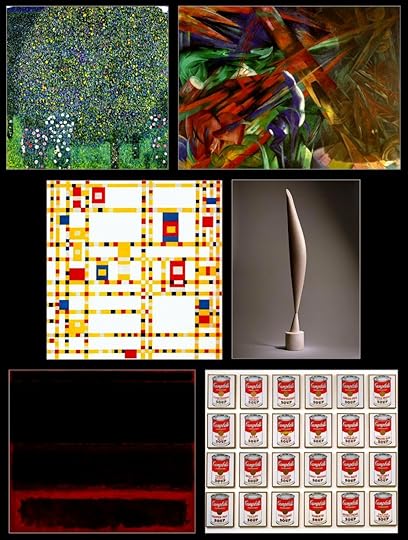
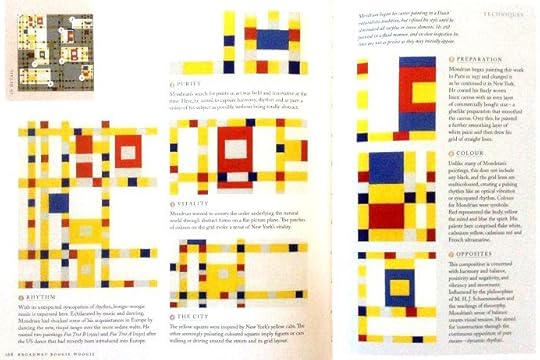
Works with representational content such as the Miró, Edward Hopper's Nighthawks, or Grant Wood's American Gothic, where the detail approach pays off are the exception rather than the rule; it works well for less than a third of the artworks chosen. For about another third, such as those in the thumbnails above (Klimt, Marc, Mondrian, Brancusi, Rothko, and Warhol), the subject is either too dense or too simple for details to mean much. Hodges may have useful things to say about Mondrian's Broadway Boogie-Woogie, for example (her headings are: Rhythm, Unity, Vitality, the City, Preparation, Color, and Opposites), but the details from such a painting are virtually meaningless, and have no necessary connection to the point being made.
I obtained this book as follow-up to my review of How to Read a Modern Painting by Jon Thompson. My problem with that book was that it did not fulfill the promise of its title—teach us how to read a painting—but instead merely annotated a number of works arranged in chronological order rather than by thematic groupings. I hoped the Hodges book might have a more meaningful arrangement, and I was excited by the potential of using the details and sidebars to make connections of style and ideas. Alas, that was not to be. Exquisitely produced though the book is, its content was a huge disappointment.

November 22, 2024
I recently enjoyed this author's other book "Art in Detail: 100 Masterpieces" which helped get a better appreciation of 100 great paintings across history. This is a similar book focusing on modern art, predominantly from the 20th century. Personally I am a fan of paintings that belong to realism and impressionism movements before the modern era, and have difficulty enjoying modern abstract art. This book played a part in deepening my understanding of modern art and its principles and various elements. May be next time I visit a museum and encounter modern art, I would be able to appreciate them better.

April 15, 2020
There is an excellent GR review by Roger Brunyate to which I would simply refer the reader:
https://www.goodreads.com/review/show...
https://www.goodreads.com/review/show...

July 1, 2022
For many, art since the late 19th century has become increasingly bewildering. Some consider much of it to be incomprehensible, while others see it as more expressive than art of previous centuries. Many maintain that art should be a vehicle for technical skills, and that it should also be beautiful, pleasing and coherent. However, a great deal of modern and contemporary art is less about beauty or technical abilities, and more about expressing ideas and philosophies. In addition, many contemporary artworks are not permanent, not as well known as some more traditional art, and often address difficult subjects. For this reason, much modern and contemporary art is better understood with some background knowledge; some insight into the artist's intentions, emotions and circumstances.
Modern and contemporary art is not always serious, and unlike a great deal of art of the past, much of it was not made to be revered. It is often intentionally absurd, or disturbing, witty or transient. Additionally, people's views of it will always be coloured by their experiences, perceptions and expectations. So knowing something of the artists' intentions can be exceptionally helpful.
Art is not a linear development, but a flexible, changeable evolution that expands in different directions often at the same time, and like many art movements that are named in hindsight, there is no one consensus of opinion that agrees on a definition for modern, postmodern and contemporary art. They are all loose descriptions of periods in time where certain values emerged in a wider range of artistic production.
From the earliest times to the late 19th century, artists were largely commissioned by wealthy individual patrons or institutions such as the Church. Most art was created to help viewers understand things like religious beliefs or morals, to recognize who was in charge, or to celebrate success. Each era had its goals and aspirations, and art was always made to assist these, such as humanism and Catholicism during the Renaissance and Baroque periods, the light-hearted extravagances of the Rococo style, and the articulation of heroism and patriotism in Neoclassicism.
In reaction to the strict academic conventions that had been adhered to by artists for centuries, the last decades of the 19th century witnessed the development of numerous new art forms and styles. Realism featuring ordinary people, loose brushwork or rough surfaces and avoiding exaggeration or idealization heralded Impressionism, closely followed by Neo- and Post-Impressionism, which were a diverse range of art styles and approaches, frequently utilizing modern synthetic pigments and focusing on brilliant color.
Following on from the new artistic directions of the 19th century, by the early 20th century, innovative technologies and discoveries emerged with even greater momentum. Avant-garde artists continued to reject the traditions and rigidity of academic art, and developed styles that challenged accepted artistic conventions even more frequently. As these fresh approaches appeared in rapid succession, they influenced and inspired each other. Expressionism, Cubism, Fauvism and Futurism began to flourish. For the first time, art moved away from being purely figurative, and once the first abstract works were produced, many more artists began exploring the concept.
------------------------------------------
1. The Church in Auvers-Sur-Oise ~ Vincent Van Gogh
His last words to his brother Theo were, "The sadness will last forever."
About him:
- In his chart, the Sun is in Aries and Venus, in Pisces.
- Paradoxical association: the enthusiasm and the spring freshness of the Aries Sun echo the subtlety and the distance of a Piscean Venus.
- His aspirations (solar), prompt him to be carried away by his heart impulses and to exchange with spontaneity … but his desires (Venusian) obey different rules that are elusive, and sometimes, irrational. Between the beginning and the end, the frontier is often tenuous and the balance is fragile.
- His affective behaviour may seem disconcerting because he can abruptly shift from enthusiasm to renunciation. This is because his senses do not follow his ideals, because his desires do not match the patterns that appeal to him, as sincere as I may be.
- Attraction or repulsion is based on ineffable impressions that short-lived and sudden impulses cannot erase nor construct. Although he may show a certain naivety, his senses quickly discriminate between the one-night-stand illusory enthusiasm and the essential harmony without which two persons drift apart, sooner or later.
- Love is not simple! And if it were, indifference would rapidly triumph over the wildest feelings.
------------------------------------------
2. Where do we come from? What are we? Where are we going? ~ Paul Gauguin
About him:
- He left his wife, their five children and his career as a stock broker to pursue his dream of becoming an artist.
About the work:
- Spiritual Belief: an exotic-looking idol is an emblem of spiritual belief. It represents what Gauguin described as "The Beyond". Animals are traditionally believed to have a sixth sense or a spirituality that [some] humans have lost.
- The Beginning: Gauguin explained that the painting should be read from right to left, beginning with the baby. The baby represents the beginning of life and the women symbolize the biblical Eve.
- Destiny and Desire: in the centre of the painting, Gauguin explores human destiny, ambition and the desire to seek more in life.
- The End of Life: on the left side of the painting, a young woman reflects on life, and an old woman prepares to die.
------------------------------------------
3. Rosebushes Under the Trees ~ Gustav Klimt
About him:
- One of the founders of the Vienna Succession and considered the greatest painter of the Art Nouveau period, Klimt began his career painting large murals in public buildings.
- His more decorative, sensuous style came later, when he amalgamated the shapes and colors of Symbolism with his notions of aesthetics, frequently painting women, allegorical scenes, flowers and landscapes.
About the work:
- Klimt often visited a small island castle, and painted the trees, bushes and flowers.
- A soft easterly wind known as the "Rosenwind" (breeze of roses) crosses the castle's rose garden and fills the air over the lake with the smell of roses.
- It was Klimt's inspiration for this painting.
------------------------------------------
4. Birthday ~ Marc Chagall
About the work:
- Chagall maintained that he fell in love with Bella at first sight.
- Wearing a black dress with white lace collar, Bella rushes towards the window, holding flowers that Chagall has given her.
- In his autobiography, he wrote of Bella: "It is as if she knows everything about my childhood, my present, my future, as if she can see right through me."
------------------------------------------
5. Portrait of the Artist's Wife, Jeanne Hebuterne ~ Amedeo Modigliani
About the work:
- Modigliani's elongated figures and masklike faces do not fit into any art movement.
- Although in his distinctive elongated style, this portrait of Jeanne resembles a Renaissance Madonna, but also shows other influences, including Cubism and ancient Egyptian art.
------------------------------------------
6. American Gothic ~ Grant Wood
About the work:
- Gothic in terms of the American Gothic home in the background.
- The woman is modern day America's Mona Lisa.
------------------------------------------
7. Blue Poles ~ Jackson Pollock
About him:
- The creator of one of the most radical abstract styles in modern art, Jackson Pollock redefined painting with his original methods.
He became the leading figure in the Abstract Expressionist movement.
About the work:
- He painted this through a form of automatism, allowing his subconscious thoughts and intuition to take over.
- Both the action itself and the resulting painting suggest energy, but the work also expresses feelings of being ensnared in the mind, body or the modern world.
Modern and contemporary art is not always serious, and unlike a great deal of art of the past, much of it was not made to be revered. It is often intentionally absurd, or disturbing, witty or transient. Additionally, people's views of it will always be coloured by their experiences, perceptions and expectations. So knowing something of the artists' intentions can be exceptionally helpful.
Art is not a linear development, but a flexible, changeable evolution that expands in different directions often at the same time, and like many art movements that are named in hindsight, there is no one consensus of opinion that agrees on a definition for modern, postmodern and contemporary art. They are all loose descriptions of periods in time where certain values emerged in a wider range of artistic production.
From the earliest times to the late 19th century, artists were largely commissioned by wealthy individual patrons or institutions such as the Church. Most art was created to help viewers understand things like religious beliefs or morals, to recognize who was in charge, or to celebrate success. Each era had its goals and aspirations, and art was always made to assist these, such as humanism and Catholicism during the Renaissance and Baroque periods, the light-hearted extravagances of the Rococo style, and the articulation of heroism and patriotism in Neoclassicism.
In reaction to the strict academic conventions that had been adhered to by artists for centuries, the last decades of the 19th century witnessed the development of numerous new art forms and styles. Realism featuring ordinary people, loose brushwork or rough surfaces and avoiding exaggeration or idealization heralded Impressionism, closely followed by Neo- and Post-Impressionism, which were a diverse range of art styles and approaches, frequently utilizing modern synthetic pigments and focusing on brilliant color.
Following on from the new artistic directions of the 19th century, by the early 20th century, innovative technologies and discoveries emerged with even greater momentum. Avant-garde artists continued to reject the traditions and rigidity of academic art, and developed styles that challenged accepted artistic conventions even more frequently. As these fresh approaches appeared in rapid succession, they influenced and inspired each other. Expressionism, Cubism, Fauvism and Futurism began to flourish. For the first time, art moved away from being purely figurative, and once the first abstract works were produced, many more artists began exploring the concept.
------------------------------------------
1. The Church in Auvers-Sur-Oise ~ Vincent Van Gogh
His last words to his brother Theo were, "The sadness will last forever."
About him:
- In his chart, the Sun is in Aries and Venus, in Pisces.
- Paradoxical association: the enthusiasm and the spring freshness of the Aries Sun echo the subtlety and the distance of a Piscean Venus.
- His aspirations (solar), prompt him to be carried away by his heart impulses and to exchange with spontaneity … but his desires (Venusian) obey different rules that are elusive, and sometimes, irrational. Between the beginning and the end, the frontier is often tenuous and the balance is fragile.
- His affective behaviour may seem disconcerting because he can abruptly shift from enthusiasm to renunciation. This is because his senses do not follow his ideals, because his desires do not match the patterns that appeal to him, as sincere as I may be.
- Attraction or repulsion is based on ineffable impressions that short-lived and sudden impulses cannot erase nor construct. Although he may show a certain naivety, his senses quickly discriminate between the one-night-stand illusory enthusiasm and the essential harmony without which two persons drift apart, sooner or later.
- Love is not simple! And if it were, indifference would rapidly triumph over the wildest feelings.
------------------------------------------
2. Where do we come from? What are we? Where are we going? ~ Paul Gauguin
About him:
- He left his wife, their five children and his career as a stock broker to pursue his dream of becoming an artist.
About the work:
- Spiritual Belief: an exotic-looking idol is an emblem of spiritual belief. It represents what Gauguin described as "The Beyond". Animals are traditionally believed to have a sixth sense or a spirituality that [some] humans have lost.
- The Beginning: Gauguin explained that the painting should be read from right to left, beginning with the baby. The baby represents the beginning of life and the women symbolize the biblical Eve.
- Destiny and Desire: in the centre of the painting, Gauguin explores human destiny, ambition and the desire to seek more in life.
- The End of Life: on the left side of the painting, a young woman reflects on life, and an old woman prepares to die.
------------------------------------------
3. Rosebushes Under the Trees ~ Gustav Klimt
About him:
- One of the founders of the Vienna Succession and considered the greatest painter of the Art Nouveau period, Klimt began his career painting large murals in public buildings.
- His more decorative, sensuous style came later, when he amalgamated the shapes and colors of Symbolism with his notions of aesthetics, frequently painting women, allegorical scenes, flowers and landscapes.
About the work:
- Klimt often visited a small island castle, and painted the trees, bushes and flowers.
- A soft easterly wind known as the "Rosenwind" (breeze of roses) crosses the castle's rose garden and fills the air over the lake with the smell of roses.
- It was Klimt's inspiration for this painting.
------------------------------------------
4. Birthday ~ Marc Chagall
About the work:
- Chagall maintained that he fell in love with Bella at first sight.
- Wearing a black dress with white lace collar, Bella rushes towards the window, holding flowers that Chagall has given her.
- In his autobiography, he wrote of Bella: "It is as if she knows everything about my childhood, my present, my future, as if she can see right through me."
------------------------------------------
5. Portrait of the Artist's Wife, Jeanne Hebuterne ~ Amedeo Modigliani
About the work:
- Modigliani's elongated figures and masklike faces do not fit into any art movement.
- Although in his distinctive elongated style, this portrait of Jeanne resembles a Renaissance Madonna, but also shows other influences, including Cubism and ancient Egyptian art.
------------------------------------------
6. American Gothic ~ Grant Wood
About the work:
- Gothic in terms of the American Gothic home in the background.
- The woman is modern day America's Mona Lisa.
------------------------------------------
7. Blue Poles ~ Jackson Pollock
About him:
- The creator of one of the most radical abstract styles in modern art, Jackson Pollock redefined painting with his original methods.
He became the leading figure in the Abstract Expressionist movement.
About the work:
- He painted this through a form of automatism, allowing his subconscious thoughts and intuition to take over.
- Both the action itself and the resulting painting suggest energy, but the work also expresses feelings of being ensnared in the mind, body or the modern world.
December 25, 2021
Как всегда с книгами такого рода, нужно понимать сборносоляночный характер материала. Есть действительно хорошие разборы (хотя уж совсем приличной глубины от этой книги ждать не стоит), а есть очень поверхностные. В основном это касается более абстрактного искусства, где вместо того, чтобы правда сосредоточиться на выделенных деталях, авторка просто раскидывает биографию и сведения о технике художника или художницы по странице. Например, читать про "Вспаханное поле" Жоана Миро было нескучно, потому что там есть где разгуляться, а вот про, скажем, Кандинского или "Ночной лес" Луизы Буржуа — наоборот, потому что это уже территория слишком туманных догадок, с которыми трудно согласиться:
"На первый взгляд произвольные, чувственные формы выражают целую гамму эмоций, которые испытывала Буржуа в связи с разлукой с Францией и все, что ей было близко, несмотря на то, что в США она прожила уже 15 лет. Здесь ощущается одиночество, уязвимость и агрессия, мысли о семье, сексуальности и самовосприятии."
А теперь погуглите "Ночной лес" Буржуа и попробуйте найти хоть что-нибудь из того, что сейчас прочитали.
По структуре книги рядом с рассматриваемым произведением искусства располагается другое, которое якобы повлияло на его создателя или создательницу. Эта секция, по-моему, в принципе довольно сомнительная, но иногда встречались уж совсем бредовые предложения вроде: "Хотя эта картина отличается большей детальностью, нежели творчество де Кунинга, между картинами имеется нечто общее — обе женщины изображены сидящими".
Русское издание также сильно расстроило большим количеством опечаток и ошибок. В одном месте предложение просто оборвалось на середине. Имена редакторки и переводчицы похожи на английские, что ещё больше сбивает с толку, но в любом случае над текстом недоработали.
Однако при всех этих минусах я открыла для себя много новых интересных имён (Умберто Боччони, Франц Марк, Эрнст Людвиг Кирхнер, Георг Гросс, Отто Дикс, Макс Эрнст) и заодно дополнила связи между отдельными личностями и разными художественными течениями.
"На первый взгляд произвольные, чувственные формы выражают целую гамму эмоций, которые испытывала Буржуа в связи с разлукой с Францией и все, что ей было близко, несмотря на то, что в США она прожила уже 15 лет. Здесь ощущается одиночество, уязвимость и агрессия, мысли о семье, сексуальности и самовосприятии."
А теперь погуглите "Ночной лес" Буржуа и попробуйте найти хоть что-нибудь из того, что сейчас прочитали.
По структуре книги рядом с рассматриваемым произведением искусства располагается другое, которое якобы повлияло на его создателя или создательницу. Эта секция, по-моему, в принципе довольно сомнительная, но иногда встречались уж совсем бредовые предложения вроде: "Хотя эта картина отличается большей детальностью, нежели творчество де Кунинга, между картинами имеется нечто общее — обе женщины изображены сидящими".
Русское издание также сильно расстроило большим количеством опечаток и ошибок. В одном месте предложение просто оборвалось на середине. Имена редакторки и переводчицы похожи на английские, что ещё больше сбивает с толку, но в любом случае над текстом недоработали.
Однако при всех этих минусах я открыла для себя много новых интересных имён (Умберто Боччони, Франц Марк, Эрнст Людвиг Кирхнер, Георг Гросс, Отто Дикс, Макс Эрнст) и заодно дополнила связи между отдельными личностями и разными художественными течениями.

May 27, 2026
Een mooi vorm gegeven overzicht van moderne tot hedendaagse kunst waarbij de selectie een persoonlijke keuze van de schrijfster lijkt te zijn. De stukjes tekst zijn een prima inleiding op de kunstenaar en de verdiepende pagina's leren je iedere keer wel wat. Ook de verbanden met andere schilderijen zijn goed meegenomen. Geen boek dat je met een structuur iets bij brengt maar wel een goede introductie in de moderne kunst en de gebruikte technieken en overwegingen.

September 25, 2025
A really excellent overview of modern art! The only thing I would have wished to see is some kind of timeline showing the overlap of the various movements to help contextualize it more but I can find that online. I really liked that there was a mix of pieces that everyone knows (American Gothic, The Persistence of Memory, etc) and many I had never heard of.
May 12, 2018
Although I didn't read all the detailing information about each piece of art in this collection I wass impressed by the quality of the book and the images and analysis of the work.
December 18, 2023
Tons of interesting art and fantastic text. Great book
Displaying 1 - 9 of 9 reviews