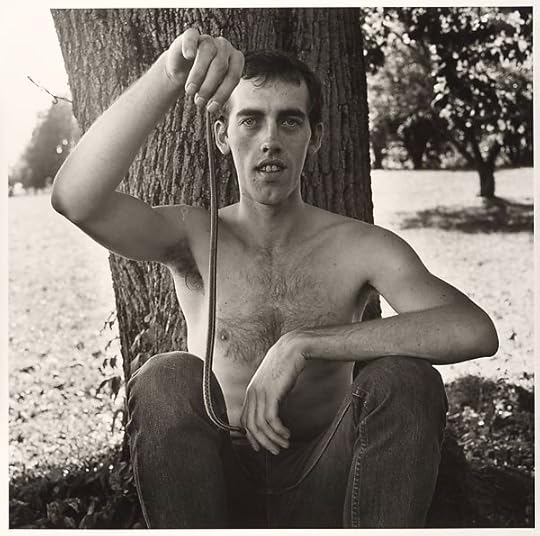
New York in the 80s was Satan's rumpus room.
There were Jean-Michel Basquiat, Andy Warhol, Keith Haring and Cindy Sherman. There were Julian Schnabel, Jenny Holzer, Jeff Koons, Richard Kern and Lydia Lunch, along with hundreds of other major and minor talents living, loving, working, fucking, dying in museums and slums, cool nightclubs and shooting galleries, fancy restaurants and seedy diners, hotels and ratholes, gentrified avenues and ghettos. There were high-class coke and cheap smack, tycoons building empires and stray kids sniffing glue, Neocon repression and revolutionary enthusiasm, Reaganomics and street gangs. A place of potential and decay just like fin-de-siècle Paris, with the Goncourt brothers recording in their diaries the glories and miseries of a modern world bursting with genius and rotting with syphilis.
Except this time it wasn't syphilis. It was AIDS.
From the mid-80s on death came in a huge, relentless wave. A disease some regarded as a welcome cleansing, a purifying fire that would rid the world of faggots, niggers, junkies and, hopefully, a few anarchoid misfits too - those who had never learnt to hold their tongue and even dared dabble with (degenerate) art. And were now dying like flies. Or rats, if they hadn't managed to become rich and famous in the meantime.
One of them vicious-tongued queers was artist/writer/filmmaker David Wojnarowicz, who lived through the light and darkness of an era of absolute polarities and died of AIDS at the age of 37. An eclectic talent, a homsexual, a man who wanted us to know what it was like to be him and therefore left us a memoir that reads like "Naked Lunch" and sounds like an Iggy Pop song.
Strictly speaking, this book has very little to do with autobiography as such, what with the lack of chronological order and the non-linear narration through fragmented flashbacks and memories. It's rather a collection of expressionist essays about the author's perception of himself and his kind, his life used as a vessel to convey images, emotions and sensations, both real and oneiric. It's an artist's outlook on himself and all those belonging to whatever minorities (racial, sexual, ideological) are struggling to survive in late 20th century USA; on the feeling of being robbed of all dignity by a system of hatred and planned neglect, overtly advocated or tacitly accepted as a matter of fact.
It's therefore a manifesto against silence: it was indeed silence that allowed AIDS to spread all over the world. Silence like a shroud in which the dead were wrapped before being thrown in society's trashbin.
These essays are heterogeneous, though not uneven in quality.
Wojnarowicz's is an account of street wanderings and road trips, with gorgeous descriptions of the American landscapes; of musings on architecture and art; of heartrending stories of friends and lovers dying of AIDS; of memories (the abusive family, the adolescence spent whoring in New York); of clandestine encounters with strangers - in toilets, truck cabins, motel rooms, dilapidated warehouses... the places where the law confines all sexuality deemed unacceptable.
The underworld of paedophiles, hustlers, winos and queers of his early teens was indeed bound to become part of his adulthood, at the core of his creativity and need to unveil the dark side of the American Dream - all those who are forgotten or deliberately left behind. Just have a look at Wojnarowicz's famous series of photographs "Rimbaud in New York" (1978-79): b/w portraits of a guy wearing an Arthur Rimbaud paper mask on his face posing in subway cars, cafes, industrial areas, rundown apartment blocks and warehouses; standing, leaning against a wall, pissing, doing heroin or just sitting, the mask staring expressionlessly at the camera. Those pictures depict the very same environment in which Wojnarowicz grew up, the only one he truly cherishes - because that hell was the only place where he could be himself. Among those perverts and bums he was allowed to be the way he was. Surrounded by a violence that, if anything, was not repressive; dealing with a society that was beastly but not malignant.
Wojnarowicz's writing is beautiful, explicit without ever being gross. His vision shifting from lucidity to hallucination, each of these texts encompasses the whole range of literary possibilities by alternating languages and styles. He talks about inner vision and mind-numbing television, filthy slums and blue skies, beauty and Kaposi's sarcoma. But then again, it's an artist's writing, the work of a man gifted with a heightened perception of the world and of himself.
And it's politically, or rather morally charged too. In fact some of these essays are among the most informative writings I've ever come across with regards to AIDS and 20th-century homophobic paranoia: the carefully orchestrated campaigns aiming to prevent the funding of medical research, the anti-gay legal system, the instrumental use of fear and prejudice. They spare nothing to the reader, including facts and statistics that are hardly ever talked about.
Which is quite obvious, since Wojnarowicz's aim is to turn language - either literary or visual - into a weapon to finally give voice to the voiceless, vibility to the invisible. One must bear in mind that he himself was a homosexual, got AIDS, lost friends and lovers and eventually died of it; it's first-hand witness he provides is with, hence the urgency of his message.
He knew what he was talking about and wanted us to know, too.
One is not supposed to 'enjoy' this book.
On the contrary, one's supposed to feel uncomfortable with it, with the world it sheds light on - and with its author too, if that's what it takes for the reader to open his eyes and start thinking.