The two volumes of 'Seventy Eight Degrees of Wisdom' have inspired a whole generation of students of the Tarot. Described by many as ‘the Bible of Tarot readers’, the books brought awareness of myth and modern psychology to the Tarot’s ancient esoteric symbolism. Now, for the first time, the texts for 'The Major Arcana' and 'The Minor Arcana' appear in one volume. To mark this special occasion, Rachel Pollack has revised and updated the book in the light of her thirty years’ teaching, reading, and writing about Tarot cards. She has also written a new preface describing her own journey through the Tarot’s world of symbols.
The Tarot is an eternally fascinating set of strange and beautiful pictures. But beyond this lies a world of potent symbols granting access to a path of self knowledge, personal growth and freedom. These symbols connect us to the great stories of world mythology and the eternal truths of the soul. 'Seventy Eight Degrees of Wisdom'shows you how to use Tarot as an effective and accessible means of self-enlightenment. The book includes a complete section on how to give Tarot readings, as well as an analysis of the origins, meaning and psychological aspects of Tarot divination.
Rachel Grace Pollack was an American science fiction author, comic book writer, and expert on divinatory tarot. Pollack was a great influence on the women's spirituality movement.
Rachel Pollack's tarot book "Seventy-Eight Degrees of Wisdom" epitomizes the errors of New Age thought.
Writing clearly is thinking clearly. Clarity is non-existent in Pollack's book. Her constant fudging of consensus reality is typical of New Age thought.
If one wanted to use tarot for divination, it would be necessary to assign clear meanings to each card. Pollack doesn't provide that. She provides rambling stream of consciousness. An example: her "explanation" of the Chariot card. Here's a paraphrase: "The Chariot could be about death, because, after all, in India people associate horses with death and funerals. And John F. Kennedy was assassinated while traveling in a limo! So maybe this card is really all about the soul's triumph over mortality! The Chariot might signify destruction because Shiva destroys the world while conducting a chariot. The Chariot could signify lingams, or yonis. But you know Freud relates horses to the libido. So maybe this card is all about sex! But forget Freud. What would Jung say? Maybe the Chariot is about the Jungian persona. Or maybe not. Maybe it's all about human speech. Only humans possess language – although we have taught chimps to communicate!" (pages 64-9).
Pollack's attempt to assign numeric values to cards is equally risible. If she doesn't like the number a card has, she divides the number, multiplies it, adds to it or subtracts from it, or places it in the context of an alternative numbering system, for example that used in ancient Sumer, thus coming up with a new number (page 120). "This card takes any number I assign to it" becomes "It's true because I say it's true. It's true because it feels true to me," Pollack's narcissistic measure of truth. An image of salamanders with their tails in their mouths means one thing on one card (164) and a completely different thing on another card (169).
At every turn, Pollack tosses out random, undeveloped references to material conventionally assumed to be "deep" and "profound": allusions to Greek and Hindu mythology, Kabbalah, Shakespeare, and televised science specials starring Carl Sagan (really). Here's the thing – Pollack exhibits no engaged understanding of any of the systems to which she alludes – it was Alexander Oparin, not Carl Sagan, who developed the theory Pollack credits to Sagan. Pollack repeats urban legends, for example the widely believed but false notion that full moons increase criminal activity (126). "Michelangelo's famous painting shows a spark leaping from God's finger to Adam's" (161). No, it does not.
Pollack's misrepresentations, in several cases, are not random. Rather, they are part of the received dogma of New Age thought. These are:
1.) Christianity is an oppressive, totalitarian, violent, misogynist, destructive system.
2.) Before the evil Christians showed up, people around the world enjoyed peaceful goddess worship (46)
3.) All over the world, once a year, priestesses representing the goddess would kill and dismember the male leader of the tribe (50, 84-5).
4.) All religions have at their core the same truth: people must transcend ego and join with the one.
None of the above postulates are true. In spite of their falsity, Many New Agers uphold them as dogma.
The Goddess belief was thoroughly debunked by Cynthia Eller in her book "The Myth of Matriarchal Prehistory: Why an Invented Past Won't Give Women a Future."
James Frazer's "Golden Bough," the source of the dying and rising God belief, has also been debunked.
Pollack has a problem with masculinity and "patriarchal society." She provides negative interpretations for tarot cards depicting male characters, even cards usually perceived as positive. The Emperor card represents the best in essential masculinity. Pollack reads it as a negative card referencing "force, aggression and war" an old, stiff, rigid, lifeless, barren scene, society and its laws, people who have never realized that their father is just a human being, people who surrender control of their lives to their lovers. Compare this to her reading of the Queen of Cups, depicting an emotional and spiritual woman. Most interpretations acknowledge that this woman has her failings; she can be overcome by her heart. Pollack, though, reads this feminine card as almost all positive, while reading the male Knight of Cups and King of Cups as almost all negative.
Again and again, Pollack insists that the pinnacle of the Tarot is to become a hermaphrodite. This is not true – tarot is a powerfully and traditionally gendered system depicting nurturing, maternal females and active, horse-riding and sword-wielding males. But Pollack herself identifies as a transsexual. The message: I am transsexual; therefore, everyone else should aspire to be a hermaphrodite.
Forget the church; rather, read comic books for your spiritual guidance (26). Pollack is a comic book author. Schizophrenics are misunderstood by rigid, Christian society. Schizophrenics are really shamans (34-5). The Christian church crushed women (36). Pollack has never heard of, or doesn't want you to know about, 2,000 years of Christian women from Mary Magdalene to Junia to Hildegard to Teresa to Dorothy Day.
Pollack's hostility to, falsification of, and envious, power-hungry insistence on supplanting Christianity with the High Church of Rachel Pollack renders her incompetent to explain tarot to anyone. Tarot cards are rife with Christian symbols. One example on a card Pollack mentions frequently: the World. This card represents the pinnacle of success and satisfaction. It depicts a central figure surrounded by a victory wreath and four animals: an angel, a lion, an ox, and an eagle.
The World card is based on a very common Christian motif: Christ in Majesty. The four animals in the corners of the image symbolize Matthew, Mark, Luke, and John, the authors of the four Gospels. You would think that a book that purports to explain tarot would mention the very close relationship between the World card and the Christ in Majesty motif. It doesn't suit Pollack's purposes to do so, so she does not mention it. Like a Soviet-era photographer, she merely airbrushes out of her revisionist history anything that does not suit her purpose.
Pollack tells us that all religions have as their goal each person transcending himself through his own effort, and uniting with an impersonal New Age super-soul. Differences between religions can be fudged in order to create the new Rachel Pollack church. Hinduism justifies suffering with the concept of reincarnation. You do a bad thing in your past life; you are reincarnated as an untouchable, and you are treated badly. That's okay, because you did bad things in your past life, and you deserve to suffer. This is just like the Christian concept of the Holy Spirit, Pollack insists, bizarrely (86). Paul meeting Christ on the road to Damascus is just like Buddha achieving enlightenment (119). No, these events and concepts from three different belief systems are not equivalent, and attempting to hijack and misrepresent them for Pollack's new church insults these traditions and misleads naïve readers.
Pollack says that the tarot's Death card rides a white horse because white symbolizes purity (103). One of the most well-recognized lines from the New Testament states, "Behold a pale horse…his name that sat on him was Death." Pollack appears to be unaware of some of the most famous scriptural lines and artistic motifs, cultural material that is essential to understanding how tarot cards come to appear the way they do.
Tarot has undeniable value: artists create their own decks; users dialogue with their inner selves; decks provide cultural data for anthropologist and ethnographers. There are fun, thought-provoking books out there that reflect on tarot. One of the best is Joan Bunning's "Learning the Tarot."
I bought this book based on positive reviews and an observation I thought I'd read somewhere about Harold Bloom having said that it was essential to understanding the tarot. (I have since looked and been unable to find mention of this anywhere.) I was rather optimistic about it, thinking I’d at last found a book that could elucidate the symbology of the (Rider-Waite-Smith) tarot for me.
Less than a hundred pages later I was grinding my teeth, doing my best to dig out any interesting bits from all the flower-scented beautiful spiritual light.
Seventy-Eight Degrees of Wisdom is not a book of analysis proper, but of interpretation. Rachel Pollack thinks the tarot carries not only the symbolism of the individual cards and perhaps an overall structure of some kind, but a very specific and organized set of teachings about life and the world: “The Tarot ... is not impartial. On the contrary, it attempts to push us in certain directions: optimism, spirituality, a belief in the necessity and value of change.” This stance distills much of the tarot’s putative divinatory powers into rather anodyne New Age advice, although by itself it is not contradictory if we’re parting from a hermeneutical blank slate.
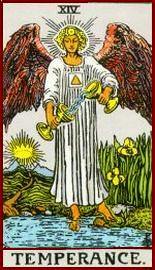
She divides the Major Arcana in three lines of seven, leaving the Fool out (she suggests he can fit in between any of several pairs of cards). The first one, which ranges from the Magician to the Chariot, she calls “the outer concerns of life in society”; the second one, from Strength to Temperance, “the search inwards to find out who we really are”; and the third, from the Devil to the World, “the development of a spiritual awareness and a release of archetypal energy”. These represent three stages in a linear path towards some kind of rapture, “a unity with the great forces of life itself”, each step being represented by one of the Major Arcana.
Even if we’re to give her the benefit of the doubt, we can at best countenance these interpretations as being inherent to the Waite tarot and not the primordial 15th century decks, since there are central concerns with the distinction between conscious and unconscious, “the materialist conception of the universe” and so on — notions that were just not around at the time when the tarot was originated. And even then it takes a lot of generosity to accept many of her analyses, for three main reasons:
One, she finds symbolism everywhere to support her desired meanings — a sword facing upright means “both resolve and the idea that wisdom is like a sword piercing through the illusion of events to find the inner meaning”, and a yellow road is “yellow for mental action”. Even if we accept the plausibility of these images carrying such meanings, still the sword has to point somewhere, the road has to be some color. Without recurring to authority, it’s hard to know what is relevant and what is not; and the ultimate authority on the RWS tarot, Arthur Waite’s own Pictorial Key to the Tarot, is known to be deliberately misleading when regarding certain topics that the Golden Dawn held secretive. Pollack is, therefore, justified in adopting his descriptions and divinatory meanings at times and ignoring them at others — but she does this without much criterion, saying that “to a great extent, the material in this book does not derive from teachers on Tarot (I never studied with anyone or took any classes) but just from working with the cards”. This leaves an opening for her to use only what she likes from the Pictorial Key, later filling the empty spaces with her own New Age preconceptions, without arguing for it.
Two, her interpretations are often implausible. For instance, she says that a child with his back to us means that, in the context of the card being considered (Judgment), “the new existence is a mystery, with no way for us to know what it will be like until we experience it ... [and] that we do not really know ourselves, and that we cannot until we hear and respond to the call”. That seems a bit more elaborate than this humble symbol can support, assuming it’s meant to symbolize anything at all. This kind of symbological overburdening is much too frequent in the book.
Three, her extremely systematic understanding of the Major Arcana involves certain relationships that are so elaborate that they could not possibly have been intended by the devisers of the Tarot, either Waite (who notoriously swapped two of the major arcana around) or whoever came before him. She draws not only all sorts of silly numerological relationships within and between the cards but also argues that cards on the same “column” in her three-line division are related — so the Moon relates to the Emperor, which is “above” it, as well as to Strength, because the Moon is card number 18 and Strength is card number 8; just as the Sun relates to the Hermit (19 and 9), as well as to the Magician (because “the other half [to 20] of 19 is 1”) and to the Wheel of Fortune (“1 plus 9 equals 10”). The claimed significance of these relations is often subtle, but it’s easy to see how quickly they get out of hand. I find it highly implausible that someone could have built a system that univocally represents some external truth, as Pollack argues the Major Arcana does when considered sequentially, all the while carrying a scheme as elaborate as that. The way out would be to dare and say that the tarot actually reflects some transcendental blueprint of human psychology, but she doesn’t go that far.
I cannot, therefore, accept Seventy-Eight Degrees of Wisdom as a book about the RWS tarot. It is an esoteric system built upon its images, vaguely buttressed on A. E. Waite’s own occult notions, but ultimately independent and, to me, unsatisfactory. If your interest in the Tarot is exegetical and distanced, as is mine, look elsewhere.
The book is not without its merits: the section on the Celtic cross spread was helpful, and in her analyses of the cards Pollack often notes the presence of interesting symbols that could easily be missed: the water behind the veil in the High Priestess, the similarity between Death and the Knight of Cups, the scales on the wall behind the old man in the Ten of Pentacles, so on. And some of her interpretations are persuasive, or at least good material for coming up with your own understanding of the cards, which seems more productive if we’re to play the game of arbitrariness anyway.
I don’t regret having read this, but I could probably have gotten the same information from somewhere else, along with much this book doesn’t offer, and without having lost my time reading about all the sparkly pseudo-Jungian esotericism. Two books I think may be closer to what I was looking for are The Tarot: History, Symbolism, and Divination and Mystical Origins of the Tarot: From Ancient Roots to Modern Usage. I haven't read them and won't read them any time soon, but if you can relate to the concerns exposed above, you may want to try starting your studies there instead.
2013/06/03: I also recommend Danusha Goska's review for a more informed analysis of some of Pollack's interpretations.
These days most anybody can do a tarot reading. There are literally hundreds of different decks all complete with canned readings for each card. In a way, it's rather like reading your daily horoscope as the results are rather generalized to match virtually anyone.
Definitely, not every tarot reader is equal in quality. The best readers go beyond simplistic generalizations. They not only tailor their layouts and reading results to match the individual but also look to the deeper meanings of the cards. These unique abilities are both invaluable skills and amazing talents.
Seventy Eight Degrees of Wisdom is a must have resource for anyone wanting to do real tarot readings. The author has an inherent ability to see depth within the cards that many need to be taught to notice. Within this book, she shares her valuable insights and urges the reader to follow suit. Originally this book was two books separating out the major and minor arcane. This new format brings these important references into one easier to access resource.
I first read Rachel Pollack's tarot classic Seventy-Eight Degrees of Wisdom: a Tarot Journey to Self-Awareness sometime in the late 2000s, and reread it this past week in celebration of her 75th birthday. It remains a foundational text for modern interpretation of the Rider-Waite-Smith deck, and of the tarot broadly. That Rachel is a veteran of the Stonewall Rebellion, a founding member of Gay Liberation Front UK's trans group in 1971, a contributor to TransSisters: the Journal of Transsexual Feminism in the early 1990s, creator of the first trans superhero Coagula in DC's Doom Patrol, and continues to be an absolute delight of a person, makes me appreciate her tarot wisdom all the more!
This is one book that I can't recommend strongly enough, and one that I feel belongs on the shelf of every Tarot enthusiast. Using the popular Rider-Waite deck for illustration, it contains essays on each card, covering aspects of the symbolism as well as origins, history, mythology, and sociological, psychological, esoteric and religious implications. It's rare to say that a book on Tarot is a “can't put down page-turner”, but this one is it!
Seventy-Eight Degrees of Wisdom is very well written and easy to understand, no matter what your level of expertise. Ms. Pollack has obviously done massive amounts of research and manages to convey a true love for the art of Tarot on each and every page, speaking to the reader as a patient, knowledgeable and wise teacher with years of experience. She also includes tutorials in the back of the book, covering such subjects as layouts, the Tree of Life, making a Mandala, and Meditations. On the whole, this is a wonderful, wonderful book and in my opinion, a true classic.
Source of book: local library Relevant disclaimers: None Please note: This review may not be reproduced or quoted, in whole or in part, without explicit consent from the author.
So this is kind of a big one because I understand it’s, like, a classic. I will say I am glad I read it, but I don’t necessarily think it’s dated all that well. There’s a tendency here to see tarot in the most esoteric and mystical way possible--as a key to truths of the universe almost equivalent to how Christians perceive the Bible--which is both somewhat inaccessible in terms of the reading experience, and doesn’t really hold up (tarot are basically a set of fancy Renaissance playing cards).
There are definitely elements of Pollack’s approach that I’ve internalised without directly knowing where they came from - for example, I do like thinking of the major arcana in groupings of 7 + The Fool (maybe just because it’s easier than trying to grapple with 22 cards simultaneously or sequentially). But it’s also incredibly rigid on so many fronts (including its adherence to Waite’s interpretations) that it mildly surprises me that this is still considered a relevant masterpiece to modern day practice.
Which is to not diss the importance of the book or its impact. But it’s heavy stuff and very rooted in 80s ideas of … well … almost everything. Gender, mysticism, learning, the value of suffering. Having complained about the Fearless Tarot reading the cards from a perspective of close-to toxic positivity, I’d rather that than the extremely dour way Pollack seems to interact with the minor arcana especially (she’s oddly mean about the knight of pentacles, who I find a really comforting and reliable card). I also find some of the gender stuff slightly disconcerting, especially from a transgender woman, like I’ve never looked at the High Priestess and though “ah, yes, there she sits, between her two vagina pillars.” But, again, that probably says more about the 80s than Pollack herself. I hope.
Anyway, I did end up finding Seventy-Eight Degrees of Wisdom somewhat interesting. But in a historical artefact way more than anything.
Book 1 (Major Arcana) 2 Stars Book 2 (Minor Arcana) 3 Stars Overall rating 2.5 Stars
I really disliked the first half of this book. Sex and gender and binaries were mentioned constantly. The justifications for many connections and conclusions drawn felt almost laughably tenuous. And we even get some low key offensive mental illness references and racial slurs… just no.
I tried to appreciate this book for what it was and it’s place in the history of tarot, but I really struggled with the first half.
It was somewhat redeemed by the second half. Although I still didn’t enjoy it all that much, I could appreciate what Pollack contributed to tarot a lot more in her exploration of the minor arcana.
I don’t think this is a must read tarot book in the 2020s, and it certainly wouldn’t be one I’d recommend to someone getting interested in tarot. I think we have many better options now. But I can still appreciate the incredibly impactful contribution Pollack made to the world of Tarot with 78 Degrees of Wisdom.
Although this book is well known and, I presume, well regarded, it was complete and utter nonsense. A large portion of the book went through the cards one by one with interpretations of the images on the Waite-Smith deck. Sometimes the author specifically referenced Waite's book regarding the deck for interpretations, but other times, I'm not sure if the interpretations were her own or not. Some details described on the cards are so subtle that seeing them on my own deck in real life was challenging at best. Concepts like "Gate" cards appear to be her own, with no satisfying explanation as to what defined a Gate card or why different numbers of them appeared in different suits. Comparisons to other decks besides the Waite-Smith deck appeared inconsistently.
Factual inaccuracies about Judaism, when she claims to be Jewish, and an anti-science rant infuriated me. This would be less aggravating if the author did not rely so heavily on information about Judaism and Kabbalah. But one of the first issues was when the author described the Tetragrammaton Yod-Heh-Vav-Heh as the unspeakable Name of God because it is a word without vowels. Ahem. She states you cannot speak the Name of God because it does not contain vowels. If she knew anything about Hebrew, she would have known that Biblical Hebrew does not contain vowels at all. Markings underneath Hebrew letters to indicate vowel sounds were added later. YHVH is unspeakable out of respect, as many Jews won't even write the word "God" but instead write it at "G-d." In reality, YHVH gave rise to the pronunciations "Yahweh" and "Jehovah." And she doubled down on this statement later in the book.
The author talks about finding a mezuzah of her mother's and beginning to wear it. She described a mezuzah as "a kind of Jewish amulet." It is nothing of the sort. A mezuzah is a scroll containing a prayer that reads, in part, "bind these words as a sign upon your doorposts." It is meant to be kept in a small box nailed to the doorposts. Not worn. And it's not an amulet.
The anti-science rant on pg. 267 was completely unnecessary, and in my eyes, lowers her credibility.
The only reason this didn't get a one star rating from me was that some of the comments within the descriptions of the cards were interesting and there were one or two that I would say were even insightful. However, there are so many books on Tarot out there, I am certain a great deal are better than this one.
It's official: I am the auntie who wears healing crystals and peasant dresses. All that aside, Rachel Pollack has much in common with Joseph Campbell and her analysis of archetypes is really interesting.
“Yes, I know of the Tarot. It is, as far as I know, the pack of cards originally used by the Spanish gypsies, the oldest cards historically known. They are still used for divinatory purposes.” (Jung letter to Mrs. Eckestein, 16 September 1930)
“Another strange field of occult experience in which the hermaphrodite appears is the Tarot. That is a set of playing cards, such as were originally used by the gypsies. There are Spanish specimens, if I remember rightly, as old as the fifteenth century. These cards are really the origin of our pack of cards, in which the red and the black symbolize the opposites, and the division of four—clubs, spades, diamonds, and hearts—also belongs to the individuation symbolism. They are psychological images, symbols with which one plays, as the unconscious seems to play with its contents. (...)Now in the Tarot there is a hermaphroditic figure called the diable [the Devil card]. That would be in alchemy the gold. In other words, such an attempt as the union of opposites appears to the Christian mentality as devilish, something evil which is not allowed, something belonging to black magic." (Jung's words on a seminar, 1 March 1933)
It seems Rachel Pollack never minded much about the Tarot cards, excepting that quote from the poem of T S. Elliot, The Wasteland, mentioning a lady called Sosotris, "wisest in Europe". By 1969-1970, Rachel got lectured on Tarot by a friend called Linda. Some time later, Rachel switched positions with Linda, and read the cards for her, ...and her guess got right on a near-future event in the life of Linda (to get married in Denmark). Ever since, Rachel, an English professor at the State University of New York, didn't stop her study of the cards.
"So began my study of the cards, not from texts or symbolism or diagrams, but from the pictures themselves"
Mind you, I'm no Tarot cards user. Just a curious mind.
I started getting frustrated when I found myself drowning in a miasma of numerology, somewhere in the preface. The connections seemed rather tenuous, and my doubts were raised. I also found that the interpretations of the meanings of the cards didn't speak to me as did other sources, although they did seem to be a little more helpful in the context of doing a multi-card reading, especially for another person. But that's not how I've been using tarot, so it wasn't particularly helpful in that regard. Also, the author has a different take on reversed cards than I was familiar with, so I struggled to get comfortable with that. I guess it could be a problem of me not being ready to digest other sources, or it could be the doubts raised by all the numerology in the beginning; either way, I wasn't compelled to read all the way through or even consult the book all that much.
Card XVI. The Tower (Upright) A strike of lightning, showcasing the symbiosis between destruction and liberation. Following Card XV implies a breaking away from illusion - the tower, as any formal structure, is misled in its separation and isolated confinement of its subjects; this delusion is necessary for any organization to perform. Judeo-God's destruction of Babel may not have been a malicious cinching of human achievement, but a reminder that the inherent restrictions of 'structure' (wherever they may be applied to reduce degrees of freedom and convoke lower forms of reality) stand paradoxically as both methods of analytical investigation and barriers to higher knowledge.
(Reversed) You're boyfriend might be cheating on you. :o
This was a super interesting look at the Tarot from a historical, philosophical, and psychological perspective. This is not a book about fortune telling. It's a book about the Tarot as a system of symbols that can be used to access the depths of your sub-conscious mind. It really reads the Tarot like a complex book that can be interpreted in almost infinite ways. A fantastic introduction for anyone who has any interest in the Tarot and what it really is--not magic, but a psychoanalytical tool that has transformed itself multiple times throughout history.
Excellent book. I'd call this a must read for anyone who works with the Tarot. Rachel Pollack takes a very through approach to the cards, this goes beyond those books that give simple formulaic meanings. She discusses the majors from many angles and it has given me new perspective. I can't believe it took me so long to get around to reading this.
This book is an incredible resource! I have a feeling I'll be returning to it many times to review the impressive range of understandable explanations and insightful analyses of the cards that Pollack provides. I highly recommend this work to anyone who, like me, has struggled with other more formulaic or dense books on the Tarot.
Un libro recomendado para todos aquellos que están empezando en el mundo del tarot, las explicaciones son largas, pero fáciles de entender acerca de los arcanos mayores, los arcanos menores, las combinaciones y las tiradas. Muy completo.
This is a book I've meant to read for a long time, not only because it's considered the tarot bible 41 years on, but also because when I flipped through it, I loved Rachel Pollack's lucid style.
After the anticipation, though, I'm slightly disappointed. Before I get into why, the beginning of the book, including all the card designations, positively glows like the moon: reputation earned! Most meanings will look familiar if you're into tarot, but Pollack's version brings authority and elegance. The book works as a card dictionary, though she might be happier to call it a guide and schematic for learning the language - or relearning what you've forgotten and going further.
Her reference deck is the standard Smith-Waite showing a scene on each of the 78 cards (22 majors and 56 minors). The included line drawings are not from a later variant, but the original design.
If you know about the ancient history of these cards (or don't want to know), feel free to skip over this paragraph and the next two. The deck in question was described by A.E. Waite and drawn by Pamela Colman Smith in 1909, though tarot itself goes back to around 1420 in Milan. The concept makes its debut in the oldest extant game design document, written by ducal advisor, teacher, and librarian Marziano da Tortona as part of a long letter outlining a new deck. His pattern sported 4 bird suits of 12 ranks each (between 11 and 14, unknown) and an extra, dedicated trump suit of 16 gods and heroes from Greek and Roman myth (blended flatteringly with Visconti family history). That deck, which does not survive (a modern reconstruction aside), had 64 cards (the reconstruction assumes 12 ranks: 1-10, queen, king). The 78-card arrangement we still use today appears in the Visconti-Sforza deck from 1441, albeit missing a couple cards. The first complete 78-card deck, the Sola-Busca c.1490, was a top source for Pamela Colman Smith in 1909, as, unique even four centuries later, it shows a scene on every card.
Playing cards themselves passed to Spain and Italy through the Middle East from China, where they were invented around 1200-1300. The story begins perhaps a century or two earlier with Chinese dominoes, which represent die rolls frozen into tiles. If you were wondering about suits, you can trace both the 4 casino suits and the 5 tarot suits to those ancient Chinese dominoes. Painting a tarot card is roughly equivalent to rolling 4 dice and lushly illustrating the outcome.
The preceding is mostly not in the book, but it shows where tarot comes from, and it's an essential backdrop to understanding what these pieces of paper are. If you've reached this point and don't know, there are thousands of other tarot decks with other philosophies, symbols, structures, and audiences, but the Smith-Waite is basically the 20th century epicenter. What's said about any one of its cards applies to most of its siblings and cousins out there in 2021.
Pollack's treatment of the majors, in particular, shines. Share thirty scattered interpretations of a card and someone might remember one or two. Share six that synergize and the person might remember them all. Now, I'm not new to tarot; deck one arrived in the mail almost ten years ago. Since then, I've added a new deck a year (which took restraint, as there are hundreds of appealing decks), and I can't tell you how many definitions, breakdowns, and systematizations I've read. Some are excellent. Yet Pollack's story of the majors is at least as good as any other. She makes otherwise unrelated meanings feel like common sense. You could, as one tarot celebrity (Enrique Enriquez) lightly mocked, memorize all the entries in 78 Degrees of Wisdom, and it would be more than enough. Ultimately the connecting themes will be of most use, and this is where my praise has no reservations.
Your imagination can do the rest. Pollack points out that too little detail isn't enough to spark anything, while too much detail is stifling and suppresses imagination. This is true of fiction, true of cards, and true of using your "knowledge" of them (which sometimes it's best to forget entirely; but even then, it tends to be best to have something to forget). Maybe it's no coincidence that she often achieves that balance? In any case, while you can always learn more, it's nice to have a guide you trust above the others.
You can read cards just by flipping one or more and improvising any which way (this is the main thing I do with them idly), but most of the time in a proper reading for yourself or anyone/anything else, you'll want a format for arranging a set number of cards. This provides concepts to attach each card to ("the past," "fears," etc), and ways they relate to each other to build a scene. 78 Degrees of Wisdom presents 5 such spreads: Minor Cross, Celtic Cross, Work Cycle, Tree of Life, and Mandala. Of these, the Minor Cross, Celtic Cross, and Tree of Life are very common, and I quite like the Work Cycle as well.
So... you don't need to know everything to read cards, or perhaps anything but your own experience and perception. You don't even need a spread. But a good, cogent, studious glance at a card will give you the prototype and many of the directions it can go. I admit that I didn't have the cards in front of me while reading (I listened to the audiobook of that part of the 2nd edition, which seems identical to the 1st edition, while traveling). Rummaging through the cards at the same time would be the right approach. And, not to worry, the pictures are in the book.
Missing those made more of a difference with the minors, because (for me, anyway) the majors are easier to remember clearly without a picture. Pollack's coverage of the minors may or may not be just as good as her coverage of the majors (I'll have to comment on this in a few weeks). The majors come across as an unqualified success, but maybe because I couldn't see details, the minors sometimes bored me, while spreads and example readings held my attention but fell short of stellar. On the other hand, it's usually a little weird reading a tarot book from cover to cover. Sooner or later, a passing train of cards will numb you. Still, the examples are usable and adequately clear. And turning to 78 Degrees for new-old insight on a specific card will probably not go out of style this decade or the next or the next.
Something I didn't like was Pollack's tendency later in the book to preach believing the cards and following what they say, seeing such faith as strength of character. I can understand why; readings tend to work best when you feel as if the deck is talking to you, ie, the universe is bubbling up through the cards, which inexplicably really know something (or everything). It's much more difficult when you keep an empirical, rationalist frame of mind. So you suspend disbelief.
But that is actually something I'd like more suggestions on. It can work: although I don't generally believe cards are magic, I can go into a frame of mind that makes them magic. But it can be a struggle similar to writer's block or any other struggle to find "the zone" again, and it's a division within myself. It's also much more difficult to get into that frame of mind when anxious (anxiety blocks creativity, look it up), ie, when someone is staring at you waiting for their "future" or a meaningful answer to their Very Important Question. (Silly admission: I hate getting serious, major life questions - until you start doing readings, you don't realize just how much everyone and their long lost Secret Santa zebra asks about love or career to the exclusion of all else. So I become that buzzkill who repeatedly insists the cards don't know anything before turning some over. Still, sometimes people really enjoy the cards anyway. And a card dj can always fall back on serving as a tour guide: check this out, this symbol means this, and you were saying a related thing, right? Just pointing out details without looking anything up casts a kind of spell.) 78 Degrees does not seem particularly helpful for any of that, unless Pollack's (claimed absolute?) faith in cards sways you. I'm not sure what her actual beliefs are, but whatever they may be, she's a great writer on cards (and I'd love to check out some of her fiction).
My own take on the "belief"/"suspension of disbelief"/"magic" issue is that if you want a coherent reading, the cards force your mind into configurations it wouldn't have gone into. The cards that make the least sense at first glance are the most satisfying - the best exercise - to puzzle out. When you think "this one is random, obviously," that's your cue that this card can mean more, not less. Whatever you now decide that it means, this wasn't your ready interpretation. It's a creativity thing (though it helps to see it as a reality thing, temporarily). It's about shifting your point of view in search of angles that might work, but that you wouldn't have thought of. Because the cards and their combinations are so expressive - able to represent almost any human situation - they can and do spur realizations, or help you come up with surprising moments in fiction. I guess I didn't need Rachel Pollack to tell me what I already think. But I'd have liked to hear more of what I don't already think but might actually believe. In short, I found the occasional strain of credulity a bit off-putting, and would have preferred advice on tapping into the mysterious potentials of tarot without feeling like I'm crazy. But what do I expect - I'm reading a book about consulting a deck of cards.
The first person who gave me a reading (one of few, still the best) said, "Trust that these images are speaking to the part of your mind that needs to know. Look at them, take note of them, but don't try to do anything with them. Don't feel that you need to respond to them with action right now. You don't need to decide anything, and you shouldn't try. Know that your unconscious mind has heard the message it needs. When the time comes, if it does, the insight will be there." I liked that. It felt just right. So I guess I don't need Rachel Pollack to tell me this, either. But our little disagreement has reminded me that I could say the same thing.
Tarot's pull on me is that it's a fluid symbol language for building stories, just abstract enough that any reading could mean many different things, and just specific enough that the unity you choose isn't arbitrary. Drawing blank index cards could mean anything - or, more likely, nothing. Drawing tarot cards gives you half-formed suggestions. Drawing random vocab produces gibberish. Tarot occupies that middle ground Pollack talks about between too little detail and too much. We see scenarios in the cards much as we see creatures in the clouds, only the cards bring along more of the world, and especially after we study their language, get much chattier.
She goes through the 10 (11 really) "books" of the Tree of Life in Kabalah while detailing the Tree of Life spread. For such a brief treatment, it's pretty good. She adapts the "books" (Sephiroth) for more everyday use. But I'd have liked more. And overall, in the spreads section, the way she narrates example readings made me feel as if I didn't know much of anything about the "real" meanings of the cards. That's a bit of a failure - both because Pollack does not actually espouse a "dictionary definition" approach at all, and also because I'm quite familiar with all these cards. (While I don't remember every Smith-Waite definition, let alone every inversion, I can interpret a card a dozen ways easily. But I lost interest for a couple years after learning all the mappings I really wanted to know... which brings us to reading a classic to brush up.)
She emphasizes that the meanings of cards tend to come from the other cards and your intuition about the person and their situation, rather than from "within" cards seen in isolation, or looked up. That's the kind of thing you hear and don't deny but might need to be reminded of when you're sure you don't know what to say about a card that seems as empty and incongruous as any other accident. So it's good she says it a few different ways. But I don't recall her mentioning that you can use the majors as an outline and any minors as detail. It's another basic tip: put all the cards down without worrying about them individually, pretend the minors aren't even there, at first, and see what comes up. (She may have said so.) In the end, if you can find evocative ways to link cards into a structure, one that has some kind of hierarchy, and tie them to the person and their question (or even just ask them for their impressions of what they see, framed by the setting of the reading), that's all you need. If you do that, you don't have to know a single thing about any of the cards, other than the sight of it, or some name for it.
So I was hoping for ideas on assembling readings from disconnected, multifaceted pieces, and Pollack gives a decent number of tips, but my overall impression was kind of an occult "you could know this truth but don't" in those chapters. In reality, I'm sure the author would agree that she applied standard interpretations - with plenty of creative flexibility - to paint vivid pictures of life situations and obstacles confidently. To put it another way, her fortune teller's tone comes through as certainty: this is what these cards mean. People don't like wishy-washy. But your own interpretations/syntheses/stories can and will be different (even if you draw on the most widely accepted meanings). The given readings exemplify an art, not a science. This is kind of a small complaint, and I probably will (and should) study the example sessions more carefully. So anyway, to be candid, I didn't love them and tended to want to skip them. But hey, I envy her skill. Maybe I'm just jealous.
She mentions but doesn't elaborate on the correspondences between the majors and the Hebrew alphabet (which is essentially the Phoenician alphabet, and still bears the ancient pre-alphabet meanings like ox, eye, tooth, nail, support, etc). That's a mapping I learned several years ago but had largely forgotten. So, just FYI, it isn't in here. The same goes for standard ways to map cards to seasons, decans, solstices and equinoxes, constellations, or objects in the solar system. You'll need a heavier duty source for that stuff (the Hermetic Tarot deck and its pamphlet, for example, or the Fortune's Wheelhouse podcast - or a bit more pedestrianly, either of the Ultimate Guides I mention four paragraphs down).
In sum, Pollack is great when describing the cards themselves with their linking themes, but I found her opaque when describing her readings here, and what with the moralizing about believing cards, it's why I'm knocking off a star. I don't think that's too mean - I would have enjoyed 78 Degrees even more if I were just starting out, and I treat stars as hedonic.
I'll give the book 4 stars for now, leaving room for a higher rating if in the future I find it especially useful.
If you're looking for other good books on tarot, I can recommend Mary Greer's 21 Ways to Read a Tarot Card. It isn't one I've read cover to cover yet, but of all the guides I've looked at, it's the most inspiring, the one that'll give you the most epiphanies about what to ask yourself as you create meaning from a deck. It's exactly what it says: 21 different, stand-alone lenses/techniques/systems for interpreting tarot cards. It's basically a book of creativity exercises, but much better than that sounds.
If you want to know the original meanings of the cards, Visconti Tarots is your best starting point (along with this website ...).
And if you want a simple system for reading cards even without scenes on the minors, Lee Bursten's pamphlet included in the Universal Tarot of Marseille (my first deck, incidentally - the one published by Lo Scarabeo, a recolored Claude Burdel 1751 edition) is wonderful. His system is simple and flexible. I've never been at a total loss for interpretations, no matter what a card looked like, because of Lee Bursten's card chemistry approach. (I think he puts the same information in one of his books. I'll update my review later with the details.)
If you'd like the wool pulled away from your eyes and a kick in the pants to think more visually and freely, try the free documentary Tarology about Enrique Enriquez. (I can't yet comment on his book of the same name.) I've watched it many times. I love it. Rachel Pollack appears in it repeatedly, too.
I won't dispute that this is THE practical tarot bible, thanks to the comprehensive overview, compelling, easygoing style, and brevity. There are some modern competitors for best card dictionary, for example The Ultimate Guide to Tarot Readings (Brigit Esselmont, aka Biddy Tarot) and The Ultimate Guide to Tarot (Liz Dean), neither of which I've read, but both of which I've flipped through and been impressed by. They cover the kinds of astronomical/alphabetical correspondences that I mentioned are missing here, but they're basically friendly little encyclopedias with 78 entries. Another that I like and own but wouldn't recommend as highly as 78 Degrees, even though it gives a better way to look up specific symbols within the cards (a series of little closeups of symbols from the card next to their meanings, within each card entry), is Essential Guide to the Tarot (David Fontana).
All are far more digestible (and more informative) than A.E. Waite's foundational The Pictorial Key to the Tarot. And they're much more helpful with the minors and suits and other deck patterns than Visconti Tarots (which does, however, reveal the original, 15th century meanings of the 22 major arcanum images). They're also more approachable and better written than any little white book I know about, other than maybe Lee Bursten's. But this here is the one you might actually want to read from front to back, in order. So if you're a tarot enthusiast and still haven't read it, I do recommend 78 Degrees of Wisdom. I'll certainly keep it as a top reference and might read through it again. But I recommend it even more for beginners. On the other hand, depending on what you're looking for, you might get more out of 21 Ways to Read a Tarot Card. And there must be better books for picking up tricks from example readings (eg, Josephine Ellershaw's Easy Tarot Reading: The Process Revealed in Ten True Readings, though I haven't read it yet myself).
I've heard people say that this is the best book you could possibly read to learn more about Tarot. I don't know if I'd agree with that, because, for my purposes, this book left a lot to be desired. I can definitely recognize the author's amount of education and experience with the Tarot, but this book had way more information than I really needed to go out and do a reading for someone else (or even myself). No way would I recommend this book for a beginner in the Tarot. This is strictly for someone who wants a billion different interpretations (bordering on rambles) on each component of each card. Oftentimes I would read her description of what a particular card means, and walk away with more questions than answers. I also don't understand why she discussed the cards in each suit from King to Ace, rather than from Ace to King. Pollack's interpretations and way of writing simply did not appeal to me or offer any valuable information. I don't feel like I could use much of her work in my own divination.
Aside from my regular tarot resource, Crystal Reflections, and the explainer book for my particular deck, I had never read a book on tarot. A tarot reading friend of mine referenced 78 Degrees on several occasions, so I finally decided to read it myself. Very recommended. It lays out a useful framework for understanding the major arcana, as well as all the minors. For imagery reference it uses the Coleman-Smith deck (the classic tarot deck seen around). It imparts/dissects meanings of the numbers, the suits, shared symbolism across cards, and most importantly offers the reader a way to build up their own interpretations of the cards rather than sheer description. I definitely think learning tarot is done through use/practice than reading about it, but I found this book useful enough to purchase, underline, and sticky tab for my own reference.
I can see why this book sometimes is called the bible of RWS tarot. Rachel Pollack does a good job going through origins, meaning and spreads of the tarot. I especially like her narrative description of each major arcana. Having said that, I also feel some things are missing, a reference list in the back would have been nice, the minor arcana especially the court cards are covered only so so, in my opinion, maybe keywords for each card would have been nice too. As a reference book I like Holistic Tarot by Wen more. However if you are looking for a fair allround RWS tarot book, Rachel Pollack´s new book "Tarot Wisdom" is a better choice, in my opinion.
Armed with this book, I am preparing myself for my encore career: psychic to the stars! I will look into your soul and discover your deepest secrets! FEAR ME.
Or not. As Tarot books go, this is by far the best I have seen - lots of subtle nuances that are missing from standard books. I love Tarot because I am a huge fan of the power of symbolic images; the Tarot deck is like a Bacchanalian feast to me. I won't really tell all your deepest secrets. But I will enjoy the heck out of seeing how Tarot's archetypal imagery evokes some unexpected thoughts and connections in your brain. Don't even think about concealing your thoughts - they're written all over your face.
Seventy-Eight Degrees of Wisdom is a tarot classic. This new publication of the book includes a new (2018) preface but otherwise, as far as I can tell, faithfully reproduces older editions. Seventy-Eight Degrees first appeared in 1980. Pollack provides extended discussions of all of the cards in the Smith-Waite deck, going well beyond keywords found in many ‘little white books.’ I actually prefer Pollack’s explanations of the minor arcana cards to her explanations of the majors, which is rare for a tarot book – so many give extended treatments of the majors and almost nothing about the minors, but here Pollack provides nuanced descriptions of the minors that situate them within the trajectories of their suit. Inevitably, reading a book like this as an experienced tarot practitioner, some of Pollack’s understandings align with or resonate with my own while others don’t – this will vary for every reader, I’m sure. While I found some aspects of the book unhelpful and/or not particularly of interest, I also learned quite a bit and found some new ideas I quite like. While I understand reproducing an older text as-is, I do feel like there are some comments in here that really should have been edited out, or at the very least given clarifying contextual footnotes. There is absolutely no call for using language like the ‘g’ word to refer to Romani people – perhaps the harmfulness of this language was not quite so well understood forty years ago, but it certainly is now, so it is disappointing to see this simply reproduced. There are some other aspects to the text do certainly mean it reads as dated in 2021. Finally, since I make a point of mentioning this for any books I read in this and adjacent genres: I appreciate that the book contains a short bibliography and a solid index, but wish that citations were included as well.
Like any text, approaching a new work should be light on one's veil and even lighter on one's judgement. While not an eloquent to-do list in how to improve your life via the tarot, Rachel Pollack (contemporary teacher & SF author) details this elder artform for its scope both internally aware and outwardly mobile. Funny how the cards have been around for centuries, and how most skeptics simply see it as a card game of predisposition and 'love-me-nots', 'stay or go' predictions. It can be that, sure, but what it truly envisions is a borderless and contemplative tool to not only help define your world, but the world around you. There is not a how-to book to the tarot, but this is a kaleidoscope gateway to understanding the esoteric art on a basic, raw level. I read this in tandem with the Taschen-produced, "Tarot: The Library of Esoterica", a visual art gallery of sorts which helps Pollack's words via weight and color. We can't forget how visually reliant we are on the Tarot. Which explains why so many artists and writers explore the decks. And to me, we can't have the major arcana without the minor. This is life, and this is what the Tarot reminds you.
Again, we're not talking of divination here, but more of a therapeutic puzzle where with patience & intrigue, you can talk to parts of yourself that otherwise remain on mute. I could go on about the mystical and how The High Priestess visited me while swimming in a pool one cold, winter Saturday morning, or how the Death card brought a sense of comfort, a prescription of reality and hope, but these two moments are only brief glimpses within my treasure chest, and for you, you can only find out your own by exploring this ancient art with whatever emotions you desire (yes, you can even be a skeptic). Seriously, whether Christian or agnostic, naysayer or mystic, there is a hidden maze within all one's grit and glamour, and in the end, we can appreciate ourselves and those paths and people we encounter. Past, present, future - explorations run deeper than we think. Pull one card, pull the whole damn deck.
i feel very conflicted about this book. i absolutely loved some aspects of it, but others seemed very scattered. Pollack seems to jump around a lot between ideas and i struggled at times to follow these threads. there are also a lot of assertions thrown around, including historical facts, that have no references to back them up. in one instance, she says that "Michelangelo's famous painting shows a spark leaping from God's finger to Adam's" which is just not true.
i know there are many varying interpretations of the cards, but i struggled with some of Pollack's. i actually skipped over most of the minor arcana section because i found the guidance lacking. she also separates the major arcana into her own divisions and draws seemingly random connections based on this, in addition to manipulating the numerology to fit her own needs.
this is definitely a 'take what you need and leave the rest' kind of book and in some ways it's likely a product of its time. i did appreciate her depth of descriptions of the cards, which pointed out details i likely wouldn't have noticed on my own. i also found her interpretation of the celtic cross helpful, as it's a spread i've always found deeply intimidating.
I read this book long back. However, I still remember the simple and lucid introduction to the major arcana cards and the four elemental suits (Air/Swords, Fire/Wands, Water/Cups, and Earth/Pentacles). This is a great book for beginners as it covers the basic well and makes the task of getting familiar with the cards an interesting adventure to look forward to.
Es un gran libro para comenzar a adentrarse tanto en el tarot como específicamente en el estudio de los arcanos mayores. Me gusta que su enfoque no sea en la adivinación, aunque sí la menciona, sino en el desarrollo personal y el autodescubrimiento, pasando por cuestiones relacionadas con la conciencia y el inconsciente, e incluso históricas.
The definitions are really fluid which is both vaguely helpful and a reminder that all things are fluid and you have to put your personhood into your practices and derive meaning from the self.