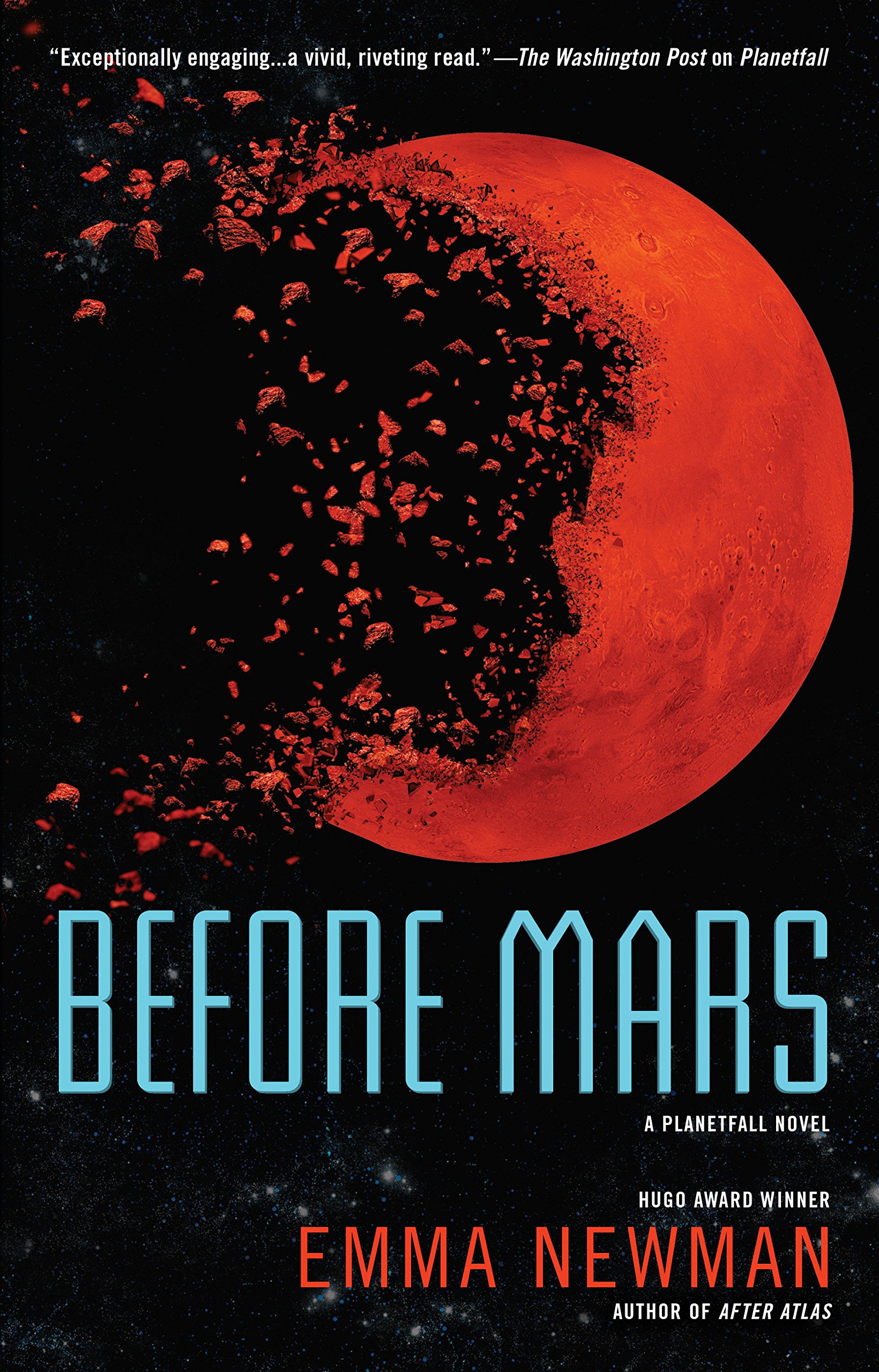
After months of travel, Anna Kubrin finally arrives on Mars for her new job as a geologist and de facto artist-in-residence. Already she feels like she is losing the connection with her husband and baby at home on Earth--and she'll be on Mars for over a year. Throwing herself into her work, she tries her best to fit in with the team.
But in her new room on the base, Anna finds a mysterious note written in her own handwriting, warning her not to trust the colony psychologist. A note she can't remember writing. She unpacks her wedding ring, only to find it has been replaced by a fake.
Finding a footprint in a place the colony AI claims has never been visited by humans, Anna begins to suspect that her assignment isn't as simple as she was led to believe. Is she caught up in an elaborate corporate conspiracy, or is she actually losing her mind? Regardless of what horrors she might discover, or what they might do to her sanity, Anna has find the truth before her own mind destroys her.
Emma Newman writes short stories, novels and novellas in multiple speculative fiction genres. She is also a Hugo Award-winning podcaster and an audiobook narrator.
She won the British Fantasy Society Best Short Story Award 2015 for “A Woman’s Place” in the 221 Baker Streets anthology. 'Between Two Thorns', the first book in Emma's Split Worlds urban fantasy series, was shortlisted for the BFS Best Novel and Best Newcomer 2014 awards. Her science-fiction novel, After Atlas, was shortlisted for the 2017 Arthur C. Clarke award and the third novel in the Planetfall series, Before Mars, has been shortlisted for a BSFA Best Novel award. The Planetfall series was shortlisted for the 2020 Best Series Hugo Award.
Emma currently creates a podcast called 'Imagining Tomorrow' for Friends of the Earth. Her hobbies include dressmaking, LARP and tabletop role playing. www.enewman.co.uk.
Sometimes it's quite hard reviewing books for which you KNOW are rather groundbreaking but do so in a quiet manner and stretch the quality across a span of books.
It's never just one thing. It's a whole slew of wonderful worldbuilding quirks, a dedication to deep mystery, and extremely complicated characters often riddled with mental health issues and/or very real plot complications.
In this third book, related only by its housing in the greater worldbuilding and future history shared with the others, we're given a very different kind of character. Not an engineer or a put-upon corporate slave, but an artist slipped into the corporate works on Mars. Is she lucky? Is she turned into a pawn for others?
She doesn't seem all that sure of herself despite being recognized as an excellent painter, but none of that really matters. She's there and a number of little things don't add up. And that's okay. We're in for a great story where the reveals are numerous, emotional, disturbing, and often made me turn against our protagonist. And that is also okay because she's complicated and sympathetic and real and often depressed.
As it turns out, she has good reasons. No spoilers, but the plot is rather cool and much bigger than the blurb implies. :)
Very solid SF. Better than most. I'm probably turning into one of those readers who will always jump on the next book no matter what she writes. She's just that good. :)
Oh, gosh. All the 'ze', 'hir' nonbinary designations? Weird but fun. Lovely Martian setting, evil gov-corps doing horrible stuff and so on... Goshy-gosh! Scary and powerful stuff.
Q: Living with injustice is one of the hardest things in the world. (c) Q: This need to prove that we are not the worst of ourselves can sometimes make us better people. (c) Q: “Just because something is possible, it doesn’t make it plausible... What is the most plausible explanation here?” (c) Q: This isn’t what happened to my father. I am in control and I know what is real. “I know what is real,” I whisper to myself. “This piece of paper is real.” The fear subsides. (c) Q: All these perfect, balanced people here must make life as a shrink so dull. (c) Q: How many times have I smiled at someone while hating them? (c) Q: “Oh JeeMuh, we’re not seriously going to have an argument about whether scientific discovery only has merit if it increases corporate profits, are we? Because believe me, I’ve spent my entire career arguing with people about different forms of merit and I thought I’d left all that bullshit behind on Earth.” (c) Q: Averages aren’t good enough when it comes to critical data. (c) Q: ... being on another planet, literally, is not conducive to deep and difficult conversations. (c) Q: IF I AM going to accept that the note is real (and I have to; otherwise, I have just spent several hours hallucinating a detailed lab analysis), then it looks like I must also accept that I painted it myself. I needed more data, now I have it, and as a good scientist I have to accept the conclusion it points me toward. (c) Q: As some put me on some unfathomable pedestal of womanhood, others downgraded me as just another baby factory, with a head addled by hormones. What a waste of a brilliant mind. I wanted to tear a new one in both kinds of people. (c) Q: ... I understand how people want things to be nice. They just want a sense of connection. Validation. Some moment of confirmation from another human being that what they feel is normal. Having never had that, I know how much it is needed. (c) Q: “But why haven’t the drones recorded it?” “Because of your friend and mine: the cost-benefit analysis, (c) Q: If there’s one thing I know, it’s that hiding behind a mask all the time is really fucking tiring. (c) Q: The pattern is more important than the detail. (c) Q: Trust me to end up rediscovering my libido on Mars. (с) Q: Questions about how I felt about my bear having to stay in the box when other children took theirs everywhere. Questions about whether I loved my bear, whether it made me sad to put him away afterward, whether I was angry at my parents for their attitudes toward it. It was so tedious. The first few times I’d point out that it had nothing to do with the problems I’d been having. Then I learned that there was no point telling a therapist that something is irrelevant. It’s all relevant to those bastards; every single sigh, every gesture, every insistence that they were barking up the wrong tree. I soon learned to stop resisting the direction they wanted to take. Better that than get frustrated with the fact that there was no way for them to ever be wrong. I much preferred comments about how guarded I was. (c) Q: “What are you doing, Daddy?” How I hate the sound of my reedy childhood voice now. “I’m protecting us,” he said. “What from?” “Monsters.” (c) Q: Russian soul music from the ’50s (c) Ouch. Is there even such a thing? Q: It’s unsettling to suddenly find yourself wondering if an AI is better at brinkmanship than you are. (c) Q: “Ze hates being left out of anything,”... “Yeah, especially finding dead bodies or monsters or a welcoming committee with guns,” (c) Q: I skim through transcriptions of private messages sent between top figures in the European government, discussing the problems my parents were causing. How they were single-handedly responsible for the groundswell movement that forced the European gov-corp to enshrine more human rights in their citizen-employee contracts. Things like the right to appeal the results of any legal dispute that relies upon a human judge. The right to change jobs. The right to equal maternity and paternity leave. All of these ideas, lost during the tumultuous ’20s and ’30s in the seismic dying throes of democracy, preserved and then reintroduced into online communities via a clever network of bots that masqueraded as people. My mother wrote the code that powered them and my father wrote the comments and posts and micro-updates that they scattered online. My parents convinced entire online populations that there were thousands of people out there who thought these rights were important and worth fighting for. The power was in the illusion of the consistent minority, the type of group that has so successfully shifted the attitudes of society in the past. I have a flash memory of my father talking to me about it when I was too young to understand. “It’s the consistency that’s important. It helps to form a pattern and that pattern is more important than the detail when it comes to changing people’s minds.” (c) Q: Mars, in all its barren, rust-colored glory, will soon be a memory, merely the place I was when everything ended, and everything began. And for the first time, I have no doubts about where I am going or even about the hope that fills me. I will be with people I love, and that is all that matters. (c)
*I was sent this for free from the publisher in exchange for an honest review*
I am SO glad I read this. It's officially my new favourite for the year, and that's becuase it made me cry. I am the sort of person who cries easily at films, but when it comes to books, I very rarely do unless the characters I love are threatened (looking at you Ms. Hobb) or the topic is so emotionally heartfelt it hits where it hurts (yep, this book falls into that category). For me, this one had a bit of both, but it's more about the themes and the way Emma writes than anything else. This story is exceptionally well detailed, beautifully evocative, and personally raw, honest and open. I feel like even though this whole book is set on Mars, I learned some very real truths about humans and humanity by reading this story.
This follows the journey of Anna Kubrin, a painter and geologist, who is going to Mars on funding from GaborCorp (one of the richest and most powerful companies on Earth) to paint and study. She has had a 6-month journey to get to Mars, and when she does things aren't quite as she expected they would be and she finds herself feeling detached from her home life and lost on Mars. Anna's story quickly takes a scary turn when she finds a painted note in her rooms (which she believes is in her own hand) and a footprint on an area of Mars believed unexplored. Things just don't really seem to be adding up and it looks like she's going to have to try and tie everything together and uncover some harsh truths.
Alongside the mystery and story we follow Anna on, we also follow her emotional and mental journey as she adjusts to life away from her family and on an entirely new planet. She's unsure about how she can go back to her mundane lifestyle after this, and at the same time she's having feelings for her crew that she can't understand. There's a lot to trouble her, and when other people like Principia (the AI based on Mars for the GaborCorp) and her others start to pop up in her subconscious, she knows that bad things are happening.
There is a lot of discussion of motherhood and postnatal depression in this book. It's done so incredibly well, fitting in with the story, the character and the situation. She's a mother who doesn't fit the mothers you see in adverts, she's a woman who doesn't fit society's mould of how you should act and what technology you should consume, basically, Anna is pretty interesting.
Again we have a non-binary character called Petranek and ze uses non-binary pronouns throughout. We also have all sorts of crazy new technology like printed food, intelligent AIs and life on Mars, it's pretty damn cool.
Overall, the last few chapters of this book hit me HARD and made me teary to the point where I have to admit I was crying and not just teary-eyed. The ending of this story is raw and devastating, emotional and heavy, but there is also hope and love and forgiveness, and basically all the feels you could want at once. I then also read the acknowledgements, and boy, they hit just as hard. Exceptional, amazing, and truly a master of her craft, Emma Newman does it again. 5*s of course.
A deeply personal book that makes for a compelling read. As was the case in the previous two Planetfall books, Planetfall and After Atlas, Newman sketches the portrait of a deeply flawed main character struggling to survive and present as "normal".
After Atlas gave us a glimpse of a future Earth, ruled by corporate governments, horrifying contracts, and profit. Before Mars continues in the same vein, and provides a bleak look at a world that seems less implausible now than it used to.
The main character, Anna, struggles with her feelings about her family, and in particular, her inability to fully embrace her role as a mother. It is extremely rare for people to talk about this, and about post-natal depression and how it really feels when you have to deal with it day after day. I have to applaud Newman for being brave enough to put what are obviously her own issues right out there on the page for everyone to see. Some people will find Anna completely unrelatable, but others, I suspect will silently feel the sense of understanding that comes from seeing something of themselves in the pages.
There is a heavy emotional and psychological side here that may not appeal to everyone, but if you like your mysteries told from an place of extreme personal honesty by the characters, this is a good choice.
It's not technically necessary to have read the previous Planetfall books prior to Before Mars, as each one is written as a stand alone story. However, the books together form pieces of a larger picture, the richness of which is better appreciated by having done so.
By now, the Planetfall books are starting to establish a pattern: each book in the series stands alone, following a different character as he or she travels their own journey across this complex and unforgiving universe. Yet every installment also adds to what we know about the world-building, exploring the ripples of effect caused by greater, overarching events taking place in the background.
Although it is the third book in the chronology, Before Mars also fits this trend. This time, the story follows the life of a young geologist who has arrived on the Red Planet to study it with a group of her fellow scientists, but mostly she is also there to put her artistic talents to work as a commissioned painter, capturing the majesty and uniqueness of the Martian surface. Anna Kubrin never thought she would find herself in such a situation, but when your sponsor is multi-billionaire Stefan Gabor and one of the most powerful people on Earth, you don’t exactly say no—especially when you could really use the money. Of course, the Martian expedition will also mean a prolonged separation from her husband and baby girl, but surely the sacrifice would be worth it if it means a better, more comfortable life for their little family. Or at least that’s what Anna tells herself, in her guiltier moments.
Upon her arrival on Mars, however, Anna is immediately confronted with adversity. While a bit of confusion and some psychological issues aren’t uncommon after coming out of months of space travel, Anna is growing concerned that she may already be losing her mind. In her new quarters, she finds a note bearing a message in her handwriting—except she can’t remember writing it—warning her not to trust Dr. Amalfi, the name of the team psychologist. Soon afterwards, she also discovers while unpacking her valuables that her wedding ring has been replaced by a fake—a good replica, to be sure, but the custom engraving her husband had put on the inside band is missing. As the mysteries continue piling up, Anna begins to wonder if she is a victim of a malicious prank. After all, she has already made an enemy of Dr. Banks, the TV documentary who has been inexplicably hostile towards Anna ever since she arrived. The other more unpleasant option is that she really is losing her grip on reality, suffering what Dr. Amalfi tells her is “immersion psychosis”, a condition affecting those who spend too much time immersed in digital recordings of their memories.
I could probably go on for paragraphs about the delectable mystery of this book, and indeed, the overall plot of it is quite addictive, filled with plenty of unexpected twists and dangerous moments. But as always, when it comes to many of Emma Newman’s novels, I felt that character development was the greatest strength. Like the two previous volumes, Before Mars stars a protagonist who feels caught outside of society’s norms and standards. This time, readers are presented a complex character study of Anna Kubrin, who often struggles with the disconnect she feels towards others, especially with the members of her own family. While deep in her heart, she knows loves her husband and daughter, those relationships have also been severely impacted by her postpartum depression and the fact that she never planned to become a mother. There was no joy for her during pregnancy, no magical spark of love for her child upon seeing her for the first time after birth, leading her to believe that she is somehow broken inside. Feeling guilty over her lack of maternal instincts, as well as wanting so badly to appear normal, Anna has long since gotten used to faking the behaviors and attitudes that are expected of her.
When it comes to hiding one’s true selves in order to conform and fit in, I feel this is a trait that all protagonists in the Planetfall series have in common. However, Before Mars does have the distinct sensation of being a more personal book for the author. You can practically feel Newman pouring her heart and soul out into Anna’s words as she describes her feelings for Mia, the character’s young daughter. A lot of it rings a little too genuine and too powerful for me to believe it is completely fiction, which along with Newman’s acknowledgement section makes me think that a lot of her protagonist’s issues with new motherhood and postpartum depression were largely based on her own experiences. Whether or not this is the case though, it doesn’t matter; in the end, nothing changes the fact that this was simply the best, most honest and undaunted portrayals of the topic I have ever read.
In a way, Before Mars is a book that perfectly exemplifies a flawless balance between plot development and characterization. I also felt that the story’s climax and denouement were handled a lot better when compared to Planetfall and After Atlas, both of which had rushed and insufficient endings. This time, however, the author allows plenty of time to digest the momentous, earth-shattering revelations for Anna at the end of this novel—and trust me when I say you’re going to need it. Newman is not known to pull any punches, and once again she is merciless in dropping gut-wrenching bombshells on her unsuspecting readers.
Needless to say, Before Mars is a book I won’t soon forget. The character-driven nature of the story and the author’s personal touch elevates this one from what is typically expected of a mystery sci-fi novel to something that is truly beautiful and extraordinary.
Emma Newman is fast becoming one of my ‘go to’ authors! Her previous two books in this Planetfall universe have been favourites of mine too, each combining popular genres, such as scifi and crime thriller, with deeply psychological subjects.
In this instance, she crafts a mystery that might be paranoia while shining a light on something that society still has problems with - depression (postpartum) and the deeply ingrained belief that parental/filial love comes by effortlessly. Anna’s narration is not going to be to everyone’s taste, the author exposing the character’s inner voice without any censorship, and it is very raw.
Although the thriller aspect was very well orchestrated and compelling, it is Newman’s portrayal of Anna’s inner turmoil that really gripped me. She has the knack of being able to present difficult topics in such an honest way, challenging society’s non-acceptance of people who don’t fit its narrow mold. There is much more I could say but instead I’ll end this review with one of Emily Dickinson’s beautifully evocative poems:
Much Madness is divinest Sense - To a discerning Eye - Much Sense - the starkest Madness - ’Tis the Majority In this, as all, prevail - Assent - and you are sane - Demur - you’re straightway dangerous - And handled with a Chain
Before Mars is the third standalone novel set in Emma Newman’s Planetfall universe, though the events of all three are loosely connected and having read the other two is helpful, if not necessary. In this one, geologist and artist Anna Kubrin takes a position at a research station on Mars, but when she arrives, she makes two startling discoveries: that her wedding ring has somehow been replaced with a fake, and among her possessions is a painting she can’t remember painting telling her not to trust the base’s psychologist. Anna is worried she can’t trust her own senses: her father suffered from a mental illness that left Anna with deep emotional scars from childhood, and now she fears she is travelling down the same path. Newman is an author I like more as a writer than as a storyteller, if that makes any sense. She is an astute observer of the various neuroses and frailties that plague the human condition, and her ability to navigate all the slippery pathways of the mind is often as frightening as it is exhilarating. Anna’s insistence on trusting her own observations as the other characters, and even the base’s AI, contradict the evidence she finds is the spine that makes Before Mars a compelling read. The novel’s structure, however, is maddeningly inducive, repeatedly contriving scenarios that shield the reader from receiving pertinent revelations well past the point at which such coyness can remain believable. Yes, I know that mystery stories are supposed to play their cards close to the vest, but there’s a big difference between keeping us guessing and just repeatedly slapping our wrists when we get too close to the cookie jar; between playing the reader like a piano and being flat out fucking mean. I had the same issue with Planetfall, and that frustration was still fresh in my mind when the second book, After Atlas, was released. I skipped that one, but as the release date for Before Mars drew closer I remembered all the things I liked about Planetfall and blocked out all the things I didn’t. Given enough time between this and the next book, I’ll probably make the same mistake again.
The third of the Planetfall books is probably the least self-contained of the three, but builds on the themes of mental health and abuse along with underlying social problems in this plausible dystopic future.
Anna Kubrin is a geologist and artist who's come to Mars partly for science, but mostly to make unique paintings using Martian materials that will make her sponsor a lot of money. She also has a husband and a young daughter that she's left on Earth, both of whom she has difficult relationships with. But when she arrives on Mars there's a bit of a mystery going on because she finds a painted note warning her not to trust the base psychologist, and it looks like the note was painted by Anna herself. And there's the actual psychologist who Anna has a natural antipathy and the rest of the Mars inhabitants who have their own issues.
The story uses the mystery and instability of Anna's present to help process her feelings towards the husband that she doesn't really love and the daughter she neither wanted or has managed to develop "traditional" maternal feelings towards, as well as the issues of her own childhood as an abuse survivor.
Emma Newman continues her Planetfall series with a 2018 release that is not quite a sequel to After Atlas but almost contemporaneous to it.
Fans of the series know how After Atlas ends and this book references that ending. The story is told obliquely, and about a troubled colony on Mars in the same world building as the rest of her Planetfall universe. Using some of the same characters, Newman expands her already brilliant vision into a humanistic, hard science fiction novel.
Dr. Anna Kubrin has signed on to be the unit geologist and artist at a Mars colony with a tight, close-knit team. But she senses something wrong even before she arrives. There are strange inconsistencies in what she’s been told and even more strange, gaps in her own memory. Kubrin has brought plenty of emotional baggage with her as well – a troubled marriage, her complicated feelings as a mother to an infant, and distant but recurring problems with her father. All of this is exacerbated by the distance in time and imperfect communications with home.
As in After Atlas, the real hero here is Newman and her writing. Imaginatively describing a world where most people have an emplaced chip in their heads to interact with a global AI system, this same network can alter one’s memory and influence behavior.
Newman also further explores her post-ideological socio-economic system reminiscent of William Gibson or Neal Stephenson. “GovCorps” rule the world and the anarchic-capitalistic structure that remains has deleterious effects on individuals.
This is series is one that SF fans should be excited about and going to read them all.
The individual books are all excellent, but what makes them stand out is how beautifully they work as a series. And wow, I am simultaneously impressed and horrified by how incredibly well Emma Newman describes the terror of feeling absolutely alone even (especially?) in the midst of other people - an ongoing theme of the series.
*4.5 stars* (because something in the last chapters didn't sit quite right with me)
Even though this book can be read as a standalone I strongly recommend to read "After Atlas", before diving into it. This way the reader has background information the characters haven't and this made the emotional impact of the story so much stronger for me.
Again Newman excels at combining a deeply relatable character study of a mentally difficult character with a suspenseful narration. This time she goes for a mystery thriller as artist/geologist Anna Kubrin arrives on Mars and soon realises that something is wrong. There is a cheater, but who and why?
Again the author's characterisation speaks profoundly to me. She is so accomplished in making her characters authentic and relatable. Anna's personal reflections were as gripping for me as the mystery story. Which made this, again, a one sitter.
On a side note: I very much appreciate that Newman used the pronouns ze/hir for the nonbinary character instead of the generally approved of they/their. This makes for a much smoother reading flow because of the unambiguity.
Another masterful novel, another reason for me to adore Emma Newman.
Some of the best psychological horror I've read in quite some time.
CONTENT WARNINGS:
Probably the strongest of Emma's books for me so far, it was deeply unsettling, earnest, relatable and repulsive in equal measures. I think it did exactly what it intended to do, even if it was upsetting to read.
Half of the book is a very dull monologue of Anna's thoughts about her painful past. This is a 100 page book stretched into 350. Perhaps this is publisher greed and pressure on the author? 😥
Starts okay, then a surprise twist and a great mystery.... Then it gets ever more absurd and dull with every page. The reader is being abused just as much as Anna. There's not a single sympathetic character in the book until the final quarter. This would have made a more interesting short story.
The world-building is good. Small comfort.
I recommend reading the first 3-4 chapters, then skipping to he last 1/4 of the book which is good and sets up future books.
7% After a "fiction-familiar" entry for Anna into the Martian base, then there's a surprise and a nice mystery already.
13% Those of us who know Gabor from After Atlas don't trust "reality", especially after we're told that a new APA chip was installed in Anna's head.
25% I'm finding far too much repetitive prose here, too many repeated internal dialogues. Too much endlessly repeated self-doubt. Not good.
30% Uh oh. We've slipped from repetitive into dull. I'm starting to skim. Not a good sign at all.
39% A truly horrible scene in Anna's childhood, and I find it hard to care after 100 pages mostly inside Anna's damaged mind. In book #1, Planetfall, Ren's damaged mind is presented within a real plot, with real pacing and a good mixing of narrative and dialogue. Ugh.
53% Now I'm becoming irritated. Not sure I will finish this book.
60% This whole book feels like some sort of therapy for the author. So many unpleasant scenes, one after another. Repeated over and over. So much childhood angst. Again and again the brutality of the father. We are not being paid as therapists for Ms Newman, though, are we?
Skimming now. Feeling cheated and abused a bit.
75% The pace picks up here. OMG there's a plot now!
95% Nasty climax. I could see this coming from very early in the book. If you've read After Atlas, you've surely come to the same conclusion.
Quotes:
Don’t think about it. There’s nothing you can do about it. It’s just the way the world works. - While he couldn’t stop me from having an abortion, I cou1dn’t keep it a secret from him. It was one of the many compromises that hung over from the last days of democracy, in which the Far Right practically removed a woman’s control over her own body. - ... that forced the European gov-corp to enshrine more human rights in their citizen- employee contracts. Things like the right to appeal the results of any legal dispute that relies upon a human judge. The right to change jobs. The right to equal maternity and paternity leave. All of these ideas, lost during the tumultuous '20s and ’3Os in the seismic dying throes of democracy, preserved and then reintroduced into online communities via a clever network of bots that masqueraded as people. - The power was in the illusion of the consistent minority, the type of group that has so successfully shifted the attitudes of society in the past. I have a flash memory of my father talking to me about it when I was too young to understand. “It’s the consistency that’s important. It helps to form a pattern and that pattern is more important than the detail when it comes to changing people’s minds.”
This series is incredible and now I've read all 4 available, granted out of order but it doesn't matter, I really can't wait for more. Subtle and intelligent I'm beginning to see the bigger picture and it's all so intriguingly gorgeous.
Bring on more Planetfall books. Totally fantastic.
This book is so slow burn I almost forgot there was heat at all. Yet the last few chapters were much more quickpaced and thus saved the book for me. While it was cleverly written, with endearing main character and intricate combination of semi(?) dystopic world building and closed room mystery, being inside the MC head for too long was exhausting. Yet, again, clearly there is something with Emma Newman's writing that is so, so attractive and made me somehow already starting the last book in the Planetfall series.
4.5 Stars Newman is quickly becoming one of my new favorite authors. In each of her stories, she blends together irresistible mysteries and thought-provoking narratives into futuristic, yet recognizable, settings. Like her previous work, this novel was well written with a deeply immersive narrative.
The main character in this novel was well developed as a complex and imperfect woman. The narrative of this detached mother suffering from post-partum depression felt incredibly raw and honest. This perspective on motherhood is so rarely depicted in fiction. Undoubtedly, some readers will consider her an unlikeable character, but I personally loved the main character, flaws and all.
Given the subject matter, this was a fairly emotional, personal story filled themes of loss and regret. This was not a space opera, but rather an intimate piece of science fiction. The technology was interesting, yet easy enough to understand. I feel like this book would be accessible to anyone newer to the genre.
I highly recommend this one to any science fiction readers, particularly though who enjoy character-centric stories.
Ahoy there mateys! This is the second companion novel to the wonderful sci-fi novel planetfall which continues to linger in me thoughts as being a super pleasurable previous read. As a companion novel, the books can be read in any order even though personally I am glad I read them in publishing order. Planetfall showed the story of a human colony on a remote alien planet far far from Earth. Book two, after atlas, is a sci-fi murder mystery novel set on Earth forty years after Atlas has left the planet.
This third installment involves Anna Kubrick, a geologist by trade and artist by hobby. She has been sent to Mars by her employers primarily because of her art. Her billionaire boss, who owns all rights to Mars, wants her to be the first person to paint the scenery of Mars while there so that it can sell to the highest bidder back home. When Anna gets to Mars, she finds surprising hostility from some of the crew members. Matters are further confused when she finds a note of warning in her room that appears to be written in her own hand! Is she going crazy or is there something more sinister going on?
Anna is a conflicted figure who cannot decide if she wants to be on Mars or back home with her family. She feels both fake and smothered from society's expectations. Her background makes her fear that she might be headed towards mental breakdown. And she is suffering from post-natal syndrome. Reading about her troubles as an overlay on top of the mysterious situation from Mars was hard at times. Anna is a very sympathetic character and also a very strong one.
Mental health is a hard issue and from outside it seems a bit easy to see some of the problems on Mars. The reader could guess at some of the problems and their corresponding solutions. But Anna's genuine confusion and self-doubt is real. Did she make the right choices? Is her life a lie? Is she a useless mother? Why isn't she like everyone else?
Like the other two books, this is a very character-driven story. As I had guessed a lot of the mystery, I found the ending to be less than exciting even though I didn't know any of the finer details. But the story is compelling, the characterization is fantastic, and the world-building as great as ever.
I believe there is going to be another story set in this world in 2019. While waiting, do pick up any of the Planetfall books and treat yerself to a delightful story.
Emma Newman might just be my favourite modern Sci-Fi writer. I really just love everything about how she writes (except almost all of her endings feel very rushed). Her characters are so wonderful human, deeply flawed, and aware of it, but their blind-spots are so damn human and relatable. Her commentary on, understanding of, and extrapolation of AI and Social Media are the perfect mix of fascinating, exciting and utterly terrifying.
This woman writes some great Sci-Fi.
I cannot wait to see how this series is going to end.
2023 Reread with my partner.
My god Emma Newman writes a damn great book. Was even better the second time around. Her insight into anxiety and PND are fascinating to read. So very relatable. Cannot wait to delve through the rest of the series. And by gods I wish she's finish writing the rest of the seires~!!!!!
This one is a big "meh". It's loosely tied to the previous two books, but if you haven't read them you won't be lost or missing out on anything. I wasn't really interested in any of the characters and only hung in there to see what the big mystery was. The reveal, when it finally happened was pretty underwhelming. IMO, you can safely skip this one
Wieder ein sehr ansprechendes Leseerlebnis ... wie bisher jede der Planetfall-Geschichten: Für sich allein stehend, komplexe Hauptfigur, spannende und intelligente Story.
Thanks to Netgalley for providing a copy of this book for review.
I've been tremendously enjoying Emma Newman's Planetfall trilogy, and it's possible that this is my favorite book by her so far. The themes of how our mental well-being is influenced by our world, how technology connects us and how far to trust it, and how end-stage capitalism might work all carry through in this novel.
OCD and anxiety were part of her main characters' mindset in the books earlier in the series. This time, we get to explore whether paranoia doesn't mean that they really aren't out to get you.
The main character, Anna Kubrin, is a geologist and an artist. She arrives on Mars to pursue both of these professions, although it will probably be her paintings that will be of most interest to everyone on earth. She's left behind a husband and baby and a lot of ambivalence about marriage and motherhood. Since I've always viewed motherhood with some trepidation, I felt relieved to read about a woman to whom motherhood does not come naturally.
Anna is joining a small crew at the station: the host of a reality show about the Mars research station, a psychologist, an engineer, and a doctor. She's suspicious of the psychologist for reasons both past and current. This uneasiness flares when she discovers a note in her room (in her own handwriting!) warning her not to trust the psychologist. She also discovers that the wedding band she had shipped to Mars with her is not her true ring- it doesn't have engraving inside it. What to make of this situation, especially when the psychologist is warning her that she might be suffering from spending too much of her solo Mars flight in virtual reality and may be experiencing hallucinations?
The reason this is probably my favorite book of the series is that Anna is my favorite character. She's honest about her feelings about her husband and child even when that's unflattering. She's smart, reads people well, and is resourceful. As she tries to solve a mystery that she can't let anyone else even know exists, she utilizes the technology that the author has extrapolated from what we already use- drones, mapping tech, virtual reality, AI- in conjunction with her own logic. Anna has learned to doubt herself and her own perceptions long before the Mars flight. The gaslighting and feeding of self-doubt from her own loved ones makes it hard to trust herrself. So many women experience this negating of their own perceptions- it was painful to read. And in a world where virtual reality is seamless, how can you really tell if you're seeing things or not? Anna must learn to trust herself again, and that was my favorite part of her journey.
If you're anything like me, the cliffhanger from the last book stunned you. I want so much to find out what happened to the starship- will it reach the planet of God's City? What is happening on that planet?? This book does not move that larger storyline further, but I got interested enough in what was happening on Mars that I was willing to be sidetracked. I REALLY want to see what happens next, though!
In my progress review i said if this was a simulation story i will be very angry. I was angry! Anna, a geologist and part time painter, spent six months alone on a spaceship and just landed on Mars...or did she?
Anna was sent to Mars do some geological stuff and was commissioned to paint Martian landscapes for this billionaire guy. What? Anna a mother, wife, and daughter is struggling with the guilt of leaving her family behind on Earth. She is suffering from postpartum depression and doesn't love her husband. What does this have to do with anything? So why go on and on and on about it.
So anyway they built a secret Noah's Ark on Mars to chase after the first one. What?
Nevermind. Just skip it or read the first two books in this series maybe it will make more sense.
Before Mars is part futuristic mystery set on a Mars base and part character portrait of the main protagonist. Though I found it quite riveting toward the beginning, I ultimately found it unsatisfying since the intriguing characterization and concepts aren't explored in enough depth for my taste.
I was excited to find a sci-fi book written by a female author that looked really good based on the blurb - and the core idea is really intriguing. But the execution is terrible.
For the record, I don't think that Emma Newman is a bad writer. In spite of this book's shortcomings, it was apparent that the author has some strengths. Even though the plot development is unbelievably slow (especially for a sci-fi thriller), I found the story engaging enough that I kept reading despite the criticisms that kept springing to mind. But the book's weaknesses did eventually lead me to put it down for good at around the halfway mark. The main problem is that Emma Newman's abilities do not lend themselves to the sci-fi genre specifically.
My first and foremost complaint is the focus of the narrative - this book is not about a conspiracy on Mars. It's about the main character's childhood trauma, consequent emotional issues, and marital problems. This story could have taken place on present-day earth and been substantially the same. I have to ask: Why did the author choose this genre if she intended to write this kind of story? Science fiction is a tool for writers who want to step outside of the ordinary limits placed on narratives by other settings. Newman has not done that. Here, the sci-fi setting is a mere accessory. Totally unnecessary. It is also misleading. Typically, when one picks up a book about a scientist on Mars, they do not expect to read through pages upon pages of a main character's self-reflective musings on how unfair life has been, how she never wanted a child, how she doesn't love her husband, et cetera, et cetera. This kind of writing isn't objectively bad, it just doesn't belong in sci-fi, where the narrative properly focuses on the [b]novelty[/b] of its world building and ideas.
The social commentary, which is a common strength of the genre, falls short in Before Mars. You have your typical diverse cast of characters, including a nonbinary character. But these characters have no further purpose in the narrative than occasional expositional preaching about their personal problems with society. They, too, are there as accessories. In the best sci-fi commentaries, the diversity of the cast lends itself to the narrative. If we have an Indian character, for example, he brings a different cultural perspective to the issues at hand. He doesn't merely check off a box, his identity serves a purpose to the narrative - he brings ideas that could not exist without him. You know, kind of like real-life diversity does. If your character's diversity begins and ends with "Society doesn't like me; that's bad" then you're doing it wrong. The social commentary attached to the main character's inability to feel motherly attachment to her child is also a poor focus because, again, this is a sci-fi book about a conspiracy on fudging Mars. Why is this happening here? This book should not have had a science fiction setting. That's its primary problem.
I regard the character's personal problems as the main plot of the book, because I'm halfway through and about 70% of what I've read is exposition about what happened back on earth and how the MC feels about it. The conspiracy points have popped up now and then, but beyond a vague notion of "something funny's happening on Mars!" I have yet to be given any indication of what exactly that might be and why it matters. In fact, there is very little sense of urgency in the narrative. The MC spends so much time talking about herself that it would appear that conspiracy is the last thing on her mind. As I said before, the pacing is painfully slow, mostly because of the pages and pages of emotional self-reflection.
Overall, the author does not seem to have set out to write a science fiction novel. She wrote a character-focused narrative about emotional trauma, marital conflict, depression, and the effects of society's expectation on a woman who just happens to be on Mars. The main character spends most of her time on earth in spirit if not in fact. We learn very little about the other characters we meet and are subjected to long, drawn-out tangents about everything from maternal love to mental illness. Also, the government has gone corporate for some reason? And we have sciency stuff like neuro-chips? And maybe something's happening on Mars? Maybe? I don't know, but whatever it is, the main character's emotional baggage is way more interesting. I mean, it's not like we're on another planet or anything.
I will start by saying I did not read the other two in the series. This was recommended to me on Net Galley, and so I was unfamiliar with the world or, if they showed up in former books, the characters. The plot synopsis sounded interesting. The writing was engaging.
It's missing three stars for a few reasons. 1) Anna (our MC) spends an inordinate amount of time talking about how she didn't want to be a mother, didn't really like her husband, and all the associated guilt that went with that. This would have been a nice payoff if those factors played hugely into the super surprising ending, but they didn't really, so it was just a lot of pages I ended up skimming.
2) The excitement took about 2/3rds of the book to build up, and I almost DNFed it in that time. Newman did a good job of building up the "am I crazy or is this really happening?" in Anna's head, but it was interspersed with too much drama and dialogue and got a bit bogged down.
3) There were actually lots of cool bits in this story that I wanted to know more about, but didn't learn anything. Like Anna's parents, for instance, and their whole schtick. (Maybe they were another book? I don't know? The synopsis' of the other ones didn't indicate that.)
4) The ending felt a bit rushed. Epsecially one bit. You can message me for further thoughts if you want, but I won't spoil it. But I didn't care for the epilogue much.
Pluses: non binary character ftw!! Space! Cool technology!
All in all, two stars. Could have been better.
P.S. Got this as a review copy from Net Galley and reviewed it ridiculously late. Sorry, NG.
Anna Kubrin leaves behind her loving husband and infant daughter in order to paint on Mars. It's the opportunity of a lifetime, but when she arrives after a long arduous journey alone in her little spaceshuttle, little is what she hoped for or expected. Her new crewmembers react to her with surprising vehemence. She took along the wrong number of canvases. And when she finally fulfills a lifelong dream and sees the surface of Mars in person, it feels oddly anticlimactic.
The universe building for this series is fascinating. Earth has become what seems like a dystopia to me, but you can see how human society got to that point, and why many would accept it as reasonable. The inner lives of the characters always feel real. And I'm excited to see what happens next in the series.
Outstanding - thought-provoking, character-driven science fiction. Such a clever book although my response to it was largely emotional. I'm really hoping for a fourth book. This sets one up perfectly. This does stand alone very well but there is a progression through the books that really adds something. I'm so glad I read Planetfall first, which means I must read After Atlas as soon as possible. Review to follow shortly on For Winter Nights.
Kada bih rangirao knjige iz ove (zasad) trilogije, Before Mars bi bila najslabija, iako bi bila uvreda nazvati knjigu slabom jer i ovaj posljednji nastavak ima svoje čari. Osim toga, nije potrebno pročitati prva dva nastavka, 'Planetfall' i 'After Atlas' da bi se razumjela ova knjiga, jer sve tri se događaju u otprilike isto vrijeme, ali u drugačijim zakucima Sunčevog sustava i svemira, svaka knjiga je zapravo samostalna.
Ovdje glavnu ulogu ima Anna Kubrin, geologinja i umjetnica koja stiže prvi put na Mars po nalogu odvratno bogatog milijardera Gabora (pojavljuje se i u prve dvije knjige) za koga mora naslikati umjetničko djelo prizora s površine Marsa rabeći boje i materijal tla. No već po dolasku je dočekaju 'hudi' pogledi nekih svojih kolega ("Kaj sam im sirota kriva sad?"), kao i zbunjenost i osjećaj dezorijentiranosti kad u svojoj sobi otkrije poruku pisanu svojim rukopisom, otkrije da joj je vjenčani prsten zamijenjen lažnim, a prilikom izlaska na površinu Marsa dobije priviđenja o drugoj bazi za koju 'ne zna' nitko od njezinih kolega, a i sam A.I. istraživačke stanice joj mučki laže o kartografskim podacima. Da pukneš od bijesa.
Kao što je i u 'Planetfallu' bio lik Renate, ovdje je u Anni također portretirana žena s psihološkim poteškoćama nakon nekog traumatičnog događaja, ovdje je to postporođajna depresija kao i svjedočenje zločina iz djetinjstva. Anna ima unutarnja previranja o svom majčinstvu jer nije naročito osjetila sreću dobitka djeteta, a sad, mlijunima kilometara daleko, počinje preispitavati svoju ulogu majke, krivnju radi napuštanja obitelji i usput, naravno, rješavati misterij još jedne baze na Marsa bez ičije pomoći.
I ova knjiga opet ima mnogo poveznica s prvim dvjema, kao i dosta šokantan kraj (za Zemlju - oops, spoiler) no ne očajavam jer je nastavak na vidiku, a Emma Newman mi polako prelazi u omiljene pisce čiju novu knjigu jedva čekam pa tako sreći nema kraja jer ovaj mjesec izlazi 4. knjiga 'Atlas Alone' a ja vrištim 'More please!'