Jump to ratings and reviews
Rate this book

Planetfall #4

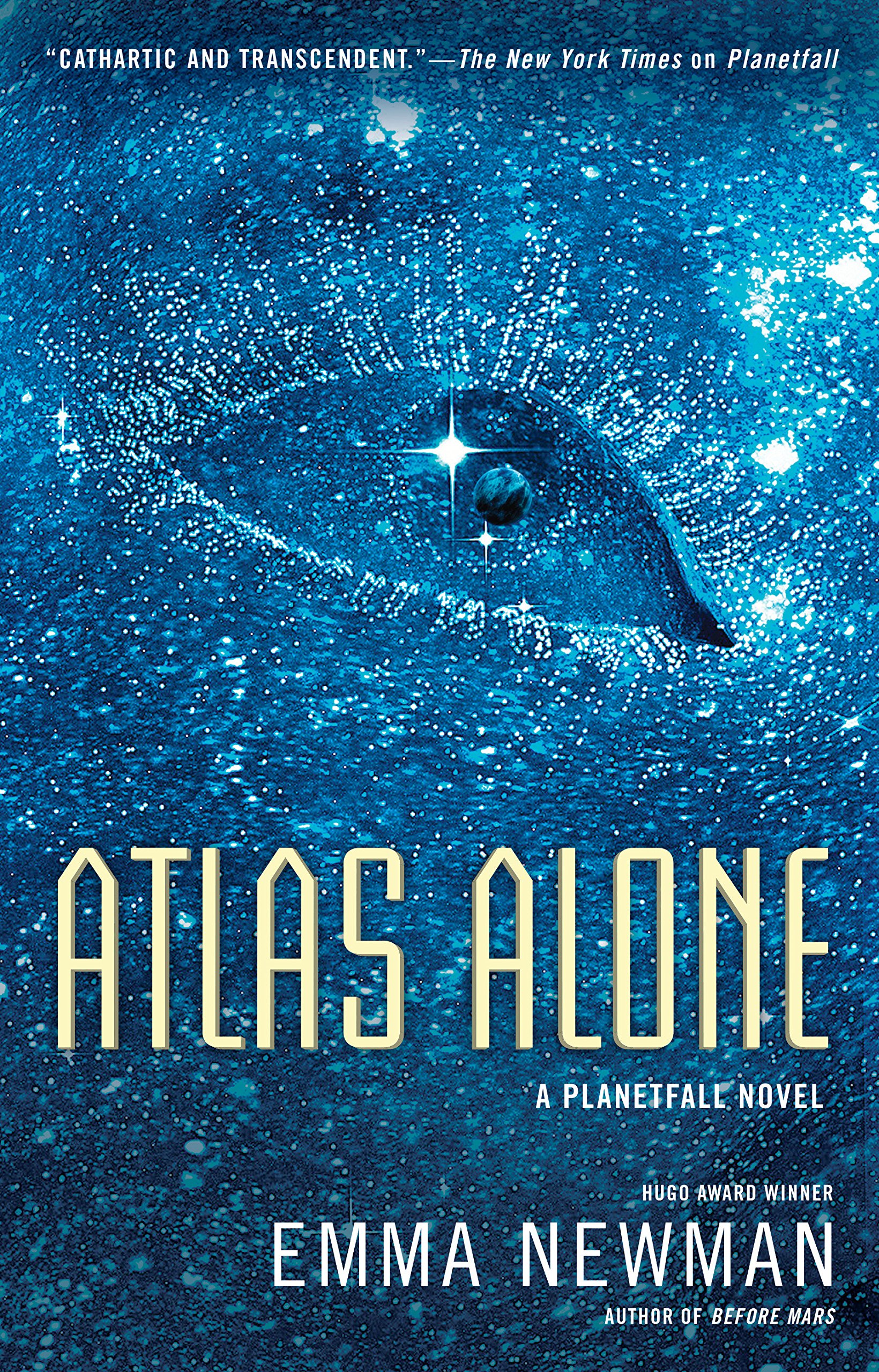
Atlas Alone

Rate this book
Hugo Award winner Emma Newman returns to the captivating Planetfall universe with a novel about vengeance, and a woman deciding if she can become a murderer to save the future of humanity.

Six months after she left Earth, Dee is struggling to manage her rage toward the people who ordered the nuclear strike that destroyed the world. She’s trying to find those responsible, and to understand why the ship is keeping everyone divided into small groups, but she’s not getting very far alone.
A dedicated gamer, she throws herself into mersives to escape and is approached by a designer who asks her to play test his new game. It isn’t like any game she’s played before. Then a character she kills in the climax of the game turns out to bear a striking resemblance to a man who dies suddenly in the real world at exactly the same time. A man she discovers was one of those responsible for the death of millions on Earth.
Disturbed, but thinking it must be a coincidence, Dee pulls back from gaming and continues the hunt for information. But when she finds out the true plans for the future colony, she realizes that to save what is left of humanity, she may have to do something that risks losing her own.

320 pages, Kindle Edition

First published April 16, 2019

91 people are currently reading
2883 people want to read

About the author

Emma Newman

97 books1,774 followers
Emma Newman writes short stories, novels and novellas in multiple speculative fiction genres. She is also a Hugo Award-winning podcaster and an audiobook narrator.

She won the British Fantasy Society Best Short Story Award 2015 for “A Woman’s Place” in the 221 Baker Streets anthology. 'Between Two Thorns', the first book in Emma's Split Worlds urban fantasy series, was shortlisted for the BFS Best Novel and Best Newcomer 2014 awards. Her science-fiction novel, After Atlas, was shortlisted for the 2017 Arthur C. Clarke award and the third novel in the Planetfall series, Before Mars, has been shortlisted for a BSFA Best Novel award. The Planetfall series was shortlisted for the 2020 Best Series Hugo Award.

Emma currently creates a podcast called 'Imagining Tomorrow' for Friends of the Earth. Her hobbies include dressmaking, LARP and tabletop role playing. www.enewman.co.uk.

Ratings & Reviews

What do you think?
Rate this book

Friends & Following

Create a free account to discover what your friends think of this book!

Community Reviews

5 stars
841 (34%)
4 stars
1,069 (44%)
3 stars
424 (17%)
2 stars
68 (2%)
1 star
18 (<1%)
Displaying 1 - 30 of 382 reviews
Profile Image for Bradley.
Author 9 books4,866 followers
May 21, 2019
Over and over, I'm confronted with the fact that I'm in love with Emma Newman's writing. She keeps changing tracks with every novel, giving us completely different KINDS of novels while still intersecting them all in not very strange but emotionally impactful ways.

I mean, JEEZE. I could just mention what big thing happens in the other books and let all my gushy bits come out, but that's spoiler territory. What I will mention is my total respect for the way she treats trauma, surreal virtual-reality/dreamlike states, and the descent into Borderline territory.

And here's the kicker... I loved every single minute of it. Did I start rocking hard to the excuses, the feel of JUSTICE pouring through my veins, the visceral satisfaction of it?

Yes. Hell, maybe I'm a bit sick in the head. But I can do nothing but praise the author. She writes excellent science-fiction. Period. From science to the imaginative bits to the implications in the SFnal tropes. And all of it is handled beautifully -- even sticking to the current philosophical zeal to AI questions! :) I particularly loved the mirroring between the modern slavery questions and the overall fears we have about Artifical Intelligence.

And then there was the story taking place. :) Muahahahahaha what a kicker. No spoilers, but damn, what a great twist. :)

Profile Image for Gabi.
729 reviews163 followers
February 18, 2020
WHAT THE BRILLIANT F***!?

This was a sledge hammer ending if I ever read one. Can I please give a sixth star for the last chapter?

I cannot say much, because nearly everything would either spoil this novel or the immediate prequel "After Atlas". This was intense, thrilling, aching, haunting, deep soul searching - prepare for a punch in the gut, or make that several punches.

Emma Newman is the real deal. I don't want to leave her universe. I read her last three Planetfall novels within the last five days and I have the nagging feeling that I won't find something this good any time soon again.
Profile Image for Justine.
1,419 reviews380 followers
May 4, 2019
Tense and tightly plotted, this fourth book in the Planetfall series is unputdownable.

Taking place six months after the events of the chronologically concurrent books After Atlas and Before Mars, Atlas Alone is set on the ship heading for the Pathfinder's world. Deanna, who we first encountered in After Atlas, is the POV character this time around.

As usual, Newman demonstrates her peerless mastery of delving the emotions and sense experiences of her characters as Dee is confronted by her past while she investigates and plans for her future.

Dee's trauma results from the way she lost her parents, her home and childhood, and ultimately her legal personhood, which culminated with a life of corporate indenture. The portrayal of the adult resulting from that trauma is unflinching and complicated, adding a tremendous layer of complexity to the story.

There are no disappointments to be had here. The Planetfall series continues to be consistently excellent, and Atlas Alone is one of my favourite books of 2019 so far.
Profile Image for Sarah.
832 reviews230 followers
April 25, 2019
I ultimately found Atlas Alone to be disappointing. Part of this is that the previous three books have set a high bar, the other part is that I wasn’t happy with the novel’s asexual representation. The majority of this review is devoted to Atlas Alone‘s depiction of asexuality.

Atlas Alone is the fourth novel in Emma Newman’s Planetfall series. Unlike the others, it isn’t really a stand-alone — I highly recommend reading After Atlas first. This review will contain spoilers for After Atlas, so stop reading now or hold your peace!

At the end of After Atlas, Carl, Travis and Dee witnessed a nuclear war that destroyed civilization on Earth. Although the three of them are safe aboard the spaceship Atlas, heading to a new planet, they know that everyone they left behind is dead or dying. And what can they do about it? Dee wants to find out who was responsible for ordering the attack, but she’s got very little information or means of gaining it — she doesn’t even know who is in charge of the Atlas. Luckily, she gets a break when she’s given a new job as a media analyst and invited to join an elite gaming server, where what you can do in the game is limited by your real-life skills. But something weird is going on. An anonymous figure invites her to a different, disturbing game where she encounters the dead bodies of everyone she knows on Earth and details of her past that no one else should know.

I listened to After Atlas as an audiobook, since I’d realized that Emma Newman herself was the narrator. I don’t have any complaints when it comes to the narration! Emma Newman clearly distinguished all the voices and effectively conveyed the emotions of the characters.

I loved the way the immersive gaming was used in the novel to depict Dee’s past. It was so creepy, almost verging onto psychological horror. Plus, it’s a wonderful mystery — who is this game creator who knows so much about Dee? I guessed the identity before it was revealed by the narrative, but I still like how that concept was used.

I’m also glad that Emma Newman decided to continue the plot threads of After Atlas. The nuclear war was one hell of an ending, and I wanted to see the ramifications! Atlas Alone certainly gives us that. I also enjoyed seeing Carl and Travis again, as I really loved them in After Atlas.

With all that said, here’s the thing I need to talk about with Atlas Alone — Dee is asexual, and as an asexual woman myself, I wasn’t thrilled with the asexual representation in Atlas Alone. Actually, “wasn’t thrilled” is an understatement. I was fairly upset, in part because I was so excited to hear that the fourth Planetfall novel would have an asexual protagonist. One of my favorite series having a book with an asexual lead? It felt like a wish come true!

In part, I’m writing this review for other asexual people, but I know the majority of people who read this likely won’t be asexual. And given the lack of visibility of the asexual community, I’m going to assume a lot of the people reading this review won’t know basic stereotypes about asexual (ace) people. So if you are asexual yourself and already know this 101 stuff, go ahead and skip the next paragraph.

Asexuality is a sexual orientation like any other. People on the asexual spectrum don’t experience sexual attraction or experience it in lower amounts than people who are not asexual. Common stereotypes about asexual people are that we are cold, emotionless, robots/aliens/inhuman, broken, all asexual because of trauma, repressed, sociopathic/psychopathic, etc. Here’s a Tumblr post about common asexual stereotypes seen in fiction that provides more detail on the topic and an essay on how asexual and aromantic people are often presented as villains. A lot of the same stereotypes apply to aromantic people. While Dee is not explicitly stated to be aromantic, she seems to be coded that way.

Dee is depicted as asexual within the text although the word is not used. The author has however stated on Twitter that Dee is asexual. The passage below is the one which I see as depicting Dee as asexual. There may be others, but as I was listening to an audiobook, I didn’t take down quotes as I was reading.

[T]hen there was kissing and all of a sudden I just knew I was not into him. No, not him, the whole sex thing. I’d just been mimicking what I saw other people do, thinking it was what I should do, thinking it was what I should do, but then, when it was actually happening, it just felt . . . crap, and I didn’t want to kiss, let alone let it progress any further. (p. 110).


We also get this scene where Dee says she’s not het. I have removed the character names to avoid spoilers.

“You’re gay and I’m—”

“I’m bi, and he knows that.”

“Well, I’m not, and he knows that too.”

His hand slides across the bed to brush mine. I pull my hand away and stand up. “I’m not het either, … So just back the fuck off, okay?”

He looks genuinely surprised. “I thought you were just . . .”

“Waiting for you to notice me?” I laugh. “Nope.” (p. 154).


As I mentioned before, the narrative never uses the word asexual. There’s also no mention of what Dee’s romantic orientation is, and as far as I know there’s no Word of God on that front. I initially read Dee never using the word to be a sign of how she hasn’t accepted herself. And of course, books don’t have to use the identity label to depict an asexual character. However, I don’t like that other identity labels like gay, bi, and het are used, but ace/asexual never is. Also, how clear is it that Dee is asexual to readers who aren’t asexual themselves? My fear is that her asexuality could be perceived as part of her mental illness. While I don’t believe this was the author’s intentions, I think it is something some readers could come away thinking, especially as the word is never used and Dee’s asexuality is never explicitly separated from her mental health issues. This is of particular concern to me because the asexual community has a problem with people trying to treat our orientation. Ace people seeking mental health treatment for things like anxiety and depression may encounter therapists who seek to treat their sexual orientation. I was incredibly lucky that coming out to my therapist went well, but I know other ace people who have had much worse experiences.

Dee’s mental health problems stem from her past as a “non-person,” as in this dystopian future homeless people are regularly rounded up and sold into corporate slavery. As a result of that and the death of her parents, Dee is quite traumatized, but she refuses to engage with her emotions. She’s unable to trust others and keeps herself emotionally walled off. In her interior monologue, she berates her inability to engage emotionally and expresses doubt in her own humanity:

Turns out that watching thermonuclear war from space in real time didn’t just run off me like water. Maybe I am human, after all. (p. 14).


But it isn’t enough to armor myself against all feelings, no matter how much I pride myself upon my ability to switch off that emotional bollocks whenever I need to. (p. 82).


But I hold him tight and I pretend that I have forgiven him for being nothing more than I am: a cold collection of trained responses, pretending to be a person. (p. 233).


As “trained responses” indicates, Dee’s trust issues and emotional problems are directly tied to the brainwashing procedure corporate slaves undergo (this is called “hothousing”). Other quotes are even clearer in that regard.

They trained me to hide what I thought and felt, and the whole time they thought they were removing those feelings altogether. Like all things put under threat, my emotions simply went underground. (p. 90).


I am aware of a cavernous space inside me, a dark emptiness that is so deep, so intense, that it might be who I really am. Maybe I’m not a person at all. Maybe I am just an emotional void, crafted into the semblance of a capable, clever woman who costs far less to maintain in a corporate structure than a real, free individual. (pp. 219-220).


Dee’s own perception of her inhumanity and emotionlessness comes up again in a conversation with Carl, the closest thing she has to a friend:

“One, Dee. Today was the first time. I mean, I know you’re tough, but . . . it was a relief to know you’re human after all.”

“Was there any doubt?”

He shrugs. “[…] Maybe ‘human’ is the wrong word.”

But then again, maybe it isn’t, I think. I’ve had less of an emotional life than most of the NPCs I’ve shot. No, that’s not true. They’ve performed more emotionality than I’ve ever experienced. But he’s still looking at me, expectant. (p. 225).
As I said before, I don’t think Emma Newman intended for Dee’s mental health issues, the discussions of Dee’s ability to perceive emotions, her coldness, or her trust issues to have any reflection on Dee’s asexuality. However, a lot of the language here is also found in negative stereotypes about asexual people — that we are cold, unable to feel emotions or create meaningful bonds with others, and somehow inhuman. I don’t think that a story about an asexual character who is cold and distant due to trauma and mental health issues is necessarily a bad thing — I think there’s a need for that type of story. But I think that it would need to be handled with a very delicate hand. Ideally, I’d want to see a clear separation between the protagonist’s asexuality and her mental health issues, as well as other asexual characters who are not cold and distant. I would also appreciate a healing arc. In general, I don’t think Atlas Alone sensitively handled the intersection of mental illness and asexuality.

The rest of my discussion on Atlas Alone and asexual representation involves major spoilers for the ending of the novel. If you want to avoid spoilers, please quit reading now.


While I don’t think any of this was done out of malice or ill intentions towards asexual people, it still winds up playing into negative stereotypes. Atlas Alone may be a book that some asexual readers want to avoid. However, I also worry about what perception it will give non-asexual readers of asexuality. Since we lack visibility, any one asexual character can have a disproportionate impact and may wind up being one of the only asexual characters a reader has encountered. Within Big Five, traditionally published science fiction and fantasy, I can name only a few books with canonically asexual protagonists. These are Seanan McGuire’s Every Heart a Doorway, Garth Nix’s Clariel, K.A. Doore’s The Perfect Assassin, and Vicious by V.E. Schwab, and Clariel and Vicious also arguably reproduce the same negative stereotypes.

A lot of times coming out to people involves explaining what my sexual orientation is and having to actively combat these stereotypes. I was originally going to recommend against Atlas Alone just for asexual readers who feel they might be upset by this narrative… but I fear what impressions this book will give people who don’t know any better (which is most people) about asexuality. So I’m reluctant to recommend Atlas Alone at all.

Again, I don’t think Emma Newman intended any of this, and I do love her work. I really appreciate how this series deals with mental health issues, but at the end of the day, more thought and care should have been put into the depiction of Dee’s asexuality.
Profile Image for Mogsy.
2,265 reviews2,777 followers
June 10, 2019
3 of 5 stars at The BiblioSanctum https://bibliosanctum.com/2019/06/09/...

So far, I’ve been really enjoying Emma Newman’s Planetfall series, but I have to say this latest one was a bit of a miss for me. At least compared to the last two books, the premise and story of Atlas Alone did not feel quite as captivating to my imagination, which is a shame. After all, I am such a sucker for books with a video game angle, and I had been greatly looking forward to this one’s unique take on immersive gaming.

Like all the rest of the books in the series, Atlas Alone is a stand-alone story. This time, the focus shifts to follow Dee, one of the passengers aboard the colony ship headed to a new planet after a nuclear apocalypse decimated Earth. Six months have passed since the ship set off, but Dee is still struggling with the trauma of witnessing all the death and destruction. To cope, she and her friends Travis and Carl escape into “mersives”, or highly realistic virtual games that immerse the user completely into its environments, but lately, her addiction to these games has been having an adverse effect on her socially and mentally. Paranoid and jittery, she is also beginning to question the circumstances around the nuclear strike that destroyed Earth, and vows to make those responsible pay.

Utilizing the tools she knows best, Dee throws herself into mersives to try to understand the ship’s hierarchical structure. One of these games, however, is like nothing she has ever played before. While testing the mersive for its designer, she becomes rattled by the realism of the game’s environments and situations, and the fact that the in-game intelligence seems to know a lot more than it should. During one of these sessions, Dee’s character kills another, and when she emerges back into “meat space”, she is shocked to discover that a man, bearing a striking resemblance to the one she’d killed in-game, had in fact also died in real life. Knowing that it can’t be a coincidence, Dee continues to search for more information in her quest to figure out how everything is connected.

Unfortunately, this was probably my least favorite book in the series so far. Granted, I had pretty high expectations before I started, considering the high bar set by the other sequels like After Atlas and Before Mars, but objectively, I also felt that Atlas Alone was not as well written or put together. For one thing, the info dumps. Boy, did they get tiresome. If the narrative wasn’t expounding on the characteristics and technicalities of gaming, it was going on and on about the psychological profile of Dee’s personality and behavior. Like, please, I got it. Enough already.

Worse, once you subtract all that, what’s left of the story is decidedly thin. To its credit, I thought the mystery plot itself was overall compulsive and very intriguing, and it didn’t bother me that it was on the simplistic side. However, I did mind that it was made more complicated than it had to be. It felt intrusive and distracting, messing with the pacing as well as taking away from Newman’s usually smooth writing style. Even the gaming aspect of the story did not really help; in fact, it eventually grew exasperating for me every time Dee entered into yet another mersive, because it often meant we were in for a long stretch where not much really happens.

Then there was the matter of Dee. So far, all the books in the Planetfall series have featured main characters who fall outside social norms, with mental health being a recurring theme. Many of them have also experienced issues with trauma, or are dealing with symptoms of depression, guilt, or anxiety. Up until Atlas Alone, I’ve always been impressed with the author’s ability to make all the protagonists in this series feel genuine and relatable, thus making it possible to connect with their personal stories, though this time, I think she might have missed the mark. Simply put, Dee didn’t feel like a fully realized character to me, almost like Neman herself was unsure of where to go with her personality. For instance, some of Dee’s thought processes and behaviors didn’t mesh well at all with what we’re supposed to know about her, and many of her decisions in the second half of the book left me scratching my head and wondering if I had missed something.

In the end, I give this book a 3 out of 5—and just barely. I enjoyed it to an extent, though unlike a couple of the Planetfall books that came before which were full of meaning and emotion, Atlas Alone left me feeling ambivalent and cold. The ending also felt rushed and forced, which robbed it of a lot of its impact. Nevertheless, I’m chalking this installment up to a fluke, as the other books in the series have been so enjoyable. I’m still looking forward to more, and given the way this book ended, here’s hoping there will be at least another volume.

Profile Image for Veronique.
1,362 reviews225 followers
May 12, 2019
4.5*

It was with trepidation that I started this new novel from Newman, expecting the usual focus on a mental illness combined with a thriller story. The author didn’t disappoint :O)

Atlas Alone is the fourth novel in this universe but the first that felt like a direct sequel, of book 2. The narration, this time shown from the point of view of Dee, meets her six months after the events of After Atlas, where she is finding it hard to adapt to life on the ship. Dee, and indeed Carl, cannot forget the covert destruction of Earth upon their departure, but also all the horrors that they experienced in their lives of corporate indenture. That is until she gets the chance to find out more about the ‘culprits’, investigating them, and even infiltrating them through immersives (virtual reality gaming). However, nothing is as it seems...

Dee’s narrative won’t be to everyone’s taste. Here is a broken person, barely holding together, but surviving by pushing her feelings away, not confronting them, and finding oblivion through games. Understandable to a certain extent. What is interesting is the difference between her and Carl, and their approaches to life. Both are beyond hurt, and yet. As for the whole notion of immersives, that is another fascinating topic.

The resulting story is compelling and thrilling, with quite a bit of suspense. And yes, there is plenty of room for the author to carry on. Please write another one - I want to know what happens NEXT!! :O)
Profile Image for Kitty G Books.
1,684 reviews2,973 followers
April 25, 2019
* I read this as part of the OWLs readathon for the Divination prompt *

This book was one of my most anticipated as Emma Newman is one of my all-time favourite people and authors. She always delivers something I haven't seen before and it's always fresh, vibrant, challenging and fun all rolled together. This latest instalment for the Planetfall series is no exception.

This story can be read as a standalone, but I would highly recommend that you read the previous three before this as I do think that although you will no doubt understand this one, it makes more sense and gives more context if you have the understanding of the previous books to draw upon. In this story we're even following some of the characters we met previously, and some pretty major events have happened to humanity.

Dee is our main character. She is fairly isolated and she has suffered through some traumas as a child when her father died. She knows that there is refuge in gaming, and so she frequently slips off into VR and games her nights away. She even has a friend, Carl, who she occasionally does this with.
Dee is not a thoroughly likable character at first, and she does some pretty bad things later in the book, but her mental health, mindset and isolation are all well covered by Newman over the course of the story and I felt like I had a strong understanding of Dee and her motivations throughout. Really, she just wants to get to the bottom of the mystery of what is left on Earth, and also what they are doing on Atlas II (the spaceship they are all on, travelling away from Earth to a new planet) and who is in control. There are a lot of secrets still to be uncovered, and when a mysterious gamer turns up and shows her the ways of leet gaming (elite and super realistic) she delves deeper.
Eventually the games and reality seem to merge, and she has to figure out what is real, how these things are happening, and who really is the 'good guy' here...is she even good?

The setting of this world is cool, there are mersives and AI and all sorts of awesome gadgets I wish were real. Emma continues to intrigue and excite, and this is a future which somehow seems both far-fetched and also tantalisingly realistic. I definitely rate the world and the discussions of this world highly on reasons why I love this so much.

Overall, superb once again and the audio which is done by Emma is highly recommended too. 4*s again and thoroughly recommended :)
Profile Image for Carly.
456 reviews198 followers
January 8, 2020
Oof, I have complex feelings about this one. So much so that after a ~3-year hiatus from reviewing and Goodreads, I actually wrote a review. I think it might still be in progress... I have a lot of roiling thoughts.

Atlas Alone is the fourth (and supposedly final?) book in the utterly fascinating and absorbing Planetfall series. The first in the series is still one of the most powerful books I've read in recent years. Like most great speculative fiction, it isn't so much about technical imaginings or creative worldbuilding --although both are present -- but about people and society, seen at a remove that allows us to examine our own beliefs and prejudices without falling into familiar partisan stances. Planetfall is a glorious, painful, heartrending, personal, bewildering examination of brokenness and grief. Each subsequent book takes place in the same world and is loosely tied to the others, but explores a new facet and centers around a new protagonist, each an unreliable narrator who is struggling and wounded in a changing world. Unfortunately, I personally have found each book progressively weaker, and that trend didn't stop with this book.

Atlas Alone takes place after After Atlas, and since the character set is the same, it really requires the former to fully understand events. It is narrated from the perspective of Dee, who we met in After Atlas as the fierce, practical friend (and protector) of that book's protagonist, Carlos. In this book, we discover just how much of that functional persona is actually a facade.

Dee is the first of the series protagonist whose fury and despair faces outwards as much as it turns inwards. The trauma she has been dragged through is perhaps the most extreme of any character so far, and she has survived by detaching from her emotions, assuming betrayal from all sides, and shaping her anger and pain into something sharp and practical and cold. She "relaxes" by killing everything in sight in hyperrealistic "mersive" games. Dee is, without a doubt, a frightening force to be reckoned with, but I saw her anger and detachment as something born from pain and despair and the desperate need to survive.

A major theme that the book plays with is who we might consider a "lost cause" past saving. I found myself in the interesting position of feeling that I think I see more hope and complexity and humanity in the characters than the author does, and more people worth saving. One aspect that made me deeply uncomfortable is the way that Dee's sexual identity-- she clearly sees herself as asexual-- appears to be tied into her emotional brokenness and trauma. She's cold, distant, violent, calculating, incapable of allowing herself to feel normal emotion or trust... and that's the character who is asexual. I'm not going to go into this one because coolcurry already discusses it better than I ever could, and there are just so many things to unpack.

Unlike previous books, that used shadowy "gov-corp" cabals, new institutions, and created structures as the enemy, in this book, Newman decided to make her baddies something far too easily recognizable: American evangelical Christians. Full disclosure: not only do I identify as ace, but I also grew up in semi-evangelical Christianity before eventually losing my faith for agnosticism, so this book was a double whammy of dehumanization. For an author who seems to pride herself on exploring flaws, I suspect it's not a coincidence that Newman has never fleshed out any religious character past a two-dimensional stereotype. Newman's scorn and disgust comes through in other books, but in this one, multiple critical characters are evangelical Christians, who, in Newman's future, have taken over the government to create a theocracy. As I said, I grew up in the church-- I remember the books and movies. portraying a feared future of religious repression, and the anger and polarization that was stoked by a future that did not happen but that we saw as realistic and imminent. To my eyes, Newman is playing exactly the same trick.

One thing I struggle with and worry about is seeing our polarized society willing to throw out and give up on entire groups of people. To my eyes, so much of the fracturing right now is because we are each operating from totally different sets of facts. Propaganda and belief and the desire to improve the world at any cost can lead to terrible things, but there are flawed and broken humans at the bottom, not unrecognizable monsters.

But it's still Newman, and even though I'm disappointed in the simplicity/banality/from-my-perspective-prejudice-and-unrealism of the solution to the mystery that propelled the last few books, it was still worth the read. Just... please understand that it's blindly perpetuating a set of stereotypes that I think the author should have examined more closely. I think Newman tends to explore issues she herself is familiar with (e.g., OCD, post-natal depression, etc). I suspect her unfamiliarity is why she seems to approach asexuality as a symptom of disorder rather than an intrinsic aspect of a person that is neither good nor bad, just there. In a time where we are polarized into dehumanization of the Other, I'd love to see some attempt to explore and humanize.
Profile Image for Lyn.
2,009 reviews17.6k followers
June 5, 2019
How good is Emma Newman’s Planetfall series? I read them all four back to back over a few weeks. Could not put them down unless it was to pick up the next in the series. Now that I have read the latest, I guess I’ll need to get in line to wait for the fifth.

Atlas Alone takes up where Before Mars left off, but is really more of a direct sequel to After Atlas. (Before Mars was something of a standalone though it referenced the other books, had some of the same characters and was in the same world building universe.

The mostly American crew and passengers aboard the Atlas have left Earth and are traveling the two decades or so required to follow The Pathfinder to her new world as described in Planetfall.

Like Tana French’s intoxicating Dublin Murder Squad books, each of these stories have been a first person narrator and from the perspective of a character mentioned in a preceding book. This one is from the viewpoint of Dee, Carlos’ badass friend and gamer. Much of this narrative is in a gamerpunk kind of set up, made all the more attention-grabbing by the heavy-with-reality and backstory “Mersives” they play. This concept is even more intriguing by the inclusion of a very crafty AI that has gotten in on the fun.

Another ubiquitous element in Newman’s fiction is her keen ability to use unreliable narration and to convey a character with some serious mental and emotional baggage. While all of the first person narrators have had some hang-ups and some issues, Dee has them all beat with her deeply troubled past and with some industrial strength behavioral disorders.

Newman left this one ripe for a generational ship plot to follow and I am all in on this great series.

description
Profile Image for Kaa.
614 reviews66 followers
Read
November 16, 2020
I just really do not know how I feel about this one. It was fascinating and I couldn't stop listening to it, but I was left dissatisfied with certain elements. In particular, the way Dee was presented as an asexual woman made me uncomfortable - this review by an asexual reviewer explores this in much more detail than I could. And I was just completely unhappy with (MAJOR SPOILERS) I would read another book in the series, but mostly because I'm really hoping Newman will address some of the things that I didn't like about the way this one ended.
Profile Image for Denise.
381 reviews41 followers
May 4, 2019
There were times when I felt like this was a 3 star book at best. I was rarely surprised by the plot twists until the end. As with the other books in this series there are intense psychological issues explored. I think this was not quite as convincing as a portrait of the thinking caused by trauma. Still, I kept with the book (audio with the author reading which I enjoyed) and I can see that the final scene will be crucial to the further story-so 4 stars.
Profile Image for The Captain.
1,484 reviews521 followers
April 16, 2019
Ahoy there mateys!  I received this sci-fi eARC from NetGalley in exchange for an honest review.  So here be me honest musings.  While the other three books in the series can be read in any order, this book follows events in after atlas.  While I try to post no spoilers, if ye haven't read that one and keep reading this log then ye have been forewarned and continue at yer own peril . . . .

I read these books in publishing order and I do recommend that a person new to the series do so as well even though the first three books be companion standalones.  But like I said, this fourth book should be read last.

A brief recap.  Book one, planetfall showed the story of  a human colony on a remote alien planet far, far from Earth.  Book two, after atlas, is a sci-fi murder mystery novel set on Earth forty years after the colony ship Atlas has left the planet.  Book three, after mars, is about the an employee of a corporation based on Mars who has to solve a wicked bad case of déjà vu.  And then we come to the fourth book.

Now I didn't read the blurb for this one and jumped in with blind faith that the author would give me an excellent story.  She did.  This installment involves the colony ship, Atlas 2 and picks up from where book two left off.  It showcases the familiar Dee, a dedicated gamer struggling to deal with the consequences of leaving Earth behind.  Dee's anger is making her want someone to blame.  She just has to figure out who and then get revenge.

And that's all yer gonna get from me about the plot because of spoilers.  I think some readers will be surprised that this book did not take place on the colony planet.  I was.  But after a small mental adjustment, I was drawn right into this tale.  Like the previous three books, this is another character study where the plot (while fun) takes a backseat to the portrayal of the inner workings of a person and what makes them tick.  I read this in one sitting.

The nice part about this book is that we already know so much about the other two main characters (Carl and Travis) and ye get to see them from the perspective of Dee who previously was a minor character.  I actually found Dee to be extremely sympathetic and wanted her to succeed and get out of the mess she's in.  I did guess one of the major plot points of Dee's troubles and also an aspect of the overall ending but it didn't bother me too much.  There were small issues about character development and the bad guys.  But I should have known the reasons would be revealed.  I just had to wait for it all to unfold.

I loved this installment and highly recommend it.  I do hope we get at least one more story of life back on the colony planet.  While waiting to find out if the author is going to have one, do pick up any of the Planetfall books and treat yerself to a delightful story.

Check out me other reviews at https://thecaptainsquartersblog.wordp...
Profile Image for Lindsay.
1,405 reviews266 followers
May 27, 2019
Like the rest of this series, this is a tight and tense examination of a person with some serious mental health issues as they deal with an intense future dystopia. It's also the first direct follow on in the series, continuing the story from the second book, After Atlas, but from the point-of-view of a different character.

Dee, Carlos and Travis are onboard the Atlas 2 with the Circle, the mysterious CSA and many others, but with the knowledge of what happened on Earth when the spaceship left to follow the Pathfinder. In the middle of their grief and plans for vengeance, Dee gets invited to join games on the ship's leet immersive gaming server, where she gets approached by a shadowy figure who also seems to know events on Earth. As Dee gets mired in plans for revenge and eventually murder and the investigation of it, she gets mired in the plans of someone she can't identify.

Dee, like Carlos, is a former corporate-indentured non-person, a slave. Only her conditioning seems to have been even more extensive than Carl's, and it came on top of trauma she had already experienced. All of which makes the thriller plotline and the mystery of her benefactor more compelling.

Great entry in an excellent series.
Profile Image for Rachel (TheShadesofOrange).
2,887 reviews4,798 followers
April 17, 2019
3.5 Stars - Video Review: https://youtu.be/Cre_bGpFKHw
Picking up in the aftermath of the previous Planetfall novels, Atlas Alone was particularly dark and rather depressing. At its core, this was a story of revenge and the subsequent fallout of those actions.

All the books in the Planetfall series are loosely connected to each other and are largely considered to be companion novels, rather than direct sequels. However, this fourth novel was much more dependant on the setup of the previous books. In order to fully understand this story, readers should ideally read the three previous books before starting this one. As a warning, the first few chapters of Atlas Alone will completely spoil the endings of both After Atlas and Before Mars. If readers intend to read all of the books in this series, then they really should read through them in chronological order, saving this one for last.

Compared to the previous Planetfall novels, Atlas Alone most closely resembled the second book, After Atlas. The novel featured the same characters, including Carlos and his friend Deanna who was the primary perspective in this novel. I consider Newman to be an exceptionally strong author for creating well developed, multifaceted characters. Therefore, I was disappointed in the charazations in this novel, finding Deanna to read quite flat.  After Atlas was previosly my least favourite book in the series so unfortunately those similarities did not enhance my enjoyment of this novel. However, I know that many readers loved After Atlas and would, therefore, love this follow up novel a lot more than I did..

While not my favourite in the series, I would still recommend this novel to fans of the previous books. Furthermore, I would recommend the entire Planetfall series to any science fiction readers who enjoy character driven narratives.

Disclaimer: I requested a copy of this book from the publisher for review.
Profile Image for William.
676 reviews413 followers
July 5, 2020
4-Stars

Yes, you should read at least book #2, After Atlas before reading this. And I recommend you read book #1, Planetfall, as well.

A very good continuation of the Planetfall series, and it would have been 5-stars except for the incredibly dull setups to the immersion video game play. I find video games pretty boring, and "reading them" is ten times worse.

The opening is very good, especially after the terribly flawed Before Mars. It's nice to be back with Carl, Trevor and Dee again. This story is first-person Dee, and she's a distinct character from Carl, Ren, Anna and Trevor - a big plus.

After the terminal horror of After Atlas, unknown to most of the passengers on the Atlas 2 ship, we find Trevor, Carl and Dee living with the horrific images of that catastrophe. Since this is Dee's book, we see and feel that horror and anger most powerfully from her.

The book really starts about 6 months after they've left earth, and both Carl and Dee are feeling "at loose ends" with nothing really to do with their lives, and no access to any real data. After Dee is offered a data analysis trial from one of the entertainment managers aboard the ship, her world expands quickly, even during the trial task.

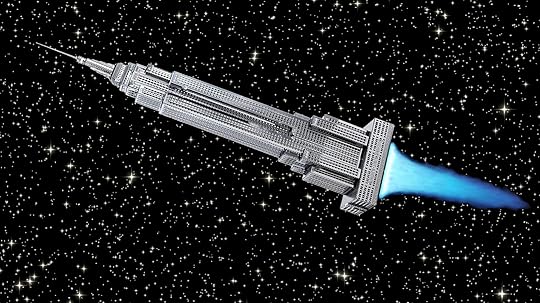
Someone talks about the Atlas 2 spaceship being the size of the Empire State building, and this came to mind 😉

Full size image here

Another few supporting characters are introduced, and Dee is mysteriously given an immersion game-player trial as well, that hits far too close to home to be a coincidence. The setup of this immersion game (from Dee's veiwpoint) is pretty dull and technical, and lasts for far too many pages before the real game action starts. During the game play, we learn a lot more about Dee's childhood and teenage years. Just like Carl's, it's awful and cruel.

After this game, which has a huge twist as Dee awakes, one of the new characters challenges Dee about her feelings, and we know that character will test her far more.

The mystery is nicely plotted, and Dee and the characters are much more fully developed. Carl appears mostly as a minor supporting character throughout, sadly. Instead of the endless dull game setup, I would have much preferred to see his detecting skills in play.

Several other games are played, again with dull setups, but Dee's character and the events leading up to the atrocity on Earth, and it's perpetrators become more clear.

The climax appears to be a bit predictable, but instead is very cleverly plotted, with several very satisfying twists. The last few pages close this book with some surprises that do not bode well for the sure-to-come fifth in the series. I can already imagine the coming title!

Note: If you are a gamer and you enjoy how the games are set up, you can add half a star to my rating.


Full size image here

Notes:
28%
Again, Newman's prose is superb.

39%
After a few long, mostly boring video game chapters.... BLAM... suddenly a huge twist. Very clever Ms Newman.

41%
One thing I don't buy ...

Leaving that niggle aside, the pacing is now driven incredibly by Carl's murder mystery. Wow.

57%
An awful lot of this book is padded with pointless video games. Dull, dull, dull. And the endless set-ups for the games are awful. What's the point of this endless crap? I skimmed quite a few pages, without any apparent loss to plot or character development.

Quotes:
In the early days of immersion technology, people did attempt to share personal recordings, driven inevitably by the porn industry. But then people started sharing murders, violent attacks as both the perpetrator and the victim and even heart attacks. Human beings are mostly garbage, after all.
-
Okay, fine, the US gov-corp picked the younger ones from the home crop, unlike the Circle, who cherry-picked their members from all over the world. Given the way the US has been since the 2020s, it doesn’t surprise me that they haven’t ever traveled outside of their home country.
-

In John Brunner's The Sheep Look Up the giant AI computer was forced to take a truth if you told it "I tell you once. I tell you twice. I tell you three times."

Dee:
I tell myself that three times. just to make sure it is true.
-
I was twelve and it was still a year before the nonperson policies became really hard-core.
-
Someone tries to help the teenage Dee:
“Can’t I at least buy you a meal? You look freezing.”
“No, thanks.”
I was starving. I hadn’t eaten for three days and had only drunk rainwater. In a society filled with food that required an identity to purchase it, I was in big trouble.
-
Another three months before they asked if I wanted to stay with them. Then I ran away. I never saw either of them again. I have no idea if it would have been as safe as I’d hoped it would be. I just couldn’t make that Final leap. I couldn’t trust them. No, I couldn’t let myself love them, or trust them. They would only leave me, or hurt me, in the end. So it was better to end it when it was still good.

-
Dee remembers the horrors of "calibration" by the hot-housers:
She’s still staring at me, like she did back then, standing next to the Machine, ready to recalibrate me. What a euphemism that was. They had good words for all sorts of terrible things in that place. Realignment of values. Reaction refinement.
-
It’s the anger I can’t shut out. These are just an infinitesimal fraction of the dead we left behind on Earth. All those lives, snuffed out in moments, just because some fcker in power-undoubtedly on this ship-didn’t want anyone to follow us.
-
It could be a woman who ordered it, of course, or a nonbinary person, but in my mind it’s a man, at the head of a table in a room full of men. White, middle-aged men, so terrified of not being the most powerful people on Earth that their fear stalked them onto this ship and made them destroy any other culture that might dare to challenge their vision on the new planet.
-
There’s no such thing as justice to be found in any system that exists on this ship, which they will no doubt have power over. I have to make my own justice; I have to find them and make sure they pay for what they did, with their own blood. And I will sleep well afterward.

-
The creed of any typical zealot religion, just replace "Christian" with whatever:

"The CSA is dedicated to upholding Christian values of moral decency, corporate and fiscal responsibility and the preservation of the American way of life. We fully commit to our moral duty to protect the one true faith and the faithful. We believe that a society built on the solid foundations of religious observance, financial stability and humility before God is superior to those of other nations, and worth defending against their prejudice and envy."
-
That was how it started before though. Protests against the appalling corruption in government, about the huge gap between the rich and the poor...
-
The Thames winds its way below, timeless, there before Londinium, there throughout all the fires, the plagues, the riots... uncaring.


.
Profile Image for Fraser Simons.
Author 9 books296 followers
April 12, 2024
This was a bit conflicting for me. The ending was fun but a bit tropey, yet it also fits the character work done, and does slightly plug the holes in the world building, especially for the factions, which were on the very light side, this go around.

It’s an improvement over the last one. Better, and more interesting plot and plotting; questions about the ship and the circle are answered; there is a murder mystery with a twist. It is also quite myopic. Dee interacts with so few people that the plot is a bit of a razors edge, the solipsism contributing to it feeling contrived, but the consequences feeling somewhat justified. I do think I overall enjoy the plot enough and how it relates to Dee in the end. Had it been more fleshed out, this could have been really great, though.

3.5 rounded up.

**Spoiler thoughts**

One of the detractors is that it ends up being technophobic, which feels somewhat antiquated, even if it does walk a certain line, since it’s the arguably true that Dee behaved and acted the way she did, and it does call into question her character, dealing with them in a satisfying way. But the whole morally grey but just self aware A.I thing feels like it there could have been more payoff across the series, rather than it being sprung on solely in this one. It feels like it slightly cheapens it.
Profile Image for Emily .
952 reviews106 followers
June 4, 2019
Some advice - You definitely need to read book 2 before this one. It's been a long time since I had read it and I couldn't find a recap anywhere online, so I checked the book out at the library and read the last 3 chapters. That's all you need to reread - those chapters summarize just about the entire book.

So, once you've done that you can move on to Atlas Alone, which was a pretty good book - although the main character is unlikeable. The reveal of who the person was seemed obvious to me, but the ending was unexpected (although - in retrospect - cliche).

I thought it was a pretty solid book. Parts of it seemed a bit drawn out, but I enjoyed it.

This spoiler is just for me to look at later so I can remember what happened in this book. Don't read it unless you want the whole book spoiled.
Profile Image for Cheryl.
12.9k reviews483 followers
library-priority
May 4, 2019
Supposedly these Planetfall books each stand alone. But I've seldom been hooked by a series as firmly as I am by these. And it's not because I absolutely love them, but more because I admire how they're crafted, and, yes, because I want to learn more about this world and these characters.

They are about as hooked together as Becky Chambers's books. *I* strongly recommend reading both 'series' in publishing order. But if you feel compelled to sample at random, that's better than skipping them altogether.
Profile Image for Silvana.
1,299 reviews1,240 followers
January 6, 2023
First book of the year and also my first DNF of the year (after 40%). I don't like games so maybe that's why the 30% of the book felt so boring to me. Also the suspense factor is not there and I failed to develop any affinity towards any character. I think it is not the right book for me so I am not giving it a one star rating. Decided to drop coz it felt like a chore already and I ain't got no time.
Profile Image for Jacqie.
1,973 reviews101 followers
February 20, 2019
Thanks to Netgalley for providing a copy of this book for review.

I've been reading along with this series ever since Planetfall. Unfortunately, I think this book was my least favorite of the series. And you should know- Atlas 2 and the colonists do NOT meet in this book. There had better be more in this series!!!!!!

So, each book has explored some sort of psychological issue. In this book, our POV character is Dee. She was a friend of Carl the Investigator (they played immersive games together), and he managed to get her onto Atlas 2 before the world blew up. I didn't remember anything about Dee, but you get to know her pretty well in this book.

Dee's issue is trust. She is a product of hot-housing, just like Carl, and was essentially a corporate slave. It looks like she primarily worked in the entertainment industry doing market and data analysis, because that's part of what she ends up doing in this book. Dee wants to get revenge on whoever blew up the earth, and she's convinced the culprit is on the ship with them. (I don't know why she thinks this; my first assumption was that government-corporations went to total war after Atlas 2 launched). To find this bad guy, Dee needs access to more detailed data than her clearance level warrants, and she gets this clearance through a hand-wavy expedience that doesn't come up in the plot again.

A lot of this book is spent in an immersive virtual environment. Dee gets hooked into a game and ends up committing a crime, not realizing that her actions would have repercussions in the real world. Dee doesn't have anyone she trusts enough to confess to, so she's on her own with a creepy co-conspirator who only contacts her in virtual space.

The end of this book is probably the darkest and most hopeless of the series so far, and that's saying a lot. As the author probably intended, I got swept up into Dee's point of view and agreed in principle with her actions but reading them being carried out really bothered me- Dee is borderline anti-social personality disorder and her moral compass is set to what is expedient and won't get her caught. This was well done on the author's part.

What threw me out of the story: in the immersive VR world, Dee is given very specific cues and touchstones. She sees people that she knew, or maybe only noticed a couple of times without interacting with them. The author tries to justify how specific VR worlds can get with a person's memory cues, but I just wasn't buying it. Here's the real spoiler part:

It turns out that Dee's co-conspirator is the AI of the ship, which ends up naming itself Atlas Alone. I had seen this coming from a mile away and was just waiting for the reveal. But that still doesn't explain just how specific the AI could be to the basement where Dee had to wait out the early 2030s London riots. There were smell, aural and touch cues. Or how it could know about Dee's last moments with her father. The atmosphere added to the spookiness of the book but I just couldn't believe it- it was too much like magic. There's no way the AI could have had some of the specific data it did.

However, I still really hope that we get more of this series, because I have to know what happens when all of these characters finally are in the same place!
This entire review has been hidden because of spoilers.
Profile Image for Julie.
2,004 reviews630 followers
April 23, 2019
Atlas Alone is the 4th book in the Planetfall series. The prior three books could be read as standalone novels. Each book told the story of the aftermath of a cult's exodus from Earth from a different perspective. Atlas Alone brings the prior plots full circle, bringing back characters from previous books and making references to events in all of the prior Planetfall novels. This isn't a standalone story a reader can jump into before reading the other books in the series. There are spoilers regarding the endings of a couple of the prior novels and characters whose back stories are essential to understanding the events in this book.

I accidentally requested this review copy months ago. I don't usually jump in mid-series. The concept sounded so interesting that I backed up and started reading the Planetfall series from the beginning before starting this book. I'm glad I did. This is by far the best science fiction series I've read in a long time. The plots and characters are complex. The first three books showed the aftermath of one event from different perspectives. This fourth book brings it all together to move the storyline along in a way I didn't expect.

Atlas 2 has left Earth, carrying what's left of humanity after nuclear strikes destroyed much of the planet. Dee speculates that the person who ordered those strikes is on board the ship. She contemplates revenge and submerges herself in "mersives''....complex video games.....to keep herself occupied during the voyage to the colony planet. I liked the gaming aspect of the plot. And as usual with this series the plot was quite complex and sucked me right in. I couldn't stop reading -- totally binge read this book!

Awesome book!

**I voluntarily read a review copy of this book from Berkley Publishing. All opinions expressed are entirely my own.**
Profile Image for Maija.
593 reviews201 followers
June 17, 2019
3.5 stars

I really like Emma Newman's writing style, it's so easy to read and has a nice pace to it, even when she deals with difficult themes such as mental illness. The mystery in this one was great: even though I guessed the identity of the hacker about halfway through the book, that didn't take away my enjoyment, and the plot still had some surprises in store for me.

I really liked this one, but my rating went down because of two things.
1) I don't really know how I feel about that ending (the very end, that is).
2) I'm not sure about the decision to have this particular protagonist be asexual. Dee talks about her lack of sexual interest without stating the actual word 'asexual' in the book itself, but Emma Newman has reportedly used the term for the character in interviews. Because of her past trauma, she has a lot of mental blocks & issues (not having to do with asexuality), but which fall under the stereotypes and misconceptions about asexual people (closed, cold, unemotional). So without meaning to, this book might reinforce those.

After Atlas remains my favourite in this series, and I hope there will be more books to come in this world.
Profile Image for Tammy.
1,069 reviews178 followers
April 22, 2019
I received this book for free from the Publisher in exchange for an honest review. This does not affect my opinion of the book or the content of my review.The nitty-gritty: A mesmerizing and dangerous thriller where reality and fantasy merge.

Emma Newman’s Planetfall series has been a wild ride, but if I’m reading the ending correctly, that ride isn’t over yet. This is the first book in the series that actually feels like a sequel. The events start a few months after the shocking ending of After Atlas , so even though I’ve always said that each book in this series can be read as a standalone in any order, Atlas Alone is the exception to that rule. If you haven’t yet read After Atlas , I would not pick this up until you do. And please beware of minor spoilers if you haven’t read After Atlas!

It’s been six months since the Atlas 2 started its journey, fleeing a dying Earth and headed toward a planet colonized years ago by Suh-Mi, a messiah-like figure who envisioned a holy place where people could live self-sustaining lives in harmony with god and each other. On board are some 10,000 people, including gamer Dee and her two friends Travis and Carl. Dee has been suffering from depression, due to the cataclysmic event back on Earth and has abandoned her usual interactions with her friends in mersives, highly addictive games that make the user feel as if they are playing the game in real life. She’s also been wondering about the chain of command on the ship. No one seems to know who’s in charge, and Dee’s inquisitive nature won’t let her rest until she finds out more information.

One day Dee is approached by Carl’s father, Gabriel Moreno, about a possible job on board, analyzing mersive data. Dee jumps at the chance, since she knows she’ll be given access to classified files, and therefore can start her own investigation about the other people on the ship. As soon as she’s granted access, she starts poking around in the personnel profiles. But her inquiries draw the attention of someone, an unidentified person who pops up on a secret chat box and invites her to participate in a game he's designed. Dee reluctantly accepts, and is drawn into a world that looks and feels eerily similar to the real world of her childhood back on Earth.

But when she emerges from the game and discovers that a man she killed in the mersive is on board the ship and has actually died while she was playing the game, Dee knows that she has a big mystery to solve. Was this man connected to the events on Earth? How could something like this have happened? And even more worrisome, was Dee responsible for his death?

Things get even more tangled when Carl decides to investigate the death, and Dee has to hide the fact that she might be involved.

Four books in, I’m finally starting to see how all the pieces are starting to fit together. Newman’s stories have jumped around from the colony established on a faraway planet, to life on Earth, to space and back again, in a meandering but ultimately purposeful way. The story’s scope is huge, and I’ve always thought that this is a world with endless story possibilities and characters to focus on. But despite this scope, each book feels very focused and tight, and Atlas Alone follows a similar format, focusing on one main character and her struggle to seek justice and solve a mystery that could impact thousands of people.

I loved the claustrophobic feeling of being trapped on a ship for twenty years, as it speeds towards another planet, and the fact that Dee has uncovered some terrifying secrets and is compelled to take action. On a spaceship there’s nowhere to go, except into the infinite world of mersives, and I thought Newman did a great job of going back and forth between the mersives and “meatspace,” as real life is called. And even though we don't spend much time with them, I loved seeing Carl and Travis again. Carl (called "Carlos") was the main character in After Atlas, a talented detective who gets to use his skills in this story as well.

I enjoyed the sections where Dee is in the virtual game space the most, especially her emotional trip back in time as she’s dragged into a mersive that forces her to face some terrible events from her childhood. The chapters inside the mersives were some of my favorites, although some parts were shockingly violent and hard to read. But we get to see a bit of Dee’s life as a slave, her days living in a “nest,” virtually homeless and starving. Dee is forced to confront people from her past, and this section was so well written and detailed and ultimately ended up being my favorite section in the book. Throughout the experience, she is wondering why this mystery person is doing this to her, dragging her through the past like this, but it isn’t until nearly the end that we find out who and why .

The story falters a bit for me near the end when Dee comes out of a mersive, blazing with anger and ready serve up justice to those responsible for the atrocities on Earth. She does some things that seemed out of character, and the final few chapters felt rushed, as though Newman were simply trying to get to the end so that she could reveal her big twist.

Newman seems to favor shocking, cliffhanger endings, and Atlas Alone is no exception. I had thought this might be the final book in the series, but after the ending there is no way she can leave us hanging, especially since the ending itself is rather depressing. The series overall has themes of making the world a better place and the downtrodden citizens of society rising up to topple the oppressors, so in my mind I’m hoping for an upbeat, optimistic resolution to the story. I’ve always thought of the Colony as a place of peace and serenity, and I do hope the Atlas 2 eventually makes it to the planet, because I have got to know what happens next!

This is an excellent series, and I love the way the author is slowly revealing her master plan. Newman's ideas are fascinating, and the emotional depth and resonance of her characters is one reason I keep reading this series. I do hope there will be at least a few more books, because I still have so many questions that need to be answered.

Big thanks to the publisher for supplying a review copy.This review originally appeared on Books, Bones & Buffy
Profile Image for Teleseparatist.
1,275 reviews159 followers
April 18, 2019
I received the ARC of this book from NetGalley in exchange for a review.

I am not quite sure what to say about this novel! I have been enthralled by this series since I read the first volume, and the fourth novel continues to complicate the world and the story - one not only of individuals but humanity in this dystopian near future. This story is satisfactory, fascinating and complex. I cannot wait for its next chapter. The themes of freedom and enslavement, capitalism and religious fundamentalism, working on one's trauma and wanting justice are explored and at the same time, this novel is a well-paced sf thriller with a central mystery and plot twists. I know what novel I most want to compare it to, but to name it would serve as a spoiler - thinking about it in the beginning certainly primed me to guess the central mystery ahead of its reveal.

The second most direct comparison for me would be with an episode of Black Mirror - a lot of story beats and construction seems similar, both as a strength and a weakness. Which also means that I think Black Mirror fans could find this book quite interesting.

At the same time, this novel has some issues with its choice(s) of/for central character. While I found the plot twists interesting and mostly earned, the voice was a little off, and the representation is not necessarily for me to dissect, but falls into some problematic tropes.

All I can say is that the ending makes me want to read the next book sooner rather than later and I will be looking forward to it.
Profile Image for Lata.
4,922 reviews254 followers
May 17, 2019
Another excellent entry in Emma Newman's Planetfall series. This time, we follow Deanna, Dee, on board the Atlas as she, Carlos, Travis and others are on their way to God City. Dee is nursing a growing fury against the perpetrators of the horrific situation that ends the previous Atlas story. Dee begins her own investigation into who might have been responsible. She's assisted by some unknown entity on board, and when things go seriously, horribly wrong during what Dee thought was a game/simulation, she suddenly has Carlos' superlative investigative abilities trained on her.
Like her other Planetfall stories, Newman shows us the thought processes of her a flawed protagonist. It's a messy, deeply uncomfortable place to be. Dee's life has been awful, from her early trauma to her hothousing and years of continued abuse as an indentured worker. She's full of anger, has no empathy for others, and has a raging lack of trust for anyone. It's painful spending time with Dee, and yet, Newman had me feeling compassion and concern for her character, even while Dee made poor decisions and even worse justifications for her actions. And the twist at the end....
I find the Planetfall series so compelling, as Emma Newman really gets me thinking about trauma, coping mechanisms and motivations for behaviours. I really hope there will be more installments in this series.
Profile Image for Stephen Richter.
912 reviews38 followers
December 6, 2019
First person narrative read by the author, so what not to like. Excellent plot with a fascinating mystery. This series just gets better and better. What groups all the books together is a single event which provides the plot for all 4 books so far, each are like a stand alone, but it is still best to read them in order.
484 reviews29 followers
April 7, 2019
*copy from Netgalley in exchange for a review*

Atlas Alone is the fourth in Emma Newman’s ‘Planetfall’ series, though (as I can attest) it also works as a standalone novel. There are some callbacks to the earlier works, but while they add additional flavour and context, you can quite happily read this book on its own.
This is a story which examines big ideas in a futuristic setting. And a story about one person, and the choices which they make, and why. And a story about the near future, and what it may look like. And a story about colonising other worlds, and what that may look like. All these facets of the narrative are wound together into a narrative which crackles with potential, and works hard to live up to that potential.

Our protagonist is Dee. Dee is clever, and driven, and very goal oriented. Dee also struggles with people, with the kind of social cues that most of us take for granted. Where people are kind to her, or affectionate, or less than selfish, Dee is always looking for their angle, trying to understand what their behaviour means, refusing to believe that everyone will not, at some point, fail or betray her. Part of this is due to events of her past, the sort of childhood trauma which could leave anyone on edge. Part is perhaps due to some more interventionist conditioning received as part of an (initially vague) corporate debt deal. The genius of the writing here is in giving us a character so wrapped up in containing their own past, and so affected by it as to be atypically non-empathetic – and getting the reader to feel empathy for that character, to understand them on their own terms.
Dee’s internal voice is an angular, precise, edged thing, which makes for sometimes difficult, but utterly believable reading. It matches perfectly with the self-contained emotional chameleon that Dee has perfected as an exterior – giving people what they expect, and hiding what remains of herself, past the façade, behind barriers of pain and emotional armour.

Given we’re in Dee’s head, I’d be hard put to describe her as a good person – but that’s one of the questions the text gives to the reader as it progresses. Whether the actions which Dee takes are the right ones is, it seems, a matter of moral perspective. Because Dee is on a spaceship, which appears to have barely escaped the ruination of Earth in a cataclysm of fire. And it appears that whoever ordered that catastrophe to unfold made sure they were also on that ship. Dee’s initial plan is to find that person, and to make sure they pay for their crime. Doing so will require intelligence, guts, quick thinking, and a mile-wide streak of ruthlessness. As the reader walks that long mile with Dee, we can see the decisions she makes in the face of moral expedience, deciding when enough is enough, shaped by her own remembered pain.

That moral journey is matched by an investigative one, as Dee delves into some rather dark corners trying to work out what happened, who did it, and how she can get to them. That investigation moves between the sterile corridors of the spaceship Dee calls home, and a variety of sweeping virtual environments. The corridors of the ship are described in a clipped, bare way which leaves them feeling cramped and utilitarian as much as their descriptions do; by contrast, the virtual environs are vividly imagined, richly detailed worlds – and they give us an opportunity to dig into our own future history – such as seeing the prelude to widespread riots in near-future London. In all cases, the world has its own feel; you can taste the smoke in the virtual air, and smell the tang of machined cleaning product in the sparse corridors of the ship around Dee’s compartment. The wider world is there in flashes, in cultural indicators in dialogue, in the studied disdain and flatly keen analysis Dee provides for most of her personal interactions.

Both edges of this world fit together seamlessly as Dee investigates what she believes is democide, and both feel real. Often bloodily, horrifyingly so. This is a world which pulls no punches, which wants both its characters and the readers to know that every action will have a consequence, and it may be swift and brutal, or it may be slow and corrosive. Dee begins as a prisoner of her past, of her past actions, the actions imposed upon her, and her reactions to them – shaped by trauma and circumstance into who she is – an open blade.

So, this is a really strong and intriguing character piece, and the world-building is plausible, tight and detailed. But is the story any good? I’d say so. The investigative threads are drawn ever tighter as the narrative progresses, until the tension is as taut as a piano-wire garrotte. There’s some snappy, visceral action scenes wrapped around that thread, and they’re not afraid to be dangerous or bloody or packed with narrative consequence. The threads were never quite going where I expected, which combined with the relentlessly paced prose to keep me turning pages to find out what happened next, and to see my questions answered.

In the end, this is a story which takes excellent characterisation with an interesting world and an intriguing plot that blends mystery and personal discovery, and combines them into a sterling piece of top notch science fiction.
Profile Image for Xan Rooyen.
Author 48 books136 followers
Read
July 28, 2019
I'm conflicted on this one. The story mostly takes place in-game so readers who aren't gamers might not find it as interesting or relatable. I also figured out the twist pretty early on so spent a lot of the book waiting and wishing for Dee to figure out something I thought was fairly obvious.

Also, Dee is ace. This excited me at first, but the fact that she is

In the end, this series was hit and miss for me. I loved books 2 and 3 but books 1 and 4 didn't quite work for me :/
Displaying 1 - 30 of 382 reviews

Can't find what you're looking for?

Get help and learn more about the design.