Leave it to a guy.
More pointedly: leave it to a fucking guy.
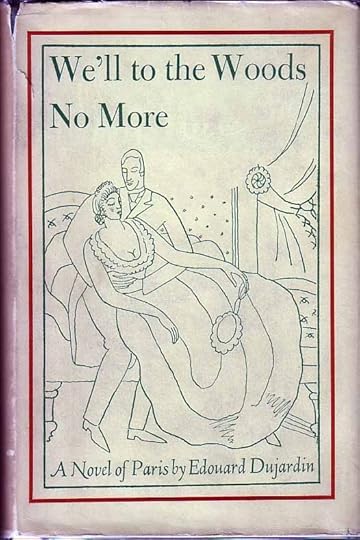
This brief novel is the first in space when it comes to interior monologue, full stop. Yeah, the alpha; Genesis 1, pg. 1; Genesis’ From Genesis to Revelation (28 March 1969; Decca); “Rocket 88;” Big Bang/Jackie Goddam Robinson/and some literary trinational hybridity of Chuck Yeager-Ed Hillary-Tenzing Norgay for books occurring entirely in the mind and its moment, a constant real-time, on the page. Short version: running interior monologue a la Ulysses; in fact, much the same leaf of tea.
Which translates, in praxis, to something very much like a Lou Reed lyric: “Now, who is that knocking? Who's knocking at my chamber door? Now could it be the police? They come and take me for a ride-ride. Oh, but I haven't got the time-time. ‘Hey, hey, hey, she's busy sucking on my ding-dong. She's busy sucking on my ding-dong.’ ‘Oh, now do it just like Sister Ray said.’” That particular VU pull was no accident, as, taking out the whole frustrating inability to find an uncollapsed vein for mainlining a little smackum yackum, Édouard and Lewis are writing about the same thing. That’s right: the evolution of and/or possibilities of a new literary modality as a pathway for self-expression concerns…(Mo Tucker drumroll)…getting fucking laid. Yep. Whole goddamn thing.
While it must be chalked up to fin de siècle mores and a plain ol’ case of being French, that the first-person thoughts of the dandy-bon vivant narrator are almost exclusively limited to 1880’s poetic flouncing around straight-up fucking/hoping to ‘get’ straight-up fucked are a total drag for just how predictable they are. Not only in its obsessive compulsion to bed a budding ingenue, more so in the larger solipsism that the very same compulsion betrays. Not only is too much frontal lobe dedicated to the description of said ‘buds’ (umm, the narrator isn’t musing on her career prospects), he spends the narrative as an explication of the ‘I—I—I’ as the totality of the universe. Now, I’m not unaware that Dujardin was a bright guy that ran in intellectual(ite) circles, nor am I blind to the obvious possibility that this solipsism was used as a device—an incredibly subversive one—to comment upon man’s prediction for the self and self-satisfaction above all other things…but I’m also not buying that shit, either.
Disclaimer: Bear in mind my oft-stated aversion to ‘romantic’ narratives unless used/extant for another purpose. I don’t answer to Harlequin. If you do, and by every and all means, then this may very well be up your amorous and puffèd sleeve. Remember the jaundiced eye informing this ‘review’ and decide for yourself. Oh, and at the request of the vox populi: they go and do stuff (…aaaaaaand that’s all the plot covered).
Postscript (The Serious Bit): It’s not on GR, but I’ve been reading this book by Carol Gilligan called Why Does the Patriarchy Persist? Well, Carol, your largest theses are supported by this, the same I now submit as evidence to the Court of Philosophy; Ethics, Virtue and/of Care Dept. Gilligan, who I hold is unfairly underread/discussed, centers the Oedipal Myth early in it as Freud gave it such columnar import in the reification of Western psychiatry as it is known and practiced today (good luck finding a Jungian shrink). Her contention is that Freud vesting Oedipus-as-myth with so much import illustrates how patriarchal systems are both born anew and perpetuated. She makes the brilliant point that the myth of Oedipus is, historically, based upon what are purported to be true events—but those true events are shunted aside when they’re even known at all. Cliff's Notes for those that mightn't: circa 1300 BCE, King Laius of Thebes was caught committing pederasty with some local young boy, and Laius was subsequently told by the Oracle at Apollo (the Freud of his time) that vengeance would come in the form of his firstborn son. When that child, the real Oedipus was born, a series of tragedies took place that, over time, were sublimated into myth. But all the other stuff? Not a part of history. Not even a part of the theoretical myth that begat the Oedipal myth. Ergo, the true story of Oedipus is one of trauma and tragedy, neither of which are very ‘masculine.’ (Plain: no motherfucking.) What does masculine mean? Well, Freud had an answer for that…something about loving thy mother, right? That he knew both the history and the myth (obviously he'd flipped through Sophocles Monthly once or twice) and chose the latter says everything to me about perpetuality (not to discount Freud’s inheritance of mantle as a man, etc, but stop the fucking buck somewhere, eh, buddy?) My point? Of course the first fucking first-person interior monologue novel is written by a man trying, at great length and with unsubtle remunerative enticement, to convince a young woman to copulate. I’m not faulting Dujardin for his choice; he was a product of an inheritance to which he was very likely blind. Nor am I saying that this barely read novel from the late 19th century is anywhere equal in impact to Freud’s disastrous effects on Western thought through today. So, what am I saying? Only that—maybe—it may serve us well, at least we men, to be aware of the operant levels that even the seemingly innocuous do regrettably occur on. Why? Because we SURE AS FUCK seem to have managed to do one hell of a SHITTY JOB since running the joint! Can we get new management? Please?
Digestif: While I guess it was worth my time reading the first of its kind (not really), I’m enriched in no way for it. In fact, all I want to do is wash all these goddamn secretions off my hands and smoke a cigarette—American. I’m a Camel man, me, just like my daddy before me and his daddy before him down here in the Old South(ern California). A smoke to blow away the stink.
And I have the oddest craving for one of those chocolate Ding-Dongs by Hostess Cupcakes. I’ve no idea why….