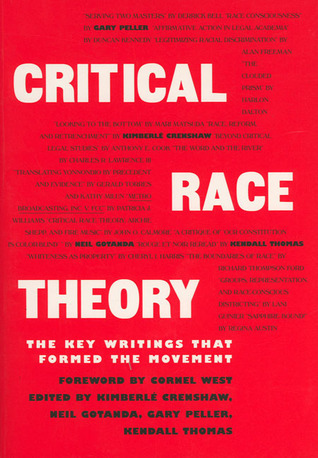
AN EXCELLENT COLLECTION OF ESSAYS ABOUT CRT AND CRITICAL LEGAL STUDIES
The Foreword by Cornel West to this 1995 collection explains, “Critical Race theorists have, for the first time, examined the entire edifice of contemporary legal thought and doctrine from the viewpoint of law’s role in the construction and maintenance of social domination and subordination. In the process, they not only challenged the basic assumptions of the prevailing paradigms among mainstream liberals and conservatives in the legal academy, but also confronted the relative silence of legal radicals… who ‘deconstructed’ liberalism, yet seldom addressed the role of deep-seated racism in American life.”
The editorial Introduction states, “This volume offers a representative, though by no means exhaustive, compilation of the growing body of legal scholarship known as Critical Race Theory (CRT). As we conceive it, Critical Race Theory embraces a movement of left scholars, most of them scholars of color, situated in law schools, whose work challenges the ways in which race and racial power are constructed and represented in American legal culture and, more generally, in American society as a whole.” (Pg. xiii) It continues, “however compelling the liberal vision of achieving racial justice through legal reform overseen by a sympathetic judiciary may have been in the sixties and early seventies, the breakdown of the national consensus for the use of law as an instrument for racial redistribution rendered the vision far less capable of appearing even merely pragmatic. By the late seventies, traditional civil rights lawyers found themselves fighting, and losing, rearguard attacks on the limited victories they had only just achieved in the prior decade, particularly with respect to affirmative action and legal requirements for the kinds of evidence required to prove illicit discrimination. An increasingly conservative judiciary made it clear that the age of ever expanding progressive law reform was over.” (Pg. xvii)
Richard Delgado suggests, “I think I have discovered a second scholarly tradition. It consists of white scholars’ systematic occupation of, and exclusion of minority scholars from, the central areas of civil rights scholarship. The mainstream writers tend to acknowledge only each others’ work. It is even possible that, consciously or not, they resist entry by minority scholars into the field, perhaps counseling them, as I was counseled to establish their reputations in other areas of law. I believe that this ‘scholarly tradition’ exists mainly in civil rights; nonwhite scholars in other fields of law seem to confront no such tradition.” (Pg. 48) He adds, “In explaining the strange absence of minority scholarship from the text and footnotes of the central areas of legal scholarship dealing with civil rights, I reject conscious malevolence or crass indifference. I think the explanation lies at the level of unconscious action and choice. It may be that the explanation lies in a need to remain in CONTROL, to make sure that legal change occurs, but not too fast.” (Pg. 52)
Mari Matsuda explains, “The movement known as Critical Legal Studies [CLS] is characterized by skepticism toward the liberal vision of the rule of law… by agreement that fundamental change is required to attain a just society, and by a utopian conception of a world more communal and less hierarchical than the one we know now. This movement is attractive to minority scholars because its central descriptive message---that legal ideals are manipulable, and that law serves to legitimate existing maldistributions of wealth and power---rings true for anyone who has experienced life in nonwhite America.” (Pg. 64)
Anthony E. Cook observes, “Many CLS scholars see the liberal conception of community as heavily dependent on the faith that the state can and does set community-defining boundaries that establish the limits of collective action through the neutral application of objective and determinative principles. Although sovereignty is theoretically vested in ‘the people,’ the specific nature and conditions of that sovereignty are … subject to the interpretation of a ‘judicial aristocracy’ of federal judges. CLS asks, ‘On what grounds can the people be legitimately robbed of this sovereignty?’ … The most troubling aspect of this story of neutrality and dispassionate adjudication is that those in power draw the line between public and private so as to preserve the distributions of wealth and power which limit transformative change and preserve hierarchies directly or indirectly benefiting them.” (Pg. 87)
Kimberlé Williams Crenshaw notes, “CLS scholars do not significantly disagree with the goal of racial equality, but assert only that the basic counterproductivity of seeking that objective through the use of legal rights… [and] that even engaging in rights discourse is incompatible with a broader strategy of social change. They view the extension of rights, although perhaps energizing political struggle or producing apparent victories in the short run, as ultimately legitimating the very racial inequality and oppression that such extension purports to remedy.” (Pg. 103)
She adds, “This belief in color-blindness and equal process, however, would make no sense at all in a society in which identifiable groups had actually been treated differently historically and in which the effects of this difference in treatment continued into the present. If employers were thought to have been influenced by factors other than the actual performance of each job applicant, it would be absurd to rely on their decisions as evidence of true market valuations… One could not look at outcomes as a far measure of merit, since one would recognize that not everyone had been given an ‘equal’ start. It would be apparent that institutions had embraced discriminatory policies in order to produce disparate results, so it would be necessary to rely on results to indicate whether these discriminatory policies have been successfully dismantled.” (Pg. 106)
She continues, “CLS literature exhibits the same proclivities that mainstream scholarship does---it seldom speaks to or about black people. The failure of the CLS scholars to address racism in their analysis also renders their critique of rights and their overall analysis of law in America incomplete. Specifically, this failure leads to an inability to appreciate fully the transformative significance or the civil rights movement in mobilizing black Americans and generating new demands.” (Pg. 110)
Charles R. Lawrence III says, “A crucial factor in the process that produces unconscious racism is the tacitly transmitted cultural stereotype. If an individual has never known a black doctor or lawyer … he is likely to deduce that blacks as a group are naturally inclined toward certain behavior and unfit for certain roles. But the lesson… is learned, internalized, and used without an awareness of its source. Thus, an individual may select a white job applicant over an equally qualified black and honestly believe that this decision was based on observed intangibles unrelated to race.” (Pg. 241)
Cheryl I. Harris argues, “At the individual level, recognizing oneself as ‘white’ necessarily assumes premises based on white supremacy: it assumes that black ancestry in any degree… automatically disqualifies claims to white identity, thereby privileging ‘white’ as unadulterated, exclusive, and rare… Recognizing or identifying oneself as white is thus a claim of racial purity, an assertion that one is free of any taint of black blood.” (Pg. 283) Later, she points out, “Even if one rejects the notion that properly constructed affirmative action policies cause whites no injustice, affirmative action does not implement a set of permanent, never-ending privileges for blacks.” (Pg. 289)
Kimberlé Williams Crenshaw states, “The problem with identity politics is not that it fails to transcend difference, as some critics charge, but rather the opposite---that it frequently conflates or ignores intragroup differences… Moreover, ignoring differences WITHIN groups contributes to tension AMONG groups… Thus, when the practices expound identity as ‘woman’ or ‘person of color’ as an either/or proposition, they relegate the identity or women of color to a location that resists telling.” (Pg. 357)
Later, she points out, “Because black women face subordination based on both race and gender , reforms of rape law and judicial procedures which are premised on narrow conceptions of gender subordination may not address the devaluation of black women… Thus, black women are essentially prepackaged as bad women in cultural narratives about good women who can be raped and bad women who cannot… These narratives may explain why rapes of black women are less likely to result in convictions and long prison terms than are rapes of white women.” (Pg. 369)
She says, “recognizing the ways in which the intersectional experiences of women of color are marginalized in prevailing conceptions of identity politics does not require that we give up attempts to organize as communities of color. Rather, intersectionality provides a basis for reconceptualizing race as a coalition between men and women of color… race can also be a coalition of straight and gay people of color, and thus serve as a basis for critique of churches and other cultural institutions that reproduce heterosexism.” (Pg. 377)
Regina Austin argues, “Implementation of an agenda for black feminist legal scholarship, and the expanded study of the legal status of minority women in general, will require the right sort of environmental conditions, such as receptive or at least tolerant nonminority publishers and a network of established academics engaged in similar pursuits. We minority female scholars must devote a bit of our sass to touting the importance of the perspective of minority women and the significance of their acceptable law review topics.” (Pg. 427)
Richard Thompson Ford says, “I disagree with the critics who insist that such attempts to combine insights about the necessity of group and cultural membership with pluralist and republican thought are hopelessly self-contradictory. Such a criticism misses the point that ALL political thought recognizes such conflicts and attempts to mediate them. I believe that my proposals and the analysis herein are largely consistent with these more sophisticated forms of liberalism, pluralism, and republicanism.” (Pg. 460)
This is a complex, detailed, and ‘academic’ collection of important essays, that (while hardly suitable as an ‘introduction’ to the subject for beginners) will practically be ‘must reading’ for anyone seriously studying Critical Race Theory, or Critical Legal Studies.