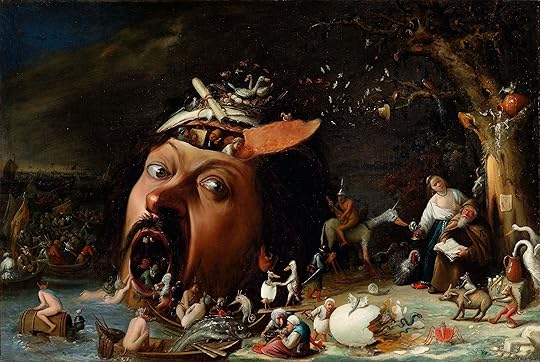
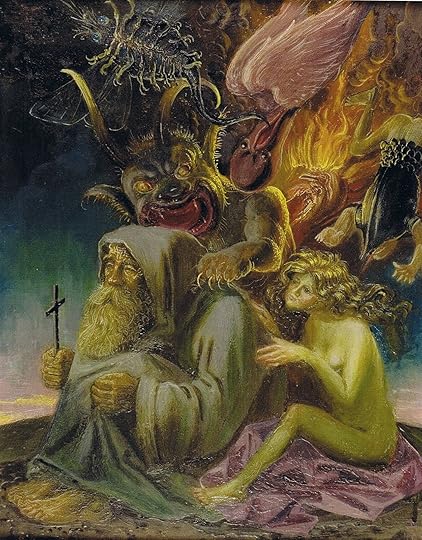
The temptation of Saint Anthony is Flaubert's entire life’s work. He had had the first idea of it in 1845, in Genoa, Italy, by watching a painting by Breughel, The Temptations of Saint Anthony. Besides, in the descriptions of the book, we find many of Breughel's paintings.
Since that time, he hasn’t stopped thinking about it.
In 1846, Flaubert launched into immense readings, without any apparent goal, but all of which gravitated more or less around the Greco-Latin antiquity and led by infinite detours on this terrible subject: Saint Anthony.
Flaubert works on his Saint-Antoine, episodically, all his life long. He wants to "get into the skin of Saint Anthony ... This is also a book that mustn’t fail to write. I know what's missing now, but it takes time, time ... "
In 1869, Flaubert starts again working on his Saint Anthony. He devours ecclesiastical memoirs, and the Fathers of the Church. He wants to find a logical link between the various hallucinations of the Saint. This extravagant environment pleases him.
But happen the death of his friend Louis Bouilhet and the Franco-German war of 1870. Flaubert is morally depressed. He can no more read and write.
Then he gets used to "what is the natural state of man, that is to say, to misfortune" and he works once more in his Saint Anthony.
In April 1872, Flaubert's mother died. Saint Antoine bothers its author like life itself. "I'd need enthusiasm to finish it," he writes.
In June, The Temptation of Saint Anthony is finally ended.
"... I'm done with this work that has been my job for twenty-five years!"
Flaubert’s work is slated by criticism in the press.
Personally, it was not easy for me to read The Temptation of Saint Anthony. To truly appreciate it, one must probably be as erudite as Flaubert in matters of religion, religions, history of Greco-Roman antiquity ... and I am not.
But what does it matter if, just like this poor Saint Anthony, sometimes I lost myself in this fantastic tohubohu of ideas and images. For Flaubert made me suffer like the holy man; I made his dreams, I suffered his nightmares, I lived his hallucinations.
But I also met the temptress Queen of Sheba:
« I am not a woman: I am a world! My cloak has only to fall in order that thou mayest discover a succession of mysteries. »
She offers Saint Anthony all she has (and the list is long! 😊).
« Do you want the shield of Dgian-ben-Dgian, who built the pyramids? There it is! Upon one side are represented all the wars that have taken place since the invention of weapons; and upon the other, all the wars that will take place until the end of the world. »
The whole world in a woman, all the wars of the world on a shield ...
… Aren’t these sentences simple, perfect, a jewel of thought ?
But the holy man is strong :
Hilarion says to him : « All the Capital Sins came hither. But their wretched snares can avail nothing against such a Saint as you. » And he adds :
"Hypocrite! burying thyself in solitude only in order the more fully to abandon thyself to the indulgence of thy envious desires! What if thou dost deprive thyself of meats, of wine, of warmth, of bath, of slaves, or honours?—dost thou not permit thy imagination to offer thee banquets, perfumes, women, and the applause of multitudes? Thy chastity is but a more subtle form of corruption, and thy contempt of this world is but the impotence of thy hatred against it! Either this it is that makes such as thyself so lugubrious, or else 'tis doubt. The possession of truth giveth joy. Was Jesus sad? Did he not travel in the company of friends, repose beneath the shade of olive trees, enter the house of the publican, drink many cups of wine, pardon the sinning woman, and assuage all sorrows? Thou!—thou hast no pity save for thine own misery! It is like a remorse that gnaws thee, a savage madness that impels thee to repel the caress of a dog or to frown upon the smile of a child."
I quite agree with Hilarion…
There are so many interesting thoughts, like this one :
"Is not the word of God confirmed for us by miracles? Nevertheless the magicians of Pharaoh performed miracles; other imposters can perform them; one may be thereby deceived. What then is a miracle? An event which seems to us outside of nature. But do we indeed know all of Nature's powers; and because a common occurrence causes us no astonishment, does it therefore follow that we understand it. »
Or this one :
Tertullien thinks that "Jesus’ face was wild and repulsive; forasmuch as he had burthened himself with all the crimes, all the woes, all the deformities of mankind."
But Saint Anthony replies : "Oh! no, no! I imagine, on the contrary, that his entire person must have been glorious with a beauty greater than the beauty of man!"
And you ? what do you think ?
Finally :
"... What is the purpose of all this? Antoine asks.
"There is no goal," the devil answers. "Things happen to you only through your mind. Like a concave mirror, it deforms objects, and you lack all means to verify their accuracy. You’ll never know the universe in its full extent; therefore, you cannot get an idea of its cause, have a fair notion of God, or even say that the universe is infinite. The form is perhaps an error of your senses, the substance an imagination of your thought. Unless, the world being a perpetual flow of things, the appearance, on the contrary, is all that is most true; the illusion, the only reality! "