The Washington Post has called Gene Wolfe "the finest writer the science fiction world has yet produced."
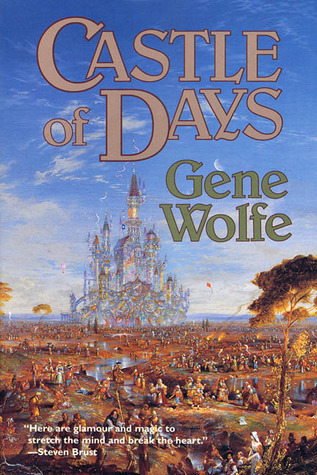
This volume, Castle of Days, joins together two of his rarest and most sought after works--Gene Wolfe's Book of Days and The Castle of the Otter--and add thirty-nine short essays collected here for the first time, to fashion a rich and engrossing architecture of wonder.
Gene Wolfe was an American science fiction and fantasy writer. He was noted for his dense, allusive prose as well as the strong influence of his Catholic faith, to which he converted after marrying a Catholic. He was a prolific short story writer and a novelist, and has won many awards in the field.
While attending Texas A&M University Wolfe published his first speculative fiction in The Commentator, a student literary journal. Wolfe dropped out during his junior year, and was drafted to fight in the Korean War. After returning to the United States he earned a degree from the University of Houston and became an industrial engineer. He edited the journal Plant Engineering for many years before retiring to write full-time, but his most famous professional engineering achievement was a contribution to the machine used to make Pringles potato crisps. He lived in Barrington, Illinois, a suburb of Chicago.
A frequent Hugo nominee without a win, Wolfe nevertheless picked up several Nebula and Locus Awards, among others, including the World Fantasy Award for Life Achievement and the 2012 Damon Knight Memorial Grand Master Award. He was also a member of the Science Fiction Hall of Fame.
A fun and fascinating portmanteau of a book, Gene Wolfe’s “Castle of Days” represents the shotgun marriage of two earlier Wolfe collections—“The Castle of the Otter” (*more on the title for this one later) and “The Book of Days.” The enjoyably idiosyncratic fusion of these two disparate works—which is tailor-made for Wolfe fans—amounts to a potent and delightfully piquant salmagundi (I love that word) of short stories, mixed in with a generous gallimaufry (another good one) of Wolfe’s essays and thoughts, mostly meditating on the creative processes behind his beautifully enigmatic masterpiece, the cycle of SFF novels collectively known as “The Book of the New Sun”. Some of these essays are more structured, and even exegetic, while others tend more toward the random and ruminative; but they all lend tantalizing insight into the magisterial mind of one of the greatest American writers of the second half of the 20th century. That he happened to be a writer of SFF is merely incidental to this fact.
The one qualification I’d give for reading and enjoying this book is that the reader be familiar with Wolfe’s “New Sun” canon. Otherwise, find a comfortable spot and dig into this eclectic congeries (yet another good one!), this fanciful farrago (yup, another), this potpourri, this melange, this dog’s breakfast, this dog’s dinner, this omnium gatherum, this fucking macédoine (that one actually looks made up; but seriously- how many awesomely archaic terms can be synonymous for the same fuckin thing??), you won’t be disappointed!
*Fun fact for fans of the New Sun: Wolfe originally found the strange and striking title for “The Castle of the Otter” in an obscure sci-fi trade publication, which made the utterly (in?)glorious blunder of mangling the title for the fourth book of the series (which is, correctly, “The Citadel of the Autarch”) into the magnificently nonsensical phrase, “The Castle of the Otter.”
Ovo definitivno nije knjiga od koje treba početi upoznavanje s Vulfom. Vulf je inače jedan od dva pisca pred kojima se uvek osećam istovremeno zaneseno i jezivo intelektualno neadekvatno (drugi je Nabokov) ali ove pripovetke i eseji (često prigodničarski) uglavnom ne spadaju u vrh njegovog opusa. Daleko od toga. Takođe, u nekom trenutku postaje bolno jasno da Vulf pripada onim ljudima koji vole da pričaju viceve koji nikome nisu smešni osim njima ali oni ih svejedno ispričaju, od srca se nasmeju i onda pređu na idući vic dok se ostali prisutni preznojavaju i osvrću za najbližim vratima.
Ali opet, ovo je čovek koji je napisao "Peace" i može mu se oprostiti i više od nekoliko loših viceva ili osrednjih priča (dobro, neoprostiv je Hitler koji pravi greške na nemačkom i to u kapsloku, ZERSTOREND GEWALT malo sutra). A može i jednostavno da se pređe na obnavljanje Knjige Novog Sunca jer zašto da ne (i zapravo, najbolje i za čitaoce najkorisnije strane ove knjige jesu one posvećene pisanju tetralogije).
This is only a review of the short fiction section "The Book of Days". A gimmick where each story is tied thematically in some way to an American national holiday (or significant event).
And man, they are mostly toothless and worse still, cheeseball. Surely this can't be the work of the same mind that brought us the infinitely imaginative Books of the New Sun series? Talking about neo nazi apocalypses or a perfect Tinder app. It's George Saunders without the wit, perspicacity and goofy charm.
Okay I'll give him flowers when due. Car Sinister is an absolute macabre delight that J.G. Ballard would have loved. Forlesen is the standout gem here amongst the pyrite on offering, with a cynical and mysterious take on wage slaves and the corporate structure.
I started in on the essays, but they were kind of flippant and even more dull. Maybe he's more charming in person. And if you have read this book completely and can recommend the "good" essays that I skipped, please let me know. It can't all be this bad.
On Writing and Writing. A fabulous collection of mild-dystopia, SF evangelism, and good old snarky letters.
Stephen King's "On Writing" is generally seen as one of the most popular books on the craft by a popular author. Wolfe's 1992 "Castle of Days" should be right up there. It combines Wolfe's 1981 story collection "Book of Days" and 1982's essay collection "The Castle of the Otter" along with additional essays on writing and writers, and it's wonderful
First off, "Book of Days" is a fabulous collection of short stories centered around popular (primarily American) national holidays like Armed Forces Day, Arbor Day, Memorial Day, etc. Other, more universal holidays (Valentine's Day, Xmas, Xmas Eve) have entries as well, but it's mostly American holidays here.
While these national holidays serve as a sort of binding agent for American society, Wolfe's stories show an America that is coming apart at the seams....whether it's rationalizing neo-corporate slavery in "How the Whip Comes Back" (for Lincoln's Birthday), fleeing up into the trees as secret police descend upon your town in "Paul's Treehouse" (Arbor Day) or describing how people won't donate money to save endangered flora/fauna, but they might pay money to destroy it in "Beautyland" (Earth Day) -- the tales here present inventive, sometimes plausible, but consistently show a society that has lost its way in ways big and small (the computer aided matchmaking described in "Of Relays and Roses" (Valentine's Day) that's the subject of a Congressional inquiry is particularly quaint in hindsight).
"The Castle of the Otter" is a similarly rewarding, but for very different reasons, collection of essays about how Wolfe came to write his opus, "The Book of the New Sun" -- the essays largely occur between the 3d and 4th volumes and cover everything from his influences, definitions of some of his more esoteric vocabulary choices, and a fun little collection of novel characters telling their versions of jokes (it's as weird as it sounds).
Rounding out "Castle of Days" is a series of essays/letters/convention speeches by Wolfe on everything from authors he admires, trends he abhors, and several full-throated defenses of SF/Fantasy (or "fantastical literature") as a genre of literature deserving and DEMANDING respect (and study). Most of these defenses come in the form of convention speeches. With the popularity and nigh-ubiquity of cosplayers at events like ComiCon and the like -- reading about hyper-niche SF **book** conventions in the early 1980s is simply adorable
Anachronisms aside, "Castle of Days" might be among my favorite Wolfe collections -- primarily because of its non-fiction components -- where we finally get a glimpse of the (friendly, sarcastic, passionate) sheep in Wolfe's clothing.
Castle of days is basically two books combined in one book, the first book consists of lot of short stories where Wolfe packs lot of content in few pages, and the second book are essays and interviews, where Wolfe gives an insight into his writing process, and also goes in depth regarding his writing process, and also goes in depth regarding his whole process in writing of Book of new sun.
I definitely enjoyed the short stories in first part of the book, but got a bit bored reading second part, because Wolfe goes into a lot of details regarding the writing process for a person who wants to be writer, but for a person like me who is not interested to be a writer, I got bored reading the second part.
Excluding the second part, I really enjoyed the first part of the book, and some of the short stories in the first part of book are jam packed with content.
Some of the stories which I remember distinctly are
1. Of Relays and Roses
Here a company designs an indigenous algorithm where they capable of predicting a suitable women for any person, and what this leads to another business's which are involved in divorce or remarriage.
2. Car Sinister
Another leap of imagination by Wolfe where cars reproduce to produce cars, with twist at the end.
3. Forlesen
The biggest short story in this collection, and perhaps most interesting one this tells the robotic nature of the modern day corporate life.
Above are just few stories which I enjoyed from this collection.
Some books you chase for a long time and they turn out to be great, some less so. I'd been hoping to come across or be gifted a copy of Castle of Days for a long time because I was desperately curious about one of the two books it was composited out of - "The Castle of the Otter", said to be the closest thing Wolfe ever wrote to an "explainer" for the great, somewhat impenetrable, Book of the New Sun.
My first discovery of course was that it's actually three books composited into one:
- Gene Wolfe's Book of Days, a collection of short stories Wolfe wrote themed around various holidays. This is easily the best part. The starter, "How the Whip Came Back", is a little thin in my opinion, but there are some other great, haunting stories in there - 'Forlesen", "The Changeling", "The War Beneath the Tree".
- The aforementioned Castle of the Otter which...I dunno. It feels unfair to say it but I expected a lot more from this section. There is a pretty fun part with Wolfe writing jokes for the different BOTNS characters, and an essay on the "destriers" that feels like it gets closest to what I wanted, but most of the rest of this section is taken up with talk about the writing of the books that's not super interesting, and a list of "here's what all the weird words mean" which I skipped as that's on my list of things to do for the next time I reread them.
- Castle of Days, which I believe was compiled specifically for this edition and which is mostly Wolfe's letters, conference speeches, etc. Maybe some hardcore completionists will love this, I mostly found it boring.
Overall - I will now be keeping my eyes peeled for a copy of Book of Days all on its own, which feels appropriate somehow.
Really, truly excellent, although its odd structure makes it kind of hard to recommend to most people, I think. The book is separated into three sections; the first being a collection of short stories, the second being a collection of essays detailing Wolfe's process writing The Book of the New Sun, and the third a random assortment of essays on pretty much anything.
The first third of this book is probably some of the best science fiction short stories that you can find; of the short stories I think the following are simply exceptional: Paul's Treehouse, The Blue Mouse, The Adopted Father, Forlesen, The Changeling, and Three Million Square Miles. It's really very, very hard to overexaggerate how good these stories are, and they kind of prove the cliche about Wolfe that he was one of a few writers who transcended speculative fiction. Paul's Treehouse, for example, is maybe the best exploration of upper-middle class anxiety I've ever seen filtered through Science Fiction. Three Million Square Miles is an amazing exploration of the alienating effect that the colonization of North America has had on the people in place to benefit the most from it. This is (I can't stress this enough) really good shit.
The rest of it? Depends on how much you like Wolfe, I guess. I happen to like Wolfe a lot, and I want to read his thoughts on SF and literature, so this book is "for me". Is it for you? I have no idea. Start with The Book of the New Sun if you don't know the answer to that one.
My main reason to buy "Castle of Days" were the articles about "The Book of the New Sun". They provide interesting background information and also reveal something about the author himself and his work as a professional writer. A must for every Wolfe aficionado. I considered the included "Book of Days" as a nice bonus but nothing more.
Recently I have started to read Wolfe's short stories that are in my possession and looked for the first time at the stories in this collection. In his introduction Gene Wolfe advises the reader to read the stories slowly and not as someone eats potatoe chips. This is a good advise because the stories require - without exception - some pondering and it's very likely that you want to reread them again to understand them better. Most of them are quite short and that's the main reason why they don't have the same impact as Wolfe's novelettes or novellas. However, I was surprised how much I enjoyed them and I can wholeheartedly recommend this book to lovers of short fiction.
Three books in one, the majority of which are for Wolfe acolytes only. The short story collection Book of Days is pretty strong, by turns whimsical, unsettling, inscrutable and profound. Different readers will have different favourites (I particularly liked the hardboild narrator in 'Beautyland'), but they all have something to recommend them. The Castle of the Otter collects essays on Wolfe's masterpiece The Book of the New Sun published before the final volume came out, so many questions in the series are not answered (readers are better off looking to the Lexicon Urthus for a guide to its mysteries). I am someone who puts a lot of emphasis on understanding authorial intent when finding meaning in fiction, and the tidbits here, particularly on Wolfe's inspirations and what first set him on the track of writing New Sun, were of some interest. Less useful is the lenthy account of the publication process and some of the early reviews. The final part collects more Wolfe non-fiction (and some fiction), most interesting in revealing how the research into the Byzantine empire for New Sun led to an interest in Greek history and the writing of the Latro books. But a lot of it is ephemera (including dated reflections on science fiction conventions and advice for would-be writers), and I have the sense that a lot of valuable Wolfe non-fiction is still out there and could do with collecting in a new definitive volume – not least his very revealing essay on J.R.R. Tolkien, as well as some of the interviews he has done.
I read it for the essays, but I did read all of the short stories too.
I liked Car Sinister, Forlesen, The Changeling and Many Mansions well enough, but the other stories were not for me. If you are also here for the essays I think you can skip the stories without losing too much. They are not in any way connected to the essays. The essays and the stories were originally contained in entirely separate works.
The Castle of the Otter is great if you want to know more about The Book of the New Sun and some of the process of writing that, as I did. The Castle of Days essays are about writing more generally and I also found these interesting to hear a little about publishers and conventions and a lot of other things I had never considered that are part of a writer's work.
Gene Wolfe recommends or name drops a lot of books and authors during the essays too, which I have written down and am taking as a good list of what to read next.
A collection that reprints The Castle of the Otter and Gene Wolfe's Book of Days in the first two-thirds, then adds a lot of uncollected ephemera - essays, letters, speeches, short stories, etc. As with the contained Castle of the Otter, this is only going to be of interest to those already seeking to read as much Gene Wolfe as they can.
I've reviewed the contained books on their own Goodreads entries, and can say only that they were interesting enough to read the whole, but wouldn't be if I hadn't already tumbled down the white rabbit's hole.
So many great stories in here. My favorites are Forelesen, Paul's Treehouse, How The Whip Came Back, The Blue Mouse, and The Changeling. Also loved all of the essays/commentary on Book of the New Sun (which I'm gearing up to re-read again later this year). And the last section of essays/correspondence had some real gems in there. Excited to dive into Algis Budrys and several others who are lauded by G.W.
Compiles a second-tier short story collection, a clutch of essays about The Book of the New Sun, and a brace of bonus essays on a broader range of subjects. Not top tier Wolfe, but fascinating stuff if you've read his essential stuff from his early career. Full review: https://fakegeekboy.wordpress.com/202...
Tucked in this neat little packaged deal are some of the finest examples of short fiction, advice in the form of short fiction, and the time honored-diatribe. This fantastical trove of insight will right the wrongs and wrong the rights that should be wrong, if we were to be right.
Recommended for those choking on a puddle of spittle under a lamp and stainless steel instruments.
Any fan of Gene Wolfe should read this! Infused with humour and wit, Castle of Days exhibits Wolfe's literary range in it's short stories, and his mastery of the art of writing in the instructional essays.
I'm kind of giving it five stars for the short stories and 3 or 4 for the essays, some of which were really cool, and others just really dated rants about the state of sci-fi back in the 80's and 90's.
++++++++++++++++++++ Sep '09: i discovered a bunch of my What Do I Read Next? reviews from the mid-90s when i was on a serious SF-canon reading tear (and, apparently, averse to capital letters). ++++++++++++++++++++
Plot Summary: a collection of stories, each of which is attached to a particular holiday or celebration day (e.g., Christmas Eve, Homecoming Day, Armistice Day). furthermore, as per the author's introduction, each story should be read only when in the mind frame of one celebrating such days. being part lemming (that's what my last name means), i first read the Thanksgiving story, "Three Million Square Miles," since i'd purchased the book in late November. i'm glad i didn't stop there, because i had yet to experience the literary and human beauty of "Forlesen" (the longest and BEST work in the collection)—mundanely, but accurately, slated for Labor Day—the prophetic "Paul's Treehouse" (Arbor Day of course), or the wait-til-they-read-the-last-sentence light bulb of "The War Beneath the Tree" (Christmas Eve).
i suppose a few story synopses are in order: "Three Million Square Miles" is the tale of a man who doggedly searches for the elusive, untamed three million square miles of land left in America; "Forlesen" gives us a day in the life of Emanuel Forlesen, a man who wakes up—along with his wife—completely unaware of who what where when why how etc. but who is given several instruction manuals, some material goods, and—apparently—instincts to survive (i sigh in remembrance of this exquisite, tip of the cerebellum, edge of the existential———*ahem* sorry about that *ahem*——onward!); "Paul's Treehouse" is about Paul (natch), an eight-year-old boy who decides to live permanently in the treehouse he has constructed 50 feet from the ground {2009 note: i'm reading The Baron in the Trees now}; and "The War Beneath the Tree" tells us of young, rich, Robin and his android toys/friends on the night when ideally not a creature should be stirring.
though these stories cover a wide range of themes, styles, voices, and greatness, and though most don't sound science-fictional in synopsis—every one is science-fiction or fantasy (some you might wish to classify as horrific?).
Comments: ATTENTION: anyone who ever lived and loved a story, read "Forlesen"! i can't remember a short story ever having as much of an effect on me; that haunted me spiritually, intellectually, and metaphysically this much; that urged me to read it again this frequently. (am i gushing?)
ATTENTION: anyone who ever tried to read Gene Wolfe but quit because he was inaccessible, start with these stories. admittedly, they are not as straightforward and as easily understood as, say, Vonnegut, but they're not anywhere near as dense as the two novels i've read (Shadow of the Torturer and The Fifth Head of Cerberus).
only a few of the pieces were worth less than the price of admission and almost every one of the others was an epiphany.
Originally published as Gene Wolfe's Book of Days; it is no longer in print under that title, but it is available as part of Castle of Days published by Orb (an imprint of Tom Doherty Associates, Inc.) in mass market paperback form in 1995 and hardcover originally by Tor in 1992.
Orb's version of Castle of Days includes the entire text of Gene Wolfe's Book of Days as well as sections entitled "Castle of the Otter" (writings on Wolfe's Urth of the New Sun series) and "Castle of Days" (various Wolfe pieces on writers, writing, and books).
Gene Wolfe's collection CASTLE OF DAYS is a must for fans, especially those who enjoyed his four-volume great work the Book of the New Sun. It consists of three parts, "Gene Wolfe's Book of Days", "The Castle of the Otter", and "Castle of Days."
"Gene Wolfe's Book of Days" is a collection of some of Wolfe's short stories, each representing a particular holiday. While these pieces are generally lighter and less substantial than Wolfe's other short stories of the late 70's and earlier 80's, there are several stories that are highly worthy. "Forlesen", representing Labor Day, is a clever jab at life in a corporation and it shows that the Dilbertesque workplace is nothing new. "The Changeling" represents Homecoming Day. A chilling and haunting piece, it takes place in the same town as Wolfe's early novel PEACE and illuminates a cryptic reference made there. This story alone makes CASTLE OF DAYS worth getting for fans of PEACE.
The second part of the book is "Castle of the Otter", named in jest after the mispelling of THE CITADEL OF THE AUTARCH which appeared in a 1982 issue of Locus. Subtitled "a book about the Book of the New Sun", it is a collection of essays about Wolfe's best-known work and can greatly expand one's knowledge of that world. "Words Weird and Wonderful", for example, defines all the archaic words in THE SHADOW OF THE TORTURER. "These Are the Jokes" is a collection of witty jokes, each told by a different character from the Book of the New Sun. "Onomastics" explains the names of many characters. "Castle of the Otter" was written when two of the four volumes of the series had been published, so it is a bit light on detail from THE CITADEL OF THE AUTARCH. Nonetheless, if you loved the Book of the New Sun, this part makes CASTLE OF DAYS the next Wolfe work worth getting.
The final section is "Castle of Days", which is a collection of diverse essays from the late 1980's. I found this the least interesting section, as much deals with science fiction fandom and a few pieces are rather quaint. However, there is the highly interesting essay "The Secret of the Greeks" which explains some of Wolfe's work on the Soldier series and why classical languages and literature are a worthwhile pastime.
All in all, CASTLE OF DAYS is an essential purchase for fans of Gene Wolfe. I didn't pick it up until six years after I read and was fascinated by the Book of the New Sun, and I instantly regretted missing out on such an illuminating collection. I can't recommend this collection enough.
This book is a joy to read from cover to cover. It is actually two books combined; Wolfe's 'Book of Days', a short story collection, and the non-fiction 'The Castle of the Otter'. The latter's title taken from a Locus writer who misunderstood the title 'The Citadel of the Autarch' and wrote it as Castle of the Otter.
This book begins with what was CotO, a collection of essays and anecdotes, many concerning the writing and publication of The Book of the New Sun quartet, others about writing and being a writer in general. Wolfe offers fun and endlessly interesting insights into the four books of the New Sun cycle with definitions, jokes, and other information about the publishing and release of he books. So, if you're a fan of the New Sun books, the first half of Castle of Days will make your day. Writers unfamiliar with Wolfe will still find his advice and experiences invaluable and entertaining.
The second half of the book (Book of Days) begins a unique collection of short fiction. The theme here is holidays with each short story representing a particular day. For example, one of my favorite stories in this book is called "Forlesen". In brief, the story is about jobs, the role of working for a living and its impact on our lives. Its corresponding day? Why Labor Day, of course. And so it goes, each story enjoyable, mysterious, and just plain good as is the majority of Wolfe's work. Highly recommended.
Wolfe is my favorite author, so I was looking forward to read some of his metawriting. While some of them are very creative and fun (he interviews himself, does an epistolary account of publishing deal in, and has characters from the New Son tell jokes in various "essays") many were rambling and didactic.
The short story collection at the beginning of the book has a very interesting premise: a themed story for a bunch of major holidays. You're supposed to read the stories on the days themselves, which is a very cool idea but I didn't have to stick to it. I didn't like all the stories that much but some were very good; "Many Mansions" for Halloween sticks out.
I haven’t read this whole book yet, merely the section previously published as The Castle of the Otter, which is Wolfe's own dissection and explanation of his (in-progress) dying earth epic. Reasonably spoiler-free, this appendix to The Book of the New Sun is well worth reading for insights into its creation and especially for the glossary to the archaic words peppered throughout the text. The rest of Castle of Days appears to be a short story and essay collection, and I fully plan to read it, but other books keep jumping ahead in line.
Devoting an equal amount of time to short stories, essays, and what would best be described as Book of the New Sun special features this book is clearly meant only for fans of Gene Wolfe. That being said, only Gene Wolfe fans are liable to have heard of this book. In conclusion, if you know about this book you will enjoy it thoroughly.
Bits and great bits and great great bits. Anyone who loves the Severian books will in mesmerelda delight, bite through. The Book of Days section recalls the best of Ovid's Fasti and pillow books couchant.
Some of the stories are a bit weak. A few bear more than a slight resemblance to Asimov's old "shaggy dog" stories. On the other hand, it's interesting to watch Wolfe in the process of "finding his voice". Kindof comforting to know Wolfe didn't just spring from the head of Zeus fully formed:)