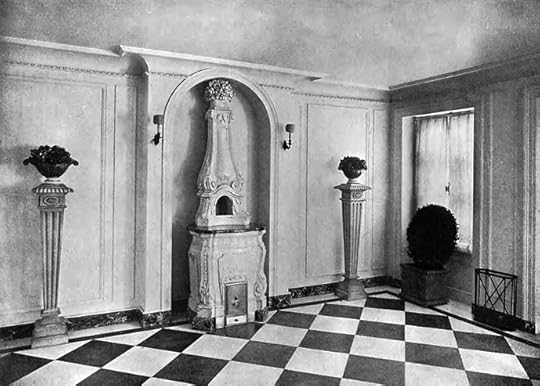
After ninety years, The House in Good Taste by America's "first lady of interior decoration," Elsie de Wolfe, still offers timeless design advice.
Compiled from her articles in newspapers and magazines and first published in 1914, The House in Good Taste is a seminal book on interior design with ideas that have lasted a century because they influenced not only the wealthy clients of Park Avenue and Palm Beach, but popular taste as well.
De Wolfe advised Americans to shun ostentation and clutter in favor of simplicity, to dismantle the draperies in order to let in the light, and to replace garish colors with beige and ivory. "I believe in plenty of optimism and white paint," she declared, "comfortable chairs with lights beside them, open fires on the hearth and flowers wherever they 'belong,' mirrors and sunshine in all rooms." The rooms that Americans inhabited in the middle of the twentieth century still today owe much to de Wolfe's tastes.
Elsie de Wolfe (1865-1950) was the first professional interior designer in America. She believed in achieving a single, harmonious, overall design statement, and felt that the decoration of the home should reflect the woman's personality, rather than simply the husband's earning power. De Wolfe introduced a startling freshness to the elaborate, heavily fringed and tasseled Victorian design sensibility of her time.
Before de Wolfe began helping her friends with home decoration around 1900, American homes had never been "designed." Upper-class women called in curtain makers, furniture salesmen, wallpaper hangers and other craftsmen, and then attempted to arrange these elements themselves. While carrying on the tradition of decorative surfaces and harmonious color combinations, de Wolfe cleared away the thickly curtained and upholstered look of the nineteenth century. Having spent summers in France, she had come to prefer the light, gilded interiors of Versailles and the delicate lines of eighteenth-century French furniture.
Elsie de Wolfe was born in 1865 to a fashionable New York City family. In 1884, she began an acting career, appearing in A Cup of Tea. At this time she met Elisabeth Marbury, who would become a lifelong friend and companion. Never an unqualified success in the theater, de Wolfe continued to act in various productions in the United States and abroad until she was in her early forties. At one stage of her career, while she had her own theatrical company, she planned all the stage designs, impressing her audiences with her great fashion sense, her fine eye for color, and her ability to create a harmonious environment.
By the early 1910s, de Wolfe had developed her own distinctive style, which included bright colors, fresh paint, and easily maintainable surfaces. One visitor described de Wolfe's home as a "model of simplicity in gold and white." De Wolfe covered dark wood with white paint, removed heavy draperies from windows to let in the light, and covered furniture in chintz. Her book The House in Good Taste (1913) has influenced several generations of designers. In addition to the Colony Club, de Wolfe's important design projects include the homes of Mrs. George Beckwith, Mr. and Mrs. William Crocker, the Barrymore, and Henry Clay Frick, as well as a dormitory for Barnard College in New York City.
In 1926, de Wolfe married Sir Charles Mendl and moved to Beverly Hills, California, where she continued to startle her contemporaries with her innovative designs. She was probably the first woman to dye her hair blue, to perform handstands to impress her friends, and to cover eighteenth-century footstools in leopard-skin chintzes.
Elsie De Wolfe may have been the first female professional interior designer (and she was half Canadian!) Some of her tips I gleaned from the book include:
- you can't have too many mirrors - cut fitted plate glass for table tops - use white muslin or matching gay chintz for curtains and upholstery - white, cream or gray walls - realize the advantages of stools and benches instead of tables and chairs - side consoles are handy when you need a table yet nest at wall when you need space - She hates Victorian styles
Best quotes from Elsie De Wolfe:
"The pendulum swings - and there is nothing new under the sun!" p. 78 "East or West, Home's best."
I would love to one day see the the Villa Trianon at Versailles where she lived as well as these places that she either decorated or greatly lauds:
- Fenway Court, Boston house of Mrs. Gardner - Inigo Jones - Palladian - Stanislas Palace @ Nancy (see the ironwork of Jean L'Amour)
I also found this hilarious anecdote from Wiki about her:
In her autobiography, de Wolfe writes that one day after arriving home from school, she found that her parents had redecorated the drawing-room.
She ran [in]... and looked at the walls, which had been papered in a [William] Morris design of gray palm-leaves and splotches of bright red and green on a background of dull tan. Something terrible that cut like a knife came up inside her. She threw herself on the floor, kicking with stiffened legs, as she beat her hands on the carpet.... she cried out, over and over: "It's so ugly! It's so ugly."
Originally published in 1913, The House in Good Taste by Elsie De Wolfe is a window into what interior design would have looked like at the time—for the upper class. De Wolfe had decided opinions on design and taste and wasn't afraid to share them. Here are a couple of gems I enjoyed:
"There is nothing more abused than the piano. . . I love music—but I am not a musician, and so I do not expose myself to the merciless banging of chance callers. I think pianos are for musicians, not strummers, who spoil all chance for any real conversation."
"There has been of late a vulgar fashion of having a huge mass of colored glass and beads suspended from near-brass chains in the dining-rooms of certain apartments and houses. These monstrous things are called "domes"—no one knows why. . . . It is the sight of hundreds of these dreadful "domes" in the lamp shops that gives one a feeling of discouragement. The humblest kitchen lamp of brass and tin would be beautiful by contrast."
I especially enjoyed the chapter on lighting, as electricity wasn't universal yet in 1913—although you can tell that Ms. De Wolfe was preaching to the upper class, because she mostly assumes that having it put in is not an issue.
I also enjoyed looking at the pictures of some of the rooms Ms. De Wolfe had designed. Here are some I liked.
All in all, I'd say read this if you're into interior design (there are good principles taught, even if it's not exactly up to date) or if you're really into the nineteen-teens.
Look, this book is very niche. If you’re not an interior designer and / or obsessed with historic design I don’t know why you would read it. It is a roller coaster ride of her saying fully unhinged things followed by incredibly insightful things and back again. She is so opinionated and convinced that her taste is the correct and enduring one I feel like she would be THRIVING as an influencer, which is after all the role she played in her own way and her own day.
My enjoyment of this book comes chiefly from its constant and joyful encouragement to make our houses beautiful. As well I liked its little historical tidbits, and the interesting window into the home lives of upper class Americans at the start of the twentieth century.
However, much of the book is taken up with descriptions of interiors that should rather be expressed in images. There are some black-and-white photos, but these do not nearly cover everything that the book now has to describe to me in text. Perhaps I'm just not imaginative enough. Still: a clear misjudgment, and I'll know to pick up a better-illustrated book next time.
She's delightfully opinionated, from the perspective of someone who picked up this book with nothing other than a mild curiosity on what interior decorating practices might have been in 1913. She nearly convinced me to try a floor cushion under our kitchen table, whatever that might be.
Would it be pretentious to make postcards featuring the exterior of our paltry apartment to give to guests to mail home? Only slightly more complicated than posting to Facebook.
DNF/skimmed. This was an interesting book that I’m glad I picked up. It’s written by one of the first professional interior designers and she gives what must have been a foundational education of interior design, especially on focusing on the overall rooms feeling of light, air and comfort/practicality rather than the previous generations focus on style over substance. But I’m not so interested in historical design that it was absolutely fascinating
Enjoyed the book, it took a long time for me to read as I was often pausing to imagine these marvelous spaces, imagining living in this proper and luxurious way. I was really surprised at the idea of water fountains indoors! This is not something I have come across before, but now I am very intrigued and I wish to see one.
Joking aside the trends are dated and her tastes are not my own but her design principles of proportion, usefulness, line, and color harmony are timeless. I will incorporate many of these foundations in my own simple home makeover. But boy there really IS an awful lot of chintz!
So I had to read this book for school, and i was NOT excited. BUT it was actually not bad and recommend it for anyone who is in the interior design industry
Reading this book is like jumping back in time, a century back in time, when the houses were huge and you cannot buy kitchens in Ikea. Fascinating.
Leggere questo libro significa tornare indietro nel tempo di almeno un centinaio di anni, quando le case erano immense e non si potevano comprare le cucine da Ikea. Affascinante.
For modern readers accustomed to glossy photos of aspirational homes, this book will disappoint. Mainly narrative with only 13 black and white photos exiled to an appendix. But if the reader is interested in time travelling to the early 20th century, to the salons and homes of the upper class. The author Elsie de Wolfe has a strong point of view and tries to offer practical advice, particularly in her chapter on decorating apartments. "When you do begin to buy furniture, buy compactly, buy carefully. Remember you will not require the furniture your mother had in a sixteen-room house."
A book for those interested in the history of Interior Design. (This is not a modern glossy decorating book). Elsie de Wolfe was a pioneer in the business. Her advice still applies today--no matter what your personal style or budget may be. She was a talent and a wit; she had me laughing out loud at times. I would love to go back in time and "do lunch".
An exquisite collection of pictures and explanations of the decoration of the early 21 century. It is impressive to have access to the reprint of the original 1913's book.
What a guilty pleasure of a book! Divine photographs, too. Some of De Wolfe's pronouncements make you laugh, but on the whole, she's right on the money.
Most interesting portion was the chapter on Villa Trianon! Otherwise, the writing style was conversational and difficult to read. People spoke differently during that period.
An interesting book on the art of decorating with a lot of food for thought on taste and what is good taste. The passing of time did not change most of the content of the book. Many thanks to Netgalley and Dover Publications
Exquisite collection of pictures and explanations of decoration of the early 21 century. It is impressive to have access to the reprint of the original 1913's book.
I am reviewing this book for Elsie de Wolfe, Dover Publications, and NetGalley who gave me a copy of their book for an honest review. I loved looking at the houses of the past – at least for the well off!