The first memoir for young readers by sports legend Kareem Abdul-Jabbar.
At one time, Lew Alcindor was just another kid from New York City with all the usual He struggled with fitting in, pleasing a strict father, and overcoming shyness that made him feel socially awkward. But with a talent for basketball, and an unmatched team of supporters, Lew Alcindor was able to transform and to become Kareem Abdul-Jabbar.
From a childhood made difficult by racism and prejudice to a record-smashing career on the basketball court as an adult, Kareem Abdul-Jabbar's life was packed with ""coaches"" who taught him right from wrong and led him on the path to greatness. His parents, coaches Jack Donahue and John Wooden, Muhammad Ali, Bruce Lee, and many others played important roles in Abdul-Jabbar's life and sparked him to become an activist for social change and advancement. The inspiration from those around him, and his drive to find his own path in life, are highlighted in this personal and awe-inspiring journey.
Written especially for young readers, Becoming Kareem chronicles how Kareem Abdul-Jabbar become the icon and legend he is today, both on and off the court.
As a center for the Los Angeles Lakers from 1975 to 1989, American basketball player Kareem Abdul-Jabbar, originally Lew Alcindor, led the all-time scores in history of national basketball association in 1984.
This former professional player current serves as assistant coach. Typically referred to as Lew Alcindor in his younger days, he changed his name when he converted to Islam.
I try to be conservative with my five star reviews, but there were just so many good things about this book.
I thought there was a good balance between Kareem's experiences with racism and intolerance without becoming overly political. It is an unapologetic look at who he has become and why, without attacking people for their different religious feelings. He skillfully approaches his life with a "here I am" lens but explains that in an age of tolerance, that doesn't mean we all have to be the same. e discusses systemic races as he and his friends experienced it in the 1960s, and though he doesn't have to come out and say it, it is clear that that systemic racism is still all too similar today.
This book goes so far beyond an autobiography of a sports hero, though it is a tremendous sports biography as well with sports lessons included. The look at who Kareem Abdul-Jabbar is as a man and as an athlete - and how they are completely dependent on each other - is a life lesson that many young people could definitely stand to learn.
This book leans toward the older end of middle grade/young adult but is a good read for most.
I've had a number of students blow through this and I was happy to have it for the little sports enthusiasts, but I assumed it would not interest me much. I don't know a hook shot from a touch down. I couldn't have been more wrong. BECOMING KAREEM shines not just on young Lew Alcindor's formative years but parallels upheavals in American society. Most moving are his relationships with his coaches and his religious journey. Sports fans won't be disappointed, but all readers who finish this will know what it means to live a principled life.
This is such an informative and inspirational book. My admiration for Kareem Abdul-Jabbar definitely doubled after reading this memoir! Powerful lessons about questioning social norms, assessing what you hear, learn at school, what your friends and parents teach you against your conscience, your logic, and your values, not just blindly accepting them, even if that means you sometimes feel absolutely alone.
So many books to pair this with! So many curriculum tie-ins. I think is must reading for everyone, not just sports fans.
And if I wasn't already in love with this book, he made it possible to pair with one of my favorite books from this year (Schomberg), quotes John Green, and Robert Frost.
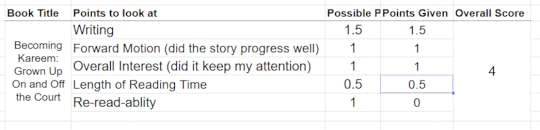
3,5/5. Very well done biography about and from Kareem Abdul-Jabbar a NBA player. The story sure talk about basketball but also about religion, racism and becoming who you want to be. Nothing really knew on those subjects or the way they are presented but just a good book that deserved its time.
I've been a Celtics fan since the early '80s, so I naturally hate the Lakers. It took a monumental effort on my part to read an autobio by an ex-Laker, but I did and you know what? I found out that Kareem is not in league with the devil. To be fair and honest, he is an immensely decent man.
I grew up as a Celtics fan in the 1980s when Kareem was a Laker at the end of his career. I always respected Kareem and found him to be an intelligent, articulate, and thoughtful person despite rooting for his primary rival. I discovered this book at the remarkable Planet Word museum in Washington, DC where it was identified as an influential book that had been banned in some areas.
The book was very well written and truly provided a genuine and thoughtful perspective on how an intelligent African American viewed how his nation treated him as he grew up and through college. The book explained why he left Catholicism and converted to Islam in a respectful and reasonable manner. Kareem also discussed his relationship with John Wooden and his high school coach. The rationale behind how he viewed the civil rights issues of his day was extremely well done. Highly recommended for anyone wanting to gain an understanding of how an African American might have viewed the world growing up in the 1960s into the early 1970s.
Wonderful book. Though I will say Abdul Jabbar seems to have used mostly simple writing. Felt like it was aimed at a middle schooler or high schooler. On a positive note this made it very easy to read and the book flows nicely. It was a pleasant and moving read.
I was hooked from the introduction. I love how he wrote, I wrote down a ton of quotes to reflect back on, I put one quote up in the classroom… Great fast-paced read chock full of lessons for young and old.
I really liked the theme of the book. Jabbar discusses all of the coaches in his life who helped him "become" Kareem, or the man he is today. Although he discusses his actual basketball coaches at length (and even wrote an entire book about his relationship with John Wooden) he broadens the term "coach" to mean anybody who ever inspired him in any way. While discussing these coaches in the book's introduction Jabbar says "some were writers, singers, poets, athletes, or activists whom I met, or who may have lived hundreds of years ago, but whose lives and works inspired me to see the world and find my place in it."
I read this in preparation for Jabbar coming to speak at my school district (COVID permitting) this year. This book will be a very timely one as it discusses police brutality in Harlem, the riots that followed, and Kareem's experience with subtle and overt racism throughout his life.
This review is dedicated to my dear friend, Keelin, who asked I read this book everyday for 2 years. The writing in this book was very simplistic, and the intended audience is more than likely middle school/high school readers. However, the story was still interesting, touching topics such as religion, race, and becoming the person you want to be. (I probably would’ve enjoyed this book more if I liked basketball.)
This book is great. I like the fact Kareem wrote this book himself. It provides so much more detail about his childhood and basketball career. He doesn't brag about his career achievements although it could be easy to do being he's the all time leading scorer in the NBA. I would recommend this book to anyone who likes basketball or likes nonfiction books.
I try to hand out my five-star reviews conservatively, but there were just so many good things about this book.
I thought there was a good balance between Kareem's experiences with racism and intolerance without becoming overly political. It is an unapologetic look at who he has become and why, without attacking people for their different religious feelings. He skillfully approaches his life with a "here I am" lens, but explains that in an age of tolerance, that doesn't mean we all have to be the same. He discusses systemic racism as he and his friends experienced it in the 1960s, and though he doesn't have to come out and say it, it is clear that systemic racism is still all too similar today.
This book goes so far beyond an autobiography of a sports hero, though it is a tremendous sports biography as well, with sports lessons included. The look at who Kareem Abdul-Jabbar is as a man and as an athlete - and how they are completely dependent on each other - is a life lesson that many young people could definitely stand to learn.
This book leans toward the older end of middle grade/young adult, but is a good read for most.
I Picked Up This Book Because: Seemed like a good idea at the time.
I’m not sure what I was expecting. I knew Kareem was a basketball player and I knew I would be hearing about his life. I was surprised to learn what a deep thinker he is. How educated and well read. How he lived and dealt with the civil unrest going on in the country while trying to build a professional career.
I think hearing this in Kareem’s voice made it feel so much more personal. Kareem is not just a record setting athlete. He is a man of many interest with quite a few tales to tell. More than even those in this book I’m sure.
My sixth grader read this for a class where he had to pick from a selection of memoirs, and I decided to read it as well. Kareem seems to be an excellent human being, and his life has intersected with fascinating people and historical times.
Here's what he says about boycotting the 1968 Olympics and "trying to explain why black Americans were in so much pain": "Sometimes it felt as if we were at the bottom of a well, shouting up to a crowd of people dressed in white summer clothes and having a garden party. Their laughter and conversation and music drowned out our cries for help, so we had no choice but to shout louder and louder, hoping someone would hear us."
About his relationship with Muhammad Ali: "His influence extended way beyond our connection as athletes. While I admired the athlete of action, it was the man of principle that was truly my role model. He taught me that personal success without community involvement was hollow and meaningless. Championship trophies and plaques and rings were merely building materials to construct a platform to rally people to fix a social problem."
Growing up even I, a kid who never watched or played basketball (outside of P.E. that is), knew the name Kareem Abdul-Jabbar. I knew he was a superstar on the court, and dabbled in acting (if you haven’t yet seen the film classic, “Airplane” find a copy!) But this autobiography sheds so much light on the life events that transformed Lew Alcindor into the man he is today. Events which include: racism, social awkwardness, a strict upbringing, and a variety of individuals who’ve made a positive impact. If you listen to the audio, you’ll get to hear Kareem narrate his own story. And I’ll just end this with a quote: “I'm sorry, son, but you must have me confused with someone else. My name is Roger Murdock. I'm the co-pilot.” - Sara Z.
I wish I read this when I bought it. This would’ve been so so so touching to read in middle school. Kareem is so cool. Like unbelievably cool. Just so unapologetic. Such a winner on and off the court. He got senioritis from winning so often in high school and college, then took the newly minted Bucks to a 66-16 record. He transformed an awful childhood to a great legacy as a person/player/activist. I hope he’s recovering well rn.
I wish he touched upon the discrimination and media coverage he faced towards the end of his Bucks tenure leading into the Lakers stint. Also, I fully understand why he’s so critical of LeBron. Waste of privilege methinks.
This book was obviously written with kids in mind but it was really powerful. 3/83 book ban books read. Good stuff.
I listened to Kareem read his book, which helped me more fully appreciate his perspective of growing up African American in the 50's and 60's - the decades covered. Joining in his realisation of the injustices African Americans have faced, face and will continue to face was a stronger experience than I have had before. I liked the central theme of choosing and becoming your name. Something Michelle Obama explored slightly differently in her book. Other themes besides basketball, are education, political activism, religion, and life coaches. He also gives a perspective on the history he lived through. My takeaway is that racism will always be with us and must be challenged daily.
This was a great book. My boyfriend and I chose this audiobook to listen to together because he loves sports and I love memoirs, but we ended up both appreciating it for the quality of the writing and the insights shared.
Personally, I also loved that the author acknowledged how different a book it would have been had he written it when he was younger and all of the struggles he’d come through were so much fresher and more actively painful. As it was, hearing him reflect back on a life well lived was very impactful and I definitely learned a lot, about the author and about the sport that means so much to him.
I don’t know much about basketball, and I know nothing about Kareem Abdul-Jabbar other than he was in an episode of The Fresh Prince of Bel-Air, but I love celebrity memoirs and heard great things about this one, so I decided to read it. I can see why it is so highly recommended. This surprisingly has very little to do with basketball; it’s more about the various coaches/influences in Abdul-Jabbar’s life that fostered his love for learning, competing, and advocating for change. He heavily discusses racism and growing up as a Black man against the backdrop of the Civil Rights Movement, noting how men like Muhammad Ali, Malcolm X, and Martin Luther King Jr. inspired him to fight for equal rights. I probably could have rated this higher, but I knocked it one star because it’s clearly written for a younger audience. It’s still a profound read for any age, and I love that you don’t need to be a basketball enthusiast to enjoy his story.
Although not as focused on basketball as I was expecting this to be, Abdul-Jabbar brings up some really good points about growing up during the days of Martin Luther King, Jr. and Malcolm X. Unfortunately, most of the points he raises are still concerns that exist today. I thought this was a good companion piece to The Hate U Give, with the bonus of not having as much sensitive content.
Quick, simple, inspiring read about the life of the legendary Kareem Abdul-Jabbar. Recommend this read to high school and college student looking to get a lesson in self-discovery, history, and psychology. Will be gifting my copy to a friend and emerging entrepreneur.
An excellent memoir for sports fans, and non-sports fans alike. This story tells a journey of discovering who you are, and how different people in your life can influence who you become.