In 1834, Osborne Russell joined an expedition from Boston, under the direction of Nathaniel J. Wyeth, which proceeded to the Rocky Mountains to capitalize on the salmon and fur trade. He would remain there, hunting, trapping, and living off the land, for the next nine years. Journal of a Trapper is his remarkable account of that time as he developed into a seasoned veteran of the mountains and experienced trapper.
“Perhaps the best account of the fur trapper in the Rocky Mountains when the trade there was at its peak.” - Aubrey L. Haines
"We butchered him, as he was very fat, packed the meat and skin on our horses and returned to the fort with the trophies of our bravery, but I secretly determined in my own mind never to molest another wounded grizzly bear in a marsh or thicket.”
The flavor of what it means to be a trapper and an iconic mountain man in the Yellowstone and Salt Lake area is captured in Osborne Russell's Journal Of A Trapper: Nine Years in the Rocky Mountains, 1834-1843. This is a rich and interesting journal that was wasn't written with retrospective nostalgia, but during the actual years covered.
That said, references to Native Americans as savages, indolent or pliant and thus one of the 'good Indians" are laced throughout the account, along with the belief that Native Americans can only be trusted, even those he says he has befriended, if he is carrying a gun. Early descriptions of Yellowstone, Old Faithful and the geysers as well as Salt Lake are a great backdrop to Osborn's activities.
Osborne Russell's journal is a fascinating read. The edition I read kept his original spelling and punctuation which made it difficult at times. No paragraphs and no periods! Often the reader enters the doldrums of the author's record keeping of navigation and geographic sightings as in "I traveled ENE 9 miles to the Fork of Milk Creek and set 4 beaver traps" but then there are surreal moments that are unbelievable if it was a work of fiction like being shot twice by arrows and dragging his body for 65 miles to the nearest fort and almost dying in the process, only to get patched up and hunt for beaver 10 days later. He faces grizzly bears, the elements, Indians, and the weakness of other men. I have traveled to the Grand Tetons and Yellowstone N.P. and his minute descriptions fulfilled my fantasy of "What did the first men think of when they saw this magnificent beauty?" Despite his spelling, he changed my view of mountain men from being brutes who would rather face the elements than be in society to men who were actually quite intelligent. He quotes classical works and mentions that he read Shakespeare, Bible commentaries, Geology, and Chemistry in the Fort's library. He humbly submits a poem which is actually quite good when you consider he wrote in on a mountain top under elements that soft, modern men would run from. Also, the edition I read had ample footnotes that transferred the names of mountains, valleys, and rivers to their current names and supplied additional information about these geographical locations. He even has the foresight to predict the extinction of the Buffalo and other species because of the massive harvesting of them some 50 years before the US government sends Bill Cody "Buffalo Bill" out to the prairies to get rid of them. This is a must read for anyone who loves Western history.
I liked it for the most part, but there were huge sections of just dates, miles, and directions with no real narrative. It would probably be more fulfilling with a map to follow. The actual narrative accounts were fascinating, and when he took the time to add his thoughts and impressions of the country his words jumped from the page. Unfortunately those instances are few. I would not recommend this to the casual reader, but it may be worthwhile for those with a deep interest in 19th century woodsmanship, trapping, and Native American interaction.
Osborne Russell was a New England born man who left to find his destiny in the Rocky Mountains in the 1830s and 1940s. He spent 9 years living with friendly Indians, trapping, riding, fighting hostile Indians, working for various fur companies, and keeping a daily diary.
This book is his (basically) unedited diary, and it's a treasure. It's hard to read because it's basically a hundred-page long paragraph without much punctuation. It tells of temperatures, and distances, and describes the wonders of Yellowstone. It talks of hunting and cooking, huge herds of buffalo, suffering in winter, the Rendezvous the Mountain Men are famous for, and his fellow mountain men. Punctuation aside, it's one of the most authentic accounts of the trapper days I've ever read.
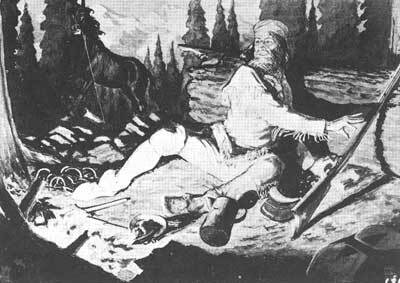
Most useful are the footnotes in the back of the book, which the editor added to help explain places and people Russell refers to. There are also many maps and reproductions of paintings by Charles Russell (no relation to the author) and others which set the tone for the book. I also enjoyed the biography of Osborne Russell, added by the editor, which prefaced the diary part of the book.
As you read this book, you will see his attitude towards wildlife change. At first he was happy to shoot multiple buffalo and only take choice parts. Towards the end he writes about the way the Indians kill only what they can use, and that perhaps white men should move on before all the wildlife is gone.
When Russell decided to leave the mountains, he wrote a beautiful poem (included in this book) which portrays a gentle, romantic side of the man that wasn't apparent in the rough and tumble of his diary. And the inclusion of some personal letters he wrote to family back East round out the whole picture of his personality.
I highly recommend this book to anyone who loves reading about the Old West, the Mountain Men, or historical diaries.
Russell cannot be reasonable charged with embellishment. Right from the get-go he recounts shooting a male buffalo literally dozens of times, and was unable to kill him and then going into a thicket after a wounded bear and narrowly avoids being mauled. More than one time the local Indian tribe leaves him entirely destitute taking everything to his name. Russell also gets lost, and generally seems to give a pretty unvarnished account of his time (unlike some ppl we might know *Hamilton*)
Some real dry bits that relay miles traveled and number of traps set... but overall valuable for its lack of BS
I’m not going to lie, this was one of the most challenging books I’ve tried to finish since high school. The writing is highly inconsistent and often dense. From chapter to chapter, the narrative shifts abruptly; moving from vivid scenic descriptions to dry, utilitarian logs of travel and movement. Yet, just as it becomes a slog, you catch glimpses of deeply reflective, almost poetic prose filled with genuine emotion and analysis. I was ready to call it quits, but the stubborn urge to finish what I started pushed me into a final reading sprint. I finally reached the appendix, which, in my opinion, was the most rewarding and nourishing part of the entire book. Ultimately, I’m glad I persevered. I originally picked up this journal to gain a raw, authentic understanding of the pioneer and trapper era around Montana and Yellowstone. While I could have easily just read a summary and skipped straight to the appendix, enduring the harshness of the primary text made the journey worthwhile.
Invaluable account of the life of a mountain man, one of few educated/literate enough to record the beaver era. Basically the whole book is endless descriptions of when he went where and what they killed (no punctuation allowed) but so cool to see the overlap in our regions. The real gems are his descriptions of the land and its fauna, the Natives he hangs out with or fights, and his occasional insights. Not many will enjoy this journal, but I liked it and can't rate it less than 5 stars due to its significance.
This was a personal journal by a man that lived the interesting life of being a fur trapper in the Rocky Mountains 1834-1843.
The events he lived through were fantastic to a modern reader, but as it is written it is a good audiobook to listen to when you need something to fall asleep. This is not written as a compelling page-turner.
Below is the poem the author wrote to close out his time in the Rockies:
“Adieu, ye hoary, icy-mantled towers That ofttimes pierce the onward fleeting mists. Whose feet are washed by gentle summer showers. While Phoebus' rays play on your sparkling crests; The smooth, green vales you seem prepared to guard, Beset with groves of ever verdant pine, Would furnish themes for Albion's noble bards, Far 'bove a hunter's rude, unvarnish'd rhyme.
Adieu, ye flocks that skirt the mountain's brow And sport on banks of everlasting snow, Ye timid lambs and simple, harmless ewes, Who fearless view the dread abyss below; Oft have I watched your seeming mad career While lightly tripping o'er those dismal heights, Or cliffs o'erhanging yawning caverns drear. Where none else tread save fowls of airy flight.
Oft have I climbed those rough, stupendous rocks In search of food 'mong Nature's well-fed herds, Until I've gained the rugged mountain's top, Where Boreas reigned or feathered monarchs soar'd; On some rude crag projecting from the ground I've sat a while, my wearied limbs to rest. And scanned the unsuspecting flocks around With anxious care, selecting out the best.
The prize obtained, with slow and heavy step Pac'd down the steep and narrow winding path, To some smooth vale where crystal streamlets met, And skillful hands prepared a rich repast; Then hunters' jokes and merry humor'd sport Beguiled the time, enlivened every face, The hours flew fast and seemed like moments, short, 'Til twinkling planets told of midnight's pace.
But now those scenes of cheerful mirth are done. The antlered herds are dwindling very fast. The numerous trails so deep by bisons worn. Now teem with weeds or overgrown with grass; A few gaunt wolves now scattered o'er the place Where herds, since time unknown to man, have fed, With lonely howls and sluggish, onward pace, Tell their sad fate and where their bones are laid.
Ye rugged mounts, ye vales, ye streams and trees, To you a hunter bids his last farewell, I'm bound for shores of distant, western seas, To view far-famed Multnomah's fertile vale; I'll leave these regions, once-famed hunting grounds, Which I, perhaps, again shall see no more. And follow down, led by the setting sun Or distant sound of proud Columbia's roar.”
Journal of a trapper is a unique recount of Wyeth's 9 year period in which he explored and experienced the life of a fur trapper and trader in the rocky mountains. The account talks of his travels all across the land and the relationships he built with his fellow trapper, Indians, and the environment. Through this book you really get the experience of a real Mountain man living off of the resources provided. He learns to trade and fight against the Native Americans as well as his competing trappers while also being able to learn and adapt the the environment. Overall this memoir is about mountain men doing what they do best. Surviving.
Overall I give this book a solid 3 stars out of 5. The reason it is not 4 or 5 stars is that it was like a diary. Time was moving so fast in the story that it felt like nothing was happening because there was no deep explanations of the days. Although if there was deep explanation, the book would be over 1000 pages long i still think that it was too fast. Through this though the book was enjoyable to read when important events happened. For example when he gets lost from his group but somehow finds his way back to them i was glued to the book waiting to see what happened. Not only this but the events that happened in this book were very specific to the time period and way of living back in the 1800 so it felt more special. AS if something I would never get to experience so I got to experience it through this book. No only this but the book had very good context to what was going to happen next. Almost every event had context that allowed me to truly understand what was happening all throughout the story. Overall this story was intriguing and fun to read. Although it could have improved in some areas it still kept me engaged for the most part.
My favorite quote from this story comes from when Wyeth and his partner killed a bear in the wilderness. After killing it Wyeth states "We butchered him, as he was very fat, packed the meat and skin on our horses and returned to the fort with the trophies of our bravery". What makes this quote so unique is that he shows no emotion through the writing. If i had killed a bear I would have talked about it for the entire book but it is just so casual for him even if he brings it as a trophy. Just cut up the meat and bring it back.
Osborne Russell ran away from his home in Maine at 16 years old, briefly went to sea, signed up for adventure with the Northwest Fur Trapping and Trading Company and spent a few years in the Wisconsin-Minnesota area. In 1834 at age 20, he begins his journal when he arrives in the Rocky Mountains and ends it in 1843 when he leaves for Oregon and the Willamette Valley. His journal was first published in 1921. His journal is just that, a log of where he went and what he did. The amount of territory he covered was impressive, some days going 30 miles over ridges and canyons to get from one stream to another in search of beaver.
He dealt with the Indians, difficult terrain, sometimes terrible weather, and the ever present need for food and shelter. The trapper’s kit was pretty much bare essentials; they lived off the land. The amount of game varied due to time and place. It was sort of a feast or famine situation, but he and his fellows were pretty hardy souls and made do with what came their way.
He mentions the rendezvous but doesn’t describe it very much. It’s usually just another notation in his journal. At random points he makes a general observation about conditions or people, but for the most part his notations are limited to went so many miles in such and such a direction to this creek or river or camp. He often briefly describes the terrain, for example, a lake of X miles wide and long with a valley of so many acres. He does not wax poetic but does admire the beauty of certain places.
Nowadays we think a 16 year old runaway would be pretty limited in his writing abilities; Russell abuses that notion. He writes quite well and makes some judicious comments at times. He uses the language far better than some rude backwoodsman. The journal gives a good description of the everyday life of a trapper in the Rockies in those days; Osborne Russell was a real mountain man.
This was a recommendation to the question “What should I read (fiction or non-fiction) before going to visit the Grand Tetons and Yellowstone National Parks?”. Had it not been for that, I don’t think I would have ever come across this book or felt compelled to read it. While not my top recommended read before visiting the parks or in general, I am happy that I crossed paths with this book. Before going to the parks, I would recommend Along the Ramparts of the Tetons: The Saga of Jackson Hole, Wyoming.
This reads very much like a trapper’s journal would, so be prepared for day to day repetition of a hard life, which in itself is a good read coming directly from the man experiencing it. There are some great surprises along the way that enhanced my reading experience:
“Here we had plenty of wood, water, meat and dry grass to sleep on, and taking everything into consideration, we thought ourselves comfortably situated- comfortably, I say, for mountaineers, not for those who never repose on anything but a bed of down or sit or recline on anything harder than silken cushions, for such would spurn the idea of a hunter talking about comfort and happiness. But experience is the best teacher, hunger good sauce, and I really think to be acquainted with misery contributes to the enjoyment of happiness, and to know one’s self greatly facilitates the knowledge of mankind.”
Reading Russell’s first encounters with geysers and Old Faithful, interacting peacefully and not so peacefully with various Indian tribes, sleeping in the snow and an encounter with a rascally wolverine.
His observation of the Natives in the Eutaw village: “There seems to be happiness in ignorance which science and knowledge destroys.”
This book, through journal entries, tells the life of a trapper/mountain man in the Rocky Mountains. Osbourne Russell tells of his experiences hunting elk, buffalo, deer and even shooting bears. He traps beavers and shoots water fowl. Among all these expeditions he has many encounters with Indians. Some were friendly and welcomed him and his companions to their camp. Some were not friendly, they stole horses and supplies and once he was shot in the leg. During his expeditions he travels through Wyoming, Idaho, Montana, Utah and ends up in Oregon. The descriptions of the land was very interesting for me because I grew up in Montana, traveled extensively in Idaho, Wyoming and Utah and so I could often recognize places that he was writing about. Other times I was confused and had to consult a map to try to decipher where it was he was talking about. He travels through "Yellowstone Park" and talks about geysers, hot pots, and what they called the "hour spring" a hot geyser that erupted every hour and shot 60 feet into the air. (I bet you can't guess what that is called today.) Oh, one other reason I liked this book was that Mr. Russell met up with and often traveled with Jim Bridger - my favorite mountain man. He is my favorite because of the many things he did and because I grew up in a small town named after him, Bridger , Montana. The only drawbacks to this book is that it is printed in original form, so no editing and that it is printed on full 8 1/2 x 11 in pages with no paragraphs or columns on the page for easier reading.
One of the rare books of this type that admits that the depredations inflicted by white men on the fauna of the west was a terrible mistake, but it’s only one sentence toward the end of his time in the western lands — and he certainly had no compunctions about killing the numerous Indian people already there.
The main drawback of “journal” narratives is that in most cases they’re really not. They’re just a quotidian accounting of events, often laconic, e.g.,November 1 — camped by the Powder River. Eight inches of snow fell. November 2...
These books still offer a look back at the exploration (though it’s mostly extirpation of Indians, beaver, and bison) of a previously pristine and changing landscape, and that’s why they attract, but too often it’s a look back in horror. Nonetheless, it doesn’t detract from Russell’s intrepidness and determination at making a life for himself (at too great a cost, I believe). We can’t change history. We can only hope not to repeat our terrible mistakes.
For those willing to be patient, and those seeking a clear descriptoon of a mountain man's life in the Rocky Mountains of the early 1800s, this story delivers. I've learned from here not hollywood's version, but the truth and vigor of those who journeyed into an unknown and dangerous landscape. This is a journal, written with eloquence, by the man who lived it. Yes, there are passages a bit thick with directions--due south along the river for 15 miles to a fork flowing easterly through a canyon of high cliffs--but there are also unfluffed reports of encounters with the tribes, friendly and not, with grizzly bears, vast herds of buffalo, elk, and antelope, and the material of the day to day "doing" of such an incredibal part of our history. Highly recommended for those of us who wish we could have lived it, and those who simply want to know the reality of the wilderness that became the United States.
This is a first-hand journal of a Rocky Mountain fur-trapper during the mountain men era (1820s-1840s). For those looking for an adventurous read, they'll find bits of it, but will probably be disappointed. Much of this book is a recounting of where and when the man moved in his quest for beaver pelts and fresh game. But there are exciting events mixed in, including battles with Indians and wild animals. This book is best appreciated by students of history. It's easy to hear this man speak in his writing, it's what you'd expect from a man living moment-to-moment on the frontier. It's not the romantic image we paint looking back, but more a blunt struggle for survival. An interesting piece of history.
I'm close to opening another selection of my goodreads shelves for 'wilderness/outdoor' - they have been a genre of stories I did not think I would enjoy, but it is interesting to be able to look back into the past and see the world through the eyes of those who lived at that time - good, bad, and indifferent.
I did not realize when I started this that it would have cross over with previous trapper's narrative, but similar stories and places began being mentioned and I was all like: 'hey, I know them', but from the alternate perspective. It has also settled in my mind how much of the previous autobigraphy was likely fabricated as some pretty large characters and events mentioned were not even addressed by Russell. But I suppose auto biography must often be 'believed at arm's length'.
I love this early "Mountain Man" and fur trapper genre as most describe the very difficult task of heading into entirely unknown land, geography, weather, flora and fauna, and opposition, then just taking whatever comes. Osborne Russell did this for nine years and kept a journal he later published and which has survived these nearly 200 years.
Much of the journal tells the story of danger, difficulty, near-misses, deaths of friends, that one would expect of the era where life expectancies were very short and these adventurers made them even shorter. But much of the journal was of the "today, we walked thirty miles from here to here" type of journal entries that made. it plod more than it should have. Still an interesting look at the west of very early American history.
I have read this several times and each time gave come away with new insights into the history of the west. First, the rate of interaction with the indigenous people always makes me wonder how high was their population 1-200 years earlier, prior to the crash following disease introduction by Europeans in Central America. Also, it shows the wide diversity of backgrounds of people in the fur trade, Russell a journalist and some of his associates had some formal education based on their campfire discussions. Last, after reading his hunter's farewell poem, I remain convinced nothing expresses feeling better than poetry.
With a perfect narrator’s voice this lulls me to sleep at night. One of the better journals and memoirs of pioneers and western travelers that I’ve read. It matters not if I drift off as it’s easy to pick up later, or repeat. Well written (1840’s) with a great attention to detail. You really feel that you are in those places in that time period. Because this was an audio, I am missing maps and footnotes. Worth reading for the Appendix alone where he describes in great detail and accuracy, the various Indian tribes he had contact with, the animals that he hunted or trapped, their peculiarities and their value.
I thought I would be reading about the trials and escapades of a mountain man.. but what I got was a travel log of all the rivers and streams in the "west". I know to go west or north or south or east to find this stream or river or meadow but I still don't know much about the life of a mountain man. This was supposedly written by an uneducated person from Boston.. I wish I could write as well as this uneducated Bostonian "did".......
Super interesting read of life in the Rocky Mountains during the 1830s and early 1840s. "A party came from the United States" Wild to think that they weren't part of the US then and to read about the annual supply wagons coming from the States and buying a bit of coffee or sugar or a cotton shirt. Most of what they wore were animal hides, including their footwear.
The format is in the original journal entry style with little to no punctuation so that makes it difficult to track at parts, but other than that, it's a great read.
While this is undoubtedly a racist account, it is nonetheless intriguing.
Definitely worth the read if you are interested in the era and of understanding what the average person was like of this time.
After having read Bury my Heart at Wounded Knee I was curious what the average white trappers life was like and how they could fathom or commit the atrocities they did, stories like this help to contextualize it *NOT EXCUSE*.
Modern trappers were undoubtedly a mess of contradictions and this was a great exploration of one mans inconsistencies.
The book was great, but I also found some interesting changes in language. Telling a "fish tale" had to be defined as if it was new slang. Rather than saying that someone was sitting "Indian style" he said that the Indians sat Turkish style. Apparently, that slang had not caught on yet either. Most fascinating was the last few minutes of the book. Those uncanny details are amazing! But, I don't want to spoil the best part of the book here.
The author went through some amazing adventures and experiences with a unique perspective on the place and time. This book had so much potential, but I think his skills as a writer failed him. There were a few points where he waxed poetic, but most of the time he just skims over really fascinating experiences, and goes back to listing how far they traveled and camped every day. This is a book that could have used a ghostwriter.
This was a boring in spots but there were highlights of a past and scenery and even animals and their behavior that we can only imagine now. The insight into different Native American tribes was fascinating and his descriptions of animals and tribes and their lifestyles and characteristics at the end of the journal were very enlightening.
This is probably the worst written book I have ever read. I know he was not an writer, and he does give a hint now and then that he does have some deeper thoughts. I struggled through it and glad that I did just to have a "trappers" journal of his day to day life while being a trapper in the Rocky Mountain West.