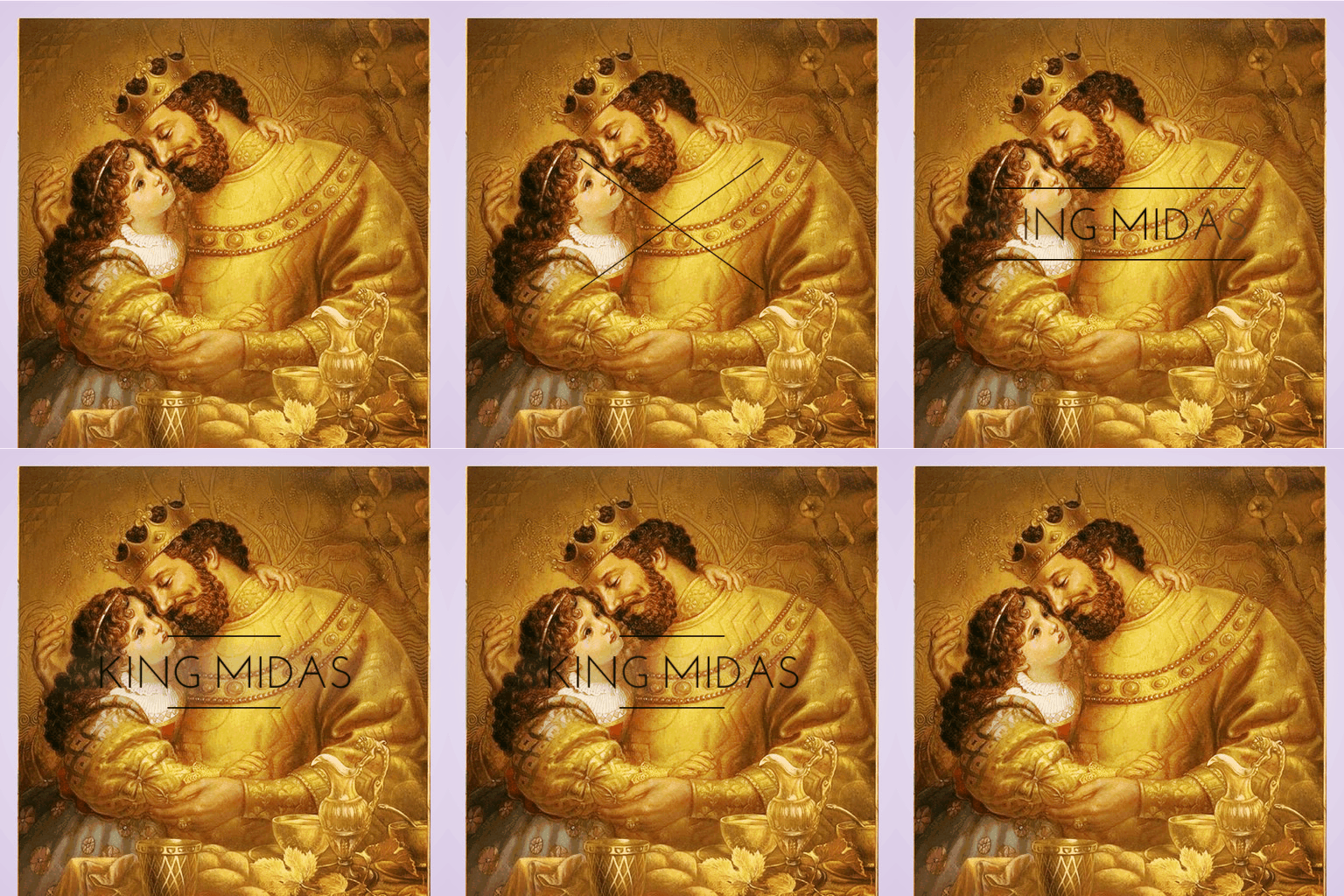
فقط یک چیز در دنیا بود که شاه میداس بیشتر از طلا دوست داشت و آن هم دختر کوچکش بود. یک روز پیرمردی مهمان او شد و آرزوی همیشگی او را برآورده کرد. از آن پس، او به هر چیزی که دست میزد، تبدیل به طلا میشد. خوشبختی او زیاد طول نکشید، زیرا دختر عزیزش نیز تبدیل به مجسمهای طلایی و بیروح شد.
Charlotte Craft studied comparative literature at Columbia University in New York. After graduating, she traveled to Japan, where she worked as an interpreter and photographer. She now lives in Scotland with her family. The New York Times complimented her first book, Cupid and Psyche, for its “clear, simple text” and noted that the book a “excels in conveying the mythology.”
الطمع يجعل الاغنياء فقراء الملك ميداس ملك يوناني واقعي تروى عنه اسطورة خيالية :انه لم يكتفِ بمُلكه تمنى أن يتحول كل شيء يلمسه إلى ذهب، فلبت له إلهه الميثولوجيا اليونانية هذا الطلب بعد أن رأى صنائع حسنة فعلها ميداس، وصار ميداس الآن يحوّل كل شيء يلمسه إلى ذهب، ويا لفرحته عندما لمس حصاة صغيرة فتحولت ذهباً،، فذهب إلى أهله بنشوة ليحمل الأخبار العظيمة فلما أمسك بابنته فرحاً ليبشرها تجمدت على هيئة تمثال ذهبي، وأصابت اللمسة الذهبية كل شيء حتى الطعام، وندم ميداس على تلك الأمنية التي حوّلت حياته إلى جحيم لتنتهي اشهر اسطورة عن الجشع الانساني اللامحدود
هر کدوم از نقاشی هاش واقعا مثل یک تابلو هنری پر جزییات بود و چندجای داستان به جای متن داستان با تصاویر جلو میرفت داستان ساده و قابل پیشبینی ولی قشنگ برای بچهها هست.
A retelling of the ancient Greek myth of King Midas, who foolishly believed that gold was the ultimate blessing, only to learn his lesson when Dionysus gives him the gift of the "golden touch." Unable to eat golden food, or drink golden water, Midas is miserable - but when his new-found ability transforms his beloved daughter Aurelia into a golden statue, he truly knows sorrow...
Based upon the version of this story found in Nathaniel Hawthorne's A Wonder-Book for Girls and Boys, Charlotte Craft's narrative is engaging, but it is the illustrations by Kinuko Craft that truly give this picture book a magical quality. One of my favorite illustrators, Craft's work is always vibrant and richly-detailed, with a lushly romantic quality, and her luminous, light-filled paintings are always a delight. Although this is a classical story, Craft chooses to locate it in a more medieval setting, making it seem like more of a fairy-tale than a myth. The scene in which Midas rushes down the stairs, a wave of golden transformation fanning out behind him, is exactly the kind of picture I would have spent hours poring over as a girl. Highly recommended to folklore and mythology lovers, and to anyone who values beautifully-illustrated picture books.
For a story that could easily become a moralizing tale, the Craft duo take Midas's woes more seriously. I like this version of the tale about as well as any I've heard before. Well worth using to introduce young readers to this tale.
Nicely retold myth of King Midas but what is really outstanding about it are the illustrations! So many little details in the full-color, full-page artworks and even the initial capitals change to match the story.
This is a beautiful book. Recommended on multiple lists, but specifically on the third grade read aloud lists for Memoria Press curriculum and I look forward to that. We found it at the library, and I am ready to blindly trust their lists, because everything they suggest is worth buying for our own shelves. K.Y. Craft is an artist that I stumbled upon by accident when I saw a gorgeous book in the library, it was Baba Yaga and Vasilisa the Brave, which is another one on our to-buy list. King Midas and the Golden Touch is beautiful as I said and I definitely would go for more stories told by Charlotte Craft. I'm not sure that I knew this book before, but I did know the story and this is a gorgeous way to read it. With large images and small to adorn the pages as well as some full two page spreads that continue to tell the story with images instead of words in parts is amazing and powerful for the readers. While right now I was reading this for my own benefit and not to my girls, I am quite sure that they will love it. I will not hesitate to buy this one when I find the right price.
I remember being told the Nathaniel Hawthorne version of the story. Which was really mournful for me back in my childhood. However, I'm still a big fan of it; I grew up fond of dark romanticism genre. It suggests that sins like the seven deadly sins yet guilt and evil are naturally inherent in human beings. This is absolutely true. I believe that parents must tell their children dark versions of the fairy tales. For me, I wouldn't like it if my child grew up believing that the world is so nice and will do him good, and life is a rose pink and fairy tales can possibly happen in reality.
I was just thinking that not every child will respond to a tale in the same way. Some will be fond of the greediness of the king, some will feel agonized for the state the king had reached, some will fear to make a wish because what you wish for might just come true. We should not expect children to interact with one interpretation of the story (good interpretation). We should keep their eyes open to the rest of the possibilities and discuss them with them and give them the freedom to adopt the opinion they want for themselves.
Now allow me, dear readers, to shred this tale into piece:
First of all, I like to admit that I do not have the slightest concern of seeing any goodness, or bright side of any story or the explicit meaning it holds. However, I like to focus more on the badness and the implicitly. It's more fun and stimulus.
Greediness And the first deadly sin we have is: greediness. When I was reading that King Midas "had everything that money could buy, but he wasn’t happy." I said alright, that's cool, he might be lonely, melancholic, lost a loved one. But hell no, he's just a greedy MOF , "More than anything else, King Midas loved counting his money and piling it into great shining heaps of gold, but always he wanted more." However, when a wish was offered to him, he could not think of something else but to wish that everything he touches turn to gold. YOU HAD ONE WISH! AND YOU BLEW IT, BITCH.
Pride Let's go back to the first lines of the story, where you'll discover the second deadly sin for the day: pride. That mad kind is taking a huge pleasure of counting his gold like a maniac, "More than anything else, King Midas loved counting his money and piling it into great shining heaps of gold, but always he wanted more." This is so close to the character of The Businessman in The Little Prince, he was concerned with matters of consequence, like counting an recounting the stars so he can be richer. Nevertheless, that Businessman said one hall of thing to The Little Prince, "Kings do not own, they reign over. It is a very different matter."
Gluttony Well, what King Midas did with his old school teacher and the friend of the God Dionysus MIGHT look so generous, lovely and thoughtful of King Midas, but no. Let us just focus on the implicitly: Gluttony, our third deadly sin. As you see, it was just the two of them for a meal. However, King Midas felt the urge to show off in front of the old man and "he ordered his servants to prepare a feast for him." See the word FEAST, this is gluttony mixed with greediness.
Dionysus Obviously, gods judges by appearances. COME ON, HE'S A SINFUL KING! But who can blame Dionysus; he's the god of ritual madness and religious ecstasy. However, this story explicitly tells us that the God Dionysus is kind of merciful; he's not a Genie who can't reverse a wish you've made. He'll give you the wish you want and watch you regret it, and beg him until his ego is fully satisfied then he'll reverse your wish.
And now, that I'm all satisfied with my critique I'll leave you for your thoughts.
Retold by by Charlotte Craft and illustrated by KY Craft, this timeless tale was a delight to read again! The illustrations are just beautiful and mesmerizing! Also please bare in mind that the tale is modified a little but still bares resemblance to the original and is very well written and the illustrations are just spectacular!
Beautifully illustrated. The vocabulary was advanced, but with conversation and dramatic reading, nearly every 6/7 year old student was able to comprehend and retell the story.
یکی دیگه از کتابای کانون که تصویرگری «بسیااار حیرت انگیز» و فوقالعادهای دارن. من واقعا از دیدن عکسای این کتاب سیر نمیشدم :)) هنوز هم سیر نمیشم :) البته خود داستان هم (بازگویی افسانهی شاه میداس) خیلی قشنگ و قابل تأمل (و صدالبته آموزنده) بود.
Gorgeous illustrations are the highlight of this retelling of the classic myth. Deep jeweled tones and exquisite details place the setting of the story in a medieval castle, making the story feel more like a tale from the Brothers Grimm.
The narrative isn't too long, so this would be a good book for most elementary school-age children. Our youngest daughter and I had both read The Chocolate Touch recently, and so I thought this would be a good way to compare the two tales. We really enjoyed reading this book together.
According to the illustrator's note, the author based her excellent retelling on Nathaniel Hawthorne's retelling. However, scholars believe that the Phrygian King Midas on whom the myth may have been based appears to have lived in the 8th century B. C. The illustrator, in her note, states that she placed the setting during the Middle Ages (no particular year) in an unnamed European country, to "bring the tale just a bit closer to our own century." Her exquisite paintings were rendered in oil over watercolor. Three beautiful double-page spreads enhance the overall beauty of the book and illustrations. This picture book is perfect for K and early elementary children.
The myth of King Midas is one of my favourite stories from the Greek tradition, but I really enjoyed Craft's change of location to a mock-War of the Roses-era England. Greed for gold is afterall a universal problem, and the contrast of the living roases that the King's daughter loves so much is a nice nod to the English themes.
In teaching different genres of literature with my students, I have used this to teach myth. Because the story itself leans heavily upon a moral, students will want to identify this as a folktale. So I do just a little groundwork with explaining its origin in Greek mythology.
King Midas and the Golden Touch (2003), written by Charlotte Craft and illustrated by Kinuko Y. Craft, is a book about the the mythological figure King Midas and the origin story of how he got his powerful touch to turn everything gold. King Midas loved gold more than anything in the world, except for his daughter. One night, while feasting, his men find an old man asleep in the King's rose bushes; when his men try to capture and imprison the old man, King Midas instead takes pity on the man and invites him in for a feast. The next day, the old man re-appears as a young man in spirit form and grants the King the power of turning everything he touches into gold. With this new power, the King merrily turns sheets, clothes and flowers into gold, but when he goes to eat with his daughter, he realizes that even the food he touches turns into gold! Understanding the double-sidedness of his new power and inability to eat food, the King sobs. Wanting to comfort her dad, his daughter runs and hugs him, something the King embraces but then quickly realizes the danger he put her in. She turns into a gold statue and the King is stricken with grief. The spirit of the old man reappears and informs Midas of a way to get rid of his power, to which the King quickly sets off on his journey for the cure.
The text in the book are done on a single page and accompanied by a drawing on that same page, as well another drawing on the very next page, giving plenty of visual aide to the story. The book has beautiful artwork with highly detailed illustrations that are reminiscent of most paintings from the Romantic era. Each photo is framed within a white border, which helps give each illustration a more elegant and classical look. Sometimes though, the design and placement of some illustrations (mainly the ones sharing a page with text) is awkward as a lot of white/blank space is left on the page and not fully utilizing the allotted space of the book. If it weren't for this awkwardness, I would award the book five stars.
While some of the text may be long (usually no longer than 2 paragraphs), the vocabulary isn't too complex for most elementary school students to understand. I would recommend this book for parents/educators to read to their young ones, and would recommend 1-3 grade students to read this book independently.
Craft, Charlott. King Midas and the Golden Touch (1999). This is a classic retelling of a familiar Greek myth about King Midas who learned a valuable lesson when he got his wish that everything he touched would turn to beautiful, yellow gold. Midas is a rich king who loves gold more than all others. The only thing he loves more is his beloved daughter, Aurelia. One day, because of Midas’ generosity, he is granted one wish. Midas wishes to turn everything he touched into gold. When his wish is granted, he starts to transform everything in his palace into gold including his beautiful daughter, Aurelia. Midas is heartbroken and remorseful when he realizes the consequences of his greed. He then asks to reverse the wish and have his daughter restore to him. After Midas washes his wish away, his daughter and the palace are restored to him. The stunning paintings are definitely the highlight of the book. Every page is glistering with gold tones and fine details which invite the readers for a closer inspection. The ornate illustrations are so well done it seems like museum master pieces. The realistic depictions of the people and objects engage the readers from the beginning to the end. The story is a bit abbreviated but flows well. This is a great introductory of Greek myth to younger children. Target audience: ages 5 – 10
Title: King Midas and the Golden Touch Author: M. Charlotte Craft Awards: N/A
Summary: King Midas is a greedy old king with a beautiful daughter. One day a Mysterious stranger offers King Midas the chance to fulfil his greedy nature. What follows is what can happen to us when we let our greed and desires overwhelm our reason and what is truly important in this life. A delightful tale with excellent illustrations. A beautiful book for classroom use.
Review / Application This story can be explored in a K-2 setting under the genre of Myths. It might be paired with fables or taught as a day 2 exploration of cause and effect relationships. The story is very versatile in these respects. However, for the 2nd-grade audience, it might also be a valued lead in towards and exploration of "Story Structure". The story teaches a lesson to be sure, but more it helps early students identify the framework of a story. Who is the main character? What is the goal or problem?How does the story end? These are all questions that can help a teacher begin to show the dynamics behind a story beyond the meaning of the myth itself.
King Midas and the Golden Touch by M. Charlotte Craft, Illustrator- Kinuko Y. Craft- Children’s Illustrated Colour Picture Book- The book narrates the story of Greek King Midas, God Dionysus and his daughter Marigold. King Midas becomes too greedy for gold. One day, God Dionysus appeared and enquired if he had any wish to make. King Midas wishes that “everything he touches will turn to gold.” However, what he touches on the next day, turns into gold. His fruit juice, his food turns in gold. He starts weeping. His dear daughter hears him weep. She arrives and hugs her father. She turns into gold. Midas ultimately feels shame and sadness about his greed and begs for his wish to be undone. Dionyses, the God who granted the wish in the first place, sees how sorry Midas is and eventually allows for the power to turn everything into gold to be taken away from him. Message greed is bad. Coloured illustrations help the reader in relating to the story.
It's a telling of the story of King Midas, a king who loved gold so much that he ended up wishing that everything he touched turned to gold and ends up not being able to touch anything or anyone.
It's the moral about how greed can ruin your life.
We've all heard this story at one time or another, but the things I really love here are the beautiful illustrations [they remind me of the old storybooks I used to have as a child, it's very nostalgic], and how he managed to get rid of his cursed gold touch [I could not for the life of me remember a version that turned out well, so kudos on happy endings].
It's a little more wordy so I would suggest it to readers 5+.