Wussten Sie, dass Dinosaurier gar nicht ausgestorben sind? Wieso entwickelten unsere Vorfahren eigentlich Haare? Und wie realistisch ist Jurassic Park? Steckt Paläo in der Paläo-Diät? Der Paläontologe Kai Jäger führt uns in diesem Buch an entlegene Grabungsstellen, erklärt die Arbeitsweisen seiner Zunft (einen echten Knochen erkennt ein Paläontologe, indem er an ihm leckt!), entlarvt Mythen (noch nie wurde ein Fossil allein mit einem Riesenpinsel ausgegraben) und erläutert auf anschauliche und unterhaltsame Weise, was unsere versteinerten Verwandten über die Evolution des Menschen verraten. Oder anders: wie viel von ihnen noch heute in uns steckt.
I was an unusual kid. Not just because I actually liked to sit still for hours, but because instead of loving ponies, I loved dinosaurs. Ever since, I have read countless books about them and seen movies of all sorts (old and new ones). The topic never fails to capture me.
Thus, I finished this book very late last night, almost in one sitting. Which is not to be taken for granted because I usually like to spread non-fiction books like this one out over a few days to let the information sink in.
However, the author has a unique way of lightly telling you all about paleontology (well, as much as you can cover in a single book) so that wasn't necessary. It's basically like sitting somewhere with him and him telling you all about it in a nice and interesting conversation. The fact that he's not one of the dinosaurs himself but actually a year younger than I am certainly doesn't hurt (younger scientists often have a different way of approaching their work and making it more accessible to the public).
This book gives a nice overview of 1) how one can become a paleontologist 2) what paleontology is good for 3) fossil lore 4) tools of the trade 5) evolution 6) family tree of life 7) what happened to the dinosaurs 8) what happened after the dinosaurs' extinction 9) humans as fossils 10) what will happen to us next and thus serves as an informative and entertaining introduction into the world of paleontology.
Basically, we start with zero knowledge (therefore, the book had a few things I already knew well thanks to biology classes I paid attention to as well as other books I have read) and then take it from there. Always with up-to-date examples and findings. He even explains why many theories have to be reinvented so often (using Jurassic Park and scientists counselling the movie producers as the example).
There are also some photographs of fossils from well-known museums (many German ones since the author is German, of course) to showcase certain species or differences (like age or the location where something was found).
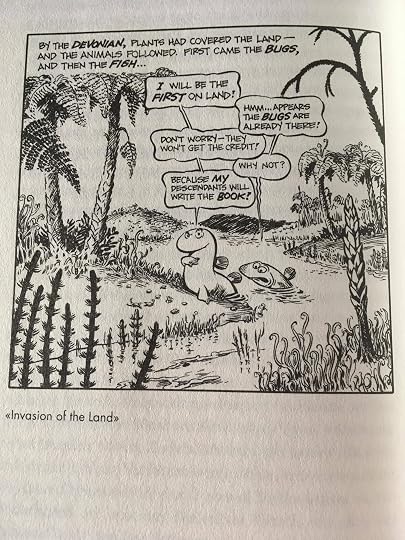
The book was really nice although I'd consider it a first (though thorough) step. The author's writing style is what makes this so agreeable and can probably interest even people who usually aren't all that much into non-fiction. (This was at the back, after the epilogue, and perfectly sums up the kind of humour the author used as well.)