The great pyramids of Giza have intrigued humanity for thousands of years. Questions about the construction and the purpose of these majestic monuments have existed since the middle period of ancient Egyptian civilization, but recent cutting-edge research has uncovered information about how and why they were built. In Mountains of the Pharaohs, Zahi Hawass, a world-renowned archaeologist and the official guardian of Egypt’s timeless treasures, weaves the latest archaeological data and an enthralling family history into spellbinding narrative.
Nearly five thousand years ago, the 4th Dynasty of Egypt’s Old Kingdom reigned over a highly advanced civilization. Believed to be gods, the royal family lived amid colossal palaces and temples built to honor them and their deified ancestors. Hawass brings these extraordinary historical figures to life, spinning a soap opera–like saga complete with murder, incest, and the triumphant ascension to the throne of one of only four queens ever to rule Egypt.
The magnificent pyramids attest not only to the dynasty’s supreme power, but also to the engineering expertise and architectural sophistication that flourished under their rule. Hawass argues that the pyramids—including the Great Pyramid of Khufu, the only one of the Seven Wonders of the World still standing—were built by skilled craftsmen who took great pride in their work.
Mountains of the Pharaohs is an unprecedented account of one of civilization’s greatest achievements
If you like Egyptology, you will love this book. If you don't know what Egyptology means, you probably won't love this book. If you are like me, and you really want to like Egyptology but whenever you read anything about Egypt you feel as though your brain is being extracted through your naval cavity, who knows what you'll think of this book.
Mountains of the Pharaohs is interesting in that it endeavors to tell the whole story of how the Great Pyramids were built. It does this with minute detail which is sure to fascinate the scholar, but tends to leave the guys who don't like to get sand in their shoes, like me, a little lost. Hawass does throw a bone to guys like me by filling in the gaps of his historic puzzle with little anecdotes about what people in Ancient Egypt might have said or done in a certain situation. But, not even this occasional narrative departure enticed me because I was trapped in believing that he couldn't know what they actually said or did out of the historical artifacts he has collected. The author even admits to this. Hey, he's trying. I can't fault him for that.
So, very well-written. Obviously very well-studied. Just not very well-entertaining. At least for me, the average Djoser who prefers Memphis rub to Memphis statuaries. That's a little joke for all you Egyptologists out there. Take it or leave it.
Zahi Hawass is an important guy when it comes to Egyptology. He knows it, and he wants us to know it too.
He spends a great deal of time in Mountains of the Pharaohs dropping names, asserting his authority when it comes to the possible readings of the artefact record, and sharing anecdotes about his own finds and discoveries. Yet amidst all this self-aggrandizement is some excellent information, and a reassuring vision of how healthy the debate surrounding Egyptian finds continues to be within the community of Egyptologists.
Mountains of the Pharaohs is at its worst when Hawass gives in to his imaginings of "what might have happened" to the Pharaohs and those close to them. These fictions -- containing emotion, action, and an off-puttingly omniscient narration -- might very well be rooted in facts about the 4th Dynasty of the Old Kingdom, but they are mostly silly and annoying, offering up a fanciful vision of Hawass' utopian vision of Old Kingdom Egypt. And this utopian vision doesn't dissipate when he leaves the fiction behind. Hawass tends to read the archaeological record with a romantic view of a near perfect ancient world that was mirrored in their near perfect monuments.
The book is at its best, however, when Hawass spends some time with the common folk. The closing chapters about the regular Egyptians who were engaged in building the pyramids discusses some exceptional finds, and brings Hawass to a more balanced place in his vision of Ancient Egypt. The common Egyptian is a perspective I've always felt was poorly represented in popular Egyptology, so it was refreshing to see it here.
Finally, the reading by Simon Vance (of whom I am a fan, having only ever listened to his audio recordings of the Aubrey-Maturin books) is suitably noble and weighty, impeccably matching the voice to the source material.
*3.5 stars This book gives a general overview of the Old Kingdom pharaohs and their monumental pyramids. The information overall is very clear, but can sometimes become too academic. I did like the little imagined vignettes at the beginning of each chapter, as I think they added more personality to these long ago kings, without assuming too much. The reason I didn’t completely love this book is because I think it lacks illustrations that could have really helped explain the pyramid layouts. There was a lot of discussion about the inside of the pyramids, but it was hard for me to visualize corridors and chambers just by dimensions and cardinal directions alone. Also this book badly needed a royal family tree. I know it’s difficult to say for certain who was the son of who, and the number of wives a pharaoh had, but even a rough tree would have helped.
Lei la versión en español de este libro publicada por Crítica y que encontré en una sección de rebajas en la Librería Panamericana en Medellín. Nunca entendí como un libro con un tema tan atractivo como la historia de las pirámides en Guizá, escrita por uno de los más reconocidos y carismáticos egiptólogos de las últimas décadas, Zahi Hawass, podría estar entre las rebajas.
Las bondades del libro. La narración detallada de la planeacion, construcción y “decadencia” de unos de las obras de ingeniería más fantásticas que nos legó la antigüedad, las pirámides de Guiza.
El inicio de cada capítulo contiene una pequeña narración, de estilo literario y teniendo como protagonistas los personajes históricos alrededor de las pirámides, que me recordaron al maravilloso Sinuhe el Egipcio de Mika Waltari. No estoy muy seguro si estas narraciones iniciales, que de extenderse podrían constituir por sí mismas un entretenido libro, fueron escritas por el autor o por un escritor o periodista colaborador (que de existir tampoco es mencionado en los agradecimientos) pero jugando a la “arqueología” (que es una suerte de ciencia forense geológica) diría que así es. El estilo literario es impecable y contrasta con la técnica más científica del resto del texto.
Lo malo del texto (por lo que no le doy más estrellas en la puntuación): las prolongadas e inútiles descripciones del interior de las pirámides, los templos y estructuras adyacentes a ellas que lamentablemente no vienen acompañadas de suficientes ilustraciones y planos. En más de una ocasión me vi consultando Google y Wikipedia Para entender la descripción de una pirámide o de una estela. En otras ni siquiera encontré una versión en línea que pudiera contrastar con el texto. No se si esto lo hicieron los editores para ahorrarse unos centavos. Espero que si el texto tiene una edición futura (ojalá) la hagan mejor ilustrada.
El manejo de los nombres de los personajes, las inscripciones jeroglíficas que les corresponden (y que se reproducen bellamente en algunos apartes del libro) también es inadecuado. Si bien Zahi es egipcio y seguro respeta la tradición de usar “correctamente” los nombres de muchos personajes (Queope en lugar de Keops griego), el libro debería tener una tabla que presentará las equivalencias y la razón de la diversidad de esos nombres, así como su correspondencia en arábigo, un idioma en el que están escritos (con su correspondencia en castellano) por ejemplo el nombre de muchos lugares en el texto.
En síntesis un bello e ilustrativo libro, que como la esfinge tiene una naturaleza dual, mitad texto académico, mitad texto divulgado sobre un tema que no ha pasado de moda en 4,600 años y del que parece (por algunos misterios inacabados que describe el mismo texto) se seguirá hablando por otro par de milenios.
I’m reading this book in preparation for my trip to Egypt. If I hadn’t been watching lectures on Ancient Egypt, the slew of names would have just confused me.
Dr. Hawass paints a very nice picture of the Early Kingdom, expressing both known and unknown portions of this history. He is not shy to expose mysteries or interesting inconsistencies nor look down upon cult theories.
It appears there are a lot of reviewers/readers who simply do not like Zahi Hawass and a small portion of those reviews prove they didn't read much more than the intro or first chapter... a shame. I assume this is because Hawass is not tickled by outlandish theories of electricity producing pyramids. One must remember that he is actually an Egyptian, therefore cares about the facts of his heritage and not of dramatized Western imaginations. One must remember he is educated. I prefer both versions, though, so I must both love Zahi for his passion and respect him for his distaste with pop-fiction.
The Publisher Says: World-renowned archaeologist Zahi Hawass weaves a spellbinding narrative about how the pyramids were built and why, new in paperback
Nearly five thousand years ago, the fourth dynasty of Egypt’s Old Kingdom reigned over a highly advanced civilization. Believed to be gods, the royal family lived amid colossal palaces and temples built to honor them and their deified ancestors.
In Mountains of the Pharaohs, Zahi Hawass brings these extraordinary historical figures to life, detailing a soap opera-like saga complete with murder, incest, and the triumphant ascension to the throne of one of only four queens ever to rule Egypt. It was during this dynasty that the magnificent pyramids of Giza were built. These monuments attest not only to the dynasty’s supreme power, but also to the engineering expertise and architectural sophistication that flourished under its rule.
Hawass tells the complete story of the pyramids, weaving archaeological data with a history of Egypt’s powerful pharaohs, and argues that the pyramids—including the Great Pyramid of Khufu, the only one of the Seven Wonders of the World still standing—were built by skilled craftsmen who took great pride in their work.
Illustrated with black-and-white photographs and drawings, Mountains of the Pharaohs is a compelling account of one of civilization’s greatest achievements.
I RECEIVED A DRC FROM THE PUBLISHER VIA EDELWEISS+. THANK YOU.
My Review: If you've watched a single documentary about Egypt in the last thirty years, you've seen and heard the inimitable Zahi Hawass addressing us in those unique cadences as he expounds on his passion. His life has been dedicated to spreading factual knowledge about the history of one of Earth's earliest superpowers. He's risen to the august heights of the secretary general of Egypt's Supreme Council of Antiquities. This narrative history is about the Fourth Dynasty pharoahs who created by their incredible command of Egypt's entire resources the pyramids at Giza.
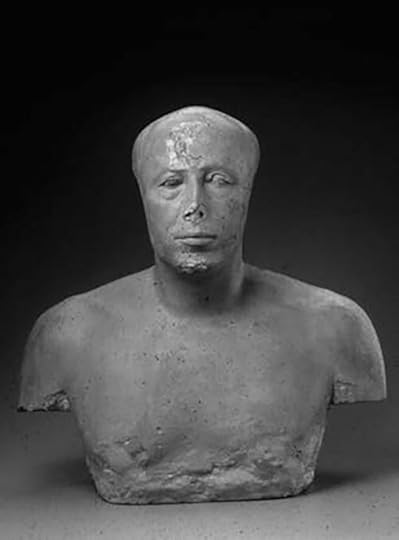
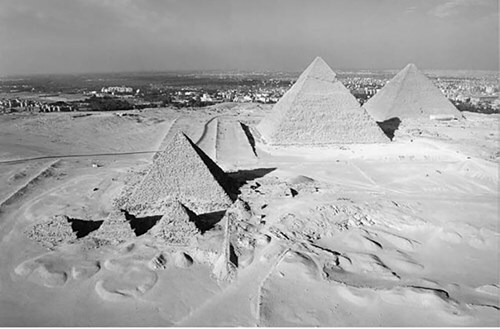
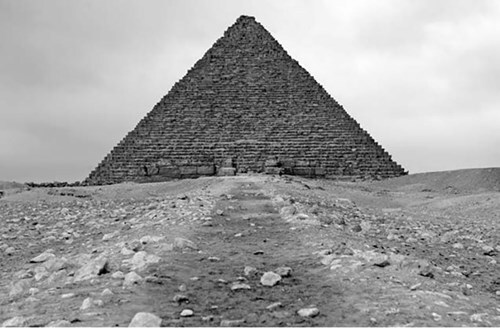
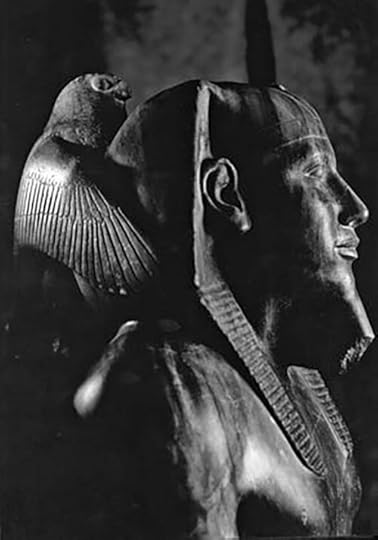
There are nineteen black & white images to bring the text to life. I offer these six to show you what you are in for. The American University in Cairo Press made this trade paper edition to their usual quality standard. You'll be treated to a story that is astonishing in its timelessness, amazing in how very old it is, and unnerving in how familiar the personalities are.
Personalities are all we have left when history gets through with us. Hawass has one of the Egyptian personalities that will shape the pharoahs' journey into a very long future, one even greater than they could've imagined. Read his spirited advocacy of the culture and people who...by their own mental and physical labor...created the pyramids that we're gawkin' at five thousand years on.
A MOUNTAIN OF DISTORTIONS ENDS IN ZAHI HAWASS'S MOUNTAINS OF THE PHARAOHS
Zahi Hawass has produced another rather sad and sorry book that attempts to transform the ancient African Negro cultures of the Nile Valley into the "Middle Eastern" culture of "Ancient Egypt". Mr. Zahi Hawass has set for himself an impossible task.
In his mad and frantic flight from the black African realities of his "Ancient Egypt," Mr. Hawass has embraced an extreme form of out of date German Eurocentricism tinged with modern Egyptian nationalism. Surely, Mr. Hawass knows enough about ancient African Nile valley cultures to realize that his beloved "Ancient Egyptians" would have instantly considered him to be a "sand dweller" (shau), not a man of the Black Land (Kemit)! Mr. Hawass would have been considered a foreigner.
Let's state at the outset that Mr. Hawass gets no points for being born in Egypt. Nor is his attempt at scholarship in anyway enhanced by his place of birth or his nationality.
Modern Egyptians had nothing to do with the ancient African Nilotic and nonNilotic cultures of the Nile. Modern Egyptians are mainly the descendants of various invaders and many other settler populations, composed of various Arab tribes, Persians, Greeks, Romans, African,Turks and others. Modern Egypt is not African; nor are we talking about the modern country of Egypt. Our subject is the ancient African Nile valley civilizations(kemet) now referred to as "Ancient Egypt."
We must remember that all we admire about ancient Egyptian Civilization was already in place during the reign of Djoser ( 3rd Dynasty) 5018-4989 BC. So the later Arab Muslim invaders(639-641AD) and settler populations had nothing to do with the building of Pharaonic civilization along the Nile.
After stripping his mythical "Ancient Egypt" of its black African core, Mr. Hawass is left with gross distortions in the form of an empty shell of disconnected facts and silly speculations. On page 6 Mr. Hawass writes about the impact of the work of the 150 or so French scientist and scholars who compiled the huge DESCRIPTION de l'EGYPT. Hawass goes on to mention Jean -Francois Champollion the gifted French linguist"who brought the silent hieroglyphic writing back to life." The mad flight from Africa emerges almost immediately: in the Description de l'Egypt there is a very interesting bas reliefs of men jumping over a bull while other men appear to be holding the bull.(See A Vol. V. Pyramides de Memphis. PL18 #8 Monuments of Egypt, Napoleonic Edition ,The Complete Archaeological Plates From LA DESCRIPTION DE L'EGYPT, Editors: Charles C. Gillispie and Michel Dewachter 1987 Princeton Architectural Press. Eurocentric scholars pass over in utter silence the Jumping the bull ceremonies that occurs to this very day in many parts of Africa. In these ceremonies the bulls are jumped over as part of initiation rituals. The place of cattle in many parts of modern Africa can help shed light on the ancient cultures of the Nile valley. Yet, Hawass dare not step outside the intellectual paradigm set up by his German masters. Hawass goes on to mention Champollion. We must remember that after studying the people, language and culture of the ancient Egyptians, Champollion made this unequivocal statement:"Tout en semble, en effet, nous montre dans les Egyptiens un peuple tout-a-fait etranger au continent asiatique." (In fact everything about the Egyptians seem to show that they were a people completely foreign to the Asian continent.) See Precis Du Systeme Hieroglyphique Des anciens Egyptiens Elibron Classics page 456.
Mr. Hawass continues on page 14 with this gross distortion of the African reality that he finds so repulsive. "In ancient Egypt, queens-the king's chief wife, his mother, and sometimes his eldest daughter symbolized the female principle and were essential to rule." Mr. Zahi Hawass does not want his least informed readers to realize that his "Ancient Egypt" was not patriarchal. The kinship system is completely different from Arab, Hebrew and European kinship patterns. Descent was traced through the mother-not the father. The divine right to be pharaoh came from the Royal Mother.Perhaps this helps explain the many depictions of the Pharaohs seated beside their mothers. There are depictions of Pepi sitting on his mother's lap. We could give many more examples. This is alien to European cultures and perhaps more so to any form of Semitic cultures both Hebrew and Arabic. There could be no God without a Goddess in ancient African Nile Valley cultures! Like most other African languages the Egyptians had no word for"cousin". A cousin would be a "brother or a "sister" since both would have had the same mother(the grandmother). Hawass ignores these facts and attempts to force his Eurocentric world view on these ancient African peoples we now call "Egyptians". Later Mr. Hawass admits that the"eldest son" of the king does not "necessarily" inherit the throne. p.135 Mr. Hawass even calls George Reisner "the great American Egyptologist", yet he clearly has ignored George Reisner's conclusions after a lifetime of study: "Egyptian civilization was from the south and from the black tribes of Punt and that Egypt and Lower Nubia were "culturally and racially one land". See Race and the Writing of History Maghan Keita, 2000 Oxford, page 79. Mr. Hawass continues to distort the ancient cultures of the Nile when he writes on page 136 that the dwarf performed dances for the "amusement" of the king. This is a typical euro-centric distortion. If Mr. Hawass knew anything about African cultures he would know that the Twa peoples(the dwarfs) have always been associated with the mythology and culture of African life. Not only did they perform sacred dances of Gods and Goddesses(in African religions each deity has a special dance and a particular piece of music, this seems to have also been the case in ancient Egypt) the deng(dwarfs) also took part in burial ceremonies of the sacred Apis bull. This indicates a profound cultural , ethnic and racial connection between the Egyptians and other African peoples. Dwarfs have always been considered keepers and guardians of wild and domestic animals. In Peul mythologies of Senegal. dwarfs were said to have been the original shepherd for the sacred cattle of the God Geno. Dwarfs were believed to bring good fortune to others. So we see that dwarfs were an integral part of both ancient Egyptian African cultures and modern African cultures. See De L'Origine Egyptienne Des Peuls ,Aboubacry Moussa Lam Presence Africaine . Mr. Hawass engages in this kind of distortions time and time again in this book. So much so ,until the book collapses under the heavy weight.
In his effort to strip "Ancient Egypt" of all things African, Mr. Hawass has delivered a mass of distortions and personal opinion based largely on dogma and ideology. Perhaps Mr. Zahi Hawass should spend less time with his fan club and his line of clothes and hats. In any case, this is a book that cries out for the oblivion that it so richly deserves.
In the Mountain of the Pharaohs, Dr. Hawass brings the people who built the pyramids to the pages. While we mainly focus on the royals, and they do appear in this book, we are going to get a different viewpoint here. There is no way of discussing the pyramids without talking about the kings who were responsible for their building, but we often forget that real men created these huge works. There have been prevailing myths for quite a while that slaves built the pyramids. What we see instead, are farmers who are not able to work their land due to flooding, working for the pharaoh. We have artisans, jewelry makers, and many more craftsmen that were responsible for the building, painting, and preparing the tomb for the eternal rest of the king.
I really enjoyed this read. Anything on ancient Egypt catches my interest. Dr. Hawass has been a favorite of mine for years, and I was able to see him speak last year. His work in the antiquities and the preservation of the monuments throughout Egypt has been very instrumental in spreading knowledge and sharing new discoveries.
Highly recommend this read if you enjoy Egyptian history.
Seeing as this was written by a legend in the field, I expected something masterful. That said, many legendary Egyptologists manage to be both masterful and as dry as the sands they excavate in. Thankfully, that is not the case here. The superlative quality of the material and of its presentation surprised and delighted me.
The whole book is clear, vivid, and packed with insight, all delivered with a crisp, unpretentious, economical prose. Chalk-full of details and a clear line of thinking and deduction that feels highly satisfying.
Having read this book, I now know much more about the funerary practices of the elites of 4th dynasty culture, as well as the contributions archaeology is making to understanding the lives of the common men and women of that time (as well as the limits in the material record and the questions left to be answered). More than that, I felt at times as though I could actually glimpse the mindset of the pyramid builders, that I could see the cosmos as they saw it and thus make sense of their myriad pyramids, temples and mastabas.
Zahi Hawass is an important archeologist but a also a character who's great than life and this book is fascinating, informative, but it becomes a bit irritating when it becomes irritating when the personality of the writer takes the front seat. I enjoyed it and learn something new. Informative. Recommended. Many thanks to the publisher for this ARC, all opinions are mine
Lots of information and explanation about the Great Pyramid and other pyramids. This book would have been more useful with illustrations to show what Hawass is talking about. The writing itself is fairly accessible.This would be a decent guide for someone visiting Egypt and wanting to know more.
Great book by an icon in Egyptology, Hawass tells us of the people (not slaves) who actually built the pyramids at Giza. Wonderfully insightful & clear prose. Thanks Dr. Hawass for Mountains of the Pharaohs.
A couple of years ago, I read Zahi Hawass's autobiography, Secrets From the Sand. It covered his career from his start in Egyptian archaeology to his current position as "Secretary General of the Supreme Council of Antiquities." I was impressed with his story, and his general outlook. (Unfortunately, I missed an opportunity to see a free lecture he did in Reno a few months ago. Mountains of the Pharaohs is his latest book. It serves as a general explanation of what is known, thought, and debated about the dynasty that built the pyramids at Giza. The format is kind of interesting: Hawass begins each chapter with a short sketch of what might have been happening in the lives of the ancient Egyptian kings, craftmen or workmen, then explains why that is a plausible scenario using whatever evidence is available. Pretty interesting how little is actually known about that period, and how much of Egytpology is based on inference and guesses. What most impressed me was the level-headed approach Dr. Hawass takes - if there is debate on an issue, he explains or at least mentions all sides of it, seemingly not weighting his view more than any others. It was refreshing to hear a topic like this presented in what seemed like an unbiased way.
While I really dislike Hawass when he struts across the screen during the many documentaries on ancient Egypt, I like him as an author.
There is so much more at the Pyramids at Giza in Egypt than just the pyramids themselves. As more and more research is coming to light, more is becoming known about not only the pyramids themselves, but also about the Pharaohs who ordered them built but more importantly about the people who worked on building them.
I've come to the conclusion that, unless a book about ancient Egypt is a renowned classic, it is best not to read any book if it is more than 6-8 years old. New information is coming to light all the time and a book written even 10 years ago can have what we now know are errors. This book is a good one to read for now, but in a few years even more information will be known rendering this one out of date, too.
Did you know Hawass is a world-famous Egyptologist? Did you know he's responsible for some amazing archeological finds? Did you also know that he's so brilliant that he's discovered ruins completely by accident or after a heart attack? Well read this book and let him tell you! He sure likes to talk about himself!
The fictional narratives at the beginning of each book are the only reason I gave this two stars. They are riveting, but far too brief. He then tries to justify each narrative with the history of Ancient Egyptian culture. This is a good introduction to the 4th Dynasty pyramid builders, but if you want to know more information about a articular source, good luck flipping through the bibliography. Even wikipedia cites better than this guy.
Very Enjoyable. This short book was full of new and interesting information so often lost in the thousands of years between the pyramids and our civilization. He begins with the age of the pyramids and Djoser, then on to Snefru and the birth of the true pyramids. He then goes into detail of the construction of the Pyramids of Giza. A must read for any who love pyramids. Hawass has a frank manner of writing which I appreciate, especially his description of the museum holding Khufu's boat as ugly. He also tells the reader what he thinks which again is much appreciated.
I found this book to be uneven. The author didn't shy away from using technical terms, and conveyed a good deal of historical information, but the writing was too informal for my tastes. I had a hard time distinguishing the author's opinions from the rest of the text, and at times the book seemed to be written for a middle-school audience, with asides such as, "Just imagine what an energetic man he was!"
While I am very interested in the history of the Pharaohs and how the pyramids were built, the book was really hard to follow. The problem for me was a lack of diagrams. The author spent a lot of time explaining features and locations of each find, but you had to try to piece it together in your head. It reads like he was giving a tour but, without the visuals, you are lost. Could be interesting if they added some diagrams or photos of what he is attempting to describe.
As someone who is very intrigued by the ancient Egyptian lifestyle and the archeology of it's ruins, this book was definitely worth reading. It gives insight as to how not only the pharaohs of the time but the pyramid builders lived and worked. Mr. Hawass did an outstanding job in giving details on every aspect he could.
This was a very interesting book about the Giza pyramids, written by a controversial figure in Egypt today. I was predisposed not to like him from the start. But It was not the pompous book I thought it would be. I find it difficult to understand, however, that not one map was included in the book. Also, Hawass could have included a few more relevant illustrations.
Hawass does a fine job portraying the Egypt of the 4th Dynasty, that responsible for the great pyramids. He imagines the royals, the builders and the laborers. There's ample and lucid material on the pyramids themselves, the lives of people in the shadow of the pyramids, as it were, and a refreshing lack of "ancient alien" style nonsense.
However the pyramids were built, one must wonder WHO did the building. The practical, everyday lives of human beings who actually put the things together is addressed in Hawass' book. While a little dry at times, like the sun-parched sands beyond the Nile, it is still an interesting subject.
A lot of detail about the kings and queen and dynasties, all of it interesting but a lot to absorb. I found most intriguing the parts about the lives of the ordinary people who built the extraordinary pyramids. Apparently they were not slaves, as is commonly assumed.