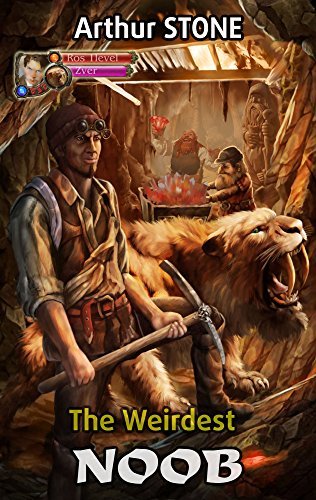
Merkwürdige Dinge geschehen in der Zweiten Welt, einem multinationalen Online-Rollenspiel gigantischer Ausmaße. Auf einmal sind Neutralitätsabkommen und sogar Freundschaften vergessen. Ehemalige Verbündete schleichen wie Wölfe umeinander herum, und bald klirren ihre Schwerter aufeinander, schwirren Pfeile durch die Luft, und magischer Donner grollt über dem Land. Eine weltvergessene, völlig wertlose Mine wird zum Schauplatz erbitterter Kämpfe. Ihre niedergebrannten Ruinen wechseln mehrmals täglich den Besitzer. Jede Straße der Provinz wird kontrolliert. Niemand darf die Städte betreten oder verlassen, ohne seine Identität überprüfen zu lassen. Die Schwachen leiden unter der anhaltenden Gewalt durch Invasoren aus dem Osten, und die Starken...Die Starken setzen alles daran, den Schuldigen zu finden: den seltsamsten Noob, den die virtuelle Welt je gesehen hat.
Arthur Stone is the pen name of one Arthur Smirnov, a prolific author in the sci-fi and fantasy genres. Born in 1973 in Donetsk, Ukraine, Arthur worked as a geologist, and also in the environmental sector and industrial archeology all over the world. He lives and works in Ukraine. Arthur began writing fiction in 2005 on a bet, and thus his addiction was born. His first book was published in 2006, and by mid - 2025 he had published a total of 84 books in Russian, English and German-speaking markets.
This guy is supposed to be intelligent and a scientist or engineer. But as soon as he gets in game he act like a fucking moron with an IQ equal with forest gump. I get the noob angel and the fact the author used it as a shity meathod to inform the reader but wtf. It is so annoying that it's like actually like interacting with a noob in game. Even if he is a noob anyone with basic street smarts can see him literally being taken for a ride. And his only real contact should have been able to spend fucking more than 2 minutes with the dude to explain to him basic knowledge or point him to a forum before logging on. The author used to many forced plot devices and we the readers are left with crap to read. LitRPG is a large genre now and the mmorpg they loosely resemble are common knowledge in today's world. Explaining the same fucking concept in everyfucking book is retarded. Do authors of urban fantasy explain what P.I.'s are or werewolves and vampires are. NO! Do they explain what a fireball is? NO. SO why the fuck to author of litrpg explain the same shit over and over and over again like their readers are fucking noobs?
This book was quite enjoyable, a little heavy on the explanations but not too bad. The emphasis on stats and equipment messages went away at the end of the book but I'm hoping it'll be back in the next one.
The book has some interesting ideas, which keep you reading for a while, despite some critical flaws. I could not finish this. At some point I just gave up.
From the onset, one can easily notice that the book is missing an editor. He could have streamlined a lot of it. The never-ending explanations. The atrocious dialogue. But the thing that becomes most annoying is the repetition of the word "noob", and how often the other characters use it. In the first quarter of the novel it gets used so much that you every other dialogue line contains it. Every interaction between characters contains some form of "you're a big noob huh?". We get it, the novel is about the biggest noob, so we must repeat it until the reader dreams about it.
But the biggest issue is the way the main character behaves and his mental faculties. As the title suggests, he is, as it is repeated to us ad nauseam, a noob. So he is extremely unfamiliar with the game's mechanics and systems. However, it seems that being unfamiliar with the game also translates in the character being mentally challenged. The correlation is uncanny. The more Ros understand about the game, the smarter he becomes. It makes for an extremely frustrating reading experience, where pure dumb luck and plot armour are the only things keeping the story going.
I would not recommend this, simply because of how infuriating it is to see some good ideas thrashed in such a way.
This book can be split into three parts. Part 1 is enjoyable, if a bit tedious (noob, noob, noob, bla bla bla). Part 2 is classic LitRPG template, with the lucky strike and everything . Part 3 is simply boring.
This book is full of excruciatingly BAD dialogue. The template is the same. MC asks a game-related question, counterpart launches in a 10-min info-dump monologue. Rinse and repeat all through the book. You can skip that stuff easily when you're reading, but in an audiobook? Groan and despair!
There is a big problem with most LitRPG books out there. And it's called "levels".
I may be wrong, but I always considered that LitRPG was about an actual story that used an RPG world as a backdrop. But what we get in most books is the opposite: a blow-by-blow game narration. And that is freaking boring. Especially when the author sucks at combat-time. This book is no exception. Combat in this book is absolutely horrible. MC gets an early OP tools, and from then on, author believes we don't deserve to get realistic fights anymore. We're relegated to counting skill points at the end. Do that enough times and half the book just becomes pointless.
I didn't buy the hype that started in the middle of the book. The extremes to which clans and guilds were ready to go to to get their hands on the MC made zero sense to me. Because of that, I couldn't get into the second half of the book at all. It felt like pointless attempts to give the MC a purpose, now that his original one is dead.
All in all, I'm disappointed. The premise wasn't unusual, but the tone of the book certainly was. I was hoping for more.
This was an awesome book. I really enjoyed it. Lots of humor. Running on the treadmill at Snap, I was reading it, and it was cracking me up. I had to slow down to a walk before I killed myself. It's rare I've been finding books that peek my interest so well I can't put it down. Character development was well done. Only issue I had was too much description on the mechanics and the repetitiveness of the verbiage in leveling. Those were so minor of issues. I was greatly saddened when the story ended. I can't wait to read book 2.
Not my favorite litrpg for sure. The author does wayyyyyyyyyyyyy to much explaining. Almost every character in the game instantly hating noobs got old very fast. The racist propaganda and reference to child porn were not needed in any part for the story to work or be fulfilling. I"m really on the fence about finishing the series.
To avoid the need to read through a hefty manual, Video game RPGs have computer controlled characters explaining the concepts in the early levels. More experienced players will press X to skip the lengthy dialogue. After the first few chapters I really wanted that X button.
The premise here is that a person with no experience with online RPGs is involved in a debilitating accident, and finds himself in a situation where he is permanently logged into a full-immersion version of an online fantasy role playing game, trying to gain as much money as possible in order to resolve the medical issue.
He starts as a level 0 "noob" and spends the first few chapters having other characters infodump at him while calling him "noob", and laughing at his badly statted character. After a while he gets the hang of the game, and things get to a more reasonable pace, where he actually works out some stuff for himself, and improves his character.
So I've discovered that LitRPG is a thing. It's enjoyable enough in its way. The various challenges are amusing. There's a lack of tension in that the main character is never in any serious danger. He will simply respawn at a lower level. Rather disappointingly, the book doesn't really end on any sort of resolution, and as mentioned above, there's the whole tedious exposition, which takes it down a star (I am typically stingy with my ratings). An annoyance in the audiobook version is that a repeated system message is read out in full several times. I'm sure this works fine in print, where I imagine it's also a different font, and most readers will just skim it, but it gets tedious listening to it the 10th time.
On the whole, it's an entertaining enough journey. There are a couple of hint that there's something weird going on with the game's AI, which I hope gets expanded upon. I may well read the second book when I get through the rest of my backlog.
3.5 stars maybe 3.75. This book is a lot like "Project Daily Grind" as Dark Ape said in his review. I also agree that this one is a little better. It is at times a typical RPG book but sometimes it comes up with something unique. I found the book enjoyable even tho it was heavy on explaining skills and other boring type RPG story filler at times. The MC is likable and you want he to success in his adventures. Other character are also interesting and the main story is not bad and I looking forward to reading the next book.
Holy hanna! I really really enjoyed this book. It has its issues.. But it really snagged my attention. Would recommend this to anyone who enjoys LitRPG style books!
Def well worth reading 4 stars due to so minor nitpicking issues i have with the book. Real score 4.7
Can confirm the hype. This really is a great discovery. Current reigning champion of the transported into the game genre. YES the title sucks, but the book doesn't. Written by Arthur Sergeevich Smirnov (pen name: Arthur Stone) and translated by Mikhail Yagupov. We get a different point of view wile avoiding most of the hackneyed clichés. If you are bothered by grammatical inconsistencies and unconventional word choices and parings try to recall that this is a foreign language novel. I personally found the translation to be an added bonus. It's effective at adding a quality of exoticism to the fantasy world at cerebral level. The translation suggests that here is a wold that doesn't think like you do, all the rules you used to know are gone, were not in Kansas anymore. Oh one last thing. the fantasy world here is of the computer game mmorpg type. There will be stats quoted a plenty. Followed by more stats, an Obsessive fixation on stats, and the occasional lengthy description of a magical item. To long time players we find this no more troublesome that a lavish description of each dish in a seven course meal. Others might find it a bit excessive.
I've gotten really behind on tracking my books so these are going to be quick.
Very similar to Survival Quest and Project Daily Grind. The main character is stuck in the game due to an extreme body injury and he's grinding as a miner to earn money. At least the economy in this makes a bit more sense than those books. I was getting REALLY tired of hearing the word "Noob" by the end. Still, some interesting ideas put forward in this and things seem better thought out than normal. Also, surprising for a Russian translated book to mention the USA and in this one the players body is located there. O_O
Pretty good in general. I felt that the cluelessness of the main character was a bit overdone, but perhaps, I just can't imagine someone who has never played or heard about role playing games :). Apart from that, I've enjoyed the character's determination to go after his objective and I liked the fact that the book had a pretty good flow without an overarching plot. I mean....With a lot of books these days, you get a goal at the beginning "we must save the world" or something similar, and then the whole book is just about getting to that point. Here however, the character has a goal (sort of), but it's not that looming and it doesn't spoil the plot. Humorous at times, and an enjoyable LitRPG, if a bit heavy on the explanations.
A delightful and engaging book that started out poorly (an almost incompetently deficient character) and sucked me in about a quarter of the way through and did not let up.
I love new character builds with an emphasis on crafting and unusual victories and this had everything I could want. It's followed up by a solid sequel and then a disappointing final third volume.
The book won't be for everyone. The MC is ridiculously lucky and overpowered, and as I mentioned, he seems to turn off his brain at the start, but it was exactly the kind of engaging read I needed while battling through some pain.
Man this is a hard review to write. The first half of this book was one of the best LitRPGs I have ever read, and was fun to read. Yes, there was obviously parts lifted from WotS but it had an original feel. The second part lost me immediately. What an about face! The author spent half the book building up a particular character and then totally abandoned it. This felt like a huge slap in the face to the reader who had bought into the premise.
So much happens in this book that it will blow your mind. I'm honestly not sure what is left for book two, but I can't wait to find out! I did find a few errors in this book. One of the most memorable ones was when he got his first bag. Said it had 25 slots and a few pages later it was 30. Overall a very nice read and I very highly recommend this one.
Worth your time. The one slight detractor was the sheer magnitude of explanatory notes that had to be put into the story. Actually, use this as a primer for all your non MMORPG friends who’ve never played video games but like fantasy. Besides, this book is hilarious.
I enjoyed it. Thanks to the author and translator.
Got this book as a fill in whilst waiting for the next book in a series. i will now be waiting for the next one in this series as well, fun read with rye humer throughout
The author is delusional/irrational/nonsensical. The author makes a sub-zero (way in the negative) player person that no longer has a physical body because of an accident, Ros, a Russian native that had been hired by an American company. The thing is, no LitRPG/gamer reader would be interested in a sub-standard (way past zero in the negative) noob player that is constantly mentally challenged... The learning curve in any game is steep (even for pro-gamers), but Ros and the author lack basic common sense. The thing is privacy is a Universal Human Right, the moment a game company releases the real-life information of a player, in that moment they can be sued for millions for damages and compensation...The author places a lot of news/forum articles within the first book and yet the main character Ros, was unable to read them, so why spam this information?? Isn't it a first person narrative? (of what Ros can do and think?) Nobody would place all of their skill/ability points on the same (ability) skill no matter how little time one has (especially if Ros has already lost days/weeks waiting for legal counsel, doctors, etc.) Main character, Ros, finds a new only one instance dungeon at the mine he got contracted to work in. The thing is, he only had one summoned familiar "Gorgeous", but being a summoner, why didn't he continue to farm soul crystals in the mine, and then in the Unique Dungeon? He could have had half-bosses, and even the Boss as a familiar at the end of the Dungeon delve?? The translator or the author use mob/mobs to describe single monsters, when mob is plural for a series of monsters, mobs is a series of several types of monsters... The author creates a "godly character"/probably rogue Artificial Intelligence within the game, that gives main character the ability to "recreate his character" but why? The game company is required by law, all around the World, to safeguard the privacy of their users (or be faced with million dollar lawsuits and public lawsuits/fines as well) so why does the author negate reality of "privacy" and make the main character, Ros, commit suicide 79 times to "roll-back" his account to Level 10??? Can the author and main character be even more mentally challenged? (irrational/illogical/nonsensical)??? No one but digits and Pup and the mine chief know who Ros is and yet everyone in this story is stalking and investigating/etc Ros? At best is a fear of persecution, and probably author/main character suffers from Schizophrenia, paranoia, etc. The main character chose a unique (only one in the whole game) Rrokh species and the same author who created that unique species, gives the main character a one time ability to change his unique species and look like a Light Elf?? Why??? No one knows who Ros is, no one should care and yet, the only uniqueness that created Ros an opportunity to become a summoner, to be at the same time a Miner, and to stay alive, changes to an Elf (the most commonly chosen fantasy character for players in fantasy games)??? Then changes his character genre to woman (something impossible in the game) just because, the author is delusional, irrational, nonsensical... Where is the game balance? How can rules that are required to be followed by everyone, broken time and time again by the author (who created these rules) and the main character who has no idea of the game mechanics/ game system/ etc.? The book 1 has a lot of inside illustrations, but no inside maps of this other game world. There are a lot of plot holes even though this book has much better character descriptions and game-world descriptions than most other game-like isekai (immersed totally in a VRMMORPG) game... Some reviews consider this Book 1 to be the best of LitRPG, and yet this Book 1 lacks a game-system, game-balance, and a "real gamer-protagonist" so how can this book be a good LitRPG game book if it lacks all of the ingredients needed to be a LitRPG fantasy-full-immersion-game-isekai- book series??? To explain it further, it's like if the author created a sports car (stick-shift), worth hundreds of thousands of dollars, and only used it in reverse, because he thought that a "driver" (in this case Ros), did not need to know how to drive a car, to be able to drive this really expensive and stick-shift car, so then Ros starts driving it "backwards", (because he does not know how to drive a car) through the streets and highways, and the author does not find anything wrong with Ros, because Ros is "driving the car" without knowing how to drive cars, and he is going "backwards" on the roads, probably causing a lot of accidents and running over other people, because nobody taught him how to properly drive a car, to me, this would be a good summary to this Book 1 story of an author who refuses to "play by the rules" that he himself created in a game-like-system, that lacks balance, lacks real gamer knowledge and adventures and the forwarding of the main plot arc which is to create enough wealth for the main character to keep on living (at least "virtually") until he can find and clone his physical body back into reality...Can an author be any more delusional and stubborn than in this book?
Final Rating: 2.86/5.00 Starting score: 2.50 +0.30 for the bodily survival premise and its immediate emotional stakes. +0.32 for an economy that connects labor, equipment, trade, and class power. +0.38 for practical experimentation and increasingly resourceful problem-solving. +0.36 for reciprocal relationships and their eventual emotional payoff. +0.23 for danger built around vulnerability, dependence, and control of respawn locations. +0.16 for the mystery of a game world outgrowing its advertised rules. +0.12 for situational humor and references that serve characterization or explanation. -0.28 for the relentless repetition of the noob label and its associated joke. -0.36 for excessive instruction, repeated notifications, and stretches of mechanical grind. -0.32 for exceptional advantages and escalating rewards that weaken the sense of earned progress. -0.18 for confirmed English grammar errors and awkward wording. -0.20 for national, racial, and sexual caricatures that flatten parts of the cast. -0.17 for the weakening connection to the personal medical stakes established at the beginning. Calculated final score: 2.50 + 1.87 - 1.51 = 2.86/5.00
I returned to this audiobook after leaving it unfinished years ago, and the word that still fits it best is strange. There is an engaging survival story here, with a desperate man turning a poor starting position into something he can live on. There is also an enormous amount of explanation, with the same insult rattling through the tunnels long after its comic usefulness has worn out. I can become invested in a small improvement, a workable bargain, or someone choosing to help another person. As an Alpha Ice Wolf, I care about how a survivor finds his footing and whom he can trust beside him. This adventure sometimes understands that very well, then buries it under another heap of notifications.
The repeated use of "noob" absolutely grinds my gears. I want to be precise about what irritates me: the exact title phrase belongs to Pup's remark about Ros, and it is intended as a compliment. The much larger problem is how persistently Ros's own thoughts and the surrounding dialogue return to the label in different forms. He is a noob, an exceptional noob, a hopeless noob, an emperor of noobs, or a noob whose existence apparently requires another explanation. Initially, that establishes the hostility of the player culture and his humiliating position within it. Eventually, it becomes a verbal habit shared by so many people that individual voices start disappearing behind it. A question prompts an insult, the insult prompts an explanation, and the next question starts the machinery again. My ears are up. I understood the first twenty times. The changing balance of mockery and admiration gives the word some purpose, but I do not need that purpose underlined this relentlessly. The story can demonstrate Ros's inexperience and growth without announcing them at every turn.
The opening gives me a much stronger reason to care about him than the title suggests. Yevgeny's ruined body, his isolation inside it, and the conversation about what can realistically be done for him establish a frightening loss of control. His insistence on his own lawyer matters. I meet someone capable of recognizing that an employer's convenient solution may not protect his interests, even while he is almost entirely dependent on other people. Entering Second World carries the possibility of continued existence and of earning money toward his physical survival. That gives work, food, and small purchases a different weight from ordinary recreational leveling. I am interested in the indignity of having to earn the means to remain alive while learning the rules of an unfamiliar world. The first sensations of having a body again also provide a welcome opening in the darkness: sunlight, movement, smells, and a street full of details suddenly matter. I wanted that vulnerable human being to remain close to the center of the adventure.
I do not find all of Ros's ignorance implausible. His background in technical work and flight games does not automatically teach him the conventions of an immersive fantasy MMO. His hurried entry, limited account, and inability to log out also matter. The guides that everyone tells him to consult are initially unavailable to him from inside that account. What bothers me is how often an explanation proceeds through tiny, obvious steps after the central idea is clear. His mind can be sharply analytical when he negotiates, tests an ability, or protects a secret, then become remarkably laborious when the story wants another lesson delivered. I want his questions to develop with his experience. There is genuine improvement, including greater caution about allocating points, but the teaching voice takes a long time to loosen its grip.
The economy is one of the strongest reasons I kept finding substance beneath the chatter. Ore has customers. Better food changes workers' productivity. A bag's capacity affects how much can be collected and transported, while access to a seller affects the price someone must accept. Shoto's cooking and Ros's hunting become useful to each other because their needs fit together. I understand why that arrangement grows, and why a better tool or a reliable supply of meat can feel like a victory. Even the unpleasant mine has reasons for attracting particular workers, including the freedom to develop skills that a stricter employer would not allow them time to practice. That is more interesting to me than a fantasy economy where valuable objects exist only to decorate the hero. The contrast between the grand promise of opportunity and the working conditions underneath it gives the setting some teeth. Getting a new body inside a game does not automatically get someone out of poverty, exploitation, or dependence on whoever controls the job.
Pup, Shoto, and Digits give that system human weight. Their usefulness does not stop at supplying information. They have restrictions, ambitions, and reasons for being where they are, and those reasons change the meaning of their behavior. A small gift of equipment, a meal, honest dealing, or a warning can matter because nobody involved has limitless resources. Shoto's practical ambition is especially effective: improving a craft can open a route toward a different future. Digits brings a harder question into the story, because a world offering extraordinary physical freedom can still reproduce a person's exclusion through account restrictions. I respond to these relationships most when assistance becomes reciprocal and Ros begins recognizing what another person needs. A place in the pack means more when someone makes room for you before you are powerful. That is where my protective side has something solid to hold. These people make the game feel inhabited, and their presence gives Ros better reasons to grow than collecting another impressive title.
I also enjoy the practical side of his progression. The early rat hunting, the use of distance, the interaction between gathering resources and recovering strength, and the construction of traps give him problems that can be understood. A failed attempt can teach him something useful. A barrier needs a better design; a weapon has limitations; a creature's behavior can be exploited if he observes it properly. Those details let me follow the reasoning behind a success. As the story develops, bargaining, crafting, and managing what other people know about him expand the meaning of progress. Compared with progression stories that chiefly increase the size of the next opponent, I appreciate how much value this one can place on transport, preparation, and finding a viable trade. Ros becomes more interesting when he applies an idea to a particular situation. His competence has the strongest impact when I can see what he noticed and what he changed.
The balance becomes less satisfying when his exceptional advantages start feeding one another. His unusual race gives him possibilities ordinary workers cannot access, and a powerful summoned creature transforms what he can accomplish. Further rewards create access to still more rewards. Several advantages are established before they become useful, and the story signals that something unusual is happening behind the apparent rules. I can recognize that preparation while questioning how satisfying the accumulation becomes. A helper can do much of the killing, progress can continue while Ros rests, and one accomplishment produces several layers of exceptional benefits. The distance between effort and reward widens considerably. I prefer the stubborn worker discovering a workable method to the system repeatedly confirming that he is unprecedented. My claws find less purchase when every foothold turns into a staircase laid out especially for him.
Gorgeous gives Ros protection, dependence, and a relationship that gradually becomes more than a useful command followed by a result. The limitations matter: enemies can get around a creature protecting him, and the wrong attack can ruin valuable loot. Magic creates different dangers from physical force. I appreciate action when those distinctions demand decisions about positioning, healing, timing, or retreat. Too many encounters, however, settle into the helper handling the enemy and Ros collecting the consequences. Larger stretches of fighting are sometimes condensed while the resulting rewards receive extensive attention. That puts the emphasis on accounting for victory. The most involving battles show me what might fail and how the participants adapt; a long list of gains cannot supply that tension afterward.
My largest structural complaint is how often the story teaches what it has already made understandable. Repeated equipment descriptions, achievement announcements, respawn warnings, and discussions of overlapping mechanics demand considerable patience. A later explanation of combat roles and magical specialization runs at length just when a group adventure ought to be gathering momentum. In an audiobook, every repeated condition and item property occupies listening time, whether it changes the situation or simply restates it. I do not need the mathematics removed from LitRPG. I need the narrative to distinguish between a number that changes the next choice and one that merely proves the record has been updated. The detailed economy earns its place through consequences; the repeated instructions do not always earn theirs.
The consequences of death are more interesting than a simple claim that respawning removes all danger. Early on, Ros can use death with relatively little permanent loss, which does flatten some encounters. Later, where he will return, who controls that location, what he might lose, and who would be waiting for him become important. A return point can function like a leash. Other players can exploit those systems, and protection offered by a clan can come with a claim on the person receiving it. I find that kind of pressure convincing because survival and freedom are different problems. The clans also have concrete reasons to value Ros: benefits that extend to a group can make one person a strategic asset. Their interest is not simply a crowd of enemies deciding to hate the protagonist for being the protagonist. The resulting coercion gives the story a useful change of scale, even though the frequency of bullying and roadside hostility eventually makes some encounters feel interchangeable.
What fades too far into the background is the personal reality that made entry into the game urgent. The need for money returns, and the expense of remaining alive has not been forgotten. Nevertheless, the opening establishes medical uncertainty, outside relationships, and an uncomfortable dependence on institutions. Much of the later story measures urgency through items, upgrades, and the danger of being discovered. I wanted more sustained contact with what that effort means for the man behind the character. The survival premise launches the adventure, then too often feels like a distant justification for accumulating resources. An occasional meaningful development outside the game could have restored some emotional pressure. I care more about whether Ros is gaining a future than whether his current total has become impressive.
The uncertainty surrounding Second World does help keep the broader story interesting. Official assurances about how the game works sit uneasily beside its changing inhabitants, strange behavior, and apparent failures. The technical interludes suggest that the people responsible for the system do not possess the control their public confidence implies. I like the resulting question of whether players are merely using a constructed environment or living somewhere that has begun to exceed its intended purpose. The NPCs contribute to that unease through trades, memories, private interests, and unexpected responses. The retired craftsman's pride and affection for his work give a small encounter more life than a quest marker could. A later encounter involving supposedly malfunctioning content also allows the world’s oddness to develop a personality. These details give me reasons to look beyond the next level. The first book opens more of that mystery than it resolves, but it provides enough concrete oddities for the question to have substance.
The humor works best for me through situations and personalities, particularly an agreement that means something different to each participant. I also appreciate references that perform a job within a scene. The comparison with Lewis Carroll's Alice and the inhabitants of Wonderland makes the distinction between a player and NPCs immediately accessible. It becomes more interesting as those supposedly background inhabitants develop individual lives. The early Snoop Dogg impersonation has a practical context too: Ros is testing whom he is speaking to through voices stripped of their usual identifying qualities. These references help a scene work. I wish more of the banter had that economy, allowing the characters' individual wit to emerge through the familiar insults.
The national, racial, and sexual caricatures wear thin much faster. Russian aggression and ingenuity, anxious reactions from other players, groups built around racial identities, and jokes about who might really inhabit an attractive avatar create a noisy picture of online culture. Some of it fits a competitive world full of prejudice and opportunism. The openly racist recruitment material is also shown being moderated, so I would not flatten everything depicted into an unqualified endorsement. My problem is the repeated use of broad categories as shortcuts to personality. Too often, nationality, skin color, attractiveness, or sexual appetite arrives before much individual characterization. The sexual harassment and predatory threats contribute ugliness, but the surrounding presentation can turn that ugliness into another routine obstacle on the road. I have an appetite for dark fiction and adult material. I still want cruelty to reveal something specific about a person, a relationship, or an institution. The best supporting characters achieve that specificity; the stock leering aggressors and repeated group caricatures do not.
The English needs firmer editing. The phrase "twice faster" appears more than once, where "twice as fast" would express the meaning naturally. "The boost to Summoning was made sense" is a broken construction, not a matter of preferring one conversational style. Elsewhere, formal phrasing sits awkwardly beside slang, and exchanges can take a cumbersome route to a simple point. I would not classify every unusual expression as an error, especially with deliberately abrasive speakers, but these examples give me specific grounds for a deduction. This is an English translation of a Russian novel, and I cannot establish that the translator changed Stone's meaning without the corresponding Russian wording. I can criticize the resulting English directly. Assigning every weakness specifically to the translator would claim more than those sentences establish. The language remains understandable, but it needs a cleaner edit.
The ending brings the question of dependence back into focus, and that is the part I value most in its final movement. Without revealing the choice that closes the book, I appreciate that another person's circumstances become something Ros can respond to rather than merely information he can use. Generosity and self-interest can coexist here without cancelling each other out. That fits the working relationships developed earlier and gives the first installment an emotional point of arrival, even while the larger story remains open. For me, this is where the pack finally matters as more than a source of shared bonuses. A person can need help and still have something valuable to offer. Ros's movement toward understanding that does more for his character than another crowd being astonished by him. I would have welcomed more space for that development across the adventure, but its presence at the end gives the journey a stronger shape than an unfinished sequence of upgrades would have.
I find enough ingenuity and imperfect human connection here to understand why I came back and continued. The repetition, overexplaining, and accumulating exceptional advantages keep it from becoming a strong overall success. The most compelling Ros is the man building a tolerable life while deciding whom he can trust. I want that man to have more room. Back in my den in HowlStrom, I have more respect for the hand offering help than for the nameplate glowing above it. This is a flawed adventure with a survivor worth following, and a very noisy system standing between us.
After reading Video Game Plotline Tester and the rest of The Dark Herbalist series, Russian-litRPG-style stories are not for me. I decided to read this series based on the fact that the author's name was Arthur Stone. I thought there wouldn't be much in the way of conspiracies or the beginner MC getting the attention of the gods/developers. How wrong I was. Apparently, Stone is a pseudonym and the author is Russian. So, unbeknownst to me, I was suckered into the same stupid plotline.
After a lengthy, skimmable intro to over-explain why the character knows nothing about RPGs but has to now fully-immerse in such a VR world to have any shot at life, I figured the book would drop the crap and focus on how such an oddly-statted character could overcome the obstacles presented to him to keep living in this world and become a successful player-character.
And I got that. There were insults and crude jokes enough to quickly tire out the reader but the stats, game-mechanics, and character progression held promise for the story. I was fine with the MC getting the necessary "item" to begin breaking the game a little by exploiting loopholes, allowing Ros to start actually improving himself, but the story devolved soon after into massive game interest in tracking Ros down and company intrigue in this nobody character.
That was what was unbelievable about this book and what drags the litRPG genre down. NOBODY CARES! Players, especially those with high-level characters, aren't going to chance losing everything in raid ambushes just to get a peek at the author's speshul snowflake character. So the character got some rare game achievements or fantastic loot drops? So the character doesn't respond to social messages and prefers to solo play as much as possible? Who in the actual gaming industry even cares? If the game made it possible, then the developers know about it.
So much attention was spent with the developers talking about certain achievements being impossible to obtain, yet instead of congratulating the main character on figuring out a way to get them, the company directors start hunting the player down. Not to say the character is rewarded, but the developers have no way of actually interfering in the gameplay, according to in-universe rules repeatedly stated. So apparently the AI is advanced enough to start pulling random stuff out of its bum.
The translators of Russian litRPG are insane. Half the translation is crappy humour and lewd statements. The other half is technical drivel that reads like a monotonous manual on how to brush your teeth. The tone of the novel is all over the place and it gets disjointing to read.
I love the premise of the book and the main character kind of speaks to me. Also this kind of adventuring where you're basically a sad excuse of a noob just trying to get by in a game is kind of amusing and one of the tropes I tend to love in both Isekais/Lit!RPGs.
The main problems you find in this book is that it's a translated Russian novel and thus suffers because of it. The translator tends to make everyone speak as if they're Senior College Students just about to pass their thesis papers instead of gamer speak which is what being called a NOOB should be.
Something like: Chatspeak: U f*cking noob omg! In the Book: You are an intercourse noob! Oh my god!
So it kind of pulls you out of the headspace a bit when people who are such idiots normally in gamespeak sound like college professors trying to speak L33T.
Another thing that might take a little bit of getting used to is the fact that the author LOVES to infodump. Sometimes you get pages of him just basically explaining world game mechanics even if it doesn't have ANYTHING at all to do with the MC or anything the MC is doing at the moment. I tried to read them because I normally love world building but sometimes you just wanna skip pages of those because you want to know what the MC's doing in his quest.
I got to book 3 before aforementioned problems made me put the series down. Books 1-2 is pretty decent with the translation and the info dump tolerable enough to be able to go through the story which is pretty epic. I like that unlike a lot of Lit!RPGs this doesn't focus on how female players are nothing but sexual objects but actually on adventuring storyline.
I just wished they would invest on a better translator in the future. * sigh *
Very good story here. I've always enjoyed the stories where the main character flies in the face of accepted wisdom, and comes out on top. Well, in this one, our hero came out on top in a big way. Of course, then he threw most of it away, for what he considered to be good reasons, but Me personally, I thought that was kind of a stupid move, but hey, it's his game/life, so . Otherwise, it was a pretty decent story, characters, plots and all. I'm hoping the rest of the series will be just as good, but those will have to wait, since they aren't available on kindle unlimited, so additional funds are necessary to read those. I'll get to them eventually. Good stuff here folks, adventure, bullies, outwitting (galore), and so much more.most folks should enjoy this one, and of course, it never hurts that even the supposed game developers haven't a clue about how this guy is getting the drop on everyone. Always fun to watch that sort of thing, when you can leave the developers scratching their heads.
This is probably the weirdest mmorpg book that I've listened to, to date, and that makes it pretty dang weird indeed! This player (Ross), instead of turning off all the updates and stats, actually welcomed them (as he had no idea about the game and what he was doing)... So as one reviewer put it, the story is very crunchy, with numbers and updates. Initially, that would pull me out of the story, but then I grudgingly accepted it, and finally realised that it was laughable and fun! The story is actually quite mesmerizing as we follow Ross' adventure, so yeah, it's crunchy, but with a nummy nougat finish! I've got to say that the narrator, Kevin T Collins, isn't going down as my favorite narrator, not by any means, but he's not offensive either, and he didn't mispronounce anything, either! To me, he just seemed kinda' bland... C'est la vie! Now, I've got to say, that in spite of all the "crunchy" bits, I'm actually looking forward to listening to the next story!
I liked the starting premise and style of this book. There's a sound reason (if you ignore the medical part of it, but sure, litrpg fiction) for the person to remain in game. The game is clearly explained enough for even non-players to understand. A unique character who makes a few friends in game who are great resources. All good.
But then the character learns how to start leveling up his stats, and that's All. He. Does. Fight using his pet, read the game stats of rewards. And again. And again. Just too much repetition, I DNF'ed at about 60% when I couldn't keep reading the same thing.
Also, finding the spot in the book where the book title comes from is a sort of magic. It's often buried in a discussion, lightly mentioned, etc. Here? It's almost a hello, every character tells him he's a weird noob, to the point of ridiculousness.
Amazon is clueless and careless about recommendations to their Kindle Unlimited readers.
The first thing I do after downloading a book is use the Search feature for several crude words. (Sorry, but if I put those words in this review it would not meet Amazon "standards" and the review would be REJECTED. Fact. )
Well, guess what. "The Weirdest Noob" by Arthur Stone has some such potty mouth. Not 'R-rated' but there are clean books to read. So, I pass.
Why Amazon continues to recommend such books to me is inexplicable. I've read every day for 227 weeks in a row according to Reading Insights. (87 titles in 2022.) They could know what I read - or do NOT read- if they tried.