The New Mutants graduate into X-Force! Cable turns his young charges into a mutant militia that means business! Cannonball, Boom Boom, Warpath, Domino, Shatterstar and Feral go in guns blazing and swords swinging — not to mention all the claws, knives and explosions! They're on the hunt for the mysterious Stryfe and his Mutant Liberation Front, but what is the villain's uncanny connection to Cable? X-Force will take on all comers, from Deadpool and the Morlocks to the new Brotherhood of Evil Mutants! The unstoppable Juggernaut will knock X-Force and Spider-Man sideways, while Shatterstar faces off with Wolverine! Siryn and Rictor join the squad, and Sunspot makes his return! Meanwhile, Cable's past with the Wild Pack returns to haunt him! They're a Force to be reckoned with.
Rob Liefeld is an American comic book writer, illustrator, and publisher. A prominent artist in the 1990s, he has since become a controversial figure in the medium.
In the early 1990s, self-taught artist Liefeld became prominent due to his work on Marvel Comics' The New Mutants and later X-Force. In 1992, he and several other popular Marvel illustrators left the company to found Image Comics, which rode the wave of comic books owned by their creators rather than by publishers. The first book published by Image Comics was Rob Liefeld's Youngblood #1.
This book is the comic equivalent of mixing cans of Kick and Jolt cola. Everything is totally tubular to the max! It is a book that deserves no stars, but should also receive a million. It is the Troll 2 of reading. The stories are overstuffed with terrible ideas and nonsense. Is Cannonball an immortal of some sort? That seems like a good idea for an X-book. There are so many characters involved and so few have almost nothing to do. Boom boom is in the book but I don't remember her contributing more than 90s slang. The villains are mostly bad ideas with an Old Testament name to make the sound ominous. ( but we can forget that Krule was also a name that passed the editor)
The dialog is just wonderful. Every character finds the works comebacks in every fight. We are also treated to such phrases as "beef-bags" and "butt-screaming." It has All the violence and language of the most extreme PG-13 horror movie.
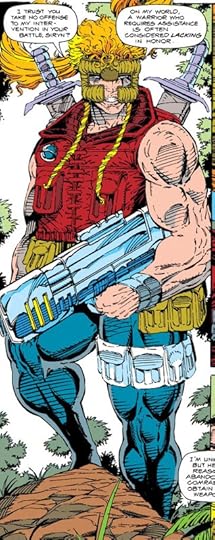
But the icing on the turd flavored 90s cake I'd the "art." Robert Liefield is a where's Waldo of incompetence. I laughed every few pages of his work. It's not just the pouches and giant guns that make it so much fun. His inability to draw feet and hiding them behind things is good. But the best of all is when he has to draw something being held. It always looks like it was just drawn In front of a hand. Giant gun? No need for a trigger! The fun drops right out of the book as soon as the artist changed. (Not that the replacement was much better)
I can't do this book justice. It really has to be experienced.
X-Force was one of the faces of the 90s, excessive and juvenil, but also quite entertaining and iconic, and a nostalgic trip for me, but I don't think it aged very well, the stories are a bit messy, but the characters are still very fun to read, Shatterstar and Cannonball stole the show, and Boom Boom and Domino are as cool as I remembered.
That was really intense. Yes, most of Liefeld's art is trash, but thankfully Fabian Nicieza's writing more than makes up for it. The conflicted team of militant mutants fight their way through various teams of enemies, and basically beat the shit out of all of them in brutal fashion. And even though I know most of Cable's story, I am definitely interested in seeing how it all came to be.
This was actually better than I remember (I haven't read these for about 20 years). The art isn't the best - I'm not a huge fan of Rob Liefeld - but it's a decent read and well worth checking out.
Desde que hemos empezado a hablar de Jim Lee en X-Men y Rob Liefeld en Nuevos Mutantes, hemos comentado que iba a llegar un momento en que los dos se marcharían de Marvel y revolucionarían el mundo del cómic, junto a Portaccio y McFarlane, creando Image. Pues X-Force fue justo lo que ocurrió antes, la obra que lanzó a Liefeld a las alturas, y cuyo número 1 ha sido el cómic más vendido de la historia. ¿Y qué tiene de especial? A priori, que el dibujo de Liefeld impacta muchísimo. No es el mejor dibujo del mundo, es muy particular, y desde luego Liefeld demostró desde el principio que tenía muchísimas carencias como guionista (no tardaría en necesitar de Fabian Nicieza con los diálogos), y de hecho, los últimos números antes de La Canción del Verdugo ya ni siquiera contarían con Liefeld, siendo dibujados por un tal Pacella que hace que añores al propio Liefeld.
La cuestión es que desde la llegada de Cable (en la que Louise Simonson tiene mucho que decir por mucho que Liefeld grite a los cuatro vientos que es cosa suya), los Nuevos Mutantes se habían convertido en una especie de grupo juvenil militar, y con la salida de Espejismo, Loba Venenosa, Mancha Solar y Rictor del grupo (así como la muerte de Warlock en Genosha), Bala de Cañón y Bum-Bum (que se había unido ya muy avanzada la historia del grupo, después de Inferno), se convirtieron en los "guardianes" de los Nuevos Mutantes, integrados dentro de la fuerza militarista de Cable. A ellos se unirían Feroz, de los Morlock, Sendero de Guerra (James Proudstar, antiguo Ave de Trueno de los Infernales), y Estrella Rota, un personaje nuevo procedente de Mundo Mojo; y no tardaría mucho en unirse a ellos Syrin, la hija de Banshee. Junto a una vieja aliada de Cable, Dominó, y asentándose en la Base Centinela de Larry Trask en las Adirondacks, X-Force se convertirá en un grupo militar que se enfrentará en estos primeros números al que sería su enemigo recurrente, el Frente de Liberación Mutante, dirigido por Dyscordia, y que parece tener mucho que ver con Cable.
Además, el grupo pasaría su bautismo de fuego en Nueva York, en las mismísimas Torres Gemelas, combatiendo a Black Tom Cassidy y a Juggernaut con la ayuda de Spiderman, y teniendo que hacer frente a una nueva encarnación de la Hermandad de Mutantes Diabólicos dirigida por el Sapo, y en la que se encontrarían la Mole, Pyros, los morlocks Máscara y Espinna, Sauron y un nuevo personaje muy de la época, Fantazia. Y durante el combate, viviríamos la muerte y resurrección de Bala de Cañón, lo que permitiría que los guionistas se adentraran en el mundo de los llamados X-Ternos, un grupo de mutantes inmortales entre los que estarían Gideon (el actual tutor de Mancha Solar), y otros mutantes manipuladores. En los últimos números anteriores a la Canción del Verdugo y ya con Liefeld yendo y viniendo, X-Force tuvo que hacer frente a la traición de Dominó (que resultó no ser Dominó, si no Copycat), a Masacre, a los antiguos aliados de Cable reunidos en un equipo llamado Arma Prima, al externo Crule (enviado para podar a Bala de Cañón) y al mismísimo Gideon, lo que acabaría con el equipo sin Cable y con dos nuevos miembros, Ríctor y Bala de Cañón, preparados para afrontar La Canción del Verdugo.
Much critique of this title in particular, and this era of the X-Men in general, focuses on how bad Rob Liefeld's art is. While I'm not a fan of his, this fails to take into account that Rob Liefeld is a considerably better artist than Fabien Nicieza is a writer.
There are no decent ideas anywhere in this book. Sure, there are plot points in issue #9 that are sort of relevant to other X-books, but is it necessary to read them here? Nah.
I recognize that "Hey, there's a bad guy, let's have a two issue fight scene about it," isn't a surprise when you're reading a mediocre comic but the X-books were usually much more focused on characters and tended to keep fight scenes just a few pages long while building up things like suspense. Nicieza doesn't know how to do that now, and certainly had no idea how to do that thirty years ago. So we get sprawling battles with occasional weird reveals that are quickly retconned by better writers (which is most writers).
If you like dumb, extreme violence from the 90s, then this is the kind of book to pick up and laugh at. But if you're looking for a story? This is not the book for you.
The art is terrible and it's the best thing about this book. The time I lost reading this would have been better spent sleeping. It's crazy to think this was around the time when comics peaked in terms of commercial success. If this is what it takes to succeed commercially, I don't want comics to succeed commercially.
having jumped ahead from some early new mutants stuff it was very jarring to see how different things would become. this took a minute to click, but I found myself really enjoying it soon enough. I can definitely see why this was as popular as it was at the time.
The start of X-Force is objectively terrible with disproportionate Liefeld art and 90s writing but it was a fun read. Cable is awesome in this as are all the mutants in the team. 1991-1992. 7/10
DNF. I got about 3/4 of the way to the end and realized it wasn't worth finishing. I wanted to see what I thought about 90s superhero comics – specifically, Liefeld – and yeah, they're not very good.
...and to beat a dead horse, Liefeld's proportions are distracting. This is just one of the most egregious examples I could find from this book:
I don't think I've read Rob Liefeld's comic books before but the art certainly has it's trashy charm. The action is high-packed and plentiful, the dialogues are short and edgy, what else would you wish from the comics in the 90s, eh? It very highly reminds me of Stormwatch, except that one has better art by Jim Lee. Considering that Image Comics was created next year after the creation of X-Force, it's no wonder. A couple of issues are pencilled by Greg Capullo, and while I haven't seen his earlier art before that, I like it more than his high definition work of current year, probably due to the coloring. Also the Wikipedia says the first issue sold five million copies, geez. Sure, it's fun but it's not THAT fun.