

What do you think?

Adults in the Room: My Battle with Europe's Deep Establishment
What happens when you take on the establishment? In this blistering, personal account, world-famous economist Yanis Varoufakis blows the lid on Europe’s hidden agenda and exposes what actually goes on in its corridors of power.
Varoufakis sparked one of the most spectacular and controversial battles in recent political history when, as finance minister of Greece, he attempted to renegotiate his country’s relationship with the EU. Despite the mass support of the Greek people and the simple logic of his arguments, he succeeded only in provoking the fury of Europe’s political, financial and media elite. But the true story of what happened is almost entirely unknown – not least because so much of the EU’s real business takes place behind closed doors.
In this fearless account, Varoufakis reveals all: an extraordinary tale of brinkmanship, hypocrisy, collusion and betrayal that will shake the deep establishment to its foundations.
As is now clear, the same policies that required the tragic and brutal suppression of Greece’s democratic uprising have led directly to authoritarianism, populist revolt and instability throughout the Western world.
'Adults In The Room' is an urgent wake-up call to renew European democracy before it is too late.
Varoufakis sparked one of the most spectacular and controversial battles in recent political history when, as finance minister of Greece, he attempted to renegotiate his country’s relationship with the EU. Despite the mass support of the Greek people and the simple logic of his arguments, he succeeded only in provoking the fury of Europe’s political, financial and media elite. But the true story of what happened is almost entirely unknown – not least because so much of the EU’s real business takes place behind closed doors.
In this fearless account, Varoufakis reveals all: an extraordinary tale of brinkmanship, hypocrisy, collusion and betrayal that will shake the deep establishment to its foundations.
As is now clear, the same policies that required the tragic and brutal suppression of Greece’s democratic uprising have led directly to authoritarianism, populist revolt and instability throughout the Western world.
'Adults In The Room' is an urgent wake-up call to renew European democracy before it is too late.
561 pages, Kindle Edition
First published May 4, 2017
About the author
Yanis Varoufakis
70 books2,701 followersIoannis "Yanis" Varoufakis is a Greek-Australian economist and politician. A former academic, he has been Secretary-General of the Democracy in Europe Movement 2025 (DiEM25), a left-wing pan-European political party he co-founded in 2016. A former member of Syriza, he served as Minister of Finance from January to July 2015 under Prime Minister Alexis Tsipras.
Ratings & Reviews
Friends & Following
Create a free account to discover what your friends think of this book!
Community Reviews
Displaying 1 - 30 of 641 reviews
October 3, 2019
Behind the closed doors of a Financial Crisis…
Highlights:
--I’ve read Varoufakis’ general public books numerous times; this one started lowest in my priorities as I assumed general readers would already flock to it for its first-person narrative, whereas I focus on structural analysis of society’s abstractions (ex. capital) more than vicariously re-enacting an individual’s personal behavior.
--Thus, this turned out to be a rare 5-star rating for the autobiographical format. What a compelling on-the-grounds case study of the tight rope that a radical party must walk when facing down hostile status-quo institutions, both external and from within, combined with snippets of the structural analysis I expect from Varoufakis:
1) Divided-and-Conquered:
--This is the innovation of the autobiographical format. Outside of the book, it was cringeworthy seeing those on the Left fret about Varoufakis’s public image/attire during his negotiations. We can expect the Left, being critical, to live in perpetual debates, but I would also expect leftist critique to rise above such personality preferences.
--Do we really need to encourage the tabloids? The mass media, as always, played a major role in divide-and-rule social control. Greek corporate media was the proxy of the Greek oligarchy who (behind closed doors) benefit from the bubble-inducing credit of the Euro system conjured by German/French creditors while sheltered from the consequences (see later). The two “sides” are not German vs. Greek, but those committed to capitalist bureaucracies vs. the rest.
--Varoufakis starts with the Larry Summers dilemma of being an insider (i.e. to know what’s going on and make changes, you must be an “insider”, but you can only be an insider by not outing other insiders). The radicals who enter institutional power face this dilemma of being co-opted to reproduce these “black boxes” (power from hidden information), making them vulnerable to division. Varoufakis references Wikileaks’ strategy of ossifying the arteries of these black box networks by having to contend with information leaks, which inspired Varoufakis’ step-by-step ideas for a democratic postcapitalism in Another Now: Dispatches from an Alternative Present.
--For hidden information and systems failures in the arms race: The Doomsday Machine: Confessions of a Nuclear War Planner
2) Systemic Crises:
--Crises offer a brief moment where convenient myths evaporate, “a portal, a gateway between one world and the next.” (Arundhati Roy). During financial crises, the assumption that capitalism is a natural (“human nature”), national (so you can compare countries and forget about their interdependencies esp. imperialism) system of individuals freely exchanging their goods/services culminating in harmonious market equilibrium crashes into reality.
--In this reality, global capitalism’s viral growth is also the source of crises; waves of boom/bust “business cycles”, “hot money” speculative bubbles and technological “creative destruction” crash into communities, where elite share/bondholders surf for short-term spoils while the rest are washed away:
a) Private banking:
--In And the Weak Suffer What They Must? Europe's Crisis and America's Economic Future, Varoufakis details the magic of private banks to conjure money (credit, thus debt) during the good times. This went into overdrive with the Euro common currency because banks no longer worried about deficit countries’ emergency option of devaluing their own currencies (an option when you have a sovereign currency + central bank); under the Euro, private banks confidently flooded deficit countries with loans to take advantage of their higher interest rates (from deficit countries' scarcity of money, which flowed out into surplus countries via purchases).
--If not strictly regulated, this over-lending bubble grows until it bursts. Thus, the Euro Crisis stems from giving the reigns of money-creation to private banks (esp. German/French) while neutering any chance of democratic influence by Euro members on the clean-up costs of the over-lending crash. On top of this, these private banks became addicted to another bubble: toxic derivatives from Wall Street (for the origins, see Varoufakis’ The Global Minotaur: America, the True Origins of the Financial Crisis and the Future of the World Economy).
b) Trade imbalances:
--Remember, one's deficit is the other's surplus; surpluses are sustained by the other side’s deficits. Myopic arrogance can derail this symbiosis (i.e. failing to "recycle" some surplus back to the deficit region to feed their purchasing power); if the deficit region is left to die, the demand dies as well, which brings the crisis to the surplus region as the crisis becomes systemic!
--The real world will always have asymmetrical trade relations (ex. urban vs. rural), but certain structural logic (i.e. private banks free to create money to maximize debt/interest payments) will exacerbate trade imbalances to unsustainable proportions, while stressing the working/poor on both sides (bubbles and gentrification on the deficit side, inflation eating away real wages on the surplus side).
--The crisis grew because the EU lacked political mechanisms (i.e. functioning national central banks + democratic power) to provide long-term regulation (i.e. restraints on over-lending during the boom, restructure bad debts to revive surplus recycling during the bust, radical alternatives to short-term profit maximization to alleviate boom/bust). Thus, the EU resorted to hide these failures by pretending to bail out Greece (which cannot possibly recover against further austerity cuts/privatization) while actually bailing out the over-lending by German and French private banks (as always, follow the money)! Ponzi-growth became "Ponzi-austerity".
--Varoufakis' illustrative analogy: if the State of Delaware can bring down the US economy, the problem would be in how the US economy is structured. Thus, Greece was the canary in the coalmine, the first to signal the EU’s systemic failures.
3) Morality of Debt:
--Now, when the crash happens and the debts go bad, there is the blame game. Creditors or debtors? What should be the moral of the story: “austerity” (further cuts during crisis targeting services for the masses) is a short-sighted ploy to put 100% of the blame and burden starting from the lowest of the debtors (thus omitting debtor countries’ domestic elites…).
--"Over-borrowing" or "over-lending"? It is crucial to consider the scale and visibility of the actors, to prevent us from becoming useful idiots who blame the visible for crumbs in social assistance while omitting the absentee speculators behind closed doors who gamble with astronomical sums.
--The public as individuals take on debt in our daily lives (in no small part due to the privatization and accumulation of necessities like housing), and this is visible. Invisible are the private institutional debtors of incomparable magnitudes (financial institutions who trade purposefully-complex debt instruments, transnational corporations and the global financial/intellectual property regime, the one “social” spending omitted: military spending, etc.), who happen to be the creditors of the public’s individual debts. As Michael Hudson reminds us, abolishing the debts of the masses means abolishing the savings of the rulers.
--A bank’s accounting still seems unfathomable to an outsider. How do banks just conjure up money out of thin air to lend (instead of solely distributing deposits) and charge interest on top of this made-up money?! Perhaps it is the morality that we have more trouble with, as technically this does fit with capitalism’s magical growth. The anticipation of growth builds confidence for future repayments (but both can be reversed!), making endless economic growth (market transactions) synonymous with the health of the capitalist economy (despite our finite planet: Less is More: How Degrowth Will Save the World)
--Graeber’s Debt: The First 5,000 Years blows the lid off the morality of debt. I still need to dive into the technical details of the banking system’s accounting: Where Does Money Come From?: A Guide To The Uk Monetary And Banking System
The Contentious:
--Now, I’ve been mostly a follower of Varoufakis’ academic works, so I am more distant from the details of his negotiation strategies (also, the whole “this is only one side of the story” business). I base my reflections on what I can make of his general analysis and consistency of his principles. 2 contentions stick out:
1) Liberalism?:
--Towards the end of the book, Varoufakis’ positive characterization of “liberalism” using a quote from JFK’s 1961 inaugural address in contrast to the EU deep state regime was questionable. After all, Varoufakis frequently critiques liberalism’s roots in being against democracy until it became politically advantageous; it is no coincidence that this is when power left the political sphere to reside in the closed doors of the private economic sphere.
--Varoufakis is well-aware of contrasting liberal rhetoric (Adam Smith’s “invisible hand” of self-seeking producer-owners, i.e. “butchers, bakers, brewers”) vs. liberal realities, especially globally (absentee shareholders’ East India Company colonizing Asia and profiting from opium/slave trade). Indeed, the EU’s debt bondage of Europe’s periphery was long perfected in Europe’s colonies. This reminds me of Michael Hudson, who also clearly understands the other side (Trade, Development and Foreign Debt) but still slips into Western-centric romantized Industrial capitalism/liberal Enlightenment when contrasting with Finance capitalism/Neo-feudalism (Varoufakis’ “Techno-feudalism”) (Killing the Host: How Financial Parasites and Debt Bondage Destroy the Global Economy).
--I doubt a Leftist of the Global South like Vijay Prashad would slip so easily since the Global South lives in other side of liberalism: imperialism. JFK’s 1961 inauguration led to an escalation of the US war on Vietnam/Laos/Cambodia, target practice for chemical warfare and more bombs than WWII. John Maynard Keynes, another liberal icon with perhaps some radical ambitions, also has censored imperialist baggage (advising British India’s WWII drain: Capital and Imperialism: Theory, History, and the Present). Varoufakis seems reluctant to fully detail the New Deals/Keynesianism in the context of the Soviet challenge/Third World Nationalism (ex. The Darker Nations: A People's History of the Third World), preferring to be confined to the West and portray New Deal liberals being enlightened by the Great Depression.
2) Class Power?:
--Nuanced Left critics of Varoufakis do have compelling points regarding perspectives on class power and strategy.
--I have not fully unpacked the debate with, say, Costas Lapavitsas on Greece/EU: The Left Case Against the EU). How much reform can be done on the EU is just half of the debate in my eyes. Varoufakis’ skepticism over the other half is clear: amidst the chaos (ex. EU dissolving from a chain reaction of “Leave”), is the Left at all ready to unify and provide accessible, coherent alternatives vs. reactionaries primed for visceral scapegoating during the panic (with the Great Depression and rise of Fascism as a historical case study)? At least Varoufakis is stepping out of academia to put words into action with Progressive International/DiEM25.
--From a 2018 Q&A , Varoufakis contends that labour lost all bargaining power during the Great Depression’s mass unemployment. I can see the logic, but I do wonder how blunt this analysis is; I remember Howard Zinn emphasizing the power of wildcat strikes around this time; need to look more into this, as well as other debt crises (ex. “Ángel [Gurría] had made his name as the finance minister of Mexico who had negotiated a major haircut of its unpayable public debt in the 1980s.”).
Highlights:
--I’ve read Varoufakis’ general public books numerous times; this one started lowest in my priorities as I assumed general readers would already flock to it for its first-person narrative, whereas I focus on structural analysis of society’s abstractions (ex. capital) more than vicariously re-enacting an individual’s personal behavior.
--Thus, this turned out to be a rare 5-star rating for the autobiographical format. What a compelling on-the-grounds case study of the tight rope that a radical party must walk when facing down hostile status-quo institutions, both external and from within, combined with snippets of the structural analysis I expect from Varoufakis:
1) Divided-and-Conquered:
--This is the innovation of the autobiographical format. Outside of the book, it was cringeworthy seeing those on the Left fret about Varoufakis’s public image/attire during his negotiations. We can expect the Left, being critical, to live in perpetual debates, but I would also expect leftist critique to rise above such personality preferences.
--Do we really need to encourage the tabloids? The mass media, as always, played a major role in divide-and-rule social control. Greek corporate media was the proxy of the Greek oligarchy who (behind closed doors) benefit from the bubble-inducing credit of the Euro system conjured by German/French creditors while sheltered from the consequences (see later). The two “sides” are not German vs. Greek, but those committed to capitalist bureaucracies vs. the rest.
--Varoufakis starts with the Larry Summers dilemma of being an insider (i.e. to know what’s going on and make changes, you must be an “insider”, but you can only be an insider by not outing other insiders). The radicals who enter institutional power face this dilemma of being co-opted to reproduce these “black boxes” (power from hidden information), making them vulnerable to division. Varoufakis references Wikileaks’ strategy of ossifying the arteries of these black box networks by having to contend with information leaks, which inspired Varoufakis’ step-by-step ideas for a democratic postcapitalism in Another Now: Dispatches from an Alternative Present.
--For hidden information and systems failures in the arms race: The Doomsday Machine: Confessions of a Nuclear War Planner
2) Systemic Crises:
--Crises offer a brief moment where convenient myths evaporate, “a portal, a gateway between one world and the next.” (Arundhati Roy). During financial crises, the assumption that capitalism is a natural (“human nature”), national (so you can compare countries and forget about their interdependencies esp. imperialism) system of individuals freely exchanging their goods/services culminating in harmonious market equilibrium crashes into reality.
--In this reality, global capitalism’s viral growth is also the source of crises; waves of boom/bust “business cycles”, “hot money” speculative bubbles and technological “creative destruction” crash into communities, where elite share/bondholders surf for short-term spoils while the rest are washed away:
a) Private banking:
--In And the Weak Suffer What They Must? Europe's Crisis and America's Economic Future, Varoufakis details the magic of private banks to conjure money (credit, thus debt) during the good times. This went into overdrive with the Euro common currency because banks no longer worried about deficit countries’ emergency option of devaluing their own currencies (an option when you have a sovereign currency + central bank); under the Euro, private banks confidently flooded deficit countries with loans to take advantage of their higher interest rates (from deficit countries' scarcity of money, which flowed out into surplus countries via purchases).
--If not strictly regulated, this over-lending bubble grows until it bursts. Thus, the Euro Crisis stems from giving the reigns of money-creation to private banks (esp. German/French) while neutering any chance of democratic influence by Euro members on the clean-up costs of the over-lending crash. On top of this, these private banks became addicted to another bubble: toxic derivatives from Wall Street (for the origins, see Varoufakis’ The Global Minotaur: America, the True Origins of the Financial Crisis and the Future of the World Economy).
b) Trade imbalances:
--Remember, one's deficit is the other's surplus; surpluses are sustained by the other side’s deficits. Myopic arrogance can derail this symbiosis (i.e. failing to "recycle" some surplus back to the deficit region to feed their purchasing power); if the deficit region is left to die, the demand dies as well, which brings the crisis to the surplus region as the crisis becomes systemic!
--The real world will always have asymmetrical trade relations (ex. urban vs. rural), but certain structural logic (i.e. private banks free to create money to maximize debt/interest payments) will exacerbate trade imbalances to unsustainable proportions, while stressing the working/poor on both sides (bubbles and gentrification on the deficit side, inflation eating away real wages on the surplus side).
--The crisis grew because the EU lacked political mechanisms (i.e. functioning national central banks + democratic power) to provide long-term regulation (i.e. restraints on over-lending during the boom, restructure bad debts to revive surplus recycling during the bust, radical alternatives to short-term profit maximization to alleviate boom/bust). Thus, the EU resorted to hide these failures by pretending to bail out Greece (which cannot possibly recover against further austerity cuts/privatization) while actually bailing out the over-lending by German and French private banks (as always, follow the money)! Ponzi-growth became "Ponzi-austerity".
--Varoufakis' illustrative analogy: if the State of Delaware can bring down the US economy, the problem would be in how the US economy is structured. Thus, Greece was the canary in the coalmine, the first to signal the EU’s systemic failures.
3) Morality of Debt:
--Now, when the crash happens and the debts go bad, there is the blame game. Creditors or debtors? What should be the moral of the story: “austerity” (further cuts during crisis targeting services for the masses) is a short-sighted ploy to put 100% of the blame and burden starting from the lowest of the debtors (thus omitting debtor countries’ domestic elites…).
--"Over-borrowing" or "over-lending"? It is crucial to consider the scale and visibility of the actors, to prevent us from becoming useful idiots who blame the visible for crumbs in social assistance while omitting the absentee speculators behind closed doors who gamble with astronomical sums.
--The public as individuals take on debt in our daily lives (in no small part due to the privatization and accumulation of necessities like housing), and this is visible. Invisible are the private institutional debtors of incomparable magnitudes (financial institutions who trade purposefully-complex debt instruments, transnational corporations and the global financial/intellectual property regime, the one “social” spending omitted: military spending, etc.), who happen to be the creditors of the public’s individual debts. As Michael Hudson reminds us, abolishing the debts of the masses means abolishing the savings of the rulers.
--A bank’s accounting still seems unfathomable to an outsider. How do banks just conjure up money out of thin air to lend (instead of solely distributing deposits) and charge interest on top of this made-up money?! Perhaps it is the morality that we have more trouble with, as technically this does fit with capitalism’s magical growth. The anticipation of growth builds confidence for future repayments (but both can be reversed!), making endless economic growth (market transactions) synonymous with the health of the capitalist economy (despite our finite planet: Less is More: How Degrowth Will Save the World)
--Graeber’s Debt: The First 5,000 Years blows the lid off the morality of debt. I still need to dive into the technical details of the banking system’s accounting: Where Does Money Come From?: A Guide To The Uk Monetary And Banking System
The Contentious:
--Now, I’ve been mostly a follower of Varoufakis’ academic works, so I am more distant from the details of his negotiation strategies (also, the whole “this is only one side of the story” business). I base my reflections on what I can make of his general analysis and consistency of his principles. 2 contentions stick out:
1) Liberalism?:
--Towards the end of the book, Varoufakis’ positive characterization of “liberalism” using a quote from JFK’s 1961 inaugural address in contrast to the EU deep state regime was questionable. After all, Varoufakis frequently critiques liberalism’s roots in being against democracy until it became politically advantageous; it is no coincidence that this is when power left the political sphere to reside in the closed doors of the private economic sphere.
--Varoufakis is well-aware of contrasting liberal rhetoric (Adam Smith’s “invisible hand” of self-seeking producer-owners, i.e. “butchers, bakers, brewers”) vs. liberal realities, especially globally (absentee shareholders’ East India Company colonizing Asia and profiting from opium/slave trade). Indeed, the EU’s debt bondage of Europe’s periphery was long perfected in Europe’s colonies. This reminds me of Michael Hudson, who also clearly understands the other side (Trade, Development and Foreign Debt) but still slips into Western-centric romantized Industrial capitalism/liberal Enlightenment when contrasting with Finance capitalism/Neo-feudalism (Varoufakis’ “Techno-feudalism”) (Killing the Host: How Financial Parasites and Debt Bondage Destroy the Global Economy).
--I doubt a Leftist of the Global South like Vijay Prashad would slip so easily since the Global South lives in other side of liberalism: imperialism. JFK’s 1961 inauguration led to an escalation of the US war on Vietnam/Laos/Cambodia, target practice for chemical warfare and more bombs than WWII. John Maynard Keynes, another liberal icon with perhaps some radical ambitions, also has censored imperialist baggage (advising British India’s WWII drain: Capital and Imperialism: Theory, History, and the Present). Varoufakis seems reluctant to fully detail the New Deals/Keynesianism in the context of the Soviet challenge/Third World Nationalism (ex. The Darker Nations: A People's History of the Third World), preferring to be confined to the West and portray New Deal liberals being enlightened by the Great Depression.
2) Class Power?:
--Nuanced Left critics of Varoufakis do have compelling points regarding perspectives on class power and strategy.
--I have not fully unpacked the debate with, say, Costas Lapavitsas on Greece/EU: The Left Case Against the EU). How much reform can be done on the EU is just half of the debate in my eyes. Varoufakis’ skepticism over the other half is clear: amidst the chaos (ex. EU dissolving from a chain reaction of “Leave”), is the Left at all ready to unify and provide accessible, coherent alternatives vs. reactionaries primed for visceral scapegoating during the panic (with the Great Depression and rise of Fascism as a historical case study)? At least Varoufakis is stepping out of academia to put words into action with Progressive International/DiEM25.
--From a 2018 Q&A , Varoufakis contends that labour lost all bargaining power during the Great Depression’s mass unemployment. I can see the logic, but I do wonder how blunt this analysis is; I remember Howard Zinn emphasizing the power of wildcat strikes around this time; need to look more into this, as well as other debt crises (ex. “Ángel [Gurría] had made his name as the finance minister of Mexico who had negotiated a major haircut of its unpayable public debt in the 1980s.”).

May 4, 2017
A work for the ages! "Adults in the Room" masterfully oscillates between the thrilling and the lyrical, the very personal and the universal, giving us a unique glimpse behind the high walls of power.
This book will be uncomfortable or even dangerous for many current politicians, from Europe's governments and EU institutions to the IMF and of course Greece's Syriza party. Former Greek Finance Minister Yanis Varoufakis (boy, does that title ever feel inadequate given the impact he had and has!) never made a secret of the fact that he comes to politics as an outsider. He is not a member of any party, not even the one that put him in office (which they couldn't fail to do after he won more votes than any other MP). As such, he is not entangled with a net of interests and he has no qualms to tell all that he saw during his time on the 'inside' of international politics.
Behind closed doors, politicians like German Finance Minister Wolfgang Schäuble turn out to be not monsters but protagonists of a classic Greek tragedy. Varoufakis is not unkind or unsympathetic to him - which should come as a big surprise to anyone who bought into the mainstream media reporting of the time, which often presented the 2015 negotiations as a cock fight between Varoufakis and Schäuble. But the mainstream media were/are not uninvolved in the Greek crisis, they have a role to play, too, in a system that, like the Soviet Union in the late 80s, will deny basic economic and political truths and pretend that all is well until the very moment of its collapse.
Varoufakis came as a non-insider to save the system, flawed as it may be, knowing that a collapse would cause untold hardships for tens of millions of people. And after having discovered, over the course of the time period narrated in this book, that the insiders well know the truth, and know what needs to be done, but are unable or unwilling to do it, the logical next step is to expose them, so that the light of transparency may bring about the change that working with these people could not. That is also one of the ideas of the movement he founded last year, DiEM25 (Democracy in Europe Movement 2025), which demands not just a re-orientation of the EU to serve its people, but also complete transparency of all powerful illegitimate (formally non-existent) institutions like the Eurogroup. Disclaimer: after one year of volunteering, DiEM25 has now become a near full-time occupation of mine and I regularly talk to Varoufakis because of that.
I knew that Yanis Varoufakis could make even dull subjects very interesting, as proven in the economics textbooks he authored and his account of the history of a common currency. Given an interesting subject to start with, one that affects everyone who is concerned about the future of the European Union, his writing becomes absolutely breathtaking. Highly recommended!
This book will be uncomfortable or even dangerous for many current politicians, from Europe's governments and EU institutions to the IMF and of course Greece's Syriza party. Former Greek Finance Minister Yanis Varoufakis (boy, does that title ever feel inadequate given the impact he had and has!) never made a secret of the fact that he comes to politics as an outsider. He is not a member of any party, not even the one that put him in office (which they couldn't fail to do after he won more votes than any other MP). As such, he is not entangled with a net of interests and he has no qualms to tell all that he saw during his time on the 'inside' of international politics.
Behind closed doors, politicians like German Finance Minister Wolfgang Schäuble turn out to be not monsters but protagonists of a classic Greek tragedy. Varoufakis is not unkind or unsympathetic to him - which should come as a big surprise to anyone who bought into the mainstream media reporting of the time, which often presented the 2015 negotiations as a cock fight between Varoufakis and Schäuble. But the mainstream media were/are not uninvolved in the Greek crisis, they have a role to play, too, in a system that, like the Soviet Union in the late 80s, will deny basic economic and political truths and pretend that all is well until the very moment of its collapse.
Varoufakis came as a non-insider to save the system, flawed as it may be, knowing that a collapse would cause untold hardships for tens of millions of people. And after having discovered, over the course of the time period narrated in this book, that the insiders well know the truth, and know what needs to be done, but are unable or unwilling to do it, the logical next step is to expose them, so that the light of transparency may bring about the change that working with these people could not. That is also one of the ideas of the movement he founded last year, DiEM25 (Democracy in Europe Movement 2025), which demands not just a re-orientation of the EU to serve its people, but also complete transparency of all powerful illegitimate (formally non-existent) institutions like the Eurogroup. Disclaimer: after one year of volunteering, DiEM25 has now become a near full-time occupation of mine and I regularly talk to Varoufakis because of that.
I knew that Yanis Varoufakis could make even dull subjects very interesting, as proven in the economics textbooks he authored and his account of the history of a common currency. Given an interesting subject to start with, one that affects everyone who is concerned about the future of the European Union, his writing becomes absolutely breathtaking. Highly recommended!

May 31, 2017
Author thinks he's the biggest badass on the planet and economic Jesus (the sacrifice bit, less of the saving angle). I guess if he failed then there's no hope for Greece.
I find it curious how he constantly portrays himself as the only honest politician who's repeatedly being played for a fool by everyone around him friends and enemies alike. He is clearly a clever man so this makes me question how genuine his stories are. Also in case you've not picked up on how principled he is he recounts his father's story of selfless sacrifice in the name of principles just to make sure you get it. Gives an impression of narcissism, even though I don't think he is one having seen many interviews with him.
Despite my doubts and this being mostly biographical (was expecting some discussion of economic problems but found none) it's still interesting to catch a glimpse of how politics is done.
Edit:
If you're interested in this topic (debt crisis, not Varoufakis) from a more global perspective and in greater scope I can recommend Crashed by Adam Tooze.
I find it curious how he constantly portrays himself as the only honest politician who's repeatedly being played for a fool by everyone around him friends and enemies alike. He is clearly a clever man so this makes me question how genuine his stories are. Also in case you've not picked up on how principled he is he recounts his father's story of selfless sacrifice in the name of principles just to make sure you get it. Gives an impression of narcissism, even though I don't think he is one having seen many interviews with him.
Despite my doubts and this being mostly biographical (was expecting some discussion of economic problems but found none) it's still interesting to catch a glimpse of how politics is done.
Edit:
If you're interested in this topic (debt crisis, not Varoufakis) from a more global perspective and in greater scope I can recommend Crashed by Adam Tooze.

September 3, 2018
This is an explosive tale, or autobiography, of the former Greek minister of finance, from January to July 2015, who almost destroyed the troika: European Commission, European Central Bank, and International Monetary Fund (and ultimately the EU as well if he succeeded). Yanis Varoufakis rejected the bailout offer from Germany or the EU. In his charismatic, robust, bold and brash manner this highly popular, internationally well-known professor of economic theory, tried to take on the big guns and failed miserably. He came in as an outsider, belonging to no political party, and created a tsunami of truths which rattled the cages of the elusive, hidden directors of private banks and the ' shadow government' behind the EU and the rest of the world.
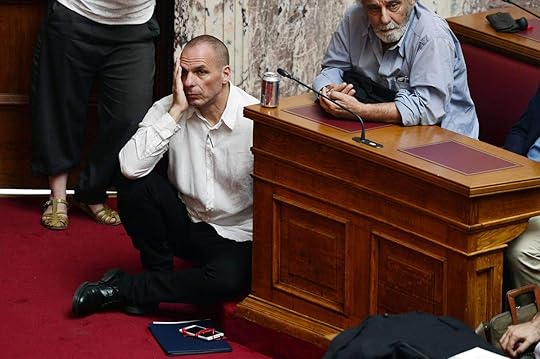
Despite his criticism of Germany and Angela Merkel, he is still regarded as an unlikely hero in Germany. https://www.washingtonpost.com/news/w...
Right of the bat I must say that I wanted to read another opinion on these three institutions, known as the EU troika, fondly and ferociously hated by all who are forced to live under their austerity measures. I have just finished reading A History of Central Banking and the Enslavement of Mankind by Stephen Mitford Goodson, which I found fascinating, particularly since I knew nothing really about the history of money and banking. Goodson's book is a must-read for anyone interested in their own money! Yanis Varoufakis's book, the first one for me, but not the last, is by far one of the most eye-opening reads of this year!
I was rightfully informed at last about the upcoming demise of the world as a result of usury (compound interest), the vanishing of state banks, and the dire consequences for the world when private banks forced themselves onto governments, even instigating war if these governments refused their privately printed money as outrageous loans. Even worse, spreading money that was created out of nothing, forcing tax payers and citizens to pay back real money for artificial, non-existing money. Crazy as crazy can be. Bear in mind that I'm a know-nothing-am-nothing pathetically informed reader, nothing else.
I don't know about you, but I get quite emotional about my hard-earned money. Uhummmm yes, we've all seen these angry mobs burning down buildings when their 'free money' in the form of social grants, were roped in by their governments(austerity measures kicking in). I'm sadly not one of those lucky people who qualify for 'free money'. I have to work extremely hard for mine and hand over almost 45% to the government in the obvious taxes (apart from the multitude of hidden taxes). Add a little Marxist twist to our plot. Our government informed us that other people want our land for free, which we bought with loans and paid off through natural disasters, buckets full of tears, truck loads full of determination, skyrocketing interest rates and high taxes. But we did it. So, 'they' said, watch this space, you might be expropriated soon, if 'they' can get away with it. Now we're waiting and waiting and waiting...and we thank all the gods on all the planets for not being slaughtered, attacked, murdered YET as is currently happening in our country.
So when I started out Yanis Varoufakis's book, it was to quench my thirst to know where our own country might be heading, and after reading Goodson's book, I had a better understanding of the Greek revolt against these banks. With Mr. Varoufakis, supporter of the Greek radical left party Syriza, and as one of their spokespersons, spilling the beans on the events, I was getting ready for a real juicy scandal or Greek tragedy. The latter it was for sure. And a scandal it is already. For him it was like watching a version of Macbeth unfold in the land of Oedipus.
Prof. Varoufakis knew the minuscule influence or power that politicians held. According to him democracy have no effect whatsoever on money. Wall Street and a network of hedge funds, billionaires and media owners have the real power, and the art of being in politics is to recognize this as a fact of life and achieve what you can without disrupting the system. This allegation corresponds with Stephen Goodson's.
Varoufakis describes himself as an erratic Marxist(but also called himself once a libertarian Marxist), and provides his reasons in this article: https://www.theguardian.com/news/2015...
This memoir is hailed as one of the greatest. As one reviewer stated: "Varoufakis has written one of the greatest political memoirs of all time. It stands alongside Alan Clark’s for frankness, Denis Healey’s for attacks on former allies, and – as a manual for exploring the perils of statecraft – will probably gain the same stature as Robert Caro’s biography of Lyndon B Johnson. Source: https://www.theguardian.com/books/201...
To save private banks, German and other country's tax payers, particularly America via the IMF, will foot the bill. It is inevitable. And it is already happening. Germany is not the wealthy country it once was. High taxes and over-spending by the government brought many ordinary people to their knees. It is not the glamour and glitzy state that the Greeks accuse of cruelty and Nazi-ism, burning German flags on the plains of the Greek cities. Ordinary Germans are suffering as a result too. Badly so. Very badly indeed.
Despite the annoying repetitions and the confusion it created in the first part of the book, it remains a great read - often being experienced as a thriller. The European crisis eventually included countries such as Portugal, Ireland, Italy, Greece and Spain (the PIIGS countries as referred to by financial markets). The crisis kicked off a worldwide movement, with Brexit and the American election forming part of the results.
Sometimes we need to have a glimpse into our own future. Start here. But watch a few Youtube videos as well about the events, and the people involved. It's a good bet when you need more background, as well as a look into the aftermath of this battle with the EU 'beasts'. In fact, the real impact on the ordinary citizens of Greece will be found elsewhere, such as Youtube. It is a wake-up call. Here is only one of them: https://www.youtube.com/watch?v=Pee_w...
In his own article, The Six Brexit Traps That Will Defeat Theresa May Prof.Varoufakis fearlessly and straightforward express his opinion of the EU and the enslavement of European citizens to private bankers: In truth, Brussels is a democracy-free zone. From the EU’s inception in 1950, Brussels became the seat of a bureaucracy administering a heavy industry cartel, vested with unprecedented law-making capacities. Even though the EU has evolved a great deal since, and acquired many of the trappings of a confederacy, it remains in the nature of the beast to treat the will of electorates as a nuisance that must be, somehow, negated. The whole point of the EU’s inter-governmental organisation was to ensure that only by a rare historical accident would democratic mandates converge and, when they did, never restrain the exercise of power in Brussels.
I don't have any knowledge of banking, so cannot voice an opinion. But he is supported by a wide group of economists from different backgrounds, countries and ideologies. Julius Assange is a fan too.
I spent many days reading the book, watching Youtube videos, reading articles and learn more about Yanis Varoufakis. It was absolutely worth the time. At least it does not require a rocket scientist anymore to know where we are all heading.
Here is another important documentary. All countries are in danger of collapsing, because everyone is directly, or indirectly involved, including America, and the wrong people will be blamed.
You need to watch this:
Europe's Debt: America's Crisis - Full Video
https://www.youtube.com/watch?v=uhZ0R...
The Imperfect Union: The eurozone In Crisis - full documentary
https://www.youtube.com/watch?v=LpwpI...
PS. If you're interested you can read my review of A History of Central Banking and the Enslavement of Mankind by Stephen Mitford Goodson. So by the way, remember the notorious but famous Mitford sisters of Britain? Stephen shares the same family tree.
https://www.goodreads.com/review/show...
However, there are excellent reviews on GR. Today is tomorrow's history, and all our names is written into the script of destiny. Those who ignore this kind of books, are fools, especially when it comes to voting. As simple as that.
Ps: I just want to add this link for my own records
An Economic Hit Man Speaks Out: John Perkins on How Greece Has Fallen Victim to “Economic Hit Men“
https://truthout.org/articles/an-econ...
Despite his criticism of Germany and Angela Merkel, he is still regarded as an unlikely hero in Germany. https://www.washingtonpost.com/news/w...
They appreciated that you could squeeze blood out of a stone more easily than make a bankrupt entity repay its loans by lending it more money, especially if you shrink its income as part of the deal. They could see that the troika, even if they managed to confiscate the fallen state's silverware, would fail to recoup the money used to refinance Greece's public debt. They knew that the celebrated 'rescue' or 'bailout' package was nothing more than a one-way ticket to debtor's prison. How do I know that they knew? Because they told me.He later would reveal the secret tapes he made of conversations in which top IMF officials, Germany's finance minister, leading figures in the ECB and the European Commission admitted it. They at first tried to deny it, which forced his hand to reveal the existence of the tapes.
Right of the bat I must say that I wanted to read another opinion on these three institutions, known as the EU troika, fondly and ferociously hated by all who are forced to live under their austerity measures. I have just finished reading A History of Central Banking and the Enslavement of Mankind by Stephen Mitford Goodson, which I found fascinating, particularly since I knew nothing really about the history of money and banking. Goodson's book is a must-read for anyone interested in their own money! Yanis Varoufakis's book, the first one for me, but not the last, is by far one of the most eye-opening reads of this year!
I was rightfully informed at last about the upcoming demise of the world as a result of usury (compound interest), the vanishing of state banks, and the dire consequences for the world when private banks forced themselves onto governments, even instigating war if these governments refused their privately printed money as outrageous loans. Even worse, spreading money that was created out of nothing, forcing tax payers and citizens to pay back real money for artificial, non-existing money. Crazy as crazy can be. Bear in mind that I'm a know-nothing-am-nothing pathetically informed reader, nothing else.
I don't know about you, but I get quite emotional about my hard-earned money. Uhummmm yes, we've all seen these angry mobs burning down buildings when their 'free money' in the form of social grants, were roped in by their governments(austerity measures kicking in). I'm sadly not one of those lucky people who qualify for 'free money'. I have to work extremely hard for mine and hand over almost 45% to the government in the obvious taxes (apart from the multitude of hidden taxes). Add a little Marxist twist to our plot. Our government informed us that other people want our land for free, which we bought with loans and paid off through natural disasters, buckets full of tears, truck loads full of determination, skyrocketing interest rates and high taxes. But we did it. So, 'they' said, watch this space, you might be expropriated soon, if 'they' can get away with it. Now we're waiting and waiting and waiting...and we thank all the gods on all the planets for not being slaughtered, attacked, murdered YET as is currently happening in our country.
So when I started out Yanis Varoufakis's book, it was to quench my thirst to know where our own country might be heading, and after reading Goodson's book, I had a better understanding of the Greek revolt against these banks. With Mr. Varoufakis, supporter of the Greek radical left party Syriza, and as one of their spokespersons, spilling the beans on the events, I was getting ready for a real juicy scandal or Greek tragedy. The latter it was for sure. And a scandal it is already. For him it was like watching a version of Macbeth unfold in the land of Oedipus.
Just as the father of Oedipus, King Laius of Thebes, unwittingly brought about his own murder because he believed the prophecy that he would be killed by his son, so too did the smartest and most powerful players in this drama bring about their own doom because they feared the prophecy that foretold it...One of the first revelations in the book is that Greece was already bankrupt in 2010, and that the bailout was designed to save the French and German banks, but that Angela Merkel and Nicolas Sarkozy knew this; and they knew it would be a disaster.
I have tried to see their actions and my own through the lens of an authentic ancient Greek or Shakespearean tragedy in which characters, neither good nor bad, are overtaken by the unintended consequences of their conception of what they ought to do.
Prof. Varoufakis knew the minuscule influence or power that politicians held. According to him democracy have no effect whatsoever on money. Wall Street and a network of hedge funds, billionaires and media owners have the real power, and the art of being in politics is to recognize this as a fact of life and achieve what you can without disrupting the system. This allegation corresponds with Stephen Goodson's.
Varoufakis describes himself as an erratic Marxist(but also called himself once a libertarian Marxist), and provides his reasons in this article: https://www.theguardian.com/news/2015...
This memoir is hailed as one of the greatest. As one reviewer stated: "Varoufakis has written one of the greatest political memoirs of all time. It stands alongside Alan Clark’s for frankness, Denis Healey’s for attacks on former allies, and – as a manual for exploring the perils of statecraft – will probably gain the same stature as Robert Caro’s biography of Lyndon B Johnson. Source: https://www.theguardian.com/books/201...
To save private banks, German and other country's tax payers, particularly America via the IMF, will foot the bill. It is inevitable. And it is already happening. Germany is not the wealthy country it once was. High taxes and over-spending by the government brought many ordinary people to their knees. It is not the glamour and glitzy state that the Greeks accuse of cruelty and Nazi-ism, burning German flags on the plains of the Greek cities. Ordinary Germans are suffering as a result too. Badly so. Very badly indeed.
Despite the annoying repetitions and the confusion it created in the first part of the book, it remains a great read - often being experienced as a thriller. The European crisis eventually included countries such as Portugal, Ireland, Italy, Greece and Spain (the PIIGS countries as referred to by financial markets). The crisis kicked off a worldwide movement, with Brexit and the American election forming part of the results.
Sometimes we need to have a glimpse into our own future. Start here. But watch a few Youtube videos as well about the events, and the people involved. It's a good bet when you need more background, as well as a look into the aftermath of this battle with the EU 'beasts'. In fact, the real impact on the ordinary citizens of Greece will be found elsewhere, such as Youtube. It is a wake-up call. Here is only one of them: https://www.youtube.com/watch?v=Pee_w...
In his own article, The Six Brexit Traps That Will Defeat Theresa May Prof.Varoufakis fearlessly and straightforward express his opinion of the EU and the enslavement of European citizens to private bankers: In truth, Brussels is a democracy-free zone. From the EU’s inception in 1950, Brussels became the seat of a bureaucracy administering a heavy industry cartel, vested with unprecedented law-making capacities. Even though the EU has evolved a great deal since, and acquired many of the trappings of a confederacy, it remains in the nature of the beast to treat the will of electorates as a nuisance that must be, somehow, negated. The whole point of the EU’s inter-governmental organisation was to ensure that only by a rare historical accident would democratic mandates converge and, when they did, never restrain the exercise of power in Brussels.
I don't have any knowledge of banking, so cannot voice an opinion. But he is supported by a wide group of economists from different backgrounds, countries and ideologies. Julius Assange is a fan too.
I spent many days reading the book, watching Youtube videos, reading articles and learn more about Yanis Varoufakis. It was absolutely worth the time. At least it does not require a rocket scientist anymore to know where we are all heading.
Here is another important documentary. All countries are in danger of collapsing, because everyone is directly, or indirectly involved, including America, and the wrong people will be blamed.
You need to watch this:
Europe's Debt: America's Crisis - Full Video
https://www.youtube.com/watch?v=uhZ0R...
The Imperfect Union: The eurozone In Crisis - full documentary
https://www.youtube.com/watch?v=LpwpI...
PS. If you're interested you can read my review of A History of Central Banking and the Enslavement of Mankind by Stephen Mitford Goodson. So by the way, remember the notorious but famous Mitford sisters of Britain? Stephen shares the same family tree.
https://www.goodreads.com/review/show...
However, there are excellent reviews on GR. Today is tomorrow's history, and all our names is written into the script of destiny. Those who ignore this kind of books, are fools, especially when it comes to voting. As simple as that.
Ps: I just want to add this link for my own records
An Economic Hit Man Speaks Out: John Perkins on How Greece Has Fallen Victim to “Economic Hit Men“
https://truthout.org/articles/an-econ...

August 30, 2017
I had to put this down halfway through because it was depressing me; the constant up-and-down mirroring the swing of US politics all summer. And like any horror movie where you know the ending, much of it is excruciating in that it leaves you hoping that things will end differently, only to crash when the result--the result you know is coming--arrives.
Varoufakis is a hell of a writer, something rare for an economist, and he brings things to life. Other people no doubt have a different take on what happened, but his is worth reading, I think, in any case. But make sure you're emotionally prepared. It's hard.
Varoufakis is a hell of a writer, something rare for an economist, and he brings things to life. Other people no doubt have a different take on what happened, but his is worth reading, I think, in any case. But make sure you're emotionally prepared. It's hard.

June 15, 2017
The Guardian review is right, it is indeed one of greatest political memoirs of all time; also: a towering achievement, a magnificent intellectual endeavour, and one of the best and most important books I ever had the privilege and pleasure of reading.
It is 2 in the bloody morning and I couldn't stop turning the damn pages! As if it was a proper thriller. And I even knew the ending. Also: After all these years, this is a book that manages to be more depressing than 1984! Unbelievable.
I was reminded of "History will be kind to me, for I intend to write it". And of "victory in defeat, there is none higher."
There's a moment in the book, Varoufakis is meeting with Lagarde in Washington, when he quips that "Greece is a libertarian’s wet dream" and then proceeds to illustrate a world of human disgrace. Well, the man may be the antithesis of a libertarian, but in his devastating denunciation of European statism gone rogue and the never-ending manipulation of facts by the "systemic" media, to use his characterization, this essay is inter alia a paean for liberty, in the best libertarian tradition.
That's one of the myriad aspects that makes this complex, rich, multilayered book so great, to use Jo Walton's standard inquiry. What really makes the book so great is the exhaustive identification of the lack of democratic accountability in the European project and its immense cost on the present and the futures of the continent and of this world, in impeccable, even inspired, language: "The story in this book is not only symbolic of what Europe, Britain and the United States are becoming; it also provides real insights into how and why our polities and social economies have fractured. (...) During my discussions with the creditors I often warned them that crushing us was not in their interests. If our democratic, Europeanist, progressive challenge was strangled, the deepening crisis would produce a xenophobic, illiberal, anti-Europeanist nationalist international. This is exactly what transpired after the crushing of the Greek Spring. How did the so-called liberal establishment respond to the nationalist, bigoted backlash that its dark and dangerous illiberalism brought about? A little like the parricide who throws himself on the court’s mercy, demanding lenience because he is now an orphan. (...) to take back our countries, I would explain, we need to reclaim common decency and restore common sense across Europe. (...) The danger is not that we shall aim too high and miss; the real danger is that we train our eyes on the floor and end up there."
Greece's ignominious predicament is shown as mainly the criminal responsibility of its disgraceful ruling elites and secondarily as the useful instrument of appeasement branded by powerful Germany officials on the rest of Europe, specially France. "Forcing new loans upon the bankrupt on condition that they shrink their income is nothing short of cruel and unusual punishment. (...) For capitalism to advance in the nineteenth century, the absurd notion that all debts are sacred had to be ditched and replaced with the notion of limited liability. After all, if all debts are guaranteed, why should lenders lend responsibly? And why should some debts carry a higher interest rate than other debts, reflecting the higher risk of going bad? (...) They appreciated that you could squeeze blood out of a stone more easily than make a bankrupt entity repay its loans by lending it more money, especially if you shrink its income as part of the deal." Ah, well, we are way past any logic or reasonability. I've just read this in Zero Hedge (published yesterday, June 15 2017, two full years after the events narrated in the book): "It appears there isn't really a deal, but merely a can kicking. As the WSJ adds, the Greek "agreement" merely unlocks a key disbursement of bailout fund but puts a decision on debt relief off until next year. Specifically, the agreement reached in Luxembourg among the finance ministers of the eurozone unlocks €8.5 billion for Greece and puts off a final decision on debt relief until August of next year. In other words, Europe agrees to pay Greece so Greece can then turn around and repay Europe the July €7 billion debt payment; meanwhile no firm, long-term deal has been reached. As the WSJ put its, "the creditors’ refusal to lighten the burden of Greece’s crushing debt reflects a mix of mistrust and indifference that leaves the depleted country with bleak prospects for the future and at risk of needing yet another bailout." This is full vindication of everything Varoufakis tried to achieve in his brief tenure, but he's not exactly celebrating, that's clear.
There's lots to be said about this extraordinary masterpiece for the ages, but I'll close with the score settling, which is out of this world magnificent. To fully grasp its awesomeness is not so easy, actually, as we are into a realm of really amazing sophistication. So, first, Lagarde is treated with sympathy, even empathy, almost, but not quite, with condescension. She even figures in the acknowledgedments and she gave the book it's title. Schäuble is treated critically, but with utmost respect ("As Wolfgang told the troika that its final offer to us was worthless, one that he could not take to his parliament, I whispered to Euclid, ‘This is why I like this guy,’ fully aware as I did so that our intelligence service would probably relay this back to Maximos as further evidence that I was Wolfgang’s stooge."). Merkel is a supporting actor to the narrative, even if essential for the aftermath; she's Merkel, how we would expect her to be, personally and politically. Emmanuel Macron is presented as a decent and minimally competent European politician (this was way before he got elected). These balanced and fully realized characterizations make their powerful magic when the author goes for the kill on his actual targets: the assassinations are merciless and truly glorious, something to behold. As a lifetime reader, I was floored and humbled. Three (3) examples.
Moscovici: "I turned to Pierre. Something important was at stake at that moment, I told him, something that went beyond Greece’s plight or that day’s Eurogroup meeting: it was the principle of compromise and of mutual respect and of the European Commission’s authority to safeguard them. ‘Pierre,’ I asked, ‘are you just going to submit to the enforcement of this totally one-sided communiqué against the commission’s views and the draft that you prepared?’ Avoiding eye contact and in a voice that quavered with dejection, Pierre responded with a phrase that might one day feature on the European Union’s tombstone: ‘Whatever the Eurogroup president says.’ (...) From the moment Jeroen shot down his suggestion of a compromise until the three of us walked into the Eurogroup, Pierre had remained silent. During the Eurogroup meeting, whenever I looked at him I imagined the horror Jacques Delors or any of the EU’s founding fathers would have felt had they observed the scene in Jeroen’s office. Listening to him express views in the meeting that were subservient to Schäuble and Dijsselbloem, views that I knew perfectly well he did not agree with, I was hearing the sound of the EU’s descent into ignominy. His humiliation was emblematic to me of the complete subjugation of the European Commission to forces lacking legal standing or democratic legitimacy. In the months that followed, Pierre Moscovici and I remained on friendly terms and agreed on all matters of substance, but our agreement was as irrelevant as the draft communiqué he was still holding in his hand when we left Jeroen’s office. Indeed, from that day onwards, every time he or Jean-Claude Juncker tried to help our side, I felt a sense of dread, for I knew that those with real power would strike us down pitilessly in order to teach Moscovici and Juncker a lesson and beat the European Commission back into its pen. A few weeks later Pierre began to spread the story that at that meeting in Dijsselbloem’s office on 16 February 2015 Jeroen and I had nearly come to blows and that he had had to step in to separate us. Later, in his memoirs, he claimed that it had been impossible to negotiate with me and welcomed my disappearance from the Eurogroup. I can only assume that these were attempts to deal with his own disgrace."
Gabriel: "Did Sigmar Gabriel or any in his circle defend the proposal that he had seemed so keen to see me implement? The answer may not surprise you. If anything, his office helped spread the propaganda. If anyone wonders about the nature and causes of the general Waterloo now facing European social democracy, this story may provide some clues. Of course, compared to the way Sigmar Gabriel was to behave four months later, during the last week of June 2015, this change of heart does not even register on the Richter scale of cowardice."
Tsipras: "Everyone was looking at Alexis. He walked over to the bay window; he was smoking a cigar – a relatively recent habit. (...) Watching him buckle under the pressure of that probability made me want to forgive, legitimize and rationalize his unforgivable, unethical and irrational slip-ups. There were many of these, but two above all: his retreat from our firm agreement, on which we had based our original strategy, that a continuation of the nation’s insolvency through a new bailout would be worse than Grexit, however painful Grexit might be; and his rejection of my plea to address the nation with the dignified surrender speech I had prepared for him, instead of organizing a referendum that he secretly hoped to lose. (...) When I saw Danae afterwards, she asked me what had happened. ‘Tonight we had the curious phenomenon of a government overthrowing its people,’ I said."
"There are times in politics when you must be on the right side and lose." --John Kenneth Galbraith
It is 2 in the bloody morning and I couldn't stop turning the damn pages! As if it was a proper thriller. And I even knew the ending. Also: After all these years, this is a book that manages to be more depressing than 1984! Unbelievable.
I was reminded of "History will be kind to me, for I intend to write it". And of "victory in defeat, there is none higher."
There's a moment in the book, Varoufakis is meeting with Lagarde in Washington, when he quips that "Greece is a libertarian’s wet dream" and then proceeds to illustrate a world of human disgrace. Well, the man may be the antithesis of a libertarian, but in his devastating denunciation of European statism gone rogue and the never-ending manipulation of facts by the "systemic" media, to use his characterization, this essay is inter alia a paean for liberty, in the best libertarian tradition.
That's one of the myriad aspects that makes this complex, rich, multilayered book so great, to use Jo Walton's standard inquiry. What really makes the book so great is the exhaustive identification of the lack of democratic accountability in the European project and its immense cost on the present and the futures of the continent and of this world, in impeccable, even inspired, language: "The story in this book is not only symbolic of what Europe, Britain and the United States are becoming; it also provides real insights into how and why our polities and social economies have fractured. (...) During my discussions with the creditors I often warned them that crushing us was not in their interests. If our democratic, Europeanist, progressive challenge was strangled, the deepening crisis would produce a xenophobic, illiberal, anti-Europeanist nationalist international. This is exactly what transpired after the crushing of the Greek Spring. How did the so-called liberal establishment respond to the nationalist, bigoted backlash that its dark and dangerous illiberalism brought about? A little like the parricide who throws himself on the court’s mercy, demanding lenience because he is now an orphan. (...) to take back our countries, I would explain, we need to reclaim common decency and restore common sense across Europe. (...) The danger is not that we shall aim too high and miss; the real danger is that we train our eyes on the floor and end up there."
Greece's ignominious predicament is shown as mainly the criminal responsibility of its disgraceful ruling elites and secondarily as the useful instrument of appeasement branded by powerful Germany officials on the rest of Europe, specially France. "Forcing new loans upon the bankrupt on condition that they shrink their income is nothing short of cruel and unusual punishment. (...) For capitalism to advance in the nineteenth century, the absurd notion that all debts are sacred had to be ditched and replaced with the notion of limited liability. After all, if all debts are guaranteed, why should lenders lend responsibly? And why should some debts carry a higher interest rate than other debts, reflecting the higher risk of going bad? (...) They appreciated that you could squeeze blood out of a stone more easily than make a bankrupt entity repay its loans by lending it more money, especially if you shrink its income as part of the deal." Ah, well, we are way past any logic or reasonability. I've just read this in Zero Hedge (published yesterday, June 15 2017, two full years after the events narrated in the book): "It appears there isn't really a deal, but merely a can kicking. As the WSJ adds, the Greek "agreement" merely unlocks a key disbursement of bailout fund but puts a decision on debt relief off until next year. Specifically, the agreement reached in Luxembourg among the finance ministers of the eurozone unlocks €8.5 billion for Greece and puts off a final decision on debt relief until August of next year. In other words, Europe agrees to pay Greece so Greece can then turn around and repay Europe the July €7 billion debt payment; meanwhile no firm, long-term deal has been reached. As the WSJ put its, "the creditors’ refusal to lighten the burden of Greece’s crushing debt reflects a mix of mistrust and indifference that leaves the depleted country with bleak prospects for the future and at risk of needing yet another bailout." This is full vindication of everything Varoufakis tried to achieve in his brief tenure, but he's not exactly celebrating, that's clear.
There's lots to be said about this extraordinary masterpiece for the ages, but I'll close with the score settling, which is out of this world magnificent. To fully grasp its awesomeness is not so easy, actually, as we are into a realm of really amazing sophistication. So, first, Lagarde is treated with sympathy, even empathy, almost, but not quite, with condescension. She even figures in the acknowledgedments and she gave the book it's title. Schäuble is treated critically, but with utmost respect ("As Wolfgang told the troika that its final offer to us was worthless, one that he could not take to his parliament, I whispered to Euclid, ‘This is why I like this guy,’ fully aware as I did so that our intelligence service would probably relay this back to Maximos as further evidence that I was Wolfgang’s stooge."). Merkel is a supporting actor to the narrative, even if essential for the aftermath; she's Merkel, how we would expect her to be, personally and politically. Emmanuel Macron is presented as a decent and minimally competent European politician (this was way before he got elected). These balanced and fully realized characterizations make their powerful magic when the author goes for the kill on his actual targets: the assassinations are merciless and truly glorious, something to behold. As a lifetime reader, I was floored and humbled. Three (3) examples.
Moscovici: "I turned to Pierre. Something important was at stake at that moment, I told him, something that went beyond Greece’s plight or that day’s Eurogroup meeting: it was the principle of compromise and of mutual respect and of the European Commission’s authority to safeguard them. ‘Pierre,’ I asked, ‘are you just going to submit to the enforcement of this totally one-sided communiqué against the commission’s views and the draft that you prepared?’ Avoiding eye contact and in a voice that quavered with dejection, Pierre responded with a phrase that might one day feature on the European Union’s tombstone: ‘Whatever the Eurogroup president says.’ (...) From the moment Jeroen shot down his suggestion of a compromise until the three of us walked into the Eurogroup, Pierre had remained silent. During the Eurogroup meeting, whenever I looked at him I imagined the horror Jacques Delors or any of the EU’s founding fathers would have felt had they observed the scene in Jeroen’s office. Listening to him express views in the meeting that were subservient to Schäuble and Dijsselbloem, views that I knew perfectly well he did not agree with, I was hearing the sound of the EU’s descent into ignominy. His humiliation was emblematic to me of the complete subjugation of the European Commission to forces lacking legal standing or democratic legitimacy. In the months that followed, Pierre Moscovici and I remained on friendly terms and agreed on all matters of substance, but our agreement was as irrelevant as the draft communiqué he was still holding in his hand when we left Jeroen’s office. Indeed, from that day onwards, every time he or Jean-Claude Juncker tried to help our side, I felt a sense of dread, for I knew that those with real power would strike us down pitilessly in order to teach Moscovici and Juncker a lesson and beat the European Commission back into its pen. A few weeks later Pierre began to spread the story that at that meeting in Dijsselbloem’s office on 16 February 2015 Jeroen and I had nearly come to blows and that he had had to step in to separate us. Later, in his memoirs, he claimed that it had been impossible to negotiate with me and welcomed my disappearance from the Eurogroup. I can only assume that these were attempts to deal with his own disgrace."
Gabriel: "Did Sigmar Gabriel or any in his circle defend the proposal that he had seemed so keen to see me implement? The answer may not surprise you. If anything, his office helped spread the propaganda. If anyone wonders about the nature and causes of the general Waterloo now facing European social democracy, this story may provide some clues. Of course, compared to the way Sigmar Gabriel was to behave four months later, during the last week of June 2015, this change of heart does not even register on the Richter scale of cowardice."
Tsipras: "Everyone was looking at Alexis. He walked over to the bay window; he was smoking a cigar – a relatively recent habit. (...) Watching him buckle under the pressure of that probability made me want to forgive, legitimize and rationalize his unforgivable, unethical and irrational slip-ups. There were many of these, but two above all: his retreat from our firm agreement, on which we had based our original strategy, that a continuation of the nation’s insolvency through a new bailout would be worse than Grexit, however painful Grexit might be; and his rejection of my plea to address the nation with the dignified surrender speech I had prepared for him, instead of organizing a referendum that he secretly hoped to lose. (...) When I saw Danae afterwards, she asked me what had happened. ‘Tonight we had the curious phenomenon of a government overthrowing its people,’ I said."
"There are times in politics when you must be on the right side and lose." --John Kenneth Galbraith

July 7, 2019
I have mixed feelings about this book. Starting with style: Varoufakis's prose tends to be overly dramatic and pretentious at times, but it's also undeniably engaging, and his book reads like a thriller.
Regarding substance: the book is a fascinating account of Greece's negotiation with the IMF, the ECB and the European Commission, and I am pretty sure there is much truth in it, but it needs to be taken with a mountain of salt.
Varoufakis's core argument, that Greece's debt is unsustainable, is fair - a position with which the IMF actually agrees. Some of his proposed solutions around debt swaps seem reasonable, as do large parts of his technical commentary (e.g. on the Troika's economic models' assumption that demand is perfectly inelastic with regards to VAT) and some of his policy actions (e.g. his attempt to establish a team to algorithmically detect tax evasion).
But a great deal of his narrative is disingenuous at best. First of all, Varoufakis consistently argues that his position and his proposals were rational, in sharp contrast to that of the Troika, and that the Troika is at fault for failing to engage with them seriously. Even if that were the case though, he completely fails to account for the fact that his job was not to represent himself as a scholar defending a thesis, but to represent a government. And that government lacked credibility. It came to the negotiation table cursing the other side, promising to annul any past agreements, and seeming to drive away investment on principle (see El Dorado); contrary to Varoufakis's claims that he was planning to go after corruption and entrenched interests (and regardless of his personal views on the matter), his government appointed party apparatchiks to the public sector and passed legislation for the benefit of supportive oligarchs. Far from confronting the elite, his prime minister spent summer vacations on a shipowner's boat. So, even if the policies Varoufakis was arguing for were inarguably right on paper, why should he expect the Troika to believe that his government would be willing (or even capable) to execute them?
Second, Varoufakis's argument rests on the belief that, though exiting the Euro would be terrible, it would still be better than continuing down the path of austerity. This is debatable. Moreover, Varoufakis's team was working towards a plan for managing this worst-case scenario - a plan that at its core would have the government issue electronic IOUs (to be repaid via tax deductions) that could function as a parallel currency. I have written elsewhere about this plan and do not want to expand here too much, but in short, I highly doubt this would be workable in a country where the vast majority of people do not use credit cards. Still, though Varoufakis felt that the government should be prepared for a no-deal, he believed that if the threat of a Great were credible, the EU would cave; in fact, it seems that the EU was actually prepared to go down the Grexit route.
Third, Varoufakis's account of events is not verifiable. He argues his team had concrete proposals every step of the way, but the Troika accuses him of coming to meetings unprepared and with high-level ideas only; who's to say who's telling the truth? Based on anecdotal evidence, I am not sure we can take Varoufakis 100% at his word: for example, he mentions visiting Deutsche Bank and making a good impression there; an (admittedly second-hand) account I've heard, however, paints a different picture: the bankers' reaction to Varoufakis's presentation was, apparently, 'what is this guy on about'?
Finally, Varoufakis presents himself as a lone warrior, battling both the Troika and the rest of Syriza, standing up for reason and moderation, an outsider who had to be dragged into politics almost against his will, and who decided to keep working with Syriza (and its ultra-right wing coalition partners) despite serious misgivings. I cannot credit any of this. Syriza broke too many of its own principles for a genuinely principled person to continue working with them. Furthermore, Varoufakis himself did many things that do not gel well with the image he is trying to craft: how does he justify voting in favour of a law that would have a terrorist and murderer (a left-wing one) released from prison to serve his sentence at home? How does he justify the uber-kitsch Paris Match photoshoot, posing and smiling for the camera, if he were as upset about his country's humiliation as he claims? How does he explain demanding gratitude of National Television reporters (who, he claims in his book, ought to be unbiased and independent)? Etc.
All in all, I do feel a little sorry for Varoufakis - I imagine there is some truth to his claims that many people failed to engage with his proposals. But is he the martyr he claims? Absolutely not.
Regarding substance: the book is a fascinating account of Greece's negotiation with the IMF, the ECB and the European Commission, and I am pretty sure there is much truth in it, but it needs to be taken with a mountain of salt.
Varoufakis's core argument, that Greece's debt is unsustainable, is fair - a position with which the IMF actually agrees. Some of his proposed solutions around debt swaps seem reasonable, as do large parts of his technical commentary (e.g. on the Troika's economic models' assumption that demand is perfectly inelastic with regards to VAT) and some of his policy actions (e.g. his attempt to establish a team to algorithmically detect tax evasion).
But a great deal of his narrative is disingenuous at best. First of all, Varoufakis consistently argues that his position and his proposals were rational, in sharp contrast to that of the Troika, and that the Troika is at fault for failing to engage with them seriously. Even if that were the case though, he completely fails to account for the fact that his job was not to represent himself as a scholar defending a thesis, but to represent a government. And that government lacked credibility. It came to the negotiation table cursing the other side, promising to annul any past agreements, and seeming to drive away investment on principle (see El Dorado); contrary to Varoufakis's claims that he was planning to go after corruption and entrenched interests (and regardless of his personal views on the matter), his government appointed party apparatchiks to the public sector and passed legislation for the benefit of supportive oligarchs. Far from confronting the elite, his prime minister spent summer vacations on a shipowner's boat. So, even if the policies Varoufakis was arguing for were inarguably right on paper, why should he expect the Troika to believe that his government would be willing (or even capable) to execute them?
Second, Varoufakis's argument rests on the belief that, though exiting the Euro would be terrible, it would still be better than continuing down the path of austerity. This is debatable. Moreover, Varoufakis's team was working towards a plan for managing this worst-case scenario - a plan that at its core would have the government issue electronic IOUs (to be repaid via tax deductions) that could function as a parallel currency. I have written elsewhere about this plan and do not want to expand here too much, but in short, I highly doubt this would be workable in a country where the vast majority of people do not use credit cards. Still, though Varoufakis felt that the government should be prepared for a no-deal, he believed that if the threat of a Great were credible, the EU would cave; in fact, it seems that the EU was actually prepared to go down the Grexit route.
Third, Varoufakis's account of events is not verifiable. He argues his team had concrete proposals every step of the way, but the Troika accuses him of coming to meetings unprepared and with high-level ideas only; who's to say who's telling the truth? Based on anecdotal evidence, I am not sure we can take Varoufakis 100% at his word: for example, he mentions visiting Deutsche Bank and making a good impression there; an (admittedly second-hand) account I've heard, however, paints a different picture: the bankers' reaction to Varoufakis's presentation was, apparently, 'what is this guy on about'?
Finally, Varoufakis presents himself as a lone warrior, battling both the Troika and the rest of Syriza, standing up for reason and moderation, an outsider who had to be dragged into politics almost against his will, and who decided to keep working with Syriza (and its ultra-right wing coalition partners) despite serious misgivings. I cannot credit any of this. Syriza broke too many of its own principles for a genuinely principled person to continue working with them. Furthermore, Varoufakis himself did many things that do not gel well with the image he is trying to craft: how does he justify voting in favour of a law that would have a terrorist and murderer (a left-wing one) released from prison to serve his sentence at home? How does he justify the uber-kitsch Paris Match photoshoot, posing and smiling for the camera, if he were as upset about his country's humiliation as he claims? How does he explain demanding gratitude of National Television reporters (who, he claims in his book, ought to be unbiased and independent)? Etc.
All in all, I do feel a little sorry for Varoufakis - I imagine there is some truth to his claims that many people failed to engage with his proposals. But is he the martyr he claims? Absolutely not.

April 24, 2021
Čerčil je navodno rekao: "Ako nisi liberal sa 25, nemaš srca. Ako sa 35 nisi konzervativac, nemaš mozga." Za mene to ili ne važi, ili je ono u mojoj glavi nešto drugo. Levičar u srcu ne da mi mira i sviđa mi se progresivni socijalista Janis Varufakis, bivši grčki ministar finansija, koji se suprotstavio liberalno-kapitalističkom establišmentu u vreme najveće grčke krize. Ovo je priča insajdera koji je postao autsajder i do detalja nam prenosi šta se dešava u "sobama u koje uđu odrasli ljudi koji se ponašaju veoma loše". (Ili, što bi rekao predsednik Evropske komisije Junker: "Kad stvari postanu ozbiljne, moraš da počneš da lažeš.")
U 6 godina pre nego što je Varufakisova Siriza došla na vlast, grčka nezaposlenost porasla je sa 7 na 28%, BNP pao za 27%, a 500,000 zaposlenih u privatnom sektoru nije primilo plate 3+ meseci. Fraza "dužan kao Grčka" dobila je neke nove dimenzije. Nama, koji smo pratili izveštavanje manje-više zapadnih medija, Grci su predstavljeni kao nacija lenština - ne žele da vrate stare dugove, žive na račun marljivog zapada i ne žele da se odreknu 14. i 15. plate.
Siriza je želela da preokrene situaciju - glavni cilj je bio pregovaranje oko novih uslova vraćanja dugova. Ti pregovori su tekli najviše sa Međunarodnim monetarnim fondom, Evropskom centralnom bankom i Evropskom komisijom. Redom samo sa birokratama koji drže stotine milijardi dolara, a nikad nisu pobedili na izborima. To su administratori koji priznaju da grčki program ne može da deluje, ali da jednostavno mora da se nastavi. Kad se sruši? Ništa, pobrinuće se tada za to. 2012-te program je recimo preoblikovan tako da se stotine milijardi dugova sa nemačkih i francuskih banaka prebaci na građane Evropske Unije.
Varufakis piše za grčku i za zapadnu publiku, ali mi smo možda u situaciju da možemo neke stvari bolje da shvatimo. Nalazili smo se (nalazimo se?) i u većim krizama od ove grčke, a nismo daleko ni od "dužničkog ropstva", kad nam se objašnjava da zaduženost države od 50 ili 60 milijardi evra nije loša stvar. Varufakis je levičar, koji razume da socijalistički raj u okviru globalne organizacije kakva je EU nije moguć, ali je svestan da se treba suprotstaviti međunarodnoj liberalnoj birokratiji koja radi protivno interesu građana - gdegod.
Knjiga je prepuna detalja i do reči opisuje šta se dešava u tim sobama sa odraslima koji se ponašaju loše. Sastanak na kom se ucenjuje nova grčka vlada nekoliko dana nakon što je došla na vlast, na kom kolo vode birokrate poput Šojblea i "njegovih čirlidersica" (finansijski ministri Slovenije, Litvanije, Slovačke idr), dok Francuzi, Španci i Italijani nemo posmatraju.
Varufakis je načitan čovek, pa citira Eshila, Šekspira, Pajtona i Stajnbeka. Koristi metafore iz grčke mitologije. Ali, koliko je potrebno citata sa tih sastanaka ili rečenica poput "u 13.58 poslao sam poruku Aleksisu, a on mi odgovorio to i to"? Saznajemo ko je sedeo pored koga ili kakav je neko nosio kaput. Da sam neko sa političkim ambicijama, verovatno bi mi i ove stvari bile interesantne, ali shvatio sam pu potpunosti šta je autor želeo da kaže otprilike u prvoj trećini knjige. Da je imao agresivnijeg urednika, ovo bi bilo nešto za širu javnost.
U 6 godina pre nego što je Varufakisova Siriza došla na vlast, grčka nezaposlenost porasla je sa 7 na 28%, BNP pao za 27%, a 500,000 zaposlenih u privatnom sektoru nije primilo plate 3+ meseci. Fraza "dužan kao Grčka" dobila je neke nove dimenzije. Nama, koji smo pratili izveštavanje manje-više zapadnih medija, Grci su predstavljeni kao nacija lenština - ne žele da vrate stare dugove, žive na račun marljivog zapada i ne žele da se odreknu 14. i 15. plate.
Siriza je želela da preokrene situaciju - glavni cilj je bio pregovaranje oko novih uslova vraćanja dugova. Ti pregovori su tekli najviše sa Međunarodnim monetarnim fondom, Evropskom centralnom bankom i Evropskom komisijom. Redom samo sa birokratama koji drže stotine milijardi dolara, a nikad nisu pobedili na izborima. To su administratori koji priznaju da grčki program ne može da deluje, ali da jednostavno mora da se nastavi. Kad se sruši? Ništa, pobrinuće se tada za to. 2012-te program je recimo preoblikovan tako da se stotine milijardi dugova sa nemačkih i francuskih banaka prebaci na građane Evropske Unije.
Varufakis piše za grčku i za zapadnu publiku, ali mi smo možda u situaciju da možemo neke stvari bolje da shvatimo. Nalazili smo se (nalazimo se?) i u većim krizama od ove grčke, a nismo daleko ni od "dužničkog ropstva", kad nam se objašnjava da zaduženost države od 50 ili 60 milijardi evra nije loša stvar. Varufakis je levičar, koji razume da socijalistički raj u okviru globalne organizacije kakva je EU nije moguć, ali je svestan da se treba suprotstaviti međunarodnoj liberalnoj birokratiji koja radi protivno interesu građana - gdegod.
Knjiga je prepuna detalja i do reči opisuje šta se dešava u tim sobama sa odraslima koji se ponašaju loše. Sastanak na kom se ucenjuje nova grčka vlada nekoliko dana nakon što je došla na vlast, na kom kolo vode birokrate poput Šojblea i "njegovih čirlidersica" (finansijski ministri Slovenije, Litvanije, Slovačke idr), dok Francuzi, Španci i Italijani nemo posmatraju.
Varufakis je načitan čovek, pa citira Eshila, Šekspira, Pajtona i Stajnbeka. Koristi metafore iz grčke mitologije. Ali, koliko je potrebno citata sa tih sastanaka ili rečenica poput "u 13.58 poslao sam poruku Aleksisu, a on mi odgovorio to i to"? Saznajemo ko je sedeo pored koga ili kakav je neko nosio kaput. Da sam neko sa političkim ambicijama, verovatno bi mi i ove stvari bile interesantne, ali shvatio sam pu potpunosti šta je autor želeo da kaže otprilike u prvoj trećini knjige. Da je imao agresivnijeg urednika, ovo bi bilo nešto za širu javnost.

May 11, 2017
Thoroughly engrossing. Varoufakis tells the story of his attempt to solve the eurocrisis using
He has three good reasons for taking this approach:
1. It mimics the game theory approach that he took to the negotiations, where he assumed that his opponents were self-interested, rational actors who'd rather reduce Greece's debt but get some payment instead of receiving no payment and punishing Greece.
2. Absurdly, he has a charge of high treason hanging over his head that's been fuelled by a character assassination campaign from Brussels. So by showing his opponents as something other than cardboard villains, he encourages people to look at him as something more than that, too.
3. His boss during the negotiation, Greek PM Alexis Tsipras's seduction by Angela Merkel over the course of the negotiations happened precisely because he first viewed her in such a dim light. As Varoufakis puts it:
On the other hand, his dealings with the Troika, who agree with him in private but absolutely refuse to negotiate and in fact insist on punishing the people of Greece for no reason other than to hold on to their own power, comes off as thoroughly frustrating (and his one moment of splitting the IMF from the Troika after the referendum is so cathartic).
I think Varoufakis made two major mistakes in his short time as finance minister. The first is that he should have insisted on getting rid of Chouliarakis as soon as he found out he was getting backdoored to the Troika by him. Second, he should have called the negotiations off full stop during the teleconference when it became clear that not only would the Troika not negotiate with Greece, but they wouldn't even listen to them. At that point, V should've ended the conference and prepared for default and bank closures. His mistake was thinking his colleagues would let the default happen when he himself wouldn't.
Other thoughts:
- the absolutely undemocratic nature of the EU is stunning. For example, most of the negotiating is done in the Eurogroup meetings. It's an in camera meeting of all the EU ministers of finance, with a rotating president. At the end of the meeting they release a statement, but only if it has unanimous consent. Varoufakis objects when the president 1. tries to release a statement without Greece's consent, and 2. decides that the group will kick Greece out of their next meeting. Varoufakis is told that, technically, the group is an informal one that doesn't have any legal standing in the EU and isn't part of any treaty, thus there are no rules to bound their conduct.
- There's a really interesting idea V has for a system to fight a liquidity crunch: essentially a parallel banking system for when the real banks close, based on linking ID cards to tax files via microchips and trading tax credits. Sadly, he never gets to implement it.
- Bernie Sanders and Emmanuel Macron come off well in the book, Obama and Hollande less so. Merkel it's harder to get a read on. She's really just a force that controls so much of the EU.
- There's a great anecdote where V tells his advisor James Galbraith over the phone that it looks like Greece is going to default to the IMF. They hang up and Galbraith calls him back half an hour later, laughing uncontrollably:
the lens of an authentic ancient Greek or Shakespearean tragedy in which characters, neither good nor bad, are overtaken by the unintended consequences of their conception of what they ought to do. I suspect that I have come closer to succeeding in this task in the case of those people whom I found fascinating and rather less so in the case of those whose banality numbed my senses. For this I find it hard to apologize, not least because to present them otherwise would be to diminish the historical accuracy of this account.
He has three good reasons for taking this approach:
1. It mimics the game theory approach that he took to the negotiations, where he assumed that his opponents were self-interested, rational actors who'd rather reduce Greece's debt but get some payment instead of receiving no payment and punishing Greece.
2. Absurdly, he has a charge of high treason hanging over his head that's been fuelled by a character assassination campaign from Brussels. So by showing his opponents as something other than cardboard villains, he encourages people to look at him as something more than that, too.
3. His boss during the negotiation, Greek PM Alexis Tsipras's seduction by Angela Merkel over the course of the negotiations happened precisely because he first viewed her in such a dim light. As Varoufakis puts it:
But Alexis saw Merkel’s behaviour differently. When she intervened before 20 February, his negative expectations resulted in euphoric surprise. Then, with his expectations raised, Merkel was at liberty to dash them at will, causing Alexis to sink into the depths of misery. She used this capacity to toy with Alexis, lifting his spirits, depressing them and raising them again as it suited her. I did my best to weaken her influence over my prime minister with my own analysis of her behaviour, arguing that the only way to secure a decent agreement was to ensure she was constantly aware that we were not afraid to press the Off button. But it was not working. By April I sensed that Alexis had succumbed to the chancellor’s spell.
On the other hand, his dealings with the Troika, who agree with him in private but absolutely refuse to negotiate and in fact insist on punishing the people of Greece for no reason other than to hold on to their own power, comes off as thoroughly frustrating (and his one moment of splitting the IMF from the Troika after the referendum is so cathartic).
I think Varoufakis made two major mistakes in his short time as finance minister. The first is that he should have insisted on getting rid of Chouliarakis as soon as he found out he was getting backdoored to the Troika by him. Second, he should have called the negotiations off full stop during the teleconference when it became clear that not only would the Troika not negotiate with Greece, but they wouldn't even listen to them. At that point, V should've ended the conference and prepared for default and bank closures. His mistake was thinking his colleagues would let the default happen when he himself wouldn't.
Other thoughts:
- the absolutely undemocratic nature of the EU is stunning. For example, most of the negotiating is done in the Eurogroup meetings. It's an in camera meeting of all the EU ministers of finance, with a rotating president. At the end of the meeting they release a statement, but only if it has unanimous consent. Varoufakis objects when the president 1. tries to release a statement without Greece's consent, and 2. decides that the group will kick Greece out of their next meeting. Varoufakis is told that, technically, the group is an informal one that doesn't have any legal standing in the EU and isn't part of any treaty, thus there are no rules to bound their conduct.
- There's a really interesting idea V has for a system to fight a liquidity crunch: essentially a parallel banking system for when the real banks close, based on linking ID cards to tax files via microchips and trading tax credits. Sadly, he never gets to implement it.
- Bernie Sanders and Emmanuel Macron come off well in the book, Obama and Hollande less so. Merkel it's harder to get a read on. She's really just a force that controls so much of the EU.
- There's a great anecdote where V tells his advisor James Galbraith over the phone that it looks like Greece is going to default to the IMF. They hang up and Galbraith calls him back half an hour later, laughing uncontrollably:
Half an hour later my phone rang again. It was Jeff, laughing uncontrollably. ‘You will not believe this, Yanis,’ he said. ‘Five minutes after we hung up, I received a call from the [US] National Security Council. They asked me if I thought you meant what you’d said! I told them that you did mean it and that, if they want to avert a default to the IMF, they’d better knock some sense into the Europeans.’
I had fully expected my phone to be tapped, but two things made Jeff ’s news remarkable. First, the eavesdroppers not only had the capacity to recognize that what I had said was of real significance but they must also have had an open line to the NSC. Second, they had no compunction whatsoever about revealing they were tapping my phone!

August 24, 2017
Astonishing. I imagine he only wrote this as potential alternative to endless screaming.

Read
June 19, 2017Fully aware of what I was getting myself into when I started reading this book, nothing prepared me for the impact it was to have on me.
Proudly seeing and feeling myself as a European, this tale reinforces the idea that the European Union I have so often romanticised does not exist (and maybe never did). The narrative beautifully details the European establishment - opaque, belligerent and undemocratic - through the lens of a breathtaking drama. Except that the final twist, the volte-face that, at the very last minute, changes the course of the unfolding disaster never happened...
On the other hand, it also accurately portrays the worst side of (more-or-less) revolutionary movements. Once in power, politicians forget the principles that got them there in the first place and rapidly betray those who they ought to represent. They themselves become insiders, the new establishment.
Crushed by both sides, the only real losers are those who suffer the consequences of this Tragedy, the Greek people. Powerless and betrayed, they have become, for generations to come, trapped in a prison they are unlikely to ever escape.
Like Varoufakis or not, agree or disagree with him, this is certainly the best political memoir of modern times.
Proudly seeing and feeling myself as a European, this tale reinforces the idea that the European Union I have so often romanticised does not exist (and maybe never did). The narrative beautifully details the European establishment - opaque, belligerent and undemocratic - through the lens of a breathtaking drama. Except that the final twist, the volte-face that, at the very last minute, changes the course of the unfolding disaster never happened...
On the other hand, it also accurately portrays the worst side of (more-or-less) revolutionary movements. Once in power, politicians forget the principles that got them there in the first place and rapidly betray those who they ought to represent. They themselves become insiders, the new establishment.
Crushed by both sides, the only real losers are those who suffer the consequences of this Tragedy, the Greek people. Powerless and betrayed, they have become, for generations to come, trapped in a prison they are unlikely to ever escape.
Like Varoufakis or not, agree or disagree with him, this is certainly the best political memoir of modern times.

January 9, 2019
Just my reaction because others have said it better. This is an outstanding memoir from his precise and exact experience as Finance / Greece. It's an extremely difficult read. Difficult in depth, in context tangent (for people like me, possibly, who are NOT European), difficult to understand the Troika and its "limits" and origins of power especially, and difficult in the overwhelming frustration and depression (quite a spirit killer if you are a fan of democratic republic structure) of the hopelessness involved for the debtor nation. And who "cares" about that.
He's an economist and also an excellent writer. He lets you understand the futility and the nuance of "it all" despite not knowing all the power broker names and where they fit on the chess board- you will if you have the page patience.
I'm from Chicago, Illinois. This is the same kind of "fighting city hall" for "fair" I've experienced for 70 years, so I thoroughly understand the Varoufakis reaction. It becomes a silent scream. Or like trying to learn to love hitting your own head against a wall to obtain logical and just consequences by law or "authority". You might think you have a seat at "the table", but you just don't.
See Margitte's review. Most, most supreme for the details. That's the first time I've ever suggested another review, but it's especially worth the read.
He's an economist and also an excellent writer. He lets you understand the futility and the nuance of "it all" despite not knowing all the power broker names and where they fit on the chess board- you will if you have the page patience.
I'm from Chicago, Illinois. This is the same kind of "fighting city hall" for "fair" I've experienced for 70 years, so I thoroughly understand the Varoufakis reaction. It becomes a silent scream. Or like trying to learn to love hitting your own head against a wall to obtain logical and just consequences by law or "authority". You might think you have a seat at "the table", but you just don't.
See Margitte's review. Most, most supreme for the details. That's the first time I've ever suggested another review, but it's especially worth the read.

September 1, 2017
Worth the reading. Explains the whole chronology of the Greek crisis and provides us with a rare insider's picture of how EU negotiations look.
However, the great limitation of this book lies in its subjectivity. Varofakis is obsessed with the plans he had proposed and explains them over and over again. He provides us only with very shallow explanations of the EU's reasons to act as it did towards Greece and renders EU leaders as deluded, incompetent, or uncaring. He provides few reasons for the U-turns of individual Syriza members and interprets them mostly as a betrayal of their cause.
Varofakis portraits himself as having all the answers to the crisis and as being the ONLY person who fought for the Greek people until the very end (he's alebo confident that his plan would be a win for all other Europeans).
Therefore, the book provides an interesting insight but requires the reader to make a lot of further research to be able to form an opinion about the rightfulness of both EU's and Syriza's stance.
However, the great limitation of this book lies in its subjectivity. Varofakis is obsessed with the plans he had proposed and explains them over and over again. He provides us only with very shallow explanations of the EU's reasons to act as it did towards Greece and renders EU leaders as deluded, incompetent, or uncaring. He provides few reasons for the U-turns of individual Syriza members and interprets them mostly as a betrayal of their cause.
Varofakis portraits himself as having all the answers to the crisis and as being the ONLY person who fought for the Greek people until the very end (he's alebo confident that his plan would be a win for all other Europeans).
Therefore, the book provides an interesting insight but requires the reader to make a lot of further research to be able to form an opinion about the rightfulness of both EU's and Syriza's stance.

March 25, 2018
With Q1 almost over, this is my first contender for best book I read in 2018.
Yanis Varoufakis was the finance minister, briefly, of the left-insurgent Syriza government in Greece that took power in 2015. He is not a career politician, but rather an academic economist who agreed to serve as finance minister because of his strong beliefs about the injustice of the current political and economic situation of Greece. (Actually, I met Varoufakis once at a finance conference in New York, probably in 2010 or so, and spoke with him briefly there, well before he was world-famous.) By 2015, Greece had already been exposed as having severe economic problems that had been swept under the rug for years, had defaulted on its debt, and had accepted an austerity-heavy bailout package from the so-called "troika" of multilateral institutions (the European Central Bank, the European Commission, and the International Monetary Fund). Syriza was voted into office on a wave of popular discontent, as the Greek people realized that the bailout package was doing nothing to revive the economy. Syriza in general, and Varoufakis in particular, promised to renegotiate the bailout agreement on terms that would be more favorable to the Greek people, on the strength of their willingness to trigger "Grexit" and leave the euro if the troika refused to renegotiate.
While Syriza remains in power in Greece today, they were spectacularly unsuccessful in fulfilling their popular mandate. Prime minister Alex Tsipras ultimately signed an extension of the original bailout agreement, with as much or even more austerity measures, and Varoufakis resigned immediately before this happened due to his unwillingness to countenance such an action. Even worse, this capitulation immediately followed a referendum on the extension of the bailout, called by Tsipras himself, in which the Greek people voted overwhelmingly to reject it!
So finally, with that background set, I can come to Varoufakis's book. It is his memoir of his time as finance minister, as well as the lead-up in which he is convinced to run for parliament and accept the role of finance minister. He frames the book as a "Greek tragedy" of sorts--a dramatic story in which the well-meaning protagonists are brought low by their own flaws. Much like, say, "Oedipus Rex," our knowledge of how events turn out does nothing to lessen the drama of the story; indeed, I would say it largely heightens it--Syriza's capitulation was so complete that I was dying to know how it could possibly have happened. ("How could someone possibly accidentally kill his father and marry his mother??")
Varoufakis does not disappoint and absolutely brings the drama. There are betrayals, a vote that the government hopes to lose, an attack with a broken bottle, even a dramatic point centering on the "author" metadata of a Microsoft Word document! The key attraction of the book is Varoufakis's detailed recounting of many, many conversations that went on behind closed doors between himself and other political and economic leaders--primarily Wolfgang Schauble, the German finance minister; Jeroen Dijsselbloem, the Dutch finance minister and leader of the Eurogroup roundtable of finance ministers; Mario Draghi, the president of the European Central Bank; Christine Lagarde, managing director of the IMF; and of course, the key domestic players such as Alex Tsipras and Yannis Stournaras, the governor of the Bank of Greece (effectively a branch of the ECB). (The very biggest players, Angela Merkel and Barack Obama, largely float above the drama like greater gods.) Although Varoufakis has plenty to be angry about, this doesn't come across as a score-settling tell-all, nor (mostly) as an attempt at self-exculpation; rather, it comes across as a real desire to communicate to "civilians" the pathologies of the current European political and economic governance structures.
This is the heart of what makes this book great--it is a fascinating view into how policy is made, behind the scenes, in a formally multilateral environment where there is in fact a heavy imbalance of power (with German and global forces basically holding all the cards). It is also a very interesting portrait of how difficult it is for a radical movement to succeed within this context. Inertia, vested interests, and concern for appearances all militate heavily in favor of the status quo. I got the very strong impression from the book that Syriza, and Varoufakis in particular, planned its strategy extremely carefully and executed on it almost flawlessly--but only almost. Varoufakis himself very specifically identifies a particular meeting where, in hindsight, he believes the capitulation would have been averted if he had chosen differently--but that choice was made in a split second under immense pressure.
A corollary to this point is that the book shows how difficult it is to pull the trigger on a course of action that will upset the status quo and cause significant disruption, even when you have already decided rationally that this course of action is in fact preferable to the status quo (in this case, the disruptive course of action being Grexit). For someone who studies game theory academically, Varoufakis keeps his book admirably free of jargon, but his approach to the negotiations boils down to a strategy that is easy to outline. He believes that the best outcome for Greece is a renegotiation of the bailout that eases austerity. He believes that Grexit will be extremely disruptive and burdensome on the Greek people; however, for all this, he believes that it is nonetheless preferable to a continuation of the status quo austerity bailout. Therefore, he approaches the negotiations by making it clear that he is in no way gunning for Grexit, and wants to avoid it at almost all costs--with the only cost he is not willing to pay essentially being continuation of the status quo. Because Grexit will also be very bad for those on the other side of the table, his credible threat thereof should result in a successful renegotiation, which will be better for both sides than Grexit.
As I said, of course, this does not actually work. The primary weakness in the plan that Varoufakis identifies in the book is that it is not his call alone to make; that he needs the support of Tsipras, which erodes away over the course of the narrative. Varoufakis is overly willing to believe in Tsipras's commitment, even after repeated "tells" that his resolve is weakening. I don't think this is mostly naivete on Varoufakis's part, but rather, a real commitment to try every other possible option before pulling the Grexit trigger. It's hard to be an armchair finance minister and say what Varoufakis should have done differently in an extremely challenging situation. But if I had to say one thing, which I think is also externalizable to other contexts, it's that it was a mistake to structure the deterrent as one "big bang" of a bunch of stuff that gets triggered all at once. This maximizes its unpalatability, meaning you want to put it off if at all possible, and also allows for extended "cheap talk," in which your allies (Tsipras in this case) can pay lip service to the strategy without having to do anything concrete in support of it. I think it would have been preferable if Varoufakis's Grexit plan, which did have several different components, had been structured as a series of ratcheting actions to be taken as negotiations continued to fail. It may be challenging to think of the exact right way to do this, but I think it would have been possible.
A final message that I took away from the book regards the incredible power of discretion by political decision-makers. Numerous times, when someone in power does not want to cooperate with Varoufakis, they "throw the book at him" or hide behind bureaucratic rules. In all of these cases, Varoufakis points out to them how the rules have been bent in the past, or more broadly how loopholes and creative solutions can be found where there is political will. (This is similar to, for example, discussions around bank bailouts during the financial crisis.) In _Seeing Like a State_, James Scott discusses at length the importance of local practices, and how this powers something like a "work-to-rule" strike. In this book, we see how "work to rule" can be used by the powerful against the weak, as well. Of course the powerful can always exercise power by enforcing rules, but by evincing the possibility of not enforcing rules, they can dissuade the weak from exercising what power they do have.
Anyway, enough of the nitty-gritty. Varoufakis is a very charismatic writer (as I remember him being in person), and mixes in plenty of humor and personal stories alongside the play-by-play. He comes across as a committed leftist and a committed Europeanist (which makes the outcome all the more tragic). He uses a charmingly large amount of allusions to Greek myth and literature, which could come across as clunky but in fact seemed natural to me. As I mentioned, he does not come across as self-exculpatory, but reflects on multiple occasions when he feels in hindsight he should have acted differently. If this book has a weakness, it is that it is difficult to know how reliable a narrator Varoufakis is. Although he comes across as genuine, he clearly has an interest in portraying things a certain way, particularly given his ongoing involvement in European politics as a leader of the pan-European leftist movement DiEM25. As far as I know, none of the other players have disputed his characterizations of what went on behind closed doors, so I think we don't have any real cause to doubt his truthfulness there. But I would love to see a similarly open recounting from the perspective of one of the other major players! In particular, I ended the book still seeing Tsipras as something of a cipher. I think this is because it is the same for Varoufakis, who does his best to analyze the actions of his former comrade, but is ultimately also in the dark. The story seems to be that Tsipras was coopted by the establishment and converted into an insider. This seems credible given how things played out (Tsipras is still the PM in 2018). But I would be fascinated to know his view of the events narrated in Varoufakis's book.
Yanis Varoufakis was the finance minister, briefly, of the left-insurgent Syriza government in Greece that took power in 2015. He is not a career politician, but rather an academic economist who agreed to serve as finance minister because of his strong beliefs about the injustice of the current political and economic situation of Greece. (Actually, I met Varoufakis once at a finance conference in New York, probably in 2010 or so, and spoke with him briefly there, well before he was world-famous.) By 2015, Greece had already been exposed as having severe economic problems that had been swept under the rug for years, had defaulted on its debt, and had accepted an austerity-heavy bailout package from the so-called "troika" of multilateral institutions (the European Central Bank, the European Commission, and the International Monetary Fund). Syriza was voted into office on a wave of popular discontent, as the Greek people realized that the bailout package was doing nothing to revive the economy. Syriza in general, and Varoufakis in particular, promised to renegotiate the bailout agreement on terms that would be more favorable to the Greek people, on the strength of their willingness to trigger "Grexit" and leave the euro if the troika refused to renegotiate.
While Syriza remains in power in Greece today, they were spectacularly unsuccessful in fulfilling their popular mandate. Prime minister Alex Tsipras ultimately signed an extension of the original bailout agreement, with as much or even more austerity measures, and Varoufakis resigned immediately before this happened due to his unwillingness to countenance such an action. Even worse, this capitulation immediately followed a referendum on the extension of the bailout, called by Tsipras himself, in which the Greek people voted overwhelmingly to reject it!
So finally, with that background set, I can come to Varoufakis's book. It is his memoir of his time as finance minister, as well as the lead-up in which he is convinced to run for parliament and accept the role of finance minister. He frames the book as a "Greek tragedy" of sorts--a dramatic story in which the well-meaning protagonists are brought low by their own flaws. Much like, say, "Oedipus Rex," our knowledge of how events turn out does nothing to lessen the drama of the story; indeed, I would say it largely heightens it--Syriza's capitulation was so complete that I was dying to know how it could possibly have happened. ("How could someone possibly accidentally kill his father and marry his mother??")
Varoufakis does not disappoint and absolutely brings the drama. There are betrayals, a vote that the government hopes to lose, an attack with a broken bottle, even a dramatic point centering on the "author" metadata of a Microsoft Word document! The key attraction of the book is Varoufakis's detailed recounting of many, many conversations that went on behind closed doors between himself and other political and economic leaders--primarily Wolfgang Schauble, the German finance minister; Jeroen Dijsselbloem, the Dutch finance minister and leader of the Eurogroup roundtable of finance ministers; Mario Draghi, the president of the European Central Bank; Christine Lagarde, managing director of the IMF; and of course, the key domestic players such as Alex Tsipras and Yannis Stournaras, the governor of the Bank of Greece (effectively a branch of the ECB). (The very biggest players, Angela Merkel and Barack Obama, largely float above the drama like greater gods.) Although Varoufakis has plenty to be angry about, this doesn't come across as a score-settling tell-all, nor (mostly) as an attempt at self-exculpation; rather, it comes across as a real desire to communicate to "civilians" the pathologies of the current European political and economic governance structures.
This is the heart of what makes this book great--it is a fascinating view into how policy is made, behind the scenes, in a formally multilateral environment where there is in fact a heavy imbalance of power (with German and global forces basically holding all the cards). It is also a very interesting portrait of how difficult it is for a radical movement to succeed within this context. Inertia, vested interests, and concern for appearances all militate heavily in favor of the status quo. I got the very strong impression from the book that Syriza, and Varoufakis in particular, planned its strategy extremely carefully and executed on it almost flawlessly--but only almost. Varoufakis himself very specifically identifies a particular meeting where, in hindsight, he believes the capitulation would have been averted if he had chosen differently--but that choice was made in a split second under immense pressure.
A corollary to this point is that the book shows how difficult it is to pull the trigger on a course of action that will upset the status quo and cause significant disruption, even when you have already decided rationally that this course of action is in fact preferable to the status quo (in this case, the disruptive course of action being Grexit). For someone who studies game theory academically, Varoufakis keeps his book admirably free of jargon, but his approach to the negotiations boils down to a strategy that is easy to outline. He believes that the best outcome for Greece is a renegotiation of the bailout that eases austerity. He believes that Grexit will be extremely disruptive and burdensome on the Greek people; however, for all this, he believes that it is nonetheless preferable to a continuation of the status quo austerity bailout. Therefore, he approaches the negotiations by making it clear that he is in no way gunning for Grexit, and wants to avoid it at almost all costs--with the only cost he is not willing to pay essentially being continuation of the status quo. Because Grexit will also be very bad for those on the other side of the table, his credible threat thereof should result in a successful renegotiation, which will be better for both sides than Grexit.
As I said, of course, this does not actually work. The primary weakness in the plan that Varoufakis identifies in the book is that it is not his call alone to make; that he needs the support of Tsipras, which erodes away over the course of the narrative. Varoufakis is overly willing to believe in Tsipras's commitment, even after repeated "tells" that his resolve is weakening. I don't think this is mostly naivete on Varoufakis's part, but rather, a real commitment to try every other possible option before pulling the Grexit trigger. It's hard to be an armchair finance minister and say what Varoufakis should have done differently in an extremely challenging situation. But if I had to say one thing, which I think is also externalizable to other contexts, it's that it was a mistake to structure the deterrent as one "big bang" of a bunch of stuff that gets triggered all at once. This maximizes its unpalatability, meaning you want to put it off if at all possible, and also allows for extended "cheap talk," in which your allies (Tsipras in this case) can pay lip service to the strategy without having to do anything concrete in support of it. I think it would have been preferable if Varoufakis's Grexit plan, which did have several different components, had been structured as a series of ratcheting actions to be taken as negotiations continued to fail. It may be challenging to think of the exact right way to do this, but I think it would have been possible.
A final message that I took away from the book regards the incredible power of discretion by political decision-makers. Numerous times, when someone in power does not want to cooperate with Varoufakis, they "throw the book at him" or hide behind bureaucratic rules. In all of these cases, Varoufakis points out to them how the rules have been bent in the past, or more broadly how loopholes and creative solutions can be found where there is political will. (This is similar to, for example, discussions around bank bailouts during the financial crisis.) In _Seeing Like a State_, James Scott discusses at length the importance of local practices, and how this powers something like a "work-to-rule" strike. In this book, we see how "work to rule" can be used by the powerful against the weak, as well. Of course the powerful can always exercise power by enforcing rules, but by evincing the possibility of not enforcing rules, they can dissuade the weak from exercising what power they do have.
Anyway, enough of the nitty-gritty. Varoufakis is a very charismatic writer (as I remember him being in person), and mixes in plenty of humor and personal stories alongside the play-by-play. He comes across as a committed leftist and a committed Europeanist (which makes the outcome all the more tragic). He uses a charmingly large amount of allusions to Greek myth and literature, which could come across as clunky but in fact seemed natural to me. As I mentioned, he does not come across as self-exculpatory, but reflects on multiple occasions when he feels in hindsight he should have acted differently. If this book has a weakness, it is that it is difficult to know how reliable a narrator Varoufakis is. Although he comes across as genuine, he clearly has an interest in portraying things a certain way, particularly given his ongoing involvement in European politics as a leader of the pan-European leftist movement DiEM25. As far as I know, none of the other players have disputed his characterizations of what went on behind closed doors, so I think we don't have any real cause to doubt his truthfulness there. But I would love to see a similarly open recounting from the perspective of one of the other major players! In particular, I ended the book still seeing Tsipras as something of a cipher. I think this is because it is the same for Varoufakis, who does his best to analyze the actions of his former comrade, but is ultimately also in the dark. The story seems to be that Tsipras was coopted by the establishment and converted into an insider. This seems credible given how things played out (Tsipras is still the PM in 2018). But I would be fascinated to know his view of the events narrated in Varoufakis's book.

June 19, 2017
Gravy train derailment: a hefty read with a lot of new-endogenous theorising that went a bit over my pretty little head I'm afraid, but don't let that put you off: skip the graph-infested waters and head for the shallows, where Yanis tells a cracking tale of plucky little Greeks (the author, mainly) taking on the Eurovision commission or something. No one bar Yanis emerges from this tale with much credit - neither the Eurocrats, nor the multinational "troika" (his arch-enemy) nor his ex-comrades on the Greek left. Most are shifty, self-interested turncoats, spinners and liars and spivs. Oddly, it's the deeply shady Christine Lagarde who emerges as a sort of weird anti-hero, at least prepared to be honest with those she's shafting. It's partly the kind of self-justifying tome politicians tend to when they're finished, but if he's even half-right then we're pretty fucked, in my considered opinion, Brexit or no. The whole world order needs a shake but this isn't so much a rallying call, more a wail of frustration and anguish. Still, it's a change from Polly Toynbee, and who am I to complain?
July 27, 2017
I have to say I was a bit baffled by the great reviews this book got. It was very occasionally interesting, but it was very often repetitive and boring with Yannis setting out his principles ad infinitum, seemingly repeating them to anyone of influence. Constantly referring to his earlier books and their content (e.g. "A Modest Proposal...") I found myself constantly checking how much I had left to read. Points that could be made succintly were dragged out for pages and then repeated in every chapter. Far from the rockstar image of the motorcycle riding, leather jacket-wearing revolutionary, his tone is dull and full of condescension, particularly towards his party leader Alexis Tsipras. In the end I gave up about half-way through.

Read
September 3, 2019I get the feeling Yanis Varoufakis wrote this basically as an "I didn't do it" for future historians who might be researching what the hell happened in Greece in the 2010s. And of course, it was clearly his perspective on matters, complete with heroes and villains.
But... it's good. It's gripping as a narrative, and if we are to trust Varoufakis' narrative, which I'm inclined to, it's a master class on organizational failure among politicians and the perfect storm of malevolence and stupidity among the elites that produced and perpetuated the Greek debt crisis.
But... it's good. It's gripping as a narrative, and if we are to trust Varoufakis' narrative, which I'm inclined to, it's a master class on organizational failure among politicians and the perfect storm of malevolence and stupidity among the elites that produced and perpetuated the Greek debt crisis.

April 9, 2020
This book got way too in the weeds and play by play for me--especially since I had followed a lot of this, but the general story is a must-read. Varoufakis pushed back hard on the IMF and the EU's austerity demands and in doing so, exposed some of the deep problems with neoliberal/conservative ideologies baked into these institutions and how hard it is to buck them.

April 17, 2023
I guess this book falls into the category of 'political memoir', but rather than cover a career in politics, Varoufakis wrote this to give his side in his role during the 'Greek Spring' in 2015, where an elected government sought to renegotiate the austerity imposed upon Greece following the 2010 Euro crisis.
To make sense of this book, a little history helps. When Greece joined the Eurozone back in 2000, it lead to an economic boom, albeit one fueled on credit. Greek government bonds paid better than, say, Germany's, and as they were both denominated in Euros, money from banks flowed into buy Greek government debt and financial system in general. In Greece, this led to 'easy credit', leading to a property boom and buying lots of imports from Germany among other European nations. When the 'Great Recession' hit Europe, that credit dried up for Greece, and basically, without a 'roll over' of the debt, the Greek state and its largest banks were bankrupt. A similar situation was faced by Portugal, Italy, Ireland and Spain (the so-called PIIGS), but in the case of Greece, if they declared bankruptcy and defaulted on their government debt, the largest banks in Germany and France, their largest creditors, would also go under. Hence the name 'Eurocrisis'!
To avoid this, the 'troika' comprised of the IMF, the European central bank (ECB) and the Eurogroup (the finance ministers of all the nations in the Eurozone) arranged a 'bailout' of Greece, where sums of money were lent in order to make payments on Greek national debt, thus avoiding their bankruptcy and, perhaps most importantly, the largest banks in the Eurozone. The problem, however, lay in the conditions of the loan, the so-called 'memorandum of understanding' (MoU) that the Greek government had to sign to obtain the bailout. This MoU, like the ones the IMF had been forcing on developing nations for decades, insisted in a wide range of reforms, such as privatizing state assets, cutting state pensions, raising taxes, etc., to allow for the Greek government to get the money it needed to pay off its creditors. Unfortunately, as even the IMF has admitted, these austerity conditions also induce massive recessions upon economies and Greece was no exception.
So, for four years, Greece was mired in a 'doom cycle', where the economy shrunk, unemployment rose, tax revenue fell and it just kept getting worse and worse. This necessitated a second bailout in 2012, which was given under even harsher austerity conditions. In 2015, the Greek population had enough, tossed the historic two leading political parties under the bus and elected a radical left wing party to do something about the ongoing economic and humanitarian crisis in Greece. Varoufakis, an economist, ran for and won a seat in the election and was appointed by the prime minister to be the finance minister, tasked with renegotiating the terms of the 'bailout' as Greece once again was at the end of its tether and about to be either forced to declare bankruptcy once again or get another bailout. Whew.
Adults in the Room chronicles the blow by blow account of Varoufakis' attempts to renegotiate the Greek debt and to end the austerity that was ruining the Greek economy. For about six months, some deal was sought, but the ECB, IMF and the Eurogroup would have nothing of it. Why? If Greece were get a new deal, than the troika were worried that other debtor nations in the Eurozone would also want one, e.g., the rest of the PIIGS. Varoufakis expected a difficult time, but perhaps underestimated the solidarity of his party to support his plans, the obstinacy of the Troika and the 'technocrats' who were calling the shots. In the end, Greece was 'forced' to once again sign a new MoU that was perhaps worse than the previous ones and the economic 'doom cycle' continued.
The strength of this lays with the detailed, step by step negotiation process, although this did get a bit tedious at times. Varoufakis writes well, however, so this reads more like a tragic novel than strictly a memoir. It also highlights the lack of democracy in the Eurozone, where bankers and 'technocrats' have power to force fiscal policies upon member nations, despite the objections of the government and the population. The Eurocrisis not only demonstrated the fragility of the Eurozone, it also highlighted the pressing need for democratic reforms at the highest levels of policy within it. Good stuff! 4 stars!
To make sense of this book, a little history helps. When Greece joined the Eurozone back in 2000, it lead to an economic boom, albeit one fueled on credit. Greek government bonds paid better than, say, Germany's, and as they were both denominated in Euros, money from banks flowed into buy Greek government debt and financial system in general. In Greece, this led to 'easy credit', leading to a property boom and buying lots of imports from Germany among other European nations. When the 'Great Recession' hit Europe, that credit dried up for Greece, and basically, without a 'roll over' of the debt, the Greek state and its largest banks were bankrupt. A similar situation was faced by Portugal, Italy, Ireland and Spain (the so-called PIIGS), but in the case of Greece, if they declared bankruptcy and defaulted on their government debt, the largest banks in Germany and France, their largest creditors, would also go under. Hence the name 'Eurocrisis'!
To avoid this, the 'troika' comprised of the IMF, the European central bank (ECB) and the Eurogroup (the finance ministers of all the nations in the Eurozone) arranged a 'bailout' of Greece, where sums of money were lent in order to make payments on Greek national debt, thus avoiding their bankruptcy and, perhaps most importantly, the largest banks in the Eurozone. The problem, however, lay in the conditions of the loan, the so-called 'memorandum of understanding' (MoU) that the Greek government had to sign to obtain the bailout. This MoU, like the ones the IMF had been forcing on developing nations for decades, insisted in a wide range of reforms, such as privatizing state assets, cutting state pensions, raising taxes, etc., to allow for the Greek government to get the money it needed to pay off its creditors. Unfortunately, as even the IMF has admitted, these austerity conditions also induce massive recessions upon economies and Greece was no exception.
So, for four years, Greece was mired in a 'doom cycle', where the economy shrunk, unemployment rose, tax revenue fell and it just kept getting worse and worse. This necessitated a second bailout in 2012, which was given under even harsher austerity conditions. In 2015, the Greek population had enough, tossed the historic two leading political parties under the bus and elected a radical left wing party to do something about the ongoing economic and humanitarian crisis in Greece. Varoufakis, an economist, ran for and won a seat in the election and was appointed by the prime minister to be the finance minister, tasked with renegotiating the terms of the 'bailout' as Greece once again was at the end of its tether and about to be either forced to declare bankruptcy once again or get another bailout. Whew.
Adults in the Room chronicles the blow by blow account of Varoufakis' attempts to renegotiate the Greek debt and to end the austerity that was ruining the Greek economy. For about six months, some deal was sought, but the ECB, IMF and the Eurogroup would have nothing of it. Why? If Greece were get a new deal, than the troika were worried that other debtor nations in the Eurozone would also want one, e.g., the rest of the PIIGS. Varoufakis expected a difficult time, but perhaps underestimated the solidarity of his party to support his plans, the obstinacy of the Troika and the 'technocrats' who were calling the shots. In the end, Greece was 'forced' to once again sign a new MoU that was perhaps worse than the previous ones and the economic 'doom cycle' continued.
The strength of this lays with the detailed, step by step negotiation process, although this did get a bit tedious at times. Varoufakis writes well, however, so this reads more like a tragic novel than strictly a memoir. It also highlights the lack of democracy in the Eurozone, where bankers and 'technocrats' have power to force fiscal policies upon member nations, despite the objections of the government and the population. The Eurocrisis not only demonstrated the fragility of the Eurozone, it also highlighted the pressing need for democratic reforms at the highest levels of policy within it. Good stuff! 4 stars!

May 20, 2017
Varoufakis is the famously difficult character who was (briefly) the inexperienced but economically skilled Greek Finance Minister, and his account of the attempts by Greece's then new left-wing government to engineer a change of direction in Europe's economic policies is fascinating. Through detailed recollection of events, he conveys the extraordinary machinations of the 'Troika' who were responsible for the punishing austerity imposed on Greece and its people, in their collective and prolonged refusal to consider even minor changes in the policies they had adopted. Even evidence that the policies would not work (and, indeed, since Varoufakis left the finance ministry, they still haven't), does not dissuade them. Greece must be punished for its profligacy, no matter that the banks who carelessly lent it the money are allowed to get away with no punishment at all.
The book is particularly fascinating in the context of Britain's exit from the EU. It shows how hard it will be to achieve a deal, and how skilled are the EU negotiators at dragging the process out until deadlines expire. All the UK negotiators who begin their task next month (june, 2017) should read Varoufakis's book.
The book is particularly fascinating in the context of Britain's exit from the EU. It shows how hard it will be to achieve a deal, and how skilled are the EU negotiators at dragging the process out until deadlines expire. All the UK negotiators who begin their task next month (june, 2017) should read Varoufakis's book.

May 28, 2017
This is a technical read (largely limited to a day-by-day account of Varoufakis' five months as Finance Minister of Greece), but is the single clearest overview I've read of how Syriza was ultimately unable to honour its commitments to resist the troika's imposed economic policies. Although the author's account may be selective, it accurately summarises how limited the German vision of Greece's economic future is. The book also captures the sheer complexity and difficulty of conducting multilateral international negotiations. All-in-all this is far less polemical than you'd might expect, and is essentially a more clearly sourced Andrew Ross Sorkin book.

February 6, 2021
Ήταν στο ράφι καιρό και με περίμενε. Ήξερα ότι δυσκολα θα το πιάσω. Ο όγκος του και το θέμα έκανε την ψυχολογία μου περισσότερο εύθραυστη από όσο ήδη είναι λόγω καραντίνας. Και ήρθε μια Δευτέρα βράδυ το Agora 2 του Αυγερόπουλου στην ΕΡΤ και να τραβήξει την σκανδάλη. Ξημερώματα το είχα ήδη ξεκινήσει.
Ήμουν από τους ανθρώπους που έζησαν πολύ έντονα εκείνους τους μήνες. Θεωρούσα και ακόμα θεωρώ ότι ήταν η στιγμή μας. Ή τότε ή ποτέ. Αποδείχθηκε ποτέ. Δεν έχει σημασία που ανήκεις. Εκείνους τους μήνες καταλάβαμε ότι οι ζωές μας δεν πιάνουν μία μπροστά στα οικονομικά συμφέροντα. Ήταν μια επίδειξη δύναμης. Επιβλήθηκαν και θα ζήσουμε με αυτό. Γνωρίζοντας ότι είμαστε ένα προτεκτοράτο που επάνω του και στο παράδειγμα του στήριξαν την πολιτική τους επιβολή και εξουσία.
Ο Βαρουφάκης δίνει πολλές συνομιλίες, μέιλ, πισώπλατα μαχαιρώματα μέσα από την ίδια την κυβέρνηση, φωτίζει το ρόλο Ευρωπαίων αξιωματούχων και πως όλοι τους συνασπίζονται πίσω από το κοινό συμφέρον των τραπεζών.
Μπαίνοντας στο Goodreads να δω κριτικές με έκπληξη είδα ότι το 80% αυτών ήταν από ξένους αναγνώστες.
Λογικό. Εμείς ασχολούμαστε με τα πουκάμισα, τη μηχανή, και το ψυχολογικό προφίλ ενός ανθρώπου που κανείς δεν αρνήθηκε ότι επιστημονικά ήταν κλάσεις ανώτερος από τις μαριονέτες που αναγκάστηκε να συνδιαλαγει.
Ήμουν από τους ανθρώπους που έζησαν πολύ έντονα εκείνους τους μήνες. Θεωρούσα και ακόμα θεωρώ ότι ήταν η στιγμή μας. Ή τότε ή ποτέ. Αποδείχθηκε ποτέ. Δεν έχει σημασία που ανήκεις. Εκείνους τους μήνες καταλάβαμε ότι οι ζωές μας δεν πιάνουν μία μπροστά στα οικονομικά συμφέροντα. Ήταν μια επίδειξη δύναμης. Επιβλήθηκαν και θα ζήσουμε με αυτό. Γνωρίζοντας ότι είμαστε ένα προτεκτοράτο που επάνω του και στο παράδειγμα του στήριξαν την πολιτική τους επιβολή και εξουσία.
Ο Βαρουφάκης δίνει πολλές συνομιλίες, μέιλ, πισώπλατα μαχαιρώματα μέσα από την ίδια την κυβέρνηση, φωτίζει το ρόλο Ευρωπαίων αξιωματούχων και πως όλοι τους συνασπίζονται πίσω από το κοινό συμφέρον των τραπεζών.
Μπαίνοντας στο Goodreads να δω κριτικές με έκπληξη είδα ότι το 80% αυτών ήταν από ξένους αναγνώστες.
Λογικό. Εμείς ασχολούμαστε με τα πουκάμισα, τη μηχανή, και το ψυχολογικό προφίλ ενός ανθρώπου που κανείς δεν αρνήθηκε ότι επιστημονικά ήταν κλάσεις ανώτερος από τις μαριονέτες που αναγκάστηκε να συνδιαλαγει.

June 18, 2018
My summary of Adults in the Room, written by Greece’s six month left-leaning finance minister, Yanis Varoufakis, in 2015. This autobiographical account details the political workings of a Eurozone establishment, and how vetted economic models to pull Greece out of a deflationary loop did not matter to its creditors whose sole objective was to push tough austerity measures regardless of the economic cost to the average European and to the European Union itself.
Some key takeaways are:
- Greece’s recessionary rut was prolonged by three politically charged Eurozone bailouts extending a debt deficit and combining harsh austerity measures that depressed the economy instead of giving the country space to grow.
- For each new bailout, Greece had to sign an increased austerity agreement to slash pensions, increase value added tax, increase corporation tax, and privatize state assets to pay off their previous loans.
- Without the ability to devalue their currency and increase competitiveness, Greece’s austerity measures depreciated the economy and without growth they could not pay back interest on the loans forcing them to take on more bailouts.
- The Eurozone is not a democracy, but a collection of debtor and creditor states forming a monetary union that contradicts its policy of stabilizing Europe by using a central bank and other institutions like the European Commision, IMF (known as the Troika), and the Eurogroup to push political agendas from the richer states onto the debt imprisoned states.
- Berlin was the greatest creditor state and its finance minister, Wolfgang Schäuble, had the political power to force austerity measures onto Greece hoping to force a Grexit.
- Varoufakis was able to debunk the troika’s poor economic models proving of any possible debt payback by Greece was impossible to achieve in the short, medium, and long term.
- Eventually, he learned that the creditors didn’t care whether Greece could pay back the loans, they just wanted Greece to be an example to other debtor states that any attempt of negotiating a debt restructuring would be punished by harsh austerity or a forced exit from the Union.
- Varoufakis’ term lasted six months during which he participated in the newly elected radical left-wing Greek party, Syriza, which began as a party promising to end the debt cycle of bailouts, but eventually transforming into a spilt party that had no energy to fight the deep establishment any longer.
- The Prime Minister, and leader of the party, Alexis Tsipras, was a rousing speaker but the the politics of the Eurozone crushed his spirit when member states that promised to help Greece ended up backstabbing them to increase political power.
- The internally agreed Syriza’s economic strategy formed by Varoufakis opposed any new bailouts by promising either defaulting or reaching a growth positive debt restructuring agreement, but nearing the end of his term the Syriza party turned on Varoufakis and he was made out to be an enemy of Greece’s recovery.
- In June 2015, Varoufakis reluctantly resigned when Alexis turned against the Greek citizens agreeing to another bailout even after a referendum by the Greek people voted “no” by 61.2%.
Some key takeaways are:
- Greece’s recessionary rut was prolonged by three politically charged Eurozone bailouts extending a debt deficit and combining harsh austerity measures that depressed the economy instead of giving the country space to grow.
- For each new bailout, Greece had to sign an increased austerity agreement to slash pensions, increase value added tax, increase corporation tax, and privatize state assets to pay off their previous loans.
- Without the ability to devalue their currency and increase competitiveness, Greece’s austerity measures depreciated the economy and without growth they could not pay back interest on the loans forcing them to take on more bailouts.
- The Eurozone is not a democracy, but a collection of debtor and creditor states forming a monetary union that contradicts its policy of stabilizing Europe by using a central bank and other institutions like the European Commision, IMF (known as the Troika), and the Eurogroup to push political agendas from the richer states onto the debt imprisoned states.
- Berlin was the greatest creditor state and its finance minister, Wolfgang Schäuble, had the political power to force austerity measures onto Greece hoping to force a Grexit.
- Varoufakis was able to debunk the troika’s poor economic models proving of any possible debt payback by Greece was impossible to achieve in the short, medium, and long term.
- Eventually, he learned that the creditors didn’t care whether Greece could pay back the loans, they just wanted Greece to be an example to other debtor states that any attempt of negotiating a debt restructuring would be punished by harsh austerity or a forced exit from the Union.
- Varoufakis’ term lasted six months during which he participated in the newly elected radical left-wing Greek party, Syriza, which began as a party promising to end the debt cycle of bailouts, but eventually transforming into a spilt party that had no energy to fight the deep establishment any longer.
- The Prime Minister, and leader of the party, Alexis Tsipras, was a rousing speaker but the the politics of the Eurozone crushed his spirit when member states that promised to help Greece ended up backstabbing them to increase political power.
- The internally agreed Syriza’s economic strategy formed by Varoufakis opposed any new bailouts by promising either defaulting or reaching a growth positive debt restructuring agreement, but nearing the end of his term the Syriza party turned on Varoufakis and he was made out to be an enemy of Greece’s recovery.
- In June 2015, Varoufakis reluctantly resigned when Alexis turned against the Greek citizens agreeing to another bailout even after a referendum by the Greek people voted “no” by 61.2%.
This entire review has been hidden because of spoilers.

June 5, 2018
Mr Varoufakis' autobiography as a policymaker is a must read despite flaws.
This is perhaps the best book to narrate how inadequate and shortsighted powerbrokers who decide the fate of tens of millions are. Their behind the scenes negotiations are as uncertain in the way they go about as their subsequent decisions appear in their decisiveness. And if the author's views are believed, the decisions are often based on factors that are anything but salubrious. The long-term future of Euro is particularly bleak as one such crisis someday in future will unravel forces that will not be contained as they have been so far.
The biography is particularly engaging because of the way it is written. The ex Finance Minister is not only thoroughly knowledgable and passionate but has a way with words. He makes most intricate default details understandable and is even better describing his emotions. As a result, here is a page turner on a real life tragedy, full of twists and drama with its own hero and a bunch of villains!
That said, the book is a saga from one single Vantage Point (remember that 2008 movie?!). The author's passionate case for a debt restructuring for humanitarian, political and economic purposes is not as valid as he makes it out to be. Counterfactuals are impossible to prove, but had his conditions were implemented, it was quite possible that Euro would have cracked three years ago with many others asking for similar forgiveness/concessions and even Germany for political purposes giving up after a while if not many others. This could have led to immediate more misery all across Europe including Greece despite one round of concessions. The author spares no thoughts for potential secondary impacts of his suggestions in the near-term, let alone the moral hazards and other issues in the long-term. Eurozone's problems are definitely solved and are perhaps without permanent solutions, but the author's path was not the unequivocal best case for all involved that he makes it out to be.
That shortcoming aside, this is definitely a must read.
This is perhaps the best book to narrate how inadequate and shortsighted powerbrokers who decide the fate of tens of millions are. Their behind the scenes negotiations are as uncertain in the way they go about as their subsequent decisions appear in their decisiveness. And if the author's views are believed, the decisions are often based on factors that are anything but salubrious. The long-term future of Euro is particularly bleak as one such crisis someday in future will unravel forces that will not be contained as they have been so far.
The biography is particularly engaging because of the way it is written. The ex Finance Minister is not only thoroughly knowledgable and passionate but has a way with words. He makes most intricate default details understandable and is even better describing his emotions. As a result, here is a page turner on a real life tragedy, full of twists and drama with its own hero and a bunch of villains!
That said, the book is a saga from one single Vantage Point (remember that 2008 movie?!). The author's passionate case for a debt restructuring for humanitarian, political and economic purposes is not as valid as he makes it out to be. Counterfactuals are impossible to prove, but had his conditions were implemented, it was quite possible that Euro would have cracked three years ago with many others asking for similar forgiveness/concessions and even Germany for political purposes giving up after a while if not many others. This could have led to immediate more misery all across Europe including Greece despite one round of concessions. The author spares no thoughts for potential secondary impacts of his suggestions in the near-term, let alone the moral hazards and other issues in the long-term. Eurozone's problems are definitely solved and are perhaps without permanent solutions, but the author's path was not the unequivocal best case for all involved that he makes it out to be.
That shortcoming aside, this is definitely a must read.

July 19, 2019
46th Book of 2019
I will summarize this book with a parable: 'Yanis negotiates with a brick wall'
Yanis - "Brick wall, you look reasonable I think we can make a deal for the good of the neediest, that can deliver Greece from debt bondage."
Brick wall - "..."
Yanis - "As a gesture of good faith, I will give you a new coat of paint. In return, you will let me through the brick wall. This is in both of our interests, and can deliver the birthplace of democracy from eternal debt bondage."
Brick wall - "..."
*Yanis applies paint*
Yanis - "Now brick wall, if you don't let me through, I will have no choice but to treat it as an act of betrayal, and will walk away from this negotiation even though that hurts us both."
Brick wall - "..."
*Yanis runs at brick wall, does not break through.*
Yanis, now bloodied - "How could you betray me like this? You must be one of the global elite, either too cowardly or too sinister to break free of the system and walls you've built for yourself! You are the sort of people I protest and detest, and in the interests of poor greek widows, I will stand up to this tyranny!"
Brick wall - "..."
...Years later, after failing to to break through the brick wall
Yanis - "I'm going to write a book exposing your lies and petty dealings!"
In sum: This author makes himself into a trope. Outsider tries to take on the system, relying on inexhaustible reserves of righteous indignation and self-confidence. After a short period, this outsider alienates too many people, finds themselves marginalized, then gets fired or rage-quits. Then the outsider writes a book. 'We Meant Well' and 'Chaos Monkeys' are examples of the rage-quit genre, and both are less insufferable than 'Adults in the Room'.
I will summarize this book with a parable: 'Yanis negotiates with a brick wall'
Yanis - "Brick wall, you look reasonable I think we can make a deal for the good of the neediest, that can deliver Greece from debt bondage."
Brick wall - "..."
Yanis - "As a gesture of good faith, I will give you a new coat of paint. In return, you will let me through the brick wall. This is in both of our interests, and can deliver the birthplace of democracy from eternal debt bondage."
Brick wall - "..."
*Yanis applies paint*
Yanis - "Now brick wall, if you don't let me through, I will have no choice but to treat it as an act of betrayal, and will walk away from this negotiation even though that hurts us both."
Brick wall - "..."
*Yanis runs at brick wall, does not break through.*
Yanis, now bloodied - "How could you betray me like this? You must be one of the global elite, either too cowardly or too sinister to break free of the system and walls you've built for yourself! You are the sort of people I protest and detest, and in the interests of poor greek widows, I will stand up to this tyranny!"
Brick wall - "..."
...Years later, after failing to to break through the brick wall
Yanis - "I'm going to write a book exposing your lies and petty dealings!"
In sum: This author makes himself into a trope. Outsider tries to take on the system, relying on inexhaustible reserves of righteous indignation and self-confidence. After a short period, this outsider alienates too many people, finds themselves marginalized, then gets fired or rage-quits. Then the outsider writes a book. 'We Meant Well' and 'Chaos Monkeys' are examples of the rage-quit genre, and both are less insufferable than 'Adults in the Room'.

May 19, 2017
The collapse of the European Union into a collection of non-democratic institutions that threaten the sovereignty of its member states is one of the great disappointments of the past few decades. Something that history will record as being a lost opportunity no matter how the 21st century transpires. Yanis Varoufakis in this memoir of his time as finance minister for Greece observes these institutions (the so-called "troika" of the European Central Bank, the European Commission, and the International Monetary Fund) from an insiders point of view. What he shows is not pretty: technocrates caught up in a hubristic game where social programs are playing cards for egos more concerned with maintaining the status quo than positive solutions. It’s a sobering picture which eloquently makes the case for Greece's role in the debt crisis for which the contemporary left-wing government plays the sacrificial lamb for past governments' profligacy and the extravagances of Wall Street. Just as he seemed at the time, Varoufakis comes across as honest man defamed by his party, the press, and the European economic elite.

March 9, 2025
Kroz celu knjigu navijam da ga Janis izvadi na sto i otera i EU i pregovarače i sve institucije u... Nekad je to jedini način da se zavredi poštovanje druge strane, posebno kada ne žele da sarađuju i drže sve konce pregovora. Šteta, Janise, ne pruža se ta prilika više od jedanput u životu, ako i toliko.
Ko nije upućen, Janis Varufakis je bio grčki ministar finansija u jeku krize koja je Grčku tresla godinama od 2008. godine kao posledica prezaduženosti, nemogućnosti vraćanja kredita i igranja na tankoj žici zvanoj bankrot.
Ako vas zanima visoka politika, kako EU izgleda iza kulisa i to koliko se mi zapravo ništa ne pitamo, topla preporuka.
Ko nije upućen, Janis Varufakis je bio grčki ministar finansija u jeku krize koja je Grčku tresla godinama od 2008. godine kao posledica prezaduženosti, nemogućnosti vraćanja kredita i igranja na tankoj žici zvanoj bankrot.
Ako vas zanima visoka politika, kako EU izgleda iza kulisa i to koliko se mi zapravo ništa ne pitamo, topla preporuka.
June 14, 2019
As memoir: wooden, defensive, overly detailed. As a glimpse into the political machinations around the Greek crisis: fascinating and at times inspiring. Only recommended if you're actually interested in the inner workings of international institutions like the IMF/ECB, not if you're simply looking for a literary memoir.

October 8, 2019
If you like sausage, you must be careful in studying too closely how the sausage is made. This epic tome of blow-by-blow labyrinthine intrigue to rescue Greece from its own Oligarchic centred financial meltdown within the EU is a must-read.

September 20, 2017
As someone who spent the first half of 2015 constantly refreshing the Guardian website (and Varoufakis' blog, whom I'd discovered in his Valve days) for the latest Greece news, this book came to me like a stream of golden nectar straight from the chalice of Zeus. To anyone following these kind of geopolitical events, such a memoir is a rare glimpse behind closed doors, uncovering facts and features usually out of reach for the non-initiatied.
Now, Yanis is a rockstar, and his bombastic persona might put some people off... which is unfortunate, because he also seems like an articulate, honourable, generous guy as well as a serious professional, with a heck of a story to tell.
Obviously (aside from YV's reliance on recordings and diary entries) the book has to show just one side of the story. Yanis mentions one inconsistency between his record and P. Moscovici's memoir, ascribing it to the latter's attempt to save face. I've also read PM Tsipras say in an interview that someday maybe he'll tell his own tale of the 2015 events. Bring it on, I say!
Finally, hindsight being 20-20, it's always tempting to give outsider advice. Mine would be that Yanis should've made more steps towards the pro-Grexit Left Platform. Of course, there was a major disagreement as to the final goal, but surely none of them would've been worse than that worm Chouliarakis. And let's not forget, the Left were the only faction to wholeheartedly campaign for Oxi. Sure, this might have precipitated their break with Alexis - but if you think this was coming anyway, why not have it earlier rather than not?
Now, Yanis is a rockstar, and his bombastic persona might put some people off... which is unfortunate, because he also seems like an articulate, honourable, generous guy as well as a serious professional, with a heck of a story to tell.
Obviously (aside from YV's reliance on recordings and diary entries) the book has to show just one side of the story. Yanis mentions one inconsistency between his record and P. Moscovici's memoir, ascribing it to the latter's attempt to save face. I've also read PM Tsipras say in an interview that someday maybe he'll tell his own tale of the 2015 events. Bring it on, I say!
Finally, hindsight being 20-20, it's always tempting to give outsider advice. Mine would be that Yanis should've made more steps towards the pro-Grexit Left Platform. Of course, there was a major disagreement as to the final goal, but surely none of them would've been worse than that worm Chouliarakis. And let's not forget, the Left were the only faction to wholeheartedly campaign for Oxi. Sure, this might have precipitated their break with Alexis - but if you think this was coming anyway, why not have it earlier rather than not?
Displaying 1 - 30 of 641 reviews