

What do you think?
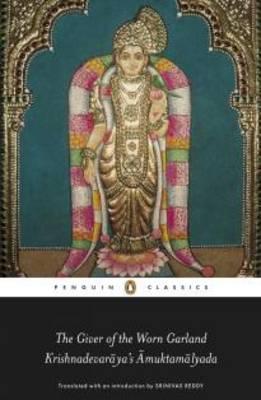
Giver Of The Worn Garland
And below her hair, she would put on a garland and spend a few minutes just gazing into a pond, seeing her reflection and satisfying her desire before turning away and returning the worn garland to her flower basket The emperor Krishnadevaraya s epic poem Amuktamalyada (Giver of the Worn Garland) depicts the life of the medieval Vaisnava poet-saint Andal, or Goda Devi as she is also known, and her passionate devotion to Lord Visnu. Krishnadevaraya s unique poetic imagination brings to life a celestial world filled with wonder, creativity, humour and vibrant natural beauty. The mundane is made divine and the ordinary becomes extraordinary; the routine activities of daily life become expressive metaphors for heavenly actions, while the exalted gods of heaven are re-imagined as living persons. The poet s ability to see divinity in the most commonplace activities is an extension of his powerful belief that god is everywhere, in everything, at all times.
220 pages, Paperback
First published December 7, 2010
Ratings & Reviews
Friends & Following
Create a free account to discover what your friends think of this book!
Community Reviews
Displaying 1 - 8 of 8 reviews
September 12, 2013
What a spectacular work! If the translation of select passages is this good, one can only imagine how the original would be!
Composed by the sixteenth century king Krishnadevaraya, Amuktamaalyada is an epic (mahaa-kaavya) in part prose part poem in the telugu language. Srinivas Reddy has done a commendable job in translating this difficult work retaining much of the lyrical beauty and mood and flow of the original.
The work is that much more interesting because it was composed by a Tulu ruler of the Kannada lands, in the Telugu language about a Tamil saint! The author (references to author are to Krishnadevaraya, the composer of the original work) gives the story of how he came about creating this work in the introduction: while on a military expedition, he was commanded by the god Andhra Vishnu to compose a work in Telugu, the best of languages.
The original work falls in the 'naarikela paaka' category of ancient/medieval works. Naarikela literally means the coconut; it takes effort to peel away the layers of fibre and shell of the coconut to reach the sweet fruit inside. So is it with works in the 'naarikela paaka' category - they are difficult to read and understand, but once you do, they are a joy.
The work is filled with imaginative descriptions of the key regions of the book: Shri Villiputtur, where Amuktamalyada (the title character) is born; Madhura, the capital of the Pandya king in whose realm Shri Villiputtur falls and Srirangam, where Amuktamalyada is taken by her father Vishnu-chitta, to be married to Lord Ranganatha.
The descriptions are evocative, spell binding and surely the work of a poetic genius. Consider for instance: with a piece of fine cotton cloth, the maidens applied turmeric on their bodies, so gently that it did not stain the cloth!
The composition starts with how while on a military expedition to the Kalinga kingdom, Krishnadevaraya was commanded by the God Andhra Vishnu in a dream to compose a great work in Telugu.
There are enchanting descriptions of Sri Villiputtur where Andal grows up, of Madhura, the capital of the Pandya king in whose court Vishnuchitta, Andal’s father wins a landmark spiritual debate and of Srirangam, the temple city of God Ranganatha. There are also vivid descriptions of the four seasons, of which grishma rutu varnana or description of summer is spectacular (the other seasons are not translated in this book).
The story then progresses to Vishnuchitta’s devotion and piety and the Pandya king’s qualities and character. This part could be autobiographical in that the author, a great king himself, hints at these qualities in himself.
The Pandya king, desirous of understanding the meaning of life, throws open the question to the scholars of his court. The God Vishnu orders Vishnuchitta to travel to Madhura and participate in the debate. To a bewildered Vishnuchitta, who has not studied the vedas and other scriptures, the Lord promises help in winning the debate. Accordingly, Vishnuchitta participates in the debate and with sound arguments, wins to be generously rewarded by the king.
The next part of the story is how the childless Vishnuchitta and his wife find the infant Andal in the forest and bring her up. Andal, an incarnation of God Vishnu’s consort referred to as Goda in the poem, grows up to be a beautiful young maiden, pining for her Lord. The author employs the well established technique of ninda-stuti or praise by blame to express Andal’s love for Vishnu.
In the last part, Vishnuchitta is ordered by the Lord to bring Andal to Srirangam and give her in marriage to Lord Ranganatha. This Vishnuchitta does and Andal is ultimately united with the Lord.
A quick note on the title – Amuktamaalyada: Amuktamaalyada literally means ‘given of the worn garland’. In Hindu tradition, it is considered sacrilege to offer worn flowers or pre-tasted foodstuffs to God. However, Andal, due to her love for the Lord, secretly wears garlands meant for the Lord and after admiring herself thus, replaces them. When her father Vishnuchitta discovers this, he offers other fresh garlands, but Lord Vshnu demands that he be offered the garlands that have already been worn by Andal. Hence the title – A-mukta-maalya-da: giver of worn garlands.
A poetic masterpiece and a must read.
Composed by the sixteenth century king Krishnadevaraya, Amuktamaalyada is an epic (mahaa-kaavya) in part prose part poem in the telugu language. Srinivas Reddy has done a commendable job in translating this difficult work retaining much of the lyrical beauty and mood and flow of the original.
The work is that much more interesting because it was composed by a Tulu ruler of the Kannada lands, in the Telugu language about a Tamil saint! The author (references to author are to Krishnadevaraya, the composer of the original work) gives the story of how he came about creating this work in the introduction: while on a military expedition, he was commanded by the god Andhra Vishnu to compose a work in Telugu, the best of languages.
The original work falls in the 'naarikela paaka' category of ancient/medieval works. Naarikela literally means the coconut; it takes effort to peel away the layers of fibre and shell of the coconut to reach the sweet fruit inside. So is it with works in the 'naarikela paaka' category - they are difficult to read and understand, but once you do, they are a joy.
The work is filled with imaginative descriptions of the key regions of the book: Shri Villiputtur, where Amuktamalyada (the title character) is born; Madhura, the capital of the Pandya king in whose realm Shri Villiputtur falls and Srirangam, where Amuktamalyada is taken by her father Vishnu-chitta, to be married to Lord Ranganatha.
The descriptions are evocative, spell binding and surely the work of a poetic genius. Consider for instance: with a piece of fine cotton cloth, the maidens applied turmeric on their bodies, so gently that it did not stain the cloth!
The composition starts with how while on a military expedition to the Kalinga kingdom, Krishnadevaraya was commanded by the God Andhra Vishnu in a dream to compose a great work in Telugu.
There are enchanting descriptions of Sri Villiputtur where Andal grows up, of Madhura, the capital of the Pandya king in whose court Vishnuchitta, Andal’s father wins a landmark spiritual debate and of Srirangam, the temple city of God Ranganatha. There are also vivid descriptions of the four seasons, of which grishma rutu varnana or description of summer is spectacular (the other seasons are not translated in this book).
The story then progresses to Vishnuchitta’s devotion and piety and the Pandya king’s qualities and character. This part could be autobiographical in that the author, a great king himself, hints at these qualities in himself.
The Pandya king, desirous of understanding the meaning of life, throws open the question to the scholars of his court. The God Vishnu orders Vishnuchitta to travel to Madhura and participate in the debate. To a bewildered Vishnuchitta, who has not studied the vedas and other scriptures, the Lord promises help in winning the debate. Accordingly, Vishnuchitta participates in the debate and with sound arguments, wins to be generously rewarded by the king.
The next part of the story is how the childless Vishnuchitta and his wife find the infant Andal in the forest and bring her up. Andal, an incarnation of God Vishnu’s consort referred to as Goda in the poem, grows up to be a beautiful young maiden, pining for her Lord. The author employs the well established technique of ninda-stuti or praise by blame to express Andal’s love for Vishnu.
In the last part, Vishnuchitta is ordered by the Lord to bring Andal to Srirangam and give her in marriage to Lord Ranganatha. This Vishnuchitta does and Andal is ultimately united with the Lord.
A quick note on the title – Amuktamaalyada: Amuktamaalyada literally means ‘given of the worn garland’. In Hindu tradition, it is considered sacrilege to offer worn flowers or pre-tasted foodstuffs to God. However, Andal, due to her love for the Lord, secretly wears garlands meant for the Lord and after admiring herself thus, replaces them. When her father Vishnuchitta discovers this, he offers other fresh garlands, but Lord Vshnu demands that he be offered the garlands that have already been worn by Andal. Hence the title – A-mukta-maalya-da: giver of worn garlands.
A poetic masterpiece and a must read.

December 10, 2020
Lovely translation of a Telugu classic https://www.anuradhagoyal.com/amuktam...

January 18, 2021
Rating: 4.5/5
Detailed review to come.
Detailed review to come.
October 11, 2023
It was a 'Fall of Civilisations' video on the Vijayanagara empire that led me to read the Amuktamalyada. I'll also admit that the stunning Thanjavur painting of Āndāl on the cover was a contributing factor. 😁
I read it twice - once, only reading the poem, and the second time when I read each verse while reading the notes at the back.
The vivid descriptions of Madhura and Sri Villuputtur by Sri Krishnadeva Raya transported me to an era that seemed like a fantasy but was, in fact, real in India's history. It was as if those green fields of paddy were right in front of me; as if I could smell the camphor and incense in the evening air; and as if I could hear the hymns and temple bells reverberating all around me.
Might sound like an exaggeration, but I loved the emphasis on the seemingly mundane and common things the people of the time did. It was as if they carried on with their lives with silent pride, knowing very well that poems eulogising them would leave readers in awe and longing for a world like the one they inhabited.
Reading verses that spoke of pride, ego, love, passion, honour, duty, and devotion - I couldn’t help but be moved. Above all, I was left with a deep sense of admiration for Sri Krishnadeva Raya. Writing about events that unfolded centuries ago with such authority and exquisite detail is a testament to his exceptional talents and perhaps, even divine inspiration.
It surprises me how a mere translation of this poem transformed my perspective on the world. I find myself with a greater appreciation for nature, people, life, and God.
At what point it started, I’m not sure. But it was probably when I read the chapter titled ‘The King’s Contest’
The Pandyan king of Madhura happened to overhear a wise sage utter the following words -
“Just as you should gather provisions for the rainy season
In the eight months before the monsoon,
You should prepare for night during the day,
For old age when still young,
And for the next life, right now, in this life.
While you still can, you should try your very best
To lead a righteous life!”
These words struck a deep chord within the king’s heart, as he thought to himself -
“Oh! What is this glorious empire?
What are these pleasures?
Why these emotions?
This body is nothing but a bubble about to burst.
Even Manu, the primal man who was born at the dawn of time
Was ultimately destroyed, trampled by the great God of Death!
I’ve enjoyed this life without ever considering the path to freedom,
But have I ever really lived?
Just as travellers are ferried to the far shore
Without even noticing the movements of the boat, so too
Does Time pass, quickly without our realising it.
And in this trance, life just passes us by.”
So, incredibly profound.
I remember setting the book down for five solid minutes, gazing out the window with overwhelming gratitude for having read this. For everything, really.
Reading this book has made me realise that some of humanity's most important questions haven’t really changed. They’ve assumed newer forms, sure, but at their very core, they remain the same.
When and how did it start? Why am I here? Where was I before? Who is behind all this? and most importantly, ‘Why did it all happen?’
I do love it when a book makes me contemplate like this! 😁
And then there's Goda. How much I’ve come to adore her! I remember visiting Srirangam a few years ago and thought it was very interesting how she offered God a garland already worn by her. Now, I see her in a new light, appreciating her inner turmoil, and then her calm; her love and devotion. She embodies both the earthly and the divine, serving as a beautiful reminder of her connection to the Goddess of Earth.
About Srinivas Reddy. Where do I begin? Incredible talent! His respect for the material he’s engaged with becomes very obvious right from page one.
To have enabled his readers to connect with the characters and the imagery so well, only through a translation, suggests that the degree to which he stayed true to the original is very, very high.
The notes at the end too proved very insightful.
What I also loved was his little introduction to the Telugu language and culture at the beginning. That he describes it as lying at the heart of both Northern and Southern Indian cultures, and as one that draws inspiration from the many cultures dwelling in its lands, is very endearing to read.
Another of my favourite chapters was the last one about Goda’s and Sri Ranganatha Swamy’s wedding. I could very well visualise all the Telugu rituals and found it wonderful how much they’ve remained the same even today.
Overall a wonderful, wonderful book. I hope to read it in Telugu someday.
I read it twice - once, only reading the poem, and the second time when I read each verse while reading the notes at the back.
The vivid descriptions of Madhura and Sri Villuputtur by Sri Krishnadeva Raya transported me to an era that seemed like a fantasy but was, in fact, real in India's history. It was as if those green fields of paddy were right in front of me; as if I could smell the camphor and incense in the evening air; and as if I could hear the hymns and temple bells reverberating all around me.
Might sound like an exaggeration, but I loved the emphasis on the seemingly mundane and common things the people of the time did. It was as if they carried on with their lives with silent pride, knowing very well that poems eulogising them would leave readers in awe and longing for a world like the one they inhabited.
Reading verses that spoke of pride, ego, love, passion, honour, duty, and devotion - I couldn’t help but be moved. Above all, I was left with a deep sense of admiration for Sri Krishnadeva Raya. Writing about events that unfolded centuries ago with such authority and exquisite detail is a testament to his exceptional talents and perhaps, even divine inspiration.
It surprises me how a mere translation of this poem transformed my perspective on the world. I find myself with a greater appreciation for nature, people, life, and God.
At what point it started, I’m not sure. But it was probably when I read the chapter titled ‘The King’s Contest’
The Pandyan king of Madhura happened to overhear a wise sage utter the following words -
“Just as you should gather provisions for the rainy season
In the eight months before the monsoon,
You should prepare for night during the day,
For old age when still young,
And for the next life, right now, in this life.
While you still can, you should try your very best
To lead a righteous life!”
These words struck a deep chord within the king’s heart, as he thought to himself -
“Oh! What is this glorious empire?
What are these pleasures?
Why these emotions?
This body is nothing but a bubble about to burst.
Even Manu, the primal man who was born at the dawn of time
Was ultimately destroyed, trampled by the great God of Death!
I’ve enjoyed this life without ever considering the path to freedom,
But have I ever really lived?
Just as travellers are ferried to the far shore
Without even noticing the movements of the boat, so too
Does Time pass, quickly without our realising it.
And in this trance, life just passes us by.”
So, incredibly profound.
I remember setting the book down for five solid minutes, gazing out the window with overwhelming gratitude for having read this. For everything, really.
Reading this book has made me realise that some of humanity's most important questions haven’t really changed. They’ve assumed newer forms, sure, but at their very core, they remain the same.
When and how did it start? Why am I here? Where was I before? Who is behind all this? and most importantly, ‘Why did it all happen?’
I do love it when a book makes me contemplate like this! 😁
And then there's Goda. How much I’ve come to adore her! I remember visiting Srirangam a few years ago and thought it was very interesting how she offered God a garland already worn by her. Now, I see her in a new light, appreciating her inner turmoil, and then her calm; her love and devotion. She embodies both the earthly and the divine, serving as a beautiful reminder of her connection to the Goddess of Earth.
About Srinivas Reddy. Where do I begin? Incredible talent! His respect for the material he’s engaged with becomes very obvious right from page one.
To have enabled his readers to connect with the characters and the imagery so well, only through a translation, suggests that the degree to which he stayed true to the original is very, very high.
The notes at the end too proved very insightful.
What I also loved was his little introduction to the Telugu language and culture at the beginning. That he describes it as lying at the heart of both Northern and Southern Indian cultures, and as one that draws inspiration from the many cultures dwelling in its lands, is very endearing to read.
Another of my favourite chapters was the last one about Goda’s and Sri Ranganatha Swamy’s wedding. I could very well visualise all the Telugu rituals and found it wonderful how much they’ve remained the same even today.
Overall a wonderful, wonderful book. I hope to read it in Telugu someday.

April 10, 2022
A very beautiful translation. Need to read it again and again to fully immerse in the beauty of the passages
January 8, 2026
Krishna Deva Raya’s Telugu poem, beautifully translated...
KDR was arguably the greatest of the Vijayanagara kings, an impressive administrator and a superb poet, in both Sanskrit and Telugu. This poem is the outcome of a dream in which Andhra Vishnu appeared before him; asking him to write a poem in Telugu, to be dedicated to his Ishta devata, Lord Venkateshwara of Tirupati.
The result was Amuktamalyada, which recounts the wedding of Andal and Lord Vishnu in Srirangam. However, a big part of the poem is dedicated to descriptions of seasons, cities, nature, love etc. This qualifies it to be classified as a prabandha. There are truly beautiful and evocative descriptions of village life, scrumptious feasts, elaborate grooming rituals of ladies, delightful nature, bustling temple towns et al. The meeting of Andal and Visnhu at Srirangam, and the ensuing wedding is enchanting.
There are also revealing passages about the social mores and ways of that time, incl.
- The lives of the courtesans in Madurai
- The Pandyan kings religiosity
- The respect shown to pilgrims on teerthayatras
Although this is an abridgement of the original, nothing is lost of its skillful descriptions, and emotive passages. The feelings and tribulations of a young girl, captured 500 years ago feel so contemporary and relatable.
The explanatory notes at the end of the book are very helpful to set context and provide additional information, on the theme and topics addressed verse by verse.
KDR was arguably the greatest of the Vijayanagara kings, an impressive administrator and a superb poet, in both Sanskrit and Telugu. This poem is the outcome of a dream in which Andhra Vishnu appeared before him; asking him to write a poem in Telugu, to be dedicated to his Ishta devata, Lord Venkateshwara of Tirupati.
The result was Amuktamalyada, which recounts the wedding of Andal and Lord Vishnu in Srirangam. However, a big part of the poem is dedicated to descriptions of seasons, cities, nature, love etc. This qualifies it to be classified as a prabandha. There are truly beautiful and evocative descriptions of village life, scrumptious feasts, elaborate grooming rituals of ladies, delightful nature, bustling temple towns et al. The meeting of Andal and Visnhu at Srirangam, and the ensuing wedding is enchanting.
There are also revealing passages about the social mores and ways of that time, incl.
- The lives of the courtesans in Madurai
- The Pandyan kings religiosity
- The respect shown to pilgrims on teerthayatras
Although this is an abridgement of the original, nothing is lost of its skillful descriptions, and emotive passages. The feelings and tribulations of a young girl, captured 500 years ago feel so contemporary and relatable.
The explanatory notes at the end of the book are very helpful to set context and provide additional information, on the theme and topics addressed verse by verse.
September 15, 2025
King Krishnadevaraya (who grew up in Chandragiri, a Telugu Tamil border area) chose to write in vernacular Telugu and borrowed from the Tamil Sri Vaishnava canon. He wrote the story of Andal/Goda and her longing for Ranganatha Swami. The book beautifully visualizes Sri Rangapatnam, Sri Villiputtur, Madurai, and ends with the wedding of Andal and Ranganatha, in which he writes that they put jaggery on each other (jilakara bellam, an exclusively Telugu wedding ritual). It also shows Vishnucitta, Andal’s father, winning a debate contest by proving that the only path to moksha is surrendering to Vishnu. The king writes in support of Sri Vaishnavism, using Ramanuja’s Sri Bhashya. So, a Kannada Tulu king chooses to write in Telugu about a Tamil canon.
When he was campaigning against the Gajapathis of Orissa in coastal Andhra, he had a dream in which Andhra Vishnu appeared and ordered him: “You have written many Sanskrit works; now write the story of the girl who offered me the worn garland in Telugu. For I am a Telugu king and you a Kannada king. If you ask why Telugu, this land is Telugu” (coastal Andhra, the lands he had newly occupied, by the way). “I, Andhra Vishnu, am a Telugu king. Telugu is one of a kind. After speaking with all the kings that serve you (your vassals), didn’t you realize Telugu is the best?”
These words reflect his vision of gaining more Telugu vassals serving him, his kingdom expanding, and how much the loyalty of Telugu chiefs mattered to him. So, for purely political reasons, this line is written but this is a very beautiful work. This great king wrote himself into history and shaped the very culture we live in today.
When he was campaigning against the Gajapathis of Orissa in coastal Andhra, he had a dream in which Andhra Vishnu appeared and ordered him: “You have written many Sanskrit works; now write the story of the girl who offered me the worn garland in Telugu. For I am a Telugu king and you a Kannada king. If you ask why Telugu, this land is Telugu” (coastal Andhra, the lands he had newly occupied, by the way). “I, Andhra Vishnu, am a Telugu king. Telugu is one of a kind. After speaking with all the kings that serve you (your vassals), didn’t you realize Telugu is the best?”
These words reflect his vision of gaining more Telugu vassals serving him, his kingdom expanding, and how much the loyalty of Telugu chiefs mattered to him. So, for purely political reasons, this line is written but this is a very beautiful work. This great king wrote himself into history and shaped the very culture we live in today.

February 11, 2021
It's actually a telegu poetry mixed with prose...I wish I knew telegu .The translation is beautiful the poetry itself is amazing but can't understand in English as it spoils the real form
Displaying 1 - 8 of 8 reviews