

What do you think?

Summoning Pearl Harbor
Summoning Pearl Harbor is a mesmerizing display of linguistic force that redefines remembering. How do words make the past appear? In what way does the historian summon bygone events? What is this kind of remembering, and for whom do we recall the dead, or the past?
In this highly original meditation on the past, renowned art historian Alexander Nemerov delves into what it means to recall a significant event—Pearl Harbor—and how descriptions of images can summon it back to life. Beginning with the photo album of a former Japanese kamikaze pilot, which is reproduced in this volume, Nemerov transports the reader into a different world through his engagement with the photographs and the construction of a narrative around them.
Through its lyrical prose, Summoning Pearl Harbor expands what we traditionally associate with ekphrastic writing. The kind of writing that can enliven a work of art is also the kind of writing that makes the past appear in vivid color and deep feeling. In the end, this timely piece of writing opens onto fundamental questions about how we communicate with each other, and how the past continues to live in our collective consciousness, not merely as facts but as stories that shape us. Here, Nemerov’s constant awareness of the power of language to make an experience—seen or remembered—become real reminds us that great ekphrastic writing is at the heart of every effective description.
In this highly original meditation on the past, renowned art historian Alexander Nemerov delves into what it means to recall a significant event—Pearl Harbor—and how descriptions of images can summon it back to life. Beginning with the photo album of a former Japanese kamikaze pilot, which is reproduced in this volume, Nemerov transports the reader into a different world through his engagement with the photographs and the construction of a narrative around them.
Through its lyrical prose, Summoning Pearl Harbor expands what we traditionally associate with ekphrastic writing. The kind of writing that can enliven a work of art is also the kind of writing that makes the past appear in vivid color and deep feeling. In the end, this timely piece of writing opens onto fundamental questions about how we communicate with each other, and how the past continues to live in our collective consciousness, not merely as facts but as stories that shape us. Here, Nemerov’s constant awareness of the power of language to make an experience—seen or remembered—become real reminds us that great ekphrastic writing is at the heart of every effective description.
80 pages, Paperback
First published November 21, 2017
About the author
Alexander Nemerov
54 books27 followersA scholar of American art, Nemerov writes about the presence of art, the recollection of the past, and the importance of the humanities in our lives today. Committed to teaching the history of art more broadly as well as topics in American visual culture — the history of American photography, for example — he is a noted writer and speaker on the arts. His most recent books are Wartime Kiss: Visions of the Moment in the 1940s (2013) and Acting in the Night: Macbeth and the Places of the Civil War (2010). In 2011 he published To Make a World: George Ault and 1940s America (2011), the catalogue to the exhibition of the same title he curated at the Smithsonian American Art Museum. Among his recent essays are pieces on Peter Paul Rubens, on Henry James, on Thomas Eakins and JFK; and on Rothko and Rembrandt.
Ratings & Reviews
Friends & Following
Create a free account to discover what your friends think of this book!
Community Reviews
Displaying 1 - 4 of 4 reviews
Read
April 13, 2026I’ve read a fair share of high quality essays. Only recently i’ve read A Dream of Stone by M. Yourcenar where each essay is creating its own world; The Teller and the Tale: Essays on Literature and Culture a brilliant diverse and thought-provoking collection by G. Josipovici; The Ways of Paradise a fragmentary by P. Cornell, a very creative majestic construction; and Something Speaks to Me: Where Criticism Begins by M. Chaouli, a greatly inspirational essay on poetic criticism that has managed to articulate literary tastes and preferences that seemed somehow intimately my own. Those texts has inspired me, challenged me and stimulated my thoughts. Often they would leave me in awe.
However, i’ve had a different, quite peculiar and weird feeling reading this one: i wished i could write like this. It was totally irrational. I will try to explain: I’ve never in my life had any literary ambition whatsoever; moreover i was never particularly inspired to write for any audience. Instead, i’ve always considered writing as a tool to clarify my own thoughts and feelings, to help to understand myself and the others better. That was all. It is still is pretty much, i hope. So this feeling was pretty new. Neverov writes very well of course. But so do many other art historians, critics, writers. However, there was some glimpse of magic in this slim book that has captivated me. The whole story of confessing to such a desire makes me feel mildly embarrassed. The consolation I've got that it would be hardly realised. But he has managed to summon some ghost inside of me I didn't know existed. With hindsight, this might be less surprising as his way of dealing with the subject matter of these essays is mainly through summoning the ghosts.
The subject matter is Pearl Harbor and what follows. In eight short essays, he looks at the different traces of the past still available to him, he is trying to get as close to that moment as he possibly can. However his way is far from the direct.
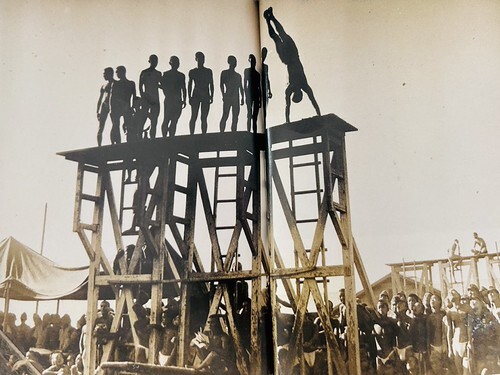
In one essay, he might start with the underpass he walks through daily in Paolo Alto. This underpass was built in 1941 just nine months before the event. That would bring him to the idea of being ‘curator of absence’. In the other essay, he might look at the phenomena of fear through The Wolf Man a horror film that was showing in the theatres ‘in the months after Pearl Harbour'. There would be more traditional ways as well: photographs, interviews, visits. The one of the most poignant and haunting document included into this book is a photo-album complied for each kamikaze pilot in their training camp to be given to his family after his 'heroic' death. The photos show their daily existence: sleep, exercise regimen, camaraderie. But the boys eyes seem to be totally empty already. One image shows them preparing for a some kind of jump. We cannot see their faces, only the darkened silhouettes. It seems they are already half-disappeared from this world, the moment between present and the past:
Neverov has borrowed this album as a part of an interview with the one of those boys decades later (who has managed to avoid that last flight). What is so special is not that much his elegant use of the documents but how he summons his own imagination and how he then makes history alive on the page. Here is an except from the first essay:
Now he had time to think. Tadayoshi Koga, nineteen years old, had just crash-landed his Mitsubishi Zero airplane on the remote Aleutian island of Akutan. It was June 1942, six months after Pearl Harbor, and Koga's plane had been hit as he attacked an American installation on the Aleu-tians. Leaking oil, his Zero would never make it back to the carrier Ryujo, so he looked for a good place to land. His one error had been to mistake a flatland for a field, when in fact it was a marsh. Lowered for landing, the plane's wheels dug into the swamp, flipping the Zero upside down and breaking Koga's neck, killing him instantly.
Five weeks later, an American salvage team would find the Zero and bury Koga nearby. But for those five weeks in summer 1942, all by himself, Koga had time to think. It was a lonely study, but quietude of this kind comes rarely, and the unusual position—upside down in the cockpit-afforded a different way of seeing the world.
Like Koga’s position in the cockpit, Neverov has turned the usual logic of the story upside down. He starts at the end of Koga’s life when Koga instantly dead lies upside down in his plane which is in the process of being swallowed by the natural growth. The nature embraces the plane as its own part and simply keeps doing what it does best: living.
In this narrative Neverov makes Koga’s think for the first time when he has died: a mirror image what one would expect -any thoughts should end with death. But here it is the opposite; and this way of rendering this scene throws out of the window all our expectations of the beginning, middle and the end; but also of any causation in history or even the direction of time.
Neverov also brings into the focus the humanity of this individual soldier. During his life he didn’t have any capacity to think as he was a cog in a killing machine created without his will. He was an enemy. But now finally he has time to be yourself though it is too late for him.
Do not forget that this is an essay, not a piece of fiction. Neverov’s purpose is not to write just yet another story but to show how it really happened as well as to prompt the limits what he could know as a historian. This is a picture of this plane as it was found:
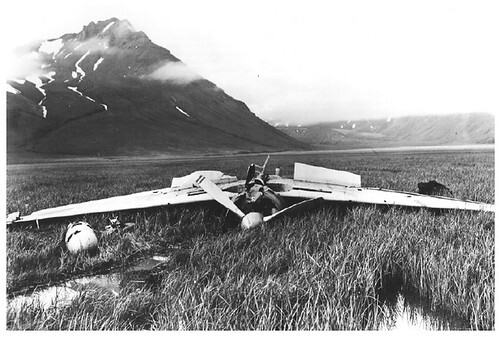
This is his historical evidence. His imagination does not distort any historical truth. I would argue it adds to it somehow. It creates a connection between me, a person who reads this many decades later, and that moment when the life ended for this boy but his role in history has started. And all of this is through what Nemerov’s imagination has conjured in these few paragraphs.
In these essays Nemerov circles around the role of a historian, the inherent limitations of a historical inquiry how her efforts to approach the past directly, frontally is bound to fail. He knows that history would not open itself to a full-frontal assault. He celebrates the possibility of getting close to the past in more subtle ways:
The historian ...measures the retraction of the world. With each step she takes, the past recedes a step further. Sensitive ghosts perpetually retreat, ever curious to explore their native atmosphere of disappearance. Yet in that duet, a fellow feeling emerges between the historian and what is not there.
It seems Nemerov is saying that there exists a very subtle region, an intersection of the historian’s attuned state of mind with ghostly, disappearing but still real traces of the past available to her. This region that she would be able to visit occasionally and hopefully come back with the version of history closer and closer to truth. But this story of this quest would never end. It is like seeing the ice melting on one’s open palm. Talking about ice, in the other essay Nemerov approaches the role of a historian from other angle giving him a perspective of snow:
Maybe the historian, embracing defeat, is also meant to drift through the world. Maybe only that drifting can secure him a place. Maybe only by being snow can he be certain of not freezing to death. Maybe only by identifying with the snow's way of making and obliterating his footsteps can he see that the point of history as ecstasy, as storm, is the creation and erasure of oneself.
In her diary, Susan Sontag once said about other essayists whom she admired and considered better stylists: ‘No ideas but what a music’. I believe she did not mean these writers lacked ideas; instead she meant that the music of their words, their images delivered their ideas in a more effective way than simple concepts. I was thinking of this phrase reading the passage above. I would not want to dig deeper whether his analogy is working here. What I admire is the subtlety and the beauty of the image, of an idea he has created.
In the final essay, Neverov visits the site of Pearl Harbour and notices a petrol leaking from the bottom of the ship. ‘Here was the past still emerging in the present, taking an aquatic form like breath spooling up from below,’. He imagines that maybe the sailors dead for decades are having a party somewhere down there.
In those oil smears on the water, the dead began to take shape for me as a group difficult to please. They were rowdy, unruly, not only in their sailor patois gurgling up in halting, half-strangled offensive phrases. They were unruly in their unwillingness to be helped or honored or remembered. Et in Arcadia ego the tomb says to the shepherds, but it was the great fuck you of the past to the kindhearted present that I thought I heard in the oil.
So in his imagination these dead just refuse to play a solemn role of being a lesson ‘never again’. In fact they do not care. Maybe those sailors do exist alive in some other dimension. Maybe they party there. They certainly do not care now from there how we remember them. But would they if they knew what was going to happen to them beforehand? More to the point, what does their fate signify to us? And how can we use their plight to avoid something like that happening to the future children. Is there a way?
I totally accept their ‘great fuck you of the past’; but should I reciprocate the gesture? The fact that those sailors managed to appear momentarily in Neverov’s mind and then travel to mine tells me that maybe not.
This has reminded me of Gerald Murnane, a writer from my small treasured pantheon. He writes fiction but believes all his characters are real. They just exist in a different way to us. Some might consider this proposition rather eccentric, but it works for him and his readers. In one case though the story of his character was more complicated. He has read a historical account of a thirteen year old girl who was living in the 30s of the last century in a Hungarian village. Sadly the medieval barbaric order of life was still strong in that time. I wonder how is that now. Anyway, she was given away to a lord for the night of his pleasure. The next morning she has drowned herself in a well. Murnane has read her story and since then he couldn’t get her out of his mind. This girl has existed once in the same way as the teenage girl in headphones who has just passed behind my window. But her earthy life was brutally negated and snatched away. One day she has become alive in Murnane’s mind and traveled from one of his book to another. Evidently, unlike Neverov’s sailors she seemed to want to be remembered.
This is where these essays've lead me to: otherworldly, metaphysical places that are a bit far from any historical science. But then if anything to be taken out of this slim book is probably the idea: a historian has to be creative if he wants to get closer to the true past. Always he has to try to find ‘a different way of seeing the world.’. I am not sure what the rest of people should do. In my case while approaching a historical narrative, I would attempt balancing imagination and goodwill with a pinch of scepticism and critical thinking. However, I hope it could be combined with sheer bliss the art of a good essay could deliver. It was perfect in this case.
However, i’ve had a different, quite peculiar and weird feeling reading this one: i wished i could write like this. It was totally irrational. I will try to explain: I’ve never in my life had any literary ambition whatsoever; moreover i was never particularly inspired to write for any audience. Instead, i’ve always considered writing as a tool to clarify my own thoughts and feelings, to help to understand myself and the others better. That was all. It is still is pretty much, i hope. So this feeling was pretty new. Neverov writes very well of course. But so do many other art historians, critics, writers. However, there was some glimpse of magic in this slim book that has captivated me. The whole story of confessing to such a desire makes me feel mildly embarrassed. The consolation I've got that it would be hardly realised. But he has managed to summon some ghost inside of me I didn't know existed. With hindsight, this might be less surprising as his way of dealing with the subject matter of these essays is mainly through summoning the ghosts.
The subject matter is Pearl Harbor and what follows. In eight short essays, he looks at the different traces of the past still available to him, he is trying to get as close to that moment as he possibly can. However his way is far from the direct.
In one essay, he might start with the underpass he walks through daily in Paolo Alto. This underpass was built in 1941 just nine months before the event. That would bring him to the idea of being ‘curator of absence’. In the other essay, he might look at the phenomena of fear through The Wolf Man a horror film that was showing in the theatres ‘in the months after Pearl Harbour'. There would be more traditional ways as well: photographs, interviews, visits. The one of the most poignant and haunting document included into this book is a photo-album complied for each kamikaze pilot in their training camp to be given to his family after his 'heroic' death. The photos show their daily existence: sleep, exercise regimen, camaraderie. But the boys eyes seem to be totally empty already. One image shows them preparing for a some kind of jump. We cannot see their faces, only the darkened silhouettes. It seems they are already half-disappeared from this world, the moment between present and the past:
Neverov has borrowed this album as a part of an interview with the one of those boys decades later (who has managed to avoid that last flight). What is so special is not that much his elegant use of the documents but how he summons his own imagination and how he then makes history alive on the page. Here is an except from the first essay:
Now he had time to think. Tadayoshi Koga, nineteen years old, had just crash-landed his Mitsubishi Zero airplane on the remote Aleutian island of Akutan. It was June 1942, six months after Pearl Harbor, and Koga's plane had been hit as he attacked an American installation on the Aleu-tians. Leaking oil, his Zero would never make it back to the carrier Ryujo, so he looked for a good place to land. His one error had been to mistake a flatland for a field, when in fact it was a marsh. Lowered for landing, the plane's wheels dug into the swamp, flipping the Zero upside down and breaking Koga's neck, killing him instantly.
Five weeks later, an American salvage team would find the Zero and bury Koga nearby. But for those five weeks in summer 1942, all by himself, Koga had time to think. It was a lonely study, but quietude of this kind comes rarely, and the unusual position—upside down in the cockpit-afforded a different way of seeing the world.
Like Koga’s position in the cockpit, Neverov has turned the usual logic of the story upside down. He starts at the end of Koga’s life when Koga instantly dead lies upside down in his plane which is in the process of being swallowed by the natural growth. The nature embraces the plane as its own part and simply keeps doing what it does best: living.
In this narrative Neverov makes Koga’s think for the first time when he has died: a mirror image what one would expect -any thoughts should end with death. But here it is the opposite; and this way of rendering this scene throws out of the window all our expectations of the beginning, middle and the end; but also of any causation in history or even the direction of time.
Neverov also brings into the focus the humanity of this individual soldier. During his life he didn’t have any capacity to think as he was a cog in a killing machine created without his will. He was an enemy. But now finally he has time to be yourself though it is too late for him.
Do not forget that this is an essay, not a piece of fiction. Neverov’s purpose is not to write just yet another story but to show how it really happened as well as to prompt the limits what he could know as a historian. This is a picture of this plane as it was found:
This is his historical evidence. His imagination does not distort any historical truth. I would argue it adds to it somehow. It creates a connection between me, a person who reads this many decades later, and that moment when the life ended for this boy but his role in history has started. And all of this is through what Nemerov’s imagination has conjured in these few paragraphs.
In these essays Nemerov circles around the role of a historian, the inherent limitations of a historical inquiry how her efforts to approach the past directly, frontally is bound to fail. He knows that history would not open itself to a full-frontal assault. He celebrates the possibility of getting close to the past in more subtle ways:
The historian ...measures the retraction of the world. With each step she takes, the past recedes a step further. Sensitive ghosts perpetually retreat, ever curious to explore their native atmosphere of disappearance. Yet in that duet, a fellow feeling emerges between the historian and what is not there.
It seems Nemerov is saying that there exists a very subtle region, an intersection of the historian’s attuned state of mind with ghostly, disappearing but still real traces of the past available to her. This region that she would be able to visit occasionally and hopefully come back with the version of history closer and closer to truth. But this story of this quest would never end. It is like seeing the ice melting on one’s open palm. Talking about ice, in the other essay Nemerov approaches the role of a historian from other angle giving him a perspective of snow:
Maybe the historian, embracing defeat, is also meant to drift through the world. Maybe only that drifting can secure him a place. Maybe only by being snow can he be certain of not freezing to death. Maybe only by identifying with the snow's way of making and obliterating his footsteps can he see that the point of history as ecstasy, as storm, is the creation and erasure of oneself.
In her diary, Susan Sontag once said about other essayists whom she admired and considered better stylists: ‘No ideas but what a music’. I believe she did not mean these writers lacked ideas; instead she meant that the music of their words, their images delivered their ideas in a more effective way than simple concepts. I was thinking of this phrase reading the passage above. I would not want to dig deeper whether his analogy is working here. What I admire is the subtlety and the beauty of the image, of an idea he has created.
In the final essay, Neverov visits the site of Pearl Harbour and notices a petrol leaking from the bottom of the ship. ‘Here was the past still emerging in the present, taking an aquatic form like breath spooling up from below,’. He imagines that maybe the sailors dead for decades are having a party somewhere down there.
In those oil smears on the water, the dead began to take shape for me as a group difficult to please. They were rowdy, unruly, not only in their sailor patois gurgling up in halting, half-strangled offensive phrases. They were unruly in their unwillingness to be helped or honored or remembered. Et in Arcadia ego the tomb says to the shepherds, but it was the great fuck you of the past to the kindhearted present that I thought I heard in the oil.
So in his imagination these dead just refuse to play a solemn role of being a lesson ‘never again’. In fact they do not care. Maybe those sailors do exist alive in some other dimension. Maybe they party there. They certainly do not care now from there how we remember them. But would they if they knew what was going to happen to them beforehand? More to the point, what does their fate signify to us? And how can we use their plight to avoid something like that happening to the future children. Is there a way?
I totally accept their ‘great fuck you of the past’; but should I reciprocate the gesture? The fact that those sailors managed to appear momentarily in Neverov’s mind and then travel to mine tells me that maybe not.
This has reminded me of Gerald Murnane, a writer from my small treasured pantheon. He writes fiction but believes all his characters are real. They just exist in a different way to us. Some might consider this proposition rather eccentric, but it works for him and his readers. In one case though the story of his character was more complicated. He has read a historical account of a thirteen year old girl who was living in the 30s of the last century in a Hungarian village. Sadly the medieval barbaric order of life was still strong in that time. I wonder how is that now. Anyway, she was given away to a lord for the night of his pleasure. The next morning she has drowned herself in a well. Murnane has read her story and since then he couldn’t get her out of his mind. This girl has existed once in the same way as the teenage girl in headphones who has just passed behind my window. But her earthy life was brutally negated and snatched away. One day she has become alive in Murnane’s mind and traveled from one of his book to another. Evidently, unlike Neverov’s sailors she seemed to want to be remembered.
This is where these essays've lead me to: otherworldly, metaphysical places that are a bit far from any historical science. But then if anything to be taken out of this slim book is probably the idea: a historian has to be creative if he wants to get closer to the true past. Always he has to try to find ‘a different way of seeing the world.’. I am not sure what the rest of people should do. In my case while approaching a historical narrative, I would attempt balancing imagination and goodwill with a pinch of scepticism and critical thinking. However, I hope it could be combined with sheer bliss the art of a good essay could deliver. It was perfect in this case.

December 29, 2024
Nemerov is revelatory, and so incredibly nimble. Honestly one of my favorite scholars working today.
On going below decks on the *Hornet* ship in the SF Bay:
“We find the throbbing heart of the now-quiet engine, sleeping in its room of meters and levers. Stooping into doorways, turning corners, and staring through screens of metal mesh, we walk among the gray passages and think of the mind of the ship, of minds in general—of passageways and walkways out of Hitchcock and Dali, dream sequences Hollywood-style, of traumas and evasions and dead-ends and spiraling staircases that recall who we are and where we have gone and how we have gotten lost. Stephanie does not mind me writing of her depression, of her traumas and sadness and her long-walking resolve, of her father muttering nonsense to himself in a North beach cafe and of her own attempt to portray, in the measured meter of her words, some note of sanctity and sanity.” (26)
“The past is a slumber of many layers: unconscious, unthinking, dead. It can only dream of what it was. It is gone and even when it was not—when it was fresh-faced and as yet un-seduced by the hag and the fog—it did not know it was awake. Events cast a hex on life as it unfolds, dispensing drams and elixirs to each actor who plays a part. Every act of these actors is a drinking of their action. We recall what we did, we differentiate between our states of waking and sleeping, yet much of what we experience feels like the vapor of a dream. So it is that each player in the past has left no mark. As the beverage went down the throat, so the drinker was erased by degrees. All that is left is the bottle that contained the potion, which, not being consumable itself, fell and cracked on the pavement. Finding the broken glass, the historian smells the perfume of this long-ago stupor. Not by degrees does the vapor of the past’s vanishing come to him. Rather, he gets it all at once, close to the glass, and becomes intoxicated. Holding the broken bottle to his face, he notices that his fingers start to disappear and puts it down. But then he picks it up again.” (34-35)
On “the art of Rubens and the *Metamorphoses* of Ovid on which it is based”:
“I read of Hippomenes chasing speedy Atalanta, tricking her with the ruse of dropping the golden apples. Of the couple unwisely consummating their post-race lust in a cave sacred to the gods, and of their transformation into lions as punishment. I read, too, of Apollo chasing Daphne, Pan chasing Syrinx. Nymphs changing into laurel trees; nymphs changing into river reeds, Jupiter and Io, Jupiter and Ganymede, Jupiter and Callisto—seductions, abductions, swelling tummies swirling past me in rivers of black-and-white illustrations, through which I could sense the carmine of Rubens’s fluid brush, the melting muscles of his jackknife assassins and peeling maidens, their suggestive forms askew in beds and gardens and skies.” (45)
On going below decks on the *Hornet* ship in the SF Bay:
“We find the throbbing heart of the now-quiet engine, sleeping in its room of meters and levers. Stooping into doorways, turning corners, and staring through screens of metal mesh, we walk among the gray passages and think of the mind of the ship, of minds in general—of passageways and walkways out of Hitchcock and Dali, dream sequences Hollywood-style, of traumas and evasions and dead-ends and spiraling staircases that recall who we are and where we have gone and how we have gotten lost. Stephanie does not mind me writing of her depression, of her traumas and sadness and her long-walking resolve, of her father muttering nonsense to himself in a North beach cafe and of her own attempt to portray, in the measured meter of her words, some note of sanctity and sanity.” (26)
“The past is a slumber of many layers: unconscious, unthinking, dead. It can only dream of what it was. It is gone and even when it was not—when it was fresh-faced and as yet un-seduced by the hag and the fog—it did not know it was awake. Events cast a hex on life as it unfolds, dispensing drams and elixirs to each actor who plays a part. Every act of these actors is a drinking of their action. We recall what we did, we differentiate between our states of waking and sleeping, yet much of what we experience feels like the vapor of a dream. So it is that each player in the past has left no mark. As the beverage went down the throat, so the drinker was erased by degrees. All that is left is the bottle that contained the potion, which, not being consumable itself, fell and cracked on the pavement. Finding the broken glass, the historian smells the perfume of this long-ago stupor. Not by degrees does the vapor of the past’s vanishing come to him. Rather, he gets it all at once, close to the glass, and becomes intoxicated. Holding the broken bottle to his face, he notices that his fingers start to disappear and puts it down. But then he picks it up again.” (34-35)
On “the art of Rubens and the *Metamorphoses* of Ovid on which it is based”:
“I read of Hippomenes chasing speedy Atalanta, tricking her with the ruse of dropping the golden apples. Of the couple unwisely consummating their post-race lust in a cave sacred to the gods, and of their transformation into lions as punishment. I read, too, of Apollo chasing Daphne, Pan chasing Syrinx. Nymphs changing into laurel trees; nymphs changing into river reeds, Jupiter and Io, Jupiter and Ganymede, Jupiter and Callisto—seductions, abductions, swelling tummies swirling past me in rivers of black-and-white illustrations, through which I could sense the carmine of Rubens’s fluid brush, the melting muscles of his jackknife assassins and peeling maidens, their suggestive forms askew in beds and gardens and skies.” (45)

January 26, 2021
What a beauty! This whole series by David Zwirner publishing called ekphrasis is a fascinating and so far beautiful series of books
January 26, 2026
'as if Ichihashi had cut himself shaving and touched the glass with his fingers so that the blood merged with his reflected image and became a more real version of himself' :)
Displaying 1 - 4 of 4 reviews