What happens when you stop fighting an endless war and start asking why?
It’s not easy being the junior wife. Mia’s only dream is to catch the eye of the dashing lead husband, and her sister’s unexpected death gives her the chance at last. But was it just a tragic accident? Mia’s not sure, but if she asks enough questions, maybe she’ll find out. Or maybe she’ll uncover too many secrets, and suffer a terrible punishment.
It’s not easy being the junior husband. For years, Hurst has longed to test his sword against the barbarians in the wilderness outside his orderly world, longed to take the lead, longed for Mia. He’s bided his time, seething with resentment, so when his chance comes, he’ll fight to the death for her, even if it tears the marriage apart.
But there’s far more at stake than one marriage. When Mia’s taken from him, Hurst will risk everything to save her, even if it means taking up his sword against the barbarians, his own people, and the gods themselves. And that’s when they discover what their world is really like, and who they’re really fighting.
Yet there’s one secret they don’t expect to uncover: because everyone knows there’s no such thing as magic, right?
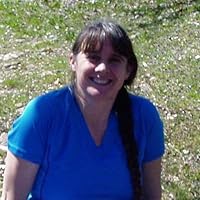
I live in the beautiful Highlands of Scotland with my husband. I like chocolate, whisky, my Kindle, massed pipe bands, long leisurely lunches, chocolate, going places in my campervan, eating pizza in Italy, summer nights that never get dark, wood fires in winter, chocolate, the view from the study window looking out over the Moray Firth and the Black Isle to the mountains beyond. And chocolate. I dislike driving on motorways, cooking, shopping, hospitals.
It's such a great feeling when you read a good epic fantasy book and this was an excellent example of the fantasy genre!
I can't quite put my finger on what specifically made me love this book, the whole thing was just so enjoyable. Some fantasy books can feel like a chore to read and while you may like the overall story, there's usually a few chapters or character perspectives that you don't enjoy as much.
That was not the case with The Plains of Kallanash. I enjoyed reading about every character and every part of the story. There were a few parts that I enjoyed most of course but there wasn't anything I disliked about this book and that's rare for me in an epic fantasy this long.
The world building was excellent, very well thought out an entirely unique. This is set in the same world as although as the societal and religious aspects of the world are comlpetely different, they're seperated by either time or distance, I'm not sure which.
I really liked the joint marriages, it's seemed to be surprisingly functional most of the time and it fit in with the world well.
The religion is this book was defenitely unique. Fantasy books usually focus on a ruling political or religious institution. In Kallanash the Voices and Slaves of the Gods ruled through fear and secrecy. The slaves were very creepy and I can see why they unsettled many people.
The characters were very well developed and I really identified with Mia. She started out as a very timid woman, always following the rules and trying to do the right thing. Her character grew and adapted naturally as her situation changed and she became fierce, someone who was willing to fight for what was right rather than sitting back and letting others fight for her.
Without spoiling anything, I have certain affection for one of Mia's husbands more than the others. He's bold and brave and not as wild as I initially thought.
Pauline M. Ross has become one of my favourite fantasy authors of all time and this is only the second book I've read by her. I can't wait for her to release another.
**This book was provided by the author in exchange for an honest review**
This book was a mixed bag, although overall I enjoyed it.
Good points:
- Great worldbuilding. A fascinating background story which is gradually revealed. Our characters are stuck in a mundane but comfortable world of home, religious law and ritual, and battle training and skirmishes against the barbarians. But there's more to the strange Slaves of the Gods than meets the eye. I love the way the mystery unravels as we go through the book.
- Ingenious plot, very detailed, with links between mechanics, engineering, artitechture and culture. Very clever.
- Thought-provoking philosophical questions raised: The old classic is religion the opiate of the masses, a link back to 1984's perpetual war to keep control syndrome, can people ever truly be good or evil, and does the poor behaviour of a religion's adherents nullify the existence of (a) God.
Stuff I didn't like:
- I felt the book was rather long-winded. A lot of it was filled with rather mundane activities, everyday life, sex, eating, and an awful lot of waiting around. For some of this the characters themselves were bored and frustrated and I found myself mirroring this.
- The end climax never really came. I was expecting a huge build up and a huge battle, and somehow everything just petered out. When interesting discussions were finally taking place, Mia, whose POV we were in, was out cold and we heard everything second-hand. It didn't quite feel satisfactory, and also gave the feeling of loose ends not properly hashed out and discussed.
- The sex wasn't really my thing. I could cope with the 4 person marriage thing as that was basically two couples, but the finale menage a trois and the way it was constantly reevaluated, and consummated became a bit too much for me. And there was a lot of sex, so I began to get bored with it, although admittedly the description tailed off towards the end of the book.
Other:
Characters:
- I didn't like Mia to start with. She was a weak character, who seemed concerned at doing her duty at the expense of, well almost her own life really. And there was one very stupid thing she did that really annoyed me. You'll know it when you get there. I mean, I know she was naive, but that took it a bit too far. However, she grew on me and I liked her better by the time she got to be warrior girl, although her obsession with sex got a bit much at times.
Magic:
- I like my fantasy to come with a healthy dose of magic, and this had barely a taster. Personal preference would have been for more.
Overall, I preferred the second book in the series (both stand alones) to this one.
The Brightmoon Series is set in a world where mages caused a great catastrophe 5000 years ago, forcing the continents and islands together into one large mass and bringing the moons closer to the earth. They left magical refuges to help preserve the population but most now don't have anywhere near the same power even if many people have a magical connection to something for example empathy etc.
As a warning the series is quite frank about sex and most of the relationships in the books seem to be polyamorous.
The books are mostly stand alone although characters do recur. There is a trilogy within the series; loved the first one, thought the second one was ok, skipped pages to the end of the third. I definitely had a waning of interest as the series went on although the last book was better than the prior two. Mostly a 4 but with a range of 2-4 over the series. You might feel differently.
I was sent a complimentary copy of that novel by the author, Pauline M. Ross, who is, like me, one of contributors of the Fantasy Review Barn. I’ve known Pauline’s online persona for some time – we’ve befriended each other on Goodreads and Twitter. At one point I even proposed (and was rejected, alas ;p). Writing my review I tried hard to be as impartial as possible, all things considering, but I admit I might be a tad biased – I had the pleasure to be one of Pauline’s beta readers when she worked on that book. Just so you know.
What I liked:
The novel is narrated in the third voice limited, alternatively from the point of view of Mia and Hurst; I found them complementing each other nicely. It is a firm stand-alone, with a nice beginning and ending – no cliffhangers or such – even if the author assured me it is a part of a larger series.
The world build was very original, especially the idea of Karnings and those double marriages which provided a nice set of characters without too many twists and turns. An additional bonus: the Vahsi barbarians and warriors fighting the Karningholders after a time proved to be quite similar to their opponents (I really cannot say more here without including some major spoilers).
I liked the fact that both Mia and Hurst, a pair of the protagonists, were so physically imperfect. Tella and Jonnor, the other pair from the same Karninghold, while beautiful and handsome were also rather selfish, cruel and weak. Such a simple trick but it made my day as a reader. In my view especially Hurst (or rather “Most High Hurst dos Arrakas, Second Husband of Karning Dranish Turs Kan-forst”) was a likeable character, ‘a lion on the line, but a mouse in his own home’ as described by one of his companions. His slow-burning passion for Mia, a girl so obviously infatuated by Jonnor’s perfect form – the lithe and toned body, the beautiful face surrounded by curls- was moving. Then came a love triangle which, surprise, surprise, didn’t irritate me at all because it was…different as it included Dethin, the warlord extraordinaire, Once again I cannot say any more because it would be a spoiler but believe me, it bore no similarity to the much-hated, pink, three-headed beast.
However you know what I liked the best? Like in real life there were no baddies rotten to the core, no really. Or rather I should say the baddies were so three-dimensional and complicated that, after a while, you didn’t perceive them as completely negative characters.
Finally the cover art is simply great – I do love both the colours and the design.
What I didn’t like:
I sometimes wished the novel was a bit darker, especially its second part. I also wanted to know more about the technology (a sky ship but no sewing machines? or firearms?) and the whole system of beliefs, behind those Voices, the Nine and Slaves. Ok, maybe later in the series.
Final verdict:
Who is to say that a good reviewer cannot turn into a good writer? A very strong debut, not without flaws but still. I wish Pauline all the best and many books to come, each one a bit better than the previous one. I certainly will read all of them.
This is a grand, ambitious tale full of thought-provoking ideas and surreal circumstances that somehow manage to strike a balance between the real and the fantastical. I was hooked from the start - the notion of the double marriage is a concept I'd never come across, and it starts out as the backbone of the many troublesome dilemmas and familial drama that the characters have to deal with. When things reach a head, the story takes a turn for the adventurous and Mia and Hurst - the two likable protagonists - are thrown into a religious conspiracy that seems to have engulfed the entire titular Plains. And things only escalate from there...
I found myself engrossed throughout, the short chapter lengths keep the pace flowing and something significant happens each time we jump from Mia and Hurst's head, making for a vast, original and entertaining epic-fantasy story.
This fantasy book is set in a wonderfully constructed world. It is slowly revealed throughout the book although the first few chapters are pretty dense with terms. If you are patient they are explained well later on. The plains are divided into Karnings and they are run by a marriage group. Our story starts with a marriage of 4 people. Hurst and Mia are the junior couple with Jonnor ans Tella being the senior couple and the only two having sex. Right at the beginning of the book and after that the marriage falls into imbalance.
The whole first part of the book is the fallout of that imbalance and how Mia and Hurst navigate the changes. It also allows us to learn about the world and be introduced to many many side characters. Arguably too many but it is mostly doable. You probably want to learn the names of Hurst's companions, father, and brothers. I found this part of the book fairly slow but interesting enough to keep going. Mia was pretty annoying though. If I was a person who needed to like the MC I might have given up at this point.
The major flaw for me comes at the end of this part. Mia may be naive in the ways of love but she is shown to be capable, knowledgeable, and strategic in her actions. Then for some inexplicable reason she suddenly behaves like a stupid thoughtless girl. But her stupidity does launch the adventure part of the tale. And I found this part engrossing. I see some mention being bored but I liked all the details. I liked the warlord and wished we got more of him.
I really liked Hurst and his three companions. For me Hurst was consistent throughout the book. His actions shock other characters but he is a trained fighter who cares about people. Even when Jonnor treats him poorly he still wants things to work out. His decisions all seem rooted in that spirit of caring. While a good skirmisher he was a poor student and this is used as a device to have Mia explain something to him, and thus to us. That got a bit old but I still prefer that to straight exposition.
I really enjoyed this story and I think for the most part Ms. Ross has done an excellent job providing her readers with enough information without overwhelming us with details. I also like her world-building but would have like a bit more detail about the religion, why multiple spouses and the companions were established, why is one of the Most High dies there companions are also put to death and I’d like to see a map of this world. Because of a devastating war magic has disappeared and those left are involved in never-ending skirmishes. The religion system is based on gods, their Voices and the Slaves who were the ones that watched all the people to make sure they were adhering to the rules. In this religion only the Most High can go to be with the gods in the Beyond and we are never told where the Lowers go. You would think ideas like this and other would lead to them fighting a rebellion within their own society as well as their borders. To make sure that the Most High are behaving as they should that re required to travel to the Ring and answer questions put to them by the Voices. The place their hands on this light that flashed through a color spectrum as it attunes itself to them and it will display a color if they attempt to lie when they answer a question or if they attempt to hide things; it seems like a blend of lie and emotion detection to me. In a world where there is no magic, this seems like magic to me as do the sky ships especially in absence of other technology. They have books, but the reader is told that many books have simply disappeared and that hundreds of books used to be printed annually and now they only new books are when scholars write a “comparison” to something that is already written. What happened to the device that used to print the books? There are just so man questions that I’d like to have answered about past events.
At first I found it hard to like Mia, she was such a doormat and had no common sense. Despite having lived in the same house, without doors to the bedrooms, how could she see what type of person Jonner is despite his attractiveness? Then there is another issue I have, their society is built on multiple marriage where the couples are ranked why would it be necessary for the senior couple to allow they junior ones to have relationships? The men could have relationships with their so-called wives companions, but not the wife unless the senior husband allowed it, yet he could sleep with anyone of the wives and that wives companions. They have a book called the “constraint of Marriage” that is given to them by the Voices to tell then what is expected and how to act within a marriage but we are just given glimpses in to be contained within. I realize that in most cases things did not happen as they did in the Tella/Jonner/Mia/Hurst marriage, otherwise the system would have been overthrown long ago. I also have a problem with the solution that Mia came up with once she was reunited with Hurst; it just seems out of character for her.
I would also like to see some sort of timeline since the books are set in the same world. How many years have passed since the events in this book and the next “Fire Mages?” What happened that allowed Bennamore to become the ruler of all the provinces? It’s little details like this that fantasy readers like especially when it appears that years or perhaps centuries have passed between books and so much has changed.
Still. I do enjoy this series and I plan on continuing to read the rest of the books from this world.
The Plains of Kallanash takes us into a world where magic once existed but was lost in a great Catastrophe. The Plains at the heart of the world are now peopled by a civilization ruled by a mysterious, powerful, and omnipresent religion, which enforces a highly stratified social order governed by strict rules and customs. Group marriage is the norm among the nobility, or Karningholders, and the men of the Plains are engaged in a never-ending but carefully-regulated war against rampaging barbarians beyond their borders.
Quiet and gentle Mia, her sister-wife Tella, and their co-husbands Jonnor and Hurst enjoy a comfortable, stable life despite Mia's feelings of unrequited love for Jonnor, who has taken Tella as his primary wife, and Hurst's for Mia; as the junior partners in the marriage, they are forbidden to consummate their relationship without permission from the senior husband. When first one and then the other of the senior couple die under mysterious circumstances, Mia begins to ask too many questions, and finds herself banished into a world she never imagined. When Hurst undertakes to discover the truth, the lies on which their civilization is based are gradually revealed, bringing Hurst and others to the unavoidable conclusion that everything they know has to be overturned.
This is a very long book, with a lot going on. It starts out at a good pace, developing the complex relationships between the characters and the original, and cruel and chilling, society they live in (among other things, when a member of the nobility dies, his or her Companions, something between an adopted sibling and a servant, are put to death alongside them). The mystery deepens with the deaths in Mia's household until the shocking revelations that come in the wake of her own punishment. From there, the pacing and conflict sometimes sags, though we do get to see some fascinating glimpses of the Plains' ancient magical history. Hurst's discovery of the truth culminates in a cleverly-plotted rebellion, which brings in more surprising revelations about the world. The climax of the book seems incomplete, a little too easy and comfortable, and some key events are told at a distance. I would have liked to be more in the thick of things as they were worked out, and for the protagonists to experience more tension and hardship in the process. After the climax, most of the story threads are tied up nicely, with just a few left dangling for future stories set in the same world.
The romantic aspect takes an unexpected turn, as Mia finds herself torn between two lovers (cue cheesy 70s pop song, or rather, don't). The unconventional solution proves satisfactory to all involved; however, I'm somewhat more conventional and straightlaced in my romance preferences and was a little taken aback. The book contains some mildly graphic sex scenes, including some menage-y bits.
The writing style is clear, smooth, and literate. The author doesn't over-explain the strange customs and other alien aspects of her world, but does give the reader enough clues to have a comfortable grasp of what's going on.
On the whole, The Plains of Kallanash is an enjoyable epic fantasy in a highly original setting combining echoes of an ancient magical past with surprisingly advanced technology such as skyships, with a mysterious history, likeable, engaging characters, and an unconventional romance. Recommended for fantasy readers who want something a little different.
Most fantasy focuses not on people but on grand quests and foes beyond human ken, but The Plains of Kallanash thankfully steps away from this well-worn path and blazes its own trail. Although the story reaches for the heights, it never gets away from the basics: the struggles of ordinary people.
The good:
The prose is crisp and clear, which sets Ross head and shoulders above the competition. This is so easy to read that the pages seem to turn themselves.
The world Ross has created is refreshingly exotic, with customs and traditions that piqued my interest. Even better, she doesn't "cheat" when it comes to making this culture familiar to the reader, which in the hands of a lesser author usually takes the form of awkward and unnecessary dialogue. ("As you know, Hurst, the time is upon us to travel back to the Ring for the ancient ceremony of…") Ross respects the readers enough to let them suss out the details of the society from the story.
Ross is a patient storyteller, which I find incredibly gratifying. A good story sells itself on every page, without needing to rush along as if the reader has the attention span of a fruit fly. This works really well in a story such as this, where it's subtly evident from the beginning that Something Is Not Quite Right.
The bad:
There are a good many secondary or tertiary characters in Kallanash – Tanist, Gantor, Jonnor, Trimon, and many more – and I felt it was sometimes difficult to keep track of them all. The Law of Conservation of Characters applies, which states that whenever an author introduces a new conflict into the story, she should integrate existing characters into that conflict before creating any new ones. Perhaps if these minor characters had been more vividly painted they would have been easier to distinguish one from the other.
I really wanted to like Mia, but this was made difficult because for about two-thirds of the story she demonstrates very little agency. She goes where she's led and does as she's told, and very rarely does she make meaningful choices. I get that this sets the stage for her eventual turn-around, but it seemed a steep hill to climb. In addition, she is ensnared in what (for me) is uncomfortably close to the "rape is love" trope. Leaving aside feminist objections, I think rape is not the most interesting way for an author to distress a female character. Obviously readers will need to make their own decisions about this, but it caught my attention, and not in a good way.
The summary:
There's a lot going on in this story, and while that can occasionally cause confusion, all in all I'd much rather read a novel with too many ideas than too few. The Plains of Kallanash certainly steps boldy in that regard, and in my view that – and not Dark Lords and Swords of Destiny – is what good fantasy is all about. So read this book.
Well, that was interesting. Ms. Ross weaves an intricate tale with threads leading to deep in the world's culture. The prose is clear and well-done. The world-building is superb.
I often say characters will make or break a story for me. Hurst and Dethin were of some interest to me, but they didn't captivate me. Mia was a door mat for the beginning parts of the book, and therefore I didn't have much vested in her. Gantor had the most personality, and I'd have to say he was most memorable and probably my favorite.
Many of the other reviews use the word "different" to describe this book, and I agree. The themes of sex and religion are heavy throughout this book, sex in particular. It wasn't hot or erotic necessarily, just a lot of it. If that disturbs you, then this is probably not your type of book. I should also warn about polygamy, in case that affects your reception.
As far as events go, chapter 34 was my favorite. The both the fight and trial were handled delightfully and I even squealed. Dethin and Hurst earned my appreciation in that chapter. I was less impressed with what is probably considered to be the final battle. A minor character steps into the lead role and, well, our heroes don't have much to do. It wasn't boring, but for my personal tastes, I would've liked to have seen more action on their part.
Overall, it's a thought-provoking, down-to-earth read--not a lot of adventure or levity. It's best suited for those who enjoy drama (not whiny-girl-causing-issues drama, but more of an ignorant girl learning life isn't as wonderful as she had hoped).
I read this book when it was still a manuscript, as a beta reader, so I won't give it a star rating. It's set in a world with multi-partner marriages and a mysterious and totalitarian religion. The characters' journey takes them beyond the edge of their known world, into barbarian lands, then back to the heart of their country as they unravel the mysteries that have ruled their lives.
This story keeps your interest the whole time. Always keeps you looking forward to the next adventure these people get involved in. You never expect what you find around the next bend in this great read. I recommend it to anyone that likes adventure and intrigue.
An interesting story with twists and turns. A stronger than she at first appears female character and plenty of problems, anguish and mysteries to keep you turning the pages. Well written, good dialogue and descriptions. There is a story behind the story and some interesting solutions to rival male syndrome! I recommend to fantasy readers.
This book would be half the size if all the characters stopped wringing their hands worrying about who should sleep with whom. The only reason I didn't abandon this book was the promise of a hint of magic, and the fact that other books in this universe are really good.
This is a long book. I liberally skimmed to get to the meat of the story. It starts with a rigid society in which women have little power, only the upper class matter, and religion dictates everything. Some of it is cruel. Then when a particular wife dies, the husband starts asking questions. This leads eventually to revolution. I ignored talk of men going to war in the beginning of the book because it was dull and seemed irrelevant. It turns out to be important later, but I still managed to understand. There is violence, death, grief, frustration, and a lot of strong emotions. Typos: some punctuation inconsistencies, a missing word ("the trapdoor opened Mannigor was gone."), fitted used for fit (it's a different meaning).
The writing and world-building were excellent but I don't think I've ever disliked a heroine more than Mia. The fact that I finished the book is really a testament to the skill of the writer because, aside from a few speeches about rape, I had a new reason to loathe her in every chapter. I'm going to try the next book since it's supposed to be about completely different characters and the writer is very good but it's on a three chapter probation.
**SPOILER WARNING** Hethin never stopped making my skin crawl - and introducing a literal rape culture run by a bunch of incels and then basically excusing and ignoring it's long-term effects on everyone except Mia & Hethin just made me hate them both even more.
Maybe even 1 1/2 I didn't hate it, but I certainly didn't like it, at all! DNF As you probably know, Pauline Ross is the pseudonym used by Mary Kingswood for her fantasy series. I tried this after reading a good number of her Regency novels, with mixed results. And OMG! It was torture! I took me forever to just get oriented and then it became more and more difficult to continue. I tried skipping ahead, just to know how it ended, but at the end I just gave up. What a chore! It goes without saying, no way I'm gonna continue with the series
Rating would be higher if I hadn't felt like I was constantly playing catch-up understanding the world. The author avoided info dumps, which is wonderful, but the world is so complex and foreign that I felt constantly on the outside trying to put the pieces together. I'd actually assumed it was a side book or later book in series because of the feel with the worldbuilding but it wasn't.
I really want to give this four stars, as the books has great characters and plot. The fantasy world is more detailed than many books I’ve read, but ultimately was its undoing (from 4 stars to three), because it was too complicated for the first book in a series. It began to seem like a data download of people, their history, religion, culture, architecture and technology ... etc. It got to be a little too much for me and got in the way of the story.
I feel like Pauline Ross understands people—how various kinds of people think, act, and behave with one another. That is invaluable in an author, because it makes a story feel real. This story kept me interested, with several twists and turns. Four stars instead of five because the end felt a little anticlimactic. (And be forewarned: polyamory is well-represented here! If that’s not your thing, skip along to the next one.)
Wow, I'm in love with the complexities of this world. I feel it's easy to forget how great epic fantasies can be, but this has been such a mesmerizing and fun read. I do hope to learn more of the magic of their world in the next book!
A cozy, enjoyable read, thought provoking and sexy... I'd read and loved The Fire Mages before and was thrilled to read this first book in the Brightmoon series. I think I'd call this a fantasy mystery with romantic elements, written in third-person limited multiple POV with two viewpoint characters. The book opens with the main characters involved in a four-person marriage, with a senior pair and a junior pair. Mia, the junior wife, is infatuated with Jonnor, the senior husband, who only has eyes for Tellah, the senior wife and Mia's sister. Meanwhile, Hurst, the junior husband, suffers in la douleur exquise, hopelessly in love with Mia.
That, in and of itself, is an interesting setup and drew me in. But add to that a mysterious religion and something happening to Tellah, and the story really takes off. Mia is the lens character as we're drawn in to unraveling secrets and shadowy goings-on. Nothing is as it seems in the book's world, and I greatly enjoyed learning its truths. I don't want to spoil it, but if you enjoy low fantasy and mystery and have an open mind about polyamory, this is the book for you.
Speaking of polyamory, yes, it's an unconventional situation in the novel, but in terms of heat level, this is mild--more broad strokes and hints and not really Romance level and certainly not erotic-romance level. But if you can't handle the idea of more than two people being in a relationship in a fantasy novel, best look elsewhere for your next read. But this setup enabled one of my favorite parts of the book--the blue arrows. Essentially, when spouses come into conflict, it can be resolved with three special arrows for each of them (if requested), which they could use against each other with the chance of death from each--god's will. Brilliant setup.
The character list was huge, and I found myself wishing it were smaller and deeper; there were many named minor characters that were hard to keep track of. Mia was a joy to read, her development from the beginning to end was heartwarming and encouraging. Hurst's journey was a joy, too. My favorite character was Dethin, and I hope I get to hear some tidbits about him in future books! Jonnor and Tellah were believable and interesting, and really, all the major characters were well thought out and believable as people.
The book was slow at times. A fast-paced, action-packed read this is not. It's more like a slow burn, bewitching you page and page and inviting you deeper and deeper into its world. This is a book for the reader who is willing to set aside the time and have the patience to go to another world. And it's worth it. That said, there were certain parts that lost me at times. When the characters were bored, there were lengthy descriptions of the mundane things they did. A little adds flavor, but a lot can make you feel just like the character: bored. There was also a lot of tunnel-traveling in the third act, on and on, and it really slowed the momentum. I'm glad I read on, though, as the rest of the book was worth the effort. I *loved* the ending.
I really enjoyed the voice, too. This isn't tight, spare prose, but winding, flowing, and as Jacqueline Carey likes to call her own writing, "baroque." Different and quite fitting for the fantasy/mystery content. I've already read and enjoyed The Fire Mages, but I'm planning a reread soon to catch up with the rest of the Brightmoon books. :) Highly recommended for fans of low fantasy and mystery who enjoy a slow burn and are open minded about polyamorous romantic elements. You'll love to unravel all the story's secrets! :)
Whether make or female this book will intrigue and entice both sexes. Sex,, battles, skirmishes, magic, let your imagination run wild and this book will have it. Truly a gifted writer, I have read all of her books in this series series and not all in order. I loved each one and hated to see the end of each book. Now I will have wail for the "Dragon Egg" to be released by Pauline Ross



 although as the societal and religious aspects of the world are comlpetely different, they're seperated by either time or distance, I'm not sure which.