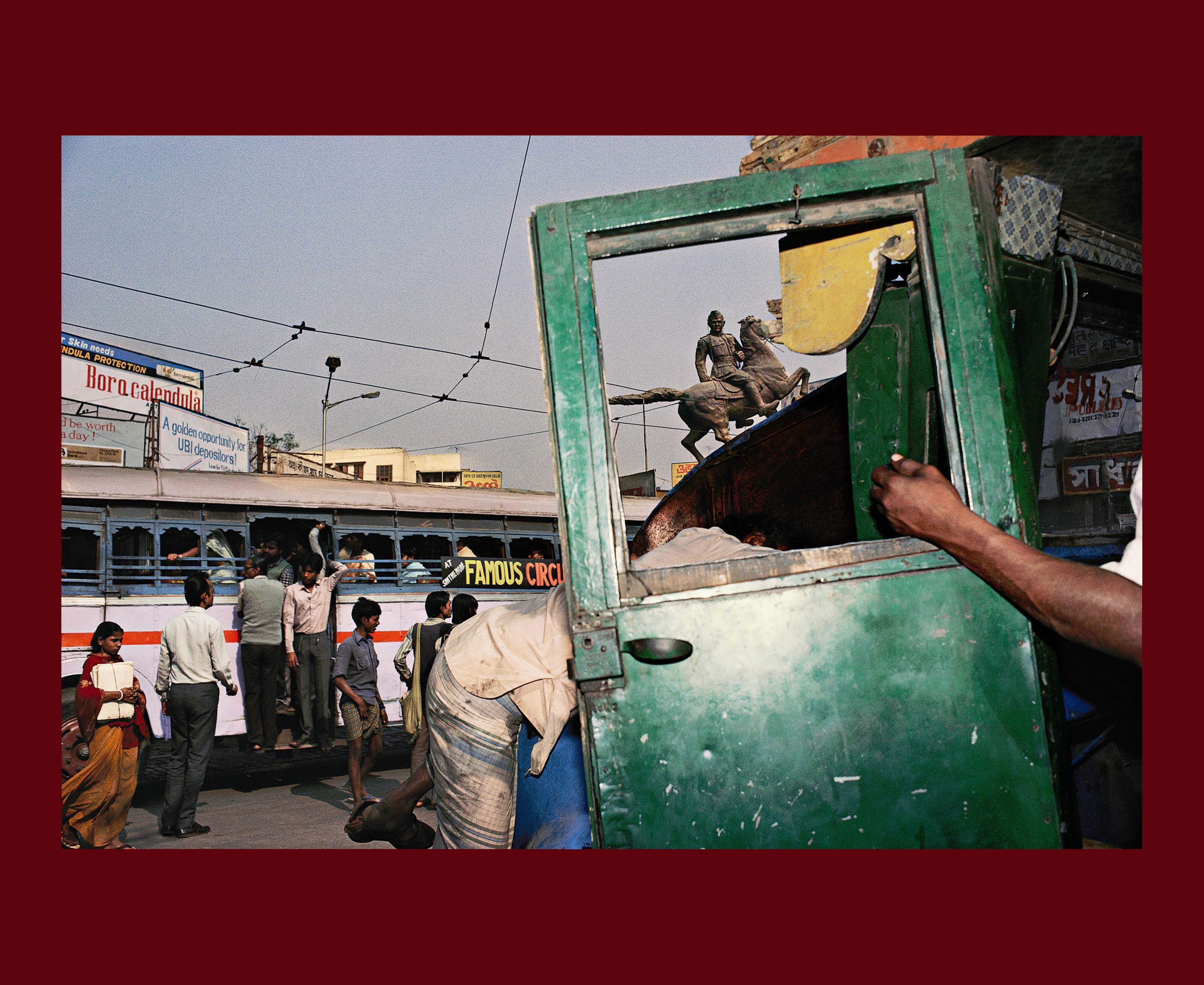
Raghubir Singh (1942–1999) was a pioneer of color street photography who worked and published prolifically from the late 1960s until his death in 1999 at age 56. His vivid, intensely hued photographs capture rural and urban India and iconic depictions of Indian culture though a truly cosmopolitan approach that succeeded in blending East and West. This richly illustrated volume studies in depth the full breadth of Singh’s work, situating it at the intersection of Western modernism and traditional South Asian modes of picturing the world. The book showcases 90 of his photographs, including some previously unpublished images, in counterpoint both with the work of his contemporaries and with images of traditional South Asian artworks that inspired his practice.
Published by The Metropolitan Museum of Art/Distributed by Yale University Press
Exhibition The Met Breuer (10/10/17–01/02/18) Museum of Fine Arts, Houston Spring 2018 Royal Ontario Museum, Toronto Fall 2018
This was a powerful exhibition and the book is a success. The plates are beautifully reproduced and include representative examples from Singh's career, and all of the essays are consistently illuminating. Amit Chaudhuri's essay "The Ambiguity of Decline and Renewal" is a must-read for anyone seriously interested in Singh.
Chaudhuri persuasively argues that Singh’s photographs demand readings more complex than the familiar observations about the unselfconscious coexistence of cultures in India or the persistence of tradition within modernity. What Singh pursued, particularly in his later work, was the formal articulation of a distinct position that rejected both middlebrow realism and orthodox Western modernism. In their place, he sought a visual language capable of representing an India suspended in transition: between the fading modernist and internationalist ideals associated with the Nehru era and the profound oncoming transformations caused by deregulation and globalization.