

What do you think?
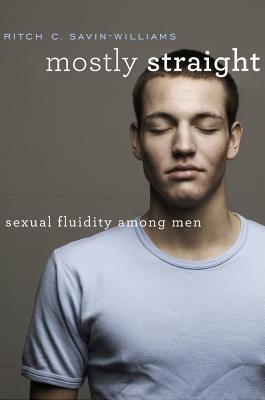
Mostly Straight: Sexual Fluidity Among Men
Most of us assume that sexuality is fixed: either you're straight, gay, or bisexual. Yet an increasing number of young men today say that those categories are too rigid. They are, they insist, "mostly straight." They're straight, but they feel a slight but enduring romantic or sexual desire for men. To the uninitiated, this may not make sense. How can a man be "mostly" straight? Ritch Savin-Williams introduces us to this new world by bringing us the stories of young men who consider themselves to be mostly straight or sexually fluid. By hearing about their lives, we discover a radically new way of understanding sexual and romantic development that upends what we thought we knew about men.
Today there are more mostly straight young men than there are gay and bisexual young men combined. Based on cutting-edge research, Savin-Williams explores the personal stories of forty young men to help us understand the biological and psychological factors that led them to become mostly straight and the cultural forces that are loosening the sexual bind that many boys and young men experience. These young men tell us how their lives have been influenced by their "drop of gayness," from their earliest sexual memories and crushes to their sexual behavior as teenagers and their relationships as young adults. Mostly Straight shows us how these young men are forging a new personal identity that confounds both traditional ideas and conventional scientific opinion.
Today there are more mostly straight young men than there are gay and bisexual young men combined. Based on cutting-edge research, Savin-Williams explores the personal stories of forty young men to help us understand the biological and psychological factors that led them to become mostly straight and the cultural forces that are loosening the sexual bind that many boys and young men experience. These young men tell us how their lives have been influenced by their "drop of gayness," from their earliest sexual memories and crushes to their sexual behavior as teenagers and their relationships as young adults. Mostly Straight shows us how these young men are forging a new personal identity that confounds both traditional ideas and conventional scientific opinion.
256 pages, Hardcover
First published November 13, 2017
Ratings & Reviews
Friends & Following
Create a free account to discover what your friends think of this book!
Community Reviews
Displaying 1 - 15 of 15 reviews

June 30, 2023
DNF at 73%. This book manages to be neither truly anecdotal nor scientific. The synopsis claimed the author would explore "the stories of 40 mostly straight young men" which he kind of does but not really. Some of the stories are lumped together in a mish-mash of being sort of similar to each other. Very few chapters are dedicated to the actual subjects of the interviews, while most of the content of the book was about the author making suppositions and giving his own spin to what he thinks the interviewees mean by their responses. I had been looking forward to hearing first-hand accounts from mostly straight men about incidents or fantasies that belie their otherwise straight nature, since this is a subject that intrigues me. Straight-identifying people who fall in love or have sexual encounters with someone of the same gender is a subject worth exploring, but I would have loved to hear from the young men themselves instead of the author droning endlessly on and repeating himself every chapter.

September 3, 2026
Confessions of a Gen Xer…
I grew up believing that people were either gay or straight. When I learned the term “bisexual,” I took this to mean that some people were confused about whether they were gay or straight. These were not uncommon views in the early 1990s.
Ritch Savin-Williams notes that Millennials are far more likely than their predecessors to believe that sexuality exists on a spectrum. Human sexuality has likely always been more fluid than traditional opinion has allowed, but younger generations are becoming increasingly willing to acknowledge and discuss this.
The book’s major claim is that a substantial number of men — perhaps 10 percent of American males — fit the label mostly straight. A mostly straight man is “heterosexual, with a slight dose of same-sex sexuality that can be either sexual, romantic, or both.”
A mostly straight man might at times find himself admiring certain male bodies, even feeling pangs of erotic desire. However, when given the choice, he would almost always pursue women, and he probably wouldn’t plan to have sex with another man. Although if the stars aligned, he might be open to such an experience, as long as it didn’t involve anal.
Some mostly straight men do not feel sexual attraction for other men but might enter into a friendship with another guy that is “clearly something more than a typical friendship.” There might be infatuation, the longing to have one’s attention reciprocated, and jealousy if the other man’s attention turns to someone else. There might be cuddling. There probably won’t be sex.
Savin-Williams references the Kinsey Scale, which holds that we can be 0 (completely heterosexual) or 6 (completely homosexual) or somewhere in between. He points out that the somewhere in between need not be fixed: a 2 in late adolescence might later become a 1, and so on.
Although the book largely consists of interviews, Savin-Williams also supports his conclusions with laboratory research. For instance, he found that, “like straight guys, mostly straight young men’s genitals are aroused and pupils are dilated for naked female images. However, unlike straight guys, mostly straight young men have nontrivial increases in arousal responses to naked male images. They are, to use conventional terms, both heterosexual and slightly homosexual.”
He argues — persuasively, I think — that some degree of same-sex sexuality makes sense from an evolutionary perspective. Certainly natural selection would favor heterosexuality to improve our chances of propagating our genes, but same-sex bonding could have also improved our fitness. “It allowed women to mutually care for and protect their children and to develop agriculture while men were out gathering protein. In turn, becoming attached with other men enhanced men’s hunting skills and success through cooperation and joint efforts.”
As a Gen Xer, I give this book an enthusiastic two thumbs up. (Which is probably a reference that many Millennials will not understand.) The writing is clear and well-paced, but more importantly, Savin-Williams offers an important corrective to the widespread belief that male sexuality falls neatly into two or three discrete categories. “We like our sexualities simple,” he writes, “especially among our male youths, and we prefer to ignore undue complexity.” By pointing out that it’s not uncommon for men to fall outside these conventional categories, he gives many permission to acknowledge parts of themselves they might otherwise feel the need to deny.
I grew up believing that people were either gay or straight. When I learned the term “bisexual,” I took this to mean that some people were confused about whether they were gay or straight. These were not uncommon views in the early 1990s.
Ritch Savin-Williams notes that Millennials are far more likely than their predecessors to believe that sexuality exists on a spectrum. Human sexuality has likely always been more fluid than traditional opinion has allowed, but younger generations are becoming increasingly willing to acknowledge and discuss this.
The book’s major claim is that a substantial number of men — perhaps 10 percent of American males — fit the label mostly straight. A mostly straight man is “heterosexual, with a slight dose of same-sex sexuality that can be either sexual, romantic, or both.”
A mostly straight man might at times find himself admiring certain male bodies, even feeling pangs of erotic desire. However, when given the choice, he would almost always pursue women, and he probably wouldn’t plan to have sex with another man. Although if the stars aligned, he might be open to such an experience, as long as it didn’t involve anal.
Some mostly straight men do not feel sexual attraction for other men but might enter into a friendship with another guy that is “clearly something more than a typical friendship.” There might be infatuation, the longing to have one’s attention reciprocated, and jealousy if the other man’s attention turns to someone else. There might be cuddling. There probably won’t be sex.
Savin-Williams references the Kinsey Scale, which holds that we can be 0 (completely heterosexual) or 6 (completely homosexual) or somewhere in between. He points out that the somewhere in between need not be fixed: a 2 in late adolescence might later become a 1, and so on.
Although the book largely consists of interviews, Savin-Williams also supports his conclusions with laboratory research. For instance, he found that, “like straight guys, mostly straight young men’s genitals are aroused and pupils are dilated for naked female images. However, unlike straight guys, mostly straight young men have nontrivial increases in arousal responses to naked male images. They are, to use conventional terms, both heterosexual and slightly homosexual.”
He argues — persuasively, I think — that some degree of same-sex sexuality makes sense from an evolutionary perspective. Certainly natural selection would favor heterosexuality to improve our chances of propagating our genes, but same-sex bonding could have also improved our fitness. “It allowed women to mutually care for and protect their children and to develop agriculture while men were out gathering protein. In turn, becoming attached with other men enhanced men’s hunting skills and success through cooperation and joint efforts.”
As a Gen Xer, I give this book an enthusiastic two thumbs up. (Which is probably a reference that many Millennials will not understand.) The writing is clear and well-paced, but more importantly, Savin-Williams offers an important corrective to the widespread belief that male sexuality falls neatly into two or three discrete categories. “We like our sexualities simple,” he writes, “especially among our male youths, and we prefer to ignore undue complexity.” By pointing out that it’s not uncommon for men to fall outside these conventional categories, he gives many permission to acknowledge parts of themselves they might otherwise feel the need to deny.

January 13, 2019
Perhaps a better subtitle for this book would have been something like "Mostly Straight: Men Who Will RUIN YOUR FUCKING LIFE (!!!) If You Fall For Them, So Stay Away From Them, Gay Guys."
As evidenced by my opening sentence, this book brought back many painful memories of "mostly straight" guys who have broken my heart over the years. Given my personal biases here, I'm not sure how to rate this book. On the one hand, the author's main thesis isn't anything that I perceive as revelatory. Just about any gay guy can repeat the following joke and relate it to their real life experiences-- "What's the difference between a straight guy and a gay guy? .... 6 beers." That said, I do applaud the author for taking this difficult, ambiguous, paradoxical topic on.
As evidenced by my opening sentence, this book brought back many painful memories of "mostly straight" guys who have broken my heart over the years. Given my personal biases here, I'm not sure how to rate this book. On the one hand, the author's main thesis isn't anything that I perceive as revelatory. Just about any gay guy can repeat the following joke and relate it to their real life experiences-- "What's the difference between a straight guy and a gay guy? .... 6 beers." That said, I do applaud the author for taking this difficult, ambiguous, paradoxical topic on.

December 26, 2017
An important book. Good science but quite engaging and readable. Super useful to me as research for a fictional character, but more than a little useful to our world right now. Particularly liked the the message of hope and acceptance directly expressed to the young reader.

November 15, 2023
Ik was op Dragvoll (de geesteswetenschappencampus) en dit boek lag zo prominent in de etalage van de boekhandel dat ik 'm niet kon laten liggen.
Dit boek is… Niet supergoed. De andere reviews vatten het eigenlijk prima samen: het is niet écht wetenschappelijk en ook niet écht anekdotisch, en als het één van die twee geweest was, was het waarschijnlijk beter leesbaar en interessanter geweest. Meest van alles lijkt de auteur het punt te willen bewijzen dat er mannen bestaan die 'mostly straight' zijn. Nou, dat wist ik al. Zoals een van de andere reviews op dit boek óók schrijft: Perhaps a better subtitle for this book would have been something like "Mostly Straight: Men Who Will RUIN YOUR FUCKING LIFE (!!!) If You Fall For Them, So Stay Away From Them, Gay Guys."'
Overigens denk ik wel dat dit, gezien de titel, een hilarisch boek is om mee gezien te worden in treinen, vliegtuigen en wachtkamers.
Dit boek is… Niet supergoed. De andere reviews vatten het eigenlijk prima samen: het is niet écht wetenschappelijk en ook niet écht anekdotisch, en als het één van die twee geweest was, was het waarschijnlijk beter leesbaar en interessanter geweest. Meest van alles lijkt de auteur het punt te willen bewijzen dat er mannen bestaan die 'mostly straight' zijn. Nou, dat wist ik al. Zoals een van de andere reviews op dit boek óók schrijft: Perhaps a better subtitle for this book would have been something like "Mostly Straight: Men Who Will RUIN YOUR FUCKING LIFE (!!!) If You Fall For Them, So Stay Away From Them, Gay Guys."'
Overigens denk ik wel dat dit, gezien de titel, een hilarisch boek is om mee gezien te worden in treinen, vliegtuigen en wachtkamers.

January 8, 2018
I think this would have done well as the academic journal article it derived from. His thesis is that on the sexual orientation continuum there are individuals who truly are just a little gay. They are not closeted individuals, nor are they likely to become more gay in the future.

September 26, 2018
I kind of gave up on this a little over half way through. It's mostly anecdotal and it just gets very boring and repetitive. This could have been condensed into an interesting article--it's too much as a book.

December 30, 2018
I don't disagree with the author's somewhat bland conclusion (which is that there are men who are mostly straight, being on a sexual spectrum) but I would have liked a lot more science and a lot less anecdotal evidence. Mostly meh.

September 28, 2018
I'm mostly gay. That's my review.
May 8, 2018
Savin-Williams' "Mostly Straight" discusses a group that you don't hear about too often. Williams reminds us that on the Kinsey scale, 0 represents totally straight and 6 represents totally gay. We hear about gay people (Kinsey 6), straight people (Kinsey 0), and even bisexual people (Kinsey 3), all the time. However, one group that is not discussed or talked about at all is the Kinsey 1's, that is, people who are mostly straight, but not totally so.
In his book, Williams discusses the lives of young men who self-describe as mostly straight, and compares and contrasts their sexual and romantic lives with those of totally straight and totally gay people. It's actually a very interesting read to learn more about this group that typically flies under the radar and doesn't get much attention. An even more intriguing pattern that becomes apparent in the book is that traditional definitions of sex and love, straight and gay, are evolving quite quickly in America, led by the youngest adults. More and more people are saying "I'm not straight, I'm not gay, I'm just me". This is quite an eye-opening read, and I thank Williams for shining some light on this little-discussed segment of the sexual continuum.
In his book, Williams discusses the lives of young men who self-describe as mostly straight, and compares and contrasts their sexual and romantic lives with those of totally straight and totally gay people. It's actually a very interesting read to learn more about this group that typically flies under the radar and doesn't get much attention. An even more intriguing pattern that becomes apparent in the book is that traditional definitions of sex and love, straight and gay, are evolving quite quickly in America, led by the youngest adults. More and more people are saying "I'm not straight, I'm not gay, I'm just me". This is quite an eye-opening read, and I thank Williams for shining some light on this little-discussed segment of the sexual continuum.

December 31, 2018
Yeah, a label-less world would be great. But we still need to talk this out for us, the ones before us, and the ones growing up. I'm far from mostly-straight, but have had friends and acquaintances I think would identify as such. We've had some great conversations about it--private ones I'd never share. Because the world isn't there yet for them. Imagine a world where it's totally okay for guys to be a little bit gay, where they wouldn't be labeled a closet-case, dirty opportunist, hesitant bisexual, or anything to demean, what if they were just self-identified men who had a firm identity, and integrity, and an openness to be? This book looks at some of these men, finds some answers, and poses a lot of questions.
November 29, 2017
Meh. Book could have been 20 pages long instead of 200 and I would have gotten the gist.

February 28, 2018
Contrived and forced concept.

February 6, 2023
There are only so many ways one can rephrase "it isn't gay if the balls don't touch"

February 1, 2023
An intriguing read on an emerging concept, with personal stories that deepened my understanding of male sexuality.
Displaying 1 - 15 of 15 reviews