

What do you think?

Harpo Speaks!
Harpo Speaks! (Coronet Books)
478 pages, Paperback
First published January 1, 1961
Ratings & Reviews
Friends & Following
Create a free account to discover what your friends think of this book!
Community Reviews
Displaying 1 - 30 of 418 reviews

September 24, 2010
I'm currently obsessed with the Marx Brothers, which is somewhat significant because only a month ago they kind of terrified me. Well, actually... it was mostly Harpo Marx, the mute, curly-wigged, trenchcoated one who tapped into my deep-seated fear of clowns.
Fear of clowns isn't itself very remarkable. It's pretty common, from what I can tell, but my phobia really got turbo-charged in my early adolescence from watching WGN of Chicago's The Bozo Show, which was a weekday morning nightmare-a-thon featuring skits, cartoons, games, music, and three clowns: Bozo was the most responsible, least terrifying one of the trio; he had weird male pattern baldness, meaning he was bald on top but had really long, teased-out cherry-red hair. Cookie also suffered from similar hair loss, but his remaining hair was orange and he had a penchant for picnic blanket gingham shirts. Cookie was borderline creepy at times, but most of the time I could deal with him because he wasn't the antagonist; he was usually the recipient of the pies in the face and the banana peel pratfalls.
No, the real ground zero of my ensuing mental illness was (buckle yourself in for trauma) Wizzo the allegedly 'Wacky' Wizard. He was the villain of the three. Aside from looking like Satan's apprentice, Wizzo continually plotted and schemed against Bozo and Cookie. (As you can see, Wizzo also happens to be an 'Arab'-styled clown, which may be the original cause of the East-West cultural divide. This clown is so demonic that I don't blame any Arab who might be offended.)
Anyway, Wizzo regularly sought the aid of magical forces, summoned by a purple amulet around his neck called the Stone of Zanzibar. He would touch the stone to a given object which he desired to work magic upon and say, 'Doo-dee-doo-dee-doo-dee.' That's an exact quote, by the way. Of course, Wizzo never won out in the end, but there was something so grotesquely malevolent, mischievous, and satyric about him that he symbolized to me (the innocent naif) all that was unpredictable and dangerous about the world.
(Yes, of course I'm glorifying my simple childhood fears into grandiose psychological complexes touching on the very nature of life/death themselves. It's what we do. We don't want to believe we're any old schmoe with any old schmoe's two-bit hang-ups.)
Early movie stars like Charlie Chaplin and Harpo Marx recalled that untamed, clownlike mischief that so occupied my early dreamlife. (Speaking of Charlie Chaplin... did anybody but Chaplin and Hitler ever have that mustache?) In the early Paramount films, Harpo certainly lives up to this reputation. First of all, mutes are inherently frightening. (Sorry, mutes!) Since they cannot speak, we reflexively presume there is something hidden or secretive about them. -- something that mere physical expression can't satisfactorily mediate. Next, Harpo is always trying to fuck with everybody all the time. It doesn't matter (in the early films) whether you're a 'good guy' or a 'bad guy,' Harpo will kick you in the ass (literally) and do his utmost to humiliate or anger you. Lastly, he's costumed (another allusion to hiddenness or subterfuge).
So basically, over the past month, I overcame my fear of Harpo Marx -- although I still have to say that he is probably my least favorite of Three Marx Brothers. Yes, that's right... Nobody's favorite Chico himself noses Harpo out of second place. (If we expand the pool to the Four Marx Brothers, Zeppo takes last place. Zeppo barely registers at all.)
I have watched all five films in which The Four Marx Brothers starred (The Cocoanuts, Animal Crackers, Monkey Business, Horse Feathers, and Duck Soup) and the eight films in which The Three Marx Brothers starred (A Night at the Opera, A Day at the Races, Room Service, At the Circus, Go West, The Big Store, A Night in Casablanca, and Love Happy). Now I accept Harpo. He is almost -- I said ALMOST! -- a comforting cinematic presence to me. Actually, I only outright dislike two of their films (Room Service and Love Happy), and since Harpo is a major part of them all, he certainly deserves a lot of credit.
Now for this book... It's apparent from reading this book that Harpo (in real life, beyond the film persona, a.k.a. Adolph Marx) is the kindest, least fucked-up of the three 'main' brothers. (I don't know about Zeppo.) Groucho -- who is needless to say my favorite -- could be cruel and aloof, and Chico was a womanizing gambling addict, apparently also with a temper. Harpo (as far as one can tell) was a family man... mostly self-deprecating and timid about his shortcomings. Harpo only attended school through the SECOND grade! Therefore, you can pretty much be sure that Rowland Barber, his collaborator on this autobiography, did all or most of the writing. Harpo likely just provided the raw material.
Harpo's stories about the hardships of working in vaudeville with his brothers at the turn of the century under the dictatorial but well-meaning control of his mother Minnie are fascinating. This is a world that is all but forgotten anymore, as most of the people who experienced vaudeville have died away. It was a rough life... traveling across the country to smaller, second-rate vaudeville houses, the familial troupe not sure if they would get to perform (or if they would be paid for their performance). Sometimes the audiences were cruel and -- true to cliche -- threw fruit. In Boston, an audience member spat chewing tobacco on Harpo during the performance. This is especially upsetting when you remember that Harpo was only a child at the time.
Also very interesting are the stories about living in New York City in the late 1800s and early 1900s... horsedrawn carriages, seedy speakeasies, Tammany Hall... It's all chronicled quite excitingly in this book.
Less interesting are Harpo's adventures with the intellectual hoi-polloi of the time, including Alexander Woollcott, a pompous buffoon (in my less than humble opinion) who was the theater reviewer for The New York Times and a member of the Algonquin Round Table, with such luminaries as Dorothy Parker and George S. Kaufman. Harpo holds Woollcott in much higher esteem than I do, and I can't help faulting him for dwelling on the peculiarities of Woollcott's character instead of telling the readers stuff they really want to know... but obviously Harpo isn't going to divulge too many negative details about his brothers, whom he obviously loves dearly -- despite their foibles.
* * * Postscript * * *
As an avid movie list-maker, I was apparently remiss in not including the official (i.e., my) rankings of all thirteen of the Marx Brothers films! I know you were thinking to yourself, 'I was really hoping to watch or re-watch some Marx Brothers films, but David didn't offer me any spiritual guidance.' Well, although you didn't really ask, ye shall receive anyhow:
1. A Night at the Opera (1935)
Their first film for MGM (under the supervision of 'The Boy Wonder' Irving Thalberg) and their first film sans Zeppo, who generally filled the role of the dull, superfluous romantic lead in the preceding films. Most (I said most) Marx Brothers films conform to a strict formula: Chico and Harpo are usually associates, friends, acquaintances who 'meet' Groucho during the course of the film; there is a bland romantic story (involving Zeppo or a Zeppo surrogate) punctuated by a few sappy ditties; at one point in the film, Chico will usually have a piano solo, and Harpo will have a harp solo. (Be sure to watch Harpo during his harp solos. You can see his face change out of the Harpo persona during most of them. He admits as much in Harpo Speaks!; he tells the reading audience that they've seen the true man behind Harpo if they've seen his harp playing performances.) In the MGM films, there is a relatively straightforward plot involving a villain pitted against the romantic leads; the Marx Brothers are then enlisted to help foil the plot of the villain. This latter point was at the insistance of Irving Thalberg. He believed that one problem with the five anarchic Paramount films (1929 - 1933) was that the audience didn't have a rooting interest in the Marx Brothers, in that they caused problems for everybody in the film, good and bad, and they were largely amoral. A Night at the Opera is the first film to place the brothers firmly and devotedly on the side of moral good, as coded by conventional Hollywood standards. In addition to George S. Kaufman, Buster Keaton assisted in writing the screenplay (although without credit). Keaton and the Marxes would suffer creative differences in their collaborations because the Marxes believed the kind of humor Keaton was writing was not appropriate for them. Nevertheless, Groucho repeatedly said that A Night at the Opera was the greatest film they ever made, and I agree -- which only goes to show what a master Irving Thalberg was. Their MGM films after the death of Thalberg in 1936 (during preproduction on Opera's follow-up A Day at the Races) would pale in comparison to their earlier efforts.
2. Duck Soup (1933)
The final film for Paramount, Duck Soup is usually the only film mentioned in competition with A Night at the Opera for the Marxes' best. It is often recalled as a box office flop, but this isn't entirely the case; it was successful to a limited extent but failed to meet the financial expectations set up by their previous films. The plot, thin as it is, focuses on Rufus T. Firefly, a wiseacre buffoon, who is instated as the leader of the fictional nation Fredonia under the patronage of wealthy Mrs. Teasdale (played by wonderful Marx film regular Margaret Dumont). Chico and Harpo are 'spies' sent in by the neighboring country of Sylvania to dig up dirt on Firefly in order to start war. This is the film which contains perhaps the most famous scene in the Marx canon: Harpo happens to be dressed up like Groucho (greasepaint mustache, eyebrows, and all) and tries to mimic Groucho through a doorway so that Groucho believes he's looking in a mirror. (An homage was paid to this gag during Harpo's visit to the I Love Lucy show in the 1950s.) But let's discuss Margaret Dumont for a second, please! Dumont starred in seven of the thirteen Marx brothers films, essentially playing the same character: a priggish, proper, upper crust type of woman who is alternately being wooed and insulted by Groucho. Some of her characters don't notice (or understand) the insults, and some of them notice the insults but forget about them in a matter of seconds... She is such a great comic foil in these films that it's a little disappointing when you realize you're watching one of the films without her.
3. Animal Crackers (1930)
Animal Crackers was the second stage play written for the Marx Brothers which was adapted (mostly literally) to screen. (The other play was their film debut The Cocoanuts.) In this one, Groucho plays a (dubious) African explorer named Captain Spaulding, who is being feted by a New York society grand dame (played by Margaret Dumont). The plot is forgettable and involves the theft of an expensive painting during the party and the attempts to figure out whodunnit. All in all, this skeletal plot is merely there to prop up the jokes, the skits, the banter, the sight gags... and the brothers are mostly at the top of their game here, including a scene where Groucho dictates a ridiculous letter in meaningless legalese to his secretary (Zeppo). One of the drawbacks of this one, however, is that it's very stagey. It seems that Groucho is even leaving breathing room after his one-liners for audience laughs, which works in the theater, but on film, not so much. So there is a tonal clunkiness, but all is forgiven because the writing is sharp and the humor is brisk.
4. The Cocoanuts (1929)
First Marx Brothers film. Early talkie with poor sound, little camera movement, and poor picture quality. Songs written by Irving Berlin. Based on the Marx Brothers' second stage play. Harpo wears a red wig in this one, but it is changed to blonde in his later films because the red reads too dark. Plot concerns the Florida real estate boom, with Groucho managing a hard-luck local hotel.
5. A Day at the Races (1937)
Thalberg died during pre-production of pneumonia, but it still bears the stamp of quality assurance. Contains the famous 'tootsie-fruitsie ice cream' routine. Maureen O'Sullivan, Mia Farrow's mother, stars as the romantic lead. Groucho is a horse doctor mistaken for a human doctor by a wealthy hypochondriac (Margaret Dumont) at a clinic near a race track.
6. Horse Feathers (1932)
Very good, but not as funny as I expected given its reputation. The football game at the end drags on and on and on (in my opinion). But there's still a lot of good stuff here in this satire on higher education. Groucho plays the new dean of a university, charged with the task of recruiting two star football players. He ends up with Chico and Harpo instead. The only surviving print of this film is damaged in parts and skips over several lines of dialogue.
7. Monkey Business (1931)
The Marx Brothers as stowaways on a cruise ship. This for me was the least of the Paramount films. But there is hilarious scene in which all three of the brothers try to get off the ship by impersonating Maurice Chevalier (because they find his passport on board).
8. At the Circus (1939)
This third film for MGM is where the decline begins. There's a lot to love in At the Circus, but you sense the film isn't quite as sharp as it used to be -- and the romantic leads in this film may be blandest, least interesting of any Marx Brothers film. Eve Arden costars as a woman who walks upside down for the circus -- leading to a scene in which Groucho walks upside down as well, trying to get some money out of Arden's cleavage while, he remarks to the camera, not violating the Hayes Production Code, which established guidelines for what might and might not be shown in films in America before the MPAA rating system came about. Also famous for a scene in which a orchestra stage on the beach is unmoored and the orchestra is cast off to sea... still playing. Margaret Dumont also stars.
9. Go West (1940)
This one's infamous for some Indian stereotypes, which I suppose is to be expected from a 'western' of this time period. The film starts fairly strongly, but inevitably gets bogged down with uninteresting plot towards the end, in a train scene somewhat reminiscent of Buster Keaton's The General.
10. A Night in Casablanca (1946)
The first Marx Brothers 'comeback film' marking a return to the screen after a five year absence during WWII. Appropriately enough, this so-so film, originally intended as a Casablanca parody, ended up featuring Nazis as the villains. Recalling The Cocoanuts, Groucho is the inept manager of a hotel -- this time in Casablanca -- where some shenanigans involving hidden Nazi loot transpire. This one's much too long for its own good. The airplane scene at the end is incredible but strangely unfunny. You really notice the brothers looking older in this one. The story is that they only agreed to make it to help Chico pay off his out-of-sight gambling debts.
11. The Big Store (1941)
Eleven, twelve, and thirteen on my list are probably not films I would recommend to anyone. The Big Store, for instance, is an overblown, ridiculous, mostly unfunny affair in which nearly every ethnic stereotype is employed at some point (to no comic effect). I couldn't even really latch on to the plot of this thing because it was too convoluted for a light Marx Brothers film. It involved Groucho working as a private detective at a large department store. That much I can say. The romantic leads were just awful in this one, and the woman who works in the infants department in the store is so bizarre, I had to watch her performance in one of the big production numbers three times in a row. Harpo has an interesting harp-playing scene here where he dons an Amadeus-era wig and outfit and has some fun with his rebellious reflections in two mirrors.
12. Love Happy (1950)
The second 'comeback film' and the final Marx Brothers film. The only film in which Groucho doesn't have greasepaint eyebrows and mustache. The DVD case shouts at me that this thing stars THE MARX BROTHERS and MARILYN MONROE! Marilyn Monroe was in it for less than one minute! No exaggeration. She was unknown at the time and is only a glorified extra. Also interesting about Love Happy: It's considered Harpo's film because he came up with the story idea and wanted to make it, but Groucho wasn't into it... as such Groucho role in this film is very diminished. Additionally, the three brothers don't appear on-screen together much in this film. A mostly pathetic farewell. (You really can never go home again.)
13. Room Service (1938)
I really, really hated this one. Really. It's the only Marx Brothers film that wasn't written specifically for the Marx Brothers, and it shows. It costars Lucille Ball and Ann Miller, and is the story of a play director (Groucho) holed up in a hotel suite, with no money, until he finds a way to get his funding. Chico and Harpo show up (I forget the details of how or why) and encamp with him, along with a thoroughly irritating doofus (also the romantic lead opposite Ann Miller) who is the author of the play (within the play). Not one laugh here for me. Not one...
Fear of clowns isn't itself very remarkable. It's pretty common, from what I can tell, but my phobia really got turbo-charged in my early adolescence from watching WGN of Chicago's The Bozo Show, which was a weekday morning nightmare-a-thon featuring skits, cartoons, games, music, and three clowns: Bozo was the most responsible, least terrifying one of the trio; he had weird male pattern baldness, meaning he was bald on top but had really long, teased-out cherry-red hair. Cookie also suffered from similar hair loss, but his remaining hair was orange and he had a penchant for picnic blanket gingham shirts. Cookie was borderline creepy at times, but most of the time I could deal with him because he wasn't the antagonist; he was usually the recipient of the pies in the face and the banana peel pratfalls.
No, the real ground zero of my ensuing mental illness was (buckle yourself in for trauma) Wizzo the allegedly 'Wacky' Wizard. He was the villain of the three. Aside from looking like Satan's apprentice, Wizzo continually plotted and schemed against Bozo and Cookie. (As you can see, Wizzo also happens to be an 'Arab'-styled clown, which may be the original cause of the East-West cultural divide. This clown is so demonic that I don't blame any Arab who might be offended.)
Anyway, Wizzo regularly sought the aid of magical forces, summoned by a purple amulet around his neck called the Stone of Zanzibar. He would touch the stone to a given object which he desired to work magic upon and say, 'Doo-dee-doo-dee-doo-dee.' That's an exact quote, by the way. Of course, Wizzo never won out in the end, but there was something so grotesquely malevolent, mischievous, and satyric about him that he symbolized to me (the innocent naif) all that was unpredictable and dangerous about the world.
(Yes, of course I'm glorifying my simple childhood fears into grandiose psychological complexes touching on the very nature of life/death themselves. It's what we do. We don't want to believe we're any old schmoe with any old schmoe's two-bit hang-ups.)
Early movie stars like Charlie Chaplin and Harpo Marx recalled that untamed, clownlike mischief that so occupied my early dreamlife. (Speaking of Charlie Chaplin... did anybody but Chaplin and Hitler ever have that mustache?) In the early Paramount films, Harpo certainly lives up to this reputation. First of all, mutes are inherently frightening. (Sorry, mutes!) Since they cannot speak, we reflexively presume there is something hidden or secretive about them. -- something that mere physical expression can't satisfactorily mediate. Next, Harpo is always trying to fuck with everybody all the time. It doesn't matter (in the early films) whether you're a 'good guy' or a 'bad guy,' Harpo will kick you in the ass (literally) and do his utmost to humiliate or anger you. Lastly, he's costumed (another allusion to hiddenness or subterfuge).
So basically, over the past month, I overcame my fear of Harpo Marx -- although I still have to say that he is probably my least favorite of Three Marx Brothers. Yes, that's right... Nobody's favorite Chico himself noses Harpo out of second place. (If we expand the pool to the Four Marx Brothers, Zeppo takes last place. Zeppo barely registers at all.)
I have watched all five films in which The Four Marx Brothers starred (The Cocoanuts, Animal Crackers, Monkey Business, Horse Feathers, and Duck Soup) and the eight films in which The Three Marx Brothers starred (A Night at the Opera, A Day at the Races, Room Service, At the Circus, Go West, The Big Store, A Night in Casablanca, and Love Happy). Now I accept Harpo. He is almost -- I said ALMOST! -- a comforting cinematic presence to me. Actually, I only outright dislike two of their films (Room Service and Love Happy), and since Harpo is a major part of them all, he certainly deserves a lot of credit.
Now for this book... It's apparent from reading this book that Harpo (in real life, beyond the film persona, a.k.a. Adolph Marx) is the kindest, least fucked-up of the three 'main' brothers. (I don't know about Zeppo.) Groucho -- who is needless to say my favorite -- could be cruel and aloof, and Chico was a womanizing gambling addict, apparently also with a temper. Harpo (as far as one can tell) was a family man... mostly self-deprecating and timid about his shortcomings. Harpo only attended school through the SECOND grade! Therefore, you can pretty much be sure that Rowland Barber, his collaborator on this autobiography, did all or most of the writing. Harpo likely just provided the raw material.
Harpo's stories about the hardships of working in vaudeville with his brothers at the turn of the century under the dictatorial but well-meaning control of his mother Minnie are fascinating. This is a world that is all but forgotten anymore, as most of the people who experienced vaudeville have died away. It was a rough life... traveling across the country to smaller, second-rate vaudeville houses, the familial troupe not sure if they would get to perform (or if they would be paid for their performance). Sometimes the audiences were cruel and -- true to cliche -- threw fruit. In Boston, an audience member spat chewing tobacco on Harpo during the performance. This is especially upsetting when you remember that Harpo was only a child at the time.
Also very interesting are the stories about living in New York City in the late 1800s and early 1900s... horsedrawn carriages, seedy speakeasies, Tammany Hall... It's all chronicled quite excitingly in this book.
Less interesting are Harpo's adventures with the intellectual hoi-polloi of the time, including Alexander Woollcott, a pompous buffoon (in my less than humble opinion) who was the theater reviewer for The New York Times and a member of the Algonquin Round Table, with such luminaries as Dorothy Parker and George S. Kaufman. Harpo holds Woollcott in much higher esteem than I do, and I can't help faulting him for dwelling on the peculiarities of Woollcott's character instead of telling the readers stuff they really want to know... but obviously Harpo isn't going to divulge too many negative details about his brothers, whom he obviously loves dearly -- despite their foibles.
* * * Postscript * * *
As an avid movie list-maker, I was apparently remiss in not including the official (i.e., my) rankings of all thirteen of the Marx Brothers films! I know you were thinking to yourself, 'I was really hoping to watch or re-watch some Marx Brothers films, but David didn't offer me any spiritual guidance.' Well, although you didn't really ask, ye shall receive anyhow:
1. A Night at the Opera (1935)
Their first film for MGM (under the supervision of 'The Boy Wonder' Irving Thalberg) and their first film sans Zeppo, who generally filled the role of the dull, superfluous romantic lead in the preceding films. Most (I said most) Marx Brothers films conform to a strict formula: Chico and Harpo are usually associates, friends, acquaintances who 'meet' Groucho during the course of the film; there is a bland romantic story (involving Zeppo or a Zeppo surrogate) punctuated by a few sappy ditties; at one point in the film, Chico will usually have a piano solo, and Harpo will have a harp solo. (Be sure to watch Harpo during his harp solos. You can see his face change out of the Harpo persona during most of them. He admits as much in Harpo Speaks!; he tells the reading audience that they've seen the true man behind Harpo if they've seen his harp playing performances.) In the MGM films, there is a relatively straightforward plot involving a villain pitted against the romantic leads; the Marx Brothers are then enlisted to help foil the plot of the villain. This latter point was at the insistance of Irving Thalberg. He believed that one problem with the five anarchic Paramount films (1929 - 1933) was that the audience didn't have a rooting interest in the Marx Brothers, in that they caused problems for everybody in the film, good and bad, and they were largely amoral. A Night at the Opera is the first film to place the brothers firmly and devotedly on the side of moral good, as coded by conventional Hollywood standards. In addition to George S. Kaufman, Buster Keaton assisted in writing the screenplay (although without credit). Keaton and the Marxes would suffer creative differences in their collaborations because the Marxes believed the kind of humor Keaton was writing was not appropriate for them. Nevertheless, Groucho repeatedly said that A Night at the Opera was the greatest film they ever made, and I agree -- which only goes to show what a master Irving Thalberg was. Their MGM films after the death of Thalberg in 1936 (during preproduction on Opera's follow-up A Day at the Races) would pale in comparison to their earlier efforts.
2. Duck Soup (1933)
The final film for Paramount, Duck Soup is usually the only film mentioned in competition with A Night at the Opera for the Marxes' best. It is often recalled as a box office flop, but this isn't entirely the case; it was successful to a limited extent but failed to meet the financial expectations set up by their previous films. The plot, thin as it is, focuses on Rufus T. Firefly, a wiseacre buffoon, who is instated as the leader of the fictional nation Fredonia under the patronage of wealthy Mrs. Teasdale (played by wonderful Marx film regular Margaret Dumont). Chico and Harpo are 'spies' sent in by the neighboring country of Sylvania to dig up dirt on Firefly in order to start war. This is the film which contains perhaps the most famous scene in the Marx canon: Harpo happens to be dressed up like Groucho (greasepaint mustache, eyebrows, and all) and tries to mimic Groucho through a doorway so that Groucho believes he's looking in a mirror. (An homage was paid to this gag during Harpo's visit to the I Love Lucy show in the 1950s.) But let's discuss Margaret Dumont for a second, please! Dumont starred in seven of the thirteen Marx brothers films, essentially playing the same character: a priggish, proper, upper crust type of woman who is alternately being wooed and insulted by Groucho. Some of her characters don't notice (or understand) the insults, and some of them notice the insults but forget about them in a matter of seconds... She is such a great comic foil in these films that it's a little disappointing when you realize you're watching one of the films without her.
3. Animal Crackers (1930)
Animal Crackers was the second stage play written for the Marx Brothers which was adapted (mostly literally) to screen. (The other play was their film debut The Cocoanuts.) In this one, Groucho plays a (dubious) African explorer named Captain Spaulding, who is being feted by a New York society grand dame (played by Margaret Dumont). The plot is forgettable and involves the theft of an expensive painting during the party and the attempts to figure out whodunnit. All in all, this skeletal plot is merely there to prop up the jokes, the skits, the banter, the sight gags... and the brothers are mostly at the top of their game here, including a scene where Groucho dictates a ridiculous letter in meaningless legalese to his secretary (Zeppo). One of the drawbacks of this one, however, is that it's very stagey. It seems that Groucho is even leaving breathing room after his one-liners for audience laughs, which works in the theater, but on film, not so much. So there is a tonal clunkiness, but all is forgiven because the writing is sharp and the humor is brisk.
4. The Cocoanuts (1929)
First Marx Brothers film. Early talkie with poor sound, little camera movement, and poor picture quality. Songs written by Irving Berlin. Based on the Marx Brothers' second stage play. Harpo wears a red wig in this one, but it is changed to blonde in his later films because the red reads too dark. Plot concerns the Florida real estate boom, with Groucho managing a hard-luck local hotel.
5. A Day at the Races (1937)
Thalberg died during pre-production of pneumonia, but it still bears the stamp of quality assurance. Contains the famous 'tootsie-fruitsie ice cream' routine. Maureen O'Sullivan, Mia Farrow's mother, stars as the romantic lead. Groucho is a horse doctor mistaken for a human doctor by a wealthy hypochondriac (Margaret Dumont) at a clinic near a race track.
6. Horse Feathers (1932)
Very good, but not as funny as I expected given its reputation. The football game at the end drags on and on and on (in my opinion). But there's still a lot of good stuff here in this satire on higher education. Groucho plays the new dean of a university, charged with the task of recruiting two star football players. He ends up with Chico and Harpo instead. The only surviving print of this film is damaged in parts and skips over several lines of dialogue.
7. Monkey Business (1931)
The Marx Brothers as stowaways on a cruise ship. This for me was the least of the Paramount films. But there is hilarious scene in which all three of the brothers try to get off the ship by impersonating Maurice Chevalier (because they find his passport on board).
8. At the Circus (1939)
This third film for MGM is where the decline begins. There's a lot to love in At the Circus, but you sense the film isn't quite as sharp as it used to be -- and the romantic leads in this film may be blandest, least interesting of any Marx Brothers film. Eve Arden costars as a woman who walks upside down for the circus -- leading to a scene in which Groucho walks upside down as well, trying to get some money out of Arden's cleavage while, he remarks to the camera, not violating the Hayes Production Code, which established guidelines for what might and might not be shown in films in America before the MPAA rating system came about. Also famous for a scene in which a orchestra stage on the beach is unmoored and the orchestra is cast off to sea... still playing. Margaret Dumont also stars.
9. Go West (1940)
This one's infamous for some Indian stereotypes, which I suppose is to be expected from a 'western' of this time period. The film starts fairly strongly, but inevitably gets bogged down with uninteresting plot towards the end, in a train scene somewhat reminiscent of Buster Keaton's The General.
10. A Night in Casablanca (1946)
The first Marx Brothers 'comeback film' marking a return to the screen after a five year absence during WWII. Appropriately enough, this so-so film, originally intended as a Casablanca parody, ended up featuring Nazis as the villains. Recalling The Cocoanuts, Groucho is the inept manager of a hotel -- this time in Casablanca -- where some shenanigans involving hidden Nazi loot transpire. This one's much too long for its own good. The airplane scene at the end is incredible but strangely unfunny. You really notice the brothers looking older in this one. The story is that they only agreed to make it to help Chico pay off his out-of-sight gambling debts.
11. The Big Store (1941)
Eleven, twelve, and thirteen on my list are probably not films I would recommend to anyone. The Big Store, for instance, is an overblown, ridiculous, mostly unfunny affair in which nearly every ethnic stereotype is employed at some point (to no comic effect). I couldn't even really latch on to the plot of this thing because it was too convoluted for a light Marx Brothers film. It involved Groucho working as a private detective at a large department store. That much I can say. The romantic leads were just awful in this one, and the woman who works in the infants department in the store is so bizarre, I had to watch her performance in one of the big production numbers three times in a row. Harpo has an interesting harp-playing scene here where he dons an Amadeus-era wig and outfit and has some fun with his rebellious reflections in two mirrors.
12. Love Happy (1950)
The second 'comeback film' and the final Marx Brothers film. The only film in which Groucho doesn't have greasepaint eyebrows and mustache. The DVD case shouts at me that this thing stars THE MARX BROTHERS and MARILYN MONROE! Marilyn Monroe was in it for less than one minute! No exaggeration. She was unknown at the time and is only a glorified extra. Also interesting about Love Happy: It's considered Harpo's film because he came up with the story idea and wanted to make it, but Groucho wasn't into it... as such Groucho role in this film is very diminished. Additionally, the three brothers don't appear on-screen together much in this film. A mostly pathetic farewell. (You really can never go home again.)
13. Room Service (1938)
I really, really hated this one. Really. It's the only Marx Brothers film that wasn't written specifically for the Marx Brothers, and it shows. It costars Lucille Ball and Ann Miller, and is the story of a play director (Groucho) holed up in a hotel suite, with no money, until he finds a way to get his funding. Chico and Harpo show up (I forget the details of how or why) and encamp with him, along with a thoroughly irritating doofus (also the romantic lead opposite Ann Miller) who is the author of the play (within the play). Not one laugh here for me. Not one...

February 20, 2026
I’ve played piano in a whorehouse. I’ve smuggled secret papers out of Russia … I’ve gambled with Nick the Greek, sat on the floor with Greta Garbo, sparred with Benny Leonard, horsed around with the Prince of Wales, played ping-pong with George Gershwin. George Bernard Shaw has asked me for advice. I’ve basked on the riviera with Somerset Maugham … I’ve been thrown out of the casino at Monte Carlo.
Harpo Speaks ~~~ Harpo Marx
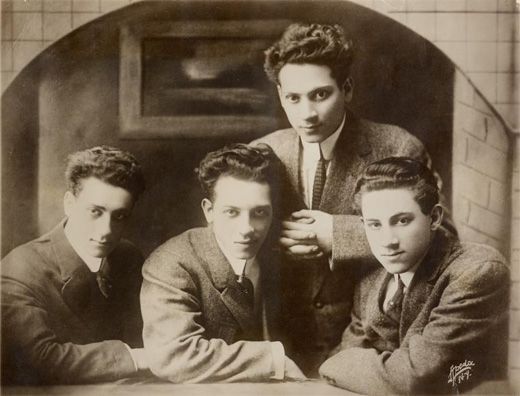
The Four Marx Brothers
Harpo Speaks is one of the funniest books I’ve ever read. Harpo tells some hilarious stories. To say I love this book would be an understatement.
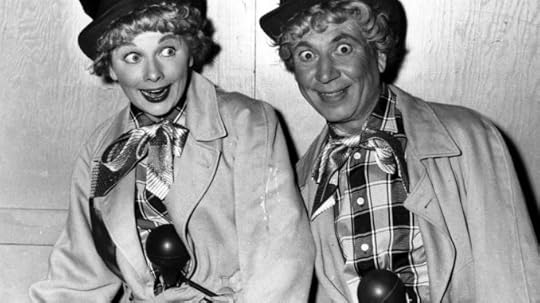
Lucy & Harpo
Harpo’s humble beginnings were in New York, where he was thrown out of Public School 86 at the age of 8 ~~ literally ~~ through a first floor window ~~ never to return. Harpo and his brothers went on to even humbler efforts to break into show business in vaudeville, performing in a new town every night, every performance a struggle to earn enough money to make it to the next town ~~ and maybe even a little extra for food and a room to sleep in. Then on to Broadway success, Hollywood success and semi-retirement.
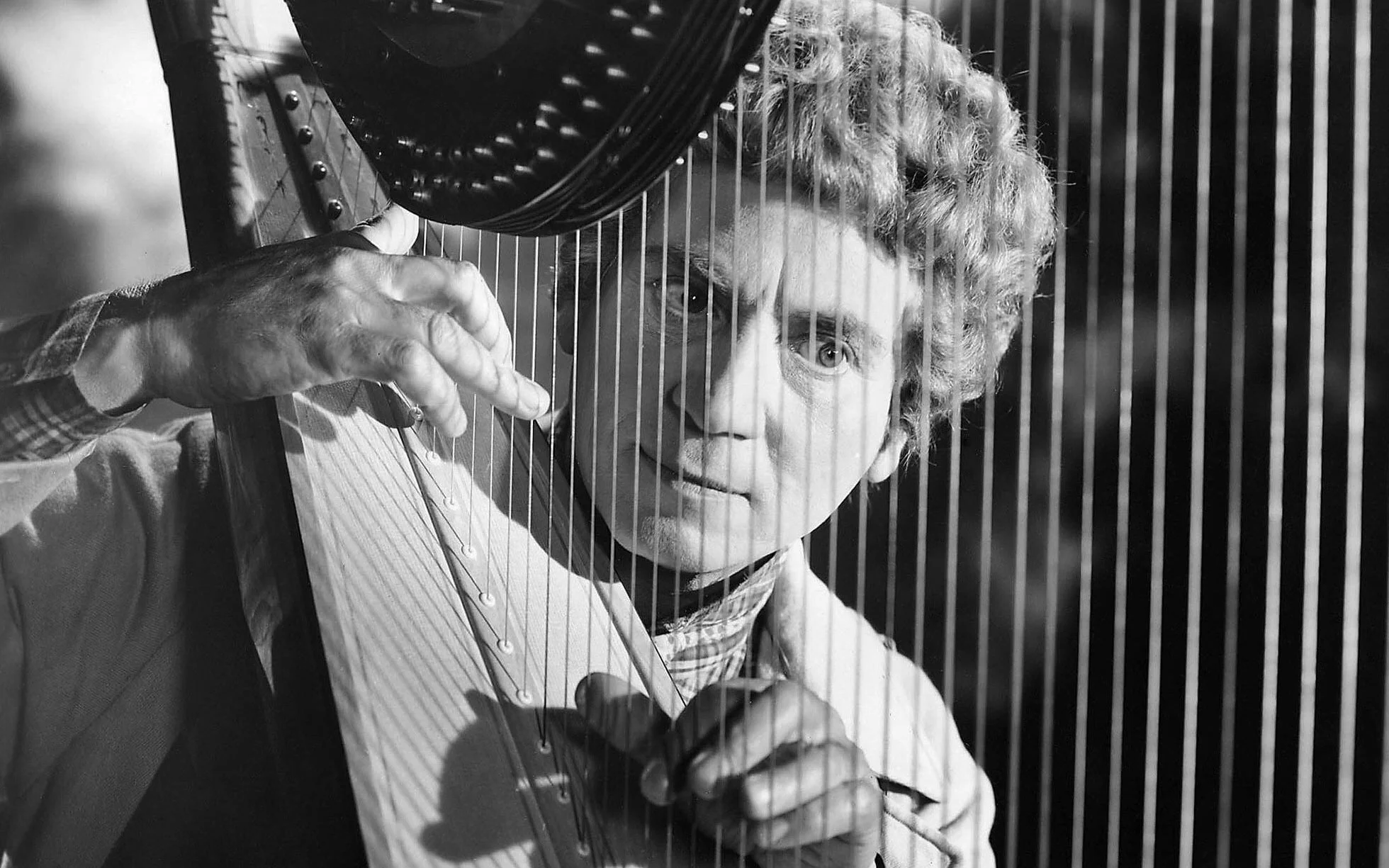
Harpo & his Harp
Harpo managed to embrace everything that happened to him, whether good or bad, and make the best of it, and the book bubbles with his good cheer, and his straightforward approach to life. It’s summed up in the first few pages of the book, where Harpo writes:
I can’t remember ever having a bad meal. I’ve eaten in the finest restaurants in Paris, but the absolutely most delicious food I ever ate was prepared by the most inspired chef I ever knew – my father. My father had to be inspired, because he had so little to work with.
I can’t remember ever having a poor nights sleep. I’ve slept in the mansions of the Vanderbilts and Otto H. Kahn and in the Gloverville jail. I’ve slept on pool tables, dressing-room tables, piano tops, bathhouse benches, in rag baskets and harp cases. I have known the supreme luxury of snoozing in the July sun, on the lawn, while the string of a flying kite tickled the bottom of my feet.
I can’t remember ever seeing a bad show. If I’m trapped in a theatre, and a show starts disappointingly, I have a handy way to avoid seeing it. I fall asleep.
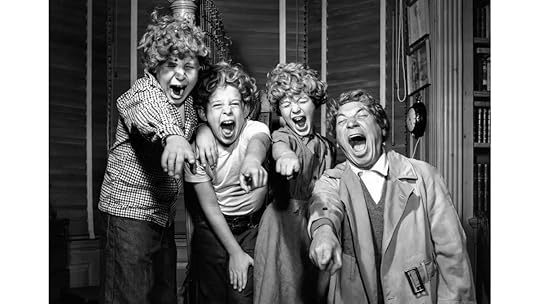
Harpo & his children
These words ~~ Harpo's words ~~ come from a person who knows how to enjoy life, and who knows to look back on his life and see only the good. Read this book, and see why the world can still learn from it’s fools.
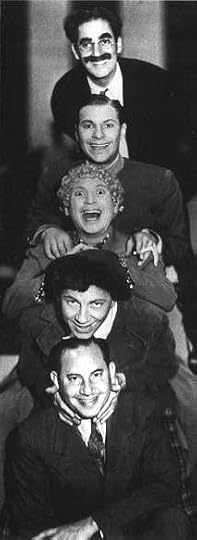
The Five Marx Brothers
Harpo Speaks ~~~ Harpo Marx
The Four Marx Brothers
Harpo Speaks is one of the funniest books I’ve ever read. Harpo tells some hilarious stories. To say I love this book would be an understatement.
Lucy & Harpo
Harpo’s humble beginnings were in New York, where he was thrown out of Public School 86 at the age of 8 ~~ literally ~~ through a first floor window ~~ never to return. Harpo and his brothers went on to even humbler efforts to break into show business in vaudeville, performing in a new town every night, every performance a struggle to earn enough money to make it to the next town ~~ and maybe even a little extra for food and a room to sleep in. Then on to Broadway success, Hollywood success and semi-retirement.
Harpo & his Harp
Harpo managed to embrace everything that happened to him, whether good or bad, and make the best of it, and the book bubbles with his good cheer, and his straightforward approach to life. It’s summed up in the first few pages of the book, where Harpo writes:
I can’t remember ever having a bad meal. I’ve eaten in the finest restaurants in Paris, but the absolutely most delicious food I ever ate was prepared by the most inspired chef I ever knew – my father. My father had to be inspired, because he had so little to work with.
I can’t remember ever having a poor nights sleep. I’ve slept in the mansions of the Vanderbilts and Otto H. Kahn and in the Gloverville jail. I’ve slept on pool tables, dressing-room tables, piano tops, bathhouse benches, in rag baskets and harp cases. I have known the supreme luxury of snoozing in the July sun, on the lawn, while the string of a flying kite tickled the bottom of my feet.
I can’t remember ever seeing a bad show. If I’m trapped in a theatre, and a show starts disappointingly, I have a handy way to avoid seeing it. I fall asleep.
Harpo & his children
These words ~~ Harpo's words ~~ come from a person who knows how to enjoy life, and who knows to look back on his life and see only the good. Read this book, and see why the world can still learn from it’s fools.
The Five Marx Brothers

March 3, 2013
This book is a cure for death. You simply wouldn't die until you found out what happened to Harpo after the Irish kids kept throwing him out of his grade school window.
This book is NOT about Harpo the movie star. It's about Harpo the human being, and it has depths that no amount of superficial glitz could ever reach. The humor is way beyond the movies. Even his movie alter ego would be cracking up.
The story starts with poverty, and lots of it to spread around. This is a type of poverty everyone's heard about but nobody knows anything about, described at family level.
This is the time of the famous joke:
"It's the garbage man!"
"Tell him we don't want any."
The Marx family, presided over by the astonishing Minnie Marx, fought its way through the soul scratching and cursing abyss of vaudeville tours, strange stage acts, and the early adolescence of the Marx Brothers. Minnie takes the kids from the absolute bottom of the heap to the top. Harpo, the grade school dropout, takes readers through an unsuspected world of a humanity few if any fiction writers could ever produce.
Harpo's journey through failure, poverty, success, the Depression and a trip through Nazi Germany to visit Russia is described with a sort of self-deprecation but a lot of chutzpah. You can see the New York street kid in Harpo clearly throughout the entire book.
Harpo Speaks is a book written by a guy who claims to be illiterate. He's also a friend of the mountainous and murderously expressive Alexander Woollcott. the maze of jagged edges otherwise known as Oscar Levant, and the cream of New York's top talents. These were Harpo's friends, and he writes about them as a friend.
He's a damn good writer, in terms of content choice. If only "literati" had that sort of instinct for good stories. He fits anecdotes and stories together in a very good mix. I gather the family historian, the very literate Groucho, had a hand in it, providing both information and probably advice, but Harpo's voice is always consistent. It's his book, his story, and fortunately for readers, his sense of humor. He's not as acidic as Groucho, but he knows how to twist a line, and he's about as funny in his own way.
When the book was written, there were a lot of big names in it, and I have a feeling that those names are still laughing. George Burns, F.P. Adams, creator of The New Yorker, and many others show up- As people, not celebrities. If you're looking for old gossip, there isn't any. If you're looking for a view from a guy who was there, this is it.
The sheer humanity in this book is also worth a mention. Harpo is a nice guy, and he gives a view of people many modern readers may never have seen before. He's never malicious, never self-serving and never apologetic about himself. He says at one point he didn't feel sorry for himself because he didn't know how.
Biographies are often better than histories. They include a lot of historical details people don't know about because historians never mention them. Harpo Speaks is a history in some ways, charting an America which never made it to the big screen. Read, enjoy, and learn.
This book is NOT about Harpo the movie star. It's about Harpo the human being, and it has depths that no amount of superficial glitz could ever reach. The humor is way beyond the movies. Even his movie alter ego would be cracking up.
The story starts with poverty, and lots of it to spread around. This is a type of poverty everyone's heard about but nobody knows anything about, described at family level.
This is the time of the famous joke:
"It's the garbage man!"
"Tell him we don't want any."
The Marx family, presided over by the astonishing Minnie Marx, fought its way through the soul scratching and cursing abyss of vaudeville tours, strange stage acts, and the early adolescence of the Marx Brothers. Minnie takes the kids from the absolute bottom of the heap to the top. Harpo, the grade school dropout, takes readers through an unsuspected world of a humanity few if any fiction writers could ever produce.
Harpo's journey through failure, poverty, success, the Depression and a trip through Nazi Germany to visit Russia is described with a sort of self-deprecation but a lot of chutzpah. You can see the New York street kid in Harpo clearly throughout the entire book.
Harpo Speaks is a book written by a guy who claims to be illiterate. He's also a friend of the mountainous and murderously expressive Alexander Woollcott. the maze of jagged edges otherwise known as Oscar Levant, and the cream of New York's top talents. These were Harpo's friends, and he writes about them as a friend.
He's a damn good writer, in terms of content choice. If only "literati" had that sort of instinct for good stories. He fits anecdotes and stories together in a very good mix. I gather the family historian, the very literate Groucho, had a hand in it, providing both information and probably advice, but Harpo's voice is always consistent. It's his book, his story, and fortunately for readers, his sense of humor. He's not as acidic as Groucho, but he knows how to twist a line, and he's about as funny in his own way.
When the book was written, there were a lot of big names in it, and I have a feeling that those names are still laughing. George Burns, F.P. Adams, creator of The New Yorker, and many others show up- As people, not celebrities. If you're looking for old gossip, there isn't any. If you're looking for a view from a guy who was there, this is it.
The sheer humanity in this book is also worth a mention. Harpo is a nice guy, and he gives a view of people many modern readers may never have seen before. He's never malicious, never self-serving and never apologetic about himself. He says at one point he didn't feel sorry for himself because he didn't know how.
Biographies are often better than histories. They include a lot of historical details people don't know about because historians never mention them. Harpo Speaks is a history in some ways, charting an America which never made it to the big screen. Read, enjoy, and learn.

January 22, 2012
This is my desert island book. I often pull it out when I'm feeling blue. In fact, I think I loaned out my current copy to a friend. Time to buy another copy, my third. This time I'll get one for me and one for loaning.
The stories in this book are often difficult, as his tour to Russia in WWII speaks volumes, but they are also uplifting, as in the household rules his family made for each other. All his kids were adopted, and their favorite bedtime story was about how their parents, Harpo and Susan, found each child as their family grew.
Most beautiful were the friendships he made, and the incredible people he was around. He repeats that he was amazed to be with such people, and suspected that it was because in a group of egotistical artists, he was the listener. I suspect he lent much to the genius of every circle he joined.
I would give anything to belong to an Algonquin Round Table such as theirs, and spend my time playing croquet on NY rooftops, or "Murder" on Neshobe Island. Anyone who values language would have loved these people, some of whom would have commited suicide to see the "texting vernacular" some are using now in everyday language.
No, I won't make this a rant. You just have to read it. Go forth, and giggle.
The stories in this book are often difficult, as his tour to Russia in WWII speaks volumes, but they are also uplifting, as in the household rules his family made for each other. All his kids were adopted, and their favorite bedtime story was about how their parents, Harpo and Susan, found each child as their family grew.
Most beautiful were the friendships he made, and the incredible people he was around. He repeats that he was amazed to be with such people, and suspected that it was because in a group of egotistical artists, he was the listener. I suspect he lent much to the genius of every circle he joined.
I would give anything to belong to an Algonquin Round Table such as theirs, and spend my time playing croquet on NY rooftops, or "Murder" on Neshobe Island. Anyone who values language would have loved these people, some of whom would have commited suicide to see the "texting vernacular" some are using now in everyday language.
No, I won't make this a rant. You just have to read it. Go forth, and giggle.
March 21, 2008
Harpo Marx, (born Adolf, but early in the 20th century changed to Arthur) who never spoke onstage or onscreen, proves to be surprisingly eloquent in his writing. Although, perhaps it's not that surprising, given the crowd he became associated with as an adult. A member of the reputed Algonquin Roundtable, he spent many nights listening to the literary giants of the age unwind and just be themselves. Hanging out with people like Alexander Woolcott and George S. Kaufman, it makes sense that he'd pick up a few tricks of the trade here and there. Despite being an uneducated kid from New York, Harpo was obviously a very deep, insightful, and observant individual. He may not have been as street smart as his brother Chico, but Harpo seemed to be a great judge of character, and like Will Rogers, never met a person he didn't like. It made him an easy mark for conmen early in his life, but overall it made him a very happy person. In fact, the only person who Harpo seemed to have anything less than the deepest admiration and respect for was a certain man who happened to share his real first name, a charismatically sinister Austrian who went by the last name of Hitler. Harpo went through Germany in the early days of Hitler's reign, and saw firsthand what it meant to be a person of Jewish descent in Hitler's Germany, and this made him both sad and angry.
Overall, though, Harpo seems like the kind of guy I would enjoy hanging out with. He and I are kindred spirits, both of us quiet loners who would be perfectly happy just wandering around whatever city we were in not knowing or particularly caring where we'd end up, just knowing that wherever it ended up being would invariably be someplace where something interesting would happen. I do sort of wish he'd talked a little about the making of his movies, a subject about which he pretty much only gives the vaguest glances at throughout the book, but when you lived a life like Harpo did, making movies was probably about the *least* interesting thing you did.
Overall, though, Harpo seems like the kind of guy I would enjoy hanging out with. He and I are kindred spirits, both of us quiet loners who would be perfectly happy just wandering around whatever city we were in not knowing or particularly caring where we'd end up, just knowing that wherever it ended up being would invariably be someplace where something interesting would happen. I do sort of wish he'd talked a little about the making of his movies, a subject about which he pretty much only gives the vaguest glances at throughout the book, but when you lived a life like Harpo did, making movies was probably about the *least* interesting thing you did.

January 4, 2008
Groucho was my favorite Marx brother when I was a kid, but as I got older I discovered what a sweetheart Harpo was and what a prick Groucho could be. This is still one of my favorite film biographies, and my hardcover edition is a prized possession. When you're done with the book, find a recording of Jonathan Richman singing "When Harpo Played his Harp" (equally affecting in English or Spanish).

May 12, 2025
I have meant to read this since hearing it being lauded on the Backlisted Podcast a few years back. I'm glad to have finally got to it. I love the Marx Brothers and am interested in that era of Hollywood.
Harpo Speaks! was first published in 1961 and co-written with Rowland Barber. It describes a personal account of a life lived with gusto. From the impoverished streets of New York City's Upper East Side to the glitz of Hollywood. Its a heartfelt, personal, funny, and often poignant journey through a remarkable era and an even more remarkable life.
This memoir paints a vivid portrait of early 20th century America. We travel with Harpo through bustling cities, witness the changing landscape of entertainment, and encounter a dazzling array of personalities, from the literary wits of the Algonquin Round Table (where Harpo was a beloved, if often mischievous, regular) to the power players of Hollywood's Golden Age. His accounts of friendships with figures like Alexander Woollcott and George Bernard Shaw are as interesting as his tales of brotherly camaraderie and rivalry.
There's virtually nothing on the making of the Marx Brothers films or what could be termed their glory days. Indeed after the sections on his childhood, and the evolution of the Marx Brothers vaudevillian act, it pretty much ignores those aspects of Harpo's life and, instead, focusses on friends, his own wife and family, his passions, and his travels.
Highly recommended for fans of the Marx Brothers, classic Hollywood, or anyone simply looking for an entertaining autobiography.
4/5
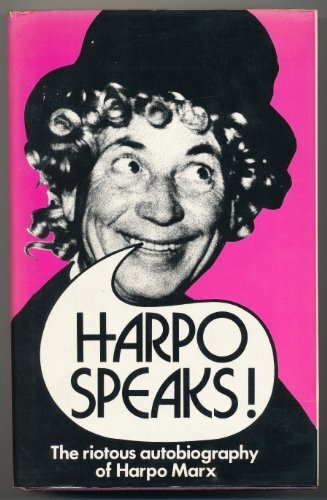
Harpo Speaks! was first published in 1961 and co-written with Rowland Barber. It describes a personal account of a life lived with gusto. From the impoverished streets of New York City's Upper East Side to the glitz of Hollywood. Its a heartfelt, personal, funny, and often poignant journey through a remarkable era and an even more remarkable life.
This memoir paints a vivid portrait of early 20th century America. We travel with Harpo through bustling cities, witness the changing landscape of entertainment, and encounter a dazzling array of personalities, from the literary wits of the Algonquin Round Table (where Harpo was a beloved, if often mischievous, regular) to the power players of Hollywood's Golden Age. His accounts of friendships with figures like Alexander Woollcott and George Bernard Shaw are as interesting as his tales of brotherly camaraderie and rivalry.
There's virtually nothing on the making of the Marx Brothers films or what could be termed their glory days. Indeed after the sections on his childhood, and the evolution of the Marx Brothers vaudevillian act, it pretty much ignores those aspects of Harpo's life and, instead, focusses on friends, his own wife and family, his passions, and his travels.
Highly recommended for fans of the Marx Brothers, classic Hollywood, or anyone simply looking for an entertaining autobiography.
4/5

March 13, 2026
Too well written and punctuated to be all his own work, I suspect the coauthor did much of the heavy lifting.
It is extremely readable and fascinating, the details of his early life, especially the early days in NYC and on the road (hmm, why did the Brothers never make a movie called On The Road? Hope and Crosby beat them to it?) alone are worth the price of admission.
The narrative drags a little (for me) when we get endless tales of "Hoppos" friendship with Aleck Wolcott, the drama critic and columnist for a major metropolitan newspaper.
Wolcott is just not that interesting (again, to me.)
Yes, he was a big deal in the 30s, but he is essentially forgotten now. In fact, he comes across as pompous, self obsessed, and hypercritical. In other words, a drama critic and columnist for a major metropolitan newspaper.
I also suspect many of the stories are exaggerated to make for a better reading experience. There are endless card games, lawn games, parties, and personal interactions that make his life seem like one long idyll, work seems to be just a vague occurrence while chasing after friends, women and living quarters. He moved around a lot.
Harpo does come across as an entirely likeable fellow though.
For someone with a second grade education (barely) he acquitted himself quite well in the company of pretentious literary types, and millionaire industrialists.
There is a curious lack of interaction with the people who you would expect to be all over this book, The Marx Brothers.
With the exception of plays and movies, he seems to spend very little time with the other 4 or 5. The last chapters are wrap ups; who died, who's left, and how wonderful life is with his amazing adopted children. No mention of why adoption and not his own. There is a fair amount apparently being held back.
There must be a back log of stories, enough to fill another 400 page book.
This is a great Companion piece to Groucho's "Groucho and Me."
Deducting one star for the aforementioned lack of information.
It is extremely readable and fascinating, the details of his early life, especially the early days in NYC and on the road (hmm, why did the Brothers never make a movie called On The Road? Hope and Crosby beat them to it?) alone are worth the price of admission.
The narrative drags a little (for me) when we get endless tales of "Hoppos" friendship with Aleck Wolcott, the drama critic and columnist for a major metropolitan newspaper.
Wolcott is just not that interesting (again, to me.)
Yes, he was a big deal in the 30s, but he is essentially forgotten now. In fact, he comes across as pompous, self obsessed, and hypercritical. In other words, a drama critic and columnist for a major metropolitan newspaper.
I also suspect many of the stories are exaggerated to make for a better reading experience. There are endless card games, lawn games, parties, and personal interactions that make his life seem like one long idyll, work seems to be just a vague occurrence while chasing after friends, women and living quarters. He moved around a lot.
Harpo does come across as an entirely likeable fellow though.
For someone with a second grade education (barely) he acquitted himself quite well in the company of pretentious literary types, and millionaire industrialists.
There is a curious lack of interaction with the people who you would expect to be all over this book, The Marx Brothers.
With the exception of plays and movies, he seems to spend very little time with the other 4 or 5. The last chapters are wrap ups; who died, who's left, and how wonderful life is with his amazing adopted children. No mention of why adoption and not his own. There is a fair amount apparently being held back.
There must be a back log of stories, enough to fill another 400 page book.
This is a great Companion piece to Groucho's "Groucho and Me."
Deducting one star for the aforementioned lack of information.

July 23, 2008
This is the best autobiography I've ever read.
Harpo Marx is a man famous for not speaking, who describes himself as a professional listener, and yet he somehow became far more eloquent and cutting than his brother Groucho, a man reputed as the mouth and wit not only of the family, but possibly of the century.
Harpo Speaks covers the whole of Harpo's life, from his childhood in New York city, where he played piano in a whorehouse, to his beginnings in vaudeville and subsequent friendships with some of the most important and influential minds of the times, to his Hollywood hobnobbing, and even the time he smuggled confidential papers out of the USSR, as the first official American performer ever allowed in.
And though The Marx Brothers are today most remembered for their films, they are barely mentioned in the book, reduced to several anecdotes so that the extraordinary life of a truly extraordinary person can be told free of the stories you already know.
I don't think I can recommend this book enough.
Harpo Marx is a man famous for not speaking, who describes himself as a professional listener, and yet he somehow became far more eloquent and cutting than his brother Groucho, a man reputed as the mouth and wit not only of the family, but possibly of the century.
Harpo Speaks covers the whole of Harpo's life, from his childhood in New York city, where he played piano in a whorehouse, to his beginnings in vaudeville and subsequent friendships with some of the most important and influential minds of the times, to his Hollywood hobnobbing, and even the time he smuggled confidential papers out of the USSR, as the first official American performer ever allowed in.
And though The Marx Brothers are today most remembered for their films, they are barely mentioned in the book, reduced to several anecdotes so that the extraordinary life of a truly extraordinary person can be told free of the stories you already know.
I don't think I can recommend this book enough.

Read
May 5, 2009I read this first when I was eighteen, and could get to L.A. Public, downtown. Then I reread it during my Hollywood years, before the Hollywood library burned down.
It's very g-rated--unlike the Marx brothers' lives--but somehow that rings true for Harpo. He seems to have been a genuinely good person, even escaping some of the darker shenanigans at Wits End, perpetrated by Woolcott, when he was the Emperor of the Algonquin Round Table. I suspect Woolcott had a crush on him.
Anyway, the part that harrowed me as a young reader was not the rough and ready life on vaudeville, but when Harpo went to Germany, and was aghast to see people staring at him through windows, yellow stars pinned to their clothes.
This was in the thirties.
It's very g-rated--unlike the Marx brothers' lives--but somehow that rings true for Harpo. He seems to have been a genuinely good person, even escaping some of the darker shenanigans at Wits End, perpetrated by Woolcott, when he was the Emperor of the Algonquin Round Table. I suspect Woolcott had a crush on him.
Anyway, the part that harrowed me as a young reader was not the rough and ready life on vaudeville, but when Harpo went to Germany, and was aghast to see people staring at him through windows, yellow stars pinned to their clothes.
This was in the thirties.

February 9, 2012
I read a lot of biography and autobiography. I love it dearly--two of my favorite genres. I can honestly say of all the film bios and autbios I have read , this is the best. My most favorite. I love Harpo Marx--my dear friend Lee hipped me to the Marx Bros. many years ago and I of course loved Groucho's wit and Chico and Harpo's antics but when I saw Harpo play the harp, it was a whole new thing. I just fell in love. I started to notice all the musical parts in their films and just watched and was blown away. This book has assistance but the voice is essentially Harpo(ironic?). He tells the story of his life from extreme poverty to wealth and acclaim and the story of his incredibly happy marriage and home life. I told my partner while I was reading that I kept expecting him to write something that would make me less enthralled with him but I will tell you--I never did.
The story is by turns tragic and funny, uplifting and funny. No matter the situation, Harpo finds the humor. It's honest and informative and the humor is the backbone. You get glimpses of the other Marx Bros, mostly Chico and Groucho but you are really impressed by the talent inherent in the entire family. The absolute most entertaining and happy making autobiography I have ever read. Highly recommend.
The story is by turns tragic and funny, uplifting and funny. No matter the situation, Harpo finds the humor. It's honest and informative and the humor is the backbone. You get glimpses of the other Marx Bros, mostly Chico and Groucho but you are really impressed by the talent inherent in the entire family. The absolute most entertaining and happy making autobiography I have ever read. Highly recommend.

March 22, 2012
The title is just as clever as the man himself. Harpo, the silent clown of the Marx Brothers movies, finally gets to tell his own story after years of witnessing the antics of some of the most famous people of his time. Adolph "Harpo" Marx grew up in the poor Jewish slums of New York, quit school in 2nd grade, and proceeded to become one of the most famous and lovable faces of the movies. He led a colorful life influenced by his four famous brothers and the people he associated himself with. His childhood is perhaps the most interesting segment, filled with hilarious anecdotes that spring to life thanks to excellent storytelling. A chunk of Harpo's adult years were spent with Alexander Wollcott, an interesting and lovingly portrayed writer with a penchant for the odd. The years spent with him during the 1920s were wild, but Harpo managed to extend the fun through the rest of his life.
Very little of this book is spent scrutinizing the films the Marx Brothers made. In fact, only a few are even mentioned at all. Harpo took more pride in the people he knew and his other accomplishments. His movies were a small part of his existence.
Coming away from this book, one feels incredibly close with the author. Harpo manages to vividly portray his life and in doing so, paint an intimate portrait of himself as well. He was a lovable man with a great attitude toward life. This book is a treasure, and a great memory of a great man.
Very little of this book is spent scrutinizing the films the Marx Brothers made. In fact, only a few are even mentioned at all. Harpo took more pride in the people he knew and his other accomplishments. His movies were a small part of his existence.
Coming away from this book, one feels incredibly close with the author. Harpo manages to vividly portray his life and in doing so, paint an intimate portrait of himself as well. He was a lovable man with a great attitude toward life. This book is a treasure, and a great memory of a great man.

January 11, 2016
What to say? I think, for a man who never spoke on stage or in the movies during his career, sure has a lot to say in his autobiography. This probably will be, the best book I well read this year or maybe in many years to come. It sure beats any book I have read in a long time. This story, being if its real or not, (since this is coming from a Marx brother,) it sure is an amazing story. It grips you in from the very beginning with, an 8 year old boy being thrown out of his second grade classroom window every day until, he just decides to give up on school. Through his childhood in New York, during the 1890's and 1900's, doing all kinds of crazy jobs so he could have money for his family to eat. Until, his mother grabs him one day out of one of these crazy jobs, and puts him on the stage with his two brothers. And then continues on with more crazy and at times, hilarious stories about vaudeville, Broadway and The Algonquin Round Table in the 1920's.
This is just part of the story. There still are a lot more that happens later in Harpo's life, that is just as amazing and at times, hard to believe. But, even if the stories here are real or not or maybe, a mix of real and fiction. This was still one of the best books I have read for a very long time.
This is just part of the story. There still are a lot more that happens later in Harpo's life, that is just as amazing and at times, hard to believe. But, even if the stories here are real or not or maybe, a mix of real and fiction. This was still one of the best books I have read for a very long time.

February 5, 2018
I read this one back in my high school years. Was fascinated by Harpo's account of growing up in New York City, his years with his mother & brothers in vaudeville and the movies, and his hanging out in the Algonquin Club, hanging out with the likes of Alexander Woollcott, Robert Benchley, Heywood Broun and other New York literary types.

February 12, 2023
Leer una autobiografía porque te encanta un personaje y descubrir a una gran persona.
Además, hacer este gran descubrimiento al ritmo sátiro de los Marx ha sido increíble.
Muy recomendable.
📖❤️
Además, hacer este gran descubrimiento al ritmo sátiro de los Marx ha sido increíble.
Muy recomendable.
📖❤️

September 4, 2014
Harpo was always my favourite Marx Brother. With his silence, his crazy antics, his naughty-little-boy grin and angry pout--and that glorious harp music. When he sat down to the harp his entire aspect changed. As he says in the book, the clown was "him", that other guy...the harpist was "me", Adolph Arthur Marx.
I learned a lot of surprising things about the Marx Brothers that I thought I already knew about. Apparently a lot of different versions of the same events have been told and written and taken as absolute truth. No, apparently they didn't get "discovered" and famous in New York, they had to hardslog their way on the old vaudeville circuit, and even leave NY for Chicago to get away from the competition. Harpo himself never finished second grade, in spite of being "left back" once. I wondered if perhaps today he would be found to have dislexia or ADD or something, since he talks about "dreaming his way" through what little schooling he had. Or maybe, like me, he had no disabilities, he was just easily bored by anything that was difficult to learn. Nor did I know that he had been the "silent member" of the famous Algonquin Round Table clique of litterati. I had known he had 4 kids, but not that they were all adopted. True to personal writings of Harpo's time, no reasons for not having "own children" are discussed.
The book is not strictly in chronological order, and there's no dirt-dishing, blame-gaming or "poor me". The Marx Brothers were indeed poor boys who made good, but Harpo was too busy enjoying the ride to posture and pose. Nor does he beg for the reader's affection; he doesn't have to. He draws you into his world, makes you see it as he did. Yes, he had some ghost-writing help producing the book, and that "other voice" is heard in some of the long descriptive passages, but Harpo then comes back. A case in point is when he describes a visit to Somerset Maugham's villa at Antibes: you can hear the ghost writer in the long descriptive passages of the "lovely gardens bla bla bla fed by fountains bla bla..." Next line: "Maugham insisted on showing us the whole joint." Pure Harpo!
This book made compulsive reading. It reminded me of my childhood, when my father's old friends would turn up and they would sit around and drink weak coffee and swap anecdotes of the past. They would range back and forth over time, one story from school days would remind them of something that happened to the same person thirty years later--and the kids would sit quiet as mice, taking it all in, not making a sound so we wouldn't be remembered and sent out to play!
I learned a lot of surprising things about the Marx Brothers that I thought I already knew about. Apparently a lot of different versions of the same events have been told and written and taken as absolute truth. No, apparently they didn't get "discovered" and famous in New York, they had to hardslog their way on the old vaudeville circuit, and even leave NY for Chicago to get away from the competition. Harpo himself never finished second grade, in spite of being "left back" once. I wondered if perhaps today he would be found to have dislexia or ADD or something, since he talks about "dreaming his way" through what little schooling he had. Or maybe, like me, he had no disabilities, he was just easily bored by anything that was difficult to learn. Nor did I know that he had been the "silent member" of the famous Algonquin Round Table clique of litterati. I had known he had 4 kids, but not that they were all adopted. True to personal writings of Harpo's time, no reasons for not having "own children" are discussed.
The book is not strictly in chronological order, and there's no dirt-dishing, blame-gaming or "poor me". The Marx Brothers were indeed poor boys who made good, but Harpo was too busy enjoying the ride to posture and pose. Nor does he beg for the reader's affection; he doesn't have to. He draws you into his world, makes you see it as he did. Yes, he had some ghost-writing help producing the book, and that "other voice" is heard in some of the long descriptive passages, but Harpo then comes back. A case in point is when he describes a visit to Somerset Maugham's villa at Antibes: you can hear the ghost writer in the long descriptive passages of the "lovely gardens bla bla bla fed by fountains bla bla..." Next line: "Maugham insisted on showing us the whole joint." Pure Harpo!
This book made compulsive reading. It reminded me of my childhood, when my father's old friends would turn up and they would sit around and drink weak coffee and swap anecdotes of the past. They would range back and forth over time, one story from school days would remind them of something that happened to the same person thirty years later--and the kids would sit quiet as mice, taking it all in, not making a sound so we wouldn't be remembered and sent out to play!

September 9, 2021
I’m a big Marx Brothers fan so I’ve had this on my reading list for some time. I borrowed an old copy from the excellent biography collection at Kensington library. While it helps to be a fan to fully enjoy this book, it has a lot to offer non-Marx Brothers fans. It gives a very vivid picture of growing up in poverty in New York and is stacked full of colourful characters from Harpo’s own parents and brothers to the writers and intellectuals who formed the Algonquin round table in the 1920s and 30s and allowed the almost totally uneducated Harpo to become a member. (Uneducated because he gave up school very early after being constantly thrown out of the classroom window by two large Irish boys).
It’s also a very funny account of what it was like touring in vaudeville alongside such acts as The Musical Cow Milkers, a husband and wife team who sang duets while milking a cow on stage. In fact, Harpo gives a lot of space to the Brothers’ stage shows and very little to the films for which they are now famous.
It’s also a very funny account of what it was like touring in vaudeville alongside such acts as The Musical Cow Milkers, a husband and wife team who sang duets while milking a cow on stage. In fact, Harpo gives a lot of space to the Brothers’ stage shows and very little to the films for which they are now famous.

September 24, 2020
In my (admittedly simple) mind, autobiographies tend to end up in one of three buckets:
1) those that are relatively quickly forgotten (i.e., most of the ones I've read),
2) the few that cause me to lose some (or all) respect for the author as a person, and
3) the very, very few that somehow touch me and actually make me feel like I got to know someone.
I can always tell when I've encountered one from the third bucket, because when I've finished, I find that I actually kind of miss that person.
IMO, Harpo Speaks! is the third kind of autobiography. It is funny, sad, interesting, crazy and, in the end, all about friends and family. I loved it. And I know he used a co-writer who was likely largely responsible for the read-ability of the work, but it still felt genuine. And, now that I'm finished reading it, I find that I kinda miss him.
1) those that are relatively quickly forgotten (i.e., most of the ones I've read),
2) the few that cause me to lose some (or all) respect for the author as a person, and
3) the very, very few that somehow touch me and actually make me feel like I got to know someone.
I can always tell when I've encountered one from the third bucket, because when I've finished, I find that I actually kind of miss that person.
IMO, Harpo Speaks! is the third kind of autobiography. It is funny, sad, interesting, crazy and, in the end, all about friends and family. I loved it. And I know he used a co-writer who was likely largely responsible for the read-ability of the work, but it still felt genuine. And, now that I'm finished reading it, I find that I kinda miss him.

June 1, 2015
An utter delight. One of the most charming, enjoyable autobiographies I've ever read, made more so by being about pretty much everything *except* for the Marx Brothers' film career. Filled with self-deprecating humour, and running the gamut from early grinding poverty through the long, hard years on the vaudeville circuit, to the freedom of movement and education afforded him by success, Harpo gives us a wonderfully human insight into the life outside of fame, and his personal journey from a place of constant deprivation to a sense of peace and happiness.
Engaging, personable, and charming. Just wonderful.
Engaging, personable, and charming. Just wonderful.

January 23, 2019
This is a remarkable book. It is the memoir of a second grade drop out, who eventually rubbed shoulders with the great literary figures of his day. It is also the memoir of one of the most famous movie stars of the first few decades of talkies. But he barely mentions his movies.
I am a life-long fan of the Marx Brothers. I can't really say why I didn't get around to reading this one sooner but I'm glad that I did. Unlike a lot of celebrity memoirs, Harpo does not skip the details of his youth. He writes at length about an impoversished existence on the Upper East Side of Manhattan at the close of the 19th century. He was the middle child of five boys, but spent his days in an odd solitude roaming the streets in hopes of finding adventur and maybe hustling somethin of value.
The best part of the book is when he writes about the Marx Brothers years as traveling vaudevillians. He writes about how their act came together, in fits and starts, and the various flop houses that they brothers stayed in between 1910 and their first Broadway show in 1924.
Then he becomes famous. But not, strictly speaking, a celebrity. No one recognized him out of costume and no one knew what he sounded like. But he fell in with the Algonquin Round Table and was more than content to be their listening partner. He writes with real affection for that crowd, and with reverence even for litary figures who have been mostly forgotten 90 years later.
The transition to movies and the move to Hollywood are given cursory coverage. He does not dissect Duck Soup or tell the tale of how Irving Thalberg got them over to MGM to make A Night at the Opera and a day at the Races before dying young and leaving them without a champion in the studio. He spends more time talking about his USO tours and night club engagements with his brother Chico.
He writes about the brothers in more or less inverse proportion to their celebrity. Gummo was his agent and very dear friend. He writes about Zeppo's business acumen with big brotherly pride. Chico is mostly seen as a scamp who stole from him as a kid and as an adult. But there's almost no judgment there. Groucho is really only spoken of as a wit. There's almost no sense of their bein friends, although he does mention that some combination of the five brothers ate lunch almost every day in their later years.
Harpo loves to drop names. And some of the anecdotes are a little too good to be true. But they are funny and warm. The last few chapers deal with his happy marriage and the joy he and his wife took in raising four children, all of them adopted. The passage about how they raised their children to view the act of adoption as an adventure is truly poignant.
Harpo might have written a more serious memoir where he exposed the grit of his relationships with Groucho and Chico or where he divulged the process that caused him to make Love Happy, the last Marx Brothers movie most famous for being the first Marilyn Monrore movie. Harpo not only leaves that story out, he actually seems to forget he made it! (He refers to A Night in Casablanca as the last Marx Brothers movie.)
But these are the quips of a die-hard Marxist of the Groucho variety. Anyone who loves comedy or show business or Dorothy Parker and her crowd, will get a lot out of reading this one.
I am a life-long fan of the Marx Brothers. I can't really say why I didn't get around to reading this one sooner but I'm glad that I did. Unlike a lot of celebrity memoirs, Harpo does not skip the details of his youth. He writes at length about an impoversished existence on the Upper East Side of Manhattan at the close of the 19th century. He was the middle child of five boys, but spent his days in an odd solitude roaming the streets in hopes of finding adventur and maybe hustling somethin of value.
The best part of the book is when he writes about the Marx Brothers years as traveling vaudevillians. He writes about how their act came together, in fits and starts, and the various flop houses that they brothers stayed in between 1910 and their first Broadway show in 1924.
Then he becomes famous. But not, strictly speaking, a celebrity. No one recognized him out of costume and no one knew what he sounded like. But he fell in with the Algonquin Round Table and was more than content to be their listening partner. He writes with real affection for that crowd, and with reverence even for litary figures who have been mostly forgotten 90 years later.
The transition to movies and the move to Hollywood are given cursory coverage. He does not dissect Duck Soup or tell the tale of how Irving Thalberg got them over to MGM to make A Night at the Opera and a day at the Races before dying young and leaving them without a champion in the studio. He spends more time talking about his USO tours and night club engagements with his brother Chico.
He writes about the brothers in more or less inverse proportion to their celebrity. Gummo was his agent and very dear friend. He writes about Zeppo's business acumen with big brotherly pride. Chico is mostly seen as a scamp who stole from him as a kid and as an adult. But there's almost no judgment there. Groucho is really only spoken of as a wit. There's almost no sense of their bein friends, although he does mention that some combination of the five brothers ate lunch almost every day in their later years.
Harpo loves to drop names. And some of the anecdotes are a little too good to be true. But they are funny and warm. The last few chapers deal with his happy marriage and the joy he and his wife took in raising four children, all of them adopted. The passage about how they raised their children to view the act of adoption as an adventure is truly poignant.
Harpo might have written a more serious memoir where he exposed the grit of his relationships with Groucho and Chico or where he divulged the process that caused him to make Love Happy, the last Marx Brothers movie most famous for being the first Marilyn Monrore movie. Harpo not only leaves that story out, he actually seems to forget he made it! (He refers to A Night in Casablanca as the last Marx Brothers movie.)
But these are the quips of a die-hard Marxist of the Groucho variety. Anyone who loves comedy or show business or Dorothy Parker and her crowd, will get a lot out of reading this one.

April 12, 2023
This is an enjoyable memoir. I specially liked Harpo’s childhood in New York, his description of his family and neighbors, the odd jobs he did, the shop and bar owners… It reminded me a lot of Saroyan’s stories.
Then comes their years a a troupe on the road, with all its hardships, but specially how his pantomime role evolved, when the harp made its appearance, how they created some of his recurring gags…
I found much less interesting his stays with rich and famous people, either in New York, Monte Carlo or Beverly Hills, although he tells some nice anecdotes. In this section, the best is his trip, alone, to the Soviet Union, as the first American performer invited to visit.
Finally comes his marriage and adoption stories of their children, and how they grew up. This again was more interesting.
Then comes their years a a troupe on the road, with all its hardships, but specially how his pantomime role evolved, when the harp made its appearance, how they created some of his recurring gags…
I found much less interesting his stays with rich and famous people, either in New York, Monte Carlo or Beverly Hills, although he tells some nice anecdotes. In this section, the best is his trip, alone, to the Soviet Union, as the first American performer invited to visit.
Finally comes his marriage and adoption stories of their children, and how they grew up. This again was more interesting.

August 2, 2020
Harpo’s story is laugh-out-loud funny, touching, and page-turning. In addition to his unmatched comic contributions and beautiful musicianship, he also “played piano in a whorehouse,” taught gangsters how to play Pinchie Winchie, played ping pong with George Gershwin, gave advice to George Bernard Shaw, modeled for Salvador Dali, smuggled secret papers out of Russia, vacationed with Somerset Maugham on the Riviera, and was a member of both the Algonquin and Hillcrest clubs. He was a wonderful father, dedicated husband, and most importantly, a life lover. “The truth is, I had no business doing any of these things. I couldn’t read a note of music. I never finished the second grade. But I was having too much fun to recognize myself as an ignorant upstart.”
“If things get too much for you and you feel the whole world's against you, go stand on your head. If you can think of anything crazier to do, do it.”
“If things get too much for you and you feel the whole world's against you, go stand on your head. If you can think of anything crazier to do, do it.”
This entire review has been hidden because of spoilers.

March 21, 2023
Such an interesting life; sometimes I was so caught in the story that I kind of forgot that I was reading. Incredible anecdotes and experiences. Even though the time line gets a bit crazy sometimes, you don’t get the feeling that you are missing any part.
June 4, 2025
This was a very fun read! I wish I hadn’t been so on and off with it for so many months. I liked learning more about Harpo’s personal life and stories. It was also cool learning about other actors, musicians, and writers from that era.

October 11, 2022
I remember being at Horton’s bookstore in Emory Village in 1978 and seeing a copy of Harpo Speaks! on the shelf. I was a Marx Brothers fan even then and filed it under “to be read later.” Well, it only took forty-two years and I’ve now finally read Harpo Speaks!
If you are looking for a rundown of his opinion about the Marx Brothers movies, this isn’t the place to go. In fact he casually dismisses such classics as The Coconuts, Monkey Business, Duck Soup and Horse Feathers! Perhaps he had performed on stage with some of these routines so long, it was old hat to him by then.
What you will get is some fascinating stories about growing up poor with a big family in New York City, his mother Minnie forcing the brothers to get on stage and form an act, initial fame on the stage, his friendship with Alexander Woollcott and other Algonquins, his romance with his wife Susan and finally his relationship with his adopted children later in life.
There are lots of other stories of note in the book. I’m not sure I believe the story about his tonsils being removed by a midget standing on a crate, but there it is. He also recounts his time on a tour of the Soviet Union and performing for the troops during World War II. There’s also plenty in the book about his love for the harp.
I reiterate, if you’re looking for detailed movie critiques, look elsewhere. But what it is is a must for Marx fans and Harpo in particular, even if it takes you a few decades to get to it.
If you are looking for a rundown of his opinion about the Marx Brothers movies, this isn’t the place to go. In fact he casually dismisses such classics as The Coconuts, Monkey Business, Duck Soup and Horse Feathers! Perhaps he had performed on stage with some of these routines so long, it was old hat to him by then.
What you will get is some fascinating stories about growing up poor with a big family in New York City, his mother Minnie forcing the brothers to get on stage and form an act, initial fame on the stage, his friendship with Alexander Woollcott and other Algonquins, his romance with his wife Susan and finally his relationship with his adopted children later in life.
There are lots of other stories of note in the book. I’m not sure I believe the story about his tonsils being removed by a midget standing on a crate, but there it is. He also recounts his time on a tour of the Soviet Union and performing for the troops during World War II. There’s also plenty in the book about his love for the harp.
I reiterate, if you’re looking for detailed movie critiques, look elsewhere. But what it is is a must for Marx fans and Harpo in particular, even if it takes you a few decades to get to it.

August 23, 2011
I loved this book from page one. Even though its a rather thick novel, I am so sad to say goodbye to Harpo, but can't wait to read it again and again. There has been some discussion whether the genius of this book comes from the author or Harpo, or a combined effort. I suspect Harpo is due a little more credit than he is given. Since he was a comic entertainer, and (from what the book reveals) a sought after storyteller, I suspect a lot of the words a genuinely his. Especially since there is a lot of comedic elements within the stories.
However, I also recognize the craft of the book, the seamless flow of stories that Barber certainly had to have his hand in. It is really hard to tell where Harpo ends and Barber begins, which is the way it should be. Evidently, they were a perfect match for creating this wonderful novel.
I think what I loved most about this book was Harpo's unique perspectives and philosphies, closely followed by the managerie of interesting and complex "characters" he befriends. What I took away was that no matter where you are in your life, rich or destitute, depressed or elated, don't take yourself or life too seriously, and no matter what your doing, you can make it a lot of fun.
However, I also recognize the craft of the book, the seamless flow of stories that Barber certainly had to have his hand in. It is really hard to tell where Harpo ends and Barber begins, which is the way it should be. Evidently, they were a perfect match for creating this wonderful novel.
I think what I loved most about this book was Harpo's unique perspectives and philosphies, closely followed by the managerie of interesting and complex "characters" he befriends. What I took away was that no matter where you are in your life, rich or destitute, depressed or elated, don't take yourself or life too seriously, and no matter what your doing, you can make it a lot of fun.

July 28, 2009
What can you say about this book? Well, what can you say about Harpo Marx?
He was an uncommon comedian whose talent has yet to be matched. Finally getting a chance to speak, Harpo gives a lengthy but infinitely worthwhile account of his life. He is, in many ways, as endearingly childlike and mischievious in his writing as his on-screen persona, but in many ways he is also alarmingly eloquent.
He provides insight as well as laughs, real history (as he remembers it) as well as zany anecdotes worthy of a Marx Brother. Through his writing you really come to know the brothers (as well as anyone can, really) as a family bred to perform, who will do anything for a laugh, and who aren't afraid to do and say the things that ordinary people would never dream of doing or saying, but secretly wish they could.
Harpo has a sincerity to him that shines through his writing as I believe it did in his acting. it is that warmth that will draw you in and keep you until the very last horn honk. =)
He was an uncommon comedian whose talent has yet to be matched. Finally getting a chance to speak, Harpo gives a lengthy but infinitely worthwhile account of his life. He is, in many ways, as endearingly childlike and mischievious in his writing as his on-screen persona, but in many ways he is also alarmingly eloquent.
He provides insight as well as laughs, real history (as he remembers it) as well as zany anecdotes worthy of a Marx Brother. Through his writing you really come to know the brothers (as well as anyone can, really) as a family bred to perform, who will do anything for a laugh, and who aren't afraid to do and say the things that ordinary people would never dream of doing or saying, but secretly wish they could.
Harpo has a sincerity to him that shines through his writing as I believe it did in his acting. it is that warmth that will draw you in and keep you until the very last horn honk. =)

April 3, 2011
Outstanding! After all the many, many Marx Brothers books I have read, I really didn't think there was anything more to learn. How many times can I read about the formidable Minnie, the early vaudeville shows, the movies, Thalberg, etc.? But this book was full of great stories of the most beloved (by his family; they were devastated when he died) and gentle of the Brothers. I learned more about his friendship with Alexander Woollcott, critic and key member of the famous Algonquin Round Table. I think "Aleck" may have been sweet on Harpo, at least for a time, although Harpo blames Woollcott's lack of wife on a childhood bout with the mumps which left him sterile.
The rest of the the Marx Brothers only lightly figure in this, but they aren't missed at all. Honestly, this is a great book for fans.
The rest of the the Marx Brothers only lightly figure in this, but they aren't missed at all. Honestly, this is a great book for fans.

July 14, 2009
I don't get it. I do get the Marx Brothers, and I do get the humor, and I do (mostly) get Harpo, even though he's my third favorite (yes, Chico, you actually come in second), but why do so many people love this book ? Is it because they just want to hear Harpo 'say' something ? Because most of what he has to say here is pretty tedious, I'm sorry to say. I completely understand that everyone found him to be the most delightful and lovely man, but I longed for more on how he felt about his movies, or about his brothers or about the development of his style. Not more on hanging out with the biggest bunch of Hollywood blowhards of the 20's. Maybe it just needed a few horn honks.


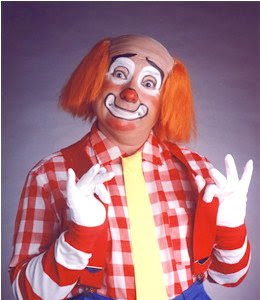
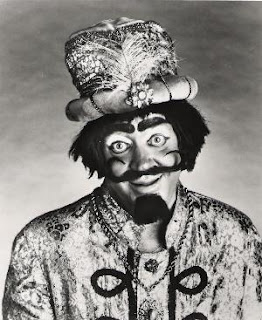
Read
October 23, 2023Maravilloso. Desde que lo cerré sé que quiero volver a leerlo. Le voy a echar en falta.
Recomendable 100 %.
No soy cinéfila y prácticamente no conocía nada de ellos salvo sus nombres, algunas frases de Groucho y alguna escena suelta de sus películas, pero me ha enamorado.
Que vida tan completa. Llena de amor, amigos, familia, celebración y disfrute de cada momento. Como a mí me gusta vivir ❤️.
Recomendable 100 %.
No soy cinéfila y prácticamente no conocía nada de ellos salvo sus nombres, algunas frases de Groucho y alguna escena suelta de sus películas, pero me ha enamorado.
Que vida tan completa. Llena de amor, amigos, familia, celebración y disfrute de cada momento. Como a mí me gusta vivir ❤️.
Displaying 1 - 30 of 418 reviews