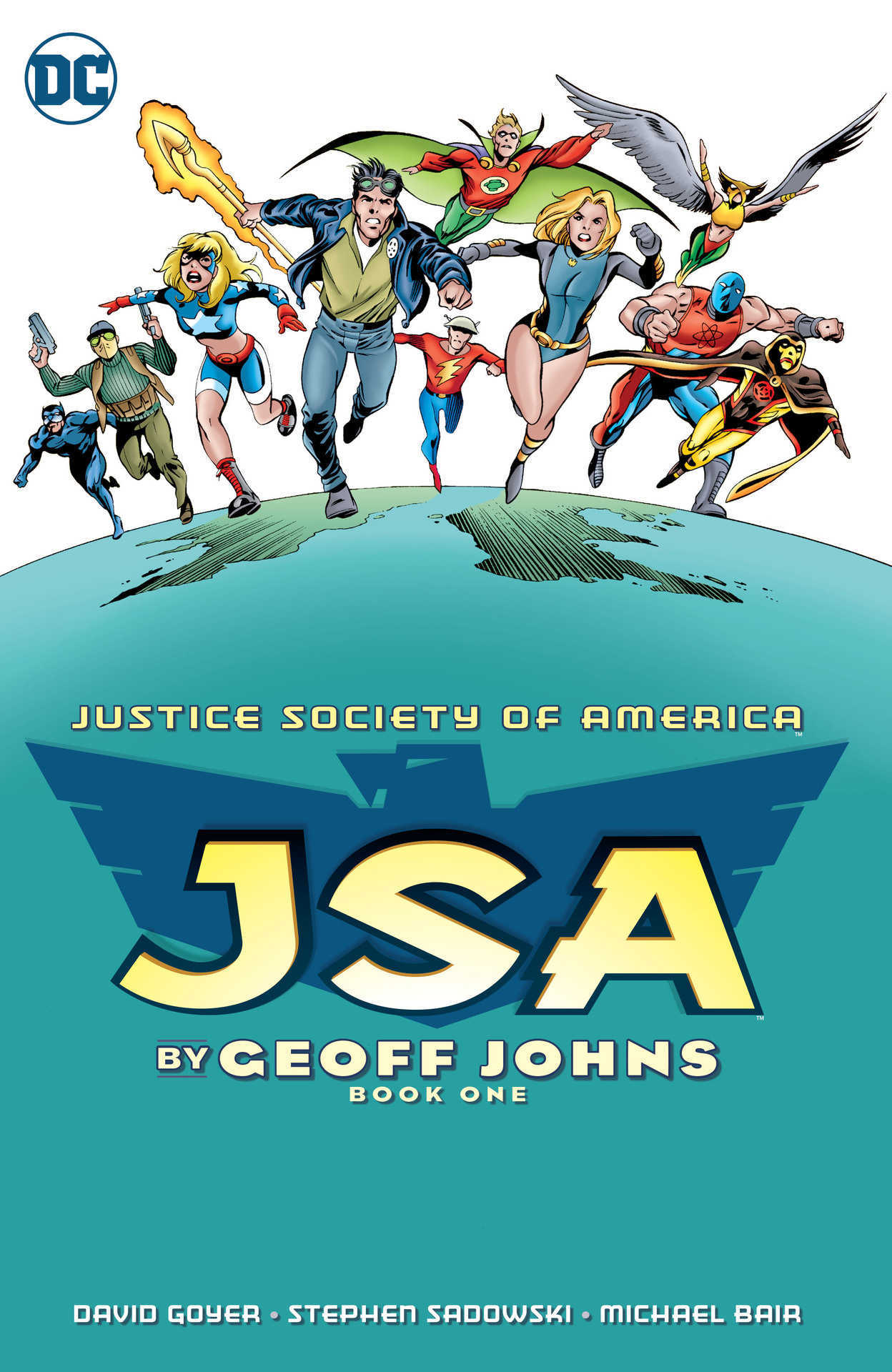
Three generations of crime-fighters join together for the greater good: Sentinel, Wildcat, the Flash, Black Canary, Starman, Sand, Hourman, Atom Smasher, the Star-Spangled Kid and Hawkgirl. The heroes of the present and legends of the past come together to form the Justice Society of America! They have been called upon to save one of their own from one of the darkest powers ever to walk this earth...
Celebrated comics writer Geoff Johns began his career here, as he mixed in younger, edgier characters with the elder statesmen of superheroes to create one of the standout DC Comics series in the 2000s. Johns is joined by acclaimed screenwriter David Goyer (The Dark Knight trilogy) and artists including Stephen Sadowski (Avengers/Invaders), Michael Bair (HAWKMAN) and others. JSA BY GEOFF JOHNS BOOK ONE collects JSA SECRET FILES #1 and JSA #1-15.
Geoff Johns originally hails from Detroit, Michigan. He attended Michigan State University, where he earned a degree in Media Arts and Film. He moved to Los Angeles in the late 1990s in search of work within the film industry. Through perseverance, Geoff ended up as the assistant to Richard Donner, working on Conspiracy Theory and Lethal Weapon 4. During that time, he also began his comics career writing Stars and S.T.R.I.P.E. and JSA (co-written with David S. Goyer) for DC Comics. He worked with Richard Donner for four years, leaving the company to pursue writing full-time.
His first comics assignments led to a critically acclaimed five-year run on the The Flash. Since then, he has quickly become one of the most popular and prolific comics writers today, working on such titles including a highly successful re-imagining of Green Lantern, Action Comics (co-written with Richard Donner), Teen Titans, Justice Society of America, Infinite Crisis and the experimental breakout hit series 52 for DC with Grant Morrison, Greg Rucka and Mark Waid. Geoff received the Wizard Fan Award for Breakout Talent of 2002 and Writer of the Year for 2005, 2006, 2007, and 2008 as well as the CBG Writer of the Year 2003 thru 2005, 2007 and CBG Best Comic Book Series for JSA 2001 thru 2005. Geoff also developed BLADE: THE SERIES with David S. Goyer, as well as penned the acclaimed “Legion” episode of SMALLVILLE. He also served as staff writer for the fourth season of ROBOT CHICKEN.
Geoff recently became a New York Times Bestselling author with the graphic novel Superman: Brainiac with art by Gary Frank.
I love the mix of original and second generation heroes, some from Infinity Inc. and various other legacy heroes like Starman and Stargirl. Johns and Goyer write some great serialized stories not only building off their own run but incorporating older JSA related stories like Zero Hour. They do a fantastic job paying homage to the JSA legacy and make this team feel like a family with the old timers mentoring the second generation. Stephen Sadowski's pencils are top notch and the colors are vibrant. Looking forward to cracking open volume 2.
I wasn't captured by the stories told in this volume. The first story arc is basically people introducing themselves to others and telling how they are related to the Golden Age heroes that have made up the JSA in the past. The story arcs after that are better and contain more action. As for the characters, there are some interesting ones, such as Hawkgirl and Stargirl, but they aren't given much to do. Other characters are boring (Sand--even his name is boring) or poorly designed (the Hourman android). Overall, I don't regret reading this, but I probably wouldn't want to read it again.
The JSA is a group of characters I’ve always wanted to read but never gotten round to, the idea of characters from the 40’s coexisting with current iterations of DC characters is interesting. It was really great to see a bunch of characters who I’ve never heard of or have limited exposure to gather together and form a team. The storylines in here were good and I thought it was an enjoyable read all in all.
I really enjoyed the way DC melded the older JSA heroes with the newer younger legacy heroes. Very good stories that kept both sets involved in the plot. Recommended
DC had a long history of acknowledging and building on its past, but Watchmen, and Dark Knight Returns, changed things, moving forward. It suddenly became more important to present a truly lived-in landscape, where the past wasn’t just a colorful lineage or fodder for some crisis, but a tapestry just waiting to be tapped. In a lot of ways, Geoff Johns, James Robinson, and David S. Goyer were the ones to finally do so in the pages of JSA. Robinson had, of course, gotten the ball rolling (along with Mark Waid’s Flash and Ron Marz’s Green Lantern, although neither tends to get credit) in the pages of Starman, an elegiac monthly comic thst explored the adventures of Jack Knight, and all the others who bore that name, including his father and brother. But that was on an intentionally limited scope. Grant Morrison’s JLA had revived the popular appeal of teams at DC, and the Justice Society at long last got a new shot at fame because of it. This version acknowledged the past but was determined to build on it, with a new generation of generational heroes (Johns had already created the hero who would become known as Stargirl, and Morrison had introduced the new Hourman, and of course Jack, and in these pages we meet the new Hawkgirl and Mr. Terrific, a name that will always be tough to swallow but a hero still waiting his due as perhaps the most recent great creation at the company).
And the villains! The most important here are two that look at the immediate past and future of the company. Closing out this volume is a return engagement with Extant, the other villain of Zero Hour, who had accidentally played a significant part in the decade preceding the launch of this series. He had assumed the role of Monarch when trigger-shy editors chose Hawk over Captain Atom as the hero who turns bad, and then as Extant, effectively, the murderer of the original Society.
Then there’s Black Adam. Here’s a guy who has become only more significant in the past two decades, not only within the pages of JSA itself but well beyond, including an unexpected defining role in the seminal weekly series 52, but now poised to revamp the DC cinematic landscape in a much-anticipated film debut with Dwayne Johnson playing him.
The storytelling in these fifteen-and-change issues can be a little simplistic, but it was all foundation for Johns, and DC, work that even longtime fans still don’t entirely appreciate (such as when the New 52 tried to start the whole thing over, for the whole line, with the same integrated feel), although Rebirth has since woven the tapestry even tighter, despite renewed concerns about continuity, the old superhero comics curse, which of course Johns himself has attempted to alleviate (Doomsday Clock, which of course is a sequel to Watchmen).
This was the first time I read the majority of this material. Hourman, and Jack Knight truly do depart, following the final issue in the collection, which is a shame, for both of them. But I have read some of the later material. It only gets wilder from here. The stuff I most want to revisit is the Justice Society of America (the series got a reboot along the way, because: modern comics) arc “Thy Kingdom Come,” which revisits the ‘90s material that most directly led to all this. I hope I don’t have to spell that out.
I've had a love-hate relationship with Johns, but this early entry in his DC career -- a reboot of the Justice Society drawing in both classic and new legacy characters -- hit on all cylinders, aided by stories written by David Goyer and James Robinson, and with largely very strong art. This 16-issue collection is a master class how to build a legacy hero team, creating new elements while respecting and imcorporating the old. Good show.
DC’s decision to make “legacy” one of their big brand ideas has always sat slightly oddly with their decision to reboot their entire line every ten or twenty years or so. But then maybe the two aren’t *that* hard to reconcile - just ask Geoff Johns, whose era as DC’s creative mainspring involved shuttling between rebirths and crises and whose story began with this most legacy-oriented of titles.
As a 90s DC reader I had zero interest in the JSA - everything involving them seemed like it was born out of guilt for fucking the characters over in the Crisis. So I missed the rise and relative buzz around this comic and came to it fresh. And fair play to Johns, James Robinson and David Goyer (despite his cover billing, Johns himself writes half of half the issues), this is the first modern JSA comic which feels like it isn’t an apology, and does blend older and newer versions of characters in a way that seems smooth and not like a finger-wagging lesson in how Important these guys are. I can see why it broke out from the ever vocal pre-Crisis fandom base to become something of an actual hit back in the day.
For all that, though, this is a very conservative comic. Not in the choice of characters, but in the way it uses them. It’s a meat and potatoes superhero team book of a kind that had been out of fashion probably since the early 80s - solid, threat of the month storytelling with a thin sprinkling of character work on top. From a company which had pushed the team book envelope continuously since the late 80s (from hits like the Giffen/DeMatteis JLI and the Morrison JLA to critically acclaimed work like Suicide Squad or Blood Syndicate) this is thin gruel. It’s the widescreen storytelling of JLA that JSA feels closest to, but the ideas aren’t as fresh and the character work isn’t as tight. It’s pleasant enough, I’d happily read more if I wanted late-90s comfort food, but it’s a comic with a lack of vision besides doing something with these generally ill-treated characters.
4.5 Stars! This volume featured the first 15 issues of the 1999 JSA relaunch and I loved every bit of it. John's (along with James Robinson and David Goyer) effortlessly combines the legacy heroes of the original JSA with newer heroes. This dynamic works very well, in several issues we see the senior members consoling or giving advice to the newer generation. The end result is that this comic book feels like a family instead of just a bunch of superheroes being thrown together. Sadowski's art is great, with some fine pencil work inked by Bair. A must read for people looking for some emotion from their superheroes instead of just action scene after action scene!
Ficar velho é uma merda. Tem vários motivos pra isso, mas o principal é que tu começa a falar que nem velho: no meu tempo que era bom. Por exemplo, leiam o crime que o Geoff Johns fez com o Capitão Fraldinha, tanto naquela porcaria de Guerra do Darkseid quanto na última série do personagem, e leiam a JSA de 20 anos atrás quando o sol brilhava e eu não tinha - tantos - boletos pra pagar. Qual é melhor? Começa com J a resposta certa. Aqui temos 15 edições que explicam isso. As primeiras são escritas pelo James "Starman" Robinson e detalham a volta da JSA enfrentando as maquinações do Mordru - o vilão com o chapéu mais ridículo de todos os tempos - que quer impedir a reencarnação do Dr Destino. Depois o Johns e o Goyer assumem as histórias e acontece de tudo, temos o Adão Negro limpando o chão com a nova JSA, temos novos "velhos" poderes para o Sandy, temos o Kobra - um vilão que eu sinto saudade -, temos um novo Dr Meia Noite todo se querendo pra cima da Canário Negro, temos uma nova Mulher Gavião e uma velha Mulher Maravilha, temos até mesmo o Onda Aérea e a Katma Tui aparecendo. Contudo a melhor história é a edição que foca no maior bad-ass do Universo DC. Que Batman, mané? O Pantera. O Pantera enfrenta, armado apenas com uma toalha de algodão egípcio e seus dois punhos, toda a Sociedade da Injustiça. Sem preparo. Com um braço quebrado. Pelado. Enquanto chaveca a Mulher Gato no telefone. O Pantera é foda bagarai. E, mesmo com tudo isso, o que mais chama a atenção é a ideia de história, de legado que passa pelo gibi. Esse era o grande trunfo da DC, a ideia de evolução e de união dos personagens, claro que a Katma Tui e o John Steward aparecem em duas páginas, mas demonstra que é um mundo em que as pessoas se conhecem, a DC da época tinha essa aparente integração entre várias histórias, e os autores respeitam isso, há várias menções a outras histórias que aconteciam na época: o novo Homem-Hora saiu da JLA do Morisson, o Starman do Robinson e por aí vai. Acho que é disso que eu sinto falta, essa interatividade entre os autores e o senso de legado. É naquele tempo era melhor mesmo. Falei que ficar velho é uma merda. A não ser que tu seja o Pantera, porque o Pantera é foda.
Esta es una muy buena serie de superhéroes, pero quizá no sea para mi, hay que ser muy fan de los cómics de DC. Aparecen un montón de personajes oscuros de los que se cuenta muy pocas cosas, la acción se puede seguir sin problemas, pero hay mil detalles y referencias a lo largo del cómic que si no conoces los personajes de antes te dan bastante igual.
por lo que me han comentado la historia de los personajes se va contando a pequeñas dosis a lo largo de toda la etapa de Johns, pero claro, es que son muchos números (setenta y tantos) y hay que tener paciencia y ganas.
En resumen, son buenos cómics de superhéroes, pasados de vueltas, muy locos pero de una forma clásica, pero hay que estar dispuesto a meterse la etapa completa.
The JSA has returned in a new comic, though it is coming out rather slowly. I'd been thinking about rereading this series and had already started with the mini-series that lead to this. So, I dove back in. What's interesting is how much I didn't remember from reading these comics when they hit the stands back around the turn of the millennium. That actually made it more fun, as I was surprised by plot twists and character reveals. These are fun comics, drawn very ably by Steven Sadowski. Oh, and the Alan Davis covers are great. I think I'll move on to the next collection in the near future.
The old Generation and the New Generation collide in this rendition of the Justice Society of America!
Wow! I really feel like they don't make DC Comics like they used to. Awesome art. Fantastic stories. I can see how this is what catapulted Geoff Johns into the mainstream.
I was originally inspired to pick up and read JSA by Geoff Johns Book One when I started watching "Stargirl" on the CW, featuring one of the "new generation" of legacy heroes who's a member of the Justice Society of America, and Johns' storytelling here mostly doesn't disappoint. To a partial extent, it suffers from the "introduce the heroes" syndrome so common to superhero comics of this type, partially exacerbated by (at this point in his career) Johns' relative inexperience writing in the DC Universe, but on the whole JSA by Geoff Johns is an enjoyable read.
One of Johns' expertises is his ability to tie in threads from all obscure corners in whichever shared universe he's writing, and Johns manages to do so quite nicely here: Drawing on Matt Wagner and John K. Snyder III's Doctor Mid-Nite, Roy Thomas' Infinity Inc., Grant Morrison's DC One Million, as well as Johns' own Stars and S.T.R.I.P.E., JSA by Geoff Johns is steeped in arguably all of the DC Universe's continuity to that point, all while being remarkably accessible to new readers. The climax of the story, in the last issue collected in JSA by Geoff Johns, ties these disparate plotlines together in an excellent tribute to Johns' deceased sister Courtney, the model for Stargirl (then known as the Star-Spangled Kid [II]), and while the volume as a whole doesn't focus on capital-L Legacy in the way Johns would in his second volume of the Justice Society of America comic, it's a nice addition to Johns' overall body of work. For a largely plot-driven comic (as opposed to one with a focus on larger themes, again like the aforementioned Justice Society of America [Vol. 3] comic series), JSA by Geoff Johns is nicely done, if a bit traditional, and the writing contributions of David Goyer and James Robinson (the latter of whom has also written for the CW's "Stargirl") are quite welcome as well.
Ultimately, the real downsides to JSA by Geoff Johns are twofold. First, I can't help but feel as if much of the material collected here is a bit inconsequential. Yes, the plot details would reverberate for many years throughout the DC Universe—and indeed, at least two other ongoing titles either spun off or tied into JSA—but plot points are not outright larger themes, and on the whole, the storytelling in JSA by Geoff Johns in general and the superhero-genre storytelling in particular feels like it's Just Another Superhero Story, and not something special, the way Johns' Justice Society of America Vol. 3 felt. More importantly, however, is the artwork. Stephen Sadowski and Michael Bair's artwork for the bulk of the book is mostly excellent, and most, if any, flaws seem to stem largely from the transfer to a different stock of paper than that on which their art was originally presented; Sadowski and Bair's art (as well as Aldrin "Buzz" Aw's fill-in work is remarkably not-cheese- or beefcakey, instead largely using an approach of portraying the characters athletically, not unlike Mike Grell's usual style. But the same cannot be said of Derek Aucoin's fill-in work; Aucoin uses a much more "traditional" superhero design, mitigated by his issue's largely focusing on Sanderson "Sand" Hawkins, Wesley "Sandman" Dodds' former sidekick and now a hero in his own right, and doesn't quite fit in with the rest of Sadowski and Bair's output. And let's not get started on Scott Benefiel's work in the introductory chapter to JSA by Geoff Johns; Benefiel's artwork does gratuitously focus on boobs and butts, and pruriently so, particularly on Kendra "Hawkgirl" Saunders, and it's more than a little off-putting, particularly as much of comics art of a more current era has only gotten worse. I recognize that the introductory chapter (from the kickoff issue of JSA Secret Files and Origins) is 100% necessary for the story, but really, couldn't've DC Comics chosen an artist who'd mesh more with the style of the soon-to-be regular art team's?
No, JSA by Geoff Johns isn't perfect. But it is rather good, if not mostly excellent, and if one wants to explore Johns' later career in general and Justice Society of America Vol. 3JSA by Geoff Johns Book One is arguably vitally important, to show how the DC Universe got where it is today, even after Johns' own Flashpoint.
First off - Goyer and Robinson are also the key writers in this book with Johns showing up as co-writer later on.
Second - this is a series I had heard a lot of buzz from when it was coming out so I dipped my toe in the water and checked out the first 4 issues and wasn't that impressed.
I love the JSA and those Golden Age characters but I found this reboot of the series enjoyable but in the end uninspired. Most of the interest came from just trotting out the characters or the reboots of the characters. Starman - in particular - which also received so much buzz (written by Robinson) generated zero zero interest from me. The other reboots (Sandman, Star Spangled Kid, Atom Smasher, Hawk Woman, Dr. Fate, Black Canary) were okay but not very interesting and a few did catch my interest (Dr. Midnight and Mr. Terrific). But the big draw for me was the original characters showing up (Sentinel/Green Lantern, The Flash, Wildcat) and hopefully future issues focus a bit more on them because it is them that make this a unique series - the mix of the old timers and the new blood. No other super hero book can draw on that history and write stories like that.
But this volume (the first 15 issues) just didn't do it for me. The stories were fine but they weren't any different than a run of the mill super hero team story. The overly large group meant the characters didn't get developed. And the disparity in powers (some are Gods and some are good at gymnastics (Black Canary without her scream? Wha??)) made it very hard for the writers to find a good villain that challenged the whole team (they erred on having overly powerful villains). The art was above average but not an artist I would look for in the future.
I might check out future volumes because at the end of this volume they jettisoned the worst reboots (Hourman the all powerful time robot and Starman) and they might have found the voice of the book, but this collection while fun to read was instantly forgettable.
As usual, these first tomes are slow to get going, lots of characters need to be set up in some way (a good dozen in this case), the status quo needs to be defined, etc. It starts with the remains of JSA coming out of retirement for the new gig after a five-year absence due to abhorrent Zero Hour event which broke a lot of their backs. A whole first third of the book is actually written by James Robinson and JSA he sets up initially strangely differs from the one we see at the end of the book. In fact, I have this nagging suspicion that when Geoff Johns came to write the series, he convinced the management for yet another shakeup. Out of 14 characters, a total of five quit in the last issue which is a dead giveaway.
The art does not do it for me, too bland and discolored for my taste. Characters quite often stand in rigid poses during the action looking like they were posing for the shot. And their faces quite often lack emotion in the same scenes. Since the covers are all done by one of my favorite artists - Alan Davis, I can see how it could have looked instead. Though even the art could not hide the difference in Robinson's and Johns' writing. As soon as the writer changes, we start to see bombastic world-shattering plots and much more lively action scenes. That's not to say that Robinson is bad, it's just that I find Johns' style much more to my liking. The last part of the book features the return of the Extant, the main antagonist of Zero Hour and we see glimpses of a much better event in the same vein. And now that everything has quieted down and necessary checkmarks have been checked, we can move on to the meat of the run.
The Justice Society regroups in the wake of their most tragic loss ever. During Zero Hour, the time traveling entity Extant killed the Atom, Dr. Mid-Nite and the original Hourman (the original Hawkman and Hawkgirl were also lost when they merged with every version of Hawkman that ever was into one new Hawkman). Dr. Fate (Kent Nelson) also eventually succumbed to old age from the same encounter.
Sandman just died, leaving Green Lantern and the Flash as the only surviving original JSA members. He died protecting the secret of where to find the child who will become the new host for Dr Fate (the current Man Called Fate was just murdered). The makeshift team did their job, and Hector Hall was reborn as the new Dr. Fate. He and the new Dr Midnight, Hawkgirl and Mr. Terrific joined the other legacy heroes (Sand, Black Canary, Atom Smasher, Starman, Stargirl and the android Hourman) to reform the team with Green Lantern, Wildcat and the Flash.
I enjoyed this incarnation of the team, as it filled in some gaps after Infinity, Inc. disbanded. A lot of the new young legacy heroes surely would have stayed with or joined Infinity if it had still been around instead of having a chance to join the JSA. It was nice seeing the former Silver Scarab and Nuklon, and also a look at Jade and Obsidian after their Infinity days- I hope to see more of the old Infinity in JSA Book 2
Aside from a few miniseries and James Robinson’s Starman, this was the first proper post-Crisis JSA series. The team was written off from continuity after Crisis then brought back over the years, with JSA characters appearing in other books during the late 80’s and 90’s. I’ve grown to really like the JSA and all the legacy involved with them, so I was looking forward to reading this run. And I love how much DC history is in it. So much continuity is referenced, from Golden Age JSA, Infinity Inc., Sandman, Starman, Fourth World, Zero Hour... and that’s just off the top of my head. But for all the deep DC references, it’s a relatively straightforward, fun team book. The interactions are good and I like the roster, even if it changes often - there’s a good mix of first and second generation heroes, with legacy always a prominent theme. There are also some cool ideas here. Character development is not at the forefront (difficult to manage with a team book), and the storytelling is predictable at times. Still, this is only the beginning and, again, I love all the DC history. This is one of Geoff Johns’ first comics, here co-written with David S. Goyer. After making my way through the 90’s and before, I’m finally getting to the Johns era. By all accounts, he’s the major DC architect of the 2000’s and this is more or less where he got his start. And it’s not a bad start.
The first few issues read a bit clunky, the continuity-/nostalgia-indulgence can get tedious, and the action scenes at times are so busy with details that it's easy to miss crucial developments at first, but overall this is one of the best retro-revival superhero series I've read from either DC or Marvel so far (similar titles are Agents of Atlas, Astro City, Black Hammer, etc.). Stories of street level heroes often boil down to the spy/crime/martial arts or the mixture of these genres, and the scope of stories with popular and high power-level heroes can get so grandiose that all nuance get lost, revealing the basic story formula behind them for what they are. This rendition of the JSA seems to be at the perfect middle-ground in this collection. Looking forward finishing the whole series and it's continuation/tie-ins.
Advertised as the start of Geoff Johns start on JSA, that is only half true. Johns co-writes beginning around issue 7.
As a capes book, this is pretty okay. The story lines are standard super hero buddy books stuff. I sporadically read Johns run on JSA, but started well after this point. The first six issues I’ve read before and used to have in a collected trade paperback that I’m sure I traded at my favorite used book store at least a decade ago. It was unremarkable enough that I barely remembered those issues. The rest of the book was new to me, but just as unremarkable.
I’ve always enjoyed the concept of JSA: Golden generation heroes taking new gen protégés under their wing. It’s good enough stuff that at some point I will continue the series.
Wowie, this is not very interesting. I know that the comic was primarily written by Goyer at first and changed to Geoff Johns after a couple of issues, but I can't pinpoint where.
What I can pinpoint is this books fatal flaw. It is extremely boring. The opening issue is interesting, and an original setting for a #1 issue, but then the story just slogs on to nothing. I don't care about anyone, nothing is happening in the story and the villains are the most comically evil counterparts to the JSA members.
Even after having read the 2 next volumes I cannot see anything of worth in this volume, and hadn't I already gotten volume 2 and 3 I likely would've thought the JSA was too old school for me. I'm glad I stuck through, but it was a damn struggle.
This book does a terrible job of telling me who these characters are and why I should care. They seem to think that if they just keep adding characters who yell out each other's names, I'll feel like I know them. (They don't all even seem to know each other.)
It might work if any of the individual stories or arcs seemed like more than a pastiche. Take, for example, the issue where Catman, alone and injured, fights a wave of supervillains by himself. It's like Die Hard or the Wolverine, "Now it's my turn."
But Catman is never really shown to vulnerable. Each of the villains falls for obvious traps, one by one. And Catman lets them all get away.
Heard a lot about this, so I gave it a go. It is a solid team book, with Johns adeptly handling both melee battles and side missions. He does fudge a little by having certain members go on hiatus, but overall a fine job giving spotlight to many different characters. The threats they face are really menacing and push the team. Kind of old school at times, with the whole “I am (insert hero name), and now you will now feel the power of (insert meta human ability)” bit, but easy to forgive since the book is going down some nostalgic roads. Coming to this after reading lots of Johns’s later stuff, I can see how he has grown as a writer.
This was okay, but It took about 2/3rd of the way through until Geoff Johns showed up before it got good.
I love the Golden Age JSA, but ever since the 1980s, it’s been increasingly difficult to pretend that the 80 year olds are young and healthy enough to adventure.
This story seems to bridge the gap by giving us updated heroes. Some from the JSA, some from the 80s Infinity Inc., and some brand new people.
Anyhow, I’ll probably read the next in the series. It if doesn’t improve, I’ll give it up.
Aided by David Goyer (Screenwriter of The Dark Knight) and James Robinson (Ash, Starman), Geoff Johns pens the first part of his epic of old school heroes alongside legacy ones in a comic that is many times out of the must read list because of the absence of top-tier pop culture heroes. But in my list, thus is a work ten times better than Johns recent run on Justice League in the new 52. It has more heart, show more respect towarda its characters, and an overall more interesting story. If you are a Geoff Johns fan, and havent read this, you are missing one of his best dc work.
The covers by Alan Davis & Mark Farmer are worth the price of this book. Things that I really, really liked about this series is seeing FLASH, GREEN LANTERN & WILDCAT as the "old guards".... What I wished was a bit more with HIPPOLYTA & BLACK CANARY... DR. MID-NITE does a good impression of BATMAN....
This team has some of the Major Powerhouses of the DCU and it was fun to follow them on their adventure.... Looking forward to reading the next one~!
Interesante enfoque para personajes menos conocidos en general. Al menos para un lector relativamente nuevo, puede que no encuentre lo q busca si está esperando a la Trinidad. Sin embargo siempre es bueno tener al Dr Destino en la historia. También hay que mencionar la capacidad de los guionistas para construir a los personajes y llegar a hacerse querer por mérito propio casa uno de ellos. Y la forma en la q escriben al Dr Medianoche, es simplemente, espectacular.
Intriguing! Overwhelming! Denser with dialogue than I usually like in a team book like this, but the art is nothing to sneeze at here. There are panels here that have seventeen characters on them at once. And it moves through plots (and villains) shockingly quickly. I've heard great things about Johns' run on this, so I'll probably keep going, but I didn't love this as much as I hoped to. That's okay! I'm intrigued.
At the funeral of an old friend, former members of the Justice Society of America must unite with new heroes to save the day once more.
Johns re-energises the JSA with a soft reboot, allowing readers to learn once more about this great and understated team of DC heroes. The plot is fresh, but allows itself a touch of nostalgia and the artwork is superb, paying homage to what's gone before but updating it for a new age.
I read these stories in the original trades, more than 10 years ago. I didn't enjoy them nearly as much this time. The art is mediocre, and the writing is choppy.
I am still going to read vol 2, probably, because I think that's where the Hawkman Returns story happens that I remember really enjoying back in the day.
Outstanding! Beautiful art and a really in-depth, well thought out story. After finishing i scanned back through and was amazed at all the story lines which tired together. I forgot a lot of the small details that worked to create this overarching arc. This is something I'll read again in the future. Looking forward to the next volume.