
What do you think?
Rate this book

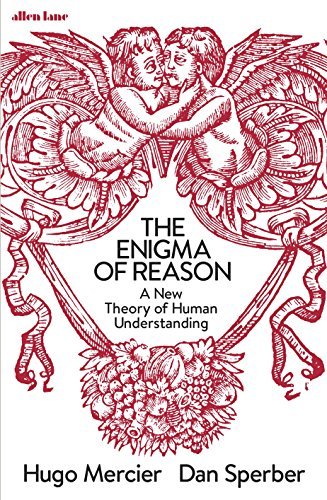
Reason, we are told, is what makes us human, the source of our knowledge and wisdom. If reason is so useful, why didn't it also evolve in other animals? If reason is that reliable, why do we produce so much thoroughly reasoned nonsense? In their ground-breaking account of the evolution and workings of reason, Hugo Mercier and Dan Sperber set out to solve this double enigma. Reason, they argue with a compelling mix of real-life and experimental evidence, is not geared to solitary use, to arriving at better beliefs and decisions on our own. What reason does, rather, is help us justify our beliefs and actions to others, convince them through argumentation, and evaluate the justifications and arguments that others address to us.
In other words, reason has evolved to help humans better exploit their uniquely rich social environment. This illuminating interpretation of reason makes sense of strengths and weaknesses that have long puzzled philosophers and psychologists - why reason is biased in favour of what we already believe, why it may lead to terrible ideas and yet is indispensable to spreading good ones. Ambitious, provocative, and entertaining, The Enigma of Reason will spark debate among psychologists and philosophers, and make many reasonable people rethink their own thinking.
379 pages, Kindle Edition
First published April 17, 2017


Higher-order intuitions in reasoning are metacognitive rather than just “metalogical.” Reasoning is based on rich and varied intuitions about intuitions. Take the kind of reasoning that would classically be represented by means of a disjunctive syllogism with a main premise of the form “P or Q.”
The main role of reasons is not to motivate or guide us in reaching conclusions but to explain and justify after the fact the conclusions we have reached. (p. 121)The following link is to an excerpt from the book that tells of a classic example of "confirmation bias" and then "belief persistence" that occurred in France related to the Dreyfus Affair in 1894.
Reason is an adaptation to the hyper-social niche humans have built for themselves. (p.339)Reasoning is thus primarily tied to social contexts and to language. It is an inner mental process closely related to argumentation which requires an interactive exchange between individuals in order to be truly argumentation.
We construct arguments when we are trying to convince others or, proactively, when we think we might have to. We evaluate the arguments given by others as a means—imperfect but uniquely useful all the same—of recognizing good ideas and rejecting bad ones. Being sometimes communicators, sometimes audience, we benefit both from producing arguments to present to others and from evaluating the arguments others present to us. Reasoning involves two capacities, that of producing arguments and that of evaluating them. These two capacities are mutually adapted and must have evolved together. Jointly they constitute, we claim, one of the two main functions of reason and the main function of reasoning: the argumentative function. (pp. 207-208)In other words, our ability to reason is built on the foundation of our innate ability of negotiate our position in our human social environment. If we want to reason well we should do it interactively with others.

“Reason is an adaptation to the hyper-social niche humans have evolved for themselves"


