Jump to ratings and reviews
Rate this book

Mrs Osmond

Rate this book
A rich historical novel about the aftermath of betrayal, from the Booker prize-winning author.

What was freedom, she thought, other than the right to exercise one's choices?

Isabel Osmond, a spirited, intelligent young heiress, flees to London after being betrayed by her husband, to be with her beloved cousin Ralph on his deathbed. After a somber, silent existence at her husband's Roman palazzo, Isabel's daring
departure to London reawakens her youthful quest for freedom and independence, as old suitors resurface and loyal friends remind her of happier times.

But soon Isabel must decide whether to return to Rome to face up to the web of deceit in which she has become entangled or to strike out on her own once more.

368 pages, Hardcover

First published October 5, 2017

544 people are currently reading
4050 people want to read

About the author

John Banville

133 books2,405 followers
William John Banville is an Irish novelist, short story writer, adapter of dramas and screenwriter. Though he has been described as "the heir to Proust, via Nabokov", Banville himself maintains that W.B. Yeats and Henry James are the two real influences on his work.
Banville has won the 1976 James Tait Black Memorial Prize, the 2003 International Nonino Prize, the 2005 Booker Prize, the 2011 Franz Kafka Prize, the 2013 Austrian State Prize for European Literature and the 2014 Prince of Asturias Award for Literature. He was elected a Fellow of the Royal Society of Literature in 2007. Italy made him a Cavaliere of the Ordine della Stella d'Italia (essentially a knighthood) in 2017. He is a former member of Aosdána, having voluntarily relinquished the financial stipend in 2001 to another, more impoverished, writer.
Banville was born and grew up in Wexford town in south-east Ireland. He published his first novel, Nightspawn, in 1971. A second, Birchwood, followed two years later. "The Revolutions Trilogy", published between 1976 and 1982, comprises three works, each named in reference to a renowned scientist: Doctor Copernicus, Kepler and The Newton Letter. His next work, Mefisto, had a mathematical theme. His 1989 novel The Book of Evidence, shortlisted for the Booker Prize and winner of that year's Guinness Peat Aviation award, heralded a second trilogy, three works which deal in common with the work of art. "The Frames Trilogy" is completed by Ghosts and Athena, both published during the 1990s. Banville's thirteenth novel, The Sea, won the Booker Prize in 2005. In addition, he publishes crime novels as Benjamin Black — most of these feature the character of Quirke, an Irish pathologist based in Dublin.
Banville is considered a contender for the Nobel Prize in Literature. He lives in Dublin.

Ratings & Reviews

What do you think?
Rate this book

Friends & Following

Create a free account to discover what your friends think of this book!

Community Reviews

5 stars
502 (18%)
4 stars
987 (36%)
3 stars
831 (30%)
2 stars
280 (10%)
1 star
126 (4%)
Displaying 1 - 30 of 467 reviews
Profile Image for Vit Babenco.
1,791 reviews5,829 followers
November 22, 2024
Mrs. Osmond is a retro novel with a subtle hint at a dark comedy. For me the best thing about John Banville is the way he tells his stories… His ability to wield the language and style with tremendous panache. 
Everything starts with a journey…
It had been a day of agitations and alarms, of smoke and steam and grit. Even yet she felt, did Mrs. Osmond, the awful surge and rhythm of the train’s wheels, beating on and on within her. It was as if she were still seated at the carriage window, as she had sat for what seemed impossibly many hours, gazing with unseeing eyes upon the placid English countryside flowing away from her endlessly in all the soft-green splendour of the early-summer afternoon. Her thoughts had sped along with the speeding train but, unlike the train, to no end.

She returns from her cousin’s funeral… Her married life is a failure… She wishes to be free…
One of the many terrible things she had recently been made to learn was that there were no limits to the depths of private disgrace and abjection to which one could plummet. Her husband and Serena Merle had together pushed her from the plaster pedestal upon which, she now realised, she had set herself so long ago, even as early as in her girlhood, that she had ceased to be aware of it under her feet…

She suddenly understands that all her previous life was a life of illusions… The secret she has recently learnt changed her attitude to the surrounding reality… And now she sees her husband as a scheming villain…
He had always prided himself on his reticence, his capacity to keep hidden from the outer world his inner wants and wishes. He had grown into the image of himself he had fashioned long ago – man and mask had merged, at least so far as the world was allowed to see.

Growing older we start paying for the mistakes we made in our youth.
Profile Image for Jim Fonseca.
1,163 reviews8,543 followers
November 11, 2025
Mrs. Osmond by John Banville

Banville has written a sequel in the life of Isabel Archer, the main character in Henry James’ novel, Portrait of a Lady. Like James, the story is full of psychological insight, and the writing style is like that of James but with shorter sentences and fewer sub-clauses. Kind of Henry James lite, as I have written of novels by Anita Brookner.

description

When we last saw Isabel, the 1880’s jet-setter in a time of steam trains and horse and buggies, she had married a wealthy American man and moved to Italy.

Irene is helped along by her hard-fisted maid who realizes that her mistress has her head in the clouds and is too soft-hearted and gullible. Still not yet 30, Irene is miserable and feels middle-aged.

All the major characters are Americans living in Europe. They’re originally from Boston, Baltimore, Philadelphia and New York. (Irene was from Albany, New York.) None have ever worked for a living – it’s all money inherited from Dad and probably Grandpa. Sometimes they marry European men or women, whose fortunes are fading, to get a title. So it’s a match made in heaven if you bring American money to the table and say you married “Princess” or “Count” so-and-so.

I’ll let the author speak for himself with some key thoughts that also illustrate the style of writing:

“Her home, the Palazzo Roccanera, was well-named, for it was there the she had run up against the immovable black rock of failure – the failure of her marriage, the failure of herself, her failure – like the engine of a steam train rounding a bend and colliding full-tilt with a boulder fallen on the track.”

Of her husband “…to lose face would have been, for him, insupportable, for what else had he other than the appearance of being what he was not?”

[her husband] “…bent upon his wife a gaze lacking in all expression save what might be a certain faint disappointment – disappointment not at finding her there, she thought, but at the notion of her in general, of her being anywhere, at any time…”

description

“ ‘I think,’ Isabel said, with a smile betokening misery, ‘that it is myself I wish to be free of.’ "

When she thinks of a former suitor: “To have married him, she acknowledged, would have been to elect to live between seasons, neither in summer nor in winter, neither in spring nor in fall; together, they would have inhabited a weatherless world.”

Her maid thinks: “…Paris was not unwelcome, for Paris she did like, despite the persistence there of French people.”

“Philosophy, in the opinion of the correspondent of the New York Interviewer, was a harmless diversion from the true brisk business of being human, which was nothing more and nothing less than to live a harmonious, fulfilled and useful life.”

[of her husband’s mysterious companion] “Madame Merle’s own smile, bland, slow, insinuative, that drew up her lips at the left side, like the corner of a curtain being lifted on something that had better not be seen…”

I liked this exchange:
“He lives as he always has, very content and quiet.”
“Well he has much to be quiet about.”

description

This is my fifth book by Banville and I enjoyed it. Obviously I like his work and I would say that my two favorites remain The Sea (his Booker winner) and The Untouchable.

John Banville is a prolific author; by my count 36 novels and a couple of non-fiction books. Many are in series and some were written under pseudonyms. I still like his Booker Prize winner, The Sea, the best. Here are links to ones I have reviewed:

The Sea

The Untouchable

The Blue Guitar

The Infinities

Snow (#2 in the St. John Strafford detective series)

April in Spain (#3 in the St. John Strafford detective series)

Kepler: The Revolutions Trilogy (fictionalized biographies. The other two are Copernicus and Newton.)

Shroud (# 2 in The Cleave Trilogy. Cleave is a pathologist in 1950s Dublin)

Top photo of Paris in the late 1880's from mymodernmet.com
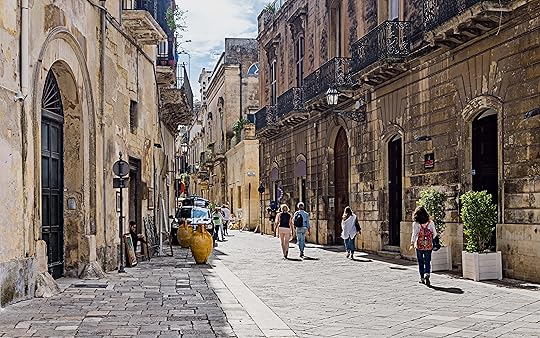
Lucce, Italy, 'The Florence of the South' from alistairdewarphotography.com
The author from theguardian.com
Profile Image for Fionnuala.
887 reviews
Read
November 17, 2024
Altered Ending

In my experience, John Banville creates memorable characters and interesting plot elements, and his craft is such that he can mould them all cleverly together so that when I reach the end of one of his books, I can only admire the overall shape of the complete work.

When I reached the end of Mrs Osmond, in which Banville sets out to alter the ending of a Henry James story, I certainly admired his craft, and appreciated how he marshalled his story elements and made them fit his conclusion, but I was a little bemused. His conclusion seemed quite vague to me, almost as ambiguous as the ending Henry James' had designed for Isabel Osmond's story in The Portrait of a Lady over a hundred years before, and which John Banville was so keen to alter. And I wondered, what if, sometime in the future, a writer comes along who feels Banville's ending isn't a fitting ending, and who begins to redirect the story towards a third conclusion. And then another writer has a similar urge, and another, and another, until the series of 'endings' of the narrative becomes never ending!

Ok, I'm being a little nonsensical, but perhaps you see my point: I'm simply wondering about Banville's surprising desire to alter the ending of Henry James' famous story, and in the process, to leave Isabel's future, if not quite as ambiguous as Henry James had intended, then almost.

But, you ask, in the course of the three hundred and seventy-five pages of this book, John Banville must surely have moved Isabel Archer's story on considerably, and thereby created some definitive outcome?
Well no, he hasn't. What he's done is to put in place one possible path she might take after he has allowed her to deal with some issues arising from James' story. But it's difficult for the reader to accept that Isabel will stick to the path Banville has picked for her because he has given us only a couple of months of her future, eight or ten weeks at most, and we wonder how she can be expected to arrive at any certainty in so short a time. Banville is very vague about Time in this book in any case, not only the time that passes in his own narrative but the time that had passed in Henry James' story; Banville leaves the reader with the impression that Isabel had been married to Gilbert Osmond for decades instead of only four or five years. She is still under thirty at the end of this book.

But even if his story doesn't cover a long period, a reader might expect, in the course of so many pages, that Banville would introduce a lot of new story elements at the very least. Well no, surprisingly few. And, on reflection, most of the new elements aren't really new at all. They feel like they were already present in The Portrait of a Lady, where they had been purposefully left undeveloped by Henry James. I had wondered, for instance, when reading 'The Portrait', what had happened within the marriage of Isabel's aunt and uncle to make them so estranged from each other, and my imagination had offered a fairly obvious reason, as yours would. John Banville thought of the same reason, and spelled it out. It filled several pages but fulfilled no other purpose.

Another new/old plot element concerned Gilbert Osmond's first marriage, which was only sketchily presented by Henry James. I'd had my own thoughts on that marriage too, and on the timing of certain events related to it, suggested by other things Henry James deliberately left unsaid. For his part, John Banville felt the need to fully investigate those unsaid things, but since he worked them into his narrative quite well, the spelling-out at least served some purpose in the end.

But there was altogether too much spelling-out and retelling of Henry James' story in this novel, which made me wonder about Banville's target audience. If he was aiming at people who haven't read The Portrait of a Lady, there was some sense to the constant reference to the back story. But even for such readers, I feel there must have been too much of the past and not enough of the present, too much history, not enough story. And too many repetitions and restatings of everything - as in the previous sentence!

On the other hand, Banville may be writing for people who've read and loved this most popular of Henry James' novels. But if that was his intention, why the need to spend so much time recalling the original story in such detail? The writing style certainly makes me think he was aiming at those who are familiar with 'The Portrait' - and perhaps even at those who are familiar with all of Henry James. Otherwise how could he expect the reader to appreciate the impressive efforts he's made to echo James' style at every turn? Yes, Banville is able to compose long sentences built from successive clauses and parentheses quite well - though at times they felt more like exaggerations of the style rather than imitations. But Banville is careful to use some rare words that I, for one, have only come across in Henry James, such as 'plash' and 'integument'.

There are also frequent echoes of other James books, references which can only be appreciated if we've read those books ourselves; the few new characters Banville introduces recall characters we may have met before in the James world. An English suffragist called Miss Janeway reminded me immediately of a combination of Olive Chancellor from The Bostonians and her reformist colleague, Miss Birdseye. And Miss Janeway's destiny echoes almost exactly the destiny Henry James gave the admirable Miss Birdseye in that book. There were other character parallels too, and little mirrorings of all sorts, so much so that I suspected John Banville of having read every single word Henry James wrote.

But perhaps he hadn't read every word.
In the 1906 Preface to the revised edition of The Portrait of a Lady, Henry James discusses the shape of his novel (originally written in 1880). He speaks in terms of architecture and proportions, and he says that of all his novels, including those he wrote much later, he considers 'The Portrait' to be one of the best proportioned.
I can't imagine that he would have wished anyone to alter its shape.

………………………………………………
Edit
Further thoughts on alterations of masterpieces arose in the comments section and offered me a new light in which to view John Banville's Mrs Osmond.
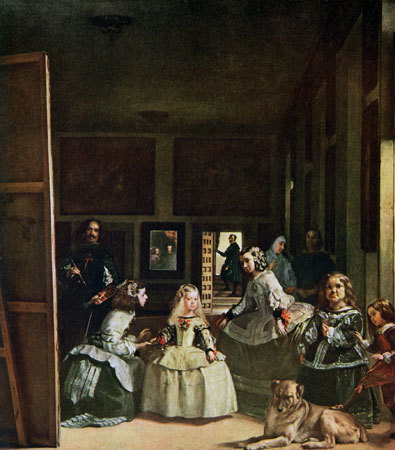
In particular, the mention of a famous painting by Velasquez, 'Las Meninas', which has inspired many artists to create their own versions, caused me to think a little more about what John Banville has done in this book.
Here's the original of Las Meninas (you'll find images of various retakes of it in the comments posted by Kalliope - who reminded me of how artists have always paid tribute by reworking a revered master's subject):


As I looked at the many versions of 'Las Meninas', I thought about how John Banville has reworked Henry James' portrait of Isabel Archer, and I concluded that Banville has altered it only very slightly. I now imagine Banville's Isabel as a new version of 'Las Meninas' which mirrors the original but for one tiny detail. In my imagined version, the main focus of Velasquez's painting, the Infanta/daughter of the King, would no longer be gazing at her own reflection (as Isabel is constantly encouraged to do by her entourage in 'Portrait of a Lady') but would have turned her head, and for the first time in her life, looked at the kneeling lady-in-waiting and seen a real person with real needs and real feelings.
Such a version of "Las Meninas' would be the perfect artistic correspondence for Banville's book; there is a moment in Mrs Osmond when Isabel turns her eyes to her maid's face and truly sees her as a person for the very first time, and that moment provides the main rationale for Banville's revised ending. I was very struck by that scene as I read, and I'm glad I've now found a way to insert it - without interfering too much with the conclusion of the review as it originally stood :-)
Profile Image for Beata .
905 reviews1,390 followers
September 13, 2018
Well, for me it was a perfect read... Banville gave the reades and Isabel the second chance and I thank him for that! The writing style is very much like HJ and again, it was very much to my liking. Pastiche? Maybe, but a perfect one.
Profile Image for Roman Clodia.
2,914 reviews4,679 followers
August 30, 2017
John Banville returning to Henry James' The Portrait of a Lady seems like an ideal match - the result, though, is more puzzling, less satisfying that I expected.

Firstly, Banville's style never matches the cool elegance and precision of James, and there are jarring colloquialisms that ensure we're only partially in James' territory: 'Even yet she felt, did Mrs Osmond' or 'Staines' devotion to her mistress had not wavered a jot'. The very presence of named servants and detailed menus (at one point Isabel nibbles at a slice of toast) is profoundly unJamesian and it's not completely clear whether the former is drawing attention to the class-ridden assumptions of the original, making the invisible servants visible.

More pressingly, the characters are *not* James': they become exaggerated and almost one-dimensional - evil Osmond, foolish and vengeful Mme Gemini, a newly-corrupt Pansy (and the nature that her 'corruption' takes is strangely anachronistic). Even Isabel herself is diminished, reduced to being a woman both self-forgiving and looking for revenge. The wonderfully dense and complicated characterisations and moral debates of the original, especially issues about decisions and consequences, are erased, and this is a far simpler tale. The introduction of a suffragette feels too pointed and the plot-point about Isabel leaving her briefcase of money lying around is just absurd.

There are long discussions which have characters telling each other what already happened in the original text and these sections feel almost like a crib for anyone who didn't 'get' what happened - almost a kind of SparksNotes for GCSE!

For all my criticisms, there is a sense of Banville re-opening in 2017 a book which was written in the 1880s - questions of money, morality, gender and marriage are still troublesome and deserving of writers' attentions. Overall, though, I felt that James' prior text stultifies rather than feeds Banville's imagination. An interesting project but not one which worked overwell for me.

Thanks to Penguin for an ARC via NetGalley.
Profile Image for Hugh.
1,295 reviews49 followers
April 2, 2019
I have to start with a disclaimer, because this book is a sequel of sorts to The Portrait of a Lady, a book which I have never read, indeed I have still never read any Henry James at all, which makes it quite difficult for me to judge how well Banville has captured the characters, tone and style. Even without that, I found this an enjoyable read, though the style was hard work at times and the vocabulary entertainingly challenging, for example "her hebetudinous husband".

At the start of the book, Isabel Osmond (née Archer) is in London visiting friends while considering whether to return to her husband in Rome. The early sections establish the characters and situations in a way that makes sense even without knowledge of James (and I will admit to reading the Wikipedia plot summary of Portrait). The book follows her and her loyal maidservant "Staines" to Italy via Paris and back, providing a neat denouement that allows Isabel a partial triumph while ending ambiguously.

As a literary challenge, this is very impressive, and one to which Banville's style seems well suited. One of these days I may read James, and if I do I may well revisit this novel.
Profile Image for Emilio Berra.
306 reviews289 followers
April 7, 2022
Isabel disse : "Io credo (...) che è da me stessa che vorrei essere libera" .

Questo libro molto bello è il sequel di "Ritratto di signora", famoso e apprezzatissimo romanzo di H. James.
La particolarità qui è costituita dalla mano di un altro autore : l'irlandese J. Banville, considerato tra i maggiori scrittori del nostro tempo.
Che qualcuno prosegua il romanzo di un altro è un fatto che di per sé non mi piace e di cui diffido. Ho scelto questa lettura proprio per le credenziali di cui gode Banville.

Effettivamente il libro è di livello parecchio alto; m'è parso anzi un omaggio a H. James. Banville adatta infatti una scrittura che crea continuità con l'opera da cui parte e soprattutto degna della prosa di James stesso.
Tutti i personaggi inoltre vengono sviluppati secondo i caratteri e le potenzialità già delineati in "Ritratto di signora". La stessa protagonista Isabel ha un'evoluzione nel rispetto della figura ivi delineata, qui proiettata verso chiarimenti e scelte, tramite un approfondimento psicologico-esistenziale notevole.

"Aveva la sensazione di aver dilapidato se stessa fino alla bancarotta emotiva e spirituale -ma era vero? O non aveva, al contrario, trattenuto e ammassato le risorse che avrebbe dovuto prodigare agli altri?" .
"Rifletteva Isabel, la vita non è una metafora (...). E' un progetto ordinario" .
Profile Image for Sofia.
324 reviews133 followers
December 15, 2020
Με κάποια βιβλία έχεις από την αρχή το προαίσθημα ότι θα σου κάνουν το κλικ και όταν αυτό επιβεβαιώνεται η χαρά είναι διπλή. Θα ξεκινήσω από έξω προς τα μέσα και θα ήθελα να σταθούμε στο υπέροχο εξώφυλλο γιατί αποτυπώνει την προσωπικότητα της κας Όσμοντ με μία τόσο στατική αλλά ταυτόχρονα πολύ δυνατή εικόνα.
Στα του μυθιστορήματος τώρα ο Banville καταφέρνει να μεταφέρει στο ακέραιο όλη την ατμόσφαιρα ενός μυθιστορήματος εποχής με τέτοιο τρόπο που αν κάποιος μου έλεγε ότι γράφτηκε το 1880 θα τον πίστευα, διατηρώντας αμείωτη την αγωνία αλλά και την σταθερή εξέλιξη του χαρακτήρα. Με λίγα λόγια καταφέρνει να σταθεί αντάξιος του δύσκολου ρόλου που ανέλαβε, να συνεχίσει επι της ουσίας το μυθιστόρημα του Χένρι Τζέιμς, το Πορτρέτο μίας Κυρίας. Μια συμβουλή για όσους το ξεκινήσουν, θα ήταν καλύτερο να διαβάσουν στο τέλος τη σύντομη περίληψη της υπόθεσης του μυθιστορήματος του Τζέιμς, σε περίπτωση που δεν έχουν διαβάσει ήδη το βιβλίο του. Ο Banville κάνει τις απαραίτητες "εξηγήσεις" αλλά σε κάθε περίπτωση βοηθάει καλύτερα τον αναγνώστη να μπει ακόμα πιο βαθιά στην ιστορία.
Κατά τα λοιπά πρόκειται για πραγματικό βάλσαμό αυτή η αφήγηση.
Profile Image for Issicratea.
229 reviews474 followers
May 26, 2019
Mrs Osmond is a curious exercise in upmarket fan fiction: a flat-footed continuation of a narrative intentionally left suspended, and an ill-judged attempt to go stylistically head to head with one of the most honed and distinctive novelistic voices of all time.

I picked this novel up after finishing The Portrait of a Lady, and, at a very basic level, I can understand Banville’s necromantic impulse. If you love a book, you want more of it—the very impulse that fuels the ever-growing industry of Pride & Prejudice spinoffs. “While visiting Lambton with the Gardiners, Elizabeth is mistaken for Miss Darcy and kidnapped along with Mr Darcy …” (I didn’t make that one up, by the way: it actually exists!)

In an interview I read, in an online journal, Banville pitches Mrs Osmond as a feminist rereading of The Portrait of a Lady. The basis of this claim is presumably his introduction of a “New Woman” theme via an invented character, Miss Janeway (or remixed, maybe, rather than invented, from a few characters in The Bostonians: Miss Birdseye, with a dash of Olive Chancellor and Mary Prance). Banville may also have intended us to read some kind of new feminist agency in the way in which Isabel Archer (or Isabel Osmond now) negotiates the icy wastes of her ruinous marriage to Gilbert Osmond and his partner in scheming, Madame Merle.

One thing that I think makes this book fail is Banville’s fundamental uncertainty about what he’s doing. At points, it seems as if he wants to inject into his sequel some of the things that James elides in his narrative, such as the fact that a “lady” such as Isabel depended on having a servant, or servants, around constantly, in order to move through life with the smoothness and airiness that she does. Banville introduces a lady’s maid, Elise Staines, to remind us that people like Elsie handled the logistics of travel and food and lodging and communications—and, indeed, of just about everything—for their spoilt patrons, so that they could get on with living their supersubtle, Jamesian inner lives.

This is not a bad idea, but Elsie never really emerges to the status of a real character; and, in fact, the way Banville treats her is really quite patronizing and clichéd (she is a kind of rough diamond type: hard on the outside, melting as a jelly on the inside, and helplessly adoring of Isabel). Elsewhere, Banville’s attempts to update James with an injection of contemporary political consciousness are winched in even more crudely. There’s a moment where Gilbert Osmond reminds his wife of all those who have suffered to raise up the fortune she inherited from Mr Touchett:

“The railroad–ah. Think of the hundreds, the thousands, of Chinese coolies whose backs were broken in the laying down of those relentless tracks, think of the labourers who fled from famine in Ireland only to die of malnutrition in the sweltering western deserts; think of the tribes of Redskins who were slaughtered …”

All useful and valid reminders … but, given to Gilbert Osmond, of all people? Anyone less political and less empathetic towards others can hardly be imagined, within James’s initial vision of the character, which Banville essentially maintains.

Then there’s the issue of style … Banville attempts a kind of homage to James by writing the entire novel in a pastiche of the latter’s reflective, meandering style. It’s an arduous, if not an impossible, task to pull off, and I found Banville’s attempt quite superficial, even annoying. He imitates James’s obliquities and mannerisms diligently enough, but it’s not close enough to the model to make you marvel at the uncanniness of it, and not different enough to revivify James’s style or transform it or fully reinhabit it with a twenty-first century consciousness. There are also some cringe-inducing anachronisms and errors, such as when an obsequious hotel manager in Rome addresses Isabel in Italian using the familiar second-person singular.

I read a few reviews of the novel when I finished it to see how others judged Banville’s approximation, and it was interesting to see how critics differed. Edmund White, writing in The Guardian, describes Banville’s style as a “superb pastiche”—but, then, it’s pretty obvious from his review that White isn't a great fan of James. Charles Finch, in the New Yorker, I found far more acute in his observations. I loved this insight, in particular: “James uses his long sentences to talk himself further into their beginnings, or sometimes out of them, into second and third and fourth layers of thought. But Banville seems to mistake this for mere elongation.”


Profile Image for Julie.
561 reviews311 followers
Read
October 18, 2020
Spoilers here, so be warned.

Good grief.

What a maudlin mess this turned out to be -- so much so, that in my universe of stars I can't pick one rating that would satisfy me, so I give none.

What was this?

Such a ghostly extension (sequel?) to The Portrait of a Lady that it positively makes the skin crawl. Here, Isabel Archer becomes a revenant in her own life: she is so ghostly yet so exact; such a phantom, yet such a macabre flesh-and-blood creature that there is more life in the Vampire Lestat -- more life, in fact, and less monstrosity, for at least Rice knew who and what Lestat was.

To be terribly, terribly cheeky, this is when fan fiction goes "terribly" wrong.

Isabel Archer, lately sprung from Henry James's carriage, meanders through this novel in an aimless helter-skelter pursuit of her own version of revenge -- though of course, it can never be described as such, for Isabel is a Lady and revenge, as a form, lacks delicacy and charm, which a lady must-ever display. (At one point, I had an image of Isabel as a tiny silver ball in a pinball machine, bouncing about hither and yon with no purpose or control over her own actions.)

In much the same way that Isabel's invertebrate spirit led her into a disastrous marriage to Osmond in the first place, her subsequent lack of perspicacity only ensures reward where avengement was intended.

How can one possibly hope to revenge oneself against a sociopath? A pair of sociopaths? By their very nature(s) both Osmond and Merle are incapable of sustaining an injury -- they both lack conscience; neither is capable of empathy or remorse; they are both cold and calculating, having their own interests solely in mind; they each have a sense of immense superiority over their fellow beings; neither has learned anything from past mistakes; they've both taken huge risks -- at the expense of others; neither is capable of loving anyone, including themselves or each other. Oh my. The list is long. In fact, as the old joke goes, if I looked up "sociopathy" in the Diagnostic and Statistical Manual of Mental Disorders DSM-IV-TR, there would be portraits of Osmond and Merle.

How can one suppose that Isabel's actions toward her husband and his erstwhile mistress would serve as any sort of redress? Such a false and weak premise overturns the novel completely for me. The bonus becomes that, not only have they lived their respective lives on their own terms, but they each end up with a castle in Italy as a reward for their sins. Are two sociopaths likely to mourn such bounty? Just desserts indeed!

Even the Christian ethos recognizes sociopathy, at some level, so it cannot be said that Banville argues from that vantage point either.

What kept me reading, then? Well, on an ironic note, for the simple pleasure of knowing I'd be able to toss the book across the room and scream garbage at it. On a truer note ... I admire Banville's writing and am seduced, much like Isabel by Osmond by his agility with words. I know at some point, it's going to end rather badly, for me, but still ...

I do admire Banville's style, but I continue to pursue him in a (perhaps-illusive?) attempt to find better substance.
Profile Image for Daphna.
243 reviews46 followers
January 20, 2018
If you are a Henry James aficionado, you must read this. Of course you must first read- or refresh your memory if it's been a while since you read- Portrait of a Lady. John Banville brilliantly recreates Henry James' style and register and it's wonderful to have him back for one more novel. Isabel Archer is as annoying and selfishly fixated on herself as ever, even more so, because it is 21st Century John Banville who is writing and not Henry James. Some may disagree, but I found her annoying in Portrait of a Lady, and she is no less annoying as resurrected by John Banville. To avoid spoilers I will limit my opinions of Isabel Archer in Mrs. Osmond to what I have already said.
John Banville has written a brilliant novel. I think Henry James would be pleased.
Profile Image for Γιάννης Ζαραμπούκας.
Author 3 books223 followers
August 22, 2019
Ένα από τα καλύτερα μυθιστορήματα που διάβασα φέτος. Σύντομα θα σας πω περισσότερα...
Profile Image for Jenny.
192 reviews11 followers
August 12, 2017
I gave up on John Banville years ago. He seemed to be writing the same novel, over and over again; I haven't picked up a new book by him in a decade. This new novel intrigued me enough to try him again. (Thank you to Edelweiss and Knopf for the ARC).
The word that best comes to mind in reviewing this book is; ambitious. I never expected to find myself describing a Banville novel as ambitious, but there it is. This is a good book. No, this is a great book. Banville takes a beloved literary classic, Portrait of a Lady, and creates a sequel that feels so authentic to the original that it seems like he is channeling Henry James at times. Isabel Osmond (nee Archer) was a complicated and fascinating character in the original novel. Here, we see her dealing with the immediate aftermath of the conclusory events in the original novel. As she navigates her new path, Banville's vision of her stays so true to the character readers have loved for generations!
I'm a casual reviewer. I imagine critics will wet themselves over this book. I'm already picturing it, at the very least, making the Booker longlist in 2018.
Profile Image for Catherine Vamianaki.
491 reviews48 followers
February 24, 2021
Είναι μια διαφορετική ιστορία. Ο John Banville το έγραψε ως συνέχεια του βιβλίου Το Πορτρέτο Μιας Κυρίας του Henry James. Οπότε θα ήταν προτιμότερο να διαβάσετε αρχικά τον Henry James. Ομως, αν το παραλείψετε, μπορείτε να διαβάσετε το επίμετρο. Υπάρχει στο τέλος, μια περίληψη τι έχει προηγηθεί. Νομιζω ειναι απαραίτητο.
Οσο για την Κυρία Ιζαμπέλ Οσμοντ ενιωσα λύπη για αυτό που της προκάλεσε ο αντιπαθής σύζυγος της...
Απο την στιγμή που το άρχισα δεν ήθελα να το αφήσω.
Το βιβλίο διαβάζεται απνευστί!!!
Profile Image for Always Pink.
151 reviews18 followers
October 22, 2017
First of all, I have to admit that I have not (as yet) read Henry James' "Portrait of a Lady". Thus I cannot compare John Banville's style - unfavourably - to that of his predecessor, as most critics seem to do. What I can say, though, is that Banville succeeds in (re)creating a modern version of a kind of writing that I feared to be lost: Feathery weightless and wonderfully elegant descriptions; sharp and witty dialogues; interspersed with short penetrating observations dissecting human frailties – all this Banville delivers seemingly effortlessly. The deliberately and in the best sense entertaining, playful proof of the sheer mastery of his writing reminded me a lot of Virginia Woolf's "Flush" and E.M. Forster's "A Room with a View" (probably also due to the perhaps not accidentally shared Florentine setting). I found this delicious 'sponge cake' of a novel to be perfectly well executed indeed and would love to read another sequel, as its open ending might give hope for.
Profile Image for David.
1,688 reviews
August 5, 2022
Brilliant. Simply brilliant.

If you are one of those that felt a little burned by the ending of “The Portrait of a Lady,” this is your cure.

The eloquence words of John Banville, his astute observation of Henry James and obviously, Banville felt “Portrait” needed a resolve more than ambiguity, works so delightfully for me.

It was closure. The Lady made her move.

In his own words, Factum est. It’s over.


Rating 4.5
Profile Image for Ιωάννα Μπαμπέτα.
251 reviews39 followers
June 27, 2020
Στην αρχή μου φάνηκε αργό... Λίγο το βαρέθηκα. Σιγά-σιγά όμως μαγεύτηκα από τη γραφή του Μπάνβιλ. Το δεύτερο μέρος ήταν εξαιρετικό. Με κέρδισε τελικά!
Είχαν περάσει πολλά χρόνια από τότε που διάβασα το Πορτρέτο μιας κυρίας κι ίσως τελικά αυτό να μην ήταν καλό. Ωραίο βιβλίο αλλά ίσως να μην ήταν το ιδανικό για αυτήν την περίοδο της ζωής μου.
Profile Image for Chryssouline.
72 reviews24 followers
May 27, 2019
Ο Μπάνβιλ μιμείται άψογα το ύφος συγγραφέα άλλης εποχής και πλάθει μια ηρωίδα αξια τουλάχιστον συμπάθειας, για την αξιοπρέπεια κ την ψυχραιμία αντιμετώπισης της εξαπάτησης από τον σύζυγο της. Αλλιώτικο βιβλίο και ωραίο
Profile Image for Yiannis.
158 reviews94 followers
May 27, 2019
Ο στυλίστας Μπάνβιλ σε ένα εξαιρετικό βιβλίο.
Profile Image for Eric Anderson.
716 reviews3,936 followers
January 2, 2018
I first read Henry James’ “The Portrait of a Lady” when I was in college, but reread it several years ago (one of the only “classics” I’ve ever reread) for a book club I was in. Part of me has always dreaded picking up a novel by Henry James because his style is so dry with complicated (albeit beautiful) sentences that demand a lot of concentration. On my second reading I thoroughly enjoyed revisiting James’ story about Isabel Archer who travels to Europe while batting away suitors, becomes an unexpected heiress and marries the wrong man. So I was fascinated to hear that one of Ireland’s greatest living writers John Banville wrote a sequel to James’ influential novel. “Mrs Osmond” picks up on Isabel’s story immediately after the end of “The Portrait of a Lady” where she’s gone to England to be beside her beloved dying cousin even though it’s against her husband Gilbert Osmond’s wishes. It’s entirely ambiguous in James’ novel whether she’ll return to her domineering husband, but Banville gives the answer in this story. But, more than resolving a plot point, this novel is a moving meditation on the meaning of personal independence.

Read my full review of Mrs Osmond by John Banville on LonesomeReader
Profile Image for Stephen.
2,183 reviews464 followers
January 22, 2018
felt this book just didn't do anything for me and struggled to the end with it
Profile Image for Nikolina Cali.
51 reviews
January 17, 2025
3.5⭐️

-Mos u mashtro nga palltoja e pluhurosur dhe supet e përkulura…
Profile Image for Mandy.
3,626 reviews334 followers
October 21, 2017
I don’t enjoy reading either Henry James or John Banville so it seemed unlikely that reading Banville’s sequel to James’ The Portrait of a Lady would do it for me. But much to my surprise it did – up to a point. I really enjoyed most of the book. Banville managed to channel James in a way that seemed true to both of them and it was interesting to enter into Banville’s imaginative foray into “what happened next” after Isabel Archer discovered her husband had been deceiving her with her close friend Madame Merle. However, Banville lost control, I felt, in the latter part of the book. Apart from some anachronisms, particularly to do with Isabel's fortune, revelations about Osmond’s sheer nastiness (he sort of becomes a stage villain) and the more than unlikely revelation about Pansy’s personality, which apart from anything else was quite unnecessary and is probably making James turn in his grave, turned what had been until then a measured and quite convincing novel of social mores with some deft characterisations into a gothic pantomime with some very unconvincing plot twists. Started well, but ended badly.
Profile Image for Eleanor.
1,137 reviews233 followers
September 22, 2017
Completely brilliant. Banville's technical skill in the language he chooses, and his command thereof, is never less than astonishing. It's not necessary to have read The Portrait of a Lady before this, though I certainly will do now, and suspect I'll find that Banville's reimagining of Isabel Archer illuminates the original.
Profile Image for Jorge.
302 reviews462 followers
December 12, 2025
“El tiempo no sólo cura, sino que al final exonera, aunque sea mediante un proceso de desensibilización”.

“El proceso alquímico se había invertido, y el oro se había convertido en inmundicia”.

Interesante tomar un personaje de otra novela y de otro autor para crear un relato independiente y tal vez de esta manera hacer un homenaje al autor o al personaje, o a los dos. Haya sido como haya sido la cuestión es que John Banville (1945) nuevamente me he deleitado con su elegante y exquisito estilo. Su prosa atrapa y embelesa por su minuciosidad descriptiva y su penetrante sensibilidad que en ocasiones llega a rozar la poesía. Si bien ya había leído su novela El Mar, la cual me pareció magnífica, me parece que me ha acabado gustando más La Señora Osmond.

El eje temático de esta novela es la crisis del matrimonio de Isabel Archer con Gilbert Osmond. Durante el relato nos cuenta la manera en que se fue dando esta crisis hasta hacerlo insostenible. A pesar de su tratamiento tan meticuloso la novela fluye muy bien aunque por momentos se puede volver morosa debido a la minuciosidad de los detalles tanto físicos como de los provenientes del interior de los protagonistas.

“…llevar en su interior algo pequeño y difunto, el frío y minúsculo cadáver de su propio corazón, su propio ser, su propia vida”.

La novela está relatada por un narrador externo que nos cuenta con profundidad y a detalle los avatares que se desencadenan por los engaños tejidos por el mezquino y siniestro Gilbert Osmond, así como por Serene Merle, dejándonos ver las motivaciones y sentimientos de estos personajes y de varios más creados por la imaginación de este autor.

La acción se ubica básicamente en Roma, Florencia y Londres hacia la mitad del siglo XIX o poco después, y a mi juicio se encuentra muy bien ambientada.

La señora Osmond es la Isabel Archer que John Banville tomó prestada de la novela de Henry James (1843-1916) llamada Retrato de una Dama. De entre todos los personajes creados por John Banville desde luego la protagonista se lleva las palmas; podemos escudriñar en su interior llegando a saber de ella de forma profunda y con exactitud sus temores, sus pensamientos, sus sentimientos y sus recuerdos, estos últimos nos son revelados continuamente ya que el relato avanza y retrocede constantemente de una forma muy entendible.

Además de ella destaca la presencia de otros personajes principalmente femeninos todos ellos delineados exhaustivamente por Banville; en especial me ha gustado la dama de compañía de Isabel Osmond llamada secamente Staines quien es una mujer sumamente resuelta, eficiente y seria, digamos que hasta belicosa.

Podríamos decir que es un libro cuya belleza se asemeja a un elegante y pulcro florero italiano coronado por un hermoso ramo de flores acomodado por una delicada mano femenina.

El conflicto central de la novela está soportado por varios pilares como los son: el tema de la sobreabundancia del dinero que suele enturbiar otras esferas de la vida, la voluntad de poder, la confianza traicionada, el engaño calculado y premeditado, el ansia de libertad, el compromiso infaltable a sostener el yugo de un matrimonio en crisis el cual en cierto momento se encona con el naciente feminismo mostrado por Isabel.

“El dinero era como un río subterráneo, una fuerza oscura, invisible y veloz que arrastraba consigo guijarros, raíces de plantas y árboles arrancadas y que rellenaba desde abajo los manantiales secretos del poder”.

No está por demás decir que todos estos temas son recurrentes en muchas obras, y me parece que la diferencia está en la manera en cómo se aborden y en cómo se expresen y John Banville lo hace con una gran inspiración.

La traducción de Miguel Temprano García ha sido maravillosa ya que ha podido transmitir toda la delicada prosa de John Banville.
Profile Image for SueLucie.
474 reviews19 followers
September 22, 2017
With thanks to Penguin UK Viking via NetGalley for the opportunity to read this book.

It is 40 years since I read ‘A Portrait of a Lady’ as a student and I remembered little of it apart from the basic plot. It was a delight to me to revisit it in the first part of this sequel by John Banville, mostly through Isabel’s memories and conversations with friends, though I appreciate that others more familiar with Henry James’ novel may think there is too much rehashing of the original before we move on to Isabel’s next moves. Once I settled into the wordy style of writing, I was hooked. I was interested from beginning to end to see how Isabel would cope with the events that led her to leave her husband and her home in Italy.

Gorgeous images - a few examples:

‘That he had it in his power to fund her fearless ascent of the sheer rock-face of her - of his! - ambitions must have seemed to him the justification, the compensation, for his having to bide below, in the shadowed valley, while she scaled the radiant heights. And what a drab disappointment it must have been for him that instead of pressing onwards to the peak she had lost her footing and plunged headlong down the sheer cliff….’

‘What she saw was that it had not been Osmond she had fallen in love with, when she was young, but herself, through him. That was why he was no more to her now than a mirror, from the back of which so much of the paint had flaked and fallen away that it afforded only fragments of a reflection, indistinct and disjointed.’

‘He still had that strange appearance of being somehow reduced, yet the effect seemed to her now not one of diminishment, but rather of concentration, as if he had drawn the belts and buckles of his armour tight the better to do battle with her.’

So you can see I loved the writing. I also very much enjoyed the way the action unfolded, with one exception - I hated what the author did with Pansy and since that comes near the end of the novel it slightly soured my whole experience.
Profile Image for N.
1,217 reviews61 followers
December 27, 2017
John Banville has written a wry, wonderful sequel to Henry James' The Portrait of a Lady, where our spirited heroine Isabel Archer Osmond picks up where his book left us- hanging over whether or not she is actually going to return to her cold, depressing marriage to Gilbert Osmond.

Mr. Banville's prose is exquisite Jamesian language at its best, with dollops of dry humor and the beautiful sentences that made Mr James' original such a masterpiece. Old favorite characters such as best friend, the spinster Henrietta Stackpole, stepdaughter, Pansy Osmond, former suitors Caspar Goodwood and Lord Warburton all reappear in perfect Jamesian form.

Isabel, older and wiser, schemes to get even with Gilbert Osmond; buy her freedom back, and provides a deliciously devious comeback towards Osmond and his accomplice, the scheming and gorgeous Madame Merle that is at once irresistible, and appropriate. Pansy's fate of being locked away at a convent also proves to be a true possibility of what could happen if love is denied.

What a gorgeous and languid book.
Profile Image for Daniel Archer.
56 reviews54 followers
February 5, 2018
The Portrait of a Lady is probably my favorite novel - ever. But this just reads like bad James fan fiction.

Somewhat admirable attempt at emulating James’s style but with no real understanding of what make James so compelling: interiority, moral ambiguity, those sentences you sometimes need a compass and map to navigate.

Instead, Mrs Osmond present a string of set pieces more or less taken from the original novel; characters thinking about/discussing events from the original novel AT LENGTH; shrill melodrama intended to be read as psychological insight; and a silly attempt to push Isabelle Archer into the modern world by having her accidentally leave a suitcase of money behind for a group of suffragettes. Come on. James’s Isabelle made some pretty bad choices but none that dumb!

Pass. Reread James. (Or at least Tóibím’s The Master to see how another contemporary writer is able to more successfully capture James’s “spirit”.)
Profile Image for etherealfire.
1,256 reviews229 followers
January 21, 2018
Won this book in a Giveaway (not Goodreads, I don't think; embarrassed that I no longer remember if it was from the publisher or some other source). I struggled a bit with the dense, though beautiful, language and the paragraphs of descriptive detail that actually felt a bit overwhelming and daunting at first. I found it necessary to read it more slowly and in small sections, particularly the first half or so of the book. The reward was in observing the transformation of Isabel Archer from self-sacrificing apathy to a woman who has recovered her confidence and strength.
Profile Image for Moreninha.
673 reviews26 followers
April 13, 2019
Qué gran escritor es Banville. Por razones personales, le he dedicado mucho tiempo a A portrait of a lady, la novela de Henry James que Banville continúa aquí y estoy absolutamente maravillada de cómo consigue replicar absolutamente el estilo de la novela original.
En esta novela, como en su inspiradora, pasa poca cosa. Pero todo lo que pasa se nos cuenta del mismo modo que lo haría el propio James. Es muy sorprendente, la verdad. Comencé esta novela pensando "qué necesidad había...", pero al final me ha llevado al huerto.
Evidentemente, quien no haya disfrutado de la lectura de A portrait... no le recomiendo La señora Osmond.
Displaying 1 - 30 of 467 reviews

Can't find what you're looking for?

Get help and learn more about the design.