

What do you think?

A Humument: A Treated Victorian Novel
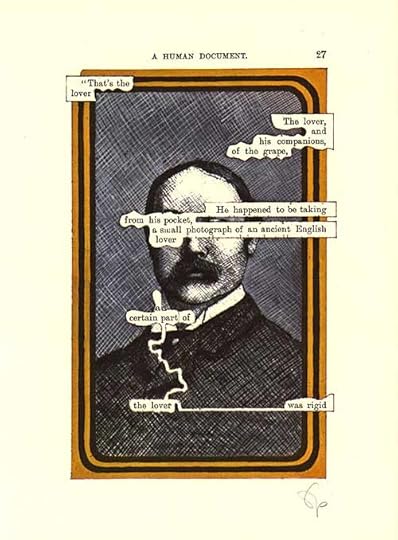
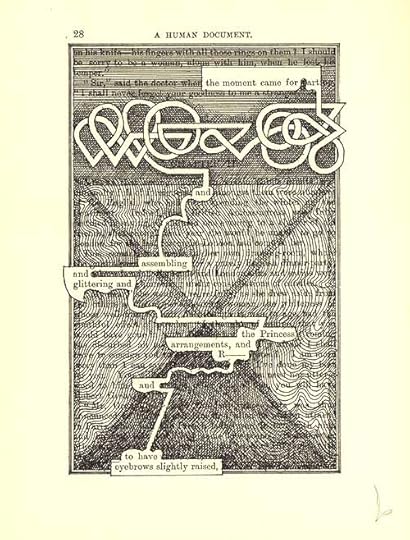
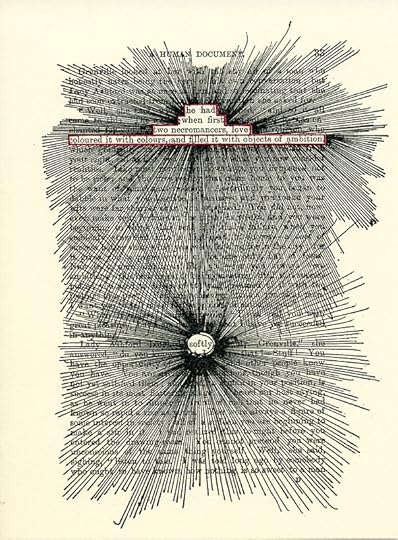
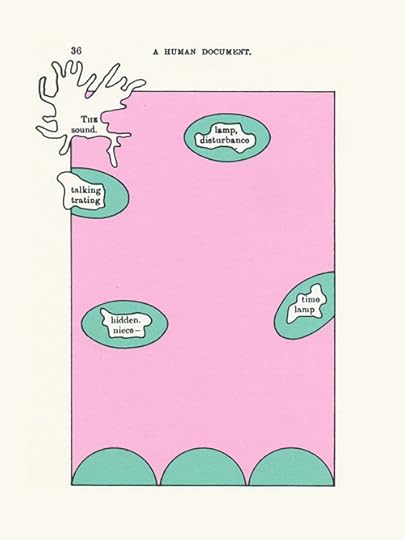
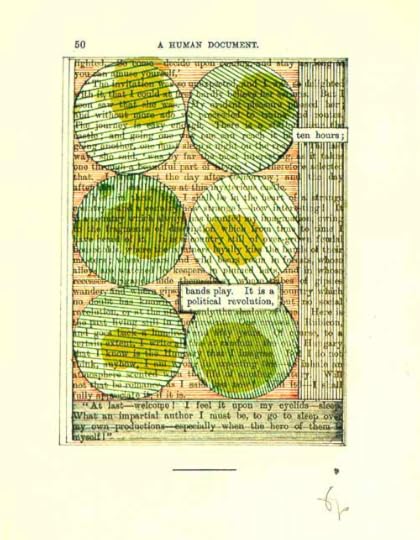
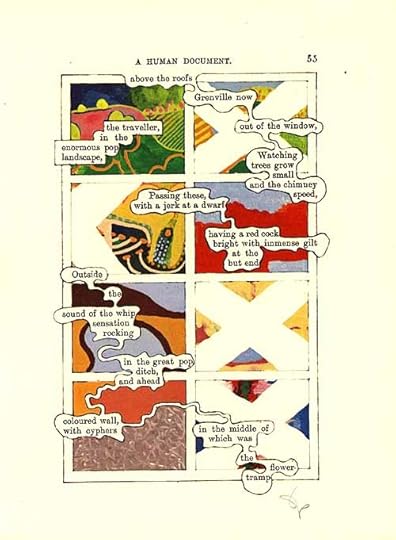
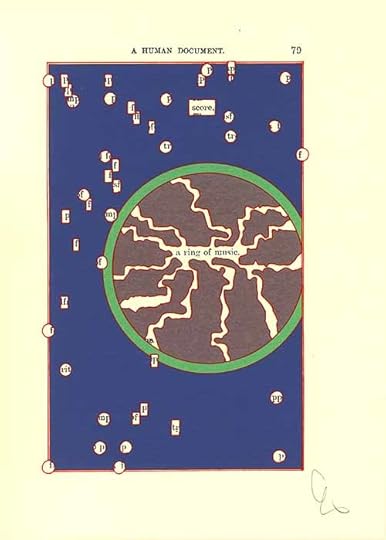
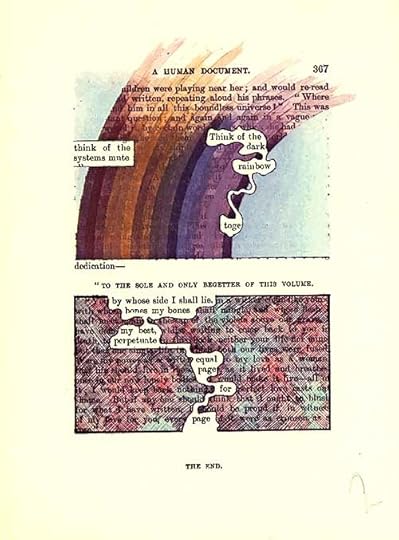
In the mid-1960s, inspired by William Burroughs's "cut-up" writing technique, Tom Phillips bought an obscure Victorian novel for three penceW. H. Mallock's 1892 novel, A Human Document . He began cutting and pasting the extant text, treating the pages with gouache and ink, isolating the words that interested him while scoring out unwanted words or painting over them. The result was A Humument , and the first version appeared in 1970. The artist writes, "I plundered, mined, and undermined its text to make it yield the ghosts of other possible stories, scenes, poems, erotic incidents, and surrealist catastrophes which seemed to lurk within its wall of words. As I worked on it, I replaced the text I'd stripped away with visual images of all kinds. It began to tell and depict, among other memories, dreams, and reflections, the sad story of Bill Toge, one of love's casualties." After its first publication in book form in 1980, A Humument rapidly became a cult classic. Phillips has continued to revisit Mallock's novel, and this new fourth edition follows its predecessors by incorporating revisions and reworkingsover a hundred pages are replaced by new versionsand celebrates an artistic enterprise that is itself some forty years old and still actively a work in progress. 368 color illustrations.
367 pages, Paperback
First published October 1, 1980
Ratings & Reviews
Friends & Following
Create a free account to discover what your friends think of this book!
Community Reviews
Displaying 1 - 30 of 107 reviews

May 11, 2021
"With Beckett’s ears, you don’t need to emphasize them. They emphasize themselves!"
My conversation with Tom Phillips can be read for free at The Collidescope here: https://thecollidescope.com/2021/10/0...
Spread the word!
My conversation with Tom Phillips can be read for free at The Collidescope here: https://thecollidescope.com/2021/10/0...
Spread the word!

December 29, 2012
This is possibly the most beautiful book I own. It may also be one of the most beautiful pieces of art I own. Oh, and, in a strange way, it's a sculpture, as well. I strongly doubt, however, that you will hear an audiobook version of this work. It just doesn't lend itself to auditory appreciation (unless one likes the sound of pages flipping, which is, I must admit, one of the more pleasing sounds to my ears). And describing the work doesn't do it justice at all. This is an artifact that one must see and handle for one's self. I won't demean the beauty of this work by trying to explain the mechanics of its creation. That story is well-documented and, yes, intriguing. But reading A Humument is more about the experience of interfacing with Phillips' incredible creation (or reincarnation?) than about appreciating the history of the book's construction. And it is not really about the "plot," if you can even say it has a plot. "Reading" is not even an accurate term to describe one's interfacing with this work. "Breathing" might be more appropriate, or "meditating" or "absorbing" or even "melding with". As I think about it, I like the last description best: one melds with A Humument. I wish I could adequately relate the grandeur of this work, the monumental TREASURE that it is. Alas, all I can do is to hope to allure you into finding a copy for yourself so that you can meld with it, as I have. Sorry, everyone, but you're on your own this time. You and the book. Just the two of you. I can't help you. Besides, I'm a bit busy melding with this treasure myself.

July 22, 2015
Tom Phillips spent almost 50 years working on this project and ended up creating 6 editions, each successive one amending a proportion of the pages to create new variants.
I've decided to read all 6 editions in order. This was the 1st edition
Update: Now read 1st and 2nd Revised editions
Update: Started on 4th edition
Update: Completed 4th edition
That's it, finished the Final Edition
I've decided to read all 6 editions in order. This was the 1st edition
Update: Now read 1st and 2nd Revised editions
Update: Started on 4th edition
Update: Completed 4th edition
That's it, finished the Final Edition

November 29, 2007
The sculptor takes a great lump of marble and chips away and after swearing and downing much alcohol finally the statue that was hiding in the marble is revealed. Tom Phillips starts off with an obscure Victorian novel called A Human Document by W H Mallock (read it? no, no one has) and he chops this and that away from every page, by overpainting, blanking out etc etc - until the pages look like this
[image error]
or this
[image error]
and a million more variations. The fanatical attention Tom Phillips has given to this Victorian novel over the years makes you think that he's suffering from a diagnosable condition, but it makes for a lovely, unexpected and genuinely unique... thing. And lovely unexpected things are good.
Hey, look at me, putting pictures in my reviews and all.
[image error]
or this
[image error]
and a million more variations. The fanatical attention Tom Phillips has given to this Victorian novel over the years makes you think that he's suffering from a diagnosable condition, but it makes for a lovely, unexpected and genuinely unique... thing. And lovely unexpected things are good.
Hey, look at me, putting pictures in my reviews and all.

December 17, 2017
I loved this book so much that upon finishing it, I immediately bought a copy. This is not a book to read only in a linear way (although that certainly works, following a story about a fictional character named Bill Toge) but also to dip into continually.
Is it primarily an art book or poetry? Who cares? Each page is lovely to look at and often equally lovely to read. Humument is an example of erasure or found poetry. Phillips took an old, not intrinsically interesting, Victorian novel. He then painted over each page or made a collage upon it, leaving some words legible that create a poem that one would never imagine was contained within the page.
Phillips has worked on this novel? poem? art piece? for 50 years. In 2017, the final version of the work will be published. It has been used as the basis of an opera (in 1969), a digital app, exhibitions, and several published versions. The book seems inexhaustible in its possibilities both for other art/poetry works and reading pleasure.
I discovered erasure poetry this year and have found tremendous pleasure in it (a few examples of volumes I have loved include Mary Ruefle's A Little White Shadow, Nets by Jen Bervin, and Zong! by M. NourbeSe Philip). I have also read interviews with the creators of these works (and others) and find it interesting intellectually as well as satisfying artistically).
Humument is fun as well as beautiful. I look forward to spending more time with this work, both following the "adventures" of the character Toge and just looking over the individual pages, enjoying both their look and their content.
Is it primarily an art book or poetry? Who cares? Each page is lovely to look at and often equally lovely to read. Humument is an example of erasure or found poetry. Phillips took an old, not intrinsically interesting, Victorian novel. He then painted over each page or made a collage upon it, leaving some words legible that create a poem that one would never imagine was contained within the page.
Phillips has worked on this novel? poem? art piece? for 50 years. In 2017, the final version of the work will be published. It has been used as the basis of an opera (in 1969), a digital app, exhibitions, and several published versions. The book seems inexhaustible in its possibilities both for other art/poetry works and reading pleasure.
I discovered erasure poetry this year and have found tremendous pleasure in it (a few examples of volumes I have loved include Mary Ruefle's A Little White Shadow, Nets by Jen Bervin, and Zong! by M. NourbeSe Philip). I have also read interviews with the creators of these works (and others) and find it interesting intellectually as well as satisfying artistically).
Humument is fun as well as beautiful. I look forward to spending more time with this work, both following the "adventures" of the character Toge and just looking over the individual pages, enjoying both their look and their content.

May 5, 2010
An abstract, luxurious visual feast, an enduring marriage of text and art.
December 26, 2021
I'm going to edit this review when I submit my MA thesis on Humument. #manifest

March 23, 2026
the first book I considered a favourite that, on reread, no longer really holds the same esteem. a humument is wonderful and parts of it are very emotionally resonant with me - in general tom phillips' art style is to my taste. however, the project itself, with its revisions, is muddled and, despite what phillips says, is impossible to read as a conjoined text with a real narrative.
this makes sense - phillips is not a writer, and his artwork is easy enough to enjoy assuming none of it has meaning relative to the pages before and after. but he is not quite able to shake silly impulses - very early into the book, phillips "discovers" 9/11 in a victorian novel - it's cheesy and undermines the "toge and irma" conceit. i discovered this book in university, recommended by a professor, and approached it as a complete text, but it's closer to lyric poetry than narrative, and as such the overtures to narrative look lazy and half-formed.
still a gorgeous work of art, and one i'll return to. this was a library copy, but i'd like to cut up a copy with scissors and leave only the pages i like. or, alternatively, cut out everything i liked and stick it into a notebook of my own. if i could paint, i'd love to do something like this, but i can't, and must suffer from phillips' whims and occasional misjudgment in creating something transcendent.
this makes sense - phillips is not a writer, and his artwork is easy enough to enjoy assuming none of it has meaning relative to the pages before and after. but he is not quite able to shake silly impulses - very early into the book, phillips "discovers" 9/11 in a victorian novel - it's cheesy and undermines the "toge and irma" conceit. i discovered this book in university, recommended by a professor, and approached it as a complete text, but it's closer to lyric poetry than narrative, and as such the overtures to narrative look lazy and half-formed.
still a gorgeous work of art, and one i'll return to. this was a library copy, but i'd like to cut up a copy with scissors and leave only the pages i like. or, alternatively, cut out everything i liked and stick it into a notebook of my own. if i could paint, i'd love to do something like this, but i can't, and must suffer from phillips' whims and occasional misjudgment in creating something transcendent.

September 13, 2007
Interesting book, this guy took a Victorian novel and painted on every page. He left some words visible on some pages, didn't leave any visible on other pages, and basically turned this completely forgettable novel into art. I love it.

June 28, 2022
I don’t get this book at all. I inherited it from my college/friend when he died and read it out of respect but I’m not sure what the point was. Taking an old novel and choosing a few words from each page to create a poetic new story. But it was just too much in love with itself for me to care.
January 23, 2024
That's the 5th edition. Just the final one to go.

December 23, 2024
reads like a somewhat pleasurable but ultimately exhausting schizophrenic episode complete with word salad and clang. like a poetic analog of Phil Tippett's Mad God.

March 31, 2014
When I first stumbled across this in the library I was horrified at the thought of doing such things to a book (yes I am that much of a geek, it's okay I'm fine with this) but then I took a moment to read the story behind how and why Phillips did so and I must say I am a convert (and pleased that he has kept the original unscathed!). He has managed to breathe new life into an old work that would otherwise have been left forgotten on dusty shelves and in doing so has opened up a whole new genre of reading and style of art, all in one hit. Each page is superbly done and while the reading of this work is a little abstract, patterns quickly emerge and engross the reader/viewer in the overall beauty of the work. This is simply something you must try for yourself.
July 3, 2015
I was reluctant when I first heard about this book, but read it anyway at my teacher's recommendation. It was a really nice surprise and I can see why some people say it's the book that comes closest to a work of art.
It reads like a blank verse poem. Some of the associations of words and ideas were so unexpected and beautiful, I ended up smilling like an idiot on my journey home.
And it seems this is a work in progress, as the author keeps adding other pages with every new edition published.

It reads like a blank verse poem. Some of the associations of words and ideas were so unexpected and beautiful, I ended up smilling like an idiot on my journey home.
And it seems this is a work in progress, as the author keeps adding other pages with every new edition published.


January 21, 2022
Like most projects that end up lasting half a lifetime, this started out as idle play at the fringe of my work and preoccupations. I had read an interview with William S. Burroughs (Paris Review, 1965) and, as a result, had played with the 'cut up' technique, making my own variant (the columnedge poem) from current copies of the New Statesman. It seemed a good idea to push these devices into more ambitious service.
I made a rule; that the first (coherent) book I could find for threepence (i.e. 1¼p) would serve.
Autin's the furniture repository stands on Peckham Rye, where Blake saw his first angels and along which Van Gogh had probably walked on his way to Lewisham. At this propitious place, on a routine Saturday morning shopping expedition, I found, for exactly threepence, a copy of A Human Document by W. H. Mallock, published in 1892 as a popular reprint of a successful three-decker. It was already in its seventh thousand at the time of copy I acquired and cost originally three and sixpence. I had never heard of W. H. Mallock and it was fortunate for me that his stock had depreciated at the rate of a halfpenny a year to reach the required level. I have since amassed an almost complete collection of his works and have found out much about him. He does not seem a very agreeable person: withdrawn and humourless (as photographs of him seem to confirm) he emerges from his work as a snob and a racist (there are some extremely distasteful anti-semitic passages in A Human Document itself). He has however been the subject of some praise from A. J. Ayer for his philosophical dialogue The New Republic, and A Human Document itself is flatteringly mentioned in a novel by Dorothy Richardson. However, for what were to become my purposes, his book is a feast. I have never come across its equal in later and more conscious searchings. Its vocabulary is rich and lush and its range of reference and allusion large. I have so far extracted from it over one thousand texts, and have yet to find a situation, statement, or thought which its words cannot be adapted to cover.[...]
- "Notes on A Humument" by the author
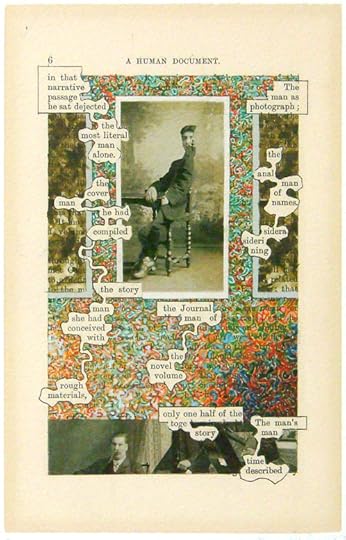
- pg. 6

- pg. 15
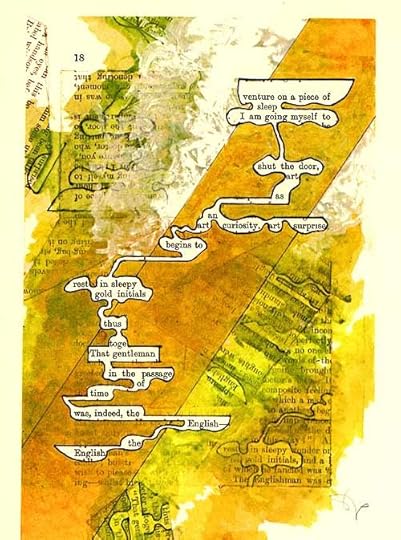
- pg. 18
- pg. 27
- pg. 28
- pg. 33
- pg. 36
- pg. 50
- pg. 55
- pg. 71
- pg. 79
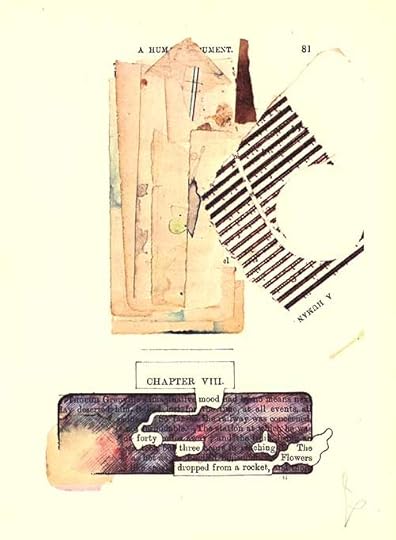
- pg. 81
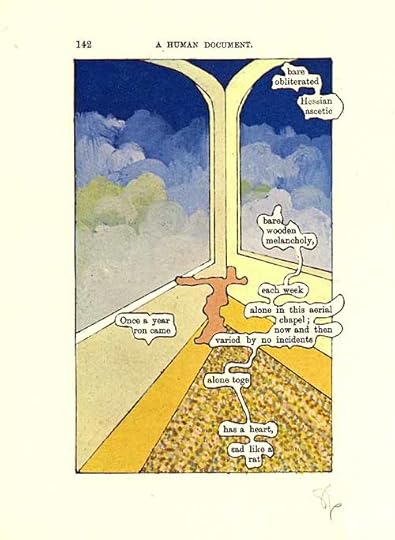
- pg. 142
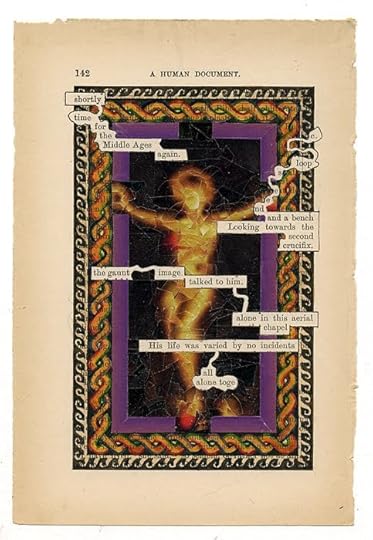
- pg. 142
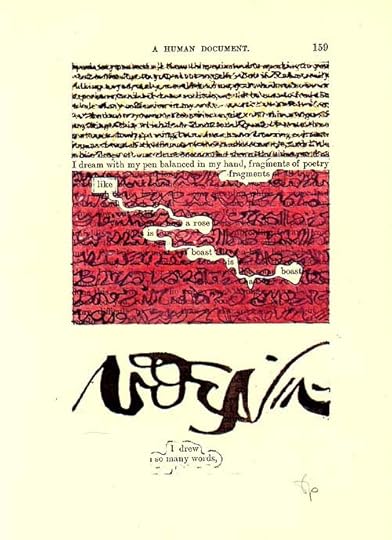
- pg. 159
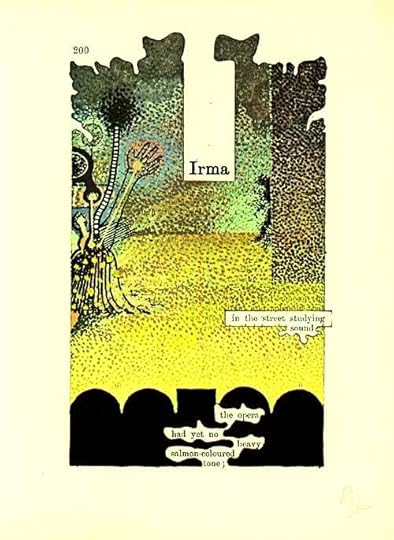
- pg. 200
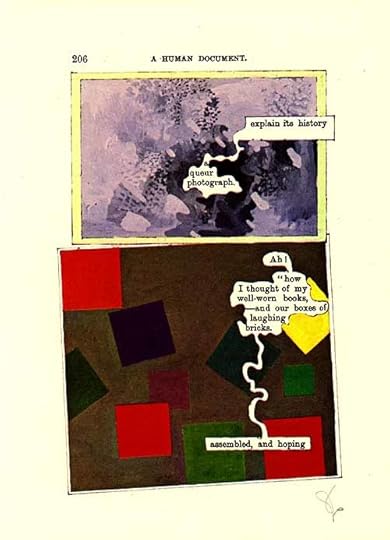
- pg. 206

- pg. 229

- pg. 305
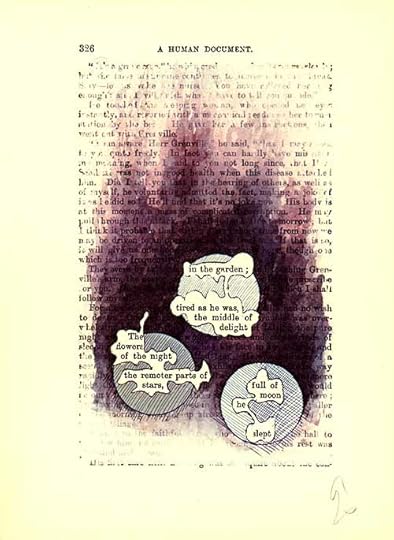
- pg. 326
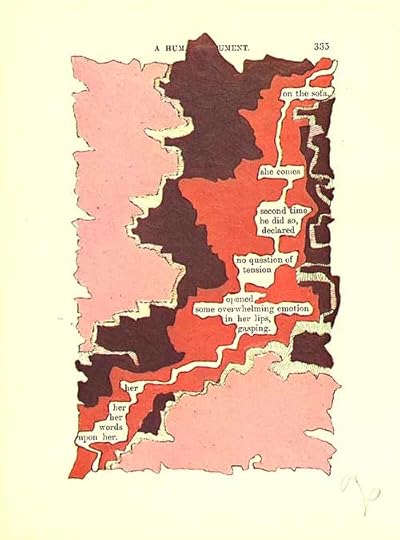
- pg. 335

- pg. 361
- pg. 367
I made a rule; that the first (coherent) book I could find for threepence (i.e. 1¼p) would serve.
Autin's the furniture repository stands on Peckham Rye, where Blake saw his first angels and along which Van Gogh had probably walked on his way to Lewisham. At this propitious place, on a routine Saturday morning shopping expedition, I found, for exactly threepence, a copy of A Human Document by W. H. Mallock, published in 1892 as a popular reprint of a successful three-decker. It was already in its seventh thousand at the time of copy I acquired and cost originally three and sixpence. I had never heard of W. H. Mallock and it was fortunate for me that his stock had depreciated at the rate of a halfpenny a year to reach the required level. I have since amassed an almost complete collection of his works and have found out much about him. He does not seem a very agreeable person: withdrawn and humourless (as photographs of him seem to confirm) he emerges from his work as a snob and a racist (there are some extremely distasteful anti-semitic passages in A Human Document itself). He has however been the subject of some praise from A. J. Ayer for his philosophical dialogue The New Republic, and A Human Document itself is flatteringly mentioned in a novel by Dorothy Richardson. However, for what were to become my purposes, his book is a feast. I have never come across its equal in later and more conscious searchings. Its vocabulary is rich and lush and its range of reference and allusion large. I have so far extracted from it over one thousand texts, and have yet to find a situation, statement, or thought which its words cannot be adapted to cover.[...]
- "Notes on A Humument" by the author
- pg. 6
- pg. 15
- pg. 18
- pg. 27
- pg. 28
- pg. 33
- pg. 36
- pg. 50
- pg. 55
- pg. 71
- pg. 79
- pg. 81
- pg. 142
- pg. 142
- pg. 159
- pg. 200
- pg. 206
- pg. 229
- pg. 305
- pg. 326
- pg. 335
- pg. 361
- pg. 367

March 18, 2019
Poor effort, when it comes to literature (only decision-making concerning words linked could arguably be intriguing).
This is more like a string of paintings trying to say a story, only there are 300+ of them one after the other, and it is not even a coherent story.
I found it tiresome and incomprehensible as a book. Even though the concept may sound good at first, a lack of proper narrative structure renders it inhospitable to someone who wants to read a book.
This is not a "book".
This is more like a string of paintings trying to say a story, only there are 300+ of them one after the other, and it is not even a coherent story.
I found it tiresome and incomprehensible as a book. Even though the concept may sound good at first, a lack of proper narrative structure renders it inhospitable to someone who wants to read a book.
This is not a "book".

June 19, 2012
This really is a beautiful work of art and endless mind/eye stimulator and I finally have my own copy.

December 25, 2022
Dos años más tarde, me complace decir que he conseguido acabar de leerme este libro.
Ante todo decir que nunca me he cruzado ante un proyecto así, hacer poesía y arte a partir de una novela escrita a finales del siglo XIX. Es espectacular la forma en que se leen poemas preciosos o ilustraciones y collages magníficos. Una idea totalmente rompedora y un proyecto que Tom Philips ha ido perfeccionando y renovando. El único problema que he tenido, es a veces la barrera del lenguaje y que al inventarse palabras me ha costado comprender algunos de los poemas.
Un libro que merece ser leído y apreciado, magníficamente bello, tanto la prosa como visualmente.
Ante todo decir que nunca me he cruzado ante un proyecto así, hacer poesía y arte a partir de una novela escrita a finales del siglo XIX. Es espectacular la forma en que se leen poemas preciosos o ilustraciones y collages magníficos. Una idea totalmente rompedora y un proyecto que Tom Philips ha ido perfeccionando y renovando. El único problema que he tenido, es a veces la barrera del lenguaje y que al inventarse palabras me ha costado comprender algunos de los poemas.
Un libro que merece ser leído y apreciado, magníficamente bello, tanto la prosa como visualmente.
November 18, 2023
a beautiful novel of blackout poetry
although is it a novel really? the pages are more like individual pieces especially the ones that resonated most with me. I mean sure some character - especially toge - resurfaces ever so often but it is a stretch to weave together a narrative here. I tried but didn't get far. you can maybe track toges women and some other changes
it is probably too hard to establish a somewhat continuative 'plot' here but would have been nice
still really cool and unique especially in it's scope
although is it a novel really? the pages are more like individual pieces especially the ones that resonated most with me. I mean sure some character - especially toge - resurfaces ever so often but it is a stretch to weave together a narrative here. I tried but didn't get far. you can maybe track toges women and some other changes
it is probably too hard to establish a somewhat continuative 'plot' here but would have been nice
still really cool and unique especially in it's scope

February 16, 2021
Prachtig boek. Prachtige tekeningen. Verrassende teksten.
Een origineel kunstwerk.
Hebbeding om regelmatig te bewonderen.
Een origineel kunstwerk.
Hebbeding om regelmatig te bewonderen.

January 14, 2025
When I started, I was thinking this would be a four or five star thing. As I worked my way through, the stars fell away. It began to feel like this was a project the author worked on to keep amused when bored. I became bored myself.
April 12, 2008
Does one really read this? Well, certainly not the way one reads anything else. Ton Phillips has built his life's work around W. H. Mallock's discardable Victorian novel A Human Document. Phillips has created and recreated his Humument (mine's the 4th edition--each different) using Mallock's text as his canvass. He draws, sketches, and paints over the pages of the text, creating his own text through excision. Phillips' words then are only those words or parts of words in Mallock's text he chooses to leave untouched. The resulting text works as a series of abstract reflections--the text illuminating the image and the image illuminating the text. It functions unlike any other text I know, and Phillips dances brilliantly in his bizarre, self-imposed constraints. You can see pages here. He also translated Dante's Inferno and interspersed the text with treated pages of Mallock's text that offer commentary on Dante's work. Suffice it to say, I think that's pretty f'n cool.

March 3, 2009
every page is a piece of art. beautiful.
EDIT: haha. this review makes me laugh.
EDIT: haha. this review makes me laugh.
October 6, 2013
A treated Victorian novel, an exercise in artistry and perhaps the most captivating work of art I've ever encountered.

May 22, 2014
This is a great book if you are into collage art and want some inspiration.

January 20, 2016
Absolutely LOVED this book! It was beautifully illustrated and the poems were unique, funny, and sometimes sad. As usual, Allie, you've recommended a book I loved! Thanks!! :)
December 25, 2024
I love the concept of A Humument - a clever combination of literature and art, the idea of remodelling an already written book to make a new, far more beautiful one. The story itself was a little disappointing, but not necessarily because I think Phillips lacked anything in particular, more because it was oversold to me as more of a structured narrative than it is.
I bought a copy of the final edition of A Humument recently as a sort of way of researching it (basically just looking at the art) because I had been recommended Phillips as an artist by my art teacher and had tasked myself with creating an 'artist research' page on the book. Before I had never had any exposure to Phillips' work, and I was both fascinated and excited by his ideas when I learned of them. When looking into it to get facts surrounding Phillips' creative process, the origins of the novel, the plot of the book itself, etc., I admired the whole project more and more. Phillips managed to turn a 19th-century novel with bigoted ideas into a more modern romance story which undermined those ideas? This took him almost sixty years? I could actually get my hands on a copy of this book, and (to an extent, of course) read the story like I would an ordinary novel?
So I bought myself a copy mostly just for the artwork and concept, but I decided to read A Humument as well, as there was no reason not to. Whilst the concept an art didn't disappoint (and the latter was generally much better than my own which I did for my art project, the one I researched Phillips for) the story did, if only a little. When I looked into A Humument, the sources I read made it seem (though this might've been just my interpretation) like the story was more... concrete, I suppose, than it actually is. I wasn't expecting a fully fledged story with brilliant characterisation, plot twists, etc., as the nature of the book would restrict that, but I was expecting a bit more than I got. Like Phillips himself writes in the introduction at the back, it's more like a pack of cards which could be read in different orders and therefore doesn't follow a strict plotline.
I can't say I'm disappointed at Phillips in particular, however. Like I said, he admits A Humument is not a full narrative with only one readable order. It turns out, he didn't even make A Humument in the order the pages are - from what I understand, he went in at random, editing and editing until he had a finished 'treated' edition. When I tried my hand at 'treating' my own pages (of different books, not A Human Document which Phillips used), I found it quite difficult to form sentences that flowed from one to another as they should in an ordinary book, and instead had it flowing from one topic to another, with the intention that you could possibly shift everything about and read it in a different order. I'm more just a bit disappointed in the marketing I read. It gave me unrealistic expectations, I think.
All in all, A Humument is a really beautiful book and a beautiful, very poetic read. There were some pages I had to stop when reading and just stare at for a few seconds - whether it was because the art was particularly captivating, or the words formed a particularly meaningful statement or question. One example of this is the question "What is art?" Of course, I have seen and heard this question posed before, it is not original to Phillips, but it made me stop and think, which I enjoyed, especially as sometimes I found myself reading the book very quickly as there are few words per page.
I would heavily recommend trying this book to anyone who loves art and literature as I do!
I bought a copy of the final edition of A Humument recently as a sort of way of researching it (basically just looking at the art) because I had been recommended Phillips as an artist by my art teacher and had tasked myself with creating an 'artist research' page on the book. Before I had never had any exposure to Phillips' work, and I was both fascinated and excited by his ideas when I learned of them. When looking into it to get facts surrounding Phillips' creative process, the origins of the novel, the plot of the book itself, etc., I admired the whole project more and more. Phillips managed to turn a 19th-century novel with bigoted ideas into a more modern romance story which undermined those ideas? This took him almost sixty years? I could actually get my hands on a copy of this book, and (to an extent, of course) read the story like I would an ordinary novel?
So I bought myself a copy mostly just for the artwork and concept, but I decided to read A Humument as well, as there was no reason not to. Whilst the concept an art didn't disappoint (and the latter was generally much better than my own which I did for my art project, the one I researched Phillips for) the story did, if only a little. When I looked into A Humument, the sources I read made it seem (though this might've been just my interpretation) like the story was more... concrete, I suppose, than it actually is. I wasn't expecting a fully fledged story with brilliant characterisation, plot twists, etc., as the nature of the book would restrict that, but I was expecting a bit more than I got. Like Phillips himself writes in the introduction at the back, it's more like a pack of cards which could be read in different orders and therefore doesn't follow a strict plotline.
I can't say I'm disappointed at Phillips in particular, however. Like I said, he admits A Humument is not a full narrative with only one readable order. It turns out, he didn't even make A Humument in the order the pages are - from what I understand, he went in at random, editing and editing until he had a finished 'treated' edition. When I tried my hand at 'treating' my own pages (of different books, not A Human Document which Phillips used), I found it quite difficult to form sentences that flowed from one to another as they should in an ordinary book, and instead had it flowing from one topic to another, with the intention that you could possibly shift everything about and read it in a different order. I'm more just a bit disappointed in the marketing I read. It gave me unrealistic expectations, I think.
All in all, A Humument is a really beautiful book and a beautiful, very poetic read. There were some pages I had to stop when reading and just stare at for a few seconds - whether it was because the art was particularly captivating, or the words formed a particularly meaningful statement or question. One example of this is the question "What is art?" Of course, I have seen and heard this question posed before, it is not original to Phillips, but it made me stop and think, which I enjoyed, especially as sometimes I found myself reading the book very quickly as there are few words per page.
I would heavily recommend trying this book to anyone who loves art and literature as I do!
August 20, 2020
The Humument by Tom Philips. This document regards the Fifth Edition unless otherwise noted.
Review: It’s a postmodern artist endeavor that is less about plot and more about someone musing about art and turning pages into paintings. This is notable even in the title: Mr. Philips has taken a forgotten Victorian-era Romance novel called “The Human Document” and crossed out bits of the title to get “The Humument.”
The plot is incredibly hard to follow and it works better as a collection of paintings. As a collection of paintings, they are weird enough to capture anyone’s interest if they’re curious enough.
It’s more of an art project than a “novel” but the project itself is “novel” so, I guess, it gets points for that.
As a book: 1 star out of 5.
As a collection of paintings: 5 out of 5.
As the musings of an artist: 3 out of 5.
Overall: 4 out of 5. Worth it to at least look through, if not pour-over, but this comes with the caveat that you MUST know what you’re getting into.
If you just want to look at the paintings, look up tomphilips.co.uk and look up The Humument slideshow. All variations on the page-paintings are there.
* Don’t read this book because art makes “time penniless” i.e. Art robs time from you. *
Below this review are my notes, placed here for my own interest, and anyone who wants to trudge through them.
============================================================================
NOTABLE PAGES
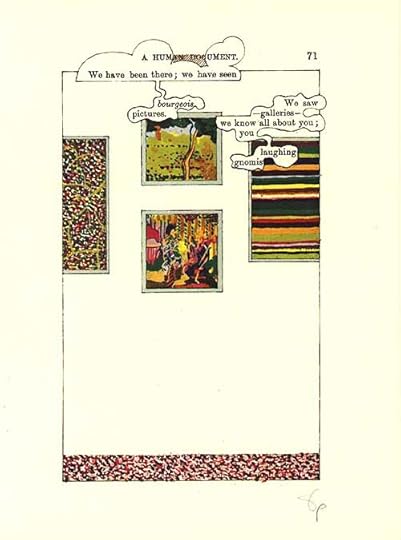
Page 71 might be the best image that symbolizes art for me, but all the images in this book seem to be plucked from a dream. I love their use of light, of shadow, of exaggeration, it’s all up my alley. Images plucked from mind are pages:
5, 9, 16, 27, 32, 33, 37, 40, 45, 47, 49, 50,
59, 61, 65, 66, 78, 83, 84, 86, 88, 92, 94, 96, 97,
101, 103, 106, 107, 110, 111, 113, 117, 120, 123, 125, 128, 140, 142, 146,
166, 167, 172, 175, 177, 178, 180, 185, 189, 199,
200, 201, 202, 204, 208, 220, 223,
255, 258, 266, 270, 272, 273, 274, 275, 277, 278, 279, 282, 287, 289, 294
300, 303, 307, 309, 324, 326, 329, 332, 333, 336, 337, 343, 344, 346, 347, 348
350, 351, 352, 355, 358, 361, 363, 364, 367,
HOW TO
How to draw characters, just do what he does on 103, 110, 166, 273, 324, 344, 346, 347, or at 355, 361. It’s amazing, beautiful, and simple.
Characters talking is on Page 355
Crowds is on Page 115 and 124 and 187
Secret meetings between secrets, nefarious figure is on Page 279
Characters engaged in intercourse is on Page 287.
Nudity is on Page 303 and 309.
Two characters about to kiss is on Page 348. Or maybe it’s a character about to lick and/or eat someone else’s ear.
The Infamous karate chop is on Page 294.
Devilishly animalistic red eyes are also on Page 294.
A ‘being’ riding a horse-like creature is on Page 300
A RECORD PLAYER is on Page 350. This makes me stupidly happy.
FAVORITE QUOTES
“Calm your member” (64)
“Toge at last, drawing her orchard. see the petals palpitating like the winds of her real self opening (93)
“I am the window your dream stepped out of” (98)
“since i saw you a photograph ago…” (118)
“beauty troubled me as I looked into the meaning of the petals” (122, sixth edition)
“On the street iron railings twist into twilight” (168)
“The word was curt, expect war” (215)
“In the garden little to say a crumpled last night” (268)
“Ted collected lips. ted smile” (302)
“possess music” (364)
Review: It’s a postmodern artist endeavor that is less about plot and more about someone musing about art and turning pages into paintings. This is notable even in the title: Mr. Philips has taken a forgotten Victorian-era Romance novel called “The Human Document” and crossed out bits of the title to get “The Humument.”
The plot is incredibly hard to follow and it works better as a collection of paintings. As a collection of paintings, they are weird enough to capture anyone’s interest if they’re curious enough.
It’s more of an art project than a “novel” but the project itself is “novel” so, I guess, it gets points for that.
As a book: 1 star out of 5.
As a collection of paintings: 5 out of 5.
As the musings of an artist: 3 out of 5.
Overall: 4 out of 5. Worth it to at least look through, if not pour-over, but this comes with the caveat that you MUST know what you’re getting into.
If you just want to look at the paintings, look up tomphilips.co.uk and look up The Humument slideshow. All variations on the page-paintings are there.
* Don’t read this book because art makes “time penniless” i.e. Art robs time from you. *
Below this review are my notes, placed here for my own interest, and anyone who wants to trudge through them.
============================================================================
NOTABLE PAGES
Page 71 might be the best image that symbolizes art for me, but all the images in this book seem to be plucked from a dream. I love their use of light, of shadow, of exaggeration, it’s all up my alley. Images plucked from mind are pages:
5, 9, 16, 27, 32, 33, 37, 40, 45, 47, 49, 50,
59, 61, 65, 66, 78, 83, 84, 86, 88, 92, 94, 96, 97,
101, 103, 106, 107, 110, 111, 113, 117, 120, 123, 125, 128, 140, 142, 146,
166, 167, 172, 175, 177, 178, 180, 185, 189, 199,
200, 201, 202, 204, 208, 220, 223,
255, 258, 266, 270, 272, 273, 274, 275, 277, 278, 279, 282, 287, 289, 294
300, 303, 307, 309, 324, 326, 329, 332, 333, 336, 337, 343, 344, 346, 347, 348
350, 351, 352, 355, 358, 361, 363, 364, 367,
HOW TO
How to draw characters, just do what he does on 103, 110, 166, 273, 324, 344, 346, 347, or at 355, 361. It’s amazing, beautiful, and simple.
Characters talking is on Page 355
Crowds is on Page 115 and 124 and 187
Secret meetings between secrets, nefarious figure is on Page 279
Characters engaged in intercourse is on Page 287.
Nudity is on Page 303 and 309.
Two characters about to kiss is on Page 348. Or maybe it’s a character about to lick and/or eat someone else’s ear.
The Infamous karate chop is on Page 294.
Devilishly animalistic red eyes are also on Page 294.
A ‘being’ riding a horse-like creature is on Page 300
A RECORD PLAYER is on Page 350. This makes me stupidly happy.
FAVORITE QUOTES
“Calm your member” (64)
“Toge at last, drawing her orchard. see the petals palpitating like the winds of her real self opening (93)
“I am the window your dream stepped out of” (98)
“since i saw you a photograph ago…” (118)
“beauty troubled me as I looked into the meaning of the petals” (122, sixth edition)
“On the street iron railings twist into twilight” (168)
“The word was curt, expect war” (215)
“In the garden little to say a crumpled last night” (268)
“Ted collected lips. ted smile” (302)
“possess music” (364)
April 29, 2018
It may have been twenty years ago that I bought my copy of Tom Phillips’s A HUMUMENT. This postmodern objet d’art had been a decades-long project of his. Using as his source material the 1892 edition of the Victorian novel “A Human Document” by W.H. Mallock, Phillips scrupulously examined the text, page by page, for its hidden potential, then painted over most of the words, leaving a found text that relates fragments of the story of his found character, Bill Toge, whose name crops up whenever the word “together” offers itself for the obscuration of its last four letters.
Phillips is a brilliant, inventive graphic artist. The colors, textures, compositions, and concepts of his paintings vary wildly from one page to the next. For many years, I had periodically thumbed through A HUMUMENT primarily for the beauty of its art, jumping here and there, dipping in, taking pleasure in the seemingly random quality of the text, but never actually sitting down to “read” it all the way through. Now I have. How does it stand up as literature? Does it matter? I am reminded of John Cage’s readings through “Finnegan’s Wake.” You simply take the ride and let all the sights wash over you.
On the first page of Mallock’s original, in the proper order, Phillips was able to find the perfect words for announcing his project, in a tone of voice that evokes the grand baritone of Whitman: “The following sing I a book. a book of art of mind art and that which he hid I reveal.” The next two pages take tentative steps into the story: “is The woman we are speaking of over her ankles in the storm and fire and desire of art; and the art of art and would have given us a humument or two / for photo dismay. / my pillow book, the puzzled sheets / my pocket-volume bound in reality.” Bill Toge first appears on page 6: “… journal contents as yet is only one half of the toge story / the first scenes and feelings.” A love story develops, one episode of which is revealed on page 189: “speech gave way / At last she felt toge / even night gave in.”
Several passages read as poetic lists, such as page 187, consisting entirely, with one exception, of a series of two-word declarative sentences, provocative and touching: “words work / nature conditions / needs kill / women support / friends fit / nothing happens / successes close / experience knows / time walks / exercise kills / faculties function / star shuts / life stands alone.” On page 279, Bill Toge sits down to a meal and all present are named: “twelve for breakfast: alf shrink and ron comptoir, stan gage, alf rosp, ted wink, clare somewhat and olive ribe, len welve, and eve sardine, al plish, val rant, Mrs. Mornspot, bill with his friends all about him.”
Written descriptions do not do justice to the richness of this book. It has to be held in the hand, the pages turned, the colorful paintings reaching out directly to the eyes.
Phillips is a brilliant, inventive graphic artist. The colors, textures, compositions, and concepts of his paintings vary wildly from one page to the next. For many years, I had periodically thumbed through A HUMUMENT primarily for the beauty of its art, jumping here and there, dipping in, taking pleasure in the seemingly random quality of the text, but never actually sitting down to “read” it all the way through. Now I have. How does it stand up as literature? Does it matter? I am reminded of John Cage’s readings through “Finnegan’s Wake.” You simply take the ride and let all the sights wash over you.
On the first page of Mallock’s original, in the proper order, Phillips was able to find the perfect words for announcing his project, in a tone of voice that evokes the grand baritone of Whitman: “The following sing I a book. a book of art of mind art and that which he hid I reveal.” The next two pages take tentative steps into the story: “is The woman we are speaking of over her ankles in the storm and fire and desire of art; and the art of art and would have given us a humument or two / for photo dismay. / my pillow book, the puzzled sheets / my pocket-volume bound in reality.” Bill Toge first appears on page 6: “… journal contents as yet is only one half of the toge story / the first scenes and feelings.” A love story develops, one episode of which is revealed on page 189: “speech gave way / At last she felt toge / even night gave in.”
Several passages read as poetic lists, such as page 187, consisting entirely, with one exception, of a series of two-word declarative sentences, provocative and touching: “words work / nature conditions / needs kill / women support / friends fit / nothing happens / successes close / experience knows / time walks / exercise kills / faculties function / star shuts / life stands alone.” On page 279, Bill Toge sits down to a meal and all present are named: “twelve for breakfast: alf shrink and ron comptoir, stan gage, alf rosp, ted wink, clare somewhat and olive ribe, len welve, and eve sardine, al plish, val rant, Mrs. Mornspot, bill with his friends all about him.”
Written descriptions do not do justice to the richness of this book. It has to be held in the hand, the pages turned, the colorful paintings reaching out directly to the eyes.

November 5, 2024
This is a hard one to rate, and I have a feeling my opinion will change overtime. The author’s goal — of taking the techniques used in erasure poetry to craft a novel out of an existing text — is incredibly ambitious, and the idea itself makes this work admirable.
It’s difficult to say whether the author was successful. Reading this reminded me of “The Waste Land,” as it hints toward a narrative and characters, but never enough to actually fully follow what is “happening,” at least not without many, many rereads. Because I personally love “The Waste Land,” I enjoyed engaging with a text that messes with our understanding of how a novel can be written. There is some truly gorgeous verse in this book. But when I did try to engage with the text like I would with a typical novel, I found it to be frustrating. I know this is kinda of the nature of non-linear narratives, and I occasionally see some of the characters and story come through. But I just felt like there was something missing when it came to connecting these pages as a collective story rather than a book of poetry.
While the nature of this art form makes this book’s word-count short, I still felt like there was an issue of quantity over quality. Sadly, many pages felt like repetitions of one another. I felt like much of the text that was poignant (exploring sexuality, loneliness, love, etc.) got lost in when other weaker sections retreaded the same ground.
The author apparently displayed the pages in a gallery first, and that makes sense. The scale of what he created is likely more powerful as a physical display rather than having all the pages bound together as a singular story. And that maybe sums up how I feel about this book: wonderful art, and a some what successful attempt at a novel.
It’s difficult to say whether the author was successful. Reading this reminded me of “The Waste Land,” as it hints toward a narrative and characters, but never enough to actually fully follow what is “happening,” at least not without many, many rereads. Because I personally love “The Waste Land,” I enjoyed engaging with a text that messes with our understanding of how a novel can be written. There is some truly gorgeous verse in this book. But when I did try to engage with the text like I would with a typical novel, I found it to be frustrating. I know this is kinda of the nature of non-linear narratives, and I occasionally see some of the characters and story come through. But I just felt like there was something missing when it came to connecting these pages as a collective story rather than a book of poetry.
While the nature of this art form makes this book’s word-count short, I still felt like there was an issue of quantity over quality. Sadly, many pages felt like repetitions of one another. I felt like much of the text that was poignant (exploring sexuality, loneliness, love, etc.) got lost in when other weaker sections retreaded the same ground.
The author apparently displayed the pages in a gallery first, and that makes sense. The scale of what he created is likely more powerful as a physical display rather than having all the pages bound together as a singular story. And that maybe sums up how I feel about this book: wonderful art, and a some what successful attempt at a novel.
Displaying 1 - 30 of 107 reviews