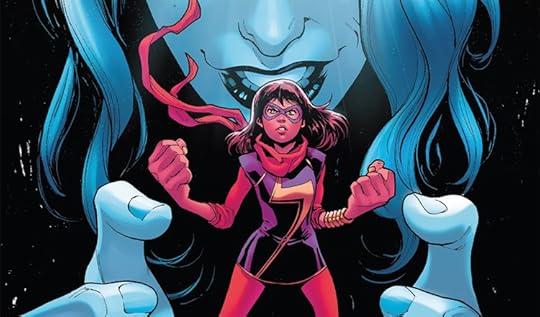
This has been said before that if there is any superhero comic currently published that is the modern equivalent of Stan Lee and Steve Ditko's The Amazing Spider-Man, it would be G. Willow Wilson's Ms. Marvel as much like Peter Parker's life, Kamala Khan's is all about balancing her personal life with friends and family, high school and her duties as the local superhero, in which despite her good intentions, it's not helping gaining the public's trust.
What was great about the previous volume was that after the slight misstep of the Civil War II tie-in issues, it told a standalone story that balanced the super-heroism with the social commentary, reminding what made this run successful in the first place. However, the consequences of Civil War II haunt Kamala as HYDRA agent Chuck Worthy has taken control as the mayor of Jersey City as he begins to target those close to her.
As Marvel has always tried to remain relevant as the All-New, All-Different initiative showcases a racially diverse cast of superheroes, the publisher has never tried to force any political statements. However, what opened volume seven was #13, which was clearly an allegory for the 2016 US presidential election and yet by the time the issue was published, we already got the disastrous results. Throughout the majority of this volume, we see a villain in mayoral charge creates an organisation that is assigned to lock up all the unregistered super powers in the city.
As a loose continuation of some of the ideas presented in Marvel's Civil War, it is a combination of comic book fantasy and politics that are not too dissimilar with today's American politics, such as terrorism and immigration. Amongst the super-powered victims (or one who did have powers briefly) are Kamala's older brother Aamir who, after getting arrested, opens #20 with a brilliant monologue explaining the common problem of people's assumption of the image of a terrorist, whether it is simply judging someone by the colour of their skin or whatever religion they're in.
Given how serious the messages Wilson is trying to display, she never talks down to her readers as the adventures of Kamala Khan are uplifting, such as our eponymous hero fighting her enemies with abilities that are closer to Mr. Fantastic, with moments of heartfelt realisation. Due to the absence of Adrian Alphona and Takeshi Miyazawa, Marco Failla takes charge of artistic duties as along with series colourist Ian Herring, his cartoony illustrations are appropriate to Kamala's elastic moves, whilst balancing the quiet character drama.
Concluding this volume is a two-issue arc, in which Kamala is reunited with Kareem, who is participating in an exchange student program in her high school, much to her dissatisfaction. However, when an ongoing train's brakes have malfunctioned, it looks like a job for Ms. Marvel, but she’s also joined by Kareem's superhero alter-ego Laal Khanjeer (or the Red Dagger). Although it very much evokes Tony Scott's Unstoppable, so much so that even Kamala references the Denzel Washington movie, this is a fun buddy-up with great Kamala-centric humour, whilst Diego Olortegui's art is very detailed and textured as the train takes the heroes through stunning locations in New Jersey.
No matter how politically G. Willow Wilson wants to be, it is the witty adventures of Kamala Khan that aren’t as big as her fellow Avengers that makes this title continuously readable, whilst setting up something in the near future that she might no longer need the persona of Ms. Marvel.