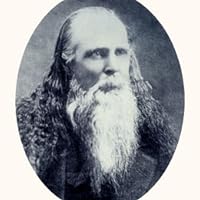
The legend of the Destroying Angel of Mormondom was well established by the time of his death, of natural causes, in 1878. Travelers sang ballads about him as they gathered around their campfires at night. Mothers used his name to frighten children into obedience. He was accused of literally hundreds of murders, all in the name of the Mormon Church.
Yet behind all the myth was a man, a human being. Orrin Porter Rockwell believed in his prophet, Joseph Smith. He spent most of a year chained in an Independence dungeon for his belief, then walked across Missouri to Nauvoo, stumbling into Joseph’s house on Christmas Day. Joseph said to him then, “Cut not thy hair and no bullet or blade can harm thee,” and the legend was born.
Rockwell continued to serve the leaders of his church—as hunter, guide, messenger, scout, guerilla, emissary to the Indians, and lawman. He traveled thousands of miles, raised three families, accumulated land and wealth—and favorably impressed almost everyone who met him. But although he walked with presidents and generals, scholars and scoundrels, in a life lived at the center of many of the great events of the American frontier, he has remained an enigma, a source of continuing controversy.
Harold Schindler’s remarkable investigative skills led him into literally thousands of unlikely places in his search for the truth about Rockwell. Dale L. Morgan, one of the west’s foremost historians, called the first edition “…an impressive job of research, one of the most impressive in recent memory, in the Mormon field. Mr. Schindler has shown great energy and sagacity in dealing with a difficult, highly controversial subject; and he has also made maximum use of the latest scholarship and newly available archival resources.”
But the author was not satisfied until he had probed even more deeply, and this revised and enlarged second edition contains greatly expanded documentation as well as textual additions that flesh out the characters and events of this classic drama of early America.
Readers of The Salt Lake Tribune were the primary beneficiaries of Schindler's skills as a writer and historian. During the last part of his 50-year Tribune career, he chronicled Utah's history leading to statehood. He wrote an ambitious series on the 150th anniversary of the Mormon pioneers' arrival in the Great Salt Lake Valley. Using pioneer journals, he took readers on a day-by-day trek to Zion.
"Harold achieved a pinnacle in this business most can only dream of," said James E. Shelledy, Schindler's last editor at The Tribune, and the one who assigned him to write about Utah history. "He is a newspaper legend. I can hear him grousing to the contrary, but it is a fact." Schindler joked that during his five decades at The Tribune, he held almost every job.
He started his career as a copyboy in 1945 at age 15. He rose through the ranks as a police reporter and on other beats--including a brief stint as the author of The Tribune's "Nothing Serious" column--then on to 27 years as television columnist.
His TV columns were legend for their strong opinions and acerbic tone. He admitted he did not care for TV, yet only missed one deadline.
John W. Gallivan, publisher emeritus of The Salt Lake Tribune, praised Schindler's opinionated columns: "Heads up, St. Peter, be prepared for debate."
Schindler landed more than his share of scoops. He broke the story of the LDS Church's plans for a new office building that would dwarf downtown Salt Lake City. Church President David O. McKay showed Schindler the drawings.
As a reporter, he witnessed five executions.
"He was a meticulous writer," said former Tribune editor Will Fehr. "An editor never really had to edit him."
Schindler was a great writer and an exacting editor. While in charge of the Sunday Arts section and magazine, he mentored many young writers, showing them the importance of cadence and rhythm.
While Schindler was passionate about the newspaper, he was even more so about Western history.
His biography of Orrin Porter Rockwell is considered the definitive work on the controversial Mormon stalwart. First published in 1966, its numerous printings have made it the best-selling University of Utah Press book ever.
"He knew as much about Utah history as anyone I ever knew," recalled Brigham D. Madsen, U. professor emeritus of history. "He had a tremendous memory for facts, and was very articulate in expressing them."
Historian Will Bagley worked with Schindler on an updated edition of West From Fort Bridger, an account of Western trails predating the Mormon exodus. The original was the work of Schindler's hero, the late historian Dale Morgan.
"Not just to me, but to many young historians, he was a mentor, an inspiration and a friend," Bagley said.
Schindler also made an indelible impression in on-camera appearances in Ric Burns' public television documentary "The Donner Party." Burns used Schindler's expertise again in "The American Experience: The Way West."
At the time of his death, Schindler was writing another book, on the Utah War. He was stricken with a heart attack at home as he prepared to go to the Utah Historical Society for more research.
Schindler was born Dec. 6, 1929, in Chicago to German immigrant parents. While an infant, his family moved to New York, a place Schindler did not care for, and later would refer to as "Noo Yawk" in his columns. The family moved to Salt Lake City in 1940.
He is survived by his wife, Benita (Bonnie), daughter Carolyn Silver and husband Kirk, sons Steve and Jeffrey, and a brother, James F. Schindler.
This book is horse shit. One lie after another concatenated together to make and all consuming lie laced with a few facts.
I have done considerable studies on the Mormon culture to know the difference. If you love watching TV or reading the News Paper as if it is true, then there is no hope for you. None of us can judge the character of Mr. Rockwell by what his enemies or rumors say.
Ruthless people have bad feelings in their demeanor and heart. Orrin Porter Rockwell never did. He was a humble, prayerful, cheerful person, a loving father and husband, and an honest business man. I believe if he ever took a man's life it was only in self defense. One more thing, this book depicts him as not knowing how to read and write. That is bull shit, where as the rest of the book is made up of horse shit.
This book more reflects the attitude / motives of the author and what he would do or wanted to do. This is a STUPID BOOK AND NOT RECOMMENDED! To read this book is like taking a big juicy cow pie and rubbing it on your face.
Lie, Lie, Lie cow pie.... just modern sensational news papers
If you want to read an entertaining book based on second, third, or even fourth hand information of questionable veracity then this is the book for you! While the author is a good story teller he leaves much to be desired as a historian. Orin Porter Rockwell left no Diary or Journal and there is little primary documentation on his life so the author resorts to contemporary accounts from the popular media of the time for his sourcing. This media which any reputable historian would acknowledge as being fiercely anti-Mormon was notorious for playing fast and loose with the truth in the best of times.
If there was a real life superhero of the 19th century more astounding than any comic book character it was Porter Rockwell. If there was a real life Western gunslinging hero the likes of which actors could only hope to impersonate it was Porter Rockwell. Unfortunately his church will never fully recognize him because of the dirty work for which he was used and like his close friend Joseph Smith, the world will never believe his story because of its divine origins. Despite this mystique, the book does some justice to a wild frontier life of shootouts, man hunts and violence in the context of church history along with some first hand accounts. To improve the book I would take out a lot of the needless details of church and political administration surrounding Porter's life and tell his story in a shorter, bolder narrative fitting to the man. Some amazing anecdotes about his life are that he outlived both Joseph and Brigham and while preparing him for burial his daughter found bullet holes in his clothes yet no evidence of wounds. He attempted an assassination on the life of Governor Boggs and also saved the lives of many saints struggling out on the plains. Like a 19th century Ammon he accompanied missionaries among the natives serving as their protection. He never learned to read or write and yet had many stories written about his adventures. He was a man of faith but never one to tempt fate, a man at home in the wild riding alone for long stretches of grueling treks on a mission no one else could accomplish. Like an echo of the Old Testament he was the improved Sampson of the 19th century whose only Delilah was a friend for whom he voluntarily cut his hair out of charity. And even more than Sampson he deserves to be canonized in a book of scripture but never will be because his tale was too wild to be believed.
This book on Porter Rockwell is excellent. Schindler does an excellent job of describing the life of one of the most controversial figures in the history of the LDS Church. I was riveted from the first page.
Rockwell has always been a figure of fascination for me. I am not a member of the LDS Church, but have long had an interest in its history. This book brings to life not just the colorful figure that it describes, but provides excellent material on the history of the LDS church and the areas surrounding Great Salt Lake City, Utah. The text is well written and informative, but I found the footnotes even more revealing where the text was supported by them.
The only downside to this great book is the feeling I had at points that facts were somewhat whitewashed. I did not feel that this was something done dishonestly. Rather, it seemed something done to cater to the primary audience for Schindler's writing; the members of the LDS Church.
In the end I recommend this great historical biography to anyone who might be interested in the history of Orrin Porter Rockwell, the LDS Church, or the formation of Utah. This recommendation goes out to members and non-members alike.
I have great respect and admiration for Orrin Porter Rockwell, so I wanted to know more about his life. This book appeared to try to tell both sides of the controversy about him, but I felt it was weighted more against than for him. Many of the sources quoted were obviously biased. I guess I am, too, but I like him!
Orrin walked a fine line. His talents were many, and arguably well used, often to the great service of others among which I count ancestors. His misdeeds were legend, and I'm glad not to be his judge. If you don't know Ol' Port, then you don't know early LDS history; he was there at the center of events, and very instrumental.
This book has lots of good information and is well-referenced. However, the author is clearly biased toward the pro-LDS position, and conveniently leaves out many sources that don't support his bias. Readers be warned.
Short notes ... Enjoyable read. Good context for other historical reading of the times. Surprising extra insight into the characters of Church leaders.
There has been a ton written about Rockwell, most of it sensationalized for book sales or for criticism of the Mormon church. E.g. the Salt Lake tribune in 1878: "It is estimated he participated in at least a hundred murders for the Church, none of which he ever divulged." You won't find that here. This is well researched and footnoted historical writing, and while some of the "wild" accusations are mentioned in footnotes, that is always done with explanations as to why they were not included as probable fact.
Footnotes are at the bottom of each page so they are easily accessed, and they contain references, evaluations of such, additional commentary, and some parallel side stories. I read every one and found among them many sources that I would like to study further. (I was also surprised at how much of the material was from the content of History of the Church and Elders' Journal and journals of faithful members.)
So, rather than lots of "shoot 'em up" stories, you will find a researched narrative of the times — context for your other historical reading.
One of the surprises for me (especially since I judged the author to be "Church friendly") was the insight I got into the characters of Joseph Smith and Brigham Young — their styles of leadership and temperaments — e.g. how it was that Joseph Smith "confronted" Rigdon when he wanted him thrown out of the church.
I don't know if Rockwell's family life wasn't covered much because not too much is known or if the author wasn't that interested in it. The book is more focused on the events going on with the LDS Saints that Rockwell was there for than with Rockwell himself. And giving backgrounds on all the different people Rockwell was rumored to have killed. I might have gotten more of an idea how seriously to take the various allegations if I had read the footnotes (of which there were many. It is a well-documented book), but there was little in the text about the evidence in many of the allegations. I think they were mostly presented as what people were saying about Rockwell at the time.
I did like the campfire songs about him.
I learned that the Salt Lake Tribune is very old. I suppose there would always be a market for a newspaper in SLC that is critical of the church.
I didn't know anything about Porter Rockwell so this was an interesting book to read. The author did a decent job of piecing together the sources available about him, but it all needs to be taken with a grain of salt since he admitted openly that the majority of the sources were anti-mormon contemporaries of his time. Especially light in substance were the chapters before Rockwell and the Saints came to Utah. A lot of "it's likely Rockwell was there." Church history in that portion of the book is recorded quite loosely as well.
I did appreciate the grittier view of Salt Lake City in the early pioneer days. Makes sense it was more like other frontier settlements than the glossed over version I usually hear.
I am learning several tidbits of LDS History I haven't heard before. Reading bit by bit, here and there. Doesn't hold my attention enough to get through it all at once.
Wow! I don't know how this man wasn't killed on several occasions. The early years of the restored church of Jesus Christ truly took place in the wild west and needed stong, courageous, and faithful men like Rockwell to help it survive. Completely different times than we live in now.
After reading Porter Rockwell's Biography by Richard Lloyd Dewey I was of course curious what this book would say about my personal hero Orrin Porter Rockwell. I felt like the author wrote this book from a completely non-bias point of view despite being a member of the Mormon church. I learned some new things about this highly controversial member of the old west!
Very well written and entertaining book about a very controversial character from the American West. It is thoroughly researched and presents a (mostly) balanced view of the early Mormon church--although I think the author erred a little on the anti-mormon perspective. Overall I thought it was pretty durn good.
I am currently reading this book and have read absolutely every other book on Porter Rockwell even the hard to find books. I have eaten at the Porter Rockwell Restaurant in Lehi and even held conversation with one of his modern day relatives. So far I love this book and think it has a very non bias perspective.
Though I read this book years ago, I felt like adding a bit of a review today. Not the best book about Rockwell, but this man is truly one of my heroes. His biography does a better job telling his life story, written by Richard Lloyd Dewey, but this provided some additional stories and entertainment. Just not well written.
This was one of those books that makes you appreciate Joseph Smith and all of those who sacrificed so much for us. Porter Rockwell was a very brave man with great devotion to the prophet. I enjoyed learning about his life.
I liked this book. I felt it was objective and the author would research from many aspects and sources he could. I also shows how much of history can be subjective and misunderstood. I would like to be a danite myself :)
Better then the other crap book I tried to read on this subject but not a whole lot better. There was a lot of material included from completely biased sources and I felt the research was a bit sloppy. It did give me some new ideas to ponder on but over all I was unimpressed.
The beginning was very fun and engaging. Toward the end of the biography, Porter's life started to wind down and so did the excitement and entertainment, however, Porter Rockwell was an incredible person and this book is well worth the time.
I wish there were more stories and legends about him.
Well done history of a controversial figure. Schindler does a good job sorting through the historical record and painting a portrait of Rockwell. Recommended for anyone interested in the origins and settlement of Utah.
It's actually my husband who is reading it but he talks enough about it that I feel like I am too! He loves that there's no sugar coating on these characters-this book really tells it like it is, or was.
It was fun to read about church history, but everything has to be taken with a grain of salt. Many of the sources for this book were histories of the church written by enemies of the church and/or ex-members of the church. I enjoyed reading it, even if I didn't believe everything in it.
This is a wonderful book about an incredible life! Some parts do read as a textbook, but I was fascinated. It is very in depth, very detailed about one of the most controversial figures of his time. This Man of God had a thunderous time here on earth.
I never knew what a bad-ass this man was. No sugar coating it here this is an historical account of his role of hit-man and church law enforcer/brute for the early Morman leadership.