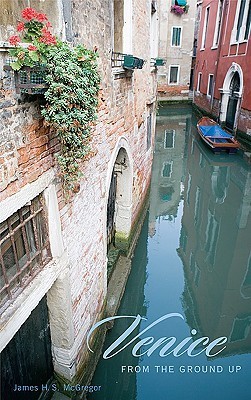
Venice came to life on spongy mudflats at the edge of the habitable world. Protected in a tidal estuary from barbarian invaders and Byzantine overlords, the fishermen, salt gatherers, and traders who settled there crafted an amphibious way of life unlike anything the Roman Empire had ever known. In an astonishing feat of narrative history, James H. S. McGregor recreates this world-turned-upside-down, with its waterways rather than roads, its boats tethered alongside dwellings, and its livelihood harvested from the sea. McGregor begins with the river currents that poured into the shallow Lagoon, carving channels in its bed and depositing islands of silt. He then describes the imaginative responses of Venetians to the demands and opportunities of this harsh environment—transforming the channels into canals, reclaiming salt marshes for the construction of massive churches, erecting a thriving marketplace and stately palaces along the Grand Canal. Through McGregor’s eyes, we witness the flowering of Venice’s restless creativity in the elaborate mosaics of St. Mark’s soaring basilica, the expressive paintings in smaller neighborhood churches, and the colorful religious festivals—but also in theatrical productions, gambling casinos, and masked revelry, which reveal the city’s less pious and orderly face. McGregor tells his unique history of Venice by drawing on a crumbling, tide-threatened cityscape and a treasure-trove of art that can still be seen in place today. The narrative follows both a chronological and geographical organization, so that readers can trace the city’s evolution chapter by chapter and visitors can explore it district by district on foot and by boat.
When I was ten I borrowed my Dad’s Smith-Corona portable typewriter and started a novel about pirates. I didn’t get very far. A few years later the Smith-Corona went to college then grad school with me. Its completion rate increased, but the work it was called on to turn out—term papers in sociology, political science, Russian history and the like—was less exciting if more meaningful than my first attempt. After working my way through a number of undergraduate majors, I stumbled into Comparative Literature and the typing grew more focused, more earnest and more fun. Comparative Literature turned into a career. The Smith-Corona morphed into a series of ever cheaper, ever smaller and more efficient computers. I wrote professional articles and books on Giovanni Boccaccio and other figures in medieval Italian literary history. Near the end of my academic career, I started writing books about cities. It turned out that all those term papers on social science and history had been waiting for a chance to get into conversation with the art and literature I had been teaching. The first book, called Rome from the Ground Up, described a city where I had spent two important, eye opening years. That book was under contract with a small press in lower Manhattan when the World Trade Center was hit. The editor there believed that the market for books about foreign cities had collapsed with the second tower and decided not to publish. I sold Rome to Yale University Press about a year later. When my editor at Yale left, enthusiasm for publishing the book went with him. Fortunately I’d gotten a good reading of the book from an expert Yale had consulted, and with that in hand, I approached the literature editor at Harvard UP. He was persuaded, and I was offered a contract. On the strength of the contract, I was able to sign on with a wonderful literary agent. Four books later, HUP and I parted ways. Yale, under dynamic new leadership, is the publisher of my latest book, which is a new direction for me but also a complement to my city books. Four of those books--Paris, Rome, Venice and Athens--focus on places either in the Mediterranean or deeply engaged with it. The new book, Back to the Garden, looks at that part of the world and the societies it has influenced from a rural rather than an urban viewpoint. It traces the history of regional reliance on and understanding of the natural environment. For the last year I’ve been writing a follow up book that focuses on American environmental issues, especially our muddled thinking about two critical and confusing topics: wilderness on the one hand, wild (and domestic) animals on the other. Now retired from academics, I live in Cambridge with my wife (we met in Rome!). And though it pains me to confess it, I still have nothing meaningful to say about pirates.
Opening: In the sixth century, waves of barbarians devastated Italy and eventually gained control of the Western Roman Empire. Just beyond their grasp on the edge of the habitable world—some would say beyond the edge—Venice came to life in the shelter of its Lagoon. Divided from the sea and its Byzantine masters by a long barrier island, and separated from the mainland of Italy by a tract of shallow water, Venice found security in its tidal estuary. Safely out of reach of potential overlords on both sides, the Venetians crafted a way of life perfectly suited to their strange environment. Fishers, salt gatherers, and traders, they lived in widely dispersed communities throughout the Lagoon.
Utilitarian and akin to the spiel of a weary tour guide. Not every historian doth a writer make.